

Paper Menu >>
Journal Menu >>
 Journal of Service Science and Management, 2011, 4, 15-21 doi:10.4236/jssm.2011.41003 Published Online March 2011 (http://www.SciRP.org/journal/jssm) Copyright © 2011 SciRes. JSSM 15 The Effects of Dual Listing on Share Prices and Liquidity in the Absence of Registration Costs Shmuel Hauser, Rita Yankilevitz, Rami Yosef Ono Academic College, I Kiryat Ono, Israel. Email: [email protected], shau[email protected], [email protected] Received January 10th, 2011; revised February 17th, 2011; accepted February 22nd, 2011. ABSTRACT In the year 2000, the Israeli Securities Authority (ISA) initiated a new amendment to the Securities Law aimed at pro- moting dual listing of Israeli companies, already traded in the US, and not in Israel, by exempting them from the burden of additional reporting to the ISA. According to this amendment, the ISA agreed to rely solely on the reporting re- quirements of the US SEC. Since then, more than 30 Israeli companies, traded on Nasdaq decided to list their shares on the TASE as well. This event allows us to examine the effect dual listing had on share prices and liquidity in a unique setup that annuls the costs of dual listing registration. The main findings are as follows: 1) trade volume of the dual listed companies has grown by about 123% on; 2) about 42% of the total volume is on the TASE without adversely a f- fect the trading volume on the Nasdaq; 3) as a result, share prices went up by about 9%. One possible policy implica- tion of these find ings is the positive in fluence harmon ized sup ervision may have over internationa l capital markets such as the Single Passport in Europe. Keywords: Dual Listing, Liquidity 1. Introduction In the year 2000, a ‘Dual-Listing Law’ was amended to the Securities Law with the intent of promoting dual list- ing on the Tel Aviv Stock Exchange (TASE). The amended law exempts firms already traded in the US from the burden of reporting to the ISA (Israeli SEC) in addition to the US reporting requirements.1 Following this amendment more than 30 Israeli companies, traded on NASDAQ, decided to dual list their shares on the TASE. This unique event allows us to examine the effect dual listing has on share prices and liquidity, in almost labo- ratory conditions given that the new “dual-listing law” annuls registration costs and other regulatory costs typi- cal to multiple listing in foreign countries. The impor- tance of examining these issues goes beyond the Israeli capital market considering the immense effort made by International Organization of Securities Commissions (IOSCO) in recent years to harmonize the supervision over world financial markets and considering Europe’s harmonized disclosure regime (Single Passport) that al- lows for a significant reduction in the costs of raising capital in various capital markets of the EU (European Directive 8).2 The sample consists of 30 firms, whose shares were traded only on the Nasdaq, that took advantage of the easements in the law, to dual list their shares for trade on the TASE as well. Contrary to previous studies examin- ing this issue, the costs of dual listing these companies on the TASE are negligible since the listing requires only a notification to the TASE and ISA and does not require prospectus and additional reporting to them beyond those required in the US. Dual listing of shares, outside the local market, is common to many international financial markets. In re- cent years, the number of companies seeking to raise capital in foreign markets had risen dramatically and motivated the discussion in the literature regarding costs and benefits of dual listings in foreign capital markets. 1Without this amendment to the Securities Law, companies traded in the US were required to submit a prospectus to the ISA, receive a per- mit for publishing it, and present current and immediate reports, in accordance with the Israeli law, the GAAP and starting in 2008 – the IFRS. The economic rational that underlies this phenomena is that such a decision is expected to take place when bene- 2In January of 2008, the dual listing law was extended to the French market too. 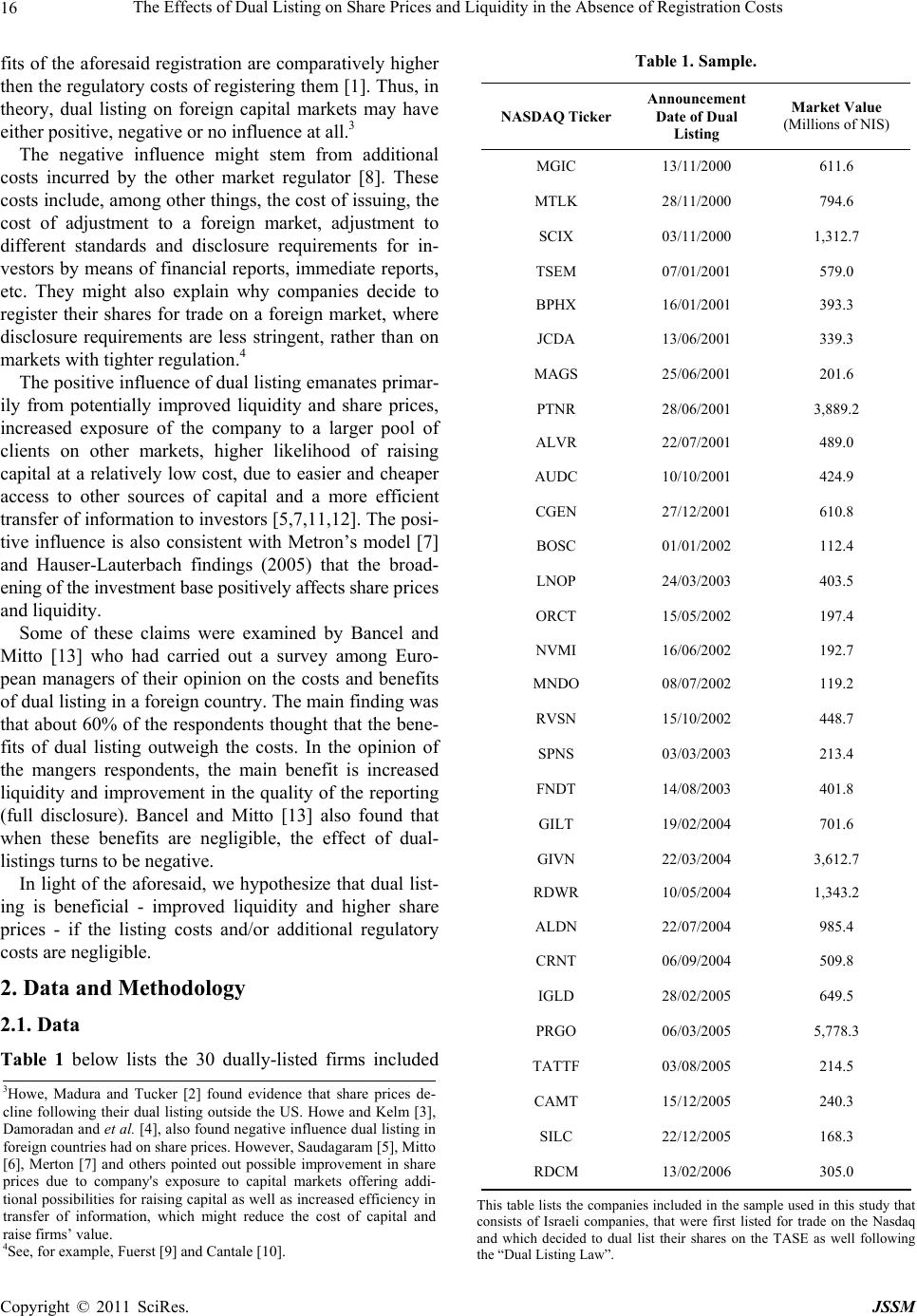 The Effects of Dual Listing on Share Prices and Liquidity in the Absence of Registration Costs 16 fits of the aforesaid registration are comparatively higher then the regulatory costs of registering them [1]. Thus, in theory, dual listing on foreign capital markets may have either positive, negative or no influence at all.3 The negative influence might stem from additional costs incurred by the other market regulator [8]. These costs include, among other things, the cost of issuing, the cost of adjustment to a foreign market, adjustment to different standards and disclosure requirements for in- vestors by means of financial reports, immediate reports, etc. They might also explain why companies decide to register their shares for trade on a foreign market, where disclosure requirements are less stringent, rather than on markets with tighter regulation.4 The positive influence of dual listing emanates primar- ily from potentially improved liquidity and share prices, increased exposure of the company to a larger pool of clients on other markets, higher likelihood of raising capital at a relatively low cost, due to easier and cheaper access to other sources of capital and a more efficient transfer of information to investors [5,7,11,12]. The posi- tive influence is also consistent with Metron’s model [7] and Hauser-Lauterbach findings (2005) that the broad- ening of the investment base positively affects share prices and liquidity. Some of these claims were examined by Bancel and Mitto [13] who had carried out a survey among Euro- pean managers of their opinion on the costs and benefits of dual listing in a foreign country. The main finding was that about 60% of the respondents thought that the bene- fits of dual listing outweigh the costs. In the opinion of the mangers respondents, the main benefit is increased liquidity and improvement in the quality of the reporting (full disclosure). Bancel and Mitto [13] also found that when these benefits are negligible, the effect of dual- listings turns to be negative. In light of the aforesaid, we hypothesize that dual list- ing is beneficial - improved liquidity and higher share prices - if the listing costs and/or additional regulatory costs are negligible. 2. Data and Methodology 2.1. Data Table 1 below lists the 30 dually-listed firms included Table 1. Sample. Market Value (Millions of NIS) Announcement Date of Dual Listing NASDAQ Ticker 611.6 13/11/2000 MGIC 794.6 28/11/2000 MTLK 1,312.7 03/11/2000 SCIX 579.0 07/01/2001 TSEM 393.3 16/01/2001 BPHX 339.3 13/06/2001 JCDA 201.6 25/06/2001 MAGS 3,889.2 28/06/2001 PTNR 489.0 22/07/2001 ALVR 424.9 10/10/2001 AUDC 610.8 27/12/2001 CGEN 112.4 01/01/2002 BOSC 403.5 24/03/2003 LNOP 197.4 15/05/2002 ORCT 192.7 16/06/2002 NVMI 119.2 08/07/2002 MNDO 448.7 15/10/2002 RVSN 213.4 03/03/2003 SPNS 401.8 14/08/2003 FNDT 701.6 19/02/2004 GILT 3,612.7 22/03/2004 GIVN 1,343.2 10/05/2004 RDWR 985.4 22/07/2004 ALDN 509.8 06/09/2004 CRNT 649.5 28/02/2005 IGLD 5,778.3 06/03/2005 PRGO 214.5 03/08/2005 TATTF 240.3 15/12/2005 CAMT 168.3 22/12/2005 SILC 305.0 13/02/2006 RDCM 3Howe, Madura and Tucker [2] found evidence that share prices de- cline following their dual listing outside the US. Howe and Kelm [3], Damoradan and et al. [4], also found negative influence dual listing in foreign countries had on share prices. However, Saudagaram [5], Mitto [6], Merton [7] and others pointed out possible improvement in share p rices due to company's exposure to capital markets offering addi- tional possibilities for raising capital as well as increased efficiency in transfer of information, which might reduce the cost of capital and raise firms’ value. 4See, for example, Fuerst [9] and Cantale [10]. This table lists the companies included in the sample used in this study that consists of Israeli companies, that were first listed for trade on the Nasdaq and which decided to dual list their shares on the TASE as well following the “Dual Listing Law”. Copyright © 2011 SciRes. JSSM 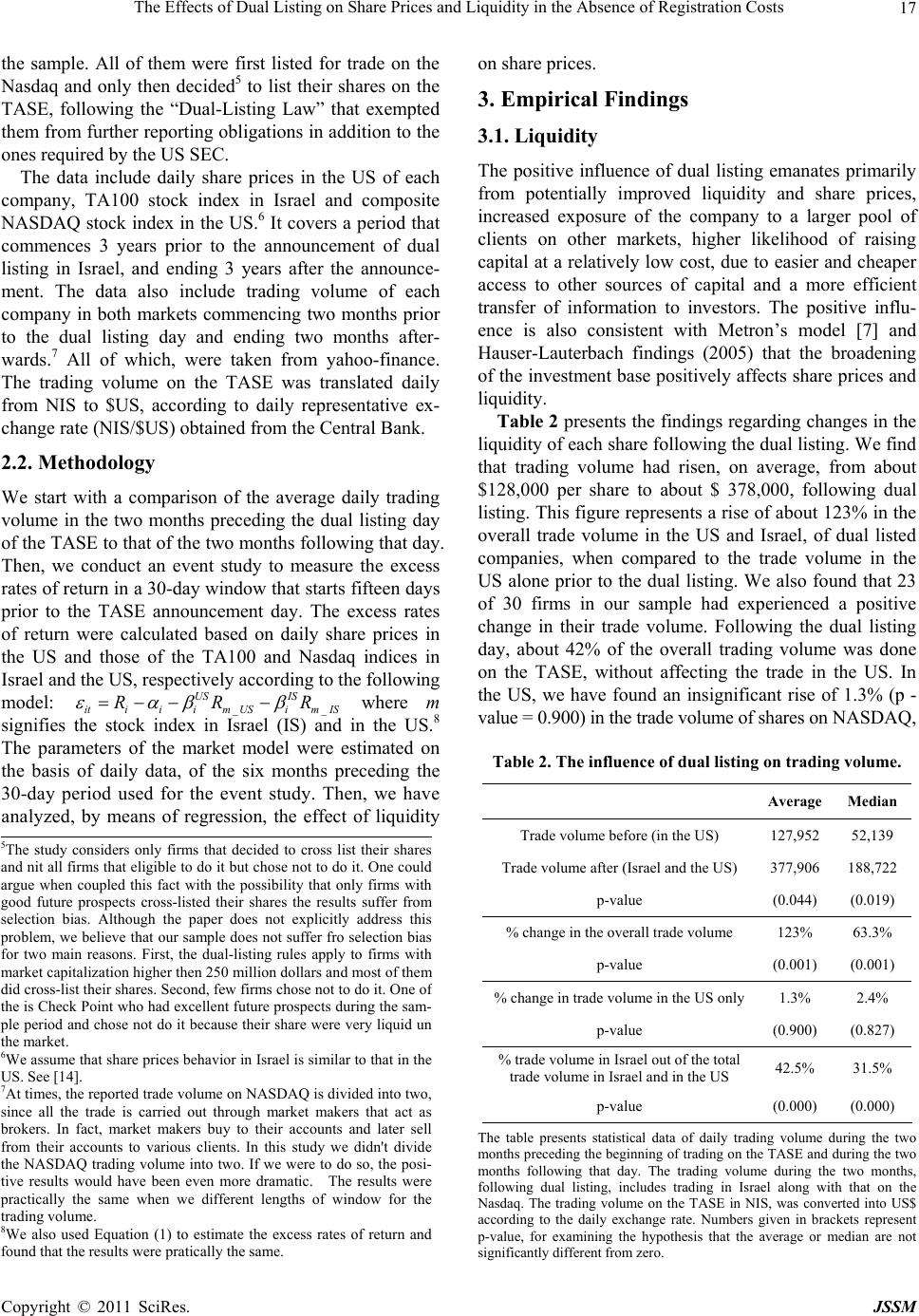 The Effects of Dual Listing on Share Prices and Liquidity in the Absence of Registration Costs 17 the sample. All of them were first listed for trade on the Nasdaq and only then decided5 to list their shares on the TASE, following the “Dual-Listing Law” that exempted them from further reporting obligations in addition to the ones required by the US SEC. The data include daily share prices in the US of each company, TA100 stock index in Israel and composite NASDAQ stock index in the US.6 It covers a period that commences 3 years prior to the announcement of dual listing in Israel, and ending 3 years after the announce- ment. The data also include trading volume of each company in both markets commencing two months prior to the dual listing day and ending two months after- wards.7 All of which, were taken from yahoo-finance. The trading volume on the TASE was translated daily from NIS to $US, according to daily representative ex- change rate (NIS/$US) obtained from the Central Bank. 2.2. Methodology We start with a comparison of the average daily trading volume in the two months preceding the dual listing day of the TASE to that of the two months following that day. Then, we conduct an event study to measure the excess rates of return in a 30-day window that starts fifteen days prior to the TASE announcement day. The excess rates of return were calculated based on daily share prices in the US and those of the TA100 and Nasdaq indices in Israel and the US, respectively according to the following model: __ where m signifies the stock index in Israel (IS) and in the US.8 The parameters of the market model were estimated on the basis of daily data, of the six months preceding the 30-day period used for the event study. Then, we have analyzed, by means of regression, the effect of liquidity on share prices. US IS itiiim USimIS RRR 3. Empirical Findings 3.1. Liquidity The positive influence of dual listing emanates primarily from potentially improved liquidity and share prices, increased exposure of the company to a larger pool of clients on other markets, higher likelihood of raising capital at a relatively low cost, due to easier and cheaper access to other sources of capital and a more efficient transfer of information to investors. The positive influ- ence is also consistent with Metron’s model [7] and Hauser-Lauterbach findings (2005) that the broadening of the investment base positively affects share prices and liquidity. Table 2 presents the findings regarding changes in the liquidity of each share following the dual listing. We find that trading volume had risen, on average, from about $128,000 per share to about $ 378,000, following dual listing. This figure represents a rise of about 123% in the overall trade volume in the US and Israel, of dual listed companies, when compared to the trade volume in the US alone prior to the dual listing. We also found that 23 of 30 firms in our sample had experienced a positive change in their trade volume. Following the dual listing day, about 42% of the overall trading volume was done on the TASE, without affecting the trade in the US. In the US, we have found an insignificant rise of 1.3% (p - value = 0.900) in the trade volume of shares on NASDAQ, Table 2. The influence of dual listing on trading volume. Median Average 52,139 127,952 Trade volume before (in the US) 188,722 377,906 Trade volume after (Israel and the US) (0.019) (0.044) p-value 63.3% 123% % change in the overall trade volume (0.001) (0.001) p-value 2.4% 1.3% % change in trade volume in the US only (0.827) (0.900) p-value 31.5% 42.5% % trade volume in Israel out of the total trade volume in Israel and in the US (0.000) (0.000) p-value 5The study considers only firms that decided to cross list their shares and nit all firms that eligible to do it but chose not to do it. One could argue when coupled this fact with the possibility that only firms with good future prospects cross-listed their shares the results suffer fro m selection bias. Although the paper does not explicitly address this p roblem, we believe that our sample does not suffer fro selection bias for two main reasons. First, the dual-listing rules apply to firms with market capitalization higher then 250 million dollars and most of them did cross-list their shares. Second, few firms chose not to do it. One o f the is Check Point who had excellent future prospects during the sam- p le period and chose not do it because their share were very liquid un the market. 6We assume that share prices behavior in Israel is similar to that in the US. See [14]. 7At times, the reported trade volume on NASDAQ is divided into two, since all the trade is carried out through market makers that act as brokers. In fact, market makers buy to their accounts and later sell from their accounts to various clients. In this study we didn't divide the NASDAQ trading volume into two. If we were to do so, the posi- tive results would have been even more dramatic. The results were p ractically the same when we different lengths of window for the trading volume. 8We also used Equation (1) to estimate the excess rates of return and found that the results were pratically the same. The table presents statistical data of daily trading volume during the two months preceding the beginning of trading on the TASE and during the two months following that day. The trading volume during the two months, following dual listing, includes trading in Israel along with that on the Nasdaq. The trading volume on the TASE in NIS, was converted into US$ according to the daily exchange rate. Numbers given in brackets represent p-value, for examining the hypothesis that the average or median are not significantly different from zero. Copyright © 2011 SciRes. JSSM 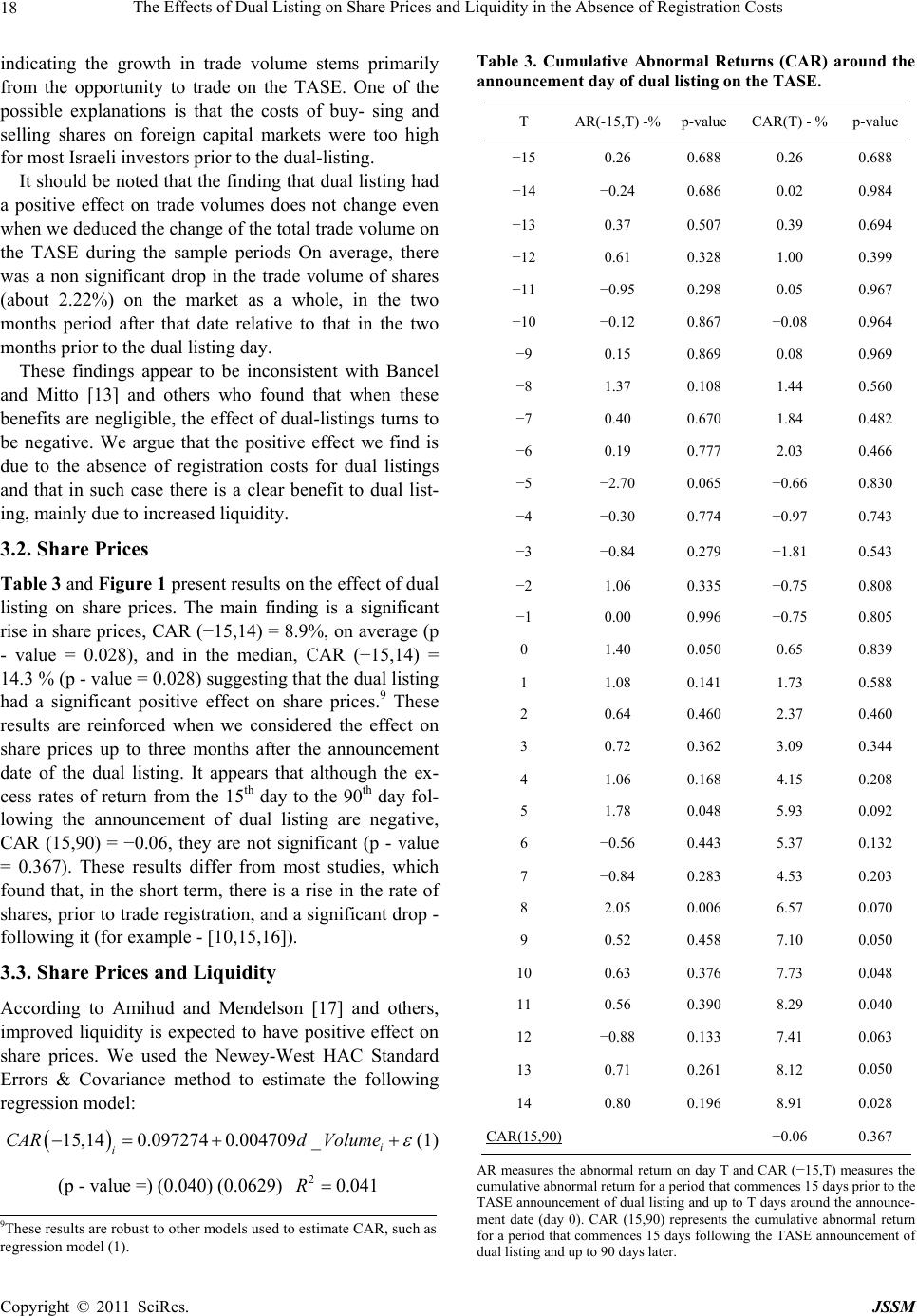 The Effects of Dual Listing on Share Prices and Liquidity in the Absence of Registration Costs 18 indicating the growth in trade volume stems primarily from the opportunity to trade on the TASE. One of the possible explanations is that the costs of buy- sing and selling shares on foreign capital markets were too high for most Israeli investors prior to the dual-listing. It should be noted that the finding that dual listing had a positive effect on trade volumes does not change even when we deduced the change of the total trade volume on the TASE during the sample periods On average, there was a non significant drop in the trade volume of shares (about 2.22%) on the market as a whole, in the two months period after that date relative to that in the two months prior to the dual listing day. These findings appear to be inconsistent with Bancel and Mitto [13] and others who found that when these benefits are negligible, the effect of dual-listings turns to be negative. We argue that the positive effect we find is due to the absence of registration costs for dual listings and that in such case there is a clear benefit to dual list- ing, mainly due to increased liquidity. 3.2. Share Prices Table 3 and Figure 1 present results on the effect of dual listing on share prices. The main finding is a significant rise in share prices, CAR (−15,14) = 8.9%, on average (p - value = 0.028), and in the median, CAR (−15,14) = 14.3 % (p - value = 0.028) suggesting that the dual listing had a significant positive effect on share prices.9 These results are reinforced when we considered the effect on share prices up to three months after the announcement date of the dual listing. It appears that although the ex- cess rates of return from the 15th day to the 90th day fol- lowing the announcement of dual listing are negative, CAR (15,90) = −0.06, they are not significant (p - value = 0.367). These results differ from most studies, which found that, in the short term, there is a rise in the rate of shares, prior to trade registration, and a significant drop - following it (for example - [10,15,16]). 3.3. Share Prices and Liquidity According to Amihud and Mendelson [17] and others, improved liquidity is expected to have positive effect on share prices. We used the Newey-West HAC Standard Errors & Covariance method to estimate the following regression model: 15,140.0972740.004709 _i i CARd Volume (1) (p - value =) (0.040) (0.0629) 20.041R Table 3. Cumulative Abnormal Returns (CAR) around the announcement day of dual listing on the TASE. p-valueCAR(T) - %p-value AR(-15,T) -%T 0.26 0.688 0.26 0.688 −15 −14 0.02 0.686 −0.24 0.984 −13 0.39 0.507 0.37 0.694 −12 1.00 0.328 0.61 0.399 −11 0.05 0.298 −0.95 0.967 −10 −0.08 0.867 −0.12 0.964 0.969 0.08 0.869 0.15 −9 0.560 0.108 1.37 −8 1.44 0.670 1.84 0.482 0.40 −7 0.466 0.19 0.777 2.03 −6 0.830 −0.66 −5 −2.70 0.065 −0.30 0.743 −0.97 0.774 −4 0.543 −1.81 0.279 −0.84 −3 0.808 −0.75 0.335 1.06 −2 0.805 0.996 0.00 −1 −0.75 0.050 0.65 0.839 1.40 0 0.588 1.08 0.141 1.73 1 0.460 0.64 0.460 2.37 2 0.344 0.72 0.362 3.09 3 0.208 1.06 0.168 4.15 4 0.092 1.78 0.048 5.93 5 0.132 −0.56 0.443 5.37 6 0.203 −0.84 0.283 4.53 7 0.070 2.05 0.006 6.57 8 0.050 0.52 0.458 7.10 9 0.048 0.63 0.376 7.73 10 0.040 0.56 0.390 8.29 11 0.063 −0.88 0.133 7.41 12 0.050 0.71 0.261 8.12 13 0.028 0.80 0.196 8.91 14 0.367 −0.06 CAR(15,90) AR measures the abnormal return on day T and CAR (−15,T) measures the cumulative abnormal return for a period that commences 15 days prior to the TASE announcement of dual listing and up to T days around the announce- ment date (day 0). CAR (15,90) represents the cumulative abnormal return for a period that commences 15 days following the TASE announcement of ual listing and up to 90 days later. 9These results are robust to other models used to estimate CAR, such as regression model (1). d Copyright © 2011 SciRes. JSSM 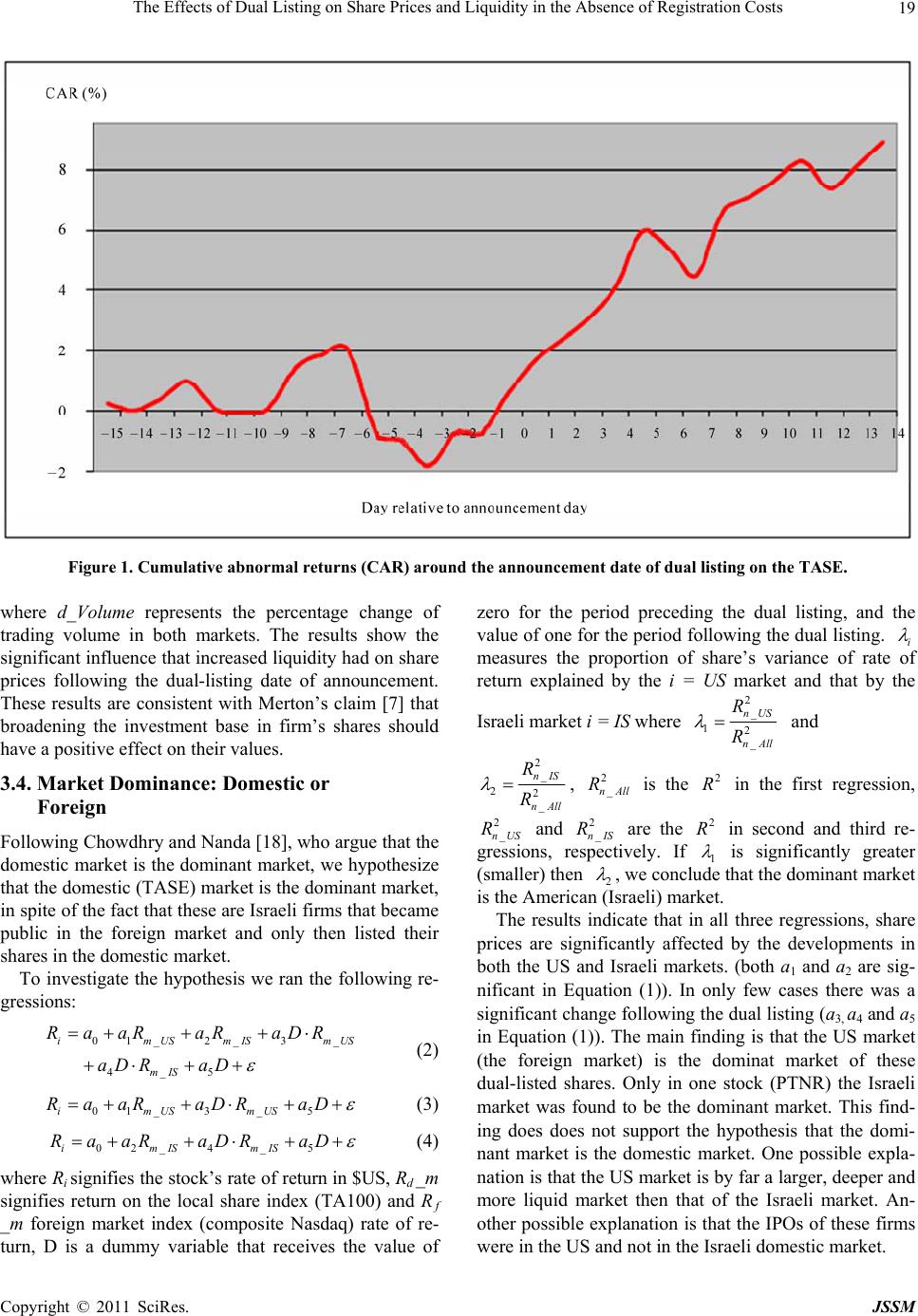 The Effects of Dual Listing on Share Prices and Liquidity in the Absence of Registration Costs Copyright © 2011 SciRes. JSSM 19 Figure 1. Cumulative abnormal returns (CAR) around the ann ouncement date of dual listing on the TASE. where d_Volume represents the percentage change of trading volume in both markets. The results show the significant influence that increased liquidity had on share prices following the dual-listing date of announcement. These results are consistent with Merton’s claim [7] that broadening the investment base in firm’s shares should have a positive effect on their values. 3.4. Market Dominance: Domestic or Foreign Following Chowdhry and Nanda [18], who argue that the domestic market is the dominant market, we hypothesize that the domestic (TASE) market is the dominant market, in spite of the fact that these are Israeli firms that became public in the foreign market and only then listed their shares in the domestic market. To investigate the hypothesis we ran the following re- gressions: 01_2_ 3_ 4_5 im USmISm US mIS RaaRaR aDR aDR aD (2) 01_3 _5imUSmUS RaaR aDR aD (3) 02_ 4_ 5imISmIS RaaR aDR aD (4) where Ri signifies the stock’s rate of return in $US, Rd _m signifies return on the local share index (TA100) and R f _m foreign market index (composite Nasdaq) rate of re- turn, D is a dummy variable that receives the value of zero for the period preceding the dual listing, and the value of one for the period following the dual listing. i measures the proportion of share’s variance of rate of return explained by the i = US market and that by the Israeli market i = IS where 2 _ 12 _ nUS nAll R R and 2 _ 22 _ nIS nAll R R , is the in the first regression, 2 _nAll R 2 2 R 22 _nUS R and _nI S are the in second and third re- gressions, respectively. If 1 RR is significantly greater (smaller) then 2 , we conclude that the dominant market is the American (Israeli) market. The results indicate that in all three regressions, share prices are significantly affected by the developments in both the US and Israeli markets. (both a1 and a2 are sig- nificant in Equation (1)). In only few cases there was a significant change following the dual listing (a3, a4 and a5 in Equation (1)). The main finding is that the US market (the foreign market) is the dominat market of these dual-listed shares. Only in one stock (PTNR) the Israeli market was found to be the dominant market. This find- ing does does not support the hypothesis that the domi- nant market is the domestic market. One possible expla- nation is that the US market is by far a larger, deeper and more liquid market then that of the Israeli market. An- other possible explanation is that the IPOs of these firms were in the US and not in the Israeli domestic market. 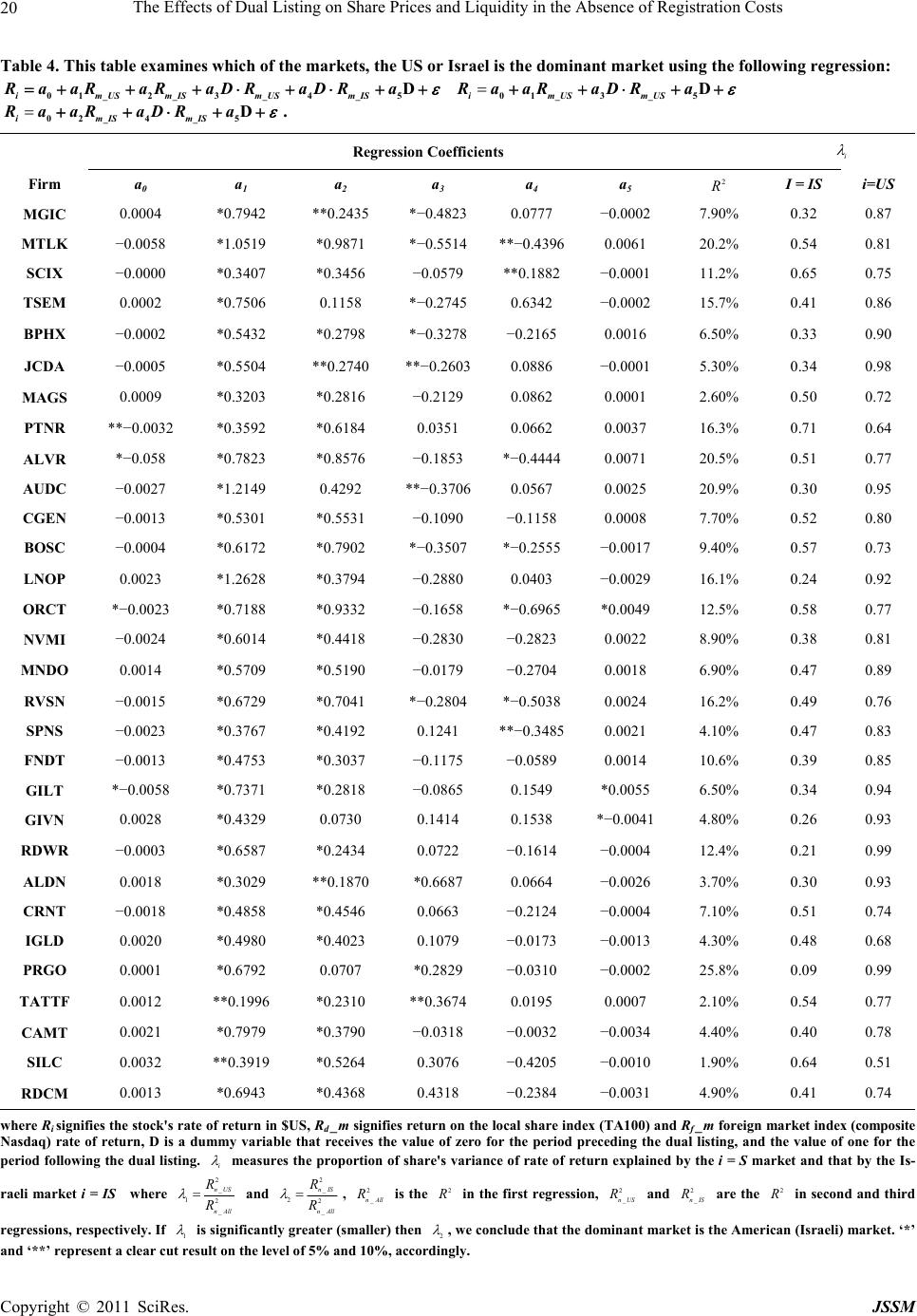 The Effects of Dual Listing on Share Prices and Liquidity in the Absence of Registration Costs 20 Copyright © 2011 SciRes. JSSM Table 4. This table examines which of the markets, the US or Israel is the dominant market using the following regression: 01_2_3 _4 _5 D im USm ISm USmIS RaaRaRaDRaDR a 01_ 3_ 5 D imUSmUS RaaR aDRa DRaaR aDRa 02_ 4_ 5imISmIS . i Regression Coefficients i=US I = IS 2 R a5 a4 a3 a2 a1 a0 Firm 0.87 0.32 7.90% −0.0002 0.0777 *−0.4823 0.2435** 0.7942* 0.0004 MGIC 0.81 0.54 20.2% 0.0061 **−0.4396 *0.9871* −0.5514 1.0519* −0.0058 MTLK 0.75 0.65 11.2% −0.0001 0.1882** −0.0579 0.3456* 0.3407* −0.0000 SCIX 0.86 0.41 15.7% −0.0002 0.6342 *−0.2745 0.1158 0.7506* 0.0002 TSEM 0.90 0.33 6.50% 0.0016 −0.2165 *0.2798* −0.3278 0.5432* −0.0002 BPHX 0.98 0.34 5.30% −0.0001 0.0886 **−0.2603 0.2740** 0.5504* −0.0005 JCDA 0.72 0.50 2.60% 0.0001 0.0862 −0.2129 0.2816* 0.3203* 0.0009 MAGS 0.64 0.71 16.3% 0.0037 0.0662 0.0351 0.6184* 0.3592* **−0.0032 PTNR 0.77 0.51 20.5% 0.0071 *−0.4444 −0.1853 0.8576* 0.7823* *−0.058 ALVR 0.95 0.30 20.9% 0.0025 0.0567 **−0.3706 0.4292 1.2149* −0.0027 AUDC 0.80 0.52 7.70% 0.0008 −0.1158 −0.1090 0.5531* 0.5301* −0.0013 CGEN 0.73 0.57 9.40% −0.0017 *−0.2555 *0.7902* −0.3507 0.6172* −0.0004 BOSC 0.92 0.24 16.1% −0.0029 0.0403 −0.2880 0.3794* 1.2628* 0.0023 LNOP 0.77 0.58 12.5% 0.0049* *−0.6965 −0.1658 0.9332* 0.7188* *−0.0023 ORCT 0.81 0.38 8.90% 0.0022 −0.2823 −0.2830 0.4418* 0.6014* −0.0024 NVMI 0.89 0.47 6.90% 0.0018 −0.2704 −0.0179 0.5190* 0.5709* 0.0014 MNDO 0.76 0.49 16.2% 0.0024 *−0.5038 *0.7041* −0.2804 0.6729* −0.0015 RVSN 0.83 0.47 4.10% 0.0021 **−0.3485 0.1241 0.4192* 0.3767* −0.0023 SPNS 0.85 0.39 10.6% 0.0014 −0.0589 −0.1175 0.3037* 0.4753* −0.0013 FNDT 0.94 0.34 6.50% 0.0055* 0.1549 −0.0865 0.2818* 0.7371* *−0.0058 GILT 0.93 0.26 4.80% *−0.0041 0.1538 0.1414 0.0730 0.4329* 0.0028 GIVN 0.99 0.21 12.4% −0.0004 −0.1614 0.0722 0.2434* 0.6587* −0.0003 RDWR 0.93 0.30 3.70% −0.0026 0.0664 0.6687* 0.1870** 0.3029* 0.0018 ALDN 0.74 0.51 7.10% −0.0004 −0.2124 0.0663 0.4546* 0.4858* −0.0018 CRNT 0.68 0.48 4.30% −0.0013 −0.0173 0.1079 0.4023* 0.4980* 0.0020 IGLD 0.99 0.09 25.8% −0.0002 −0.2829* 0.0310 0.0707 0.6792* 0.0001 PRGO 0.77 0.54 2.10% 0.0007 0.0195 0.3674** 0.2310* 0.1996** 0.0012 TATTF 0.78 0.40 4.40% −0.0034 −0.0032 −0.0318 0.3790* 0.7979* 0.0021 CAMT 0.51 0.64 1.90% −0.0010 −0.4205 0.3076 0.5264* 0.3919** 0.0032 SILC 0.74 0.41 4.90% −0.0031 −0.2384 0.4318 0.4368* 0.6943* 0.0013 RDCM where Ri signifies the stock's rate of return in $US, Rd _m signifi es return on the local sh are index (TA1 00) and Rf _m forei gn market index (composite Nasdaq) rate of return, D is a dummy variable that receives the value of zero for the period preceding the dual listing, and the value of one for the period f ollowing the d ual listing . i meas ures the pro portion of s hare's varia nce of rate of return expl ained by th e i = S market and that by the Is- raeli market i = IS where 2 _ 2 _ nU nA R R 1 S ll and 2 _ 22 _ nIS nAll R R , is the 22 _nA ll R R in th e first regressio n, and 2 2 _nUS R_nI S R are the 2 R in second and third regressio ns , resp ec tiv ely . I f 1 is significa nt ly g reat er (s ma ll er) t hen 2 , we conclude that the dominant market is the American (Israeli) market. ‘*’ nd ‘**’ represent a clear cut result on the level of 5% and 10%, accordingly. a 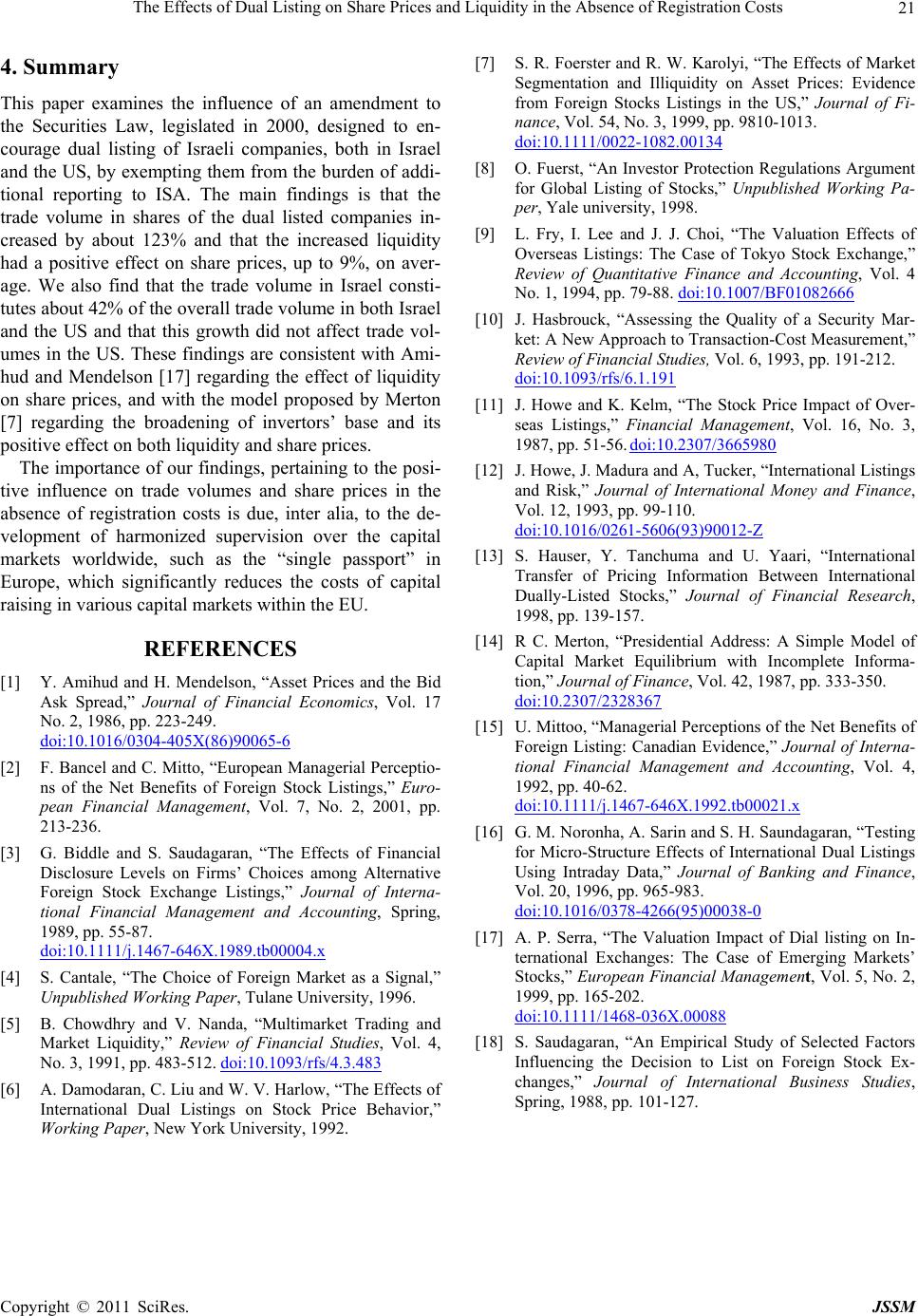 The Effects of Dual Listing on Share Prices and Liquidity in the Absence of Registration Costs 21 4. Summary This paper examines the influence of an amendment to the Securities Law, legislated in 2000, designed to en- courage dual listing of Israeli companies, both in Israel and the US, by exempting them from the burden of addi- tional reporting to ISA. The main findings is that the trade volume in shares of the dual listed companies in- creased by about 123% and that the increased liquidity had a positive effect on share prices, up to 9%, on aver- age. We also find that the trade volume in Israel consti- tutes about 42% of the overall trade volume in both Israel and the US and that this growth did not affect trade vol- umes in the US. These findings are consistent with Ami- hud and Mendelson [17] regarding the effect of liquidity on share prices, and with the model proposed by Merton [7] regarding the broadening of invertors’ base and its positive effect on both liquidity and share prices. The importance of our findings, pertaining to the posi- tive influence on trade volumes and share prices in the absence of registration costs is due, inter alia, to the de- velopment of harmonized supervision over the capital markets worldwide, such as the “single passport” in Europe, which significantly reduces the costs of capital raising in various capital markets within the EU. REFERENCES [1] Y. Amihud and H. Mendelson, “Asset Prices and the Bid Ask Spread,” Journal of Financial Economics, Vol. 17 No. 2, 1986, pp. 223-249. doi:10.1016/0304-405X(86)90065-6 [2] F. Bancel and C. Mitto, “European Managerial Perceptio- ns of the Net Benefits of Foreign Stock Listings,” Euro- pean Financial Management, Vol. 7, No. 2, 2001, pp. 213-236. [3] G. Biddle and S. Saudagaran, “The Effects of Financial Disclosure Levels on Firms’ Choices among Alternative Foreign Stock Exchange Listings,” Journal of Interna- tional Financial Management and Accounting, Spring, 1989, pp. 55-87. doi:10.1111/j.1467-646X.1989.tb00004.x [4] S. Cantale, “The Choice of Foreign Market as a Signal,” Unpublished Working Paper, Tulane University, 1996. [5] B. Chowdhry and V. Nanda, “Multimarket Trading and Market Liquidity,” Review of Financial Studies, Vol. 4, No. 3, 1991, pp. 483-512. doi:10.1093/rfs/4.3.483 [6] A. Damodaran, C. Liu and W. V. Harlow, “The Effects of International Dual Listings on Stock Price Behavior,” Working Paper, New York University, 1992. [7] S. R. Foerster and R. W. Karolyi, “The Effects of Market Segmentation and Illiquidity on Asset Prices: Evidence from Foreign Stocks Listings in the US,” Journal of Fi- nance, Vol. 54, No. 3, 1999, pp. 9810-1013. doi:10.1111/0022-1082.00134 [8] O. Fuerst, “An Investor Protection Regulations Argument for Global Listing of Stocks,” Unpublished Working Pa- per, Yale university, 1998. [9] L. Fry, I. Lee and J. J. Choi, “The Valuation Effects of Overseas Listings: The Case of Tokyo Stock Exchange,” Review of Quantitative Finance and Accounting, Vol. 4 No. 1, 1994, pp. 79-88. doi:10.1007/BF01082666 [10] J. Hasbrouck, “Assessing the Quality of a Security Mar- ket: A New Approach to Transaction-Cost Measurement,” Review of Financial Studies, Vol. 6, 1993, pp. 191-212. doi:10.1093/rfs/6.1.191 [11] J. Howe and K. Kelm, “The Stock Price Impact of Over- seas Listings,” Financial Management, Vol. 16, No. 3, 1987, pp. 51-56. doi:10.2307/3665980 [12] J. Howe, J. Madura and A, Tucker, “International Listings and Risk,” Journal of International Money and Finance, Vol. 12, 1993, pp. 99-110. doi:10.1016/0261-5606(93)90012-Z [13] S. Hauser, Y. Tanchuma and U. Yaari, “International Transfer of Pricing Information Between International Dually-Listed Stocks,” Journal of Financial Research, 1998, pp. 139-157. [14] R C. Merton, “Presidential Address: A Simple Model of Capital Market Equilibrium with Incomplete Informa- tion,” Journal of Finance, Vol. 42, 1987, pp. 333-350. doi:10.2307/2328367 [15] U. Mittoo, “Managerial Perceptions of the Net Benefits of Foreign Listing: Canadian Evidence,” Journal of Interna- tional Financial Management and Accounting, Vol. 4, 1992, pp. 40-62. doi:10.1111/j.1467-646X.1992.tb00021.x [16] G. M. Noronha, A. Sarin and S. H. Saundagaran, “Testing for Micro-Structure Effects of International Dual Listings Using Intraday Data,” Journal of Banking and Finance, Vol. 20, 1996, pp. 965-983. doi:10.1016/0378-4266(95)00038-0 [17] A. P. Serra, “The Valuation Impact of Dial listing on In- ternational Exchanges: The Case of Emerging Markets’ Stocks,” European Financial Management, Vol. 5, No. 2, 1999, pp. 165-202. doi:10.1111/1468-036X.00088 [18] S. Saudagaran, “An Empirical Study of Selected Factors Influencing the Decision to List on Foreign Stock Ex- changes,” Journal of International Business Studies, Spring, 1988, pp. 101-127. Copyright © 2011 SciRes. JSSM |