

Paper Menu >>
Journal Menu >>
 Open Journal of Synthesis Theory and Applications, 2014, 3, 1-4 Published Online January 2014 (http://www.scirp.org/journal/ojsta) http://dx.doi.org/10.4236/ojsta.2014.31001 OPEN ACCESS OJSTA Microwave Assisted Peptide Synthesis as a New Gold Standard in Solid Phase Peptide Synthesis: Phospholamban as an Example Shadi Abu-Baker1*, Philip Garber1,2, Bryce Hina1, Trevor Reed1, Ghaffari Shahrokh1, Mohannad Al-Saghir1, Gary Lorigan3 1College of Arts and Sciences, Ohio University, Zanesville, USA 2Genesis Hospital , Ohio University, Zanesville, USA 3Department of Chemistry and Biochemistry, Miami University, Oxford, USA Email: *[email protected] Received October 12, 2013; revised November 16, 2013; accepted December 10, 2013 Copyright © 2014 Shadi Abu-Baker et al. This is an open access article distributed under the Creative Commons Attribution License, which permits unrestricted use, distribution, and reproduction in any medium, provided the original work is properly cited. In accor- dance of the Creative Commons Attribution License all Copyrights © 2014 are reserved for SCIRP and the owner of the intellectual property Shadi Abu-Baker et al. All Copyright © 2014 are guarded by law and by SCIRP as a guardian. ABSTRACT In this study, we report the microwave assisted synthesis of Phospholamban protein (WT-PLB) as a new gold standard in solid phase peptide synthesis. Microwave energy offers benefits for both the coupling and deprotec- tion reactions during peptide synthesis. The use of microwave energy for both the coupling and deprotection steps makes the microwave peptide synthesizers the most versatile and powerful systems available. It produces high yield and fast synthesis when compared to conventional peptide synthesizers. KEYWORDS Solid-State Peptide Synthesis; Phospholamban; Microwave Assisted Synthesis 1. Introduction The use of microwave peptide synthesizers has several advantages over conventional peptide synthesizers. First, it allows the use of microwave energy for both the coupling and deprotection steps using fastest cycle times. Second, the peptide purity and the yield are comparable to conventional synthesis. Third, it significantly reduces purification time and waste. And finally, it allows the access to peptides impossible to synthesize under con- ventional conditions. In this study, we compared the synthesis of WT-Phospholamban (WT-PLB) using both the conventional and the microwave assisted solid-phase peptide synthesis. WT-PLB is a hydrophobic 52-amino acid transmembrane protein that is involved in regu lating the contraction and relaxation of heart muscle [1-3]. Phosphorylation of PLB by cyclic AMP- and calmodu- lin-dependent kinases is believed to increase the rate of calcium re-uptake by the sacroplasmic reticulum and result in muscle relaxation [1-3]. The isolation and puri- fication of large quantities of native PLB through mole- cular biology techniques have not yet been achieved due to difficulties encountered in the bacterial over expres- sion of phospholambanc DNA [4,5]. Alternatively, WT- PLB has been prepared by chemical synthesis using standard solid-phase peptide synthesis and purification in organic solvents [6,7]. In addition, this approach gives the opportunity to synthesize site-specific isotopically labeled peptides and proteins [8-10]. The biochemical and biophysical comparison of synthetic PLB and native PLB revealed that they are both similar in size and fun c- tionally identical [6,7]. 2. Materials and Methods WT-PLB Synthesis and Purification WT-PLB was synthesized using both the conventional solid-phase methods with an ABI 433A peptide synthe- sizer (Applied Biosystems, Foster city, CA) and with mi- crowave as sisted liberty peptide synthe sizer (see Figure 1, *Corresponding a uthor. 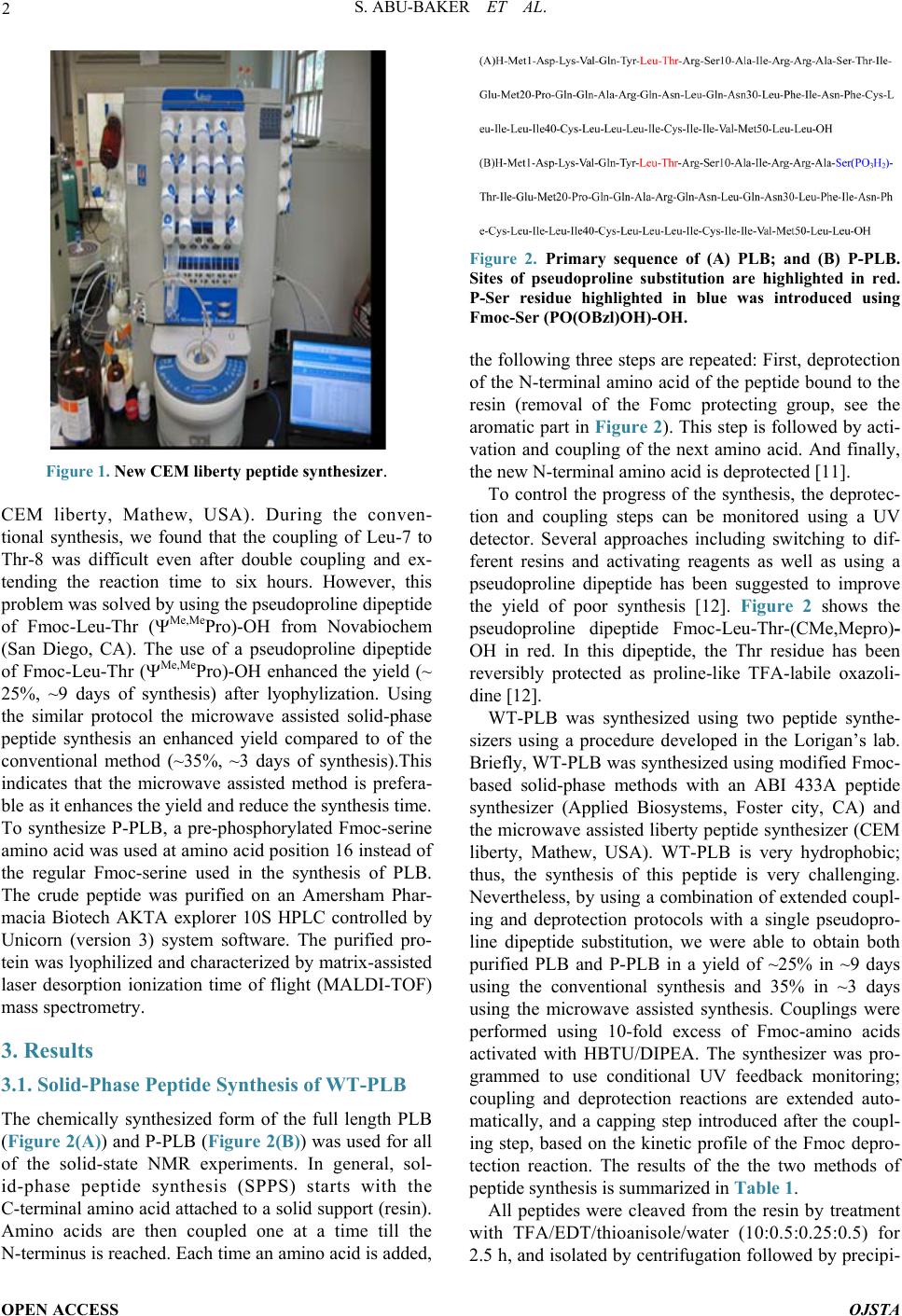 S. ABU-BAKER ET AL. OPEN ACCESS OJSTA 2 Figure 1. New CEM liberty p ept i de synthesi zer. CEM liberty, Mathew, USA). During the conven- tional synthesis, we found that the coupling of Leu-7 to Thr-8 was difficult even after double coupling and ex- tending the reaction time to six hours. However, this problem was solved by using the pseudoproline dipeptide of Fmoc-Leu-Thr (ΨMe,MePro)-OH from Novabiochem (San Diego, CA). The use of a pseudoproline dipeptide of Fmoc-Leu-Thr (ΨMe,MeP ro)-OH enhanced the yield (~ 25%, ~9 days of synthesis) after lyophylization. Using the similar protocol the microwave assisted solid-phase peptide synthesis an enhanced yield compared to of the conventional method (~35%, ~3 days of synthesis).This indicates that the microwave assisted method is prefera- ble as it enhances the yield and reduce the synthesis time. To synthesize P-PLB, a pre-phosphorylated Fmoc-serine amino acid was used at amino acid position 16 instead of the regular Fmoc-serine used in the synthesis of PLB. The crude peptide was purified on an Amersham Phar- macia Biotech AKTA explorer 10S HPLC controlled by Unicorn (version 3) system software. The purified pro- tein was lyophilized and characterized by matrix-assisted laser desorption ionization time of flight (MALDI-TOF) mass spectrometry. 3. Results 3.1. Solid-Phase Peptide Synthesis of WT-PLB The chemically synthesized form of the full length PLB (Figure 2(A)) and P-PLB (Figure 2(B)) was used for all of the solid-state NMR experiments. In general, sol- id-phase peptide synthesis (SPPS) starts with the C-terminal amino acid attached to a solid support (res in). Amino acids are then coupled one at a time till the N-terminus is reached. Each time an amino acid is added, Figure 2. Primary sequence of (A) PLB; and (B) P-PLB. Sites of pseudoproline substitution are highlighted in red. P-Ser residue highlighted in blue was introduced using Fmoc-Ser (PO(OBzl)OH)-OH. the following three steps are repeated: First, deprotection of the N-terminal amino acid of the peptide bound to the resin (removal of the Fomc protecting group, see the aromatic part in Fig ure 2). This step is followed by acti- vation and coupling of the next amino acid. And finally, the new N-terminal amino acid is deprotected [11 ]. To control the progress of the synthesis, the deprotec- tion and coupling steps can be monitored using a UV detector. Several approaches including switching to dif- ferent resins and activating reagents as well as using a pseudoproline dipeptide has been suggested to improve the yield of poor synthesis [12]. Figure 2 shows the pseudoproline dipeptide Fmoc-Leu-Thr-(CMe,Mepro)- OH in red. In this dipeptide, the Thr residue has been reversibly protected as proline-like TFA-labile oxazoli- dine [12]. WT-PLB was synthesized using two peptide synthe- sizers using a procedure developed in the Lorigan’s lab. Briefly, WT-PLB was synthesized using modified Fmo c - based solid-phase methods with an ABI 433A peptide synthesizer (Applied Biosystems, Foster city, CA) and the microwave assisted liberty peptide synthesizer (CEM liberty, Mathew, USA). WT-PLB is very hydrophobic; thus, the synthesis of this peptide is very challenging. Nevertheless, by using a combination of extended coupl- ing and deprotection protocols with a single pseudopro- line dipeptide substitution, we were able to obtain both purified PLB and P-PLB in a yield of ~25% in ~9 days using the conventional synthesis and 35% in ~3 days using the microwave assisted synthesis. Couplings were performed using 10-fold excess of Fmoc-amino acids activated with HBTU/DIPEA. The synthesizer was pro- grammed to use conditional UV feedback monitoring; coupling and deprotection reactions are extended auto- matically, and a capping step introduced after the coupl- ing step, based on the kinetic profile of the Fmoc depro- tection reaction. The results of the the two methods of peptide synthesis is summarized in Table 1. All peptides were cleaved from the resin by treatment with TFA/EDT/thioanisole/water (10:0.5:0.25:0.5) for 2.5 h, and isolated by centrifugation followed by precipi- 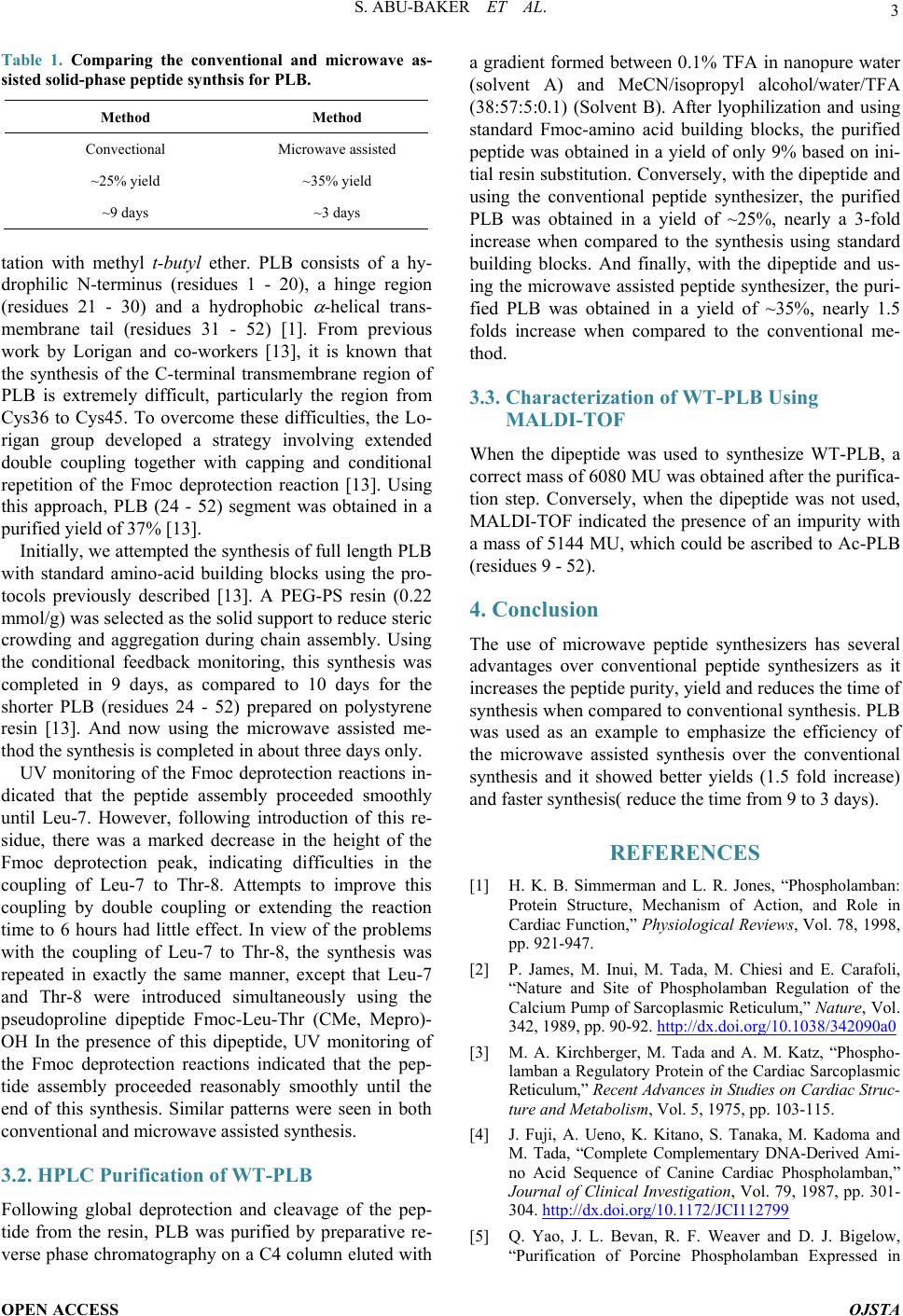 S. ABU-BAKER ET AL. OPEN ACCESS OJSTA 3 Table 1. Comparing the conventional and microwave as- sisted solid-phase pepti de synthsis for PLB. Method Method Convectional Microwave assisted ~25% yield ~35% yield ~9 days ~3 days tation with methyl t-butyl ether. PLB consists of a hy- drophilic N-terminus (residues 1 - 20), a hinge region (residues 21 - 30) and a hydrophobic α -helical trans- membrane tail (residues 31 - 52) [1]. From previous work by Lorigan and co-workers [13], it is known that the synthesis of the C-terminal transmembrane region of PLB is extremely difficult, particularly the region from Cys36 to Cys45. To overcome these difficulties, the Lo- rigan group developed a strategy involving extended double coupling together with capping and conditional repetition of the Fmoc deprotection reaction [13]. Using this approach, PLB (24 - 52) segment was obtained in a purified yield of 37 % [13]. Initially, we attempted the synthesis of full length PLB with standard amino-acid building blocks using the pro- tocols previously described [13]. A PEG-PS resin (0.22 mmol/g) was selected as the solid support to reduce steric crowding and aggregation during chain assembly. Using the conditional feedback monitoring, this synthesis was completed in 9 days, as compared to 10 days for the shorter PLB (residues 24 - 52) prepared on polystyrene resin [13]. And now using the microwave assisted me- thod the synthesis is completed in about three days only. UV monitoring of the Fmoc deprotection reactions in- dicated that the peptide assembly proceeded smoothly until Leu-7. However, following introduction of this re- sidue, there was a marked decrease in the height of the Fmo c deprotection peak, indicating difficulties in the coupling of Leu-7 to Thr-8. Attempts to improve this coupling by double coupling or extending the reaction time to 6 hours had little effect. In view of the problems with the coupling of Leu-7 to Thr-8, the synthesis was repeated in exactly the same manner, except that Leu-7 and Thr-8 were introduced simultaneously using the pseudoproline dipeptide Fmoc-Leu-Thr (CMe, Mepro)- OH In the presence of this dipeptide, UV monitoring of the Fmoc deprotection reactions indicated that the pep- tide assembly proceeded reasonably smoothly until the end of this synthesis. Similar patterns were seen in both conventional and microwave assisted synthesis. 3.2. HPLC Purification of WT-PLB Following global deprotection and cleavage of the pep- tide from the resin, PLB was purified by preparative re- verse phase chromatography on a C4 column eluted with a gradient formed between 0.1% TFA in nanopure water (solvent A) and MeCN/isopropyl alcohol/water/TFA (38:57:5:0.1) (Solvent B). After lyophilization and using standard Fmoc-amino acid building blocks, the purified peptide was obtained in a yield of only 9% based on ini- tial resin substitution. Conversely, with the dipeptide and using the conventional peptide synthesizer, the purified PLB was obtained in a yield of ~25%, nearly a 3-fold increase when compared to the synthesis using standard building blocks. And finally, with the dipeptide and us- ing the microwave assisted peptide synthesizer, the puri- fied PLB was obtained in a yield of ~35%, nearly 1.5 folds increase when compared to the conventional me- thod. 3.3. Characterization of WT-PLB Using MALDI-TOF When the dipeptide was used to synthesize WT-PLB, a correct mass of 6080 MU was obtained after the purifica- tion step. Conversely, when the dipeptide was not used, MALDI-TOF indicated the presence of an impurity with a mass of 5144 MU, which could be ascribed to Ac-PLB (residues 9 - 52). 4. Conclusion The use of microwave peptide synthesizers has several advantages over conventional peptide synthesizers as it increases the peptide purity, yield and reduces the time of synthesis when compared to conventional synthesis. PLB was used as an example to emphasize the efficiency of the microwave assisted synthesis over the conventional synthesis and it showed better yields (1.5 fold increase) and faster synthesis( reduce the time from 9 to 3 days). REFERENCES [1] H. K. B. Simmerman and L. R. Jones, “Phospholamban: Protein Structure, Mechanism of Action, and Role in Cardiac Function,” Physiological Reviews, Vol. 78, 1998, pp. 921-947. [2] P. James, M. Inui, M. Tada, M. Chiesi and E. Carafoli, “Nature and Site of Phospholamban Regulation of the Calcium Pump of Sarcoplasmic Reticulum,” Nature, Vol. 342, 1989, pp. 90-92. http://dx.doi.org/10.1038/342090a0 [3] M. A. Kirchberger, M. Tada and A. M. Katz, “Phospho- lamban a Regulatory Protein of the Cardiac Sar coplasmic Reticulum,” Recent Advance s in Studies on Cardi ac Struc- ture and Metabolism, Vol. 5, 1975, pp. 103-115. [4] J. Fuji, A. Ueno, K. Kitano, S. Tanaka, M. Kadoma and M. Tada, “Complete Complementary DNA-Derived Ami- no Acid Sequence of Canine Cardiac Phospholamban,” Journal of Clinical Investigation, Vol. 79, 1987, pp. 301- 304. http://dx.doi.org/10.1172/JCI112799 [5] Q. Yao, J. L. Bevan, R. F. Weaver and D. J. Bigelow, “Purification of Porcine Phospholamban Expressed in 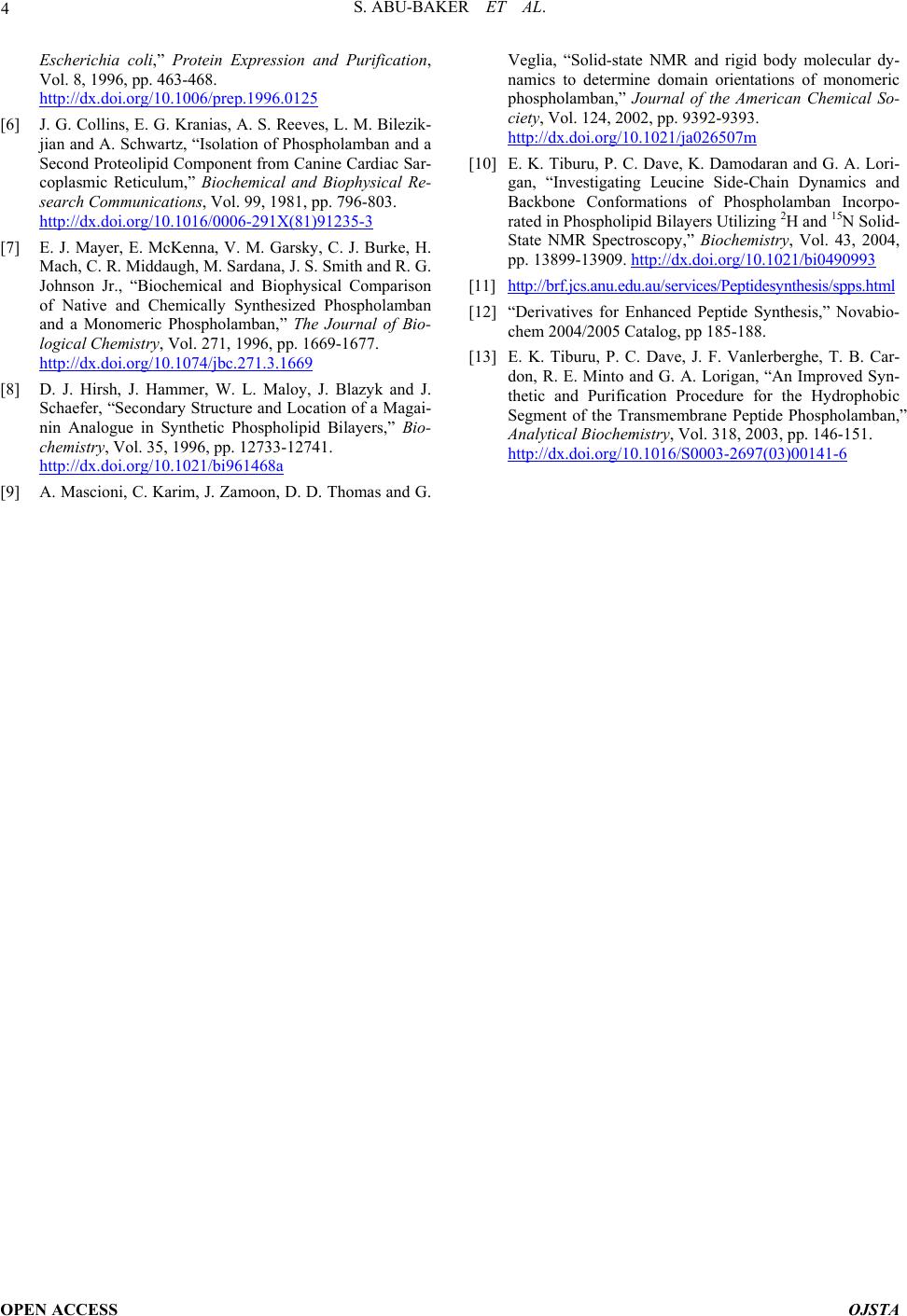 S. ABU-BAKER ET AL. OPEN ACCESS OJSTA 4 Escherichia coli,” Protein Expression and Purification, Vol. 8, 1996, pp. 463-468. http://dx.doi.org/10.1006/prep.1996.0125 [6] J. G. Collins, E. G. Kranias, A. S. Reeves, L. M. Bilezik- jian and A. Schwartz, “Isolation of Phospholamban a nd a Second Proteolipid Component from Cani ne Cardiac Sar- coplasmic Reticulum,” Biochemical and Biophysical Re- search Communications, Vol. 99, 1981, pp. 796-803. http://dx.doi.org/10.1016/0006-291X(81)91235-3 [7] E. J. Mayer, E. McKenna, V. M. Garsky, C. J. Burke, H. Mach, C. R. Middaugh, M. Sardana, J. S. Smith and R. G. Johnson Jr., “Biochemical and Biophysical Comparison of Native and Chemically Synthesized Phospholamban and a Monomeric Phospholamban,” The Journal of Bio- logical Chemistry, Vol. 271, 1996, pp. 1669-1677. http://dx.doi.org/10.1074/jbc.271.3.1669 [8] D. J. Hirsh, J. Hammer, W. L. Maloy, J. Blazyk and J. Schaefer, “Secondary Structure and Location of a Magai- nin Analogue in Synthetic Phospholipid Bilayers,” Bio- chemistry, Vol. 35, 1996, pp. 12733-12741. http://dx.doi.org/10.1021/bi961468a [9] A. Mascioni, C. Karim, J. Zamoon, D. D. Thomas and G. Veglia, “Solid-state NMR and rigid body molecular dy- namics to determine domain orientations of monomeric phospholamban,” Journal of the American Chemical So- ciety, Vol. 124, 2002, pp. 9392-9393. http://dx.doi.org/10.1021/ja026507m [10] E. K. Tiburu, P. C. Dave, K. Damodaran and G. A. Lori- gan, “Investigating Leucine Side-Chain Dynamics and Backbone Conformations of Phospholamban Incorpo- rated in Phospholipid Bilayers Utilizing 2H and 15N Solid- State NMR Spectroscopy,” Biochemistry, V ol . 43, 2004, pp. 13899-13909. http://dx.doi.org/10.1021/bi0490993 [11] http:/ /brf.jcs.a nu.edu.au/ ser vi ces/Peptidesynthesis/spps.h tml [12] “Derivatives for Enhanced Peptide Synthesis,” Novabio- chem 2004/2005 Catalog, pp 185-188. [13] E. K. Tiburu, P. C. Dave, J. F. Vanlerberghe, T. B. Car- don, R. E. Minto and G. A. Lorigan, “An Improved Syn- thetic and Purification Procedure for the Hydrophobic Segment of the Transmembrane Peptide Phospholamban,” Analytical Biochemistry, Vol. 318, 2003, pp. 146-151. http://dx.doi.org/10.1016/S0003-2697(03)00141-6 |