

Paper Menu >>
Journal Menu >>
 Open Journal of O bste tric s and Gyne c ology , 2014, 4, 10-15 OJOG http://dx.doi.org/10.4236/ojog.2014.41003 Published Online January 2014 (http://www.scirp.org/journal/ojog/) OPEN ACCESS Experience of more than 30 00 cycles of Brazilian women using the contraceptive vagi n al rin g (nuvaring®) Denise Leite Maia Monteiro1,2*, Ricardo Vasconcelos Bruno3, Zuleide A. F. Cabral4, Célia Regina da Silva5, Danielle Bittencourt Sodré Barmpas6, Nádia Cristina Pinheiro Rodrigues7 1Gynecology and Obstetrics Department, Universidade do Estado do Rio de Janeiro (UERJ), Rio de Janeiro, Brazil 2Gynecology and Obstetrics Department, UNIFESO, Teresópolis, Brazil 3Reproduction Department, Institutode Ginecologia, Universidade Federal do Rio de Janeiro (UFRJ), Rio de Janeiro, Brazil 4Gynecology and Obstetrics Department, Universidade Federal de Mato Grosso (UFMT), Cuiabá, Brazil 5Obstetrics Department, Maternidade Escola Universidade Federal do Rio de Janeiro (ME-UFRJ), Rio de Janeiro, Brazil 6Ongoing MSc at UERJ, Rio de Janeiro, Brazil 7Public Health Researcher of Instituto Oswaldo Cruz (FIOCRUZ)/Universidade do Estado do Rio de Janeiro (UERJ), Rio de Janeiro, Brazil Email: *[email protected] Received 8 October 2013; revised 8 November 2013; accepted 16 November 2013 Copyright © 2014 De nise Leite Mai a Montei ro et al. This is an open access article distributed under the Creative Commons Attribu- tion License, which permits unrestricted use, distribution, and reproduction in any medium, provided the original work is properly cited. In accordance of the Creative Commons Attribution License all Copyrights © 2014 are reserved for SCIRP and the owner of the intellectual prope r ty Denise Leite Maia Monteiro et al. All Copyright © 2014 are guarded by law and by SCIRP as a guardian. ABSTRACT Objective: To evaluate the profile of the Brazilianva- ginal ring user, reasons for choosing it, satisfaction, menstrual pattern, tolerability, efficacy, side effects and reasons for discontinuation. Methods: We review- ed the files of 148 users who attended the Hospital de Jacarepaguáand private clinics, between 2005 and 2011, in a total of 3107 cycles. Kaplan-Meier survival curves and regression models were used in statistical analysis. Results: Th e profile was: single, nulligravida, 30 years (mean) and with university education. The previous contraception used was mostly the oral hor- monal contraception (75.7%). Women chose the ring for: practicality (32.4%), forgetting the pill (32.4%) and irregular vaginal bleeding (13.5%). The satisfac- tion degree was 80.5% (119). There were good cycle control and no pregnancies. Thirty-eight patients dis- continued the use (25.7%). The main reasons were wish for pregnancy (6%), spotting (3.4%) and increas- ed vaginal discharge (2.7%). At the end of the first year, use of the greatest reduction of continuity pro- bability was observed (19.3%). Women with side ef- fects were 68% less likely to be satisfied with the me- thod than those without (p-value <0.0001). Conclu- sion: Nuvaring® is an excellent contraceptiveoption due to its sefficacy, cycle control, tolerability, practi- cality and safety. KEYWORDS Vaginal Ring; Hormonal Contr aception; Efficacy; Tolerability 1. INTRODUCTION The combined oral contraceptive pill (COC) is the most- ly used method of contraception, especially by younger women with good level of education and no children [1]. However, the literature shows a high prevalence of wo- men making irregular use of the pill, which interferes with its efficacy [2]. Some articles report fa ilu re to take 3 to 5 pills per cycle in 30% to 50% of the women [3]. The possibility of other routes of administration can benefit women who want safe contraception adapted to their profile and needs. There are few works evaluating the cr iteria of choice and the satisfaction degre e with the contraceptive method [4,5]. However there is already evi- dence of higher satisfaction amongst women who switch- ed from the COC to a non-oral route [6]. Furthermore, there are less side effects and problems related to the use of the vaginal ring than that with the transdermic hor- monal cont ra c eptive (patch) [6]. The advantages of the non-oral route are that the pro- ducts have a longer lasting action (no need for daily dos- ing) and therefore they eliminate the forgetfulness issue; and that they avoid the hepatic first-pass effect, gastric intolerance and the serum hormonal fluctuations, provid- ing a better control of the bleeding pattern [7]. *Corresponding a uthor.  D. L. M. Monteiro et al. / Open Journal of Obstetrics and Gynecology 4 (2014) 10-15 Copyright © 2014 SciRes. OPEN ACCESS 11 The vaginal ring is made of a transparent evatane core and sheath, with an external diameter of 54 mm and thickness of 4 mm. It contains 11.7 mg of etonogestrel and 2.7 mg of ethinylestradiol, with the average daily re- lease of 120 mcg and 15 mcg, respectively, for a period of three weeks. It was first approved for market release in the Netherlands (2001), followed by the EU and USA (2002) [8]. The aim of this study is to establish the profile of the Brazilian women who chose the vaginal contraception and to evaluate their satisfaction degree, menstrual bleed- ing pattern, tolerability, efficacy, side effects and the rea- sons for discontinuing the method. This information should help the health professionals counsel patients who seek a birth control method which is safe, efficient and does not require daily dosing. 2. METHODS This was a retrospective study, based on the analysis of the files of 148 women who attended either the Ministry of Health’s Hospital de Jacarepaguá (Rio de Janeiro, Br a- zil) or private clinics, between 2005 and 2011, reaching 3107 cycles of use of the product. The inclusion criteria were: to use the vaginal ring for at least one cycle, to have no known contraindication to the use of estrogen, no use of drugs that interfere with the metabolism of contraceptive hormones, not to be breast feeding, not to be in the postpartum or post abortion period (2 months) andto have a normal smear test on the recruitment visit. At the first appointment, all the subjects underwent clinical and gynecological examinations, including a cer- vical smear test. They also answered a questionnaire about their general medical and gynecological history, includ- ing any previously used contraceptives and the reason why they had chosen the vaginal ring. The anamneses and exams were thoroughly registered on the medical files. All the patients started the use of the vaginal ring with the sole objective of contraception. Before starting the use all the women were taught how and when to in- sert and remove the ring. For women on each kind of contraceptive, the manufacturer’s prescribing informa- tion leaflet was observed. The vaginal ring was self-in- serted into the vagina and was left in place for 21 days per cycle followed by a 7 day ring-free interval. In all the follow up appointments the weight and blood pressure (BP) measurements were added to their files, as well as all the information about the periods, the use of the me- thod (satisfaction or interruption) , the side effects and the use of other medications. The efficacy of the vaginal ring was determined by the incidence of pregnancy while us- ing the method. The level of satisfaction was evaluated by a simple scoring system ranging from 1 to 4, in which (1) meant the patient was dissatisfied , (2) not very satis- fied, (3) satisfied and (4) very satisfied. “Satisfaction” was also analyzed as a binary variable in the survival analyses and the categories were regrouped in: dissatis- fied (scores 1 and 2); and satisfied (scores 3 and 4). For the stat ist ic anal ysis the c atego rica l predi cto rs wer e: age (<30; ≥30 years), level of schooling (secondary; hi- gher), marital status (single; married), previous contra- ceptive method (COC; condom; patch; implant; inj ection; IUD and diaphragm), length of use (less than 2 years; from 2 to 3 years; more than 3 years), side effects, rea- sons why the vaginal ring was chosen and reasons for quitting. The categorical variables were described as propor- tions with a confidence interval of 95% (CI95%). Means and standard deviations were used to describe the nume- ric variables. Kap lan-Meier survival curv e was plotted to describe discontinuity probability of method along the time. Bivariate log-binomial regression models were us- ed to assess the association between the characteristics of the patients (age, schooling , marital status, previous con- traceptive method and side effects) and the satisfaction with the vaginal ring. Age adjusted models were applied to assess user satisfaction with the vaginal ring in rela- tion to side effects and previous contraceptive method. The softwares Epi Info/version 3.5.3, R-Project 2.15.2 and Stata/SE 8.0 for Windows were used for the statis- tical analyses. The research was approved by the Ethics Committee of the Hospital de Jacarepaguá. 3. RESULTS The mean age of the users was 29.5 years (16 to 42 years). The method was chosen by adolescents in 8.1% (12; CI95% 4.3 - 13.7) of cases; patients were between 20 and 29 ye ars in 44% (65; CI95% 35.8 - 52.3); from 30 to 39 in 41.2% (61; CI95% 33.2 - 49.6) and from 40 to 42 in 6.7% (10; CI95% 3.3 - 12.1). Regarding marital status, 52.7% (78) were single, 41.2% (61) married and 6.1% (9) divorced. Patients had either university 79% (117) or high school level of education 21% (31). Menarche had occurred from 8 to 16 years (mean = 12.4) and the first intercourse from 12 to 25 (mean = 17.1). Roughly half of the patients (50.7%, 75) were null igravidae, 29.7% (44) had one previous preg- nancy and 19.6% (29) had two to four previous pregnan- cies. Prior miscarriages were reported by 11% (16). Most women had used COC before (75.7%). The other previously used methods were condom (10.8%), patch (3.4%), implant (4.1%), injection (2.7%), IUD (1.4%), diaphragm (0.7%) and none (1.4%). The main reasons for choosing the vaginal ring were: practicality for 32.4% (48) of the women, forgetfulness to take the oral contra- ceptive for 32.4% (48) and irregularvaginal bleeding for 13.5% (20) ( Table 1). 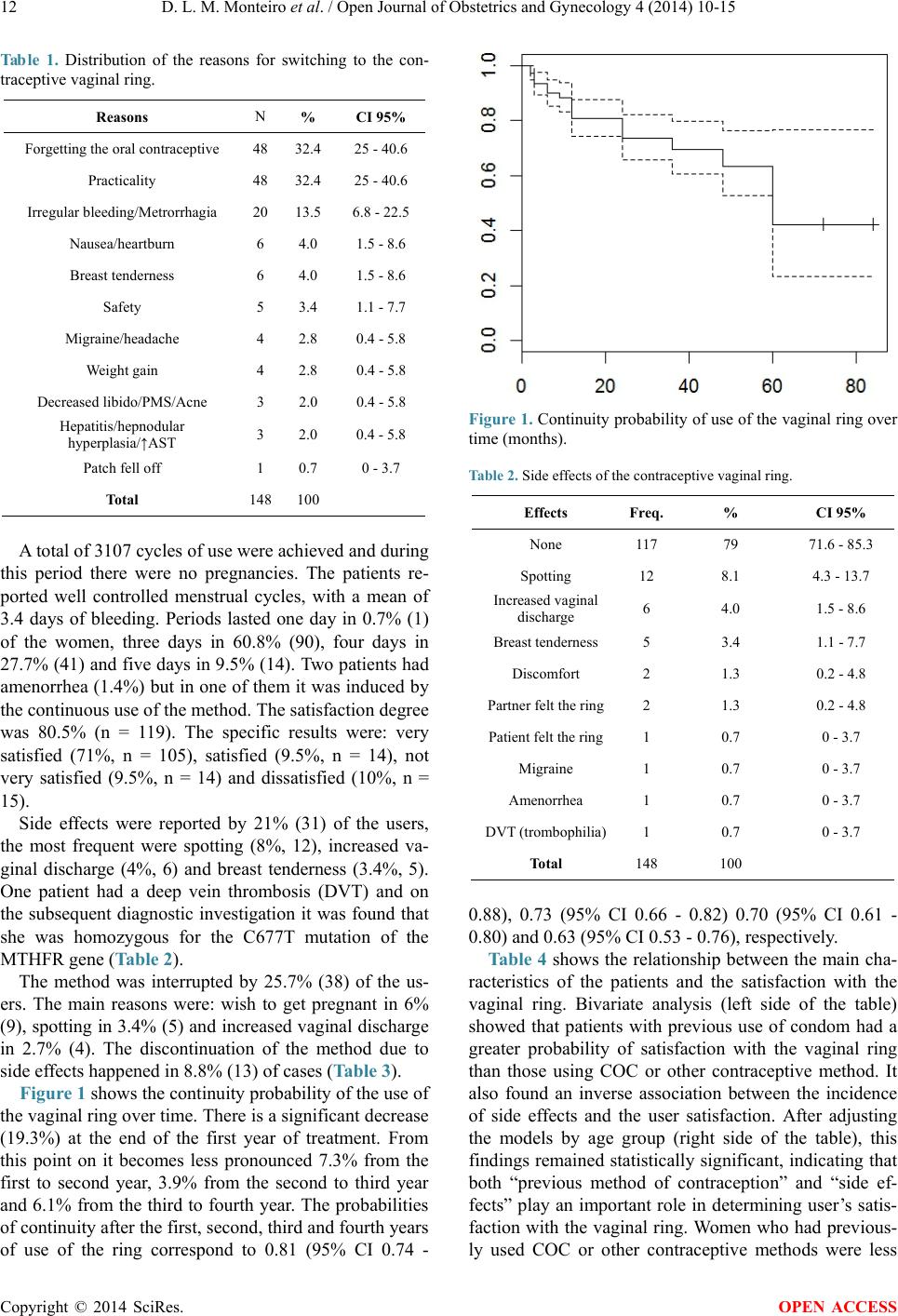 D. L. M. Monteiro et al. / Open Journal of Obstetrics and Gynecology 4 (2014) 10-15 Copyright © 2014 SciRes. OPEN ACCESS 12 Tab le 1. Distribution of the reasons for switching to the con- traceptive vaginal ring. Reasons N % CI 95% Forgetting the oral contraceptive 48 32.4 25 - 40.6 Practicality 48 32.4 25 - 40.6 Irregular bleeding/Metrorrhagia 20 13.5 6.8 - 22.5 Nausea/heartburn 6 4.0 1.5 - 8.6 Breast tenderness 6 4.0 1.5 - 8.6 Safety 5 3.4 1.1 - 7.7 Migraine/headache 4 2.8 0.4 - 5.8 Weight gain 4 2.8 0.4 - 5.8 Decreased libido/PMS/Acne 3 2.0 0.4 - 5.8 Hepatitis/hepnodular hyperplasia/↑AST 3 2.0 0.4 - 5.8 Patch fell off 1 0.7 0 - 3.7 Total 148 100 A total of 3107 cycles of use were achieved and during this period there were no pregnancies. The patients re- ported well controlled menstrual cycles, with a mean of 3.4 days of bleeding. Periods lasted one day in 0.7% (1) of the women, three days in 60.8% (90), four days in 27.7% (41) and five da ys in 9.5% (14) . Two patients had amenorrhea (1.4%) but in one of them it was induced by the continuous use of the method. The satisfaction degree was 80.5% (n = 119). The specific results were: very satisfied (71%, n = 105), satisfied (9.5%, n = 14), not very satisfied (9.5%, n = 14) and dissatisfied (10%, n = 15). Side effects were reported by 21% (31) of the users, the most frequent were spotting (8%, 12), increased va- ginal discharge (4%, 6) and breast tenderness (3.4%, 5). One patient had a deep vein thrombosis (DVT) and on the subsequent diagnostic investigation it was found that she was homozygous for the C677T mutation of the MTHFR ge ne (Table 2). The method was interrupted by 25.7% (38) of the us- ers. The main reasons were: wish to get pregnant in 6% (9), spotting in 3.4% (5) and increased vaginal discharge in 2.7% (4). The discontinuation of the method due to side effects happened in 8.8% (13) of cases (Table 3). Figure 1 shows the continuity probability of the use of the vaginal ring over time. There is a significant decrease (19.3%) at the end of the first year of treatment. From this point on it becomes less pronounced 7.3% from the first to second year, 3.9% from the second to third year and 6.1% from the third to fourth year. The probabilities of continuity after the first, second, third and fourth years of use of the ring correspond to 0.81 (95% CI 0.74 - Figure 1. Continuity probability of use of the vaginal ring over time (months). Table 2. Side effects of the contraceptive vaginal ring. Effects Freq. % CI 95% None 117 79 71.6 - 85.3 Spotting 12 8.1 4.3 - 13.7 Increased vaginal discharge 6 4.0 1.5 - 8.6 Breast tenderness 5 3.4 1.1 - 7.7 Discomfort 2 1.3 0.2 - 4.8 Partner felt the ring 2 1.3 0.2 - 4.8 Patient felt the ring 1 0.7 0 - 3.7 Migraine 1 0.7 0 - 3.7 Amenorrhea 1 0.7 0 - 3.7 DVT (trombophilia) 1 0.7 0 - 3.7 Total 148 100 0.88), 0.73 (95% CI 0.66 - 0.82) 0.70 (95% CI 0.61 - 0.80) an d 0.63 (95% C I 0.53 - 0.76), respectively. Table 4 shows the relationship b etween the main ch a- racteristics of the patients and the satisfaction with the vaginal ring. Bivariate analysis (left side of the table) showed that patients with previous use of condom had a greater probability of satisfaction with the vaginal ring than those using COC or other contraceptive method. It also found an inverse association between the incidence of side effects and the user satisfaction. After adjusting the models by age group (right side of the table), this findings remained statistically significant, indicating that both “previous method of contraception” and “side ef- fects” play an important role in determining user’s satis- faction with the vaginal ring. Women who had previous- ly used COC or other contraceptive methods were less 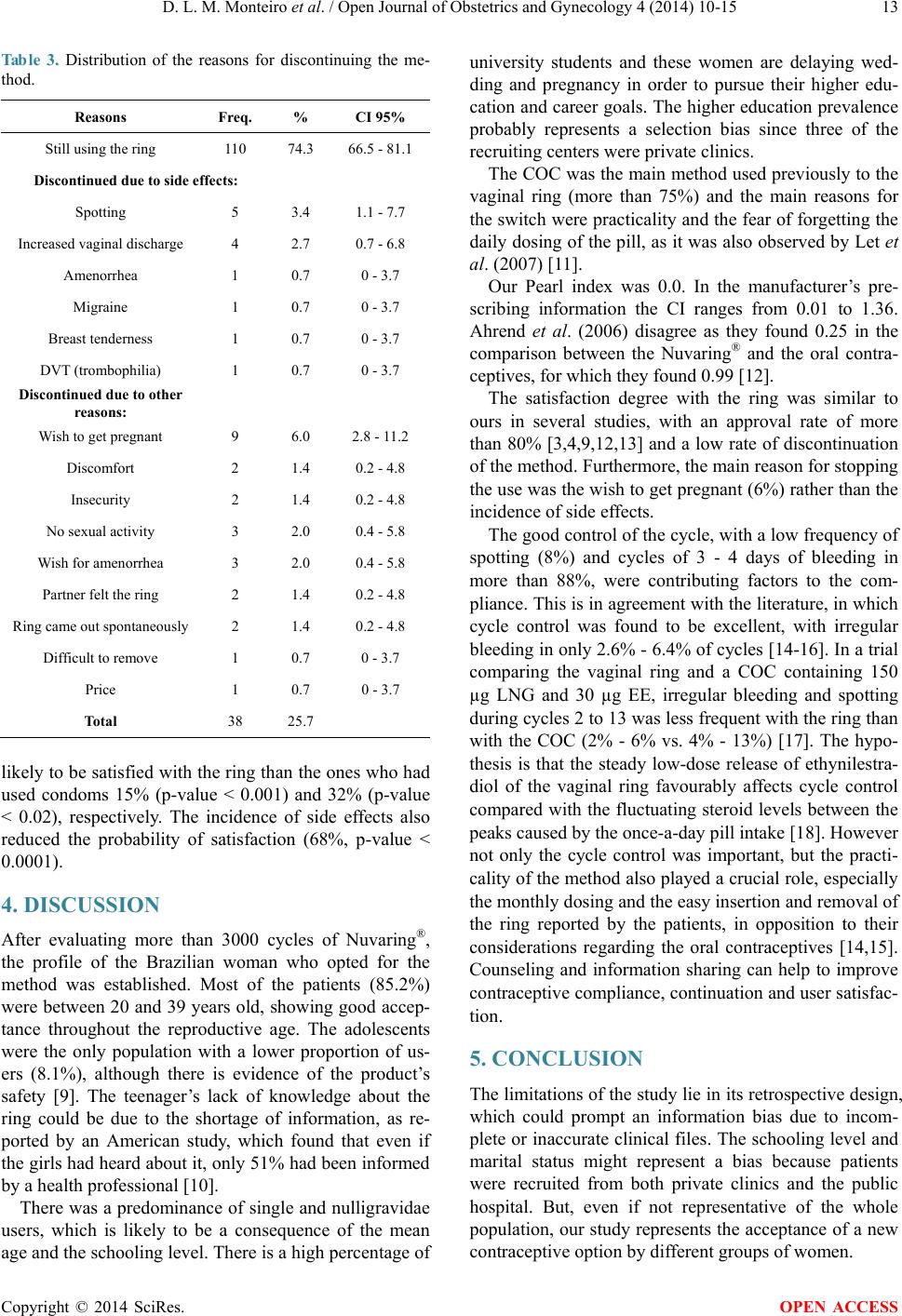 D. L. M. Monteiro et al. / Open Journal of Obstetrics and Gynecology 4 (2014) 10-15 Copyright © 2014 SciRes. OPEN ACCESS 13 Tab le 3. Distribution of the reasons for discontinuing the me- thod. Reasons Freq. % CI 95% Still using the ring 110 74.3 66.5 - 81.1 Discontinued due to side effects: Spotting 5 3.4 1.1 - 7.7 Increased vaginal discharge 4 2.7 0.7 - 6.8 Amenorrhea 1 0.7 0 - 3.7 Migraine 1 0.7 0 - 3.7 Breast tenderness 1 0.7 0 - 3.7 DVT (trombophilia) 1 0.7 0 - 3.7 Discontinued due to other reasons: Wish to get pregnant 9 6.0 2.8 - 11.2 Discomfort 2 1.4 0.2 - 4.8 Insecurity 2 1.4 0.2 - 4.8 No sexual activity 3 2.0 0.4 - 5.8 Wish for amenorrhea 3 2.0 0.4 - 5.8 Partner felt the ring 2 1.4 0.2 - 4.8 Ring came out spontaneously 2 1.4 0.2 - 4.8 Difficult to remove 1 0.7 0 - 3.7 Price 1 0.7 0 - 3.7 Total 38 25.7 likely to be satisfied with the ring than the ones who had used condoms 15% (p-value < 0.001) and 32% (p-value < 0.02), respectively. The incidence of side effects also reduced the probability of satisfaction (68%, p-value < 0.0001). 4. DISCUSSION After evaluating more than 3000 cycles of Nuvaring®, the profile of the Brazilian woman who opted for the method was established. Most of the patients (85.2%) were between 20 and 39 years old, showing good accep- tance throughout the reproductive age. The adolescents were the only population with a lower proportion of us- ers (8.1%), although there is evidence of the product’s safety [9]. The teenager’s lack of knowledge about the ring could be due to the shortage of information, as re- ported by an American study, which found that even if the girls had hear d about it, only 51% had been informed by a health professional [10]. There was a predominance of single and nulligravidae users, which is likely to be a consequence of the mean age and the schooling level. There is a high percentage of university students and these women are delaying wed- ding and pregnancy in order to pursue their higher edu- cation and career goals. The higher education prevalence probably represents a selection bias since three of the recruiting centers were private clinics. The COC was the main method used previously to the vaginal ring (more than 75%) and the main reasons for the switch were practicality and th e fear of forgetting the daily dosing of the pill, as it was also observed by Let et al. (2007) [11]. Our Pearl index was 0.0. In the manufacturer’s pre- scribing information the CI ranges from 0.01 to 1.36. Ahrend et al. (2006) disagree as they found 0.25 in the comparison between the Nuvaring® and the oral contra- ceptives, for which they found 0.99 [12]. The satisfaction degree with the ring was similar to ours in several studies, with an approval rate of more than 80% [3,4,9,12,13] and a low rate of discontinuation of the method. Furthermore, the main reason for stopping the use was the wish to get pregnant (6%) rather than the incidence of side effects. The good control of the cycle, with a low frequency of spotting (8%) and cycles of 3 - 4 days of bleeding in more than 88%, were contributing factors to the com- pliance. This is in agreement with the literatur e, in which cycle control was found to be excellent, with irregular bleeding in only 2.6% - 6.4% of cycles [14-16]. In a trial comparing the vaginal ring and a COC containing 150 µg LNG and 30 µg EE, irregular bleeding and spotting during cycles 2 to 13 was less frequent with the ring than with the COC (2% - 6% vs. 4% - 13%) [17]. The hypo- thesis is that the steady low-dose release of ethyn ilestra- diol of the vaginal ring favourably affects cycle control compared with the fluctuating steroid levels between the peaks caused by the once-a-day pill intake [18]. However not only the cycle control was important, but the practi- cality of the method also played a crucial role, especially the monthly dosing and the easy insertion and removal of the ring reported by the patients, in opposition to their considerations regarding the oral contraceptives [14,15]. Counseling and information sharing can help to improve contraceptive compliance, continuation and user satisfac- tion. 5. CONCLUSION The limitations of the study lie in its retro spective design, which could prompt an information bias due to incom- plete or inaccurate clinical files. The schooling level and marital status might represent a bias because patients were recruited from both private clinics and the public hospital. But, even if not representative of the whole population , our study represents the acceptance of a new contraceptive option by differ e nt g r oups of wom e n. 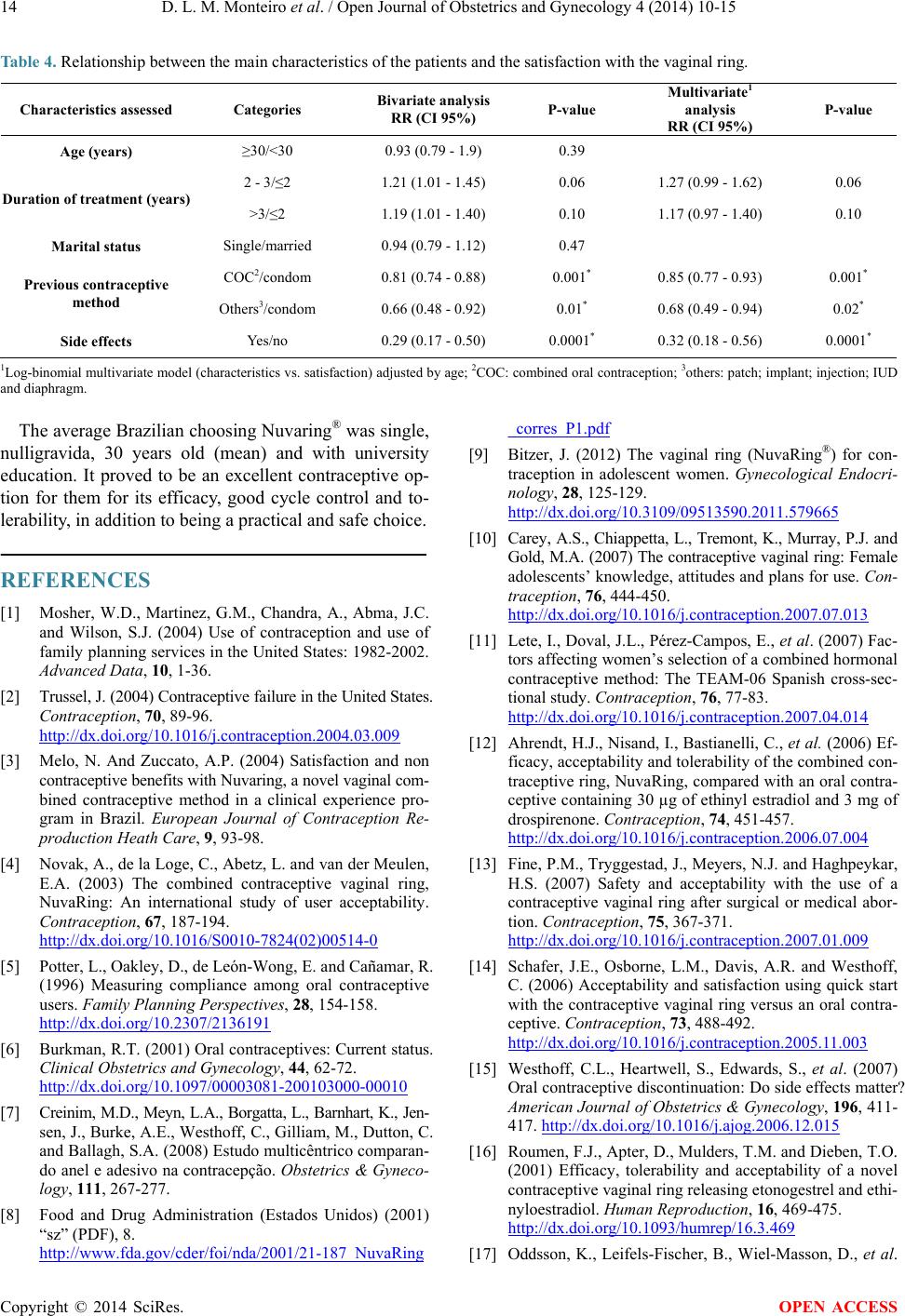 D. L. M. Monteiro et al. / Open Journal of Obstetrics and Gynecology 4 (2014) 10-15 Copyright © 2014 SciRes. OPEN ACCESS 14 Table 4. Relationship between the main characteristics of the patients and the satisfaction with the vaginal ring. Characteristics assessed Categories Bivariate analysis RR (CI 95%) P-value Multivariate 1 analysis RR (CI 95%) P-value Age (years) ≥30/<30 0.93 (0.79 - 1.9) 0.39 Duration of treatment (years) 2 - 3/≤2 1.21 (1.01 - 1.45) 0.06 1.27 (0. 9 9 - 1.62) 0.06 >3/≤2 1.19 (1.01 - 1.40) 0.10 1.17 (0.97 - 1.40) 0.10 Marital status Single/married 0.94 (0.79 - 1.12) 0.47 Previous contraceptive metho d COC2/condom 0.81 (0.74 - 0.88) 0.001* 0.85 (0.77 - 0.93) 0.001* Others3/condom 0.66 (0.48 - 0.92) 0.01* 0.68 (0.49 - 0.94) 0.02* Side effects Yes/no 0.29 (0.17 - 0.50) 0.0001* 0.32 (0.18 - 0.56) 0.0001* 1Log-binomial multiv ariate mod el (char acterist ics vs . satisfacti on) ad justed b y age; 2COC: co mbined or al contr aception; 3others: patch; implant; injection; IUD and diaphra gm. The average Brazilian choosing Nuvaring ® was single, nulligravida, 30 years old (mean) and with university education. It proved to be an excellent contraceptive op- tion for them for its efficacy, good cycle control and to- lerability, in addition to being a practical and safe choice. REFERENCES [1] Mosher, W.D., Martinez, G.M., Chandra, A., Abma, J.C. and Wilson, S.J. (2004) Use of contraception and use of family planning services in the United States: 1982-2002. Advanced Data, 10, 1-36. [2] Trussel, J. (2004) Contraceptive f ai l ure i n t he United States. Contraception, 70, 89-96. http://dx.doi.org/10.1016/j.contraception.2004.03.009 [3] Melo, N. And Zuccato, A.P. (2004) Satisfaction and non contraceptive benefi ts with N uva ring, a nove l vag inal com- bined contraceptive method in a clinical experience pro- gram in Brazil. European Journal of Contraception Re- production Heath Care, 9, 93-98. [4] Novak, A., de la Loge, C., Abetz, L. and van der Meulen, E.A. (2003) The combined contraceptive vaginal ring, NuvaRing: An international study of user acceptability. Contraception, 67, 187-194. http://dx.doi.org/10.1016/S0010-7824(02)00514-0 [5] Potter, L., Oakley, D., de León-Wong, E. and Cañamar, R. (1996) Measuring compliance among oral contraceptive users. Family Planning Perspectives, 28, 154-158. http://dx.doi.org/10.2307/2136191 [6] Burkman, R.T. (2001) Oral contraceptives: Current status. Clinical Obstetrics and Gynecology, 44, 62-72. http://dx.doi.org/10.1097/00003081-200103000-00010 [7] Creinim, M.D., Meyn, L.A., Borgatta, L., Barnhart, K., Jen- sen, J., Burke, A.E., Westhoff, C., Gilliam, M., Dutton, C. and Ballagh, S.A. (2008) Estudo multicêntrico comparan- do anel e adesivo na contracepção. Obstetrics & Gyneco- logy, 111, 267-277. [8] Food and Drug Administration (Estados Unidos) (2001) “sz” (PDF), 8. _corres_P1.pdf http://www.fda.gov/cder/foi/nda/2001/21-187_NuvaRing [9] Bitzer, J. (2012) The vaginal ring (NuvaRing®) for con- traception in adolescent women. Gynecological Endocri- nology, 28, 125-129. http://dx.doi.org/10.3109/09513590.2011.579665 [10] Carey, A.S., Chiappetta, L., Tremont, K., Murray, P.J. and Gold, M.A. (2007) The contrac eptive vaginal ring: Female adolescents’ knowledge, attitudes and plans for use. Con- traception, 76, 444-450. http://dx.doi.org/10.1016/j.contraception.2007.07.013 [11] Lete, I., Doval, J.L., Pérez-Campos, E., et al . (2007) Fac- tors affecting women’s selection of a combined hormonal contraceptive method: The TEAM-06 Spanish cross-sec- tional study. Contraception, 76, 77-83. http://dx.doi.org/10.1016/j.contraception.2007.04.014 [12] Ahrendt, H.J., Nisand, I., Bastianelli, C., et al. (2006) Ef- ficacy, acceptability and tolerability of t he combined con- traceptive ring, NuvaRing, compared with an oral contra- ceptive containing 30 µg of ethinyl estradiol and 3 mg of drospirenone. Contraception, 74, 451-457. http://dx.doi.org/10.1016/j.contraception.2006.07.004 [13] Fine, P.M., Tryggestad, J., Mey ers, N.J. and Haghpeykar, H.S. (2007) Safety and acceptability with the use of a contraceptive vaginal ring after surgical or medical abor- tion. Contraception, 75, 367-371. http://dx.doi.org/10.1016/j.contraception.2007.01.009 [14] Schafer, J.E., Osborne, L.M., Davis, A.R. and Westhoff, C. (2006) Acceptability and satisfaction using quick start with the contraceptive vaginal ring versus an oral contra- ceptive. Contraception, 73, 488-492. http://dx.doi.org/10.1016/j.contraception.2005.11.003 [15] Westhoff, C.L., Heartwell, S., Edwards, S., et al. (2007) Oral contraceptive discontinuation: Do side e ffect s ma tter? American Journal of Obstetrics & Gynecology, 196, 411- 417. http://dx.doi.org/10.1016/j.ajog.2006.12.015 [16] Roumen, F.J., Apter, D., Mulders, T.M. and Dieben, T.O. (2001) Efficacy, tolerability and acceptability of a novel contraceptive vaginal ring releasing etonogestrel and ethi- nyloestradiol. Human Reproduction, 16, 469-475. http://dx.doi.org/10.1093/humrep/16.3.469 [17] Oddsson, K., Leifels-Fischer, B., Wiel-Masson, D., et al.  D. L. M. Monteiro et al. / Open Journal of Obstetrics and Gynecology 4 (2014) 10-15 Copyright © 2014 SciRes. OPEN ACCESS 15 (2005) Superior cycle control with a contraceptive vagi- nalring compared with an oral contraceptive containing 30 microgethinylestradiol and 150 microglevonorgestrel: A randomized trial. Human Reproduction, 20, 557-562. http://dx.doi.org/10.1093/humrep/deh604 [18] Roumen, F.J. and Mishell Jr., D.R. (2012) The contracep- tive vaginal ring, NuvaRing(®), a decade after its intro- duction. European Journal of Contraception Reproduc- tion Heath Care, 17, 415-427. http://dx.doi.org/10.3109/13625187.2012.713535 |