

Paper Menu >>
Journal Menu >>
 International Journal of Analytical Mass Spectrometry and Chromatography, 2013, 1, 81-89 Published Online December 2013 (http://www.scirp.org/journal/ijamsc) http://dx.doi.org/10.4236/ijamsc.2013.12010 Open Access IJAMSC Analytical Methods in the Quality Control of Scientific Publications Part II: The Authors’, Reviewers’, Editors’ Responsibility, and the Publishers’ Authority Ilia Brondz1,2 1Department of Biosciences, University of Oslo, Oslo, Norway 2R & D Department of Jupiter Ltd., Ski, Norway Email: ilia.brond[email protected]; ilia[email protected] Received October 8, 2013; revised November 3, 2013; accepted December 7, 2013 Copyright © 2013 Ilia Brondz. This is an open access article distributed under the Creative Commons Attribution License, which permits unrestricted use, distribution, and reproduction in any medium, provided the original work is properly cited. ABSTRACT Publication of scientific documents as research reports and original papers has an important place in displaying the au- thors’ knowledge, integrity, responsibility, and honesty. The same is true for the reviewers and ed itors. The authority of a publisher strongly depends on the qualification s of the experts who review the manuscripts, and the recommendations they provide to th e authors and editors. The hon esty of the authors, review ers, and editors is of the utmost importance. The author of the paper titled “Analytical Methods in Quality Control of Scientific Publications”, which was published in the American Journal of Analytical Chemistry, 2012, 3, 443-447 (DOI: 10.4236/ajac.2012.36058) had criticized the paper published by Dongre et al., “Application of GC-EI-MS for the Identification and Investigation of Positional Iso- mer in Primaquine, an Antimalarial Drug,” Journal of Pharmaceutical and Biomedical Analysis, 2005, 39, 111-116 (DOI: 10.1016/j.jpba.2005.03.019), for presenting falsifications in this publication. Neither the reviewer nor the Edi- tor-in-Chief Bezhan Chankvetadze of the Journal of Pharmaceutical and Biomedical Analysis has reacted to accusa- tions of falsification. If a reviewer and editor are poorly qualified, unprincipled, or even corrupt, as was suggested by Bob Grant in The Scientist magazine (http://www.the-scientist.com/display/55679/#ixzz0mmsPoMIS), it is not good enough to consider simply that the publisher/journal has a high ranking and is indexed in PubMed or the Institute for Scientific Information (ISI). In this editorial, we report a profound misunderstanding or a lack of knowledge by the au- thors Shixue G., Zhuo yu L., and Wei W ., in their p aper published in ZhongguoYaoye China Pharmaceuticals, Vol. 14, No. 4, 2005, pp. 36-37 and a similar lack of professionalism by reviewers and editors. The influence and the role of internationally used pharmacopeias, such as The British Pharmacopoeia, European Pharmacopoeia, The United States Pharmacopeial Conventio n, and United States Pharmacopeia are shown as the main initiators and dr ivers of these mis - understandings. Keywords: Primaquine; Isomers; Enantiomers; TLC; Spurious Publications; Pharmacopeias 1. Historic Perspective of the Problem Every scientist in chemistry and every chemistry student know that the water is H2O and all the molecules are of the same composition and character and have the same chemical properties. The same ideas can be applied to methanol, glucose, and millions and millions of distinct chemical substances. No one refers to water as “water and related substances”. However, this was not applica- ble to primaquine as a description by the members of international pharmacopeia committees. The decision of pharmacopeia committees concerning primaquine was that primaquine is “primaquine and related substances” [1-7]. In this editorial, we report a profound misunder- standing in paper published by the authors Shixue G., Zhuoyu L., and Wei W. [8], who claimed to resolve pri- maquine enantiomers using TLC without transforming the enantiomers to diastereomers or to a diastereomeric transitional state. 2. Primaquine What meant by the “related substances” in terms of pri- maquine? How they related? Are the substan ces the deg- radation products produced during shelf life (storage), or are they byproducts of primaquine synthesis, remaining 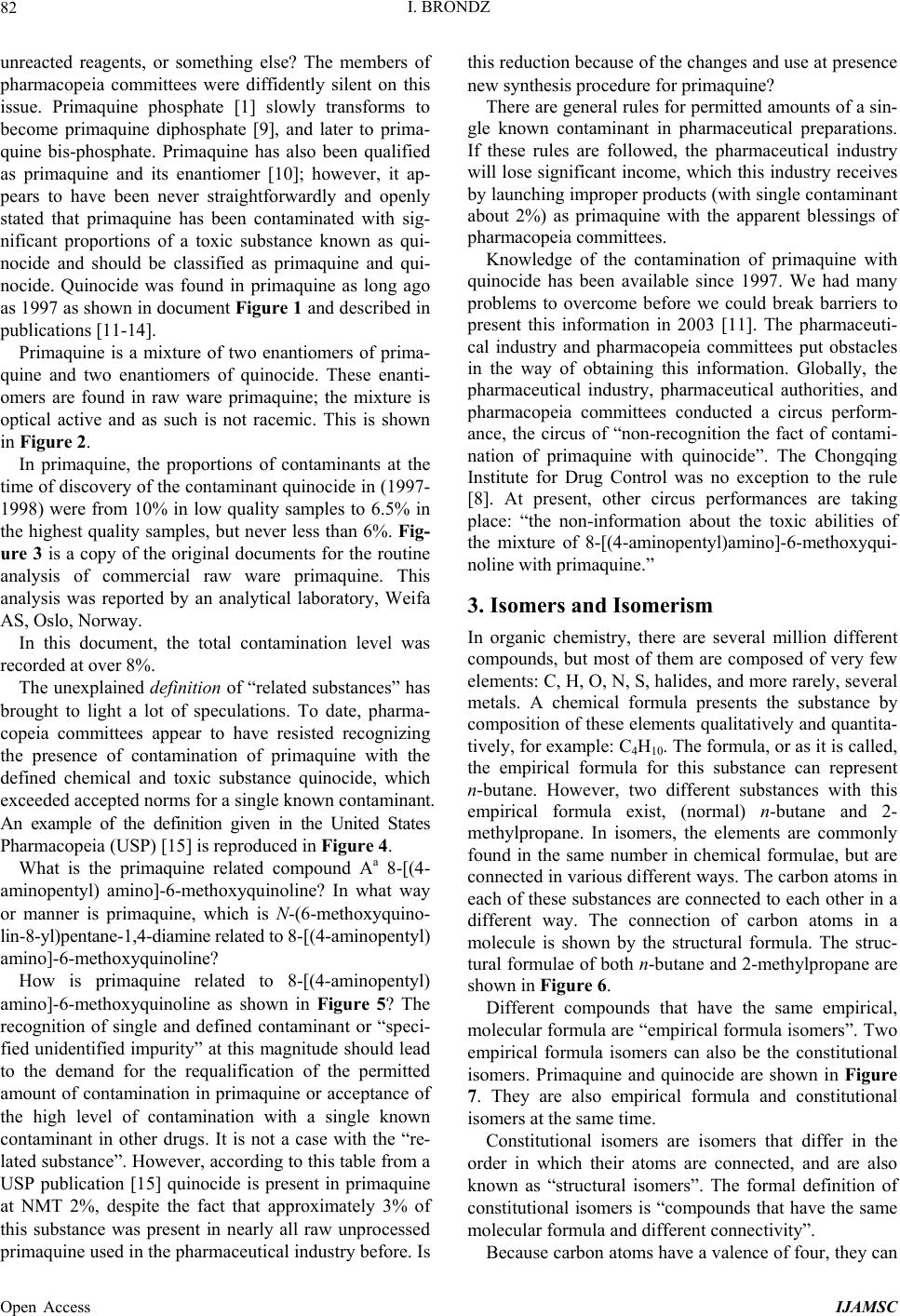 I. BRONDZ 82 unreacted reagents, or something else? The members of pharmacopeia committees were diffidently silent on this issue. Primaquine phosphate [1] slowly transforms to become primaquine diphosphate [9], and later to prima- quine bis-phosphate. Primaquine has also been qualified as primaquine and its enantiomer [10]; however, it ap- pears to have been never straightforwardly and openly stated that primaquine has been contaminated with sig- nificant proportions of a toxic substance known as qui- nocide and should be classified as primaquine and qui- nocide. Quinocide was found in primaquine as long ago as 1997 as shown in docu ment Figure 1 and described in publications [11-14]. Primaquine is a mixture of two enantiomers of prima- quine and two enantiomers of quinocide. These enanti- omers are found in raw ware primaquine; the mixture is optical active and as such is not racemic. This is shown in Figure 2. In primaquine, the proportions of contaminants at the time of discovery of the contaminant quinocide in (1997- 1998) were from 10% in low quality samples to 6.5% in the highest quality sa mples, but never less than 6%. Fig- ure 3 is a copy of the original documents for the routine analysis of commercial raw ware primaquine. This analysis was reported by an analytical laboratory, Weifa AS, Oslo, Norway. In this document, the total contamination level was recorded at over 8%. The unexplained definition of “related substances” has brought to light a lot of speculations. To date, pharma- copeia committees appear to have resisted recognizing the presence of contamination of primaquine with the defined chemical and toxic substance quinocide, which exceeded accepted norms for a single known contaminant. An example of the definition given in the United States Pharmacopeia (USP) [15] is reproduced in Fig u r e 4. What is the primaquine related compound Aa 8-[(4- aminopentyl) amino]-6-methoxyquinoline? In what way or manner is primaquine, which is N-(6-methoxyquino- lin- 8-y l) p e nt a n e -1,4- di a mi ne r e late d t o 8-[(4- am i nope nt yl ) amino]-6-methoxyquinoline? How is primaquine related to 8-[(4-aminopentyl) amino]-6-methoxyquinoline as shown in Figure 5? The recognition of single and defined contaminant or “speci- fied unidentified impurity” at this magnitude should lead to the demand for the requalification of the permitted amount of contamination in primaquine or acceptance of the high level of contamination with a single known contaminant in other drugs. It is not a case with the “re- lated substance”. Howev er, according to this table from a USP publication [15] quinocide is present in primaquine at NMT 2%, despite the fact that approximately 3% of this substance was present in nearly all raw unprocessed primaquine used in the pharmaceutical industry before. Is this reduction because of the changes and use at presence new synthes i s procedure for prim a quine? There are general rules for permitted amounts of a sin- gle known contaminant in pharmaceutical preparations. If these rules are followed, the pharmaceutical industry will lose significant income, which this industry receives by launching improper products (with single contaminant about 2%) as primaquine with the apparent blessings of pharmacopeia committees. Knowledge of the contamination of primaquine with quinocide has been available since 1997. We had many problems to overcome before we could break barriers to present this information in 2003 [11]. The pharmaceuti- cal industry and pharmacopeia committees put obstacles in the way of obtaining this information. Globally, the pharmaceutical industry, pharmaceutical authorities, and pharmacopeia committees conducted a circus perform- ance, the circus of “non-recognition the fact of contami- nation of primaquine with quinocide”. The Chongqing Institute for Drug Control was no exception to the rule [8]. At present, other circus performances are taking place: “the non-information about the toxic abilities of the mixture of 8-[(4-aminopentyl)amino]-6-methoxyqui- noline with primaquine.” 3. Isomers and Isomerism In organic chemistry, there are several million different compounds, but most of them are composed of very few elements: C, H, O, N, S, halides, and more rarely, several metals. A chemical formula presents the substance by composition of these elements qualitatively an d quantita- tively, for example: C4H10. The formula, or as it is called, the empirical formula for this substance can represent n-butane. However, two different substances with this empirical formula exist, (normal) n-butane and 2- methylpropane. In isomers, the elements are commonly found in the same number in chemical formulae, but are connected in various different ways. The carbon atoms in each of these substances are connected to each other in a different way. The connection of carbon atoms in a molecule is shown by the structural formula. The struc- tural formulae of both n-butane an d 2-methylpropan e are shown in Figure 6. Different compounds that have the same empirical, molecular formula are “empirical formula isomers”. Two empirical formula isomers can also be the constitutional isomers. Primaquine and quinocide are shown in Figure 7. They are also empirical formula and constitutional isomers at the same time. Constitutional isomers are isomers that differ in the order in which their atoms are connected, and are also known as “structural isomers”. The formal definition of constitutional isomers is “compounds that have the same molecular formula and different connectivity”. Because carbon atoms have a valence of four, they can Open Access IJAMSC 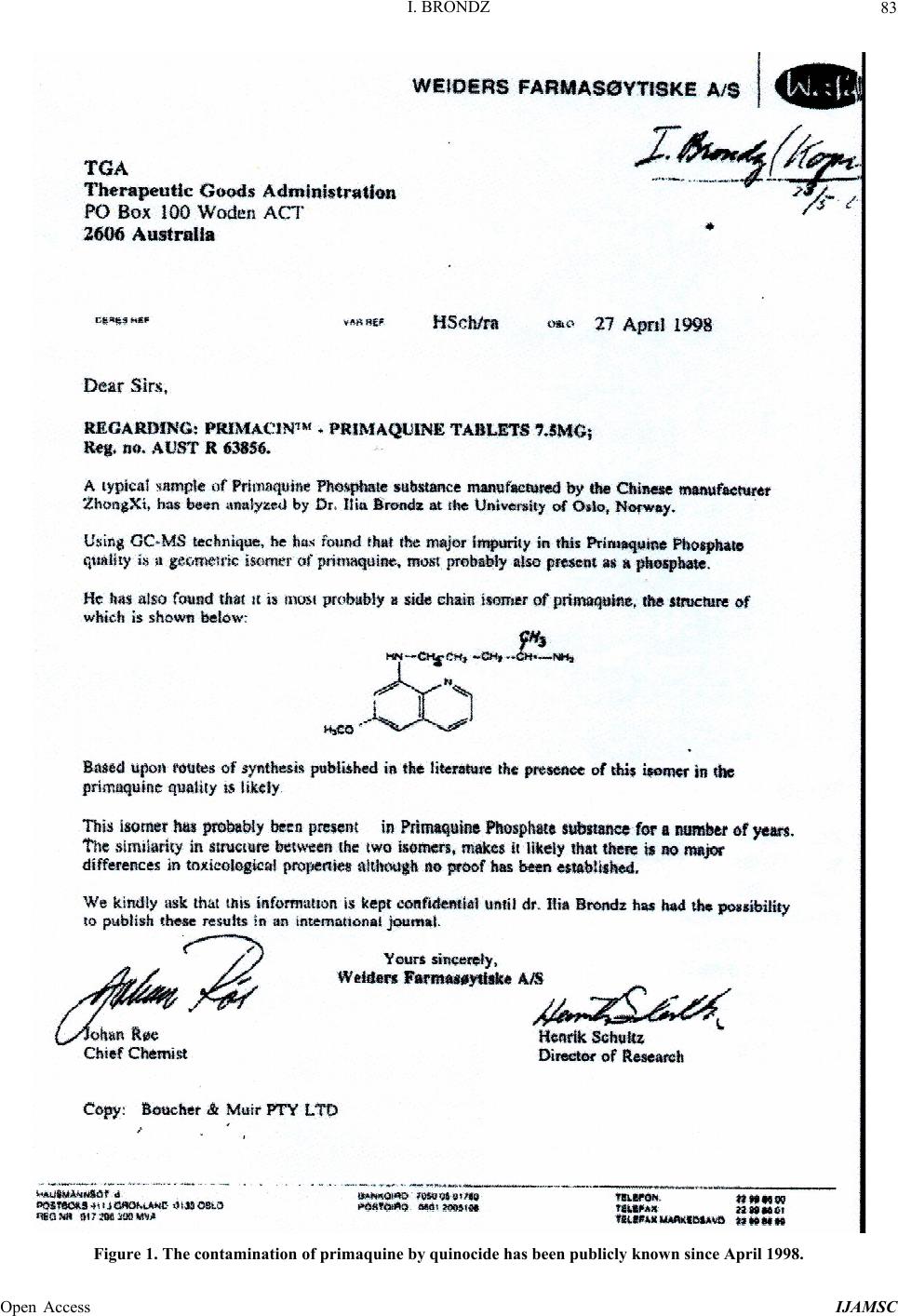 I. BRONDZ Open Access IJAMSC 83 Figure 1. The contamination of primaquine by quinocide has been publicly known since April 1998. 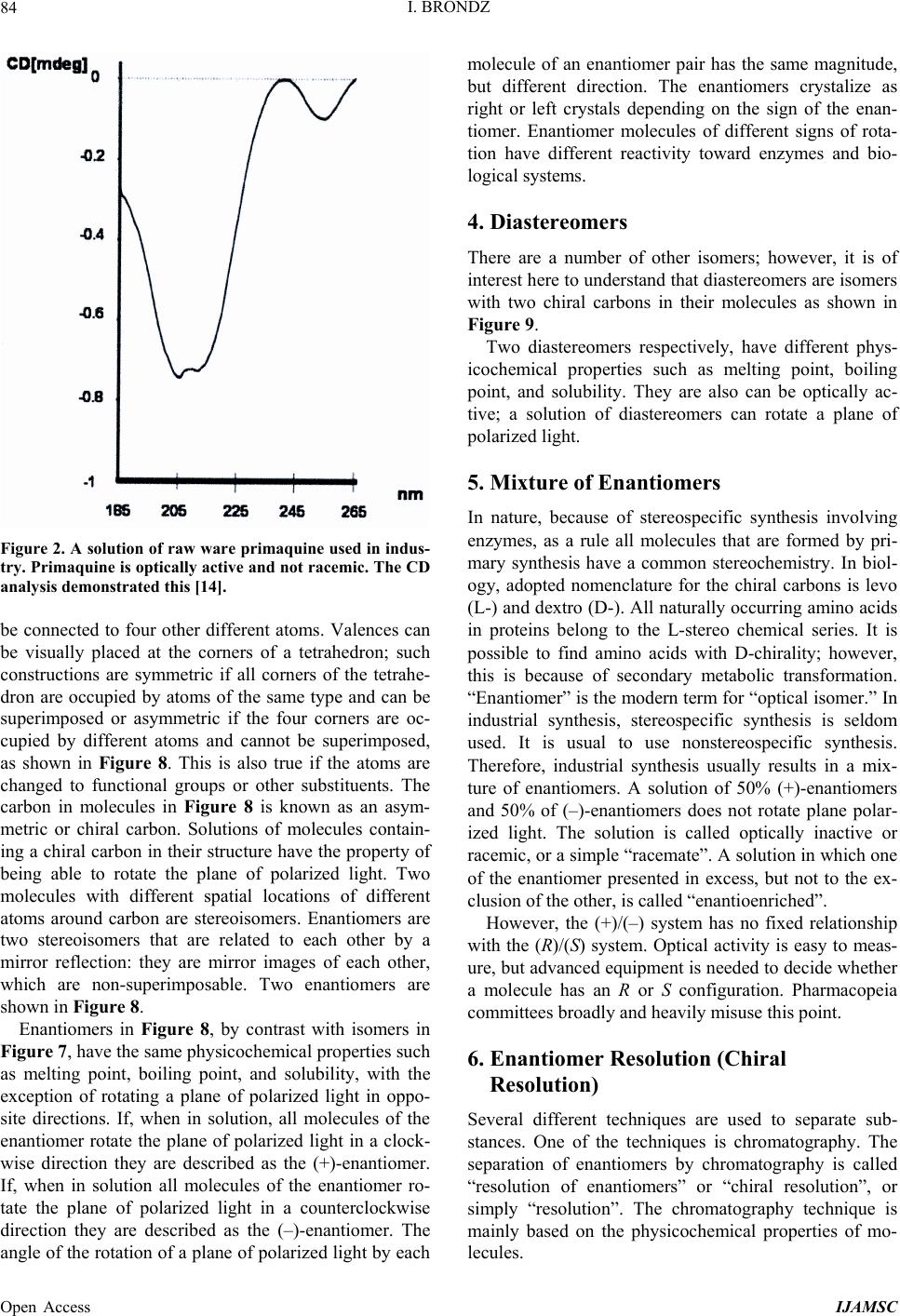 I. BRONDZ 84 Figure 2. A solution of raw ware primaquine use d in indus- try. Primaquine is optically active and not racemic. The CD analysis demonstrated this [14]. be connected to four other different atoms. Valences can be visually placed at the corners of a tetrahedron; such constructions are symmetric if all corners of the tetrahe- dron are occupied by atoms of the same type and can be superimposed or asymmetric if the four corners are oc- cupied by different atoms and cannot be superimposed, as shown in Figure 8. This is also true if the atoms are changed to functional groups or other substituents. The carbon in molecules in Figure 8 is known as an asym- metric or chiral carbon. Solutions of molecules contain- ing a chiral carbon in their structure have the property of being able to rotate the plane of polarized light. Two molecules with different spatial locations of different atoms around carbon are stereoisomers. Enantiomers are two stereoisomers that are related to each other by a mirror reflection: they are mirror images of each other, which are non-superimposable. Two enantiomers are shown in Figure 8. Enantiomers in Figure 8, by contrast with isomers in Figure 7, have the same physicochemical properties such as melting point, boiling point, and solubility, with the exception of rotating a plane of polarized light in oppo- site directions. If, when in solution, all molecules of the enantiomer rotate the plane of polarized light in a clock- wise direction they are described as the (+)-enantiomer. If, when in solution all molecules of the enantiomer ro- tate the plane of polarized light in a counterclockwise direction they are described as the (–)-enantiomer. The angle of the rotation of a plane of polarized light by each molecule of an enantiomer pair has the same magnitude, but different direction. The enantiomers crystalize as right or left crystals depending on the sign of the enan- tiomer. Enantiomer molecules of different signs of rota- tion have different reactivity toward enzymes and bio- logical systems. 4. Diastereomers There are a number of other isomers; however, it is of interest here to understand that diastereomers are isomers with two chiral carbons in their molecules as shown in Figure 9. Two diastereomers respectively, have different phys- icochemical properties such as melting point, boiling point, and solubility. They are also can be optically ac- tive; a solution of diastereomers can rotate a plane of polarized light. 5. Mixture of Enantiomers In nature, because of stereospecific synthesis involving enzymes, as a rule all molecules that are formed by pri- mary synthesis have a common stereochemistry. In biol- ogy, adopted nomenclature for the chiral carbons is levo (L-) and dextro (D-). All naturally occurring amino acids in proteins belong to the L-stereo chemical series. It is possible to find amino acids with D-chirality; however, this is because of secondary metabolic transformation. “Enantiomer” is the modern term for “optical isomer.” In industrial synthesis, stereospecific synthesis is seldom used. It is usual to use nonstereospecific synthesis. Therefore, industrial synthesis usually results in a mix- ture of enantiomers. A solution of 50% (+)-enantiomers and 50% of (–)-enantiomers does not rotate plane polar- ized light. The solution is called optically inactive or racemic, or a simple “racemate”. A solution in which one of the enantiomer presented in excess, but not to the ex- clusion of the other, is called “enantioenriched”. However, the (+)/(–) system has no fixed relationship with the (R)/(S) system. Optical activity is easy to meas- ure, but advanced equipment is needed to decide whether a molecule has an R or S configuration. Pharmacopeia committees broadly and heavily misuse this point. 6. Enantiomer Resolution (Chiral Resolution) Several different techniques are used to separate sub- stances. One of the techniques is chromatography. The separation of enantiomers by chromatography is called “resolution of enantiomers” or “chiral resolution”, or simply “resolution”. The chromatography technique is mainly based on the physicochemical properties of mo- lecules. Open Access IJAMSC 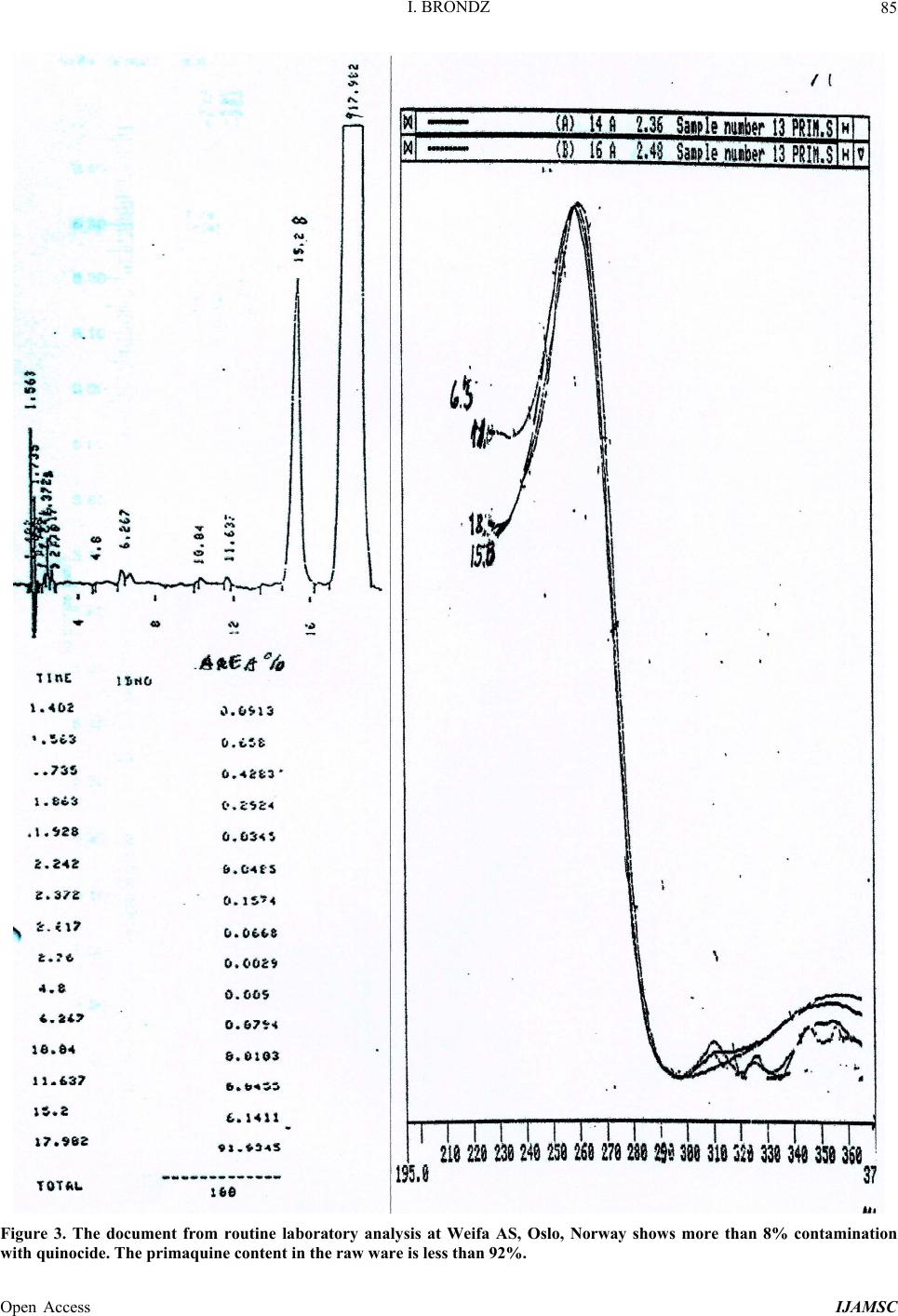 I. BRONDZ 85 Figure 3. The document from routine laboratory analysis at Weifa AS, Oslo, Norway shows more than 8% contamination with quinocide. The primaquine content in the raw ware is less than 92%. Open Access IJAMSC 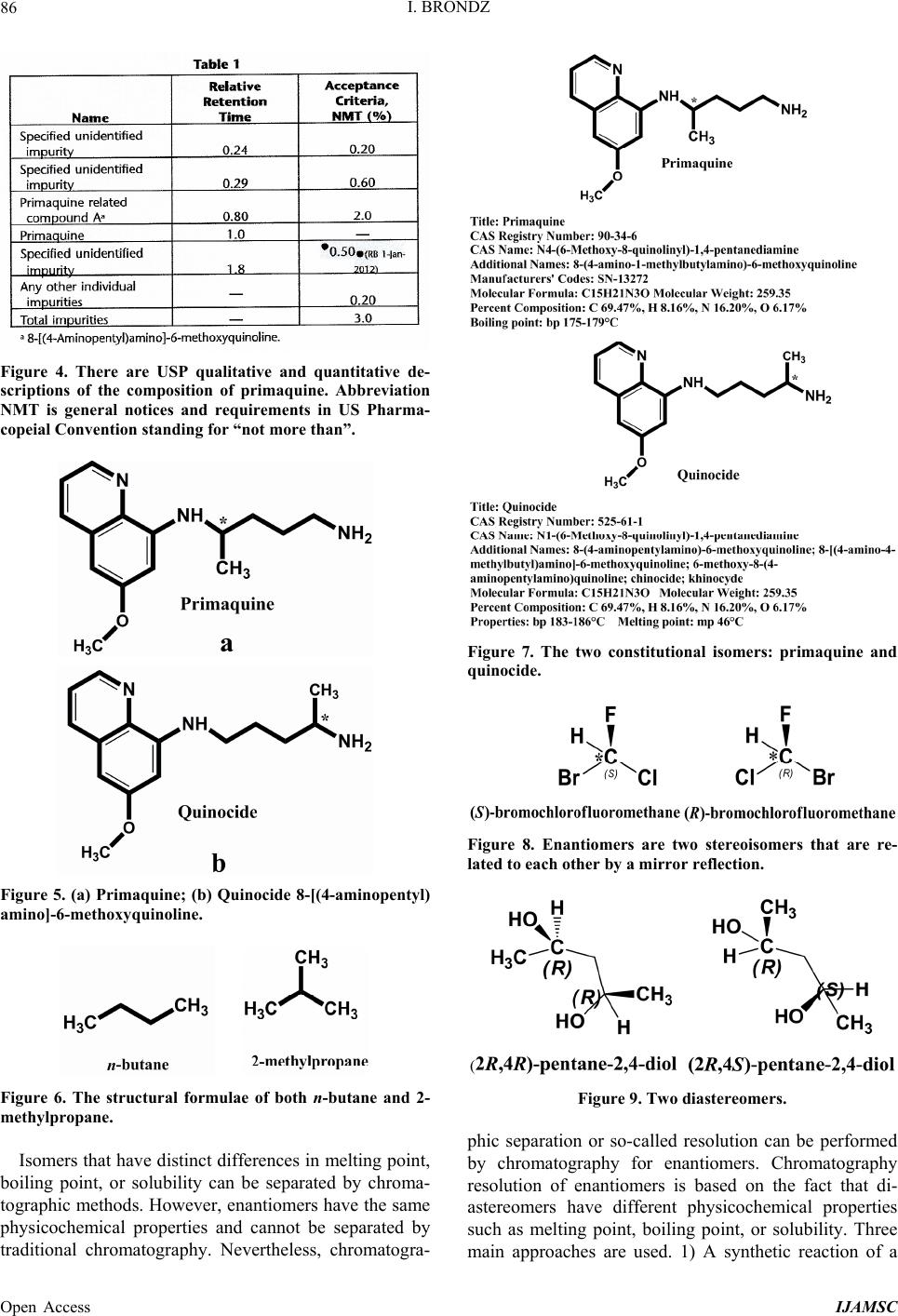 I. BRONDZ 86 Figure 4. There are USP qualitative and quantitative de- scriptions of the composition of primaquine. Abbreviation NMT is general notices and requirements in US Pharma- copeial Convention standing for “not more than”. Figure 5. (a) Primaquine; (b) Quinocide 8-[(4-aminopentyl) amino]-6-methoxyquinoline. Figure 6. The structural formulae of both n-butane and 2- methylpropane. Isomers that have distinct differences in melting po int, boiling point, or solubility can be separated by chroma- tographic methods. However, enantiomers have the same physicochemical properties and cannot be separated by traditional chromatography. Nevertheless, chromatogra- Figure 7. The two constitutional isomers: primaquine and quinocide. Figure 8. Enantiomers are two stereoisomers that are re- lated to each other by a mirror reflection. Figure 9. Two diastereomers. phic separation or so-called resolution can be performed by chromatography for enantiomers. Chromatography resolution of enantiomers is based on the fact that di- astereomers have different physicochemical properties such as melting point, boiling point, or solubility. Three main approaches are used. 1) A synthetic reaction of a Open Access IJAMSC 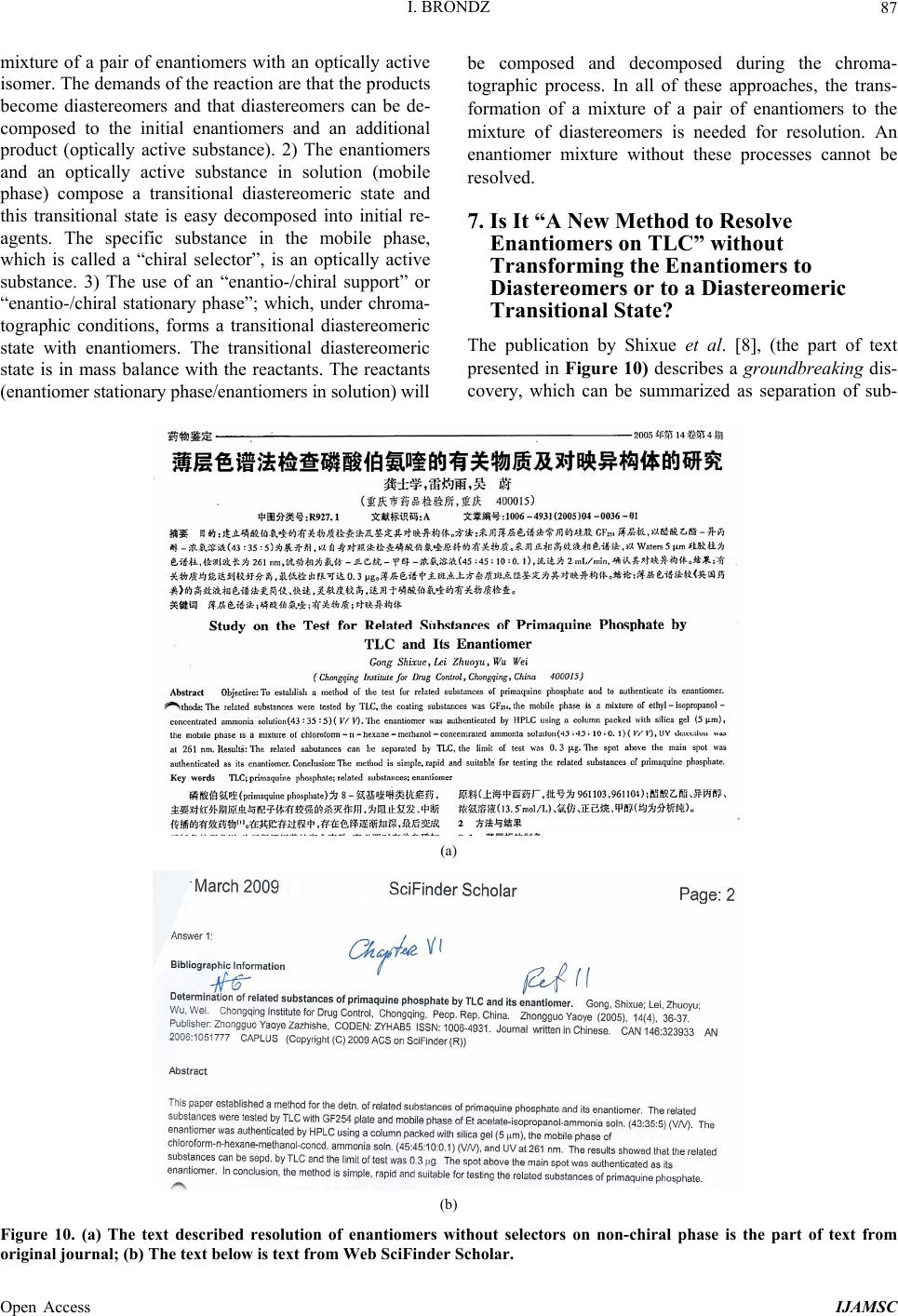 I. BRONDZ 87 mixture of a pair of enantiomers with an optically active isomer. The demands of the reaction are that the products become diastereomers and that diastereomers can be de- composed to the initial enantiomers and an additional product (optically active substance). 2) The enantiomers and an optically active substance in solution (mobile phase) compose a transitional diastereomeric state and this transitional state is easy decomposed into initial re- agents. The specific substance in the mobile phase, which is called a “chiral selector”, is an optically active substance. 3) The use of an “enantio-/chiral support” or “enantio-/chiral stationary phase”; which, under chroma- tographic conditions, forms a transitional diastereomeric state with enantiomers. The transitional diastereomeric state is in mass balance with the reactants. The reactants (enantiomer stationary phase/enantiomers in solution) will be composed and decomposed during the chroma- tographic process. In all of these approaches, the trans- formation of a mixture of a pair of enantiomers to the mixture of diastereomers is needed for resolution. An enantiomer mixture without these processes cannot be resolved. 7. Is It “A New Method to Resolve Enantiomers on TLC” without Transforming the Enantiomers to Diastereomers or to a Diastereomeric Transitional State? The publication by Shixue et al. [8], (the part of text presented in Figure 10) describes a groundbreaking dis- covery, which can be summarized as separation of sub- (a) (b) Figure 10. (a) The text described resolution of enantiomers without selectors on non-chiral phase is the part of text from original journal; (b) The text below is text from Web SciFinde r Scholar. Open Access IJAMSC 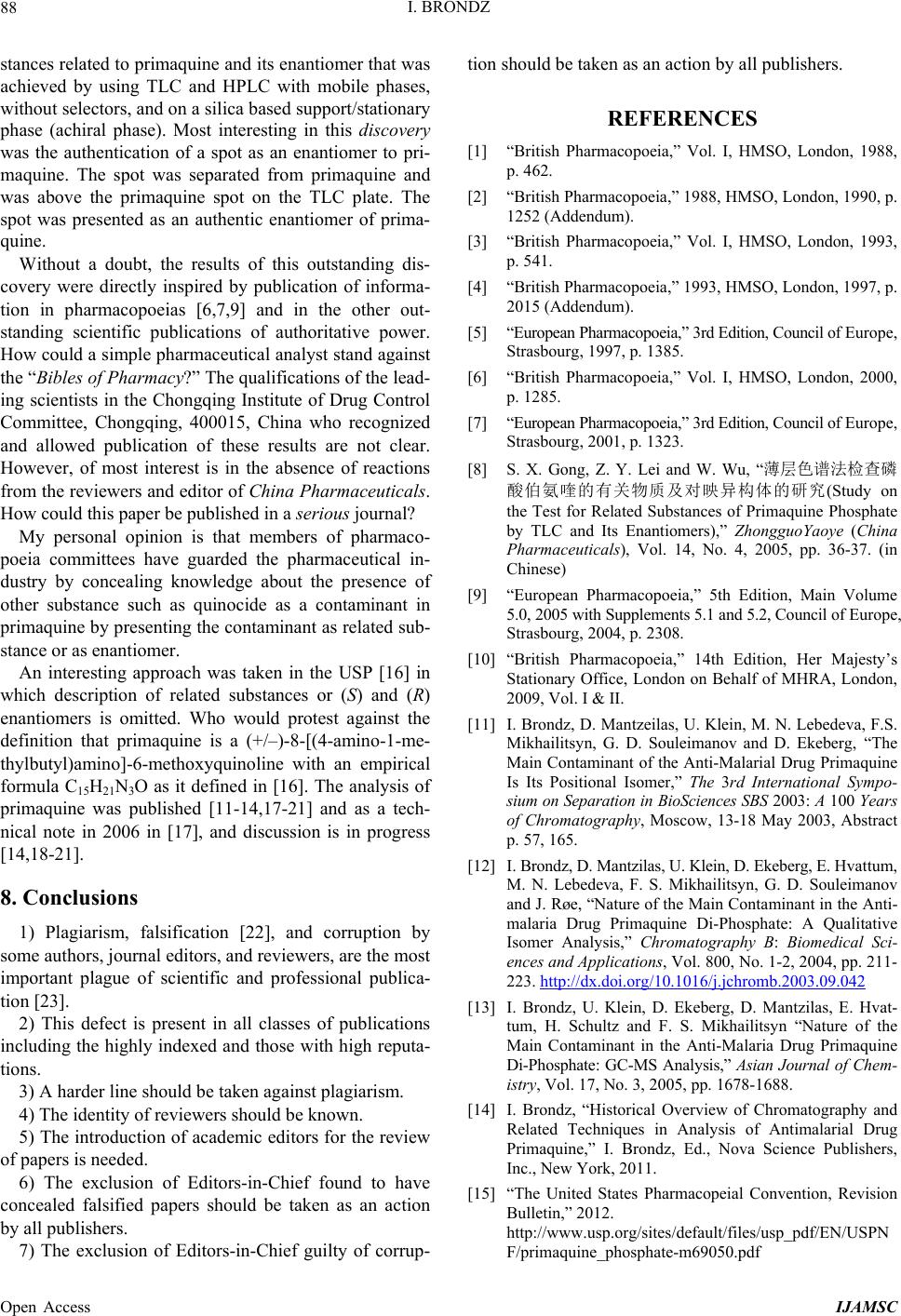 I. BRONDZ 88 stances related to primaquine and its enantiomer that was achieved by using TLC and HPLC with mobile phases, without selectors, and on a silica based support/statio nary phase (achiral phase). Most interesting in this discovery was the authentication of a spot as an enantiomer to pri- maquine. The spot was separated from primaquine and was above the primaquine spot on the TLC plate. The spot was presented as an authentic enantiomer of prima- quine. Without a doubt, the results of this outstanding dis- covery were directly inspired by publication of informa- tion in pharmacopoeias [6,7,9] and in the other out- standing scientific publications of authoritative power. How could a simple pharmaceutical analyst stand against the “Bibles of Pharmacy?” The qualifications of the lead- ing scientists in the Chongqing Institute of Drug Control Committee, Chongqing, 400015, China who recognized and allowed publication of these results are not clear. However, of most interest is in the absence of reactions from the reviewers and editor of China Pharmaceuticals. How could this paper be published in a serious journal? My personal opinion is that members of pharmaco- poeia committees have guarded the pharmaceutical in- dustry by concealing knowledge about the presence of other substance such as quinocide as a contaminant in primaquine by presenting the contaminant as related sub- stance or as enantiomer. An interesting approach was taken in the USP [16] in which description of related substances or (S) and (R) enantiomers is omitted. Who would protest against the definition that primaquine is a (+/–)-8-[(4-amino-1-me- thylbutyl)amino]-6-methoxyquinoline with an empirical formula C15H21N3O as it defined in [16]. The analysis of primaquine was published [11-14,17-21] and as a tech- nical note in 2006 in [17], and discussion is in progress [14,18-21]. 8. Conclusions 1) Plagiarism, falsification [22], and corruption by some authors, journal editors, and reviewer s , a r e the most important plague of scientific and professional publica- tion [23]. 2) This defect is present in all classes of publications including the highly indexed and those with high reputa- tions. 3) A harder line should be taken against plagiarism. 4) The identity of reviewers should be known. 5) The introduction of academic editors for the review of papers is needed. 6) The exclusion of Editors-in-Chief found to have concealed falsified papers should be taken as an action by all publishers. 7) The exclusion of Editors-in-Chief guilty of corrup- tion should be taken as an action by all publishers. REFERENCES [1] “British Pharmacopoeia,” Vol. I, HMSO, London, 1988, p. 462. [2] “British Pharmacopoeia,” 1988, HMSO, London, 1990, p. 1252 (Addendum). [3] “British Pharmacopoeia,” Vol. I, HMSO, London, 1993, p. 541. [4] “British Pharmacopoeia,” 1993, HMSO, London, 1997, p. 2015 (Addendum). [5] “European Pharmacopoeia,” 3rd Edition, Council of Euro p e, Strasbourg, 1997, p. 1385. [6] “British Pharmacopoeia,” Vol. I, HMSO, London, 2000, p. 1285. [7] “European Pharmacopoeia,” 3rd Edition, Council of Euro p e, Strasbourg, 2001, p. 1323. [8] S. X. Gong, Z. Y. Lei and W. Wu, “薄层色谱法检查磷 酸伯氨喹的有关物质及对映异构体的研究(Study on the Test for Related Substances of Primaquine Phosphate by TLC and Its Enantiomers),” ZhongguoYaoye (China Pharmaceuticals), Vol. 14, No. 4, 2005, pp. 36-37. (in Chinese) [9] “European Pharmacopoeia,” 5th Edition, Main Volume 5.0, 2005 with Supplements 5.1 a nd 5.2, Co uncil of Eu rope, Strasbourg, 2004, p. 2308. [10] “British Pharmacopoeia,” 14th Edition, Her Majesty’s Stationary Office, London on Behalf of MHRA, London, 2009, Vol. I & II. [11] I. Brondz, D. Mantzeilas, U. Klein, M. N. Lebedeva, F.S. Mikhailitsyn, G. D. Souleimanov and D. Ekeberg, “The Main Contaminant of the Anti-Malarial Drug Primaquine Is Its Positional Isomer,” The 3rd International Sympo- sium on Separation in BioSciences SBS 20 03: A 100 Years of Chromatography, Moscow, 13-18 May 2003, Abstract p. 57, 165. [12] I. Brondz, D. Mantzilas, U. Klein, D. Ekeberg, E. Hvattum, M. N. Lebedeva, F. S. Mikhailitsyn, G. D. Souleimanov and J. Røe, “Nature of the Main Contaminant in the Anti- malaria Drug Primaquine Di-Phosphate: A Qualitative Isomer Analysis,” Chromatography B: Biomedical Sci- ences and Applications, Vol. 800, No. 1-2, 2004, pp. 211- 223. http://dx.doi.org/10.1016/j.jchromb.2003.09.042 [13] I. Brondz, U. Klein, D. Ekeberg, D. Mantzilas, E. Hvat- tum, H. Schultz and F. S. Mikhailitsyn “Nature of the Main Contaminant in the Anti-Malaria Drug Primaquine Di-Phosphate: GC-MS Analysis,” Asian Journal of Chem- istry, Vol. 17, No. 3, 2005, pp. 1678-1688. [14] I. Brondz, “Historical Overview of Chromatography and Related Techniques in Analysis of Antimalarial Drug Primaquine,” I. Brondz, Ed., Nova Science Publishers, Inc., New York, 2011. [15] “The United States Pharmacopeial Convention, Revision Bulletin,” 2012. http://www.usp.org/sites/default/files/usp_pdf/EN/USPN F/primaquine_phosphate-m69050.pdf Open Access IJAMSC  I. BRONDZ 89 [16] USP 34/NF 29, Ed., “United States Pharmacopeia. The National Formulary,” The United States Pharmacopoeial Convention Inc., Rockville, Vol. 3, 2011, p. 4011. [17] I. Brondz, U. Klein, D. Ekeberg, D. Mantzilas, E. Hvat- tum, H. Schultz and F. S. Mikhailitsyn, “Nature of the Main Contaminant in the Antimalarial Drug Primaquine Diphosphate: GC-MS Analysis,” International Symposium Analytical Forum 2004, Warsaw, 4-8 July 2004, Abstract p. 119. [18] I. Brondz and U. Klein, “Separation of the Positional Isomer Quinocide from the Anti-Malarial Drug Prima- quine Using a Discovery® HS F5 HPLC Column,” The Reporter, Vol. 23, No. 4, 2005, p. 1. [19] I. Brondz, D. Ekeberg, L. Karaliova, I. Jennings, J. A. Hustad and R. Svendsen, “Separation of the Positional Isomer Quinocide fro m the Anti-Malaria Drug Primaq uine Using a Discovery® HS-F5 HPLC Column,” Trends in Chromatography, Vol. 1, 2005, pp. 78-81. [20] I. Brondz, U. Klein, L. Karaliova, V. Vlachos, P. Oakley, R. Leideborg and F. Mikhalitsyn, “Nature of the Main Contaminant in the Drug Primaquine Di-Phosphate: Comparison of HPLC and SFC Methods,” 29th Interna- tional Symposium on High Performance Liquid Phase Separations and Related Techniques, Stockholm, 26-30 June 2005, Abstract p. 12: 43. [21] I. Brondz and U. Klein, “Separation of the Positional Isomer Quinocide from the Anti-Malarial Drug Prima- quine Using a Discovery® HS F5 HPLC Column,” The Reporter, Vol. 19, 2006, p. 3. [22] V. G. Dongre, P. P. Karmuse, M. M. Nimbalkar, D. Singh and A. Kumar, “Application of GC-EI-MS for the Identi- fication and Investigation of Positional Isomer in Prima- quine, an Antimalarial Drug,” Journal of Pharmaceutical and Biomedical Analysis, Vol. 39, No. 1-2, 2005, pp. 111-116. http://dx.doi.org/10.1016/j.jpba.2005.03.019 [23] I. Brondz, “Analytical Methods in Quality Control of Scientific Publications,” American Journal of Analytical Chemistry, Vol. 3, No. 6, 2012, pp. 443-447. http://dx.doi.org/10.4236/ajac.2012.36058 Open Access IJAMSC |