

Paper Menu >>
Journal Menu >>
 International Journal of Clinical Medicine, 2013, 4, 571-576 Published Online December 2013 (http://www.scirp.org/journal/ijcm) http://dx.doi.org/10.4236/ijcm.2013.412098 Open Access IJCM 571 Dimensional Characteristics of Children and Adolescents with Mood Disorders and Autism Spectrum Disorders Bill J. Duke1, Dennis Staton1,2 1Child Psychopharmacology Institute, Fargo, USA; 2Lakeland Mental Health Center, Moorhead, USA. Email: [email protected] Received October 21st, 2013; revised November 20th, 2013; accepted December 5th, 2013 Copyright © 2013 Bill J. Duke, Dennis Staton. This is an open access article distributed under the Creative Commons Attribution License, which permits unrestricted use, distribution, and reproduction in any medium, provided the original work is properly cited. ABSTRACT Objective: We sought to identify clinical discriminators between predominantly mood disordered and predominantly autism spectrum disordered research subjects that may reflect phenotypic state and treatment response characteristics. Method: Participants were 26 boys and 4 girls aged 2 to 18 years (Mean Age = 7.70). Subjects with DSM-IV diagnoses of Major depression (N = 2), Bipolar Disorder (N = 4) and Mood Disorder not otherwise specified (NOS) (N = 11) rep- resented the mo od disorder group (MD) (N = 17, Mean Age = 8.2) and those with diagnoses of Autistic Di sorder (N = 1), Asperger’ s Disorder (7) or Pervasive Develo pmental Disorder (NOS) (N = 3) comprised the autism spectru m disor- der (ASD) group (N = 9, Mean Age = 6.8). Primary outcome measurements were continuous actigraphic measurements collected over one to three week periods. Secondary outcomes included personality and observational measurements. Personality characteristics reflected significant cross-group impairments related to self-control and self-discipline and differed relative to intellectual measures. Observational measurements reflected greater general impairments among the ASD group. Results: Predominantly mood disordered children demonstrated greater impairments related to sleep (P = 0.000) and sleep onset latency (P = 0.000) and were more active than ASD children during evening periods (P = 0.000). ASD children had lower verbal functioning and greater deviations from the norm on measures of cognitive development (P = 0.003) and psychosis (P = 0.047). Conclusions: Sleep disturbances, evening activity levels and phase delayed sleep appear to differentiate predominant mood and autism spectrum disordered children suggesting future areas for further exploration of neurological and phenotypic treatment response characteristics. Keywords: Autism Spectrum Disorders; Mood Disorders; Children; Actigraphy; Sleep 1. Introduction Children with mood disorders (MD) and autism spectrum disorders (ASD) typically share co-morbid symptoms [1-3]. The pathophysiological mechanisms which under- lie these two broad categories of disorders are multivari- ate and, in some cases, may overlap. The DSM-IV cate- gorical disorders including these two broad groups have been poor guides to effective pharmacologic treatment. ASD and MD can be examined both clinically and physiologically for dimensional abnormalities that reflect dysregulated neurophysiology. Actigraphic measure- ments give objective data regarding such dysregulation and might identify neurophysiologic subtypes among children with similar or overlapping symptoms. For ex- ample, such a study might clarify whether or not the presence of phase delayed sleep, which has been pro- posed to be characteristic of pediatric bipolar syn- dromes [4], is an important marker for clinical in- tervention. A variety of childhood circadian abnor- malities, regardless of etiology, may have pathogenic potential, i.e., may adversely impact subsequent biologic and psychosocial development. If so, early identification and treatment of these markers might be extremely important [5]. In this analysis, we evaluate measurements of sleep and activity, personality, cognitive functioning, and ob- served behaviors, in an attempt to better differentiate these complex childhood clinical groups. We propose that there is the value in sub-typing clinical pediatric subjects as either predominantly mood disordered or pre- dominantly autism spectrum disordered. This analysis seeks to determine whether or not there are significant differences between the two broad groups. We hypothe- size that despite shared behavioral and emotional symp-  Dimensional Characteristics of Children and Adolescents with Mood Disorders and Autism Spectrum Disorders 572 toms there will be significant differences be tween groups in the nature and variation of their activity patterns and sleep characteristics. 2. Methods Descriptions of age, gender and age of onset (age at which the parents first became concerned that their child had a significant problem) are examined along with di- mensional characteristics that include activity and activi- ty patterns, sleep onset latency, sleep efficiency, sleep time, cognitive measurements, multi-dimensional person- ality factors and operationally defined and repeated ob- servations. A baseline assessment included a review of a biopsychosocial history, clinical and available educa- tional testing and records, a mental status examination, operationally defined symptom history and psychological assessment. DSM IV criteria were applied and those with major depressive disorder, bipolar disorder, mood dis- order, NOS, autistic disorder and pervasive developmen- tal disorder, NOS were invited to participate in th e study as actigraphic devices were available. Children were recruited to the study between August 2010 and August of 2011 from an out-patient child evaluation and treatment clinic. The study had three actigraphic devices available. The limited availability of actigraphic devices imposed a randomization effect, with the children meeting the selectio n criteria being recruited when an actigraphic device was available at the time of that determination. During the study period one acti- watch was lost, further limiting device availability for the duration of the study. Most children wore the watches without difficulty or complaint and two children (one from each group) who were invited to participate in the study declined because they didn’t want to wear the actiwatch. Another subject, diagnosed with autistic dis- order was determined ineligible due to the parent’s assessment that the child would destroy the actiwatch. The thirty participants were two to eighteen years of age (Mean Age = 7.7) 26 of whom were males and four who were female. Despite overlapping mood and behavioral sympto- matic presentations in those with autistic characteristics and children that are primarily mood disordered there are clearly distinctions that separate the two broad groups. This study sub-typed clinical pediatric subjects, as either predominantly mood disordered or predominantly autism spectrum disordered. Subjects with DSM-IV diagnoses of Major depression (N = 2), Bipolar Disorder (N = 6) and Mood Disorder not otherwise specified (NOS) (N = 11) represented the mood disorder group (MD) (N = 19, Mean Age = 8.2) and those with diagnoses of autistic disorder (N = 1), Asperger’s Disorder (7) or Pervasive Developmental Disorder (NOS) (N = 3) comprised the autism spectrum disorder (ASD) group (N = 11, Mean Age = 6.8). The subjects categorized within the autism spectrum group scored within a range of mild to severe on either the Childhood Autism Rating Scale [6] or the Asperger’s Syndrome Diagnostic Scale [7]. The primary outcome measurements of the study were actigraphic measurements recorded every 30 seconds during one to three-week measurement periods. Actigra- phy has been demonstrated to be a valid method for estimating sleep and wakefulness in a bipolar population and has demonstrated concordance with polysomno- graphy in the presence of sedating medication use and in those with clinical sleep disturbances [8]. Both the refer- enced Kaplan study and our analysis utilized a medium threshold for sleep detection and analyzed the actigraphy data using Actiware 5.59 (Mini Mitter Philips Respir- onics Inc.). The measurements were made utilizing an Actiwatch [9] (AW-64 Phillips-Respironics, Inc.) placed on the subject’s non-dominant wrist. Actigraphic measurements collected at this frequency record motor activity detec- ting mobility, immobility, sle ep states, sleep duration and sleep disruptions. Secondary outcome measurements included baseline standardized personality and cognitive assessments and episodic repeated measurements utilizing the Systematic Observation Scale TM [10] during the measurement periods. Although there were no matched controls and the two groups were not able to be gender and age matched, standardized measures of cognition and age and gender- normed personality inventories were incorporated in a baseline assessment battery. This stud y did no t attempt to differentiate these MD probands into non-polar versus bipolar subgroups nor sub-type the ASD probands. Statistics Analysis was conducted utilizing the Statistical Package for Social Sciences (SPSS 19.0). Nonparametric analysis of group independence (Independent Samples Mann- Whitney U Test) was applied to the actigraphic, person- ality and observational measurements. An analysis of variance was applied to determine significance of vari- ance related to the standardized cognitive measure- ments. 3. Results 3.1. Dimensional Characteristics Descriptive characteristics of the subjects by Gender, Mean Age of Onset (The age at which the parent first felt their child had a significant difficulty) and Diagnostic Category are shown in Table 1. Actigraphic measurements were analyzed by active, rest and sleep intervals. The active interval represented Open Access IJCM 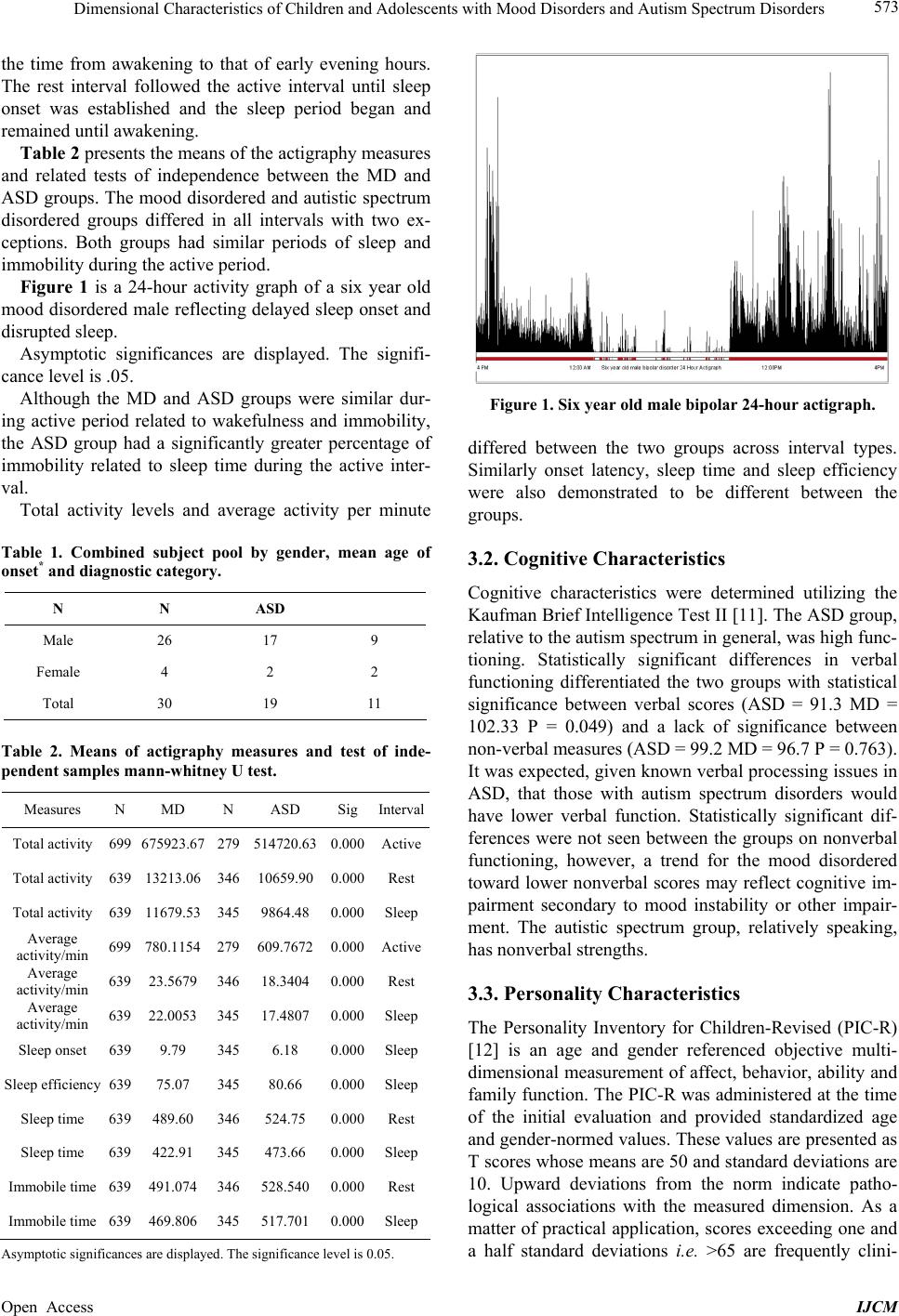 Dimensional Characteristics of Children and Adolescents with Mood Disorders and Autism Spectrum Disorders 573 the time from awakening to that of early evening hours. The rest interval followed the active interval until sleep onset was established and the sleep period began and remained until awakening. Table 2 presents the means of the actigraphy measures and related tests of independence between the MD and ASD groups . The moo d disordered an d autistic spectru m disordered groups differed in all intervals with two ex- ceptions. Both groups had similar periods of sleep and immobility during the active period. Figure 1 is a 24-hour activity graph of a six year old mood disordered male reflecting delayed sleep onset and disrupted sleep. Asymptotic significances are displayed. The signifi- cance level is .05. Although the MD and ASD groups were similar dur- ing active period related to wakefulness and immobility, the ASD group had a significantly greater percentage of immobility related to sleep time during the active inter- val. Total activity levels and average activity per minute Table 1. Combined subject pool by gender, mean age of onset* and diagnostic category. N N ASD Male 26 17 9 Female 4 2 2 Total 30 19 11 Table 2. Means of actigraphy measures and test of inde- pendent samples mann-whitney U test. Measures N MD NASD SigInterval Total activity 699 675923.67 279 514720.63 0.000Active Total activity 639 13213.06 346 10659.90 0.000Rest Total activity 639 11679.53 345 9864.48 0.000Sleep Average activity/min 699 780.1154 279 609.7672 0.000Active Average activity/min 639 23.5679 346 18.3404 0.000Rest Average activity/min 639 22.0053 345 17.4807 0.000Sleep Sleep onset 639 9.79 345 6.18 0.000Sleep Sleep efficiency 639 75.07 345 80.66 0.000Sleep Sleep time 639 489.60 346 524.75 0.000Rest Sleep time 639 422.91 345 473.66 0.000Sleep Immobile time 639 491.074 346 528.540 0.000Rest Immobile time 639 469.806 345 517.701 0.000Sleep Asymptotic s ignificances are displ ayed. The significance level is 0.05. Figure 1. Six year old male bipolar 24-hour actigraph. differed between the two groups across interval types. Similarly onset latency, sleep time and sleep efficiency were also demonstrated to be different between the groups. 3.2. Cognitive Characteristics Cognitive characteristics were determined utilizing the Kaufman Brief Intelligence Test II [11]. The ASD group, relative to the autism spectrum in general, was high func- tioning. Statistically significant differences in verbal functioning differentiated the two groups with statistical significance between verbal scores (ASD = 91.3 MD = 102.33 P = 0.049) and a lack of significance between non-verbal measures (ASD = 99.2 MD = 96.7 P = 0.763). It was expected, given known verbal processing issues in ASD, that those with autism spectrum disorders would have lower verbal function. Statistically significant dif- ferences were not seen between the groups on nonverbal functioning, however, a trend for the mood disordered toward lower nonverbal scores may reflect cognitive im- pairment secondary to mood instability or other impair- ment. The autistic spectrum group, relatively speaking, has nonverbal strengths. 3.3. Personality Characteristics The Personality Inventory for Children-Revised (PIC-R) [12] is an age and gender referenced objective multi- dimensional measurement of affect, behavior, ability and family function. The PIC-R was administered at the time of the initial evaluation and provided standardized age and gender-normed values. These values are presented as T scores whose means are 50 and standard deviations are 10. Upward deviations from the norm indicate patho- logical associations with the measured dimension. As a matter of practical application, scores exceeding one and a half standard deviations i.e. >65 are frequently clini- Open Access IJCM  Dimensional Characteristics of Children and Adolescents with Mood Disorders and Autism Spectrum Disorders 574 cally significant. The results of the PIC-R indicated both similarities and differences in symptom presentations and associated impairments. The Personality Inventory for Children in- cludes four broad factorial derived dimensions, scales measuring general adjustment and informant response style, developmental, cognitive and clinical scales. Both the mood disordered and autism spectrum groups reflect significant impairment related to self-control and self- discipline. Both groups deviate from the norm by over two standard deviations. Difficulties in social competence between the two groups approached but did not meet statistical signifi- cance. Both group’s scores suggest social impairments and deviate from the norm. The ASD group demon- strated a statistically non-significant, but higher degree of impairment in the domain of social competence. Differ- ences between groups related to somatic concerns and internalization were not significant with means of 62.89 to 66.55. Statistically significant differences existed be- tween the mood disordered and autism spectrum disorder groups related to general issues of cognitive develop- ment. Other scaled personality dimensions derived from the Personality Inventory for Children that contributed to characterizing and differentiating between children with autism spectrum disorder and children with mood disor- ders included the dimensions of intellectual screening and psychoses. These distin ctions are noted in Table 3. 3.4. Observational Characteristics The observational characteristics were based on the per- centage of symptom presence observed on over 72 op- erationally defined symptoms and the repeated meas- urements that were collected intermittently throughout the study period. The Systematic Observation Scale util- izes operationally defined symptoms [13] that are pre- sented to a primary observer (usually a self-observer or a parent) for determination regarding the percentage of time sy mptoms are pres ent . These measurements are the most limited of the meas- urements presented. Although the observations provided meaningful individua l clinical response data, they are not Table 3. Personality dimension T scores and test of inde- pendent samples Mann-Whitney U test. Description DM DSA giS Cognitive development 58.79 83.91 0.003* Intellectual screening 55.32 84.18 0.006* Psychosis 80.32 98.45 0.047* Asymptotic s ignificances are displ ayed. The significance level is 0.05. standardized measurements and do not have inter-rater reliability. And, as previously noted, various therapeutic interventions occurred across the study period that were not consistent across the groups. These confounding fac- tors resulted in few items differentiating the two groups. Nevertheless, the observational symptoms that broadly demonstrated group differences are shown in Table 4. 4. Discussion It is not the authors’ intention to suggest that all child psychiatric patients can be placed into the two broad groups we have examined. But, despite similar sympto- matic expressions of dysregulated mood, irritability and other impairments there is a clinically discernible differ- ence in social relatedness among the autism spectrum group. The fundamental neurodevelopmental nature of autism spectrum disorders suggests neurophysiologic dif- ferences despite elements of common symptomatic pre- sentations. In our sample the activity patterns and sleep characteristics differ between the included major depres- sive disorder, bipolar disorder and unspecified mood dis- order from our ASD sample. The ASD sample of this study was limited by those available in a setting where a “high functioning” bias existed. Nevertheless, there ap- pear to be significant differences between the broad groups of mood disorder and autism spectrum disorders that can be further defined by applying objective meas- ures to determine treatment response phenotypes and as a method to support and measure specific related categori- cal diagnoses. The broadly defined MD and ASD groups of this study had similar self-control and behavioral impairments, but exhibited significant differences in circadian sleep and motor activity characteristics. These findings are limited but point to the potential of further characterizing these and other differen ces. Although both groups in th is study had sleep complaints the predominantly mood disordered exhibited significantly different sleep characteristics than did those with autism spectrum diagnoses. The autism spectrum group also exhibited significantly less total activity than the mood disordered group. Phenotypic characteristics such as these may be associated with Table 4. Mean percentage present of operationally defined symptoms and test of independent samples Mann-Whitney U test. Observational measure MD ASD Sig Tics/mannerisms7.56 26.36 0.048 Picky eater 15.74 35.14 0.010 Bed wetting 6.39 32.50 0.001 Whiny 14.81 32.55 0.048 Open Access IJCM  Dimensional Characteristics of Children and Adolescents with Mood Disorders and Autism Spectrum Disorders 575 treatment response variance and may, once fully charac- terized, reveal pathological processes that precede or contribute to chronically established impairments. The clinical implications of variations of activity and sleep disruptions are numerous and include their rela- tionship to mood, cognition and development. Sleep is closely related to emotional regulation and cognitive functioning. Dysphoric mood states [14]; completed sui- cides [15] the onset of manic symptoms worsening [16] and possible long lasting learning deficits have each been associated with sleep disturbances [17]. Approximately 85% of bipolar children and adolescents exhibit sleep disturbance [18] (4). And, bipolar individuals experience sleep problems during periods of relative euthymia [19] [16] as well as during episodic worsening of affective illness. Bipolar children may be especially likely to ex- hibit low sleep efficiency, frequent awakenings [20] and phase-delayed sleep [4]. Sleep disturbances are associated with poorer acade- mic performance among children diagnosed as having autism and attention deficit hyperactivity (ADHD) dis- orders, but not among normal control children [21]. Our results suggest that predominantly mood-disordered child- ren have significantly more severe sleep impairment than do those with autism spectrum diagnoses. If a strong as- sociation exists between sleep disturbance and academic performance among predominantly mood-disordered child- ren, as seems very likely, it would be particularly impor- tant to address sleep symptoms during clinical treatment of these children and adolescents. Circadian rhythm disorders are associated with cogni- tive impairment, mood disturbances and increased risk of cardio-metabolic disorders and can be treated by light management, scheduled sleep-wake time adherence, timed low-dose melatonin and other pharmacological agents [22]. Melatonin has demonstrated effectiveness in ad- vancing sleep-wake rhythm and endogenous melatonin rhythm in delayed sleep phase disorder [23]. Sleep and activity measurements are reflections of neurophysiological states and are measureable treatment targets. Insomnia and hypersomnia, sensitivity to shifts in circadian rhythm, difficulties awakening, and prolonged sleep latency may act as vulnerability factors prior to the manifestation of manic episodes [16]. Effective reduction of sleep disturbances in children and adolescents, particularly those with predominant mood disorder symptoms, perhaps should be a primary goal. Sleep disturbed adult bipolar probands treated with ramelteon, a selective melatonin receptor agonist, were approximately half as likely to relapse as those treated with placebo through a 24 week treatment period [24]. Symptoms of delirium have been correlated with cir- cadian rhythm disturbances and are reported to have been improved by treatment with ra melteon [2 5 ]. Although the pathophysiology of mood disorders is unknown, the dis- ruptions in daily rhythms associated with major depres- sive disorder and bipolar disorder have led to considera- tion of circadian pathophysiology as a contributing cau- sal factor [26,27]. 5. Conclusion Limitations of this study are significant and include that: this is a small unmatched sample; subjects represented various developmental states; the ASD subjects are heav- ily weighted toward high functioning and are not repre- sentative of a broad ASD group; some subjects were drug naïve at baseline while others were not; and, subjects in both diagnostic categories received various pharmacol- ogical interventions during actigraphy measurement pe- riods. Despite these limitations we propose that low budget or no budget clinical investigations such as these can assist in clinical management an d incrementally shed light on phenotypic differences worthy of further inves- tigation. The results of this study are consistent with sleep dis- turbances reported in studies of pediatric bipolar subjects [18] and demonstrate the value of utilizing objective measurements for the differentiation of complex phenol- typic neurodevelopmental and neuropsychiatric disorders. Phenotypic differences may be a factor in lower antide- pressant and other variant medication efficacies seen in the ASD population [28]. Future studies may identify phenotypic subtypes of complex disorders that reveal dimensional aspects un- derlying neurophysiological effects and states. Identifica- tion of these characteristics enhances phenotypic differ- entiation and neurodevelopmental opportunities to miti- gate or reduce pathol ogi cal devel o pment. REFERENCES [1] G. Masi, M. Mucci, C. Pfanner, S. Berloffa, A. Magazù and G. Perugi, “Developmental Pathways for Different Subtypes of Early-Onset Bipolarity in Youths,” Journal of Clinical Psychiatry, Vol. 73, No. 10, 2012, pp. 1335- 1341. [2] M. Maskey, F. Warnell, J. R. Parr, A. Le Couteur and H. McConachie, “Emotional and Behavioural Problems in Children with Autism Spectrum Disorder,” Journal of Autism and Developmental Disorders, Vol. 43, No. 4, 2013, pp. 851-859. [3] D. L. Coury, E. Anagnostou, P. Manning-Courtney, A. Reynolds, L. Cole, R. McCoy, A. Whitaker and J. M. Perrin, “Use of Psychotropic Medication in Children and Adolescents with Autism Spectrum Disorders,” Pediat- rics, Vol. 130, Suppl. 2, 2012, pp. 69-76. [4] D. Staton, “The Impairment of Pediatric Bipolar Sleep: Hypotheses Regarding a Core Defect and Phenotype-Spe- cific Sleep Disturbances,” Journal of Affective Disorders, Open Access IJCM  Dimensional Characteristics of Children and Adolescents with Mood Disorders and Autism Spectrum Disorders Open Access IJCM 576 Vol. 108, No. 3, 2008, pp. 199-206. http://dx.doi.org/10.1016/j.jad.2007.10.007 [5] B. J. Duke, “Pathogenic Effects of Central Nervous Sys- tem Hyperarousal,” Medical Hypotheses, Vol. 71, No. 2, 2008, pp. 212-217. http://dx.doi.org/10.1016/j.mehy.2008.03.037 [6] E. Schopler, R. Reicher and B. Renner, “The Childhood Autism Rating Scale, s.l.,” Western Psychological Ser- vices, 1988. [7] Pro-Ed, “Asperger Syndrome Diagnostic Scale. Asperger Syndrome Diagnostic Scale. s.l.,” Pro-Ed Inc., 2001. [8] K. A. Kaplan, L. S. Talbot, J. Gruber and A. G. Harvey, “Evaluating Sleep in Bipolar Disorder: Comparison be- tween Actigraphy, Polysomnography, and Sleep Diary,” Bipolar Disorders, Vol. 14, No. 8, 2012, pp. 870-879. http://dx.doi.org/10.1111/bdi.12021 [9] Rispironics, “Philips Rispironics Actiwatch. Philips Ris- pironics,” 2008. http://actiwatch.respironics.com [10] B. Duke, “Child Psychotherapy and the Scientific Method: The Systematic Observation Scale,” Proceedings of the Pacific Division, American Association for the Advance- ment of Science, Vol. 9, No. 1, 1990, p. 21. [11] A. S. Kaufman and N. L. Kaufman, “Kaufman Brief In- telligence Test,” 2nd Edition, NCS Pearson Inc., 2004. [12] R. D. Wirt, D. Lachar, J. K. Kleindin and P. D. Seat, “Multidimensional Description of Child Personality,” Western Psychological Services, Los Angeles, 1984. [13] B. Duke, “Child Psychopharmacology Institute,” 2012. http://www.childpsychopharmacologyinstitute.org/CPIOb servationDefinitions.pdf [14] L. S. Talbot, S. Stone, J. Gruber, I. S. Hairston, P. Eidel- man and A. G. Harvey, “A Test of the Bidirectional As- sociation between Sleep and Mood in Bipolar Disorder and Insomnia,” Journal of Abnormal Psychology, Vol. 121, No. 1, 2012, pp. 39-50. http://dx.doi.org/10.1037/a0024946 [15] T. R. Goldstein, J. A. Bridge and D. A. Brent, “Sleep Dis- turbance Preceding Completed Suicide in Adolescents,” Journal of Consulting and Clinical Psychology, Vol. 76, No. 1, 2008, pp. 84-91. [16] P. S. Ritter, C. Marx, N. Lewtschenko, S. Pfeiffer, K. Leopold, M. Bauer and A. Pfennig, “The Characteristics of Sleep in Patients with Manifest Bipolar Disorder, Sub- jects at High Risk of Developing the Disease and Healthy Controls,” Journal of Neural Transmission, Vol. 119, No. 10, 2012, pp. 1173-1184. http://dx.doi.org/10.1007/s00702-012-0883-y [17] L. Seugnet, Y. Suzuki, J. M. Donlea, L. Gottschalk and P. J. Shaw, “Sleep Deprivation during Early-Adult Devel- opment Results in Long-Lasting Learning Deficits in Adult Drosophilia,” Sleep, Vol. 34, No. 2, 2011, pp. 137- 146. [18] A. Baroni, M. Hernandez, M. C. Grant and G. L. Faedda, “Sleep Disturbances in Pediatric Bipolar Disorder: A Comparison between Bipolar I and Bipolar NOS,” Fron- tiers in Psychiatry, Vol. 3, 2012, p. 22. http://dx.doi.org/10.3389/fpsyt.2012.00022 [19] A. Millar, C. A. Espie and J. Scott, “The Sleep of Remit- ted Bipolar Outpatients: A Controlled Study Using Acti- graphy,” Journal of Affective Disorders, Vol. 80, No. 2, 2004, pp. 145-153. http://dx.doi.org/10.1016/S0165-0327(03)00055-7 [20] T. R. Goldstein, A. Gilbert, D. Axelson, B. Birmaher, R. Fersch, K. Monk and E. Frank, “Sleep Actigraphy among Adolescents at Risk for Bipolar Disorder,” Western Psy- chiatric Institute and Clinic University of Pittsburgh, Pittsburgh, 2012. [21] M. Matsuoka, S. Nagamitsu, A. Iwasaki, Y. Yamashita, M. Maeda, S. Kitani, T. Kakuma, N. Uchimura and Ma- tsuishi, “High Incidence of Sleep Problems in Children with Developmental Disorders: Results of a Questionaire Survey in a Japanese Elementary School,” Brain & De- velopment, 2013. [22] P. C. Zee, H. Attarian and Videnovic, “Circadian Rhythm Abnormalities,” Continuum (Minneap Minn), Vol. 19, No. 1, 2013, pp. 132-147. [23] I. Geijlswijk, H. Korzilius and M. G. Smits, “The Use of Exogenous Melatonin in Delayed Sleep Phase Disorder: A Meta-Analysis,” Sleep, Vol. 33, No. 12, 2010, pp. 1605-1614. [24] E. R. Norris, K. Burke, J. R. Correll, K. J. Zemanek, J. Lerman, R. A. Primelo and M. W. Kaufmann, “A Dou- ble-Blind, Randomized, Placebo-Controlled Trial of Ad- junctive Ramelteon for the Treatment of Insomnia and Mood Stability in Patients with Euthymic Bipolar Disor- der,” Journal of Affective Disorders, Vol. 144, No. 1, 2013, pp. 141-147. http://dx.doi.org/10.1016/j.jad.2012.06.023 [25] M. Furuya, T. Miyaoka, H. Yasuda, S. Yamashita, I. Ta- naka, S. Otsuka, R. Wake and J. Horiguchi, “Marked Im- provement in Delirium with Ramelteon: Five Case Re- ports,” Psychogeriatrics, Vol. 12, No. 4, 2012, pp. 259- 262. http://dx.doi.org/10.1111/j.1479-8301.2012.00422.x [26] P. Salvatore, S. Ghidini, G. Zita, C. De Panfilis, S. Lam- bertino and C. Maggini, “Circadian Activity Rhythm Ab- normalities in Ill and Recovered Bipolar I Disorder,” Bi- polar Disorders, Vol. 10, No. 2, 2008, pp. 256-265. http://dx.doi.org/10.1111/j.1399-5618.2007.00505.x [27] M. J. McCarthy and D. K. Welsh, “Cellular Circadian Clocks in Mood Disorders,” Journal of Biological Rhy- thms, Vol. 27, No. 5, 2012, pp. 339-352. http://dx.doi.org/10.1177/0748730412456367 [28] C. J. Doyle and C. A. McDougle, “Pharmacologic Treat- ments for the Behavioral Symptoms Associated with Au- tism Spectrum Disorders across the Lifespan,” Dialogues in Clinical NeuroSciences, Vol. 14, No. 3, 2012, pp. 263- 279. |