

Paper Menu >>
Journal Menu >>
 Open Journal of Nephrology, 2013, 3, 217-219 Published Online December 2013 (http://www.scirp.org/journal/ojneph) http://dx.doi.org/10.4236/ojneph.2013.34037 Open Access OJNeph A Surviving Patient with Record High Creatinine Andrew C. Storm1, Naing L. Htike2, David A. Cohen3, Robert L. Benz4* 1Department of Internal Medicine, The Johns Hopkins Hospital, Baltimore, USA 2Department of Nephrol ogy, Lankenau Medical Center, Wynnewood, USA 3Department of Internal Medicine, Lankenau Medical Center, Wynnewood, USA 4Division Chief of Nephrology, Lankenau Medical Center and Main Line Health and Lankenau Institute for Medical Research, Wynnewood, USA Email: *[email protected] Received August 24, 2013; revised September 22, 2013; accepted October 20, 2013 Copyright © 2013 Andrew C. Storm et al. This is an open access article distributed under the Creative Commons Attribution License, which permits unrestricted use, distribution, and reproduction in any medium, provided the original work is properly cited. ABSTRACT Creatinine is a product of muscle protein breakdown cleared by the kidneys at a constant rate. The glomerular filtration rate is estimated based on serum creatinine. There is no definitive lev el of serum creatinine which is itself incompatible with human survival. We present the highest serum creatinine associated with survival based on a thorough review of the literature. A 34-year-old male patient with baseline serum creatinine of 1.2 mg/dl presented our emergency depart- ment with a six week history of new onset of uremic symptoms. His past medical history was unremarkable. On exam, he was in no distress. His BMI was 28. His exam was significant only for elevated blood pressure and asterixis. His peak serum creatinine was 53.9 mg/dl. The patient subsequently required maintenance hemodialysis and later changed to long-term peritoneal dialysis. To our knowledge, based on a thorough review of the literature using PubMed, Coch- rane Database and the United States Renal Data System (USRDS), this is the highest level of serum creatinine ever re- ported. We conclude that serum creatinine itself is non-lethal. It is more likely that other electrolyte and retained meta- bolic abnormalities of renal failure frequently cause symptoms or death before creatinine toxicity, if such a level exists, creatinine has reached. Keywords: Survival; Outcome; Uremia; Mortality; Creatinine 1. Introduction Creatinine is the product of dephosphorylation of crea- tine phosphate during muscle contraction and is freely filtered and normally also secreted via the proximal tu- bules and excreted by the kidneys [1-4]. Thus, creatinine clearance exceeds glomerular filtration rate by the amount or percent of creatinine secretion. The serum creatinine level is relatively co nstan t and its valu e is used to estimate glomerular filtration rate (eGFR) [5]. The normal reference range for serum creatinine is 0.7 to 1.3 mg/dL (62 - 115 umol/L) for men and 0.6 to 1.1 mg/dL (53 - 97 umol/L) for women [3]. Although creatinine is often assumed to be one of the uremic toxins, very little data are available on its adverse effects on human physi- ology [6]. One animal study reported that creatinine in- jection reduced survival time in anephric rats [7]. A ca- nine study showed gastrointestinal side effects of chronic creatinine intoxication [8]. The authors did not receive funding or support for this case study. 2. Case Presentation A 34-year-old man with a baseline creatinine 1.2 mg/dl in 2003 and no significant pa st medical history presented to the Lankenau Medical Center Emergency Department with complaints of nausea, vomiting and diarrhea over the prior six weeks. These symptoms, in addition to 30-pound weight loss, led to the patient’s hospital admis- sion. He also reported intermittent ankle swelling and nocturia two to three times nightly. He denied dysuria, hematuria, foamy urine or seizure. Past medical history included cervical radiculopathy in the distant past. He denied any childhood kidney disease or recurrent urinary tract infections. There was no history of hypertension. He did not take non-steroidal an- ti-inflammation drugs. He occasionally used mail-order herbal colonic cleansers. The patient denied tobacco, alcohol, and drug abuse. Family history was significant for diabetes, hypertension and COPD in his mother. His *Corresponding author. 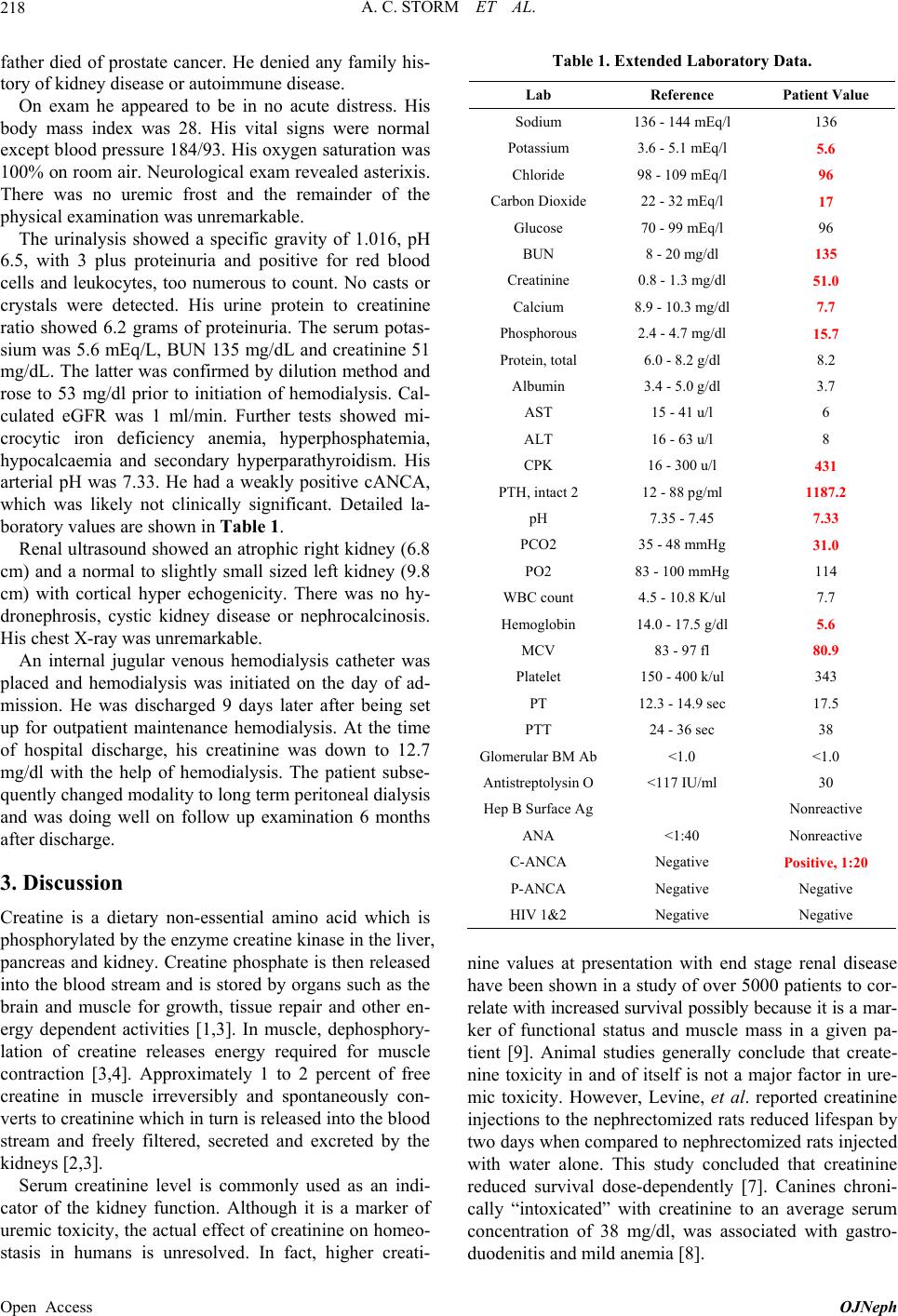 A. C. STORM ET AL. 218 father died of prostate cancer. He denied any family his- tory of kidney disease or autoimmune disease. On exam he appeared to be in no acute distress. His body mass index was 28. His vital signs were normal except blood pressure 184/93. His oxygen saturation was 100% on room air. Neurological exam revealed asterixis. There was no uremic frost and the remainder of the physical examination was unremarkable. The urinalysis showed a specific gravity of 1.016, pH 6.5, with 3 plus proteinuria and positive for red blood cells and leukocytes, too numerous to count. No casts or crystals were detected. His urine protein to creatinine ratio showed 6.2 grams of proteinuria. The serum potas- sium was 5.6 mEq/L, BUN 135 mg/dL and creatinine 51 mg/dL. The latter was confirmed by dilution method and rose to 53 mg/dl prior to initiation of hemodialysis. Cal- culated eGFR was 1 ml/min. Further tests showed mi- crocytic iron deficiency anemia, hyperphosphatemia, hypocalcaemia and secondary hyperparathyroidism. His arterial pH was 7.33. He had a weakly positive cANCA, which was likely not clinically significant. Detailed la- boratory values are shown in Table 1. Renal ultrasoun d showed an atrophic right kidney (6.8 cm) and a normal to slightly small sized left kidney (9.8 cm) with cortical hyper echogenicity. There was no hy- dronephrosis, cystic kidney disease or nephrocalcinosis. His chest X-ray was unremarkable. An internal jugular venous hemodialysis catheter was placed and hemodialysis was initiated on the day of ad- mission. He was discharged 9 days later after being set up for outpatient maintenance hemodialysis. At the time of hospital discharge, his creatinine was down to 12.7 mg/dl with the help of hemodialysis. The patient subse- quently changed modality to long term peritoneal dialysis and was doing well on follow up examination 6 months after discharge. 3. Discussion Creatine is a dietary non-essential amino acid which is phosphorylated by the enzyme creatine kinase in the liver, pancreas and kidney. Creatine phosphate is then released into the blood stream and is stored by organs such as the brain and muscle for growth, tissue repair and other en- ergy dependent activities [1,3]. In muscle, dephosphory- lation of creatine releases energy required for muscle contraction [3,4]. Approximately 1 to 2 percent of free creatine in muscle irreversibly and spontaneously con- verts to creatinine which in turn is released into the blood stream and freely filtered, secreted and excreted by the kidneys [2,3]. Serum creatinine level is commonly used as an indi- cator of the kidney function. Although it is a marker of uremic toxicity, the actual effect o f creatinine on homeo- stasis in humans is unresolved. In fact, higher creati- Table 1. Extended Laboratory Data. Lab Reference Patient Value Sodium 136 - 144 mEq/l 136 Potassium 3.6 - 5.1 mEq/l 5.6 Chloride 98 - 109 mEq/l 96 Carbon Dioxide 22 - 32 mEq/l 17 Glucose 70 - 99 mEq/l 96 BUN 8 - 20 mg/dl 135 Creatinine 0.8 - 1.3 mg/dl 51.0 Calcium 8.9 - 10.3 mg/dl 7.7 Phosphorous 2.4 - 4.7 mg/dl 15.7 Protein, total 6.0 - 8.2 g/dl 8.2 Albumin 3.4 - 5.0 g/dl 3.7 AST 15 - 41 u/l 6 ALT 16 - 63 u/l 8 CPK 16 - 300 u/l 431 PTH, intact 2 12 - 88 pg/ml 1187.2 pH 7.35 - 7.45 7.33 PCO2 35 - 48 mmHg 31.0 PO2 83 - 100 mmHg 114 WBC count 4.5 - 10.8 K/ul 7.7 Hemoglobin 14.0 - 17.5 g/dl 5.6 MCV 83 - 97 fl 80.9 Platelet 150 - 400 k/ul 34 3 PT 12.3 - 14.9 sec 17.5 PTT 24 - 36 sec 38 Glomerular BM Ab<1.0 <1.0 Antistreptolysin O<117 IU/ml 30 Hep B Surface Ag Nonreactive ANA <1:40 Nonreactive C-ANCA Negative Positive, 1:20 P-ANCA Negative Negative HIV 1&2 Negative Negative nine values at presentation with end stage renal disease have been shown in a study of over 5000 patients to cor- relate with incr eased survival possibly because it is a mar- ker of functional status and muscle mass in a given pa- tient [9]. Animal studies generally conclude that create- nine toxicity in and of itself is not a major factor in ure- mic toxicity. However, Levine, et al. reported creatinine injections to the nephrectomized rats reduced lifespan by two days when compared to nephrectomized rats injected with water alone. This study concluded that creatinine reduced survival dose-dependently [7]. Canines chroni- cally “intoxicated” with creatinine to an average serum concentration of 38 mg/dl, was associated with gastro- duodenitis and mild anemia [8]. Open Access OJNeph  A. C. STORM ET AL. Open Access OJNeph 219 A literature search of PubMed, Cochrane Reviews, and the United States Renal Data System (USRDS) failed to reveal case reports or data sets with a creatinine level as high as our patient. The USRDS records show that over the past 15 years, less than only 1.28% of all new ESRD cases have a reported initial creatinine over 20 mg/dl [10 ]. Their data also include no values over 30 mg/dl indicat- ing that the reported case herein could be the highest createnine (53 mg/dl) in the literature. Despite this re- cording the high level, the patient’s functional status and clinical outcome were remarkably stable out of propor- tion to the chemical evidence of his azotemia. It is possi- ble that this patient has a chronic single functioning kid- ney which was affected by either essential hypertension or chronic glomerulopathy. More likely, he may have focal and segmental glomerulosclerosis related to a small kidney and chronic hyperfiltration. However, renal bi- opsy was contraindicated due to advanced and irreversi- ble nature of the kidney disease and the presence of a single functio n i ng ki d ney . In summary, we report what appears to be the highest recorded serum creatinine in a surviving uremic patient. This finding implies that creatinine itself may h ave a mi- nimally pathophysiologic effect on uremic patients. REFERENCES [1] N. V. Bhagavan, “Protein and Amino Acid Metabolism,” In: J. Hayhurst, Ed., Medical Biochemistry, Harcourt/ Academic Press, Burlington, 2002, pp. 331-332. [2] D. J. Newman and C. P. Price, “Nonprotein Nitrogen Me- tabolites,” In: C. A. Burtis and E. R. Ashwood, Eds., Ti- etz Fundamentals of Clinical Chemistry, W.B. Saunders Company, Philadelphia, 2001, pp. 414-422. [3] J. M. Watras, “Berne & Levy Physiology,” 6th Edition. Mosy, Inc., Santa Clara, 2008, pp. 246-247. [4] G. C. Curhan and W. E. Mitch, “Brenner & Rector’s The Kidney,” 8th Edition. Saunders, Philadelphia, 2008, pp. 1826-1827. [5] A. S. Levey, T. Greene, J. W. Kusek, G. J. Beck and MDRD Study Group, “A Simplified Equation to Predict Glomerular Fi ltrat ion Rate from Serum Cre ati nine,” Jour- nal of the American Society of Nephrology, Vol. 11. Suppl. 2, 2000, p. 155. [6] A. Yavuz, C. Tetta, F. F. Ersoy, V. D’intini, et al., “Ure- mic Toxins: A New Focus on an Old Subject,” Seminars in Dialysis, Vol. 18, No. 3, 2005, pp. 203-211. http://dx.doi.org/10.1111/j.1525-139X.2005.18313.x [7] S. Levine and A. Saltzman, “Are Urea and Creatinine Uremic Toxins in the Rat?” Renal Failure, Vol. 23, No. 1, 2001, pp. 53-59. http://dx.doi.org/10.1081/JDI-100001283 [8] S. Giovannetti, M. Biagini, P. L. Balestri, R. Navalesi, P. Giagnoni, A. De Matteis, P. Ferro-Milone and C. Perfetti, “Uraemia-Like Syndrome in Dogs Chronically Intoxi- cated with Methyl Guanidine and Creatinine,” Clinical Science, Vol. 36, No. 3, 1969, pp. 445-452. [9] J. C. Fink, R. A. Burdick, S. J. Kurth, S. A. Blahut, N. C. Armistead, M. S. Turner, L. M. Shickle and P. D. Light, “Significance of Serum Creatinine Values in New End- Stage Renal Disease Patients,” American Journal of Kid- ney Diseases, Vol. 34, No. 4, 1999, pp. 694-701. http://dx.doi.org/10.1016/S0272-6386(99)70395-1 [10] US Renal Data System. USRDS 1995-2010 Data Report: Atlas of End-Stage Renal Disease in the United States. http://www.usrds.org/2010/view Abbreviations eGFR: estimate glomerular filtration rate. COPD: chronic obstructive pulmonary disease. USRDS: United States Renal Data System. ESRD: End stage renal disease. BUN: Blood urea nitrogen. AST and ALT : liver enz y mes. CPK: creatinine kinase. PTH: parathyroid hormone. ANA: anti-nuclear antibody. ANCA: anti-neutrophil cytoplasmic antibodies. BMI: body mass index. |