

Paper Menu >>
Journal Menu >>
 Natural Resources, 2011, 2, 22-27 doi:10.4236/nr.2011.21004 Published Online March 2011 (http://www.scirp.org/journal/nr) Copyright © 2011 SciRes. NR Macro to Micro Viewpoint of Climate Change—Linking Karnataka to Global Issue Sunil Nautiyal Centre for Ecological Economics and Natural Resources, Institute for Social and Economic Change, Bangalore, India. Email: [email protected] Received December 23rd, 2010; revised January 25th, 2011; accepted February 1st, 2011. ABSTRACT A numerous studies have been done on climate change at regional, national and global levels. Several climate models have predicted the global scenarios for climate in different parts of the world. However, the significance and practical implementation of such models at local level yet to be validated. This is because those national or global models do not consider micro variables such as such as environmental resources for exa mple ‘land availability, local climatic condi- tions, socioeconomic factors such as ‘labour and capital’, policy aspects such as ‘subsidies, nature conservation strate- gies’ and competition for labor and capital in relation of ‘national economy’. India, with a huge diversity in land, to- pography, climate and socioeconomic conditions, divided into 15 agro-ecological zones. Further, to help develop loca- tion specific research and development strategies at the micro level, a total of 127 sub-zon es (agro-climatic sub regions) have been identified in India. Therefore, research on climate change and its impact only at the regional or national level may not be a sound approach to provide solutions for adaptation to climate change at micro level. Thus the mi- cro-level research needs to be undertaken that might help us understand climate change impacts on the landscape i.e. biodiversity, health, natural resource management, land use and land cover development, adaptation and the develop- ment of socio-ecological systems. The concepts presented in this article should provide the basis for a discussion on decision-making issues among multidisciplinary experts with regard to climate change and sustainable development within complex environments. Keywords: Climate Change, Adaptation and Mitigation, Local Level Case Studies, Agro-Climatic Zones, India 1. Introduction Observational evidences indicate that high carbon emis- sions and the associated climate change effects in the 20th century, already have affected diverse sets of physical and biological systems [1]. Carbon dioxide in the at- mosphere has increased by about 30% from a pre- industrial leve l of about 270 ppm to the level of 380 ppm and is expected to further reach 600 - 700 ppm range by 2100 [1-2]. Developed nations representing about 20% of the world population, are responsible for 76% of total carbon emissions. For example, USA, amounting for just about 5% of the world population, alone is responsible for 30% of the total global carbon emission2. In general the average per capita CO2 emissions by the developing world stand at about 3.0 tons per year, however, related figure for the developed/advanced nations is about 13-14 tons [3]. In the Indian context, CO2 emissions form just about 1.2 ton per person [4]. Hence to cope with climate change and adapt to its associated hazards, the United Nations Climate Change Conference was held at the Bella Center in Copenhagen, Denmark, between 7th and 18th December 2009-commonly known as the Copenha- gen Summit. The general consensus of the conferenec reached by 192 nations was that the changing climate pattern was one of the greatest challenges con fronting th e world today. However, this consensus was no way dif- ferent from what had been discussed earlier during the 2007 United Nations Framework Convention on Climate Change (UNFCCC) conference in Bali and twelve years ago in Kyoto. Before summarizing the debates at Copenhagen it is important to remember here the gist of Kyoto protocol. At Kyoto, 37 rich countries had pledged to reduce their greenhouse gas (GHG) emissions by 5.2% at 1990 level; however, the evidences showed that most of the countries had in fact increased their emission levels and, as a con- sequence, the climate change issue became an irreversi- ble reality which no one could refute. As a result, the advanced nations called for another summit meeting  Macro to micro Viewpoint of Climate Change—Linking Karnataka to Global Issue 23 which was hel d in Co penhagen. Although at Copenhagen summit legally binding GHG emissions cuts could not be imposed on the developing countries despite the concerted efforts by some of the developed countries to bring a countries like-China and India in particularly under legally binding norms, the general consensus was that if all the countries were in- terested in avoiding “serious climate change effects”, it would be necessary to undertake appropriate measures to keep global warming to below 2˚C, though there was not consensus on how to go about it. Now the global emis- sions budget, capped by 2˚C guard rail, requires not only the industrialized countries, but also the newly-Industri- alizing and developing countries to adopt strategies to- wards a low -carbon future [5]. In th e Indian context, this requires a proper science-policy research for developing policy responses intended for climate for different agro- ecological regions and a carbon-dioxide (CO2) budget approach based upon a systematic and empirical research. Science-policy research would allow us to articulate and argue for a proper carbon space for achieving the goal of development without too many restrictions on the GHG budget under a futu re treaty on climate change effects. There are many studies/reports available at the na- tional and global levels [1,2,5-26] that deal with climate change and its potential impact on different sectors in a holistic manner. India, with a huge diversity in land, to- pography, climate and socioeconomic conditions, is di- vided into 15 agro-ecological zones. Further, to help de- velop location specific research and development strate- gies at the micro level, a total of 127 sub-zones (agro- climatic sub regions) have been identified in India [27]. In defining zonal boundaries several indicators (such as water availability, soil types, rainfall and pattern of rain- fall, edaphic factors, land use and land cover, area under irrigation and rainfed, cropping pattern etc., were taken into consideration [28]. Therefore, research on climate change and its impact only at the national level may not be a sound approach towards adaptation and mitigation activities at the micro level. Several climate models have predicted the global scenarios for climate in different parts of the world. However, the significance and practi- cal implementation of such mo d els at lo cal level yet to be validated. This is because that meso-level models do not consider region specific variables such as such as envi- ronmental resources for example ‘land availability, local climatic conditions, socioeconomic factors such as ‘labor and capital’, policy aspects such as ‘subsidies, nature conservation strategies’ and competition for labor and capital in relation of ‘national economy’. 2. Farmers’ Decision and Complex Land Use-Environmental System Farmers act in complex environment and several driving forces influence him to make his decision on land use [29] Figure 1. Land use is one of the sectors highly vulner- able to climate change. Changes in climatic conditions have lots of adverse impacts on the land use and associ- ated activities. Climate change influence farmers to de- cide on land use. Farmers’ decision adjudicates for eco- nomic success as well as ecological performance of the chosen management systems. In rural landscape for the land use management, farmer could choose one or sev- eral criteria from different goals such as from the eco- nomic goal and/or ecological goal. The achievement of profitable economic goal in general found in priority of farmers decision [30]. The land use is not an independent sector but closely linked to the other sectors of the land- scape thus influence the ecological resource flow in the system. Therefore, meanwhile the impacts of land use change and related land management practices on climate (at micro level) have to be evaluated when we study the impact of climate on the land use. The decision making behaviour of farmers is centered on maximization of this income from the existing resources available to his ease of access. In this endeavor the investigations were made to judge the attitude of the farmer towards overall sce- nario changes and development [31,32]. Farmers assess different conditions at the time - such as policy, demand for the produce, resource availability etc. Among all the options, farmer has to choose a few of them at higher scale while visualizing their potential in way to secure his livelihood in time to come. Farmers’ options are vary from region to region, hence need to investigate all the associated practices/background which directly or indi- rectly influence the farmers’ behaviour. Farmers’ deci- sion makes the overall impact on the landscape up to certain extent [33]. The results of farmers’ decision on the different branches of the landscape management need to be evaluated in economic and ecological perspective. This approach is to develop the general trend in land- scape development and examine the magnitude to use the resources such as land resource etc., and ch ange in use of resource dynamics in time to time (for example collec- tion of forest resources to sustain the traditional land use etc.). Therefore, the analyzing tradeoffs of this nature means that multiple indicators need to be evaluated si- multaneously for the assessment of management strate- gies and this is the key requirement to understand the science behind the micro level case studies [34,35]. Em- pirical field studies need to be undertaken that might help us understand climate change impacts on the landscape i.e. biodiversity, health, natural resource management, land use and land cover development and the develop- ment of socio-ecological systems. 3. Climate Change in Karnataka Perspective In case of Karnataka, national-level projections on cli- C opyright © 2011 SciRes. NR 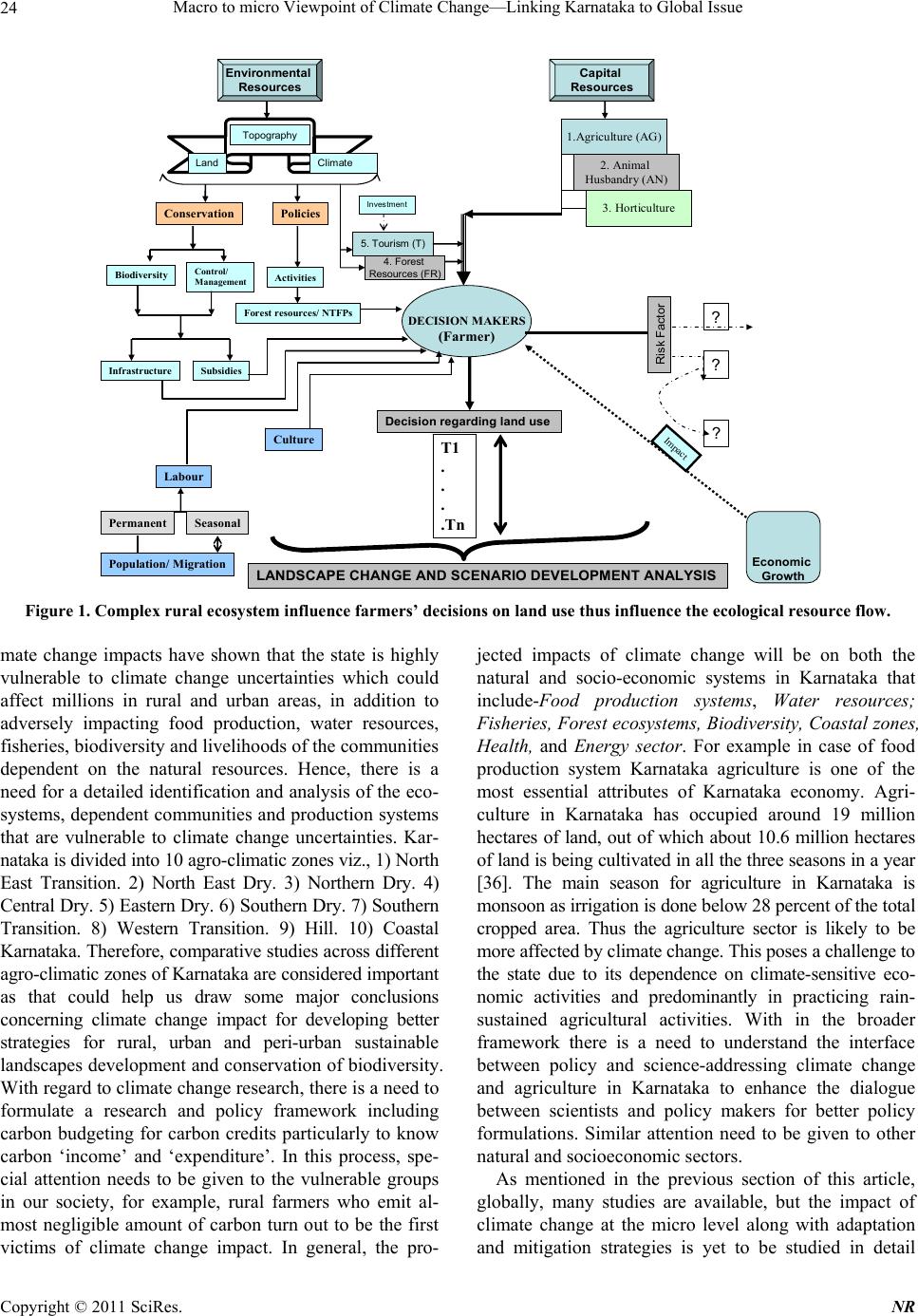 Macro to micro Viewpoint of Climate Change—Linking Karnataka to Global Issue Copyright © 2011 SciRes. NR 24 Environmental Resources 1.Agriculture (AG) 2. Animal Husbandry (AN) 3. Horticulture DECISION MAKE RS (Farmer) LANDSCAPE CHANGE AND SCENARIO DEVELOPMENT ANALYSIS Land Topography Climate Conservation 4. Forest Resour ces (FR) 5. Tourism (T) Biodiversity Control / Management Activities Forest resources/ NTFPs SubsidiesInfrastructure Population/ Migration SeasonalPerman ent Labour Economic Growth Risk Factor ? ? Decision regarding land use ? Inv estm en t Impact T1 . . . .Tn Capital Reso urce s Policies Cultur e Figure 1. Complex rural ecosystem influence farmers’ decisions on land use thus influence the ecological resource flow. mate change impacts have shown that the state is highly vulnerable to climate change uncertainties which could affect millions in rural and urban areas, in addition to adversely impacting food production, water resources, fisheries, biodiversity and liveliho ods of the co mmunities dependent on the natural resources. Hence, there is a need for a detailed identificatio n and analysis of the eco- systems, dependent communities and production systems that are vulnerable to climate change uncertainties. Kar- nataka is divided into 10 agro-climatic zones viz., 1) North East Transition. 2) North East Dry. 3) Northern Dry. 4) Central Dry. 5) Eastern Dry. 6) Southern Dry. 7) Southern Transition. 8) Western Transition. 9) Hill. 10) Coastal Karnataka. Therefore, comparative studies ac ross different agro-climatic zones of Karnataka are considered important as that could help us draw some major conclusions concerning climate change impact for developing better strategies for rural, urban and peri-urban sustainable landscapes development and conservation of biodiversity. With regard to climate change research, there is a need to formulate a research and policy framework including carbon budgeting for carbon credits particularly to know carbon ‘income’ and ‘expenditure’. In this process, spe- cial attention needs to be given to the vulnerable groups in our society, for example, rural farmers who emit al- most negligible amount of carbon turn out to be the first victims of climate change impact. In general, the pro- jected impacts of climate change will be on both the natural and socio-economic systems in Karnataka that include-Food production systems, Water resources; Fisheries, Forest ecosystems, Biodiversity, Coastal zones, Health, and Energy sector. For example in case of food production system Karnataka agriculture is one of the most essential attributes of Karnataka economy. Agri- culture in Karnataka has occupied around 19 million hectares of land, out of which about 10.6 million hectares of land is bein g cultivated in all the th ree seaso ns in a year [36]. The main season for agriculture in Karnataka is monsoon as irrigation is done below 28 percent of the total cropped area. Thus the agriculture sector is likely to be more affected by climate change. This poses a challenge to the state due to its dependence on climate-sensitive eco- nomic activities and predominantly in practicing rain- sustained agricultural activities. With in the broader framework there is a need to understand the interface between policy and science-addressing climate change and agriculture in Karnataka to enhance the dialogue between scientists and policy makers for better policy formulations. Similar attention need to be given to other natural and socioeconomic sectors. As mentioned in the previous section of this article, globally, many studies are available, but the impact of climate change at the micro level along with adaptation and mitigation strategies is yet to be studied in detail  Macro to micro Viewpoint of Climate Change—Linking Karnataka to Global Issue 25 [37-38]. Hence, the issues concerning landscape manage- ment (land use and cover), human health, human and ecosystem interactions, livelihood development of the people, natural resource management and biodiversity conservation in various parts of Karnataka need to be prioritized from the perspective of climate change re- search. The approach needs to be strengthened to gener- ate a better understanding of all the stakeholders and provide required information for advanced research and training in socioecological sciences for improving the quality of life of the people whose livelihoods are based on climate sensitive sectors such as agriculture, fisheries, animal husbandry, forest products etc. In response to a suggestion made by the Prime Minis- ter, Dr. Man Mohan Singh, for State governments to prepare a state level climate policy plan, Karnataka has a better opportunity for mitigating climate change effects through the spread of energy use efficiency and renew- able energy technologies along with large-scale affore- station activities so as to facilitate sustainab le use of bio- diversity and environmental flows. But, in the meantime, various reports show that communities and habitats in Western transition, Southern transition, Hill, Low-lying and Coastal areas, Arid & Semi-arid regions of Karna- taka may get increasingly exposed to climate change impacts that are interacting with urbanization, develop- ment, and pollution in the 21st century and beyond. Therefore, from an aggregate perspective, following points need to be addressed for devising a holistic plan with regard to climate change uncertainty in Karnataka. To identify climate variables for assessing the impact of climate change-sensitivity, adaptive capacity, vulnerabil- ity; to document assumptions, choices and the limits of scientific knowledge on climate change across different agroclimatic zones of Karnataka and enhance communi- cation between researchers, policy makers and stake- holders; to develop an action plan for climate change adaptation and mitigation, identification and assessment of vulnerability towards climate change for different sectors of Karnataka (agriculture, water bodies, forests, energy); to synthesize a knowledge base (scientific and traditional ecological knowledge) on climate change in support of decision making, communication and imple- mentation; to quantify the carbon budget of rural, peri- urban and urban landscap es in Karnataka for encourag ing low-carbon high growth and carbon credits in the global carbon market; to develop strategies for predicting the outcomes of climate changes on land use, forestry, fish- eries, water & energy sectors, sustainable livelihood de- velopment of people and biodiversity conservation and natural resource management. REFERENCES [1] Intergovernmental Panel on Climate Change (IPCC), Third Assessment Report, Cambridge Report, Cambridge University Press, UK, 2001. [2] IPCC, “Climate Change: Climate Change Impacts, Adap- tation and Vulnerability,” Working Group II Contribution to the Fourth Assessment Report, WHO and UNEP, Ge- neva, 2007. [3] M. Spence, “Climate Change, Mitigation, and Developing Country Growth, Commission on Growth and Develop- ment,” Working Paper 64, 2009. [4] R. C. Agarwal and S. Kumar, “India Official Statistics on Climate Change-Data Needs and Availability,” In: S. Nautiyal and B. P. Nayak, Eds., Climate Change: Data Requirement and Availability, ISEC-CSO, MoSPI, 2009, pp. 38-51. [5] Earth Negotiations Bulletin (ENB), Published by the In- ternational Institute for Sustainable Development (IISD), Vol. 12, No. 459, 22 December, 2009. [6] J. J. McCarthy, O. F. Canziani, N. A. Leary, D. J. Dokken and K. S. White, “Climate Change: Impacts, Adaptation, and Vulnerability,” Contribution of Working Group II to the Third Assessment Report of the Intergovernmental Panel on Climate Change, Cambridge University Press, Cambridge, UK, 2001. [7] R. J. T. Klein, R. J. Nicholls and N. Mimura, “Coastal Adaptation to Climate Change: Can the IPCC Technical Guidelines be applied?” Mitigation and Adaptation Strategies for Global Change, Vol. 4, 2004, pp. 239-252. doi:10.1023/A:1009681207419 [8] R. Warren, N. Arnell, R. Nicholls, P. Levy and J. Price, “Understanding the Regional Impacts of Climate Change,” Research report prepared for the Stern Review, Tyndall Centre Working Paper 90, Norwich: Tyndall Centre, 2006. http://www.tyndall.ac.uk/publications/working_papers/tw p90.pdf [9] N. Stern, “Stern Review on the Economics of Climate Change, London: Her Majesty’s Treasury and the Cabinet Office,” 2006. ht t p:/ / www.h mtr easury . gov.uk/independent _revie ws/ stern_ review_economics_cli mate_change/sternreview_index.cfm [10] H. Haberl, V. Winiwarter, K. Andersson, R. U. Ay res, C. Boone, A. Castillo, G. Cunfer, M. Fischer-Kowalski, W. R. Freudenburg, E. Furman, R. Kaufmann, F. Krausmann, E. Langthaler, H. Lotze-Campen, M. Mirtl, C. L. Redman, A. Reenberg, A. Wardell, B. Warr and H. Zechmeister, “From LTER to LTSER: Conceptualizing the Socioeco- nomic Dimension of Long-Term Socioecological Re- search, Ecolog y a n d Soci et y, Vol. 11, 2006. http://www.ecologyandsociety.org/vol11/iss2/art13/ [11] X. He, J. Zhou, X. Zhang and K. Tang, “Soil Erosion Response to Climate Change and Human Activity during the Quaternary on the Loess Plateau, China,” Regional Environmental C h an g e, Vol. 6, 2006, pp. 62-70. doi:10.1007/s10113-005-0004-7 [12] H. M. Fuessel, “Vulnerability: A Generally Applicable Conceptual Framework for Climate Change Research,” Global Environmental Change, Vol. 17, 2007, pp. C opyright © 2011 SciRes. NR  Macro to micro Viewpoint of Climate Change—Linking Karnataka to Global Issue 26 155-167. doi:10.1016/j.gloenvcha.2006.05.002 [13] K. Halsnæs and J. Verhagen, “Development Based Cli- mate Change Adaptation and Mitigation-Conceptual Is- sues and Lessons Learned in Studies in Developing Countries,” Mitigation and Adaptation Strategies for Global Change, Vol 12, 2007, pp. 665-684. doi:10.1007/s11027-007-9093-6 [14] U. Hellden, “A Coupled Human-Environment Model for Desertification Simulation and Impact Studies,” Global and Planetary Change, Vol. 64, 2008, pp. 158-168. doi:10.1016/j.gloplacha.2008.09.004 [15] Y. Li, D. Chen, F. Barker-Reid and R. Eckard, “Simula- tion of N2O Emissions from Rain-Fed Wheat and the Im- pact of Climate Variation in Southeastern Australia,” Plant and Soil, Vol. 309, 2008, pp. 239-251. doi:10.1007/s11104-008-9672-7 [16] S. Bauer and I. Scholz, “Adaptation to Climate Change in Southern Africa: New Boundaries for Sustainable Devel- opment?” Climate and Development, Vol. 2, 2010, pp. 83-93. doi:10.3763/cdev.2010.0040 [17] C. Arndt, K. Strzepeck, F. Tarp, J. Thurlow, C. Fant and L. Wright, “Adapting to Climate Change: An Integrated Biophysical and Economic Assessment for Mozam- bique,” Sustainability Science, 2010. doi:10.1007/s11625-010-0118-9 (online firs t). [18] S. Vavrus, W. F. Ruddiman and J. E. Kutzbach, “Climate Model Tests of the Anthropogenic Influence on Green- house-Induced Climate Change: the role of Early Human Agriculture, Industrialization, and Vegetation Feed- backs,” Quaternary Science Reviews, Vol. 27, 2008, pp. 1410-1425. doi:10.1016/j.quascirev.2008.04.011 [19] E. Archer, E. Mukhala, S. Walker, M. Dilley and K. Ma- samvu, “Sustaining Agricultural Production and Food Se- curity in Southern Africa: An Improved Role for Climate Prediction?” Climate Change, Vol. 8 3 , 2 007 , p p. 287-300. doi:10.1007/s10584-006-9192-5 [20] S. Torresan, A. Critto, M. D. Valle, N. Harvey and A. Marcomini, “Assessing Coastal Vulnerability to Climate Change: Comparing Segmentation at Global and Re- gional Scales,” Sustainability Science, Vol. 3, No. 1, 2008, pp. 45-65. [21] P. Olsson, C. Folke and F. Berkes, “Adaptive Coman- agement for Building Resilience in Socio-Ecological Systems, Environmental Management, Vol. 34, No. 1, 2004, pp. 75-90. doi:10.1007/s00267-003-0101-7 [22] J. K. Willis, D. P. Chambers and R. S. Nerem, “Assessing the Globally Averaged Sea Level Budget on Seasonal to Interannual Timescales,” Journal of Geophysical Re- search, Vol. 113, No. C6, 2008, C06015. doi:10.1029/2007JC004517 [23] W. Easterling, “Adapting North American Agriculture to Climate Change in Review,” Agricultural and Forest Meteorology, Vol. 80, No. 1, 1996, pp. 1-54. doi:10.1016/0168-1923(95)02315-1 [24] B. Smit and J. Smithers, “Sustainable Agriculture: Inter- pretations, Analyses and Prospects,” Canadian Journal of Regional Science, Vol. 16, No. 3, 1994, pp. 499-524. [25] J. Ikerd, “Understanding and Managing the Multi-Dimen- sions of Sustainable Agriculture,” Southern Regional Sustainable agriculture professional development pro- gram, SARE Regional Training Consortium, Gainesville, FL, January, 1997. [26] FAO, “World Agriculture towards 2015/2030: An FAO Perspective,” Food and Agriculture Organisation of the United Nations, Rome, 2003. [27] National Agricultural Research Project (NARP), “De- lineation of Agroclimatic Zones of India,” 2009. http://imdagrimet.org/a170.htm, Viewed on 23 December [28] A. Sharma, “Enabling Agriculture,” eAgriculture India, Vol. 1-2, 2007, pp. 17-24. [29] S. Nautiyal and H. Kaechele, “Conservation of Crop Di- versity for Sustainable Landscape Development in the Mountains of the Indian Himalayan Region,” Manage- ment of Environmental Quality, Vol. 18, No. 5, 2007, pp. 514-530. doi:10.1108/14777830710778283 [30] S. Nautiyal, K. S. Rao, H. Kaechele and P. Zander, “Conceptual Model Development for Landscape Man- agement in the Mountains of the Indian Himalayan Re- gion: An Approach for Sustainable Socio-Ecological De- velopment,” Landscape Online, Vol. 18, 2010, pp. 1-19. [31] F. Pischke and M. Cashmore, “Decision-Oriented Envi- ronmental Assessment: An Empirical Study of Its Theory and Methods,” Environmental Impact Assessment Review, Vol. 26, No. 7, 2006, pp. 643-662. doi:10.1016/j.eiar.2006.06.004 [32] S. Nautiyal, R. K. Maikhuri, K. S. Rao and K. G. Saxena, “Ecosystem Function of Cold Desert Villages of the In- dian Central Himalaya, India,” Environmental Conserva- tion for Sustainable Livelihoods in the Cold Desert Re- gion of Asia, 2010, (in press). [33] S. Nautiyal and H. Kaechele, “Natural Resource Man- agement in a Protected Area of Indian Himalaya: A Mod- eling Approach for Anthropogenic Interactions on Eco- systems,” Environmental Monitoring and Assessment, Vol. 153, No. 1-4, 2009, pp. 253-271. doi:10.1007/s10661-008-0353-z [34] P. Tittonell, M. T. van Wijk, M. C. Rufino, J. A. Vrugt and K. E. Giller, “Analysing Trade-offs in Resource and Labour Allocation by Smallholder Farmers Using Inverse Modelling Techniques: A Case-Study from Kakamega district, Western Kenya,” Agricultural Systems, Vol. 95, No. 1-3, 2007, pp. 76-95. doi:10.1016/j.agsy.2007.04.002 [35] S. Nautiyal, H. Kaechele, K. S. Rao, R. K. Maikhuri and K. G. Saxena, “Energy Use and Economic Analysis of Traditional VS Introduced Crops Cultivation in Moun- tains of Indian Himalaya: A Case Study,” Energy, Vol. 32, No. 12, 2007, pp. 2321-2335. doi:10.1016/j.energy.2007.07.011 [36] Directorate of Economics and Statistics (DES), Govern- ment of Karnataka, 2010. http://des.kar.nic.in/indexie.html, Viewed on 12 March [37] S. Nautiyal, “Changing Climate and Impacts at Micro Level: Data Requirements and Gaps,” In: S. Nautiyal and C opyright © 2011 SciRes. NR  Macro to micro Viewpoint of Climate Change—Linking Karnataka to Global Issue Copyright © 2011 SciRes. NR 27 B. P. Nayak, Eds., Climate Change: Data Requirement and Availability, ISEC & MoSPI Publication, 2009, pp. 150-161. [38] S. Nautiyal and B. P. Nayak, Climate Change: Data Re- quirement and Availability”. ISEC and MoSPI publica- tion. 2009, p. 188. |