

Paper Menu >>
Journal Menu >>
 World Journal of AIDS, 2013, 3, 364-366 Published Online December 2013 (http://www.scirp.org/journal/wja) http://dx.doi.org/10.4236/wja.2013.34047 Open Access WJA Viral Characteristic of HIV Infected Patients Naïf o f Anti-Retroviral Therapy with CD4+ T Lymphocytes Rate Greater than 350 per Microliter of Blood in Lomé Togo Ihou Nazoba Majesté Wateba, Akouda Akessiwe Patassi, Abago Balaka, Ousséni Tidjani Service de Maladies Infectieuses et de Pneumologie, CHU Sylvanus Olympio, Lomé, Togo. Email: [email protected] Received September 6th, 2013; revised October 6th, 2013; accepted October 13th, 2013 Copyright © 2013 Ihou Nazoba Majesté Wateba et al. This is an open access article distributed under the Creative Commons Attribution License, which permits unrestricted use, distribution, and reproduction in any medium, provided the original work is properly cited. ABSTRACT Obje ctive: To evaluate the virological status of ineligible HIV patients for anti-retroviral therapy based on the criterion of CD4+ T lymphocytes rate over than 350/μl of blood. Method: This is a prospective study which was conducted from November 2011 to July 2012 in the tropical and infectious disease department of CHU Sylvanus Olympio of Lomé. All HIV-1 infected patients whose CD4+ T lymphocytes rate was ≥350/μl of blood were retained. The count of CD4+ T lymphocytes was made by cytometer FACSCalibur® flow of BD biosciences and the determination of viral load was achieved by NASBA laboratory method of Biomérieux. Results: We have recruited 102 PLWHA aged between 19 and 58 years with a median of 35 years. Biologically, 102 patients had a T-CD4 rate between 355 and 432/μl of blood. The determination of viral load showed a very high viral replication more than 10,000 copies/ml among all patients and 28 (27.5%) patients had a viral load > 100,000 copies/ml of blood. Conclusion: Our results argue for a reconsideration of the criteria for starting antiretroviral therapy in Togo by including virological data if necessary in patients with T-CD4 rate below 500/μl of blood. Keywords: Viral Load; CD4+ T Lymphocytes; Naive Anti-Retroviral Therapy Patients 1. Introduction Twenty-five years after the start of the pandemic of hu- man immunodeficiency virus (HIV) and despite the in- ternational mobilization, HIV/AIDS which is a major public health problem in developing countries remains. In Togo, the HIV epidemic has been documented since 1987. Between 1987 and 2005, 20,676 cumulative AIDS cases were officially registered and 110,000 people are living with HIV [1]. The prevalence of HIV infection was successively 5.8% in 2001, 4.1% in 2003, 3.2% in 2005 and 3% in 2008 [1]. In 2012, more than 36,000 people have had received antiretroviral therapy. Since 2012, the immunological criteria for starting treatment were recon- sidered from ≤200 CD4+ T lymphocytes to ≤350 CD4+ T lymphocytes per μl of blood. For higher rates, the ini- tiation of treatment considers the clinical condition of the patient [2-4]. The aim of our study was to evaluate the viral status of patients ineligible for anti-retroviral ther- apy (CD4+ T lymphocytes rate more than 350 per μl of blood) according to the national algorithm of Togo. 2. Method This is a prospective study which was done in the tropi- cal and infectious diseases department of CHU Sylvanus Olympio of Lomé in Togo. All patients are HIV-1 in- fected and naive for anti retroviral treatment. The CD4+ T lymphocytes rate is between 350 and 500 per μl of blood. The T-CD4 count was performed by the technique of flow cytometry of BD Biosciences FACSCalibur™. The determination of the viral load was performed by the NASBA method (Nucleid Acid Sequence Based Ampli- fication) with EasyQ BioMerieux equipment. 3. Results Epidemiological data: Two hundred HIV-1 infected pa- tients were included in the study. Seventy-five patients (74.5%) were female and 27 were male (25.5%). The sex ratio M/F was 0.34. The age of patients ranged from 19 to 58 years with a median of 35 years. Biological data: The rate of CD4+ T lymphocytes was 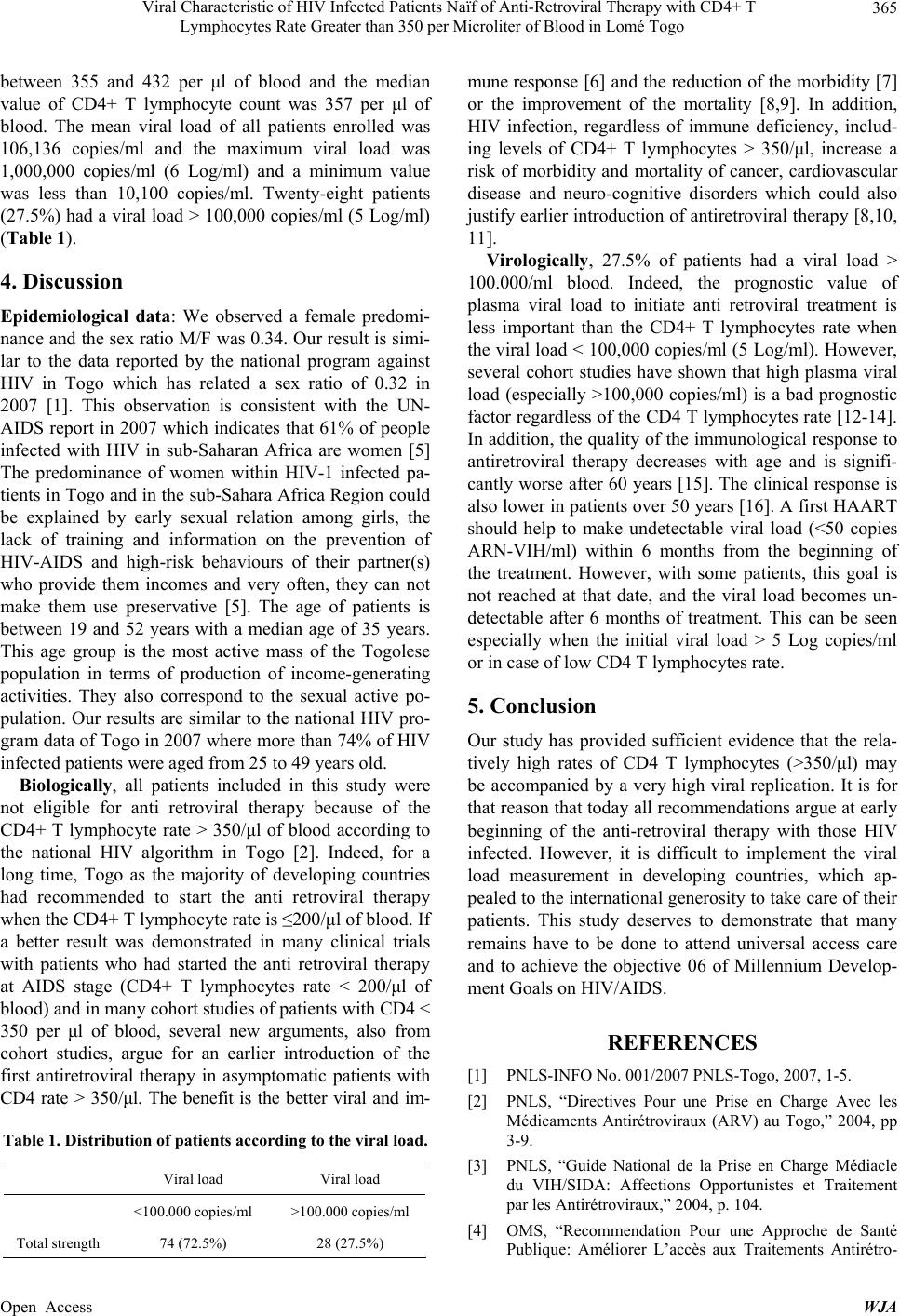 Viral Characteristic of HIV Infected Patients Naïf of Anti-Retroviral Therapy with CD4+ T Lymphocytes Rate Greater than 350 per Microliter of Blood in Lomé Togo 365 between 355 and 432 per μl of blood and the median value of CD4+ T lymphocyte count was 357 per μl of blood. The mean viral load of all patients enrolled was 106,136 copies/ml and the maximum viral load was 1,000,000 copies/ml (6 Log/ml) and a minimum value was less than 10,100 copies/ml. Twenty-eight patients (27.5%) had a viral load > 100,000 copies/ml (5 Log/ml) (Table 1). 4. Discussion Epidemiological data: We observed a female predomi- nance and the sex ratio M/F was 0.34. Our result is simi- lar to the data reported by the national program against HIV in Togo which has related a sex ratio of 0.32 in 2007 [1]. This observation is consistent with the UN- AIDS report in 2007 which indicates that 61% of people infected with HIV in sub-Saharan Africa are women [5] The predominance of women within HIV-1 infected pa- tients in Togo and in the sub-Sahara Africa Region could be explained by early sexual relation among girls, the lack of training and information on the prevention of HIV-AIDS and high-risk behaviours of their partner(s) who provide them incomes and very often, they can not make them use preservative [5]. The age of patients is between 19 and 52 years with a median age of 35 years. This age group is the most active mass of the Togolese population in terms of production of income-generating activities. They also correspond to the sexual active po- pulation. Our results are similar to the national HIV pro- gram data of Togo in 2007 where more than 74% of HIV infected patients were aged from 25 to 49 years old. Biologically, all patients included in this study were not eligible for anti retroviral therapy because of the CD4+ T lymphocyte rate > 350/μl of blood according to the national HIV algorithm in Togo [2]. Indeed, for a long time, Togo as the majority of developing countries had recommended to start the anti retroviral therapy when the CD4+ T lymphocyte rate is ≤200/μl of blood. If a better result was demonstrated in many clinical trials with patients who had started the anti retroviral therapy at AIDS stage (CD4+ T lymphocytes rate < 200/μl of blood) and in many cohort studies of patients with CD4 < 350 per μl of blood, several new arguments, also from cohort studies, argue for an earlier introduction of the first antiretroviral therapy in asymptomatic patients with CD4 rate > 350/μl. The benefit is the better viral and im- Table 1. Distribution of patients according to the viral load. Viral load Viral load <100.000 copies/ml >100.000 copies/ml Total strength 74 (72.5%) 28 (27.5%) mune response [6] and the reduction of the morbidity [7] or the improvement of the mortality [8,9]. In addition, HIV infection, regardless of immune deficiency, includ- ing levels of CD4+ T lymphocytes > 350/μl, increase a risk of morbidity and mortality of cancer, cardiovascular disease and neuro-cognitive disorders which could also justify earlier introduction of antiretroviral therapy [8,10, 11]. Virologically, 27.5% of patients had a viral load > 100.000/ml blood. Indeed, the prognostic value of plasma viral load to initiate anti retroviral treatment is less important than the CD4+ T lymphocytes rate when the viral load < 100,000 copies/ml (5 Log/ml). However, several cohort studies have shown that high plasma viral load (especially >100,000 copies/ml) is a bad prognostic factor regardless of the CD4 T lymphocytes rate [12-14]. In addition, the quality of the immunological response to antiretroviral therapy decreases with age and is signifi- cantly worse after 60 years [15]. The clinical response is also lower in patients over 50 years [16]. A first HAART should help to make undetectable viral load (<50 copies ARN-VIH/ml) within 6 months from the beginning of the treatment. However, with some patients, this goal is not reached at that date, and the viral load becomes un- detectable after 6 months of treatment. This can be seen especially when the initial viral load > 5 Log copies/ml or in case of low CD4 T lymphocytes rate. 5. Conclusion Our study has provided sufficient evidence that the rela- tively high rates of CD4 T lymphocytes (>350/μl) may be accompanied by a very high viral replication. It is for that reason that today all recommendations argue at early beginning of the anti-retroviral therapy with those HIV infected. However, it is difficult to implement the viral load measurement in developing countries, which ap- pealed to the international generosity to take care of their patients. This study deserves to demonstrate that many remains have to be done to attend universal access care and to achieve the objective 06 of Millennium Develop- ment Goals on HIV/AIDS. REFERENCES [1] PNLS-INFO No. 001/2007 PNLS-Togo, 2007, 1-5. [2] PNLS, “Directives Pour une Prise en Charge Avec les Médicaments Antirétroviraux (ARV) au Togo,” 2004, pp 3-9. [3] PNLS, “Guide National de la Prise en Charge Médiacle du VIH/SIDA: Affections Opportunistes et Traitement par les Antirétroviraux,” 2004, p. 104. [4] OMS, “Recommendation Pour une Approche de Santé Publique: Améliorer L’accès aux Traitements Antirétro- Open Access WJA  Viral Characteristic of HIV Infected Patients Naïf of Anti-Retroviral Therapy with CD4+ T Lymphocytes Rate Greater than 350 per Microliter of Blood in Lomé Togo Open Access WJA 366 viraux dans les Pays à Ressources Limitées,” 2002, pp. 8- 9. [5] ONUSIDA, “Rapport sur l’Épidémie Mondiale de SIDA,” ONUSIDA, Genève, 2006, pp. 3-4. [6] R. D. Moore and J. C. Keruly, “CD4+ Cell Count 6 Years after Commencement of Highly Active Antiretroviral Ther- apy in Person with Sustained Virologic Suppression,” Clinical Infectious Diseases, Vol. 44, No. 3, 2007, pp. 441-446. http://dx.doi.org/10.1086/510746 [7] J. V. Baker, G. Peng, J. Rapkin, et al., “CD4+ Count and Risk of Non-AIDS Diseases Following Initial Treatment for HIV Infection,” AIDS, Vol. 22, No. 7, 2008, pp. 841- 888. http://dx.doi.org/10.1097/QAD.0b013e3282f7cb76 [8] S. Emery, J. A. Neuhaus, A. N. Phillips, et al., “Major Clinical Outcomes in Antiretroviral Therapy (ART)-Na- ive Participants and in Those Not Receiving ART at Baseline in the SMART Study,” Journal of Infectious Diseases, Vol. 197, No. 8, 2008, pp. 1133-1144. http://dx.doi.org/10.1086/586713 [9] HIV-CAUSAL Collaboration, et al., “The Effect of Com- bined Antiretroviral Therapy on the Overall Mortality of HIV-Infected Individuals,” AIDS, Vol. 24, No. 1, 2010, pp. 123-137. http://dx.doi.org/10.1097/QAD.0b013e3283324283 [10] M. Guiguet, F. Boue, J. Cadranel, J. M. Lang, E. Rosen- thal and D. Costagliola, “Effect of Immunodeficiency, HIV Viral Load, and Antiretroviral Therapy on the Risk of Individual Malignancies (FHDH-ANRS CO4): A Pro- spective Cohort Study,” Lancet Oncology, Vol. 10, No. 12, 2009, pp. 1152-1159. http://dx.doi.org/10.1016/S1470-2045(09)70282-7 [11] C. F. Kelley, C. M. Kitchen, P. W. Hunt, et al., “Incom- plete Peripheral CD4+ Cell Count Restoration in HIV In- fected Patients Receiving Long-Term Antiretroviral Treat- ment,” Clinical Infectious Diseases, Vol. 48, No. 6, 2009, pp. 787-794. http://dx.doi.org/10.1086/597093 [12] M. Egger, M. May, G. Chêne, et al., “Prognosis of HIV- 1-Infected Patients Starting Highly Active Antiretroviral Therapy: A Collaborative Analysis of Prospective Stud- ies,” Lancet, Vol. 360, No. 9327, 2002, pp. 119-129. http://dx.doi.org/10.1016/S0140-6736(02)09411-4 [13] J. P. Phair, J. W. Mellors, R. Detels, J. B. Margolick and A. Munoz, “Virologic and Immunologic Values Allowing Safe Deferral of Antiretroviral Therapy,” AIDS, Vol. 16, No. 18, 2002, pp. 2455-2459. http://dx.doi.org/10.1097/00002030-200212060-00011 [14] E. Wood, R. S. Hogg, B. Yip, et al., “Higher Baseline Levels of Plasma Human Immunodeficiency Virus Type 1 RNA Are Associated with Increased Mortality after Ini- tiation of Triple-Drug Antiretroviral Therapy,” Journal of Infectious Diseases, Vol. 188, No. 10, 2003, pp. 1421- 1425. http://dx.doi.org/10.1086/379201 [15] Collaboration of Observational HIV Epidemiological Re- search Europe (COHERE) Study Group, et al., “Response to Combination Antiretroviral Therapy: Variation by Age,” AIDS, Vol. 22, No. 12, 2008, pp. 1463-1473. http://dx.doi.org/10.1097/QAD.0b013e3282f88d02 [16] A. H. Greenbaum, L. E. Wilson, J. C. Keruly, R. D. Moore and K. A. Gebo, “Effect of Age and HAART Regimen on Clinical Response in an Urban Cohort of HIV-Infected Individuals,” AIDS, Vol. 22, No. 17, 2008, pp. 2331-2339. http://dx.doi.org/10.1097/QAD.0b013e32831883f9 |