

Paper Menu >>
Journal Menu >>
 iBusiness, 2013, 5, 184-188 Published Online December 2013 (http://www.scirp.org/journal/ib) http://dx.doi.org/10.4236/ib.2013.54023 Open Access IB Tax Shield and Its Impact on Corporate Dividend Policy: Evidence from Pakistani Stock Market Akhlaq ul Hassan1, Mubashar Tanveer2, Muhammad Siddique3, Muhammad Mudasar4 1I-Mtas College Sinllanwali, Sargodha, Pakistan; 2University of Sargodha, Sargodha, Pakistan; 3Universiti Teknologi Malaysia, Johor Bahru, Malaysia; 4Govt College of Commerce Shahpur Sadar, Sargodha, Pakistan. Email: [email protected] Received July 5th, 2013; revised August 5th, 2013; accepted September 5th, 2013 Copyright © 2013 Akhlaq ul Hassan et al. This is an open access article distributed under the Creative Commons Attribution License, which permits unrestricted use, distribution, and reproduction in any medium, provided the original work is properly cited. ABSTRACT The problem: what is the taxation impact on dividend policy? While much optimal taxation research focuses on the e- conomic effects of taxation, the purpose of this study is to add a new dimension by investigating the relationship be- tween taxation and payout ratio and some other variables of dividend policy. These relations are tested using the data from financial statements of KSE listed companies. The results show that tax shield has no significant relation to the dividend payout ratio but mostly dividend policy is due to the size of the firm and its profitability. Keywords: Dividend Policy; Tax Shield; Determinant’s of Dividends 1. Introduction A snowy debate in finance and public economics litera- tures about the role of taxation in corporate dividend policies is there. Taxes and dividend policy are the one of the very important topics of corporate finance, as well as for the Pakistani stock market. A lot of arguments re- garding taxes and dividend policy have attracted many educational researchers. Dividends, since the days of Mil- ler and Modigliani, have been a topic of extensive re- search in academia and the debate between practitioners. Dividends provide “recompense” in a sense to investors who have taken a menace by investing in the stock of a certain company. Income that is earned by the company is distributed to shareholders, and repeatedly increases over time. They are normally paid on a regular basis, such as quarterly. Companies that have a record of paying divi- dends are usually traded at a first-class versus those that do not. Investors in the company are thus provided cash flow without having to sell shares; therefore, traditionally, companies paying relatively high dividends have been purchased by those on a fixed income. Manager’s base current dividend levels of past dividend levels and current earnings and imagine dividends are steady over time [1]. On the other side, some theories have conservative opin- ion that dividend policy is applicable due to the exist- ence of differential taxes in the market [2] (Poterba and Summers, 1984; Ang et al., [3,4]). Others disagree that “Clientele Effects” matter in dividend policy decisions (Pettit, 1977; Scholz, 1992). It is because investors’ pref- erences divide them in groups that tend them to select a company where their investment goals and dividend pol- icy are associated. Signaling models focus on allaying the information asymmetries. The former known as “Signal- ing” theory, assumes that the dividend is one of the sources through which a company can suggest informa- tion to the market (Bhattacharya, 1979; [5,6]). According to this theory, the dividend can moderate information asymmetries between managers and shareholders by conveying inside information of a firm’s future prospects. The latter, known as “Agency” theory, argues that the dividend reduces the costs of shareholder-manager con- flict and it performs a controlling function where moni- toring of a firm’s management by its Shareholders is in- active [7]; Easterbrook, in 1984, [8] argues that by paying dividends the flexible resources under managerial control can be decreased and in this way the over investment difficulty can be determined. Actual company earnings are another key determinant of dividend payouts. There is a statistically significant relationship between dividends and earnings [9,10] (Hsu, Wang, & Wu, 1998; Lintner, 1956). Bhattacharya (1979), Miller and Rock (1985) [11] show that adjustments in dividend payments are con- nected to changes in earnings. A relationship between dividends and earnings is also reported in other studies  Tax Shield and Its Impact on Corporate Dividend Policy: Evidence from Pakistani Stock Market 185 [12,13] (Watts, 1973, Gonedes, 1978, Lee & Kau, 1987). Analyzing time series and cross-sectional data, Fama shows that dividends and earnings are extremely corre- lated. However, a survey with 384 financial executives conducted by Brava, et al. (2005) shows that the connec- tion between earnings and dividends has weakened the market debt to capital ratio which is another possible explanation of the variability in dividend payments. Sev- eral papers have found a negative relationship between leverage and dividend payout ratios. This negative rela- tionship is plausible due to the extent that debts and divi- dends are substitutes employed by managers to mitigate agency conflicts or asymmetric information problems, and this implies that an increased market debt to capital ratio reduces dividend payout rates and vice versa. The objective of this study is to assess the effect of tax shield on the dividend policies in the KSE listed companies of Pakistan. This study will also evaluate the role of taxes to establish the dividend policies of the corporate sectors. This study has the capacity to be helpful to policy makers to better recognize how taxes impact dividend policies and they will be in a better position to develop dividend poli- cies by keeping in view of the influence of taxes. Before conducting this study, our expectation was that tax saving would directly go to the shareholders of the company. 2. Literature Review [14] suggested in their study that before- and after-tax returns to capital cannot be precisely estranged from the tax system. They emphasized that in the best dividend payout behavior, one cannot be separated away from equilibrium concern and the analysis of the effect of taxation on business valuation. [15] proposed that due to the impediment in personal tax advantage of dividend, the shareholder greatly prefers to invest in real assets to use internal financing as compared to external. The profit- ability of internally financed security investment is de- pendent on the tax status of security and also the tax bracket of shareholder. In contrast, externally-financed security purchases are making loss from a tax stand point. [16] evaluated the tax effect on dividend policy of Nige- rian banks and proposed in their study that various factors influenced the dividend pattern of companies. Due to the accessibility of the profit, the dividend policy of the banks is to frequently sustain a low but constant payout. The most important factor of the dividend structure is the liquidity position of the company. Dividend clients are a very alarming aspect in the concern of a dividend policy. [17] identified the signaling equilibrium with taxable dividends in their theory. They described in their theory that the employees of the organization, with more essen- tial and confidential information, best allocate larger dividends and obtain higher prices for their stock when- ever firms have a demand of cash; thus, its existing stockholders exceed its internal supply of cash. Green et. al. (1993) questioned the irrelevance argument and in- vestigated the relationship between the dividends and investment and financing decisions. Their study showed that dividend payout levels are not totally decided after a firm’s investment and financing decisions have been made. Dividend decision is taken along with investment and financing decisions. The results however do not support the views of Miller and Modigliani (1961) [18]. Partington (1983) revealed that firms’ use target payout ratios, firms’ motives for paying dividends and extent to which dividends are determined are independent of in- vestment policy. [19] indicates a direct link between growth and financing needs: rapidly growing firms have external financing needs because working capital needs normally exceed the incremental cash flows from new sales. Higgins (1972) shows that payout ratios are nega- tively related to firms’ need top fund finance growth op- portunities. Rozeff (1982), Lloyd et al. (1985) and Collins et al. (1996) all show significantly negative relationship between historical sales growth and dividend payout. D, Souza (1999) however shows a positive but insignificant relationship in the case of growth and negative but insig- nificant relationship in case of market to book value. In the seminal work on dividends and company’s’ maturity, Grullon et al. (2002) analyzed listed companies of New York (NYSE) and American (AMEX) stock exchanges between 1967 and 1993. They argued that company that increases dividends experience a significant decline in their systematic risk and such companies do not increase their capital expenditure and experience a decline in profitability in the years after the change in dividends. They proposed an alternative explanation of Jensens’s (1986) free cash flow hypothesis known as “Maturity Hypothesis”. According to them in growing stage a com- pany has many positive NPV projects and it earns large economic profits with high level of capital expenditure. Such companies are left with low free cash flows and experience rapid growth in their earnings. But as a com- pany continues to grow due to market competition, its share price is cannibalized which reduces its profits. In this transition phase, the company’s investment opportu- nities begins to shrink and pace of its growth becomes slow, hence company starts generating larger amount of free cash flows. Ultimately it enters into maturity phase in which the return on investment is close to the cost of capital and its cash free cash flows are high. These mature companies are now able to pay higher dividends. Ahmed and Javid [20] proposed in their study that whenever the non-financial companies of Pakistan quoted on Karachi Stock Exchange set their dividend payments, these firms consider the existing earning per share and past dividend patterns. But, the tendency of dividend should be more responsive to current earnings than previous dividends. The listed non-financial companies having high momen- Open Access IB 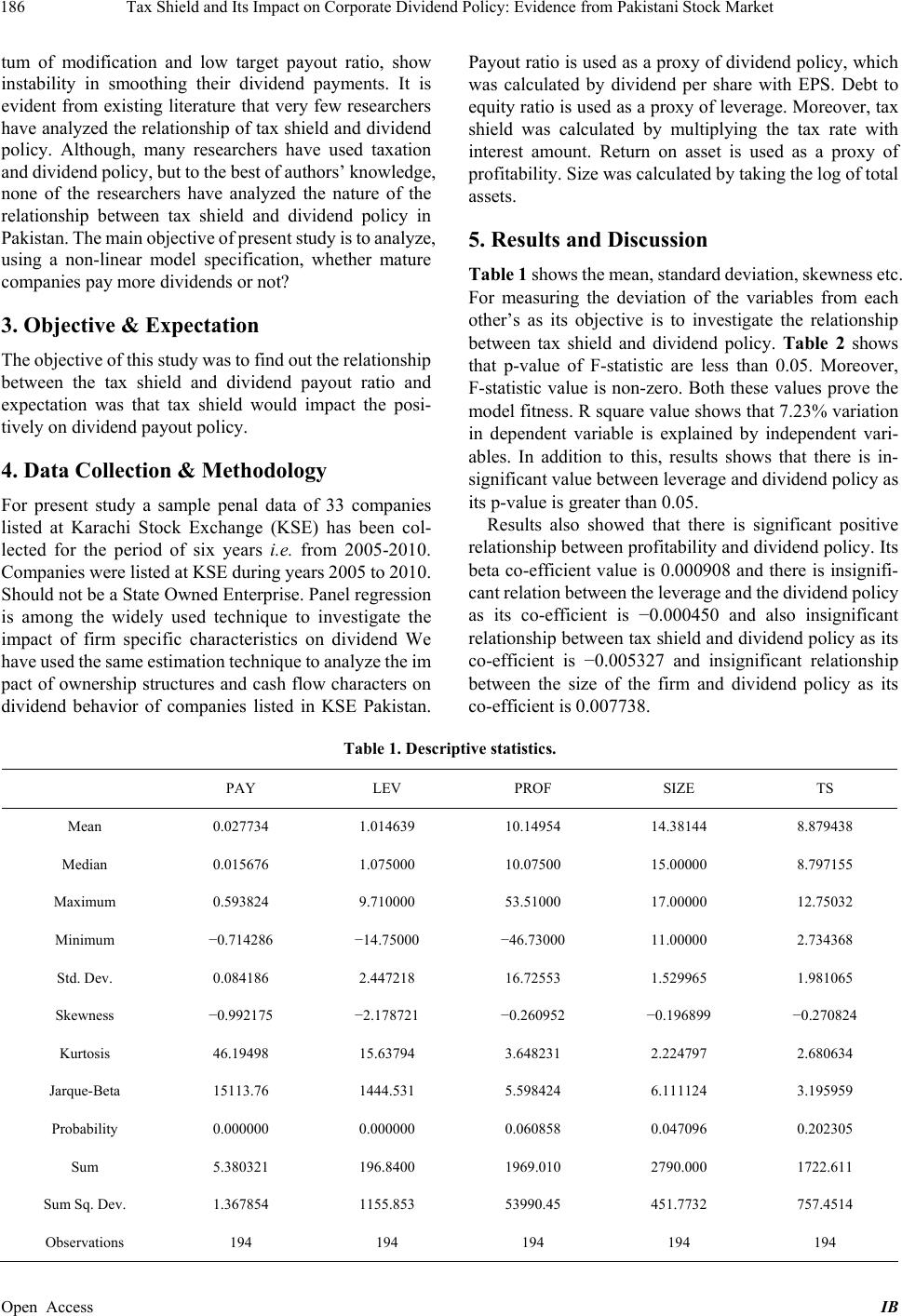 Tax Shield and Its Impact on Corporate Dividend Policy: Evidence from Pakistani Stock Market Open Access IB 186 tum of modification and low target payout ratio, show instability in smoothing their dividend payments. It is evident from existing literature that very few researchers have analyzed the relationship of tax shield and dividend policy. Although, many researchers have used taxation and dividend policy, but to the best of authors’ knowledge, none of the researchers have analyzed the nature of the relationship between tax shield and dividend policy in Pakistan. The main objective of present study is to analyze, using a non-linear model specification, whether mature companies pay more dividends or not? 3. Objective & Expectation The objective of this study was to find out the relationship between the tax shield and dividend payout ratio and expectation was that tax shield would impact the posi- tively on dividend payout policy. 4. Data Collection & Methodology For present study a sample penal data of 33 companies listed at Karachi Stock Exchange (KSE) has been col- lected for the period of six years i.e. from 2005-2010. Companies were listed at KSE during years 2005 to 2010. Should not be a State Owned Enterprise. Panel regression is among the widely used technique to investigate the impact of firm specific characteristics on dividend We have used the same estimation technique to analyze the im pact of ownership structures and cash flow characters on dividend behavior of companies listed in KSE Pakistan. Payout ratio is used as a proxy of dividend policy, which was calculated by dividend per share with EPS. Debt to equity ratio is used as a proxy of leverage. Moreover, tax shield was calculated by multiplying the tax rate with interest amount. Return on asset is used as a proxy of profitability. Size was calculated by taking the log of total assets. 5. Results and Discussion Table 1 shows the mean, standard deviation, skewness etc. For measuring the deviation of the variables from each other’s as its objective is to investigate the relationship between tax shield and dividend policy. Table 2 shows that p-value of F-statistic are less than 0.05. Moreover, F-statistic value is non-zero. Both these values prove the model fitness. R square value shows that 7.23% variation in dependent variable is explained by independent vari- ables. In addition to this, results shows that there is in- significant value between leverage and dividend policy as its p-value is greater than 0.05. Results also showed that there is significant positive relationship between profitability and dividend policy. Its beta co-efficient value is 0.000908 and there is insignifi- cant relation between the leverage and the dividend policy as its co-efficient is −0.000450 and also insignificant relationship between tax shield and dividend policy as its co-efficient is −0.005327 and insignificant relationship between the size of the firm and dividend policy as its co-efficient is 0.007738. Table 1. Descriptive statistics. PAY LEV PROF SIZE TS Mean 0.027734 1.014639 10.14954 14.38144 8.879438 Median 0.015676 1.075000 10.07500 15.00000 8.797155 Maximum 0.593824 9.710000 53.51000 17.00000 12.75032 Minimum −0.714286 −14.75000 −46.73000 11.00000 2.734368 Std. Dev. 0.084186 2.447218 16.72553 1.529965 1.981065 Skewness −0.992175 −2.178721 −0.260952 −0.196899 −0.270824 Kurtosis 46.19498 15.63794 3.648231 2.224797 2.680634 Jarque-Beta 15113.76 1444.531 5.598424 6.111124 3.195959 Probability 0.000000 0.000000 0.060858 0.047096 0.202305 Sum 5.380321 196.8400 1969.010 2790.000 1722.611 Sum Sq. Dev. 1.367854 1155.853 53990.45 451.7732 757.4514 Observations 194 194 194 194 194 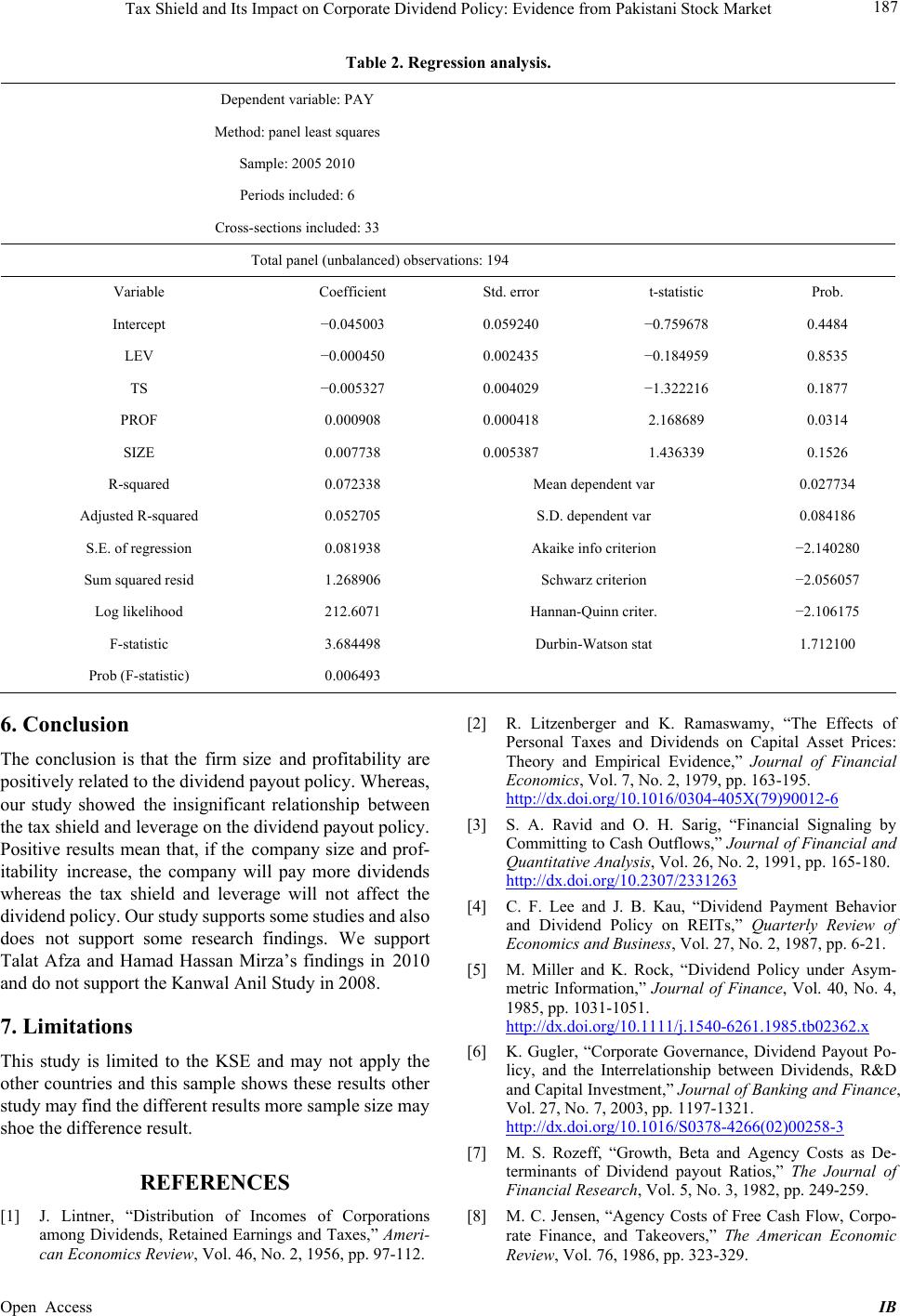 Tax Shield and Its Impact on Corporate Dividend Policy: Evidence from Pakistani Stock Market 187 Table 2. Regression analysis. Dependent variable: PAY Method: panel least squares Sample: 2005 2010 Periods included: 6 Cross-sections included: 33 Total panel (unbalanced) observations: 194 Variable Coefficient Std. error t-statistic Prob. Intercept −0.045003 0.059240 −0.759678 0.4484 LEV −0.000450 0.002435 −0.184959 0.8535 TS −0.005327 0.004029 −1.322216 0.1877 PROF 0.000908 0.000418 2.168689 0.0314 SIZE 0.007738 0.005387 1.436339 0.1526 R-squared 0.072338 Mean dependent var 0.027734 Adjusted R-squared 0.052705 S.D. dependent var 0.084186 S.E. of regression 0.081938 Akaike info criterion −2.140280 Sum squared resid 1.268906 Schwarz criterion −2.056057 Log likelihood 212.6071 Hannan-Quinn criter. −2.106175 F-statistic 3.684498 Durbin-Watson stat 1.712100 Prob (F-statistic) 0.006493 6. Conclusion The conclusion is that the firm size and profitability are positively related to the dividend payout policy. Whereas, our study showed the insignificant relationship between the tax shield and leverage on the dividend payout policy. Positive results mean that, if the company size and prof- itability increase, the company will pay more dividends whereas the tax shield and leverage will not affect the dividend policy. Our study supports some studies and also does not support some research findings. We support Talat Afza and Hamad Hassan Mirza’s findings in 2010 and do not support the Kanwal Anil Study in 2008. 7. Limitations This study is limited to the KSE and may not apply the other countries and this sample shows these results other study may find the different results more sample size may shoe the difference result. REFERENCES [1] J. Lintner, “Distribution of Incomes of Corporations among Dividends, Retained Earnings and Taxes,” Ameri- can Economics Review, Vol. 46, No. 2, 1956, pp. 97-112. [2] R. Litzenberger and K. Ramaswamy, “The Effects of Personal Taxes and Dividends on Capital Asset Prices: Theory and Empirical Evidence,” Journal of Financial Economics, Vol. 7, No. 2, 1979, pp. 163-195. http://dx.doi.org/10.1016/0304-405X(79)90012-6 [3] S. A. Ravid and O. H. Sarig, “Financial Signaling by Committing to Cash Outflows,” Journal of Financial and Quantitative Analysis, Vol. 26, No. 2, 1991, pp. 165-180. http://dx.doi.org/10.2307/2331263 [4] C. F. Lee and J. B. Kau, “Dividend Payment Behavior and Dividend Policy on REITs,” Quarterly Review of Economics and Business, Vol. 27, No. 2, 1987, pp. 6-21. [5] M. Miller and K. Rock, “Dividend Policy under Asym- metric Information,” Journal of Finance, Vol. 40, No. 4, 1985, pp. 1031-1051. http://dx.doi.org/10.1111/j.1540-6261.1985.tb02362.x [6] K. Gugler, “Corporate Governance, Dividend Payout Po- licy, and the Interrelationship between Dividends, R&D and Capital Investment,” Journal of Banking and Finance, Vol. 27, No. 7, 2003, pp. 1197-1321. http://dx.doi.org/10.1016/S0378-4266(02)00258-3 [7] M. S. Rozeff, “Growth, Beta and Agency Costs as De- terminants of Dividend payout Ratios,” The Journal of Financial Res e arch, Vol. 5, No. 3, 1982, pp. 249-259. [8] M. C. Jensen, “Agency Costs of Free Cash Flow, Corpo- rate Finance, and Takeovers,” The American Economic Review, Vol. 76, 1986, pp. 323-329. Open Access IB  Tax Shield and Its Impact on Corporate Dividend Policy: Evidence from Pakistani Stock Market 188 [9] J. Aharony and I. Swary, “Quarterly Dividend and Earn- ings Announcements and Stockholders. Returns: An Em- pirical Analysis,” Journal of Finance, Vol. 35, No. 1, 1980, pp. 1-12. http://dx.doi.org/10.1111/j.1540-6261.1980.tb03466.x [10] P. Asquith and D. Mullins, “The Impact of Initiating Dividend Payments on Shareholders’ Wealth,” Journal of Business, Vol. 56, No. 1, 1983, pp. 77-96. http://dx.doi.org/10.1086/296187 [11] J. Poterba and S. Lawrence, “The Economic Effects of Di- vidend Taxation,” In: E. Altman and M. Subrahmanyam, Eds., Recent Advances in Corporation Finance, Dow Jones-Irwin, Homewood, 1985, pp. 227-284. [12] C. Chen and C. Wu, “The Dynamics of Dividends, Earn- ings and Prices: Evidence and Implications for Dividend Smoothing and Signaling,” Journal of Empirical Finance, Vol. 6, No. 1, 1999, pp. 29-58. http://dx.doi.org/10.1016/S0927-5398(98)00008-5 [13] E. F. Fama and H. Babiak, “Dividend Policy: An Empiri- cal Analysis,” Journal of the America, 1968. [14] F. Leroy and S. Barbara, “Dividend Policy and Income Taxation,” University of California, 2008. [15] R. W. Masulis and B. Trueman, “Corporate Investment and Dividend Decisions under Differential Personal Taxa- tion,” Journal of Financial and Quantitative Analysis, Vol. 23, No. 4, 1988, pp. 369-386. http://dx.doi.org/10.2307/2331077 [16] A. Nnadi and M. Akpomi, “The Effect of Taxes on Divi- dend Policy of Banks in Nigeria,” International Research Journal of Finance and Economics, Vol. 19, 2008, pp. 48-55. [17] J. Kose and J. Williams, “Dividends, Dilution, and Taxes: A Signaling Equilibrium,” Journal of Finance, Vol. 40, No. 4, 1985, pp. 1053-1070. http://dx.doi.org/10.1111/j.1540-6261.1985.tb02363.x [18] M. H. Miller and F. Modigliani, “Dividend Policy, Growth and the Valuation of Shares,” The Journal of Business, Vol. 34, No. 4, 1961, pp. 411-433. http://dx.doi.org/10.1086/294442 [19] R. C. Higgins, “Sustainable Growth under Inflation,” Fin- ancial Management, Vol. 10, 1981, pp. 36-40. http://dx.doi.org/10.2307/3665217 [20] H. Ahmedws and J. Attiya, “Dynamics and Determinants of Dividend Policy in Pakistan (Evidence from Karachi Stock Exchange Non-Financial Firms),” International Journal of Finance and Economics, No. 25, 2009, pp. 148-171. Open Access IB |