

Paper Menu >>
Journal Menu >>
 Psychology 2013. Vol.4, No.12, 1014-1017 Published Online December 2013 in SciRes (http://www.scirp.org/journal/psych) http://dx.doi.org/10.4236/psych.2013.412147 Open Access 1014 Double-Step Adaptation of Saccadic Eye Movements Is Influenced by Priming with Age Stereotypies Otmar Bock1, Valentina Grigorova2, Milena Ilieva2 1Institute of Physiology and Anatomy, German Sport University, Köln, Germany 2Institute of Neurobiology, Bulgarian Academy of Sciences, Sofia, Bulgaria Email: [email protected] Received August 13th, 2013; revised September 16th, 2013; accepted October 12th, 2013 Copyright © 2013 Otmar Bock et al. This is an open access article distributed under the Creative Commons At- tribution License, which permits unrestricted use, distribution, and reproduction in any medium, provided the original work is properly cited. In accordance of the Creative Commons Attribution License all Copyrights © 2013 are reserved for SCIRP and the owner of the intellectual property Otmar Bock et al. All Copyright © 2013 are guarded by law and by SCIRP as a guardian. Age related deficits of sensorimotor adaptation have been observed earlier with arm, but not with eye movements. Here we evaluate whether deficits of eye adaptation may depend on the subjects’ believes about their own sensorimotor abilities. To find out, elderly subjects were primed with positive or negative age stereotypes using the scrambled-sentence task, and were then exposed to a double-step saccade adap- tation task. The outcome was compared to data from an earlier study with unprimed elderly persons. We found adaptation to be stronger after positive priming than after negative or no priming, with no differ- ence between the latter two. Aftereffects of adaptation were not modified by priming. From this we con- clude that positive primes enhanced workaround strategies, but not adaptive recalibration, while negative primes failed completely, possibly because of a floor effect. Keywords: Old Age; Plasticity; Strategies; Recalibration; Societal Stereotypies Introduction The human sensorimotor system adapts readily to a wide range of distortions (Bock, 2013): when the visual or the force environment is systematically altered, our behavior is initially perturbed but gradually normalizes with extended practice. This ability deteriorates in old age; however, it has been shown that the speed and magnitude of adaptive change are reduced, while aftereffects remain intact (Bock, 2005; Fernández-Ruiz, Hall, Vergara, & Díaz, 2000; McNay & Willingham, 1998). Since aftereffects are thought to reflect adaptive recalibration only, unbiased by strategies (McNay & Willingham, 1998; Redding & Wallace, 1996), the above work indicates that strategic con- trol but not adaptive recalibration is degraded in old age. Accor- dingly, age-related deficits of adaptive change were found to be associated with cognitive decline (Bock & Girgenrath, 2006). The above studies dealt with the effects of old age on the adaptation of arm movements. We have recently expanded this work to oculomotor saccades and found no age-related deficits for saccadic adaptation under single-task conditions, nor under dual-task conditions when the second task was spatially adja- cent; an adaptation deficit only emerged when the second task was located further away (Bock et al., under review). We at- tributed that deficit to the well-known shrinkage of the attention focus in old age (Ball & Owsley, 1993; Beurskens & Bock, 2012; Sekuler & Ball, 1986), and concluded that saccadic ad- aptation per se is largely age-independent. It seems surprising that saccadic adaptation should be im- mune to age-related decay, while other characteristics of ocular saccades deteriorate: their speed and accuracy decreases (Bono et al., 1996; Paquette & Fung, 2011), and their path across a visual scene becomes less efficient (Chapman & Hollands, 2006; Maltz & Shinar, 1999). In fact, elderly subjects in our preceding study didn’t adapt as well as young ones (Bock et al., under review), only the deficit didn’t reach statistical signifi- cance. With these arguments casting doubt on our earlier con- clusion, we decided to scrutinize it with a fresh approach. Following the arguments of others, we reasoned that sen- sorimotor performance in old age is determined not only by biological decay, but also by the actor’s confidence in her/his own capacity. This has been shown by studies which manipu- lated the self-confidence of seniors by priming them with so- cietal preconceptions about the abilities of elderly persons: positive age stereotypes (words such as “mature”) enhanced, and negative ones (words such as “frail”) degraded seniors’ performance on tasks such as locomotion (Hausdorff, Levy, & Wei, 1999), chair rising (Levy, 2000) and handwriting (Levy & Leifheit-Limson, 2009). We hypothesized that saccadic adapta- tion is affected by self-confidence as well, and therefore is im- paired in elderly persons who assimilate negative societal stereotypes towards old age, but not in those who assimilate positive ones. This differential compliance with societal ste- reotypes would increase intersubject variability, and thus might have reduced the significance level for age differences in our preceding adaptation study to below 0.05. To explore this view, we now compare saccadic adaptation in elderly participants primed with positive versus negative stereotypes of old age. Methods Sixteen healthy right-handed subjects participated. They 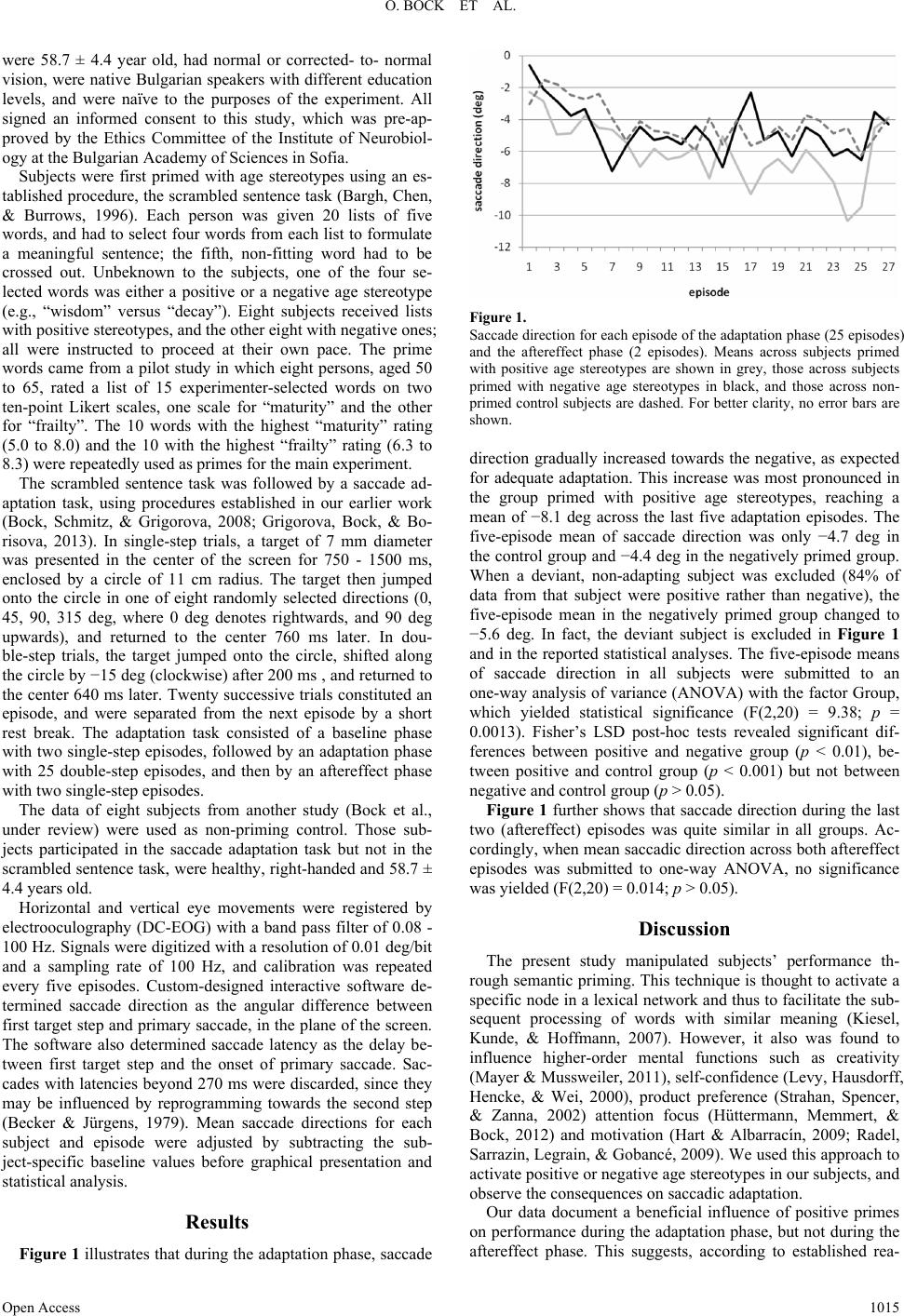 O. BOCK ET AL. were 58.7 ± 4.4 year old, had normal or corrected- to- normal vision, were native Bulgarian speakers with different education levels, and were naïve to the purposes of the experiment. All signed an informed consent to this study, which was pre-ap- proved by the Ethics Committee of the Institute of Neurobiol- ogy at the Bulgarian Academy of Sciences in Sofia. Subjects were first primed with age stereotypes using an es- tablished procedure, the scrambled sentence task (Bargh, Chen, & Burrows, 1996). Each person was given 20 lists of five words, and had to select four words from each list to formulate a meaningful sentence; the fifth, non-fitting word had to be crossed out. Unbeknown to the subjects, one of the four se- lected words was either a positive or a negative age stereotype (e.g., “wisdom” versus “decay”). Eight subjects received lists with positive stereotypes, and the other eight with negative ones; all were instructed to proceed at their own pace. The prime words came from a pilot study in which eight persons, aged 50 to 65, rated a list of 15 experimenter-selected words on two ten-point Likert scales, one scale for “maturity” and the other for “frailty”. The 10 words with the highest “maturity” rating (5.0 to 8.0) and the 10 with the highest “frailty” rating (6.3 to 8.3) were repeatedly used as primes for the main experiment. The scrambled sentence task was followed by a saccade ad- aptation task, using procedures established in our earlier work (Bock, Schmitz, & Grigorova, 2008; Grigorova, Bock, & Bo- risova, 2013). In single-step trials, a target of 7 mm diameter was presented in the center of the screen for 750 - 1500 ms, enclosed by a circle of 11 cm radius. The target then jumped onto the circle in one of eight randomly selected directions (0, 45, 90, 315 deg, where 0 deg denotes rightwards, and 90 deg upwards), and returned to the center 760 ms later. In dou- ble-step trials, the target jumped onto the circle, shifted along the circle by −15 deg (clockwise) after 200 ms , and returned to the center 640 ms later. Twenty successive trials constituted an episode, and were separated from the next episode by a short rest break. The adaptation task consisted of a baseline phase with two single-step episodes, followed by an adaptation phase with 25 double-step episodes, and then by an aftereffect phase with two single-step episodes. The data of eight subjects from another study (Bock et al., under review) were used as non-priming control. Those sub- jects participated in the saccade adaptation task but not in the scrambled sentence task, were healthy, right-handed and 58.7 ± 4.4 years old. Horizontal and vertical eye movements were registered by electrooculography (DC-EOG) with a band pass filter of 0.08 - 100 Hz. Signals were digitized with a resolution of 0.01 deg/bit and a sampling rate of 100 Hz, and calibration was repeated every five episodes. Custom-designed interactive software de- termined saccade direction as the angular difference between first target step and primary saccade, in the plane of the screen. The software also determined saccade latency as the delay be- tween first target step and the onset of primary saccade. Sac- cades with latencies beyond 270 ms were discarded, since they may be influenced by reprogramming towards the second step (Becker & Jürgens, 1979). Mean saccade directions for each subject and episode were adjusted by subtracting the sub- ject-specific baseline values before graphical presentation and statistical analysis. Results Figure 1 illustrates that during the adaptation phase, saccade Figure 1. Saccade direction for each episode of the adaptation phase (25 episodes) and the aftereffect phase (2 episodes). Means across subjects primed with positive age stereotypes are shown in grey, those across subjects primed with negative age stereotypes in black, and those across non- primed control subjects are dashed. For better clarity, no error bars are shown. direction gradually increased towards the negative, as expected for adequate adaptation. This increase was most pronounced in the group primed with positive age stereotypes, reaching a mean of −8.1 deg across the last five adaptation episodes. The five-episode mean of saccade direction was only −4.7 deg in the control group and −4.4 deg in the negatively primed group. When a deviant, non-adapting subject was excluded (84% of data from that subject were positive rather than negative), the five-episode mean in the negatively primed group changed to −5.6 deg. In fact, the deviant subject is excluded in Figure 1 and in the reported statistical analyses. The five-episode means of saccade direction in all subjects were submitted to an one-way analysis of variance (ANOVA) with the factor Group, which yielded statistical significance (F(2,20) = 9.38; p = 0.0013). Fisher’s LSD post-hoc tests revealed significant dif- ferences between positive and negative group (p < 0.01), be- tween positive and control group (p < 0.001) but not between negative and control group (p > 0.05). Figure 1 further shows that saccade direction during the last two (aftereffect) episodes was quite similar in all groups. Ac- cordingly, when mean saccadic direction across both aftereffect episodes was submitted to one-way ANOVA, no significance was yielded (F(2,20) = 0.014; p > 0.05). Discussion The present study manipulated subjects’ performance th- rough semantic priming. This technique is thought to activate a specific node in a lexical network and thus to facilitate the sub- sequent processing of words with similar meaning (Kiesel, Kunde, & Hoffmann, 2007). However, it also was found to influence higher-order mental functions such as creativity (Mayer & Mussweiler, 2011), self-confidence (Levy, Hausdorff, Hencke, & Wei, 2000), product preference (Strahan, Spencer, & Zanna, 2002) attention focus (Hüttermann, Memmert, & Bock, 2012) and motivation (Hart & Albarracín, 2009; Radel, Sarrazin, Legrain, & Gobancé, 2009). We used this approach to activate positive or negative age stereotypes in our subjects, and observe the consequences on saccadic adaptation. Our data document a beneficial influence of positive primes on performance during the adaptation phase, but not during the aftereffect phase. This suggests, according to established rea- Open Access 1015  O. BOCK ET AL. soning (Bock, 2005; McNay & Willingham, 1998), that posi- tive age stereotypes enhanced workaround strategies but not adaptive recalibration. Somewhat surprisingly, negative primes had no noticeable effect at all: they modified neither recalibra- tion nor strategies. One possible explanation is that priming with negative age stereotypes is less efficient than priming with positive ones. Another explanation could be social: maybe sub- jects came to the laboratory already with a negative attitude towards old age, and negative priming was therefore precluded by a floor effect. There indeed exists empirical evidence that in Bulgaria, compared e.g. to Germany, old age is regarded less favorably. Bulgarians rate the social status and the economical contribution of elderly persons much lower than Germans do, and rate their own experience of discrimination due to old age as much higher than Germans do (Abrams, Vauclair, & Swift, 2011). These findings might be related to the fact that suicide rates among the elderly are substantially higher in Bulgaria than in Germany (Shah, Bhat, McKenzie, & Koen, 2007). To decide between the two explanations, it would be desirable to compare the effects of positive versus negative age priming in different cultures, including those who traditionally venerate their elders. In this respect, it is interesting to note (Levy & Langer, 1994) that memory loss in old age is more severe among Americans with intact hearing than in American Deaf (who don’t experi- ence spoken age stereotypes), and also more severe than in mainland Chinese with intact hearing (who live in a culture that honors old age). The outcome of our study is in accordance with the hypothe- sis stated in the Introduction section. Thus, the strategic contri- bution towards saccadic adaptation might deteriorate in some seniors more than in others, depending on their assimilation of societal stereotypes, and only reaches statistical significance when the role of stereotypes is controlled for by priming. This could explain why no reliable deficit was observed when un- primed older subjects were compared to young ones (Bock et al., under review), but a robust deficit emerged when older negatively primed subjects were compared to older positively primed ones in the present study. In any case, age-related dec- rements of saccadic adaptation, like those of arm adaptation (Bock, 2005; Fernández-Ruiz et al., 2000; McNay & Willing- ham, 1998), seem to afflict strategies but not recalibration. The decrements seem to be less pronounced for the eyes than for the arm, where a significant difference between age groups was repeatedly observed even without primes (Bock, 2005; Fernández-Ruiz et al., 2000; McNay & Willingham, 1998), possibly because of a stronger cortical involvement in the con- trol of arm versus eye movements. Conclusion The present study takes its place alongside other researches that documented the role of social preconceptions on sensori- motor performance (Hausdorff et al., 1999; Levy, 2000; Levy & Leifheit-Limson, 2009), and thus highlights the potential dangers of a vicious circle where negative attitudes towards old age may activate performance deficits in the elderly by way of self-fulfilling prophecy, which in turn enforces the negative attitudes. REFERENCES Abrams, D., Vauclair, C.-M., & Swift, H. (2011). Predictors of atti- tudes to age across Europe. London: Department for Work and Pen- sions. Ball, K., & Owsley, C. (1993). The useful field of view test: A new technique for evaluating age-related declines in visual function. Journal of the American Optometr ic Association, 64, 71-79. Bargh, J. A., Chen, M., & Burrows, L. (1996). Automaticity of social behavior: Direct effects of trait construct and stereotype-activation on action. Journal of Personality and Social Psychology, 71, 230- 244. http://dx.doi.org/10.1037/0022-3514.71.2.230 Becker, W., & Jürgens, R. (1979). An analysis of the saccadic system by means of double step stimuli. Vision Research, 19, 967-983. http://dx.doi.org/10.1016/0042-6989(79)90222-0 Beurskens, R., & Bock, O. (2012). Age-related decline of peripheral visual processing: The role of eye movements. Experimental Brain Research, 217, 117-124. http://dx.doi.org/10.1007/s00221-011-2978-3 Bock, O. (2005). Components of sensorimotor adaptation in young and elderly subjects. Experimental Brain Research, 160, 259-263. http://dx.doi.org/10.1007/s00221-004-2133-5 Bock, O. (2013). Basic principles of sensorimotor adaptation to differ- ent distortions with different effectors and movement types: A re- view and synthesis of behavioral findings. Frontiers Hum Neurosci- ence, 7, 81. http://dx.doi.org/10.3389/fnhum.2013.00081 Bock, O., & Girgenrath, M. (2006). Relationship between sensorimotor adaptation and cognitive functions in younger and older subjects. Experimental Brain Research, 169, 400-406. http://dx.doi.org/10.1007/s00221-005-0153-4 Bock, O., Schmitz, G., & Grigorova, V. (2008). Transfer of adaptation between ocular saccades and arm movements. Human Movement Science, 27, 383-395. http://dx.doi.org/10.1016/j.humov.2008.01.001 Bono, F., Oliveri, R., Zappia, M., Aguglia, U., Puccio, G., & Quattrone, A. (1996). Computerized analysis of eye movements as a function of age. Archives of Gerontology and Geriatrics, 22, 261-269. http://dx.doi.org/10.1016/0167-4943(96)00698-X Chapman, G. J., & Hollands, M. A. (2006). Evidence for a link between changes to gaze behaviour and risk of falling in older adults during adaptive locomotion. Gait & Posture, 24, 288-294. http://dx.doi.org/10.1016/j.gaitpost.2005.10.002 Fernández-Ruiz, J., Hall, C., Vergara, P., & Díaz, R. (2000). Prism adaptation in normal aging: Slower adaptation rate and larger after- effect. Cognitive Brain Research, 9, 223-226. http://dx.doi.org/10.1016/S0926-6410(99)00057-9 Grigorova, V., Bock, O., & Borisova, S. (2013). Concurrent adaptation of reactive saccades and hand pointing movements to equal and to opposite changes of target direction. Experimental Brain Research, 226, 63-71. http://dx.doi.org/10.1007/s00221-013-3411-x Hart, W., & Albarracín, D. (2009). The effects of chronic achievement motivation and achievement primes on the activation of achievement and fun goals. Journal of Personality and Social Psychology, 97, 1129-1141. http://dx.doi.org/10.1037/a0017146 Hausdorff, J. M., Levy, B. R., & Wei, J. Y. (1999). The power of age- ism on physical functions of older persons: Reversibility of age-related gait changes. Journal of the American Geriatrics Society, 47, 1346- 1349. Hüttermann, S., Memmert, D., & Bock, O. (2012). Semantic priming of attention focus: Evidence for short- and long-term effects. Psychol- ogy, 3, 128-131. http://dx.doi.org/10.4236/psych.2012.32019 Kiesel, A., Kunde, W., & Hoffmann, J. (2007). Mechanisms of sub- liminal response priming. Advanced Cognitive Psychology, 3, 307- 315. http://dx.doi.org/10.2478/v10053-008-0032-1 Levy, B. (2000). Handwriting as a reflection of aging self-stereotypes. Journal of Geriatric Psychiatry, 33, 81-94. Levy, B. R., Hausdorff, J. M., Hencke, R., & Wei, J. Y. (2000). Reduc- ing cardiovascular stress with positive self-stereotypes of aging. The Journals of Gerontology: Se ri e s B, 55, 205-213. http://dx.doi.org/10.1093/geronb/55.4.P205 Levy, B. R., & Leifheit-Limson, E. (2009). The stereotype-matching effect: Greater influence on functioning when age stereotypes corre- spond to outcomes. Psy chol ogy and Aging, 24, 230-233. http://dx.doi.org/10.1037/a0014563 Levy, B., & Langer, E. (1994). Aging free from negative stereotypes: successful memory in China and among the American deaf. Journal Open Access 1016  O. BOCK ET AL. Open Access 1017 of Personality and Social Ps y c h o l o g y , 66, 989-997. http://dx.doi.org/10.1037/0022-3514.66.6.989 Maltz, M., & Shinar, D. (1999). Eye movements of younger and older drivers. Human Factors, 41, 15-25. http://dx.doi.org/10.1518/001872099779577282 Mayer, J., & Mussweiler, T. (2011). Suspicious spirits, flexible minds: When distrust enhances creativity. Journal of Personality and Social Psychology, 101, 1262-1277. http://dx.doi.org/10.1037/a0024407 McNay, E., & Willingham, D. (1998). Deficit in learning of a motor skill requiring strategy, but not of perceptualmotor recalibration, with aging. Learning Memory, 4, 411-420. http://dx.doi.org/10.1101/lm.4.5.411 Paquette, C., & Fung, J. (2011). Old age affects gaze and postural coor- dination. Gait & Posture, 33, 227-232. http://dx.doi.org/10.1016/j.gaitpost.2010.11.010 Radel, R., Sarrazin, P., Legrain, P., & Gobancé, L. (2009). Subliminal priming of motivational orientation in educational settings: Effect on academic performance moderated by mindfulness. Journal of Re- search in Personality, 43, 695-698. http://dx.doi.org/10.1016/j.jrp.2009.02.011 Redding, G. M., & Wallace, B. (1996). Adaptive spatial alignment and strategic perceptual-motor control. Journal of Experimental Psy- chology: Human Perception and Pe rfo rman ce, 22, 379-394. http://dx.doi.org/10.1037/0096-1523.22.2.379 Sekuler, R., & Ball, K. (1986). Visual localization: Age and practice. Journal of the Optical Socie ty of America A, 3, 864-867. http://dx.doi.org/10.1364/JOSAA.3.000864 Shah, A., Bhat, R., McKenzie, S., & Koen, C. (2007). Elderly suicide rates: Cross-national comparisons and association with sex and eld- erly age-bands. Medicine, Science and the Law, 47, 244-252. http://dx.doi.org/10.1258/rsmmsl.47.3.244 Strahan, E., Spencer, S. J., & Zanna, M. P. (2002). Subliminal priming and persuasion: Striking while the iron is hot. Journal of Experimen- tal Social Psychology, 38, 556-568. http://dx.doi.org/10.1016/S0022-1031(02)00502-4 |