

Paper Menu >>
Journal Menu >>
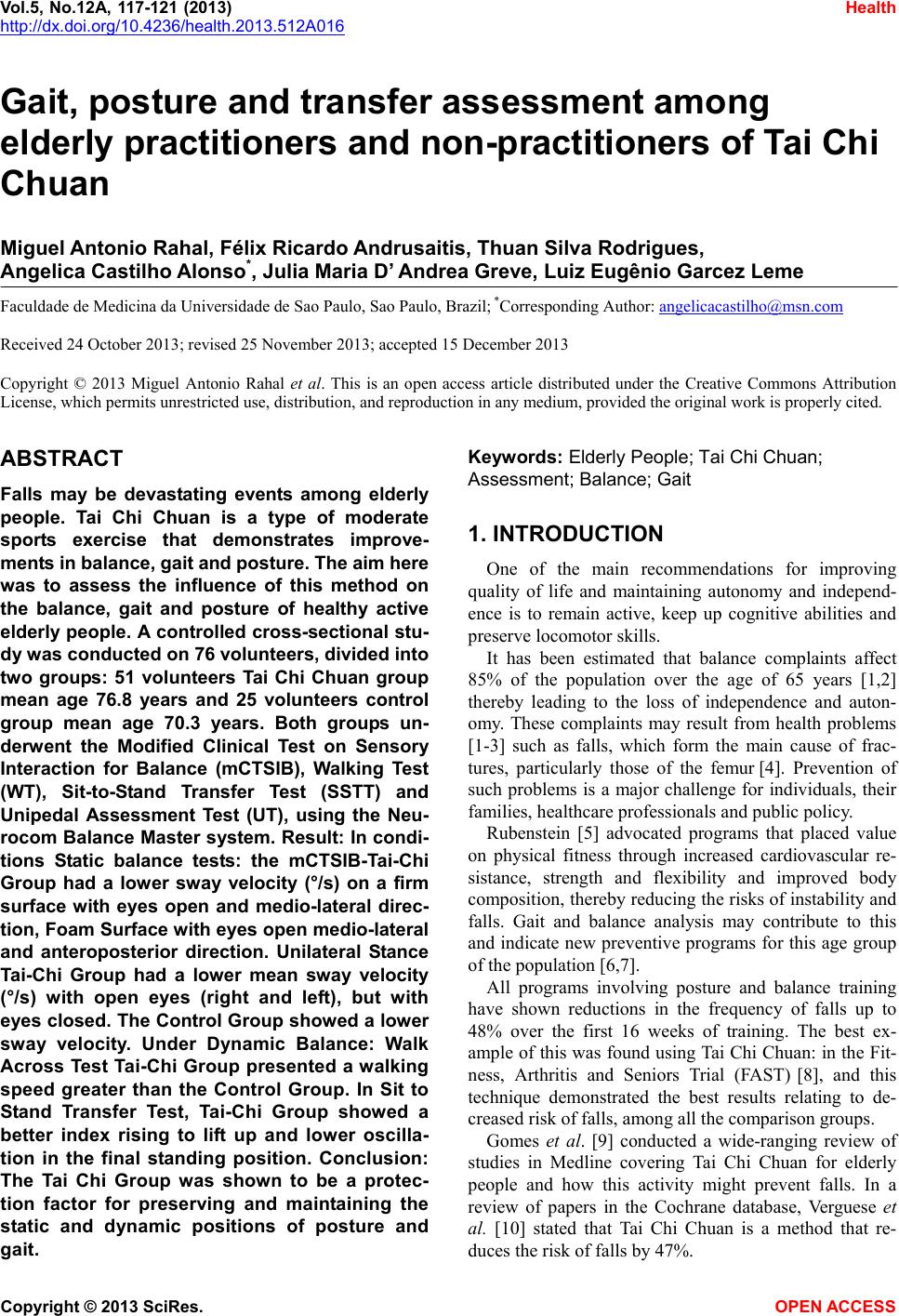 Vol.5, No.12A, 117-121 (2013) Health http://dx.doi.org/10.4236/health.2013.512A016 Gait, posture and transfer assessment among elderly practitioners and non-practitioners of Tai Chi Chuan Miguel Antonio Rahal, Félix Ricardo Andrusaitis, Thuan Silva Rodrigues, Angelica Castilho Alonso*, Julia Maria D’ Andrea Greve, Luiz Eugênio Garcez Leme Faculdade de Medicina da Universidade de Sao Paulo, Sao Paulo, Brazil; *Corresponding Author: [email protected] Received 24 October 2013; revised 25 November 2013; accepted 15 December 2013 Copyright © 2013 Miguel Antonio Rahal et al. This is an open access article distributed under the Creative Commons Attribution License, which permits unrestricted use, distribution, and reproduction in any medium, provided the original work is properly cited. ABSTRACT Falls may be devastating events among elderly people. Tai Chi Chuan is a type of moderate sports exercise that demonstrates improve- ment s in balance, gait and postu re. The aim here was to assess the influence of this method on the balance, gait and posture of healthy active elderly people. A controlled cross-sectional stu- dy was conducted on 76 volunteers, divided into two groups: 51 volunteers Tai Chi Chuan group mean age 76.8 years and 25 volunteers control group mean age 70.3 years. Both groups un- derwent the Modified Clinical Test on Sensory Interaction for Balance (mCTSIB), Walking Test (WT), Sit-to-Stand Transfer Test (SSTT) and Unipedal Assessment Test (UT), using the Neu- rocom Balance Master system. Result: In condi- tions Static balance tests: the mCTSIB-Tai-Chi Group had a lower sway velocity (°/s) on a firm surface with eyes open and medio-lateral direc- tion, Foam Surface w ith eyes open medio-lateral and anteroposterior direction. Unilateral Stance Tai-Chi Group had a lower mean sway velocity (°/s) with open eyes (right and left), but with eyes closed. The Control Group showed a lower sway velocity. Under Dynamic Balance: Walk Across Test Tai-Chi Group presented a w alking speed greater than the Control Group. In Sit to Stand Transfer Test, Tai-Chi Group showed a better index rising to lift up and lower oscilla- tion in the final standing position. Conclusion: The Tai Chi Group was shown to be a protec- tion factor for preserving and maintaining the static and dynamic positions of posture and gait. Keywords: Elderly P eo pl e; Tai Chi Chuan; Assessment; Balance; Gait 1. INTRODUCTION One of the main recommendations for improving quality of life and maintaining autonomy and independ- ence is to remain active, keep up cognitive abilities and preserve locomotor skills. It has been estimated that balance complaints affect 85% of the population over the age of 65 years [1,2] thereby leading to the loss of independence and auton- omy. These complaints may result from health problems [1-3] such as falls, which form the main cause of frac- tures, particularly those of the femur [4]. Prevention of such problems is a major challenge for individuals, their families, healthcare professionals and public policy. Rubenstein [5] advocated programs that placed value on physical fitness through increased cardiovascular re- sistance, strength and flexibility and improved body composition, thereby reducing the risks of instability and falls. Gait and balance analysis may contribute to this and indicate new preventive programs for this age group of the population [6,7]. All programs involving posture and balance training have shown reductions in the frequency of falls up to 48% over the first 16 weeks of training. The best ex- ample of this was found using Tai Chi Chuan: in the Fit- ness, Arthritis and Seniors Trial (FAST) [8], and this technique demonstrated the best results relating to de- creased risk of falls, among all the comparison groups. Gomes et al. [9] conducted a wide-ranging review of studies in Medline covering Tai Chi Chuan for elderly people and how this activity might prevent falls. In a review of papers in the Cochrane database, Verguese et al. [10] stated that Tai Chi Chuan is a method that re- duces the risk of falls by 47%. Copyright © 2013 SciRes. OPEN ACCES S 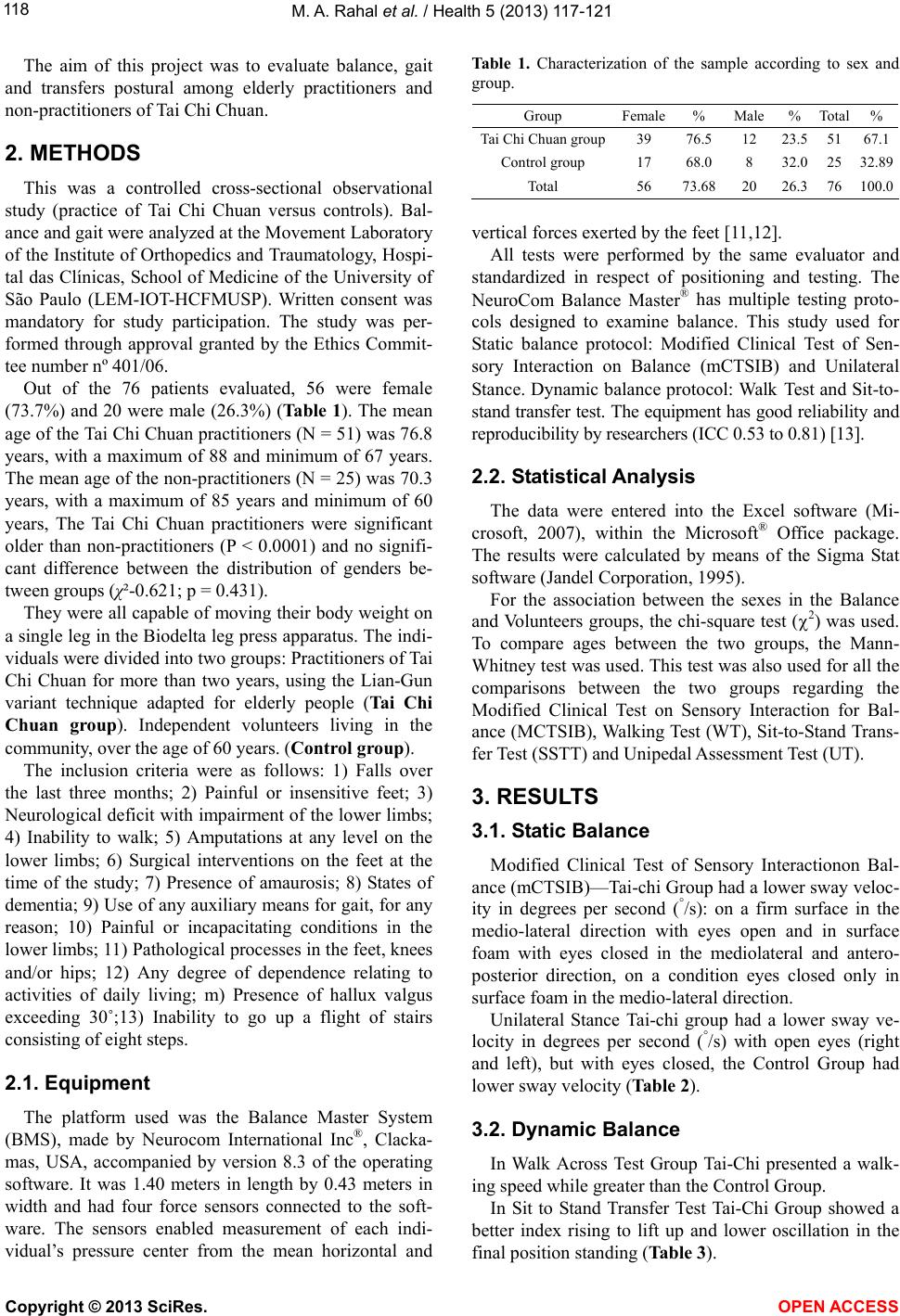 M. A. Rahal et al. / Health 5 (2013) 117-1 21 118 The aim of this project was to evaluate balance, gait and transfers postural among elderly practitioners and non-practitioners of Tai Chi Chuan. 2. METHODS This was a controlled cross-sectional observational study (practice of Tai Chi Chuan versus controls). Bal- ance and gait were analyzed at the Movement Laboratory of the Institute of Orthopedics and Traumatology, Hospi- tal das Clínicas, School of Medicine of the University of São Paulo (LEM-IOT-HCFMUSP). Written consent was mandatory for study participation. The study was per- formed through approval granted by the Ethics Commit- tee number nº 401/06. Out of the 76 patients evaluated, 56 were female (73.7%) and 20 were male (26.3%) (Ta ble 1). The mean age of the Tai Chi Chuan practitioners (N = 51) was 76.8 years, with a maximum of 88 and minimum of 67 years. The mean age of the non-practitioners (N = 25) was 70.3 years, with a maximum of 85 years and minimum of 60 years, The Tai Chi Chuan practitioners were significant older than non-practitioners (P < 0.0001) and no signifi- cant difference between the distribution of genders be- tween groups (χ²-0.621; p = 0.431). They were all capable of moving their body weight on a single leg in the Biodelta leg press apparatus. The indi- viduals were divided into two groups: Practitioners of Tai Chi Chuan for more than two years, using the Lian-Gun variant technique adapted for elderly people (Tai Chi Chuan group). Independent volunteers living in the community, over the age of 60 years. (Control group). The inclusion criteria were as follows: 1) Falls over the last three months; 2) Painful or insensitive feet; 3) Neurological deficit with impairment of the lower limbs; 4) Inability to walk; 5) Amputations at any level on the lower limbs; 6) Surgical interventions on the feet at the time of the study; 7) Presence of amaurosis; 8) States of dementia; 9) Use of any auxiliary means for gait, for any reason; 10) Painful or incapacitating conditions in the lower limbs; 11) Pathological processes in the feet, knees and/or hips; 12) Any degree of dependence relating to activities of daily living; m) Presence of hallux valgus exceeding 30˚;13) Inability to go up a flight of stairs consisting of eight steps. 2.1. Equipment The platform used was the Balance Master System (BMS), made by Neurocom International Inc®, Clacka- mas, USA, accompanied by version 8.3 of the operating software. It was 1.40 meters in length by 0.43 meters in width and had four force sensors connected to the soft- ware. The sensors enabled measurement of each indi- vidual’s pressure center from the mean horizontal and Table 1. Characterization of the sample according to sex and group. Group Female% Male % Total% Tai Chi Chuan group39 76.5 12 23.5 5167.1 Control group 17 68.0 8 32.0 2532.89 Total 56 73.68 20 26.3 76100.0 vertical forces exerted by the feet [11,12]. All tests were performed by the same evaluator and standardized in respect of positioning and testing. The NeuroCom Balance Master® has multiple testing proto- cols designed to examine balance. This study used for Static balance protocol: Modified Clinical Test of Sen- sory Interaction on Balance (mCTSIB) and Unilateral Stance. Dynamic balance protocol: Walk Test and Sit-to- stand transfer test. The equipment has good reliability and reproducibility by researchers (ICC 0.53 to 0.81) [13]. 2.2. Statistical Analysis The data were entered into the Excel software (Mi- crosoft, 2007), within the Microsoft® Office package. The results were calculated by means of the Sigma Stat software (Jandel Corporation, 1995). For the association between the sexes in the Balance and Volunteers groups, the chi-square test (2) was used. To compare ages between the two groups, the Mann- Whitney test was used. This test was also used for all the comparisons between the two groups regarding the Modified Clinical Test on Sensory Interaction for Bal- ance (MCTSIB), Walking Test (WT), Sit-to-Stand Trans- fer Test (SSTT) and Unipedal Assessment Test (UT). 3. RESULTS 3.1. Static Balance Modified Clinical Test of Sensory Interactionon Bal- ance (mCTSIB)—Tai-chi Group had a lower sway veloc- ity in degrees per second (°/s): on a firm surface in the medio-lateral direction with eyes open and in surface foam with eyes closed in the mediolateral and antero- posterior direction, on a condition eyes closed only in surface foam in the medio-lateral direction. Unilateral Stance Tai-chi group had a lower sway ve- locity in degrees per second (°/s) with open eyes (right and left), but with eyes closed, the Control Group had lower sway velocity (Table 2). 3.2. Dynamic Balance In Walk Across Test Group Tai-Chi presented a walk- ing speed while greater than the Control Group. In Sit to Stand Transfer Test Tai-Chi Group showed a better index rising to lift up and lower oscillation in the final position standing (Table 3). Copyright © 2013 SciRes. OPEN ACCESS 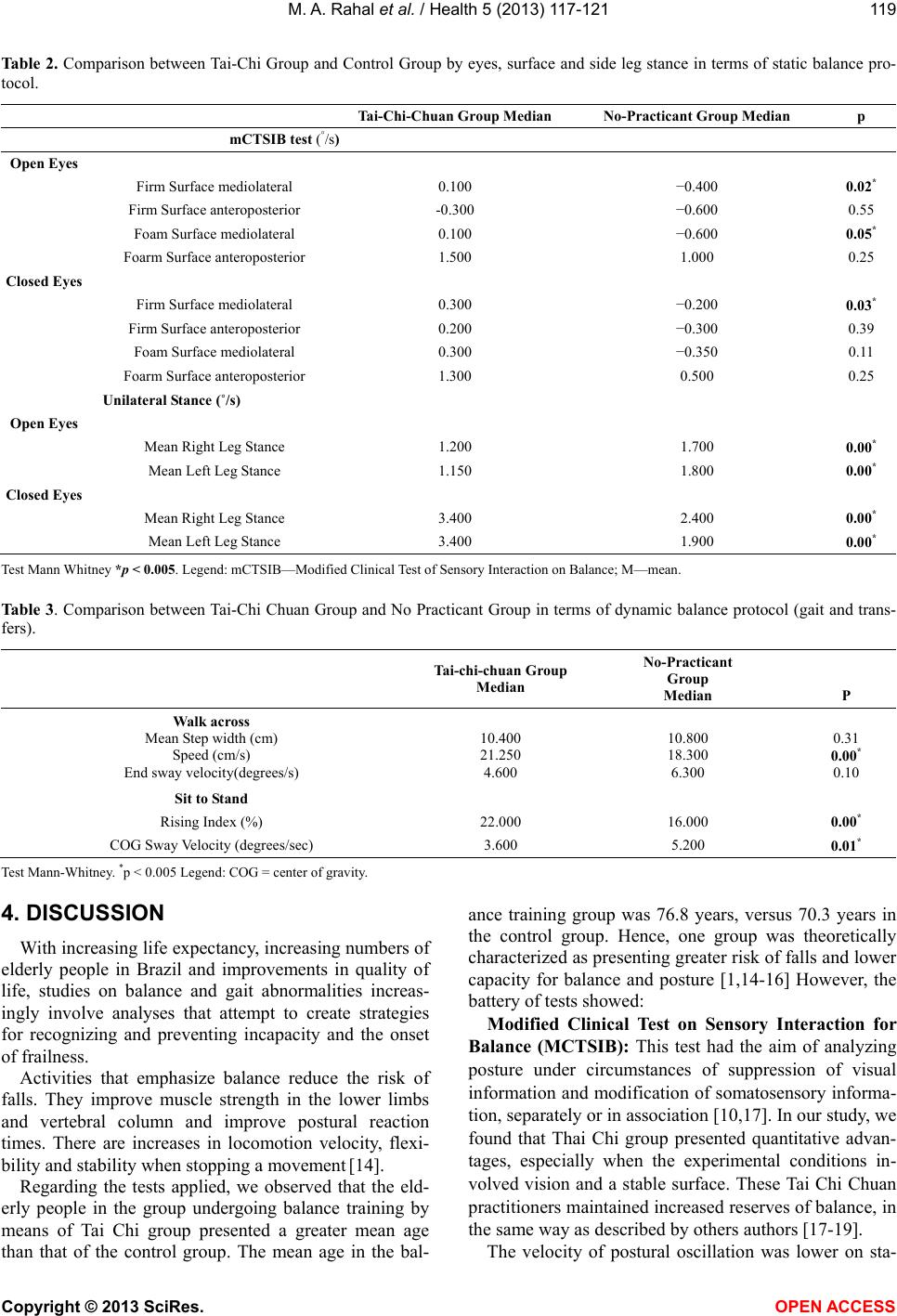 M. A. Rahal et al. / Health 5 (2013) 117-1 21 Copyright © 2013 SciRes. OPEN ACCES S 119 Tabl e 2. Comparison between Tai-Chi Group and Control Group by eyes, surface and side leg stance in terms of static balance pro- tocol. Tai-Chi-Chuan Group Median No-Practicant Group Median p mCTSIB test (°/s) Open Eyes Firm Surface mediolateral 0.100 −0.400 0.02* Firm Surface anteroposterior -0.300 −0.600 0.55 Foam Surface mediolateral 0.100 −0.600 0.05* Foarm Surface anteroposterior 1.500 1.000 0.25 Closed Eyes Firm Surface mediolateral 0.300 −0.200 0.03* Firm Surface anteroposterior 0.200 −0.300 0.39 Foam Surface mediolateral 0.300 −0.350 0.11 Foarm Surface anteroposterior 1.300 0.500 0.25 Unilateral Stance (˚/s) Open Eyes Mean Right Leg Stance 1.200 1.700 0.00* Mean Left Leg Stance 1.150 1.800 0.00* Closed Eyes Mean Right Leg Stance 3.400 2.400 0.00* Mean Left Leg Stance 3.400 1.900 0.00* Test Mann Whitney *p < 0.005. Legend: mCTSIB—Modified Clinical Test of Sensory Interaction on Balance; M—mean. Tabl e 3. Comparison between Tai-Chi Chuan Group and No Practicant Group in terms of dynamic balance protocol (gait and trans- fers). Tai-chi-chuan Group Median No-Practicant Group Median P Walk across Mean Step width (cm) Speed (cm/s) End sway velocity(degrees/s) 10.400 21.250 4.600 10.800 18.300 6.300 0.31 0.00* 0.10 Sit to Stand Rising Index (%) 22.000 16.000 0.00* COG Sway Velocity (degrees/sec) 3.600 5.200 0.01* Test Mann-Whitney. *p < 0.005 Legend: COG = center of gravity. 4. DISCUSSION With increasing life expectancy, increasing numbers of elderly people in Brazil and improvements in quality of life, studies on balance and gait abnormalities increas- ingly involve analyses that attempt to create strategies for recognizing and preventing incapacity and the onset of frailness. Activities that emphasize balance reduce the risk of falls. They improve muscle strength in the lower limbs and vertebral column and improve postural reaction times. There are increases in locomotion velocity, flexi- bility and stability when stopping a movement [14]. Regarding the tests applied, we observed that the eld- erly people in the group undergoing balance training by means of Tai Chi group presented a greater mean age than that of the control group. The mean age in the bal- ance training group was 76.8 years, versus 70.3 years in the control group. Hence, one group was theoretically characterized as presenting greater risk of falls and lower capacity for balance and posture [1,14-16] However, the battery of tests showed: Modified Clinical Test on Sensory Interaction for Balance (MCTSIB): This test had the aim of analyzing posture under circumstances of suppression of visual information and modification of somatosensory informa- tion, separately or in association [10,17]. In our study, we found that Thai Chi group presented quantitative advan- tages, especially when the experimental conditions in- volved vision and a stable surface. These Tai Chi Chuan practitioners maintained increased reserves of balance, in the same way as described by others authors [17-19]. The velocity of postural oscillation was lower on sta- 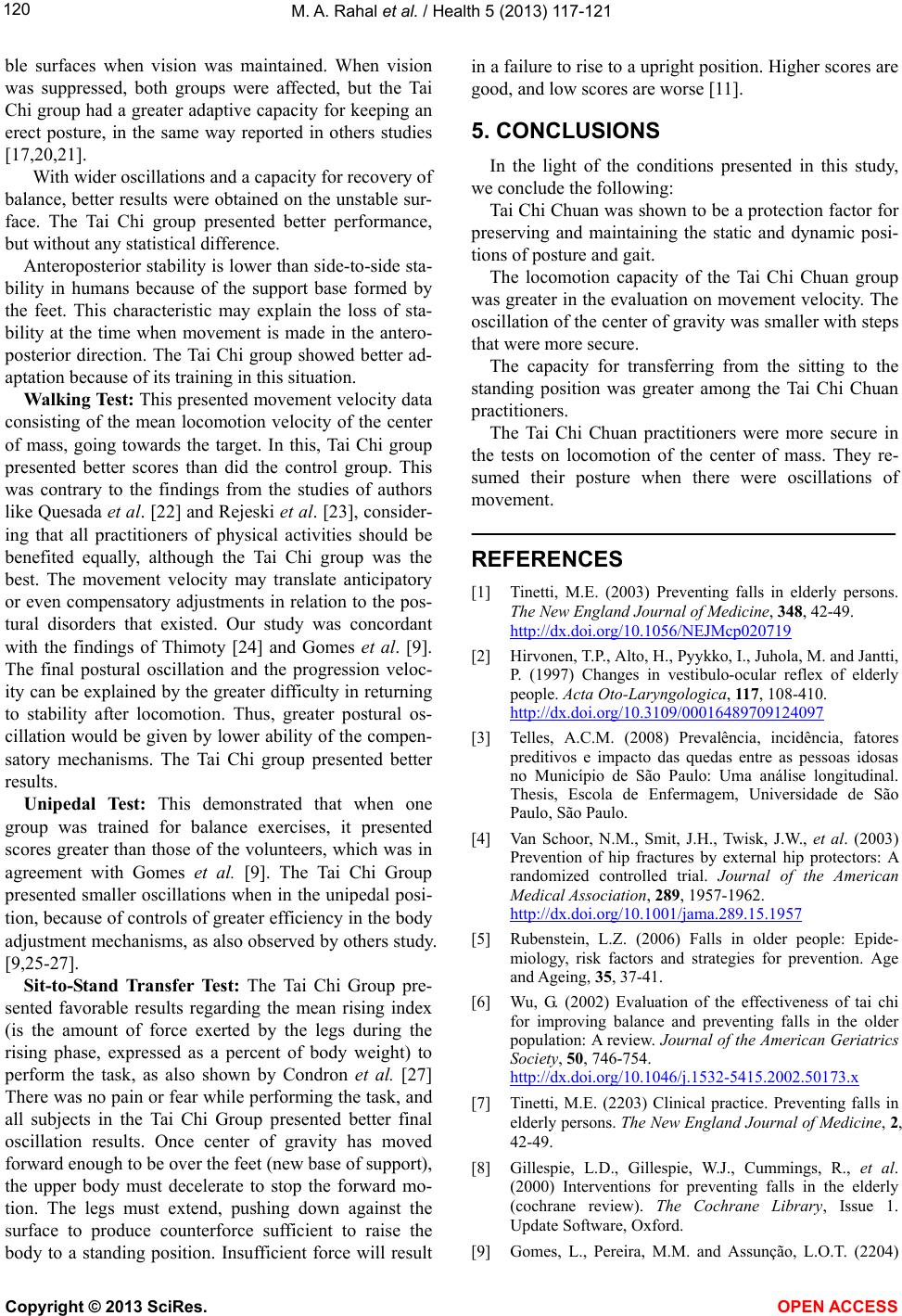 M. A. Rahal et al. / Health 5 (2013) 117-1 21 120 ble surfaces when vision was maintained. When vision was suppressed, both groups were affected, but the Tai Chi group had a greater adaptive capacity for keeping an erect posture, in the same way reported in others studies [17,20,21]. With wider oscillations and a capacity for recovery of balance, better results were obtained on the unstable sur- face. The Tai Chi group presented better performance, but without any statistical difference. Anteroposterior stability is lower than side-to-side sta- bility in humans because of the support base formed by the feet. This characteristic may explain the loss of sta- bility at the time when movement is made in the antero- posterior direction. The Tai Chi group showed better ad- aptation because of its training in this situation. Walking Test: This presented movement velocity data consisting of the mean locomotion velocity of the center of mass, going towards the target. In this, Tai Chi group presented better scores than did the control group. This was contrary to the findings from the studies of authors like Quesada et al. [22] and Rejeski et al. [23], consider- ing that all practitioners of physical activities should be benefited equally, although the Tai Chi group was the best. The movement velocity may translate anticipatory or even compensatory adjustments in relation to the pos- tural disorders that existed. Our study was concordant with the findings of Thimoty [24] and Gomes et al. [9]. The final postural oscillation and the progression veloc- ity can be explained by the greater difficulty in returning to stability after locomotion. Thus, greater postural os- cillation would be given by lower ability of the compen- satory mechanisms. The Tai Chi group presented better results. Unipedal Test: This demonstrated that when one group was trained for balance exercises, it presented scores greater than those of the volunteers, which was in agreement with Gomes et al. [9]. The Tai Chi Group presented smaller oscillations when in the unipedal posi- tion, because of controls of greater efficiency in the body adjustment mechanisms, as also observed by others study. [9,25-27]. Sit-to-Stand Transfer Test: The Tai Chi Group pre- sented favorable results regarding the mean rising index (is the amount of force exerted by the legs during the rising phase, expressed as a percent of body weight) to perform the task, as also shown by Condron et al. [27] There was no pain or fear while performing the task, and all subjects in the Tai Chi Group presented better final oscillation results. Once center of gravity has moved forward enough to be over the feet (new base of support), the upper body must decelerate to stop the forward mo- tion. The legs must extend, pushing down against the surface to produce counterforce sufficient to raise the body to a standing position. Insufficient force will result in a failure to rise to a upright position. Higher scores are good, and low scores are worse [11]. 5. CONCLUSIONS In the light of the conditions presented in this study, we conclude the following: Tai Chi Chuan was shown to be a protection factor for preserving and maintaining the static and dynamic posi- tions of posture and gait. The locomotion capacity of the Tai Chi Chuan group was greater in the evaluation on movement velocity. The oscillation of the center of gravity was smaller with steps that were more secure. The capacity for transferring from the sitting to the standing position was greater among the Tai Chi Chuan practitioners. The Tai Chi Chuan practitioners were more secure in the tests on locomotion of the center of mass. They re- sumed their posture when there were oscillations of movement. REFERENCES [1] Tinetti, M.E. (2003) Preventing falls in elderly persons. The New England Journal of Medicine, 348, 42-49. http://dx.doi.org/10.1056/NEJMcp020719 [2] Hirvonen, T.P., Alto, H., Pyykko, I., Juhola, M. and Jantti, P. (1997) Changes in vestibulo-ocular reflex of elderly people. Acta Oto-Laryngologica, 117, 108-410. http://dx.doi.org/10.3109/00016489709124097 [3] Telles, A.C.M. (2008) Prevalência, incidência, fatores preditivos e impacto das quedas entre as pessoas idosas no Município de São Paulo: Uma análise longitudinal. Thesis, Escola de Enfermagem, Universidade de São Paulo, São Paulo. [4] Van Schoor, N.M., Smit, J.H., Twisk, J.W., et al. (2003) Prevention of hip fractures by external hip protectors: A randomized controlled trial. Journal of the American Medical Association, 289, 1957-1962. http://dx.doi.org/10.1001/jama.289.15.1957 [5] Rubenstein, L.Z. (2006) Falls in older people: Epide- miology, risk factors and strategies for prevention. Age and Ageing, 35, 37-41. [6] Wu, G. (2002) Evaluation of the effectiveness of tai chi for improving balance and preventing falls in the older population: A review. Journal of the American Geriatrics Society, 50, 746-754. http://dx.doi.org/10.1046/j.1532-5415.2002.50173.x [7] Tinetti, M.E. (2203) Clinical practice. Preventing falls in elderly persons. The New England Journal of Medicine, 2, 42-49. [8] Gillespie, L.D., Gillespie, W.J., Cummings, R., et al. (2000) Interventions for preventing falls in the elderly (cochrane review). The Cochrane Library, Issue 1. Update Software, Oxford. [9] Gomes, L., Pereira, M.M. and Assunção, L.O.T. (2204) Copyright © 2013 SciRes. OPEN ACCESS  M. A. Rahal et al. / Health 5 (2013) 117-1 21 Copyright © 2013 SciRes. OPEN ACCES S 121 Tai chi chuan: Nova modalidade de exercícios para idosos. Revista Brasileira de Ciência e Movimento, 12, 89-94. [10] Verghese, J., Buschke, H. and Viola, L. (2002) Validity of divided attention tasks in predicting falls in older indi- viduals: A preliminary study. Journal of the American Geriatrics Society, 50, 1572-1576. http://dx.doi.org/10.1046/j.1532-5415.2002.50415.x [11] Brech, G.C., Alonso, A.C., Luna, N.M. and Greve, J.M. (2013) Correlation of postural balance and knee muscle strength in the sit-to-stand test among women with and without postmenopausal osteoporosis. Osteoporosis International, 24, 2007-2013. [12] Gil, J., Allum, J.H., Carpenter, M.G., Adkin, A.L. and Pierchala, K. (2001) Trunk sway measures of postural stability during clinical balance tests: Effects of age. The Journals of Gerontology, 56, 438-447. [13] Loughran, S., Tennant, N., Kishore, A. and Swan, I.R. (2005) Interobserver reliability in evaluating postural stability between clinicians and posturography. Clinical Otolaryngology, 30, 255-257. http://dx.doi.org/10.1111/j.1365-2273.2005.00988.x [14] Tinetti, ME. (2001) Guideline for the prevention of falls in older persons. Journal of the American Geriatrics So- ciety, 49, 666. [15] Bruce, D.G., Devine, A., Prince, R.L., et al. (2002) Rec- reational physical activity levels in healthy older women. The importance of fear of falling. Journal of the Ameri- can Geriatrics Society, 50, 84-89. http://dx.doi.org/10.1046/j.1532-5415.2002.50012.x [16] Tinetti, M.E., Speechey, M. and Ginter, S.F. (1988) Risk factors for falls among elderly person living in the com- munity. The New England Journal of Medicine, 319, 1701-1707. http://dx.doi.org/10.1056/NEJM198812293192604 [17] Tomomitsu, M.S., Alonso, A.C., Morimoto, E., Bobbio, T.G. and Greve, J.M. (2013) Static and dynamic postural control in low-vision and normal-vision adults. Clinics, 68, 517-521. http://dx.doi.org/10.6061/clinics/2013(04)13 [18] Baloh, R., Fife, T., Zwerling, L., et al. (1994) Comparison of static and dynamic posturography in young and older normal people. Journal of the American Geriatrics Soci- ety, 42, 405-412. [19] Bernhardt, J., Hill, K., Ellis, P., et al. (1998) Changes in balance and locomotion measures during rehabilitation after stroke. Physiotherapy Research International, 3, 109-122. http://dx.doi.org/10.1002/pri.130 [20] Woollacott, M.H. (1987) Neuromuscular control of pos- ture in the child: Is vision dominant? Journal of Motor Behavior, 19, 167-182. http://dx.doi.org/10.1080/00222895.1987.10735406 [21] Barela, J.A. (1995) The use of somatosensory information of balance control in humans. Human Movement Science, 14, 13-43. http://dx.doi.org/10.1016/0167-9457(94)00048-J [22] Quesada, P.M. and Rash, G.S. (2000) Quantitative as- sessment of simultaneous capacitive and resistive plantar pressure measurements during walking. Foot & Ankle In- ternational, 21, 928-934. [23] Rejeski, W.J., Brawley, L.R., et al. (1997) Compliance to exercise therapy in older participants with knee os- teoarthritis: Implications for treating disability. Medicine & Science in Sports & Exercise, 29, 977. http://dx.doi.org/10.1097/00005768-199708000-00001 [24] Thimoty, C.H. (1999) Effects of tai-chi on balance. Ar- chives of Otolaryngology—Head and Neck Surgery, 125, 1191-1195. http://dx.doi.org/10.1001/archotol.125.11.1191 [25] Era, P., Sainio, P. and koskinen, S.(2006) Postural Bal- ance in a random sample of 7979 subjects aged 30 years and over. Gerontology, 52, 204-213. http://dx.doi.org/10.1159/000093652 [26] Baloh, R., Fife, T., Zwerling, L., et al. (1994) Comparison of static and dynamic posturography in young and older normal people. Journal of the American Geriatrics Soci- ety, 42, 405-412. [27] Condron, J.E., Hill, K.D. and Dip, G. (2002) Reliability and validity of a dual-task force platform assessment of balance performance: Effect of age, balance. Journal of the American Geriatrics Society, 50, 157-162. http://dx.doi.org/10.1046/j.1532-5415.2002.50022.x |