

Paper Menu >>
Journal Menu >>
 Natural Resources, 2011, 2, 1-7 doi:10.4236/nr.2011.21001 Published Online March 2011 (http://www.scirp.org/journal/nr) Copyright © 2011 SciRes. NR Optimization of Photo-Hydrogen Production by Immobilized Rhodopseudomonas Faecalis RLD-53 Bing-Feng Liu, Guo-Jun Xie, Wan-Qian Guo, Jie Ding, Nan-Qi Ren State Key Laboratory of Urban Water Resource and Environment, Harbin Institute of Technology, Harbin, China E-mail: [email protected]; [email protected] Received December 7th, 2010; revised January 10th, 2011; accepted January 17th, 2011 ABSTRACT In this work, the optimization of hydrog en production by photo-fermentation bacteria immobilized on agar gel granu le was systematic investigated in batch culture. Experiment focus on the effect of some important affecting factors on photo-hydrogen production. Results indicated that immobilized Rhodopseudomonas faecalis RLD-53 exhibited the highest hydrogen yield of 3.15 mol H2/mol acetate under follow optimal condition: agar granule diameter of 2.5 mm, inoculum age of 24 h, agar concentration of 2%, biomass of 4 mg/ml in agar and light intensity o f 9000 lux. More im- portantly, immobilized photo-fermentation bacteria not only can enhance hydrogen production but can increase ac- ids-tolerance capa city, even at pH 5.0 hydrogen also was produced, and th us hopefully immob ilized photo-fermen tation bacteria can be applied in the combination of dark and photo-fermentation for hydrogen production with high yield. Keywords: Hydrogen Production, Photo-Fermentation, Agar Gel, Immobilized Rhodopseudomonas Faecalis, Acids-Tolerance Capa city 1. Introduction The shortage of fossil fuels, the pollution of global environment and emissions of greenhouse gas are at- tracting more and more attention of researches. But, up to now, the major source of energy is still supplied from fossil fuels. Hence, we urgent need to develop new and renewable energy to replace fossil fuels. Bio-hydrogen is a clean, environmental friendly and recycle energy car- rier and recognized as a promising substitute of fossil fuels in future. At present, two main pathways, dark and photo-fermentation, were used for bio-hydrogen produc- tion [1]. Recently, bio-hydrogen production by photo- fermentation has exhibited great potential. In particular dark-fermentation process produced short chain acids, which can be utilizing by photo-fermentation process for additional hydrogen production. Thus, the combination of dark and photo fermentation for hydrogen production can achieve a high overall hydrogen yield, which hope- fully close to theoretically maximum value of 12 mol H2/mol hexose. The overall hydrogen yield of 13.7 mol H2/mol-sucrose (equivalent to 6.85 mol H2/mol hexose) was obtained using sequential dark and photo-fer mentation from beet molasses [2]. Previous our work showed that the two-step of dark and photo fermentation reached a nice hydrogen yield of 6.32 [3] and 5.37 [4] mol H2/mol glucose in batch experiment. Other some reports also demonstrated that the total hydrogen yield of sequential dark and photo-fermentation was obviously higher than that of a single dark fermentation process using single substrate as sole carbon source [5-8]. The immobilization technology for dark fermentation hydrogen production has been widely studied [9,10]. Usually, bacteria main were immobilized on carrier such as polyacrylamide [11], polyvinyl alcohol [12], or agar gel [13], etc. Nearly all their work showed that immobi- lized dark fermentative bacteria can enhance and stabi- lize hydrogen production process. There are only a few reports about the immobilization of photo-fermentation bacteria for improving the bio-hydrogen process [14,15]. However, these reports have not focused on the optimi- zation of immobilized condition. Therefore, in this study photo-fermentation bacteria were immobilized on agar gel granule to explore their hydrogen production capacity. The some key immobi- lized parameters, for example, agar granule diameter, inoculum age, agar concentration, pH, biomass in agar and light intensity, were systematic optimized for im- proving photo-hydrogen production by batch culture. 2. Method 2.1. Bacterial Strain and Medium Photo-fermentative bacterium Rhodopseudomonas fae- 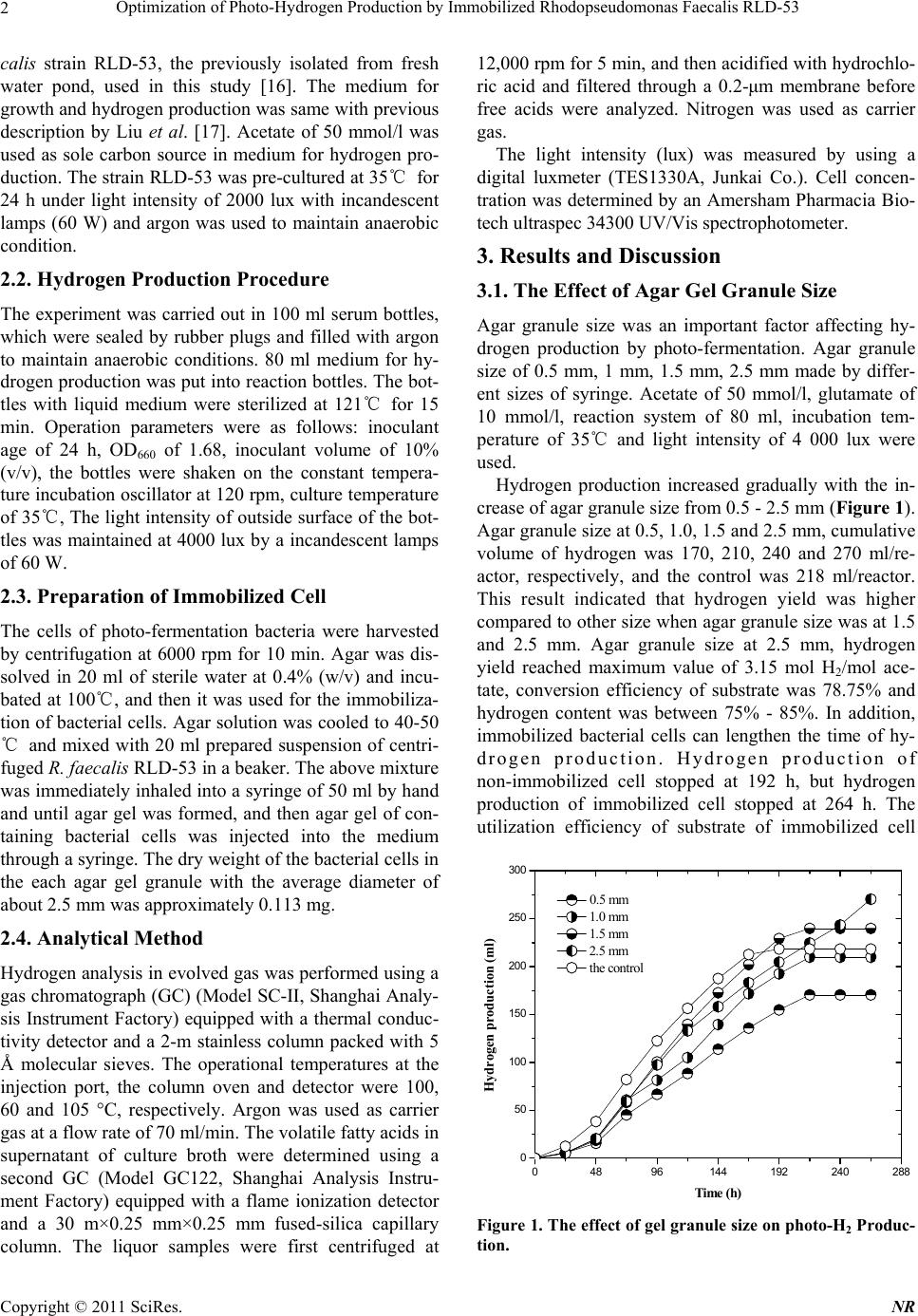 Optimization of Photo-Hydrogen Production by Immobilized Rhodopseudomonas Faecalis RLD-53 2 calis strain RLD-53, the previously isolated from fresh water pond, used in this study [16]. The medium for growth and hydrogen production was same with previous description by Liu et al. [17]. Acetate of 50 mmol/l was used as sole carbon source in medium for hydrogen pro- duction. The strain RLD-53 was pre-cultured at 35℃ for 24 h under light intensity of 2000 lux with incandescent lamps (60 W) and argon was used to maintain anaerobic condition. 2.2. Hydrogen Production Procedure The experiment was carried out in 100 ml serum bottles, which were sealed by rubber plugs and filled with argon to maintain anaerobic conditions. 80 ml medium for hy- drogen production was put into reaction bottles. The bot- tles with liquid medium were sterilized at 121℃ for 15 min. Operation parameters were as follows: inoculant age of 24 h, OD660 of 1.68, inoculant volume of 10% (v/v), the bottles were shaken on the constant tempera- ture incubation oscillator at 120 rpm, culture temperature of 35℃, The light intensity of outside surface of the bot- tles was maintained at 4000 lux by a incandescent lamps of 60 W. 2.3. Preparation of Immobilized Cell The cells of photo-fermentation bacteria were harvested by centrifugation at 6000 rpm for 10 min. Agar was dis- solved in 20 ml of sterile water at 0.4% (w/v) and incu- bated at 100℃, and then it was used for the immobiliza- tion of bacterial cells. Agar solution was cooled to 40-50 ℃ and mixed with 20 ml prepared suspension of centri- fuged R. faecalis RLD-53 in a beaker. The above mixture was immediately inhaled into a syringe of 50 ml by hand and until agar gel was formed, and then agar gel of con- taining bacterial cells was injected into the medium through a syringe. The dry weight of the bacterial cells in the each agar gel granule with the average diameter of about 2.5 mm was approximately 0.113 mg. 2.4. Analytical Method Hydrogen analysis in evolved gas was performed using a gas chromatograph (GC) (Model SC-II, Shanghai Analy- sis Instrument Factory) equipped with a thermal conduc- tivity detector and a 2-m stainless column packed with 5 Å molecular sieves. The operational temperatures at the injection port, the column oven and detector were 100, 60 and 105 °C, respectively. Argon was used as carrier gas at a flow rate of 70 ml/min. The volatile fatty acids in supernatant of culture broth were determined using a second GC (Model GC122, Shanghai Analysis Instru- ment Factory) equipped with a flame ionization detector and a 30 m×0.25 mm×0.25 mm fused-silica capillary column. The liquor samples were first centrifuged at 12,000 rpm for 5 min, and then acidified with hydrochlo- ric acid and filtered through a 0.2-μm membrane before free acids were analyzed. Nitrogen was used as carrier gas. The light intensity (lux) was measured by using a digital luxmeter (TES1330A, Junkai Co.). Cell concen- tration was determined by an Amersham Pharmacia Bio- tech ultraspec 34300 UV/Vis spectrophotometer. 3. Results and Discussion 3.1. The Effect of Agar Gel Granule Size Agar granule size was an important factor affecting hy- drogen production by photo-fermentation. Agar granule size of 0.5 mm, 1 mm, 1.5 mm, 2.5 mm made by differ- ent sizes of syringe. Acetate of 50 mmol/l, glutamate of 10 mmol/l, reaction system of 80 ml, incubation tem- perature of 35 and light intensity of 4℃ 000 lux were used. Hydrogen production increased gradually with the in- crease of agar granule size from 0.5 - 2.5 mm (Figure 1). Agar granule size at 0.5, 1.0, 1.5 and 2.5 mm, cumulative volume of hydrogen was 170, 210, 240 and 270 ml/re- actor, respectively, and the control was 218 ml/reactor. This result indicated that hydrogen yield was higher compared to other size when agar granule size was at 1.5 and 2.5 mm. Agar granule size at 2.5 mm, hydrogen yield reached maximum value of 3.15 mol H2/mol ace- tate, conversion efficiency of substrate was 78.75% and hydrogen content was between 75% - 85%. In addition, immobilized bacterial cells can lengthen the time of hy- drogen production. Hydrogen production of non-immobilized cell stopped at 192 h, but hydrogen production of immobilized cell stopped at 264 h. The utilization efficiency of substrate of immobilized cell 04896144 192 240 288 0 50 100 150 200 250 300 Hydrogen production (ml) Time (h) 0.5 mm 1.0 mm 1.5 mm 2.5 mm the control Figure 1. The effect of gel granule size on photo-H2 Produc- tion. C opyright © 2011 SciRes. NR  Optimization of Photo-Hydrogen Production by Immobilized Rhodopseudomonas Faecalis RLD-53 3 was higher compared to non-immobilized cell. Within 48 h of culture, a great quantity of substrate was consumed for cell growth and the utilization efficiency of substrate was 0.04 g acetate/l/h. However, the utilization effi- ciency of substrate of immobilized cell was 0.018 g ace- tate/l/h, more acetate was for hydrogen production (Fig- ure 2). These seem to imply that the bacteria were im- mobilized in agar gel can limit substrate for itself growth and increase hydrogen production, and lengthen the time of hydrogen production. So, agar granule size of 2.5 mm was used follow experiment for further research. 3.2. The Effect of Inoculant Age In this test, the inoculant age of 12, 24, 36, 48, 60, 72, 84 and 96 h was employed to explore their hydrogen pro- duction capacity. The difference in hydrogen production under various inoculant ages is very obviously (Figure 3). Higher yield and production rate of hydrogen was obtained when in- oculant age was 24 h and 72 h, and cumulative volume of hydrogen was 246 ml/reactor and 233 ml/reactor, respec- tively. Inoculant age was at 12, 48 and 84 h, the yield and production rate of hydrogen was similarly and it was about 200 ml/reactor. Inoculant age at 36 and 96 h, cu- mulative volume of hydrogen was about 160 ml/re- actor. However, inoculant age at 60 h, hydrogen yield only was about 100 ml/reactor. The hydrogen production by the bacteria cause the results of differences may be related to physiological state and enzymes activity of bacteria. We think that a long time of bacteria in the agar, nitrogenase activity was restored or enhanced leading to the hydrogen yield in high level. Inoculant age has a di- rect impact on the cell's physiological state and the chemical components of culture. Our result was consis- tent with Felten et al.’s report, which showed that the Figure 2. The consumption of acetate under different agar granule size in immobilized photo-hydrogen production. inoculant age of the immobilized bacteria is the key fac- tor affecting hydrogen production, R. rubrum of inocu- lant age of 70 h were immobilized with the highest hy- drogen production activity [18]. Therefore, inoculant age of about 24 h and 72 h for photo-hydrogen production is appropriate. 3.3. The Effect of Agar Concentration Photo-hydrogen production significantly influenced by agar concentration, which directly determined the ab- sorbance of photo-fermentative bacteria, utilization effi- ciency and transfer rates of substrate. Agar concentration was in the range of 1% - 4%, agar gel granule size of 2.5 mm and inoculant age of 24 h were used in this test. When agar concentration was 1.5% and 2%, cumulative volume of hydrogen was 254.98 ml/reactor and 249.67 ml/reactor, hydrogen production capacity was higher than that of other agar concentration (Figure 4). The performance of hydrogen production was similar to the control under agar concentration of 1%, 3% and 4%. Agar concentration over 3%, penetration of light into inside bacterial cell decreased and the growth rate will be decreased with increasing the agar concentra- tion, thereby affecting the utilization of its substrate and the internal mass transfer resistance increased. This result was similar to Seol. et al.’s research, which indicated that the substrate and products are easily transferred through the bead when agar concentration in proper experimental ranges [19]. In addition, the accumulation of cell me- tabolite in the agar granule caused cell toxicity and re- pressed infiltration capacity of substrate, will also affect the growth and hydrogen production of photo-fermenta- tion bacteria. 3.4. The Effect of Bacterial Concentration in Agar Gel The bacterial concentration in agar influenced utilization and mass transfer efficiency of substrate. Biomass in agar was 2, 4, 6, 8 and 10 mg/ml, respectively. Agar gel gran- ule size, inoculant age, agar concentration, acetate con- centration and reaction system were 3 mm, 24 h, 2%, 50 mmol/l and 80 ml, respectively. Result indicated the biomass range of 2 - 4 mg/ml in agar may help to improve performance of hydrogen pro- duction and hydrogen yield decreased when biomass was over 6 mg/ml; high biomass in gel granule for enhancing the hydrogen production is not obvious (Figure 5). Rea- son may be due to the substrate into the gel granules was constant and excessive photo-fermentation bacteria were employed in hydrogen production process leading to the consumption of a lot of substrate to maintain the energy require for their growth, thus reducing the use of sub- strate for hydrogen production and immobilized cells C opyright © 2011 SciRes. NR  Optimization of Photo-Hydrogen Production by Immobilized Rhodopseudomonas Faecalis RLD-53 4 Figure 3. The effect of inoculant age on photo-H2 produc- tion. 04896144 192 240 0 50 100 150 200 250 30 0 Hydrogen production (ml) Time (h) 1% 1.5% 2% 3% 4% Figure 4. The effect of agar concentration on photo-H2 production. activity was prevented. So, the biomass of a certain con- centration range can promote hydrogen production ca- pacity of immobilized photo-fermentation bacteria. How- ever, the biomass in gel granule is too high and substrate to maintain bacterial physical requirement exceeded, thereby the hydrogen production capacity reduced. The suitable cell concentration of 1 mg/ml not only achieved the highest hydrogen yield but also more important supe- rior nitrogenase activity [18]. 3.5. PH Tolerant Capacity To determine acids tolerance of immobilized cell, in this test, the pH of reaction system was adjusted to 4.0, 5.0, 5.5, 6.0 and 6.5, respectively. Agar granule diameter of 2.5 mm, inoculum age of 24 h, agar concentration of 2%, biomass of 4 mg/ml in agar and acetate of 50 m mol/l Figure 5. The effect of biomass concentration in agar gel granule. were constant in 80 ml system. A decrease in pH resulting in decrease in the yield and production rate of hydrogen (Figure 6). In all pH tests, compared to initial pH, final pH increased slightly due to the consumption of acetate (Figure 7). At low pH 4.0, bacteria can not grow and hydrogen also not produced. Little hydrogen was generated and cumulative hydrogen volume only was 50 ml at pH 5.0. The lag time of hy- drogen production was about 72 h and hydrogen produc- tion rate was 7.3 ml H2/l/h. At pH 5.5, the lag time of hydrogen production decreased to about 48 h and hydro- gen production yield and rate started to increase. Cumu- lative hydrogen volume and maximum hydrogen produc- tion rate reached 149 ml and 17.7 ml H2/l/h, respectively. At pH 6.0 and 6.5, the trend of hydrogen production was similarly within 144 h. After 144 h, hydrogen production rate increased slightly under pH 6.5. Finally, maximum Figure 6. Acid-tolerance capacity of strain RLD-53 during H2 Production. C opyright © 2011 SciRes. NR 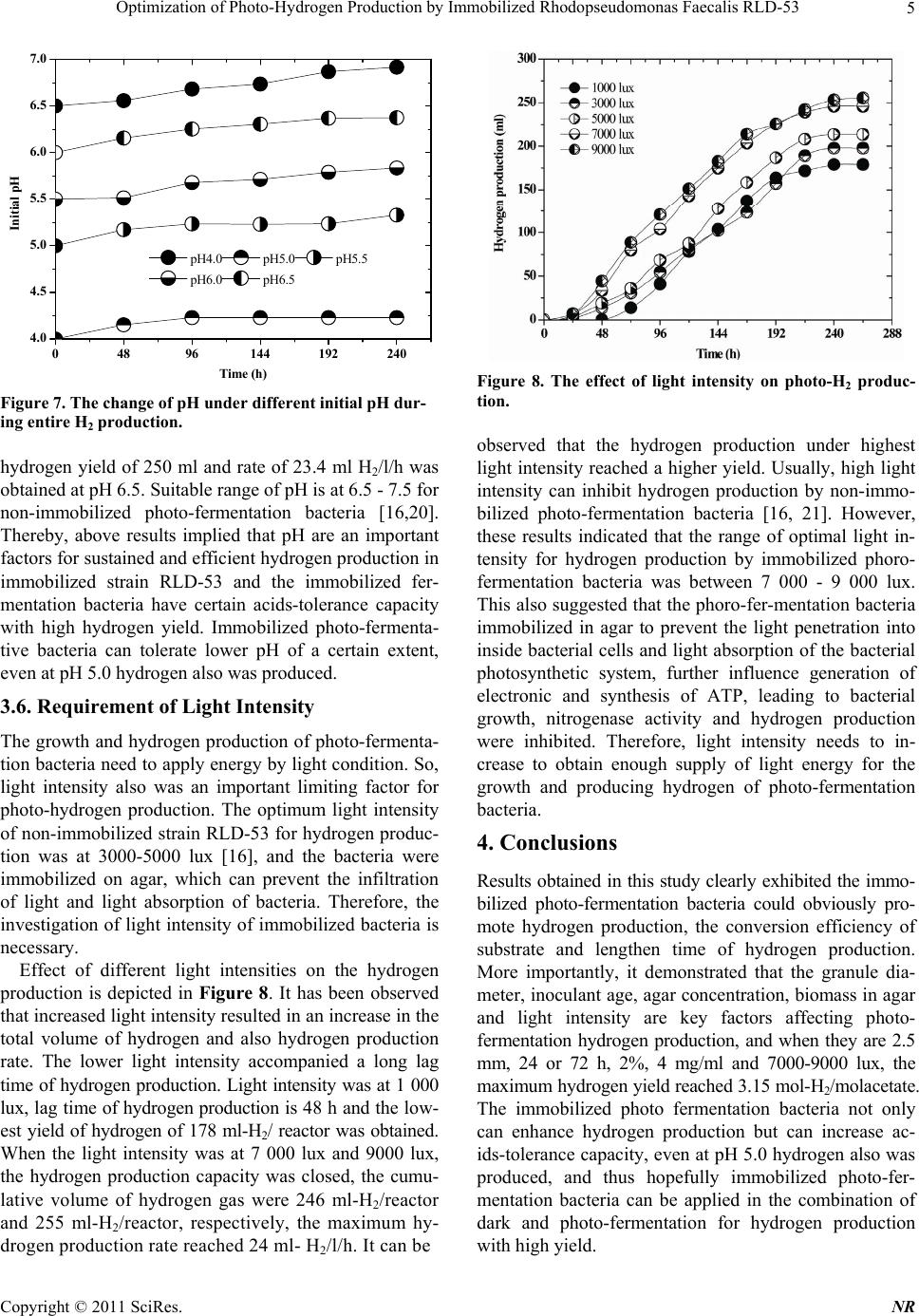 Optimization of Photo-Hydrogen Production by Immobilized Rhodopseudomonas Faecalis RLD-53 5 04896144 192 240 4.0 4.5 5.0 5.5 6.0 6.5 7.0 Initial pH Time ( h ) pH4.0 pH5.0 pH5.5 pH6.0 pH6.5 Figure 7. The change of pH under different initial pH dur- ing entire H2 production. hydrogen yield of 250 ml and rate of 23.4 ml H2/l/h was obtained at pH 6.5. Suitable range of pH is at 6.5 - 7.5 for non-immobilized photo-fermentation bacteria [16,20]. Thereby, above results implied that pH are an important factors for sustained and efficient hydrogen production in immobilized strain RLD-53 and the immobilized fer- mentation bacteria have certain acids-tolerance capacity with high hydrogen yield. Immobilized photo-fermenta- tive bacteria can tolerate lower pH of a certain extent, even at pH 5.0 hydrogen also was produced. 3.6. Requirement of Light Intensity The growth and hydrogen production of photo-fermenta- tion bacteria need to apply energy by light condition. So, light intensity also was an important limiting factor for photo-hydrogen production. The optimum light intensity of non-immobilized strain RLD-53 for hydrogen produc- tion was at 3000-5000 lux [16], and the bacteria were immobilized on agar, which can prevent the infiltration of light and light absorption of bacteria. Therefore, the investigation of light intensity of immobilized bacteria is necessary. Effect of different light intensities on the hydrogen production is depicted in Figure 8. It has been observed that increased light intensity resulted in an increase in the total volume of hydrogen and also hydrogen production rate. The lower light intensity accompanied a long lag time of hydrogen production. Light intensity was at 1 000 lux, lag time of hydrogen production is 48 h and the low- est yield of hydrogen of 178 ml-H2/ reactor was obtained. When the light intensity was at 7 000 lux and 9000 lux, the hydrogen production capacity was closed, the cumu- lative volume of hydrogen gas were 246 ml-H2/reactor and 255 ml-H2/reactor, respectively, the maximum hy- drogen production rate reached 24 ml- H2/l/h. It can be Figure 8. The effect of light intensity on photo-H2 produc- tion. observed that the hydrogen production under highest light intensity reached a higher yield. Usually, high light intensity can inhibit hydrogen production by non-immo- bilized photo-fermentation bacteria [16, 21]. However, these results indicated that the range of optimal light in- tensity for hydrogen production by immobilized phoro- fermentation bacteria was between 7 000 - 9 000 lux. This also suggested that the phoro-fer-mentation bacteria immobilized in agar to prevent the light penetration into inside bacterial cells and light absorption of the bacterial photosynthetic system, further influence generation of electronic and synthesis of ATP, leading to bacterial growth, nitrogenase activity and hydrogen production were inhibited. Therefore, light intensity needs to in- crease to obtain enough supply of light energy for the growth and producing hydrogen of photo-fermentation bacteria. 4. Conclusions Results obtained in this study clearly exhibited the immo- bilized photo-fermentation bacteria could obviously pro- mote hydrogen production, the conversion efficiency of substrate and lengthen time of hydrogen production. More importantly, it demonstrated that the granule dia- meter, inoculant age, agar concentration, biomass in agar and light intensity are key factors affecting photo- fermentation hydrogen production, and when they are 2.5 mm, 24 or 72 h, 2%, 4 mg/ml and 7000-9000 lux, the maximum hydrogen yield reached 3.15 mol-H2/molacetate. The immobilized photo fermentation bacteria not only can enhance hydrogen production but can increase ac- ids-tolerance capacity, even at pH 5.0 hydrogen also was produced, and thus hopefully immobilized photo-fer- mentation bacteria can be applied in the combination of dark and photo-fermentation for hydrogen production with high yield. C opyright © 2011 SciRes. NR 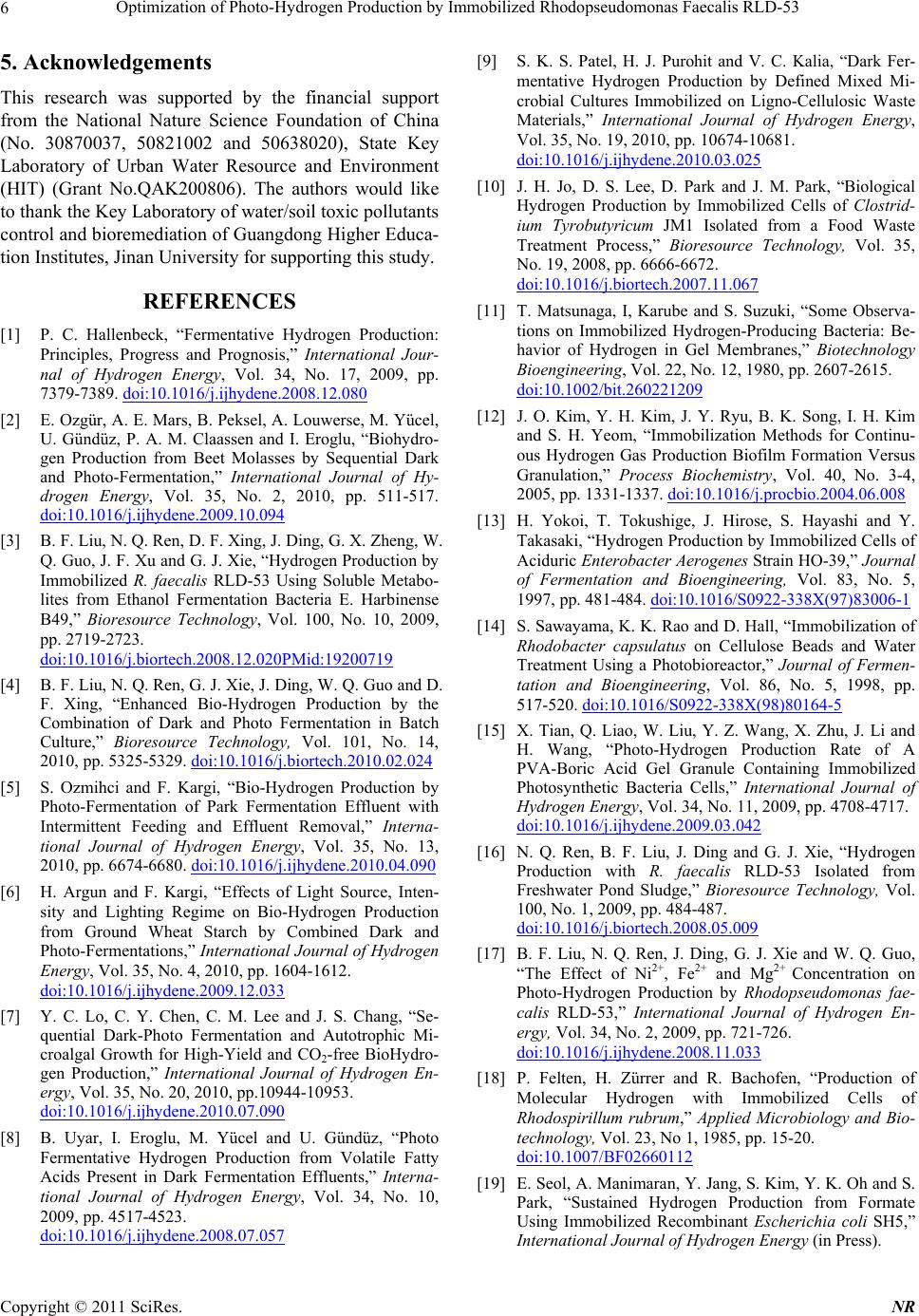 Optimization of Photo-Hydrogen Production by Immobilized Rhodopseudomonas Faecalis RLD-53 6 5. Acknowledgements This research was supported by the financial support from the National Nature Science Foundation of China (No. 30870037, 50821002 and 50638020), State Key Laboratory of Urban Water Resource and Environment (HIT) (Grant No.QAK200806). The authors would like to thank the Key Laboratory of water/soil toxic pollutants control and bioremediation of Guangdong Higher Educa- tion Institutes, Jinan University for supporting this study. REFERENCES [1] P. C. Hallenbeck, “Fermentative Hydrogen Production: Principles, Progress and Prognosis,” International Jour- nal of Hydrogen Energy, Vol. 34, No. 17, 2009, pp. 7379-7389. doi:10.1016/j.ijhydene.2008.12.080 [2] E. Ozgür, A. E. Mars, B. Peksel, A. Louwerse, M. Yücel, U. Gündüz, P. A. M. Claassen and I. Eroglu, “Biohydro- gen Production from Beet Molasses by Sequential Dark and Photo-Fermentation,” International Journal of Hy- drogen Energy, Vol. 35, No. 2, 2010, pp. 511-517. doi:10.1016/j.ijhydene.2009.10.094 [3] B. F. Liu, N. Q. Ren, D. F. Xing, J. Ding, G. X. Zheng, W. Q. Guo, J. F. Xu and G. J. Xie, “Hydrogen Production by Immobilized R. faecalis RLD-53 Using Soluble Metabo- lites from Ethanol Fermentation Bacteria E. Harbinense B49,” Bioresource Technology, Vol. 100, No. 10, 2009, pp. 2719-2723. doi:10.1016/j.biortech.2008.12.020PMid:19200719 [4] B. F. Liu, N. Q. Ren, G. J. Xie, J. Ding, W. Q. Guo and D. F. Xing, “Enhanced Bio-Hydrogen Production by the Combination of Dark and Photo Fermentation in Batch Culture,” Bioresource Technology, Vol. 101, No. 14, 2010, pp. 5325-5329. doi:10.1016/j.biortech.2010.02.024 [5] S. Ozmihci and F. Kargi, “Bio-Hydrogen Production by Photo-Fermentation of Park Fermentation Effluent with Intermittent Feeding and Effluent Removal,” Interna- tional Journal of Hydrogen Energy, Vol. 35, No. 13, 2010, pp. 6674-6680. doi:10.1016/j.ijhydene.2010.04.090 [6] H. Argun and F. Kargi, “Effects of Light Source, Inten- sity and Lighting Regime on Bio-Hydrogen Production from Ground Wheat Starch by Combined Dark and Photo-Fermentations,” International Journal of Hydrogen Energy, Vol. 35, No. 4, 2010, pp. 1604-1612. doi:10.1016/j.ijhydene.2009.12.033 [7] Y. C. Lo, C. Y. Chen, C. M. Lee and J. S. Chang, “Se- quential Dark-Photo Fermentation and Autotrophic Mi- croalgal Growth for High-Yield and CO2-free BioHydro- gen Production,” International Journal of Hydrogen En- ergy, Vol. 35, No. 20, 2010, pp.10944-10953. doi:10.1016/j.ijhydene.2010.07.090 [8] B. Uyar, I. Eroglu, M. Yücel and U. Gündüz, “Photo Fermentative Hydrogen Production from Volatile Fatty Acids Present in Dark Fermentation Effluents,” Interna- tional Journal of Hydrogen Energy, Vol. 34, No. 10, 2009, pp. 4517-4523. doi:10.1016/j.ijhydene.2008.07.057 [9] S. K. S. Patel, H. J. Purohit and V. C. Kalia, “Dark Fer- mentative Hydrogen Production by Defined Mixed Mi- crobial Cultures Immobilized on Ligno-Cellulosic Waste Materials,” International Journal of Hydrogen Energy, Vol. 35, No. 19, 2010, pp. 10674-10681. doi:10.1016/j.ijhydene.2010.03.025 [10] J. H. Jo, D. S. Lee, D. Park and J. M. Park, “Biological Hydrogen Production by Immobilized Cells of Clostrid- ium Tyrobutyricum JM1 Isolated from a Food Waste Treatment Process,” Bioresource Technology, Vol. 35, No. 19, 2008, pp. 6666-6672. doi:10.1016/j.biortech.2007.11.067 [11] T. Matsunaga, I, Karube and S. Suzuki, “Some Observa- tions on Immobilized Hydrogen-Producing Bacteria: Be- havior of Hydrogen in Gel Membranes,” Biotechnology Bioengineering, Vol. 22, No. 12, 1980, pp. 2607-2615. doi:10.1002/bit.260221209 [12] J. O. Kim, Y. H. Kim, J. Y. Ryu, B. K. Song, I. H. Kim and S. H. Yeom, “Immobilization Methods for Continu- ous Hydrogen Gas Production Biofilm Formation Versus Granulation,” Process Biochemistry, Vol. 40, No. 3-4, 2005, pp. 1331-1337. doi:10.1016/j.procbio.2004.06.008 [13] H. Yokoi, T. Tokushige, J. Hirose, S. Hayashi and Y. Takasaki, “Hydrogen Production by Immobilized Cells of Aciduric Enterobacter Aerogenes Strain HO-39,” Journal of Fermentation and Bioengineering, Vol. 83, No. 5, 1997, pp. 481-484. doi:10.1016/S0922-338X(97)83006-1 [14] S. Sawayama, K. K. Rao and D. Hall, “Immobilization of Rhodobacter capsulatus on Cellulose Beads and Water Treatment Using a Photobioreactor,” Journal of Fermen- tation and Bioengineering, Vol. 86, No. 5, 1998, pp. 517-520. doi:10.1016/S0922-338X(98)80164-5 [15] X. Tian, Q. Liao, W. Liu, Y. Z. Wang, X. Zhu, J. Li and H. Wang, “Photo-Hydrogen Production Rate of A PVA-Boric Acid Gel Granule Containing Immobilized Photosynthetic Bacteria Cells,” International Journal of Hydrogen Energy, Vol. 34, No. 11, 2009, pp. 4708-4717. doi:10.1016/j.ijhydene.2009.03.042 [16] N. Q. Ren, B. F. Liu, J. Ding and G. J. Xie, “Hydrogen Production with R. faecalis RLD-53 Isolated from Freshwater Pond Sludge,” Bioresource Technology, Vol. 100, No. 1, 2009, pp. 484-487. doi:10.1016/j.biortech.2008.05.009 [17] B. F. Liu, N. Q. Ren, J. Ding, G. J. Xie and W. Q. Guo, “The Effect of Ni2+, Fe2+ and Mg2+ Concentration on Photo-Hydrogen Production by Rhodopseudomonas fae- calis RLD-53,” International Journal of Hydrogen En- ergy, Vol. 34, No. 2, 2009, pp. 721-726. doi:10.1016/j.ijhydene.2008.11.033 [18] P. Felten, H. Zürrer and R. Bachofen, “Production of Molecular Hydrogen with Immobilized Cells of Rhodospirillum rubrum,” Applied Microbiology and Bio- technology, Vol. 23, No 1, 1985, pp. 15-20. doi:10.1007/BF02660112 [19] E. Seol, A. Manimaran, Y. Jang, S. Kim, Y. K. Oh and S. Park, “Sustained Hydrogen Production from Formate Using Immobilized Recombinant Escherichia coli SH5,” International Journal of Hydrogen Energy (in Press). C opyright © 2011 SciRes. NR  Optimization of Photo-Hydrogen Production by Immobilized Rhodopseudomonas Faecalis RLD-53 Copyright © 2011 SciRes. NR 7 doi:10.1016/j.ijhydene.2010.05.118 [20] R. Merugu, S. Girisham and S. M. Reddy, “Bioproduc- tion of Hydrogen by Rhodobacter capsulatus KU002 Isolated from Leather Industry Effluents,” International Journal of Hydrogen Energy, Vol. 35, No. 18, 2010, pp. 9591-9597. doi:10.1016/j.ijhydene.2010.06.057 [21] H. Argun and F. Kargi, “Effects of Light Source, Inten- sity and Lighting Regime on Bio-hydrogen Production from Ground Wheat Starch by Combined Dark and Photo-Fermentations,” International Journal of Hydrogen Energy, Vol. 35, No. 4, 2010, pp. 1604-1612. doi:10.1016/j.ijhydene.2009.12.033 |