

Paper Menu >>
Journal Menu >>
 International Journal of Clinical Medicine, 2013, 4, 5-9 Published Online December 2013 (http://www.scirp.org/journal/ijcm) http://dx.doi.org/10.4236/ijcm.2013.412A1002 Open Access IJCM 5 Partial Nephrectomy for Renal Cell Carcinoma: Risk Factors for Acute Post-Operative Hemorrhage and Impact on Subsequent Hospital Course and Complete Nephrectomy Rate. An Analysis of 200 Consecutive Cases James Cavalcante, Alan Perrotti, Philip Rabadi, Alicia McCarthy, Michael Perrotti* Urologic Oncology Service, Saint Peter’s Hospital Cancer Care Center, Saint Peter’s Health Partners, Albany, New York, USA. Email: *[email protected] Received October 29th, 2013; revised November 25th, 2013; accepted December 10th, 2013 Copyright © 2013 James Cavalcante et al. This is an open access article distributed under the Creative Commons Attribution License, which permits unrestricted use, distribution, and reproduction in any medium, provided the original work is properly cited. In accor- dance of the Creative Commons Attribution License all Copyrights © 2013 are reserved for SCIRP and the owner of the intellectual property James Cavalcante et al. All Copyright © 2013 are guarded by law and by SCIRP as a guardian. ABSTRACT Purpose: Clinical guidelines recommend partial nephrectomy (PN) as the preferred method of surgical excision of the small renal tumor whenever feasible. PN has comparable cancer cure rates to that of radical nephrectomy in this setting, and decreased risk of chronic kidney disease. A recognized devastating complication following partial nephrectomy is acute post-operative hemorrhage (APOH) from the reconstructed kidney. Risk factors for hemorrhage following partial nephrectomy remain poorly elucidated, as does the impact of hemorrhage on subsequent hospital stay. Identification of risk factors for hemorrhage may lead to a better understanding of and reduction of this complication. Material and Methods: We utilized a prospectively managed database comprised of patients undergoing open partial nephrectomy at our institution by the same surgical team from January 2006 to July 2012. Clinicopathologic factors assessed APOH for their relationships, including patient age, gender, diabetes, smoking, hypertension, coronary artery disease, American Society of Anesthesia Score (ASA), tumor size, RENAL nephrotomy score, pathologic result, cancer margin status, operative time, and intra-operative blood loss. The impact of APOH on subsequent hospital course was evaluated and compared with the entire cohort. Results: Data were analyzed from 200 consecutive patients. We identified 7 patients (3.5%) who experienced APOH. Compared with the entire cohort, APOH resulted in an increased hospital length of stay (median, 5 days; range, 2 - 11 days, p = 0.001), an increased transfusion requirement (median, 6 units; range, 1 - 16 units. p = 0.001), a greater risk of selective angiographic embolization (median, 2 procedures; range, 0 - 3, p = 0.001), and completion nephrectomy (n = 2, p = 0.001). One patient in the APOH group experienced cardiac arrest and was resuscitated. Clinicopathologic factors associated with the increased risk of APOH in the present cohort were male gen- der (p = 0.03) and hypertension (p = 0.006). Conclusion: In the present analysis, APOH was associated with extended hospitalization, the increased transfusion requirement and the need for more ancillary procedures. APOH patients were at significantly increased risk of renal loss. Male gender and hypertension were associated with increased risk for APOH. We have incorporated this information into an APOH risk reduction program at our institution. Keywords: Kidney Neoplasms; Partial Nephrectomy; Renal Cell Carcinoma 1. Introduction Clinical guidelines recommend partial nephrectomy (PN) as the preferred method of surgical excision of the small renal tumor whenever feasible [1]. PN has comparable cancer cure rates to that of radical nephrectomy in this setting [2], and decreased risk of chronic kidney disease [3]. A recognized devastating complication following partial nephrectomy is acute post-operative hemorrhage (APOH) from the reconstructed kidney. Risk factors for hemorrhage following partial nephrectomy remain poorly elucidated, as does the impact of hemorrhage on subse- quent hospital stay. Identification of risk factors for he- *Corresponding author.  Partial Nephrectomy for Renal Cell Carcinoma: Risk Factors for Acute Post-Operative Hemorrhage and Impact on Subsequent Hospital Course and Complete Nephrectomy Rate. 6 An Analysis of 200 Consecutive Cases morrhage may lead to a better understanding of and re- duction of this complication. In the present investigation, we sought to determine risk factors for acute post-opera- tive hemorrhage after partial nephrectomy utilizing a prospectively managed patient database. We also evalu- ated the impact of APOH on subsequent hospital stay. 2. Material and Methods A prospectively managed database was utilized com- prised of patients undergoing open partial nephrectomy at our institution. The current investigation includes all patients operated from January 2006 to July 2012 by a single surgical team. Clinicopathologic factors assessed for their relationship to APOH included patient age, gender, diabetes, smoking, hypertension, coronary artery disease, American Society of Anesthesia Score (ASA), R.E.N.A.L. nephrotomy score [4], tumor size, pathologic result, cancer margin status, operative time, and intra- operative blood loss. The impact of APOH on subsequent hospital course was evaluated and compared to the entire cohort. We identified patients with and without APOH. For the purposes of this investigation, APOH was defined as acute post-operative drop in hemoglobin (<8 mg/dl) and radiographic CT scan evidence of either peri-nephric retroperitoneal hematoma or blood within the renal col- lecting system of the operated kidney. APOH could be associated with acute hypotension (i.e., systolic BP < 100 mmHg), gross hematuria and increasing flank pain, but this was not required for the diagnosis of APOH. Evalu- ated subsequent hospital course outcome measures in- cluded blood transfusion, renal angiography procedure with or without selective renal embolization, and com- pletion nephrectomy. Univariate statistical analysis was performed using the X2 test and Fisher’s exact test as appropriate for cate- gorical data [5]. These included gender, hypertension, smoking, diabetes, coronary artery disease, American Society of Anesthesiologists (ASA) score (dichotomized as 1 and 2 versus 3, 4 and 5), tumor laterality, pathologic result (cancer versus benign), surgical margin status (i.e., cancer at margin versus not). The Mann-Whitney test [5] was utilized for continuous data including age, tumor size, R.E.N.A.L. nephrotomy score, operative time, renal artery clamp time, and intra-operative blood loss. In assessing the impact of APOH on subsequent hos- pital course, measured variables were dichotomized as length of stay (LOS) ≤3 days versus >3 days; transfusion as none versus ≥1 unit of packed red blood cell (PRBC); no angiographic embolization versus angiographic em- bolization regardless of number of procedures performed for each patient; completion nephrectomy as either per- formed or not performed. 3. Results Data were analyzed from 200 consecutive patients oper- ated from January 1st, 2006 to July 30th 2012. Table 1 presents the clinicopathologic features for the APOH cohort and the non-APOH cohort. APOH was identified in 7 patients. The only clinico- pathologic factor associated with increased risk of APOH in the present cohort were male gender (p = 0.03) and hypertension (p = 0.006). This data is shown in Table 1. Only a subset of the current cohort had calculation of R.E.N.A.L. nephrotomy score following its description in 2009. In the present investigation, R.E.N.A.L. nephro- tomy score did not correlate with APOH in the subset evaluated. Age, diabetes, smoking, coronary artery dis- ease, American Society of Anesthesia Score (ASA), tu- mor size, pathologic result, cancer margin status, opera- tive time, and intra-operative blood loss did not correlate with APOH. Table 2 illustrates the impact of APOH on subsequent hospital course. Compared to the entire cohort, APOH resulted an increased hospital length of stay (median, 5 days; range, 2 - 11 days, p = 0.001), increased transfu- sion requirement (median 6 units; range, 1 - 16 units, p = 0.001), greater risk of selective angiographic emboliza- tion (median, 2 procedures; range, 0 - 3, p = 0.001), and greater risk of completion nephrectomy (n = 2, p = 0.001). One patient in the APOH group experienced car- diac arrest and was resuscitated. There were no deaths in either cohort. 4. Discussion It is estimated that there will be 65,140 new cases of kidney cancer in the United States in 2013, and the inci- dence is increasing [6,7]. Greater than 70% of newly detected renal tumors are incidentally detected, often less than 4 cm [8], and potentially amenable to either surveil- lance (lesions ≤ 2 cm), emerging percutaneous treatments (i.e., radiofrequency ablation; cryosurgery), compete nephrectomy and partial nephrectomy [9]. For those pa- tients felt best to be managed with surgical excision, clinical guidelines recommend partial nephrectomy (PN) as the preferred method of surgical excision of the small renal tumor whenever feasible [1]. PN has comparable cancer cure rates to that of radical nephrectomy in this setting [2], and decreased risk of chronic kidney disease [3]. Despite this, investigators have reported that PN ap- pears to be underutilized in the United States, even in Open Access IJCM 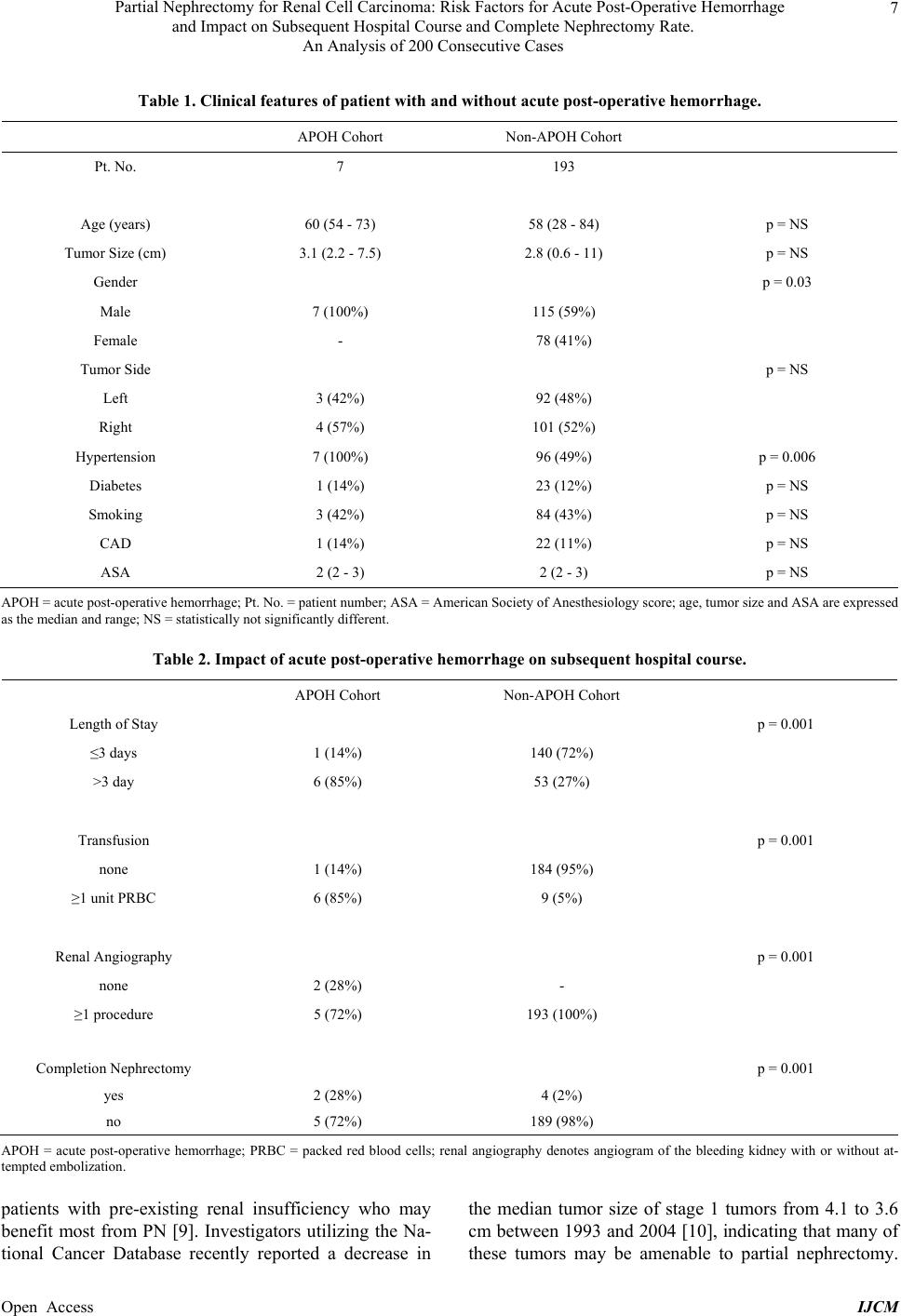 Partial Nephrectomy for Renal Cell Carcinoma: Risk Factors for Acute Post-Operative Hemorrhage and Impact on Subsequent Hospital Course and Complete Nephrectomy Rate. An Analysis of 200 Consecutive Cases Open Access IJCM 7 Table 1. Clinical features of patient with and without acute post-operative hemorrhage. APOH Cohort Non-APOH Cohort Pt. No. 7 193 Age (years) 60 (54 - 73) 58 (28 - 84) p = NS Tumor Size (cm) 3.1 (2.2 - 7.5) 2.8 (0.6 - 11) p = NS Gender p = 0.03 Male 7 (100%) 115 (59%) Female - 78 (41%) Tumor Side p = NS Left 3 (42%) 92 (48%) Right 4 (57%) 101 (52%) Hypertension 7 (100%) 96 (49%) p = 0.006 Diabetes 1 (14%) 23 (12%) p = NS Smoking 3 (42%) 84 (43%) p = NS CAD 1 (14%) 22 (11%) p = NS ASA 2 (2 - 3) 2 (2 - 3) p = NS APOH = acute post-operative hemorrhage; Pt. No. = patient number; ASA = American Society of Anesthesiology score; age, tumor size and ASA are expressed as the median and range; NS = statistically not significantly different. Table 2. Impact of acute post-operative hemorrhage on subsequent hospital course. APOH Cohort Non-APOH Cohort Length of Stay p = 0.001 ≤3 days 1 (14%) 140 (72%) >3 day 6 (85%) 53 (27%) Transfusion p = 0.001 none 1 (14%) 184 (95%) ≥1 unit PRBC 6 (85%) 9 (5%) Renal Angiography p = 0.001 none 2 (28%) - ≥1 procedure 5 (72%) 193 (100%) Completion Nephrectomy p = 0.001 yes 2 (28%) 4 (2%) no 5 (72%) 189 (98%) APOH = acute post-operative hemorrhage; PRBC = packed red blood cells; renal angiography denotes angiogram of the bleeding kidney with or without at- tempted embolization. patients with pre-existing renal insufficiency who may benefit most from PN [9]. Investigators utilizing the Na- tional Cancer Database recently reported a decrease in the median tumor size of stage 1 tumors from 4.1 to 3.6 cm between 1993 and 2004 [10], indicating that many of these tumors may be amenable to partial nephrectomy.  Partial Nephrectomy for Renal Cell Carcinoma: Risk Factors for Acute Post-Operative Hemorrhage and Impact on Subsequent Hospital Course and Complete Nephrectomy Rate. 8 An Analysis of 200 Consecutive Cases However, a recent analysis utilizing the Surveillance, Epidemiology ad End Results program during that same time period showed that in the US only 35.2% of patients with T1a (≤4 cm) renal masses received partial nephrec- tomy between 1999 and 2006 [11]. That same study re- vealed that only 50% of tumors <2 cm were treated with partial nephrectomy, and 48% of tumors between 2 and 4 cm were treated with partial nephrectomy [12]. There is increasing evidence that surgically induced chronic kidney disease [13,14] following complete neph- rectomy is associated with increased risk of cardiovascu- lar disease including death [15,16] and metabolic adverse consequences including anemia, acidosis, and osteoporo- sis [17,18] and associated significant adverse health con- sequences. The reason for underutilization of partial nephrectomy compared to radical nephrectomy for management of the T1a (<4 cm) and select T1b 4 - 7 cm) renal mass is un- clear, and is beyond the scope of the current investigation. Investigators have suggested that the explanation may be multifactorial, including physician and patient factors, and that the decision making requires complex multi perspective reasoning [19]. It is generally recognized that partial nephrectomy is a complex procedure requiring surgical expertise, a dedicated operating room team and advanced surgical technology, and that partial nephrec- tomy is associated with increased surgical risk both in- tra-operative and post-operative, the most devastating being post-operative hemorrhage. The present study sought to identify risk factors for APOH after partial nephrectomy. Though a rare event, APOH increased the hospital length of stay, the transfusion rate, the need for ancillary procedures and most importantly, the complete nephrectomy rate which was 29% in the APOH cohort compared to 2% in the non-APOH group. Furthermore, we sought to identify risk factors associated with APOH. So that such knowledge may allow preemptive risk re- duction. At our institution all hypertensive males are treated under the care of a cardiologist to maximize hy- pertension management for at least 1 month prior to par- tial nephrectomy. In addition, we have instituted a peri-operative protocol to maintain normotensive status throughout the intra-operative and post-operative period. Whereas in the past all patients received PRN supple- mental meds for hypertension, now our protocol admin- isters that medication (usually beta-blockade) as standing order with hold parameter (i.e. Systolic BP < 100 mmHg or HR < 60 bpm). We attempt to maintain a mean arterial pressure of 70 - 80. Since the institution of this protocol in October 2011 we have not experienced an APOH. During this period, our patient criteria, volume, surgical technique and post-operative pathway [20] remain con- stant. 5. Conclusion In the present analysis, APOH was associated with ex- tended hospitalization, the increased transfusion require- ment and the need for more ancillary procedures. APOH patients were at significantly increased risk of renal loss. Male gender and hypertension were associated with in- creased risk for APOH. We have incorporated this in- formation into an APOH risk reduction program at our institution. REFERENCES [1] S. C. Campbell, A. C. Novick, A. Belldegrun, et al., “Guidelines for Management of the Clinical T1 Renal Mass,” Journal of Urology, Vol. 182, No. 4, 2009, pp. 1271-1279. http://dx.doi.org/10.1016/j.juro.2009.07.004 [2] M. C. Smaldone, B. Egleston, R. G. Uzzo and A. Kutikov, “Does Partialnephrectomy Result in a Durable Overall Survival Benefit in the Medicare Population?” Journal of Urology, Vol. 188, No. 6, 2012, pp. 2089-2094. http://dx.doi.org/10.1016/j.juro.2012.07.099 [3] S. P. Kim, R. H. Thompson, S. A. Boorjian, et al., “Com- parative Effectiveness for Survival and Renal Function of Partial and Radical Nephrectomy for Localized Renal Tumor: A Systematic Review and Meta-Analysis,” Jour- nal of Urology, Vol. 188, No. 1, 2012, pp. 51-57. http://dx.doi.org/10.1016/j.juro.2012.03.006 [4] A. Kutilov and R. G. Uzzo, “The R.E.N.A.L. Nephro- tomy Score: A Comprehensive Standardized System for Quantitating Renal Tumor Score, Location and DEPTH,” Journal of Urology, Vol. 182, No. 3, 2009, pp. 844-853. http://dx.doi.org/10.1016/j.juro.2009.05.035 [5] J. L. Fleiss, “Statistical Methods for Rates and Propor- tions,” 2nd Edition, John Wiley & Sons, 1981. [6] American Cancer Society Cancer Facts and Figures, “At- lanta,” American Cancer Society. http://seer.cancer.gov/ [7] W. H. Chow, S. S. Devesa, J. L. Warren and J. F. Frau- meni, “Rising Incidence of Renal Cell Carcinoma in the United States,” JAMA, Vol. 281, No. 17, 1999, pp. 1628- 1631. http://dx.doi.org/10.1001/jama.281.17.1628 [8] P. Russo, “Renal Cell Carcinoma Presentation, Staging and Surgical Treatment,” Seminars in Oncology, Vol. 27, No. 2, 2000, pp. 160-166. [9] J. M. Woldrich, K. Palazzi, S. P. Stroup, et al., “Trends in the Surgical Management of Localized Renal Masses: Thermal Ablation, Partial and Radical Nephrectomy in the USA, 1999-2008,” BJU International, Vol. 111, No. 8, 2012, pp. 1261-1268. http://dx.doi.org/10.1111/j.1464-410X.2012.11497.x [10] C. J. Kane, K. Mallin, J. Ritchey, et al., “Renal Cell Can- cer Stage Migration: Analysis of the National Cancer Data Base,” Cancer, Vol. 113, No. 1, 2008, pp. 78-83. Open Access IJCM  Partial Nephrectomy for Renal Cell Carcinoma: Risk Factors for Acute Post-Operative Hemorrhage and Impact on Subsequent Hospital Course and Complete Nephrectomy Rate. An Analysis of 200 Consecutive Cases Open Access IJCM 9 http://dx.doi.org/10.1002/cncr.23518 [11] L. M. Duloban, W. T. Lowrance, P. Russo and W. C. Huang, “Trends in Reanl Tumor Surgery Delivery within the United States,” Cancer, Vol. 116, No. 10, 2010, pp. 2316-2321. [12] G. Yong, J. D. Villalta, M. V. Meng and J. M. Whitson, “Evolving Practice Patterns for the Management of Small Renal Masses in the United States,” BJU International, Vol. 110, No. 8, 2012, pp. 1156-1161. http://dx.doi.org/10.1111/j.1464-410X.2012.10969.x [13] W. C. Huang, A. S. Levey, A. M. Serio, et al., “Chronic Kidney Disease after Nephrectomy in Patients with Renal Cortical Tumors: A Retrospective Cohort Study,” The Lancet Oncology, Vol. 7, No. 9, 2006, pp. 735-740. http://dx.doi.org/10.1016/S1470-2045(06)70803-8 [14] J. B. Malcolm, A. Bagrodia, I. H. Derveesh, et al., “Com- parison for Rates and Risk Factors for Developing Chronic Renal Insufficiency, Proteinuria and Metabolic Acidosis after Radical or Partial Nephrectomy,” BJU In- ternational, Vol. 104, No. 4, 2009, pp. 476-481. http://dx.doi.org/10.1111/j.1464-410X.2009.08376.x [15] C. J. Wright, B. T. Larson, A. F. Fergany, et al., “Neph- rectomy Induced Chronic Renal Insufficiency Is Associ- ated with Increased Risk of cardiovascular Death and Death from Any Cause in Patients with Localized cT1b Renal Masses,” Journal of Urology, Vol. 103, No. 4, 2010, pp. 1317-1323. [16] J. M. Woldrich, R. Mehrazin, W. M. Bazzi, et al., “Com- parison of Rates and Risk Factors for Development of Anaemia and Erythropoiesis-Stimulating Agent Utiliza- tion after Radical and Partial Nephrectomy,” BJU Inter- national, Vol. 109, No. 7, 2011, pp. 1019-1025. http://dx.doi.org/10.1111/j.1464-410X.2011.10432.x [17] A. Bagrodia, R. Mehrazin, W. M. Bazzi, et al., “Com- parison of Rates and Risk Factors for Development of Osteoporosis and Fractures after Radical and Partial Nephrectomy,” Urology, Vol. 78, No. 3, 2011, pp. 614- 619. http://dx.doi.org/10.1016/j.urology.2011.02.071 [18] W. K. Lau, M. I. Blute, A. L. Weaver, et al., “Matched Comparison of Radical Nephrectomy vs Nephron-Sparing Surgery in Patients with Unilateral Renal Cell Carcinoma and a Normal Contralateral Kidney,” Mayo Clinic Pro- ceedings, Vol. 75, No. 12, 2000, pp. 1236-1242. http://dx.doi.org/10.4065/75.12.1236 [19] M. Perrotti, W. J. Badger, D. McLeod, et al., “Does Lapa- roscpy Beget the Underuse of Partial Nephrectomy for T1 Renal Masses? Competing Treatment Decision Pathways May Influence Utilization,” Journal of Endourology, Vol. 21, No. 10, 2007, pp. 1223-1228. http://dx.doi.org/10.1089/end.2007.0056 [20] B. Chughtai, C. Abraham, D. Finn, et al., “Fast Track Open Partial Nephrectomy: Reduced Postoperative Leng- th of Stay with a Goal-Directed Pathway Does Not Com- promise Outcome,” Advances in Urology, Vol. 2008, 2008, Article ID: 507543. http://dx.doi.org/10.1155/2008/507543 |