

Paper Menu >>
Journal Menu >>
 Current Urban Studies 2013. Vol.1, No.4, 166-170 Published Online December 2013 in SciRes (http://www.scirp.org/journal/cus) http://dx.doi.org/10.4236/cus.2013.14018 Open Access 166 Corner Store and Commuting Patterns of Low-Income, Urban Elementary School Students Stephanie S. Vander Veur1, Sandy B. Sherman2, Michelle R. Lent1, Tara A. McCoy1, Alexis C. Wojtanowski1, Brianna A. Sandoval2, Allison Karpyn2, Gary D. Foster1 1Center for Obesity Research and Education, Temple University, Philadelphia, USA 2The Food Trust, Philadelphia, USA Email: [email protected] Received October 14th, 2013; revised November 15th, 2013; accepted November 25th, 2013 Copyright © 2013 Stephanie S. Vander Veur et al. This is an open access article distributed under the Creative Commons Attribution License, which permits unrestricted use, distribution, and reproduction in any medium, provided the original work is properly cited. Background: While there has been considerable focus on the school environment in the context of childhood obesity, less is known about the environments around the school, particularly in low-income, urban neighborhoods. Purpose: The purpose of this study was to assess students’ corner store and com- muting habits before and after school in a low-income, urban environment. Design: This was a cross-sectional study. Setting/Participants: Participants were 702 4th - 6th graders from 10 K-8 public schools where 82.1% ± 7.4% of children qualified for free or reduce-priced meals. Methods: Participants were surveyed about their corner store and commuting habits using a questionnaire. Body mass index was assessed using measured weight and height, and student’s demographic information was self-reported. Results: The majority of 4th - 6th grade urban students shopped in corners stores either in the morning (57.4%) or in the afternoon (58.5%). Nearly half (44.8%) reported shopping and purchasing in both the morning and the afternoon. Children reported spending approximately $2.00 per corner store visit. Ap- proximately two-thirds of children reported that they walked to or from school. Children who walked to school frequented corner stores more than those using other commuting methods. Relative weight status was not related to corner store or commuting patterns. Conclusion: Many low-income children purchase food at corner stores before and/or after school making corner stores an important target for public health nutrition. While many children walk to school, those are more likely to frequent corner stores. Neither corner store nor commuting pattern was associated with relative weight. Keywords: Corner Stores; Children; Obesity; Commuting Introduction Nearly a third of children and adolescents in the United States are at least overweight, and 16.3% are obese (Ogden, Carroll et al., 2012). Minority and low-income children are dis- proportionately impacted by obesity (Kaufman, Hirst et al., 2009; Ogden, Carroll et al., 2012). Childhood obesity often contributes to the development of metabolic (Freedman, Mei et al., 2007; Kohler & van den Heuvel 2008; Singh, Foster et al., 2012) and psychosocial consequences (Puhl, Luedicke et al., 2011). Schools are often a setting to implement nutrition-based pe- diatric obesity prevention programs. However, the efficacy of school-based childhood obesity prevention programs remains mixed (Ford, Vander Veur et al., 2007; Foster, Sherman et al., 2008; Katz, O’Connell et al., 2008; Foster, Linder et al., 2010; Waters, de Silva-Sanigorski et al., 2011; Johnson, Weed et al., 2012). School-based prevention programs may be compromised by the local environments around schools, such as urban corner stores where inexpensive, high-calorie foods are easily accessi- ble before and after school (Borradaile, Sherman et al., 2009; Laska, Borradaile et al., 2010; Lucan, Karpyn et al., 2010; Gittelsohn, Rowan et al., 2012; He, Tucker et al., 2012). We previously reported that children spent $1.07 and pur- chased 356 kcal per corner store visit (Borradaile, Sherman et al., 2009). Little is known, however, about the percentage of chil- dren who frequent corner stores. One study found that 59% of low-income urban, Black youth frequented corner stores at least twice per week (Dennisuk, Coutinho et al., 2011). Even less is known about the relationship between commuting mode (walk, car, bus) and the utilization of corner stores or whether relative weight status is associated with corner store or commuting patterns. While walking to school provides children the oppor- tunity to expend energy (Alexander, Inchley et al., 2005; Davison, Werder et al., 2008; Tucker, Irwin et al., 2009), it may introduce the unintended consequence of increased energy in- take through greater exposure to inexpensive, unhealthy, food environments (Borradaile, Sherman et al., 2009; Gittelsohn, Rowan et al., 2012). More information about corner store and commuting patterns of low-income, ethnically diverse, urban youth can help identify targets for intervention among those who are at the greatest risk for obesity and its consequences. Further, such data can inform the considerable work that is ongoing about corner store interventions. The purpose of this study was to assess students’ corner store and commuting patterns before and after school in a low-in- 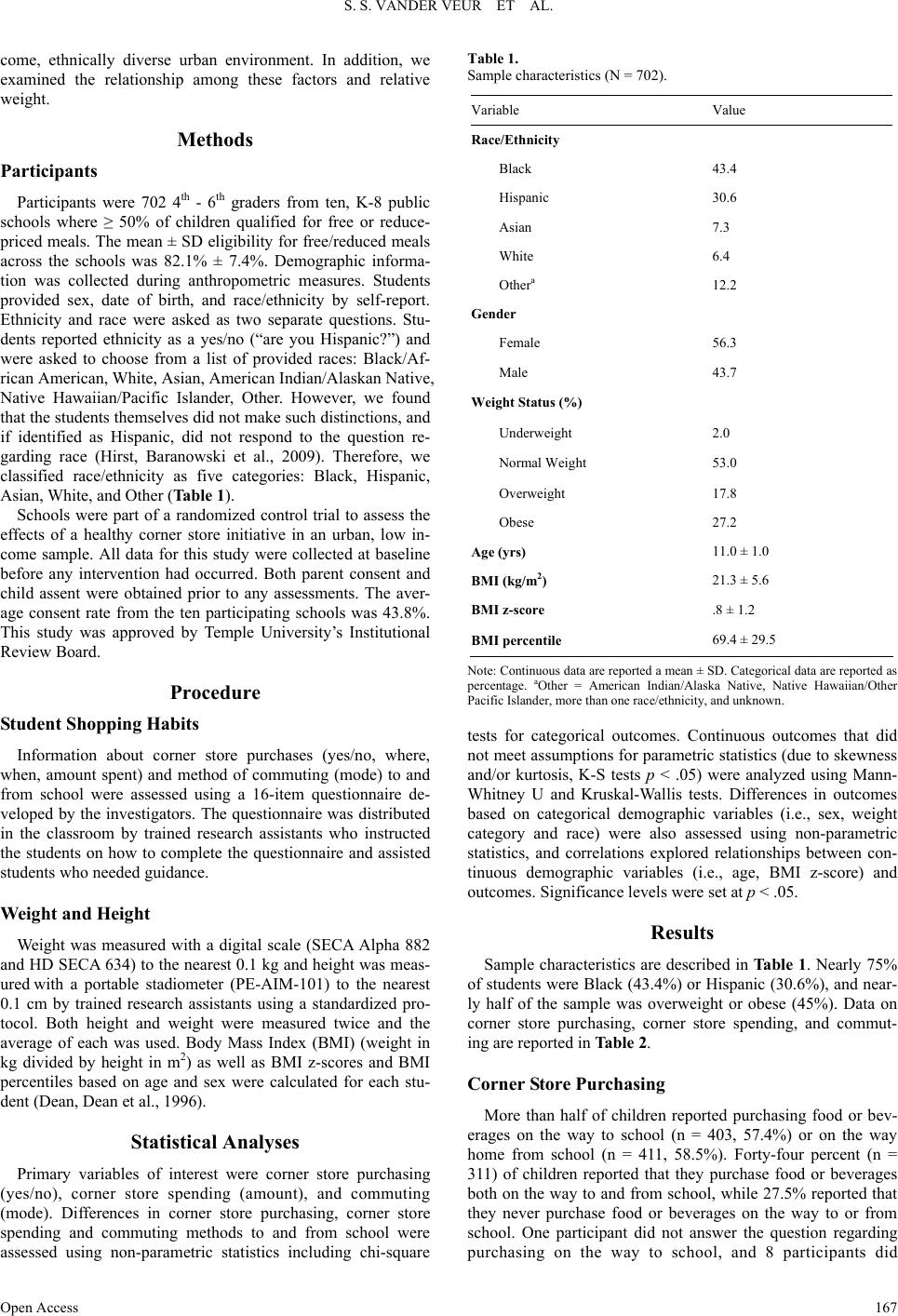 S. S. VANDER VEUR ET AL. come, ethnically diverse urban environment. In addition, we examined the relationship among these factors and relative weight. Methods Participants Participants were 702 4th - 6th graders from ten, K-8 public schools where ≥ 50% of children qualified for free or reduce- priced meals. The mean ± SD eligibility for free/reduced meals across the schools was 82.1% ± 7.4%. Demographic informa- tion was collected during anthropometric measures. Students provided sex, date of birth, and race/ethnicity by self-report. Ethnicity and race were asked as two separate questions. Stu- dents reported ethnicity as a yes/no (“are you Hispanic?”) and were asked to choose from a list of provided races: Black/Af- rican American, White, Asian, American Indian/Alaskan Native, Native Hawaiian/Pacific Islander, Other. However, we found that the students themselves did not make such distinctions, and if identified as Hispanic, did not respond to the question re- garding race (Hirst, Baranowski et al., 2009). Therefore, we classified race/ethnicity as five categories: Black, Hispanic, Asian, White, and Other (Table 1). Schools were part of a randomized control trial to assess the effects of a healthy corner store initiative in an urban, low in- come sample. All data for this study were collected at baseline before any intervention had occurred. Both parent consent and child assent were obtained prior to any assessments. The aver- age consent rate from the ten participating schools was 43.8%. This study was approved by Temple University’s Institutional Review Board. Procedure Student Shopping Habits Information about corner store purchases (yes/no, where, when, amount spent) and method of commuting (mode) to and from school were assessed using a 16-item questionnaire de- veloped by the investigators. The questionnaire was distributed in the classroom by trained research assistants who instructed the students on how to complete the questionnaire and assisted students who needed guidance. Weight and Height Weight was measured with a digital scale (SECA Alpha 882 and HD SECA 634) to the nearest 0.1 kg and height was meas- ured with a portable stadiometer (PE-AIM-101) to the nearest 0.1 cm by trained research assistants using a standardized pro- tocol. Both height and weight were measured twice and the average of each was used. Body Mass Index (BMI) (weight in kg divided by height in m2) as well as BMI z-scores and BMI percentiles based on age and sex were calculated for each stu- dent (Dean, Dean et al., 1996). Statistical Analyses Primary variables of interest were corner store purchasing (yes/no), corner store spending (amount), and commuting (mode). Differences in corner store purchasing, corner store spending and commuting methods to and from school were assessed using non-parametric statistics including chi-square Table 1. Sample characteristics (N = 702). Variable Value Race/Ethnicity Black 43.4 Hispanic 30.6 Asian 7.3 White 6.4 Othera 12.2 Gender Female 56.3 Male 43.7 Weight Status (%) Underweight 2.0 Normal Weight 53.0 Overweight 17.8 Obese 27.2 Age (yrs) 11.0 ± 1.0 BMI (kg/m2) 21.3 ± 5.6 BMI z-score .8 ± 1.2 BMI percentile 69.4 ± 29.5 Note: Continuous data are reported a mean ± SD. Categorical data are reported as percentage. aOther = American Indian/Alaska Native, Native Hawaiian/Other Pacific Islander, more than one race/ethnicity, and unknown. tests for categorical outcomes. Continuous outcomes that did not meet assumptions for parametric statistics (due to skewness and/or kurtosis, K-S tests p < .05) were analyzed using Mann- Whitney U and Kruskal-Wallis tests. Differences in outcomes based on categorical demographic variables (i.e., sex, weight category and race) were also assessed using non-parametric statistics, and correlations explored relationships between con- tinuous demographic variables (i.e., age, BMI z-score) and outcomes. Significance levels were set at p < .05. Results Sample characteristics are described in Ta bl e 1. Nearly 75% of students were Black (43.4%) or Hispanic (30.6%), and near- ly half of the sample was overweight or obese (45%). Data on corner store purchasing, corner store spending, and commut- ing are reported in Table 2. Corner Store Purchasing More than half of children reported purchasing food or bev- erages on the way to school (n = 403, 57.4%) or on the way home from school (n = 411, 58.5%). Forty-four percent (n = 311) of children reported that they purchase food or beverages both on the way to and from school, while 27.5% reported that they never purchase food or beverages on the way to or from school. One participant did not answer the question regarding purchasing on the way to school, and 8 participants did Open Access 167 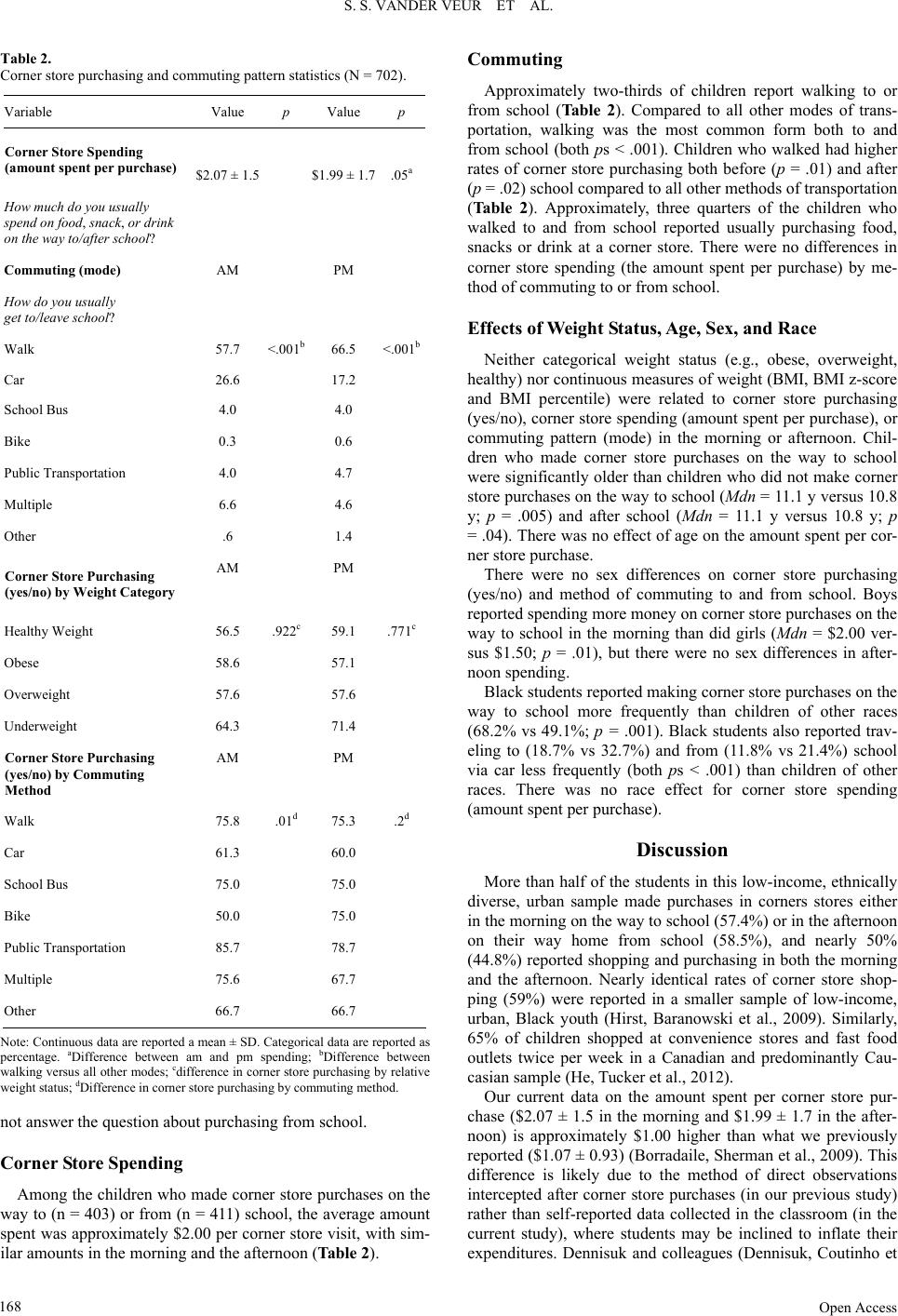 S. S. VANDER VEUR ET AL. Table 2. Corner store purchasing and commuting pattern statistics (N = 702). Variable Value p Value p Corner Store Spending (amount spent per purchase) $2.07 ± 1.5 $1.99 ± 1.7.05a How much do you usually spend on food, snac k, or drink on the way t o/ af t er school? Commuting (mode) AM PM How do you usually get to/leave school? Walk 57.7 <.001b 66.5 <.001b Car 26.6 17.2 School Bus 4.0 4.0 Bike 0.3 0.6 Public Transportation 4.0 4.7 Multiple 6.6 4.6 Other .6 1.4 AM PM Corner Store Purchasing (yes/no) by We ight Category Healthy Weight 56.5 .922c 59.1 .771c Obese 58.6 57.1 Overweight 57.6 57.6 Underweight 64.3 71.4 AM PM Corner Store Purchasing (yes/no) by Com muti ng Method Walk 75.8 .01d 75.3 .2d Car 61.3 60.0 School Bus 75.0 75.0 Bike 50.0 75.0 Public Transportation 85.7 78.7 Multiple 75.6 67.7 Other 66.7 66.7 Note: Continuous data are reported a mean ± SD. Categorical data are reported as percentage. aDifference between am and pm spending; bDifference between walking versus all other modes; cdifference in corner store purchasing by relative weight status; dDifference in corner store purchasing by commuting method. not answer the question about purchasing from school. Corner Store Spending Among the children who made corner store purchases on the way to (n = 403) or from (n = 411) school, the average amount spent was approximately $2.00 per corner store visit, with sim- ilar amounts in the morning and the afternoon (Table 2). Commuting Approximately two-thirds of children report walking to or from school (Ta bl e 2 ). Compared to all other modes of trans- portation, walking was the most common form both to and from school (both ps < .001). Children who walked had higher rates of corner store purchasing both before (p = .01) and after (p = .02) school compared to all other methods of transportation (Table 2). Approximately, three quarters of the children who walked to and from school reported usually purchasing food, snacks or drink at a corner store. There were no differences in corner store spending (the amount spent per purchase) by me- thod of commuting to or from school. Effects of Weight St atus, Age, Sex, and Ra ce Neither categorical weight status (e.g., obese, overweight, healthy) nor continuous measures of weight (BMI, BMI z-score and BMI percentile) were related to corner store purchasing (yes/no), corner store spending (amount spent per purchase), or commuting pattern (mode) in the morning or afternoon. Chil- dren who made corner store purchases on the way to school were significantly older than children who did not make corner store purchases on the way to school (Mdn = 11.1 y versus 10.8 y; p = .005) and after school (Mdn = 11.1 y versus 10.8 y; p = .04). There was no effect of age on the amount spent per cor- ner store purchase. There were no sex differences on corner store purchasing (yes/no) and method of commuting to and from school. Boys reported spending more money on corner store purchases on the way to school in the morning than did girls (Mdn = $2.00 ver- sus $1.50; p = .01), but there were no sex differences in after- noon spending. Black students reported making corner store purchases on the way to school more frequently than children of other races (68.2% vs 49.1%; p = .001). Black students also reported trav- eling to (18.7% vs 32.7%) and from (11.8% vs 21.4%) school via car less frequently (both ps < .001) than children of other races. There was no race effect for corner store spending (amount spent per purchase). Discussion More than half of the students in this low-income, ethnically diverse, urban sample made purchases in corners stores either in the morning on the way to school (57.4%) or in the afternoon on their way home from school (58.5%), and nearly 50% (44.8%) reported shopping and purchasing in both the morning and the afternoon. Nearly identical rates of corner store shop- ping (59%) were reported in a smaller sample of low-income, urban, Black youth (Hirst, Baranowski et al., 2009). Similarly, 65% of children shopped at convenience stores and fast food outlets twice per week in a Canadian and predominantly Cau- casian sample (He, Tucker et al., 2012). Our current data on the amount spent per corner store pur- chase ($2.07 ± 1.5 in the morning and $1.99 ± 1.7 in the after- noon) is approximately $1.00 higher than what we previously reported ($1.07 ± 0.93) (Borradaile, Sherman et al., 2009). This difference is likely due to the method of direct observations intercepted after corner store purchases (in our previous study) rather than self-reported data collected in the classroom (in the current study), where students may be inclined to inflate their expenditures. Dennisuk and colleagues (Dennisuk, Coutinho et Open Access 168  S. S. VANDER VEUR ET AL. al., 2011) found that children were spending nearly $4.00 daily ($3.96) on food and beverages at a variety of outlets (Dennisuk, Coutinho et al., 2011). While data from both studies were col- lected in an urban sample of predominantly low-income, Black youth, Dennisuk’s data differ from ours because they used 7- day food recalls and employed a broader definition of food out- lets to include convenience stores, fast food restaurants, super- markets, and corner stores. Further, Dennisuk documented all daily purchases at these outlets while our data focus on pur- chases per morning or afternoon visit. While we found statisti- cally significant differences by age on corner store purchasing (yes/no) as well as by gender for corner store spending (amount spent per visit) in the morning, the small median differences are not likely to be meaningful. The majority of the 4th - 6th grade students in our low-inco- me, ethnically diverse urban sample commuted to (58%) and from (67%) school on foot. Black students reported traveling to (18.7% vs 32.7%) and from (11.8% vs 21.4%) school via car less frequently (p < .001) than students of other races. Most data suggest lower rates of active commuting in elementary school children with rates from 10% - 13% in the US (Evenson, Huston et al., 2003; McDonald 2008; Drake, Beach et al., 2012) and 22% to 65% in other countries (Cooper, Page et al., 2003; Merom, Tudor-Locke et al., 2006; Arango, Parra et al., 2011; Chillon, Martinez-Gomez et al., 2012). Similar to our study, McDonald found that rates of active commuting varied signifi- cantly by race/ethnic group (9.4% of Whites, 15.5% of Blacks, 27.7% of Hispanics) (McDonald, 2008). McDonald also found that students living in households earning <$30 K per year were twice as likely to walk as students living in households making >$60 K per year. Thus, our higher rates of walking may be due to a sample that was nearly three quarters Black or Hispanic, and 82% of whom were eligible for subsidized school meals. Relative weight was not related to corner store purchasing (yes/no), corner store spending (amount spent per purchase) or commuting pattern (mode). To our knowledge, no previous studies have examined the relationship between corner store purchases or spending and relative weight. Among studies that examined corner store location rather than purchases, one study found that corner store proximity to a school was associated with a slightly higher prevalence of obesity (1.6%) but the ef- fect was limited to majority-Latino schools (Langellier, 2012). Another found that greater access to convenience stores is as- sociated with higher BMI and higher prevalence of overweight in adolescents (Powell, Auld et al., 2007). Others, however, found no relationship between food environment and BMI (Harris, Blum et al., 2011; An & Sturm, 2012). The lack of a relationship between corner store purchases and relative weight in our study may be partially explained by the ubiquity of cor- ner stores with predominantly nutritionally sparse, energy dense foods in low-income, urban environments that limited our abil- ity to detect differences. Alternatively, it may be that energy intake at other locations (home, school) may differentially con- tribute to a positive energy balance. Relative weight was not related to commuting pattern (mode). This is similar to several other studies (Tudor-Locke, Ainsworth et al., 2003; Fulton, Shisler et al., 2005; Heelan, Donnelly et al., 2005; Rosenberg, Sallis et al., 2006). Recently, however, two studies found a relationship between active commuting and relative weight among adolescents. Drake et al. found that ac- tive commuting was associated with a lower risk of obesity but not with overweight (Drake, Beach et al., 2012), and Arango found a significant association between active commuting and a reduced likelihood of overweight and obesity combined (Arango, Parra et al., 2011). There are several methodological differences among our study and these two that make the dif- ferences hard to interpret. While all three studies used self- reported data on commuting, Drake collected self-reported height and weight, but Arango and we used measured heights and weights. Another difference is that our sample had a 45% prevalence of overweight/obesity combined, while Drake and Arango’s samples were 29% and 16.1% respectively. Finally, Drake’s participants were from New Hampshire and Vermont, Arango’s were from Colombia, and our sample was from Philadelphia. While walking to and from school clearly helps children ex- pend energy, our data suggest that urban children who walk to and from school make corner store purchases more frequently than those using all other forms to commuting. Corner stores are filled with nutrient poor, high calorie foods and beverages (Borradaile, Sherman et al., 2009; Laska, Borradaile et al., 2010; Lucan, Karpyn et al., 2010) and the energy consumed from purchases at these stores are assumed to be in addition to regu- lar school meals (i.e., universal free breakfast and lunch pro- vided at school). Given that most children in our study were already walking to and from school, future urban pediatric obe- sity interventions may benefit from targeting reductions in cal- ories purchased in corner stores in conjunction with targeting increase in active commuting. The strengths of this study include individual level data, a large sample size, a low-income, high-minority sample, sys- tematically measured weights and heights and the first study to assess the relationship between corner store purchasing and relative weight status. Limitations of the study include the use of self-reported corner store and commuting patterns, and a low consent rate. Longitudinal research is needed to assess whether corner store purchasing, corner store spending and commuting patterns change over time with intervention and to examine relationships between these changes and changes in relative weight. Further research should also include a greater range of age groups to better understand if these patterns vary by age. Acknowledgements This work was supported by the Robert Wood Johnson Foundation, Healthy Eating Research grant 63052. We would like to acknowledge the contribution of the following individu- als to this research: Kelley E. Borradaile, Ph.D., Ravi Chawla, Teressa Chen, Bryant Deinhardt, Vikin Lalan, Taya Malone, Swapna Mehta, MPH, Nomfundo Msomi, Tina Nguyen, MD, and Vishwas Vanar. In addition, we express our gratitude to the many chil- dren, parents, teachers, school administrative staff, and store owners and staff for their assistance in making this research possible. REFERENCES Alexander, L. M., Inchley, J., et al. (2005). The broader impact of walk- ing to school among adolescents: Seven day accelerometry based study. BMJ, 331, 1061-1062. http://dx.doi.org/10.1136/bmj.38567.382731.AE An, R., & Sturm, R. (2012). School and residential neighborhood food environment and diet among California youth. American Journal of Open Access 169  S. S. VANDER VEUR ET AL. Open Access 170 Preventive Medicine, 42, 129-135. http://dx.doi.org/10.1016/j.amepre.2011.10.012 Arango, C. M., Parra, D. C., et al. (2011). Walking or bicycling to school and weight status among adolescents from Monteria, Colom- bia. Journal of Physical Activity & Health, 8, S171-177. Borradaile, K. E., Sherman, S., et al. (2009). Snacking in children: The role of urban corner stores. Pediatrics, 124, 1293-1298. http://dx.doi.org/10.1542/peds.2009-0964 Chillon, P., Martinez-Gomez, D., et al. (2012). Six-year trend in active commuting to school in Spanish adolescents: The AVENA and AF- INOS Studies. Internatio nal Journal of B ehavioral Medicine. Cooper, A. R., Page, A. S., et al. (2003). Commuting to school: Are children who walk more physically active? American Journal of Preventive Medicine, 25, 273-276. http://dx.doi.org/10.1016/S0749-3797(03)00205-8 Davison, K. K., Werder, J. L., et al. (2008). Children’s active commut- ing to school: current knowledge and future directions. Preventing Chronic Disease, 5, A100. Dean, A. G., Dean, J. A., et al. (1996). Epi Info™, Version 6.04a, a Word Processing, Database, and Statistics Program for Public Health on IBM-Compatible Microcomputers. Atlanta, GA: Centers for Disease Control and Prevention. Dennisuk, L. A., Coutinho, A. J., et al. (2011). Food expenditures and food purchasing among low-income, urban, African-American youth. American Journal of Preventive Medicine, 40, 625-628. http://dx.doi.org/10.1016/j.amepre.2011.02.015 Drake, K. M., Beach, M. L., et al. (2012). Influence of sports, physical education, and active commuting to school on adolescent weight sta- tus. Pediatrics, 130, e296-304. http://dx.doi.org/10.1542/peds.2011-2898 Evenson, K. R., Huston, S. L., et al. (2003). Statewide prevalence and correlates of walking and bicycling to school. Archives of Pediatrics and Adolescent Medicine, 157, 887-892. http://dx.doi.org/10.1001/archpedi.157.9.887 Ford, E. G., Vander Veur, S. S., et al. (2007). Obesity prevention in school and group child care settings. In S. Kumanyika, & R. C. Brownson (Eds.), Handbook of Obesity Prevention: A Resource for Health Professionals (pp. 349-376). New York, NY: Spinger Science + Business Media. Foster, G. D., Linder, B., et al. (2010). A school-based intervention for diabetes risk reduction. The New England Journal of Medicine, 363, 443-453. http://dx.doi.org/10.1056/NEJMoa1001933 Foster, G. D., Sherman, S., et al. (2008). A policy-based school inter- vention to prevent overweight and obesity. Pediatrics, 121, e794-802. http://dx.doi.org/10.1542/peds.2007-1365 Freedman, D. S., Mei, Z., et al. (2007). Cardiovascular risk factors and excess adiposity among overweight children and adolescents: The Bogalusa Heart Study. Journal of Pediatrics, 150, 12-17,e12. Fulton, J. E., Shisler, J. L., et al. (2005). Active transportation to school: Findings from a national survey. Research Quarterly for Exercise & Sport, 76, 352-357. Gittelsohn, J., Rowan, M., et al. (2012). Interventions in small food stores to change the food environment, improve diet, and reduce risk of chronic disease. Preventing Chronic Disease, 9, E59. Harris, D. E., Blum, J. W., et al. (2011). Location of food stores near schools does not predict the weight status of maine high school stu- dents. Journal of Nutrition Education and Behavior, 43, 274-278. http://dx.doi.org/10.1016/j.jneb.2010.08.008 He, M., Tucker, P., et al. (2012). The influence of local food environ- ments on adolescents’ food purchasing behaviors. International Jour- nal of Environmental Research and Public Health, 9, 1458-1471. http://dx.doi.org/10.3390/ijerph9041458 Healthy Corner Stores Network. http://www.healthycornerstores.org/ Heelan, K. A., Donnelly, J. E., et al. (2005). Active commuting to and from school and BMI in elementary school children-preliminary data. Child: Care, Health and Development, 31, 341-349. http://dx.doi.org/10.1111/j.1365-2214.2005.00513.x Hirst, K., Baranowski, T., et al. (2009). HEALTHY study rationale, design and methods: Moderating risk of type 2 diabetes in multi- ethnic middle school students. International Journal of Obesity, 33, S4-20. http://dx.doi.org/10.1038/ijo.2009.112 Johnson, T., Weed, L. D., et al. (2012). School-based interventions for overweight and obesity in minority school children. The Journal of School Nursing, 28, 116-123. http://dx.doi.org/10.1177/1059840511426147 Katz, D. L., O’Connell, M., et al. (2008). Strategies for the prevention and control of obesity in the school setting: Systematic review and meta-analysis. International Journal of Obesity, 32, 1780-1789. http://dx.doi.org/10.1038/ijo.2008.158 Kaufman, F. R., Hirst, K., et al. (2009). Risk factors for type 2 diabetes in a sixth-grade multiracial cohort: The HEALTHY study. Diabetes Care, 32, 953-955. http://dx.doi.org/10.2337/dc08-1774 Kohler, M. J., & van den Heuvel, C. J. (2008). Is there a clear link between overweight/obesity and sleep disordered breathing in chil- dren? Sleep Medicine Reviews, 12, 347-361. Langellier, B. A. (2012). The food environment and student weight status, Los Angeles County, 2008-2009. Preventing Chronic Disease, 9, E61. Laska, M. N., Borradaile, K. E., et al. (2010). Healthy food availability in small urban food stores: A comparison of four US cities. Public Health Nutrition, 13, 1031-1035. http://dx.doi.org/10.1017/S1368980009992771 Lucan, S. C., Karpyn, A., et al. (2010). Storing empty calories and chronic disease risk: snack-food products, nutritive content, and manufacturers in Philadelphia corner stores. Journal of Urban Health, 87, 394-409. http://dx.doi.org/10.1007/s11524-010-9453-5 McDonald, N. C. (2008). Critical factors for active transportation to school among low-income and minority students—Evidence from the 2001 national household travel survey. American Journal of Preventive Medicine, 34, 341-344. http://dx.doi.org/10.1016/j.amepre.2008.01.004 Merom, D., Tudor-Locke, C., et al. (2006). Active commuting to school among NSW primary school children: Implications for public health. Health Place, 12 , 678-687. http://dx.doi.org/10.1016/j.healthplace.2005.09.003 Ogden, C. L., Carroll, M. D., et al. (2012). Prevalence of obesity and trends in body mass index among US children and adolescents, 1999- 2010. JAMA, 307, 483-490. http://dx.doi.org/10.1001/jama.2012.40 Powell, L. M., Auld, M. C., et al. (2007). Associations between access to food stores and adolescent body mass index. American Journal of Preventive Medicine, 33, S301-307. http://dx.doi.org/10.1016/j.amepre.2007.07.007 Puhl, R. M., Luedicke, J., et al. (2011). Weight-based victimization toward overweight adolescents: Observations and reactions of peers. Journal of School Heal th , 81, 696-703. http://dx.doi.org/10.1111/j.1746-1561.2011.00646.x Rosenberg, D. E., Sallis, J. F., et al. (2006). Active transportation to school over 2 years in relation to weight status and physical activity. Obesity, 14, 1771-1776. http://dx.doi.org/10.1038/oby.2006.204 Singh, A., Foster, G. D., et al. (2012). Elevated circulating tissue factor procoagulant activity, factor VII, and plasminogen activator inhibi- tor-1 in childhood obesity: Evidence of a procoagulant state. British Journal of Haematology, 1 58 , 523-527. http://dx.doi.org/10.1111/j.1365-2141.2012.09160.x Tucker, P., Irwin, J. D., et al. (2009). Environmental influences on physical activity levels in youth. Health Pl a ce , 15, 357-363. http://dx.doi.org/10.1016/j.healthplace.2008.07.001 Tudor-Locke, C., Ainsworth, B. E., et al. (2003). Physical activity and inactivity in Chinese school-aged youth: the China Health and Nutri- tion Survey. International Journal of Obesity and Related Metabolic Disorders, 27, 1093-1099. http://dx.doi.org/10.1038/sj.ijo.0802377 Waters, E., de Silva-Sanigorski, A., et al. (2011). Interventions for preventing obesity in children. Cochrane Database Syst Rev, 12, CD001871. |