

Paper Menu >>
Journal Menu >>
 Engineering, 2013, 5, 561-565 http://dx.doi.org/10.4236/eng.2013.510B115 Published Online October 2013 (http://www.scirp.org/journal/eng) Copyright © 2013 SciRes. ENG The Pollution Ch arac teristic of Polycy cli c Aroma tic Hydrocarbons (PAHs) in Typical Sew age Irrigation Area in North of China Jiale Li1, Caixiang Zhang1*, Yihui Dong1, Xiaoping Liao1, Bin Du2, Linlin Yao1 1State Key Lab of Biogeology and Environmental Geology, China University of Geosciences, Wuhan, China 2China National Administration of Coal Geology General Prospecting Institute, Beijing, China Email: [email protected], *[email protected] Received 2013 ABSTRACT This research aims to investigate the pollution characteristic of PAHs in Xiaodian sewage irrigation area. The result shows that the concentrations of Σ PAHs range fro m 47.94 to 46432.8 5 ng/g while that of the total components of the 16 kinds of PAHs are 5969.81 ng/g. PAHs with for rings and more than 4 rings are the main and important pollutants in topsoils of Xiaod ian District. The main input of PAHs is combustion source, and the main pollution source in this area is fired coal. The topsoils in Xiaodian District are polluted by human activity in varying degrees. 23 of all 31 topsoil samples have been heavily polluted, especially those located nearby developed industrial townships and irrigation channels. Keywords: Pollution Characteristic; Polycyclic Aromatic Hydrocarbons (PAHs); Typical Sewage Irrigation Area 1. Introduction Due to the shortage of water resource for agriculture ir- rigation, sewage irrigation has become an effective ap- proach to deal with this problem since 1950s [1,2]. How- ever, sewage contains lots of contaminations such as heavy metals, soluble salt and other organic contamina- tions which are teratogenic and mutagenic such as poly- cyclic aromatic hydrocarbons [3]. Polycyclic aromatic hydrocarbons (PAHs) are com- pounds containing two or more fused benzene rings in linear, angular, and cluster like arrangements. They are mainly derived from incomplete fossil fuel combustion, volatilization of uncombusted petroleum, biomass burn- ing and the early diagenesis of organic matter. PAHs exist in the environments ubiquitously and many of them are carcinogenic and mutagenic to human beings [4-6]. Due to their negative effects, U.S. Environmental Protec - tion Agency (EPA) defined 16 kinds of PAHs as priority pollutants [5], they are naphthalene (Nap), acenaphthy- lene (Acy), acenaphthene (Ace), fluorene (Flo), phe- nanthrene (Phe), anthracene (Ant), fluoranthene (Fla), pyrene (Pyr), benz[a]anthracene (BaA), chrysene (Chry), benzo[b]fluoranthene (BbF), benzo[k]fluoranthene (BkF), benzo[a]pyrene (BaP), indeno[1,2,3-cd]pyrene (Ind), di- benzo[a,h]anthracene (DiA), and benzo[g,h,i]perylene (BghiP). Many authors have reported the pollution characteris- tic of PAHs in soil. The background concentration of soils in village is 1 - 1300 ng/g, the concentration of agri- cultural soils is 5 - 900 ng/g while 145 - 166,000 ng/g in the polluted soils [7]. The concentration of polluted Σ l6PAHs in the surface sedimentary of river, estuary and sea reached 6 - 8399 ng/g-dw [8]. The concentration of PAHs in industrialized area, coal mining area and oil producing area in Welsh reached a high level of 54,500 ng/g while 2330 ng/g in the general industrial zone, the average range is 108 - 54,500 ng/g [9] . Xiaodian sewage irrigation area lies in the southeast of Taiyuan city, north of China. This area has a 30 years’ history of sewage irrigation since 1970s. The seawage flowed through the area via East Main Channel which lies in the west of the area, irrigated the entire field and then flowed to Fenhe River through Beizhang Drainage and Taiyu Drainage. This study aimed to investigate the pollution characteristic of PAHs in typical sewage irriga - tion area—Xiaodian sewage irrigation area. 2. Materials and Methods 2.1. Sample Collection and Preparation As shown in the Figure 1, the topsoils were collected with 2 km × 2 km grids in August, 2010. 31 samples *Corresponding a uthor. 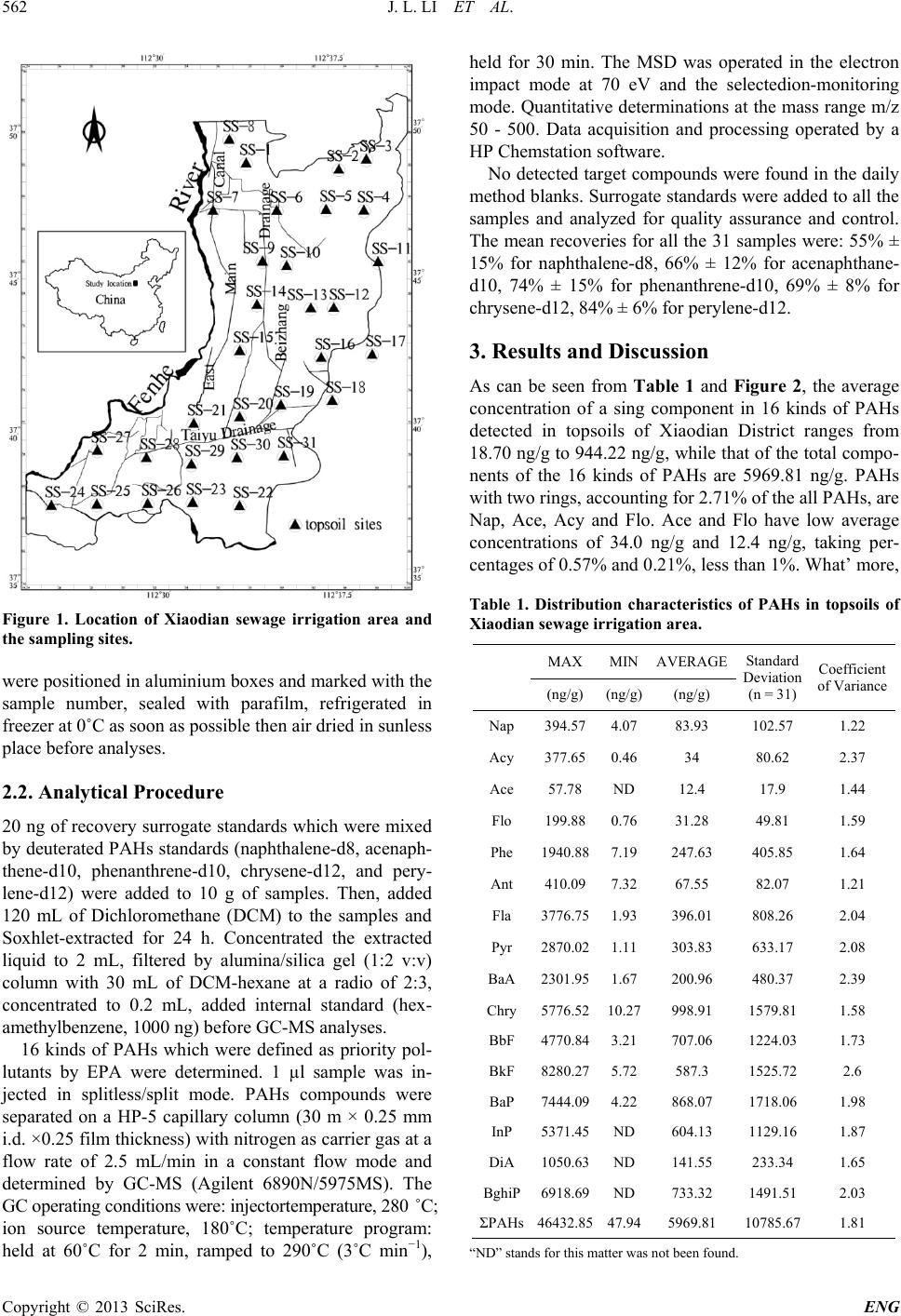 J. L. LI ET AL. Copyright © 2013 SciRes. ENG 562 Figure 1. Location of Xiaodian sewage irrigation area and the sampling sites. were positioned in aluminium boxes and marked with the sample number, sealed with parafilm, refrigerated in freezer at 0˚C as soon as possible then air dried in sunless place before analyses. 2.2. Analytical Procedure 20 ng of recovery sur rogate standards which were mixed by deuterated PAHs standards (naphthalene-d8, acenaph- thene-d10, phenanthrene-d10, chrysene-d12, and pery- lene-d12) were added to 10 g of samples. Then, added 120 mL of Dichloromethane (DCM) to the samples and Soxhlet-extracted for 24 h. Concentrated the extracted liquid to 2 mL, filtered by alumina/silica gel (1:2 v:v) column with 30 mL of DCM-hexane at a radio of 2:3, concentrated to 0.2 mL, added internal standard (hex- amethylbenzene, 1000 ng) before GC -MS analyses. 16 kinds of PAHs which were defined as priority pol- lutants by EPA were determined. 1 µl sample was in- jected in splitless/split mode. PAHs compounds were separated on a HP-5 capillary column (30 m × 0.25 mm i.d. ×0.25 film thickness) w ith nitrogen as carrier gas at a flow rate of 2.5 mL/min in a constant flow mode and determined by GC-MS (Agilent 6890N/5975MS). The GC operati ng condit ions were: injectortemperature, 280˚C; ion source temperature, 180˚C; temperature program: held at 60˚C for 2 min, ramped to 290˚C (3˚C min −1), held for 30 min. The MSD was operated in the electron impact mode at 70 eV and the selectedion-monitoring mode. Quantitative determinations at the mass range m/z 50 - 500. Data acquisition and processing operated by a HP Chemstation software. No detected target compounds were found in the daily method blanks. Surrogate standards were added to all the samples and analyzed for quality assurance and control. The mean recoveries for all the 31 samples were: 55% ± 15% for naphthalene-d8, 66% ± 12% for acenaphthane- d10, 74% ± 15% for phenanthrene-d10, 69% ± 8% for chrysene-d12, 84% ± 6% for perylene-d12. 3. Results and Discussion As can be seen from Table 1 and Figure 2, the average concentration of a sing component in 16 kinds of PAHs detected in topsoils of Xiaodian District ranges from 18.70 ng/g to 944 .22 ng/g, while that of the total compo- nents of the 16 kinds of PAHs are 5969.81 ng/g. PAHs with two rings, accounting for 2.71% of the all PAHs, are Nap, Ace, Acy and Flo. Ace and Flo have low average concentrations of 34.0 ng/g and 12.4 ng/g, taking per- centages of 0.57% and 0.21%, less than 1%. What’ more, Table 1. Distribution characteristics of PAHs in topsoils of Xiaodian sewage irrigation area. MAX MIN AVERAGE Standard Deviation (n = 31) Coefficient of Variance (ng/g) (ng/g) (ng/g) Nap 394.57 4.07 83.93 102.57 1.22 Acy 377.65 0.46 34 80.62 2.37 Ace 57.78 ND 12.4 17.9 1.44 Flo 199.88 0.76 31.28 49.81 1.59 Phe 1940.88 7.19 247.63 405.85 1.64 Ant 410.09 7.32 67.55 82.07 1.21 Fla 3776.75 1.93 396.01 808.26 2.04 Pyr 2870.02 1.11 303.83 633.17 2.08 BaA 2301.95 1.67 200.96 480.37 2.39 Chry 5776.52 10.27 998.91 1579.81 1.58 BbF 4770.84 3.21 707.06 1224.03 1.73 BkF 8280.27 5.72 587.3 1525.72 2.6 BaP 7444.09 4.22 868.07 1718.06 1.98 InP 5371.45 ND 604.13 1129.16 1.87 DiA 1050.63 ND 141.55 233.34 1.65 BghiP 6918.69 ND 733.32 1491.51 2.03 ΣPAHs 46432.85 47.94 5969.81 10785.67 1.81 “ND” stands for this matter was not been found. 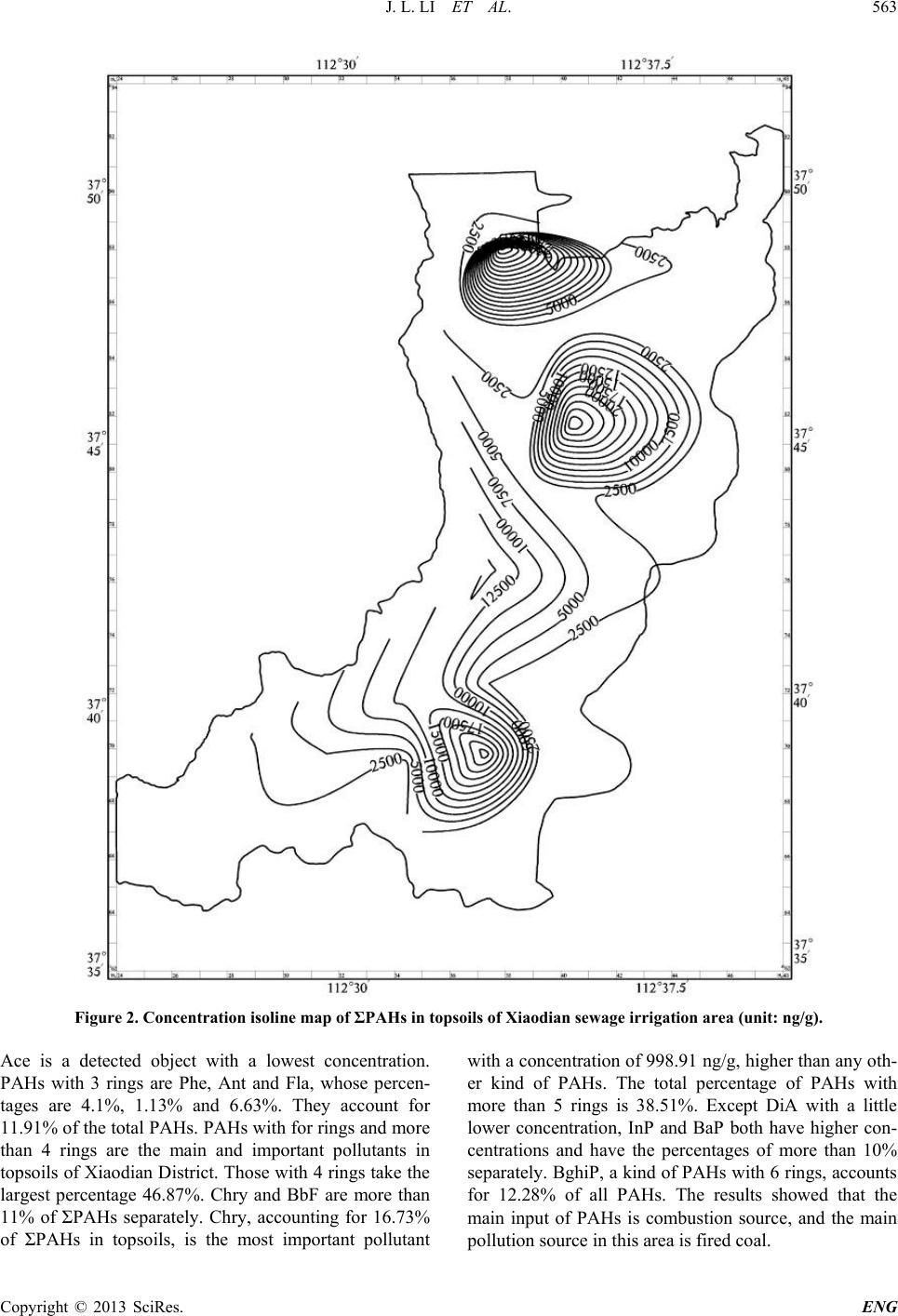 J. L. LI ET AL. Copyright © 2013 SciRes. ENG 563 Figure 2. Concentration isoline map of ΣPAHs in topsoils of Xiaodian sewage irrigation area (unit: ng/g). Ace is a detected object with a lowest concentration. PAHs with 3 rings are Phe, Ant and Fla, whose percen- tages are 4.1%, 1.13% and 6.63%. They account for 11.91% of the total PAHs. PAHs with for rings and more than 4 rings are the main and important pollutants in topsoils of Xiaod ian District. Those with 4 ring s take the largest percentage 46.87%. Chry and BbF are more than 11% of ΣPAHs separately. Chry, accounting for 16.73% of ΣPAHs in topsoils, is the most important pollutant with a concentration of 998.91 ng/g, higher than any oth- er kind of PAHs. The total percentage of PAHs with more than 5 rings is 38.51%. Except DiA with a little lower concentration, InP and BaP both have higher con- centrations and have the percentages of more than 10% separately. BghiP, a kind of PAHs with 6 rings, accounts for 12.28% of all PAHs. The results showed that the main input of PAHs is combustion source, and the main pollution source in this area is fired coal. 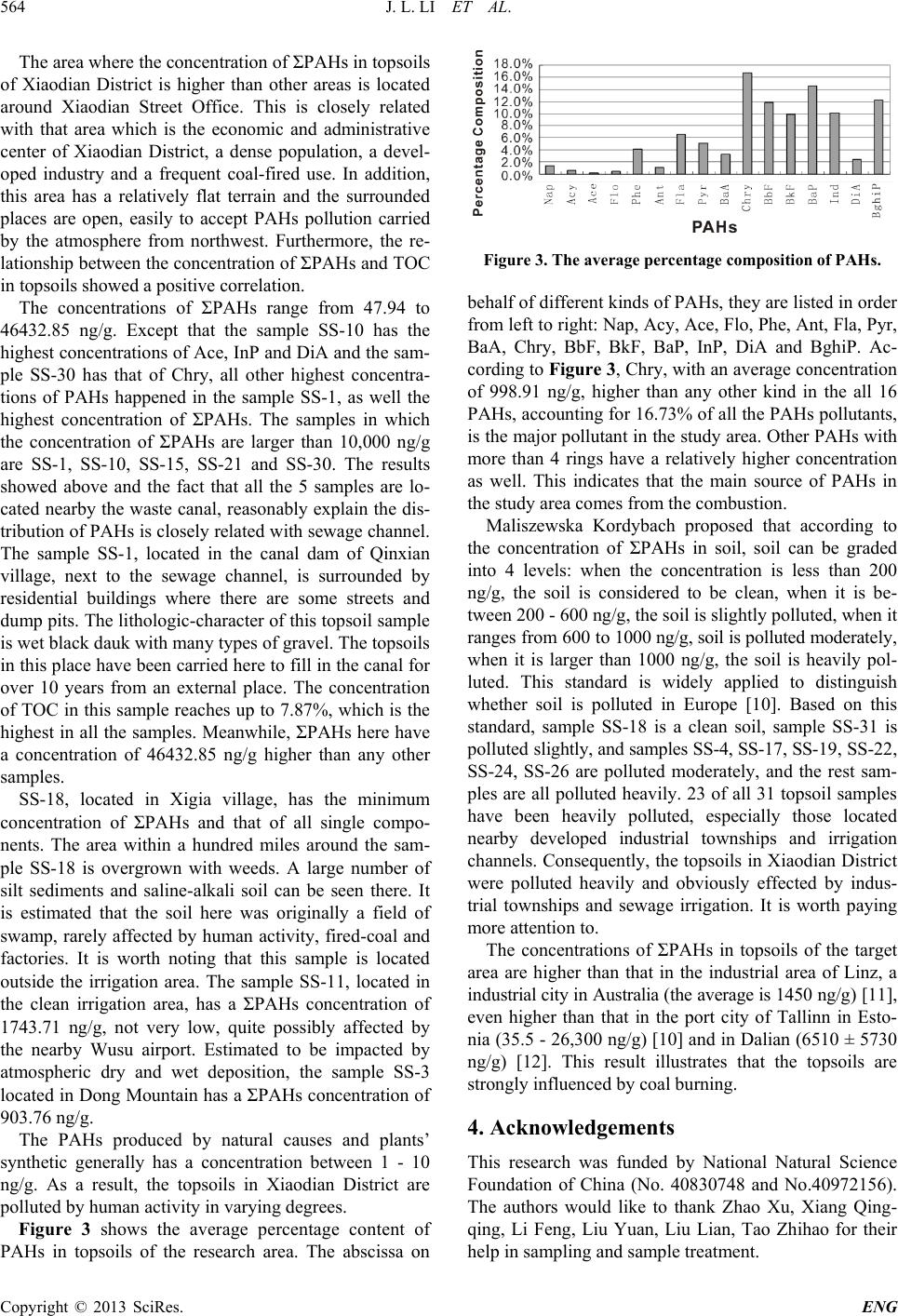 J. L. LI ET AL. Copyright © 2013 SciRes. ENG 564 The ar ea w here th e con c ent rat io n of ΣPAHs in topsoils of Xiaodian District is higher than other areas is located around Xiaodian Street Office. This is closely related with that area which is the economic and administrative center of Xiaodian District, a dense population, a devel- oped industry and a frequent coal-fired use. In addition, this area has a relatively flat terrain and the surrounded places are open, easily to accept PAHs pollution carried by the atmosphere from northwest. Furthermore, the re- lationship between the concentration of ΣPAHs and TOC in topsoils showed a positive correlation. The concentrations of ΣPAHs range from 47.94 to 46432.85 ng/g. Except that the sample SS-10 has the highest concentrations of Ace, InP and DiA and the sam- ple SS-30 has that of Chry, all other highest concentra- tions of PAHs happened in the sample SS-1, as well the highest concentration of ΣPAHs. The samples in which the concentration of ΣPAHs are larger than 10,000 ng/g are SS-1, SS-10, SS-15, SS-21 and SS-30. The results showed above and the fact that all the 5 samples are lo- cated nearby the waste canal, reasonably explain the dis- tribution of PAHs is closely related with sewage channel. The sample SS-1, located in the canal dam of Qinxian village, next to the sewage channel, is surrounded by residential buildings where there are some streets and dump pits. The lithologic-character of this topsoil sample is wet black dauk with many types of gravel. The topsoils in this place have been carried here to fill in the canal for over 10 years from an external place. The concentration of TOC in this sample reaches up to 7.87%, which is the highest in all the samples. Mean while, ΣPAHs here have a concentration of 46432.85 ng/g higher than any other samples. SS-18, located in Xigia village, has the minimum concentration of ΣPAHs and that of all single compo- nents. The area within a hundred miles around the sam- ple SS-18 is overgrown with weeds. A large number of silt sediments and saline-alkali soil can be seen there. It is estimated that the soil here was originally a field of swamp, rarely affected by human activity, fired-coal and factories. It is worth noting that this sample is located outside the irrigation area. The sample SS-11, located in the clean irrigation area, has a ΣPAHs concentration of 1743.71 ng/g, not very low, quite possibly affected by the nearby Wusu airport. Estimated to be impacted by atmospheric dry and wet deposition, the sample SS-3 located in Dong Mountain has a ΣPAHs concentration o f 903.76 ng/g. The PAHs produced by natural causes and plants’ synthetic generally has a concentration between 1 - 10 ng/g. As a result, the topsoils in Xiaodian District are polluted by human activity in varying degrees. Figure 3 shows the average percentage content of PAHs in topsoils of the research area. The abscissa on Figure 3. The average percentage composition of PAHs. behalf of different kinds of PAHs, they are listed in order from left to right: Nap, Acy, Ace, Flo, Phe, Ant, Fla, Pyr, BaA, Chry, BbF, BkF, BaP, InP, DiA and BghiP. Ac- cording to Figure 3, Chry, with an average concentration of 998.91 ng/g, higher than any other kind in the all 16 PAHs, accountin g for 16.73% of all the PAH s pollutants, is the major pollutant in the study area. Other PAHs with more than 4 rings have a relatively higher concentration as well. This indicates that the main source of PAHs in the study area comes from the combustion. Maliszewska Kordybach proposed that according to the concentration of ΣPAHs in soil, soil can be graded into 4 levels: when the concentration is less than 200 ng/g, the soil is considered to be clean, when it is be- tween 200 - 600 ng/g, the soil is slightly polluted, when it ranges from 600 to 1000 ng/g, soil is polluted moderately, when it is larger than 1000 ng/g, the soil is heavily pol- luted. This standard is widely applied to distinguish whether soil is polluted in Europe [10]. Based on this standard, sample SS-18 is a clean soil, sample SS-31 is polluted slightly, and samples SS-4, SS-17, SS-19, SS-22, SS-24, SS-26 are polluted moderately, and the rest sam- ples are all polluted heavily. 23 of all 31 topsoil samples have been heavily polluted, especially those located nearby developed industrial townships and irrigation channels. Consequently, the topsoils in Xiaodian District were polluted heavily and obviously effected by indus- trial townships and sewage irrigation. It is worth paying more attention to. The concentrations of ΣPAHs in topsoils of the target area are higher than that in the industrial area of Linz, a industrial city in Au stralia (the averag e is 1450 ng/g) [11], even higher than that in the port city of Tallinn in Esto- nia (35.5 - 26,300 ng/g) [10] and in Dalian (6510 ± 5730 ng/g) [12]. This result illustrates that the topsoils are strongly influenced by coal burning. 4. Acknowledgements This research was funded by National Natural Science Foundation of China (No. 40830748 and No.40972156). The authors would like to thank Zhao Xu, Xiang Qing- qing, Li Feng, Liu Yuan, Liu Lian, Tao Zhihao for their help in sampling and sample treatment.  J. L. LI ET AL. Copyright © 2013 SciRes. ENG 565 REFERENCES [1] X. J. Wang, Y. Zheng, R. M. Liu, B. G. Li, J. Cao and S. Tao, “Medium Scale Spatial Structures of Polycyclic Aromatic Hydrocarbons in the Topsoil of Tianjin Area,” Part B Journal of Environment Science and Health, Vol. 38, No. 3, 2003, pp.327-335. http://dx.doi.org/10.1081/PFC-120019899 [2] S. Tao, Y. H. Cui, F. L. Xu, B. G. Li, J. Cao, W. X. Liu, G. Schmitt, X. Wang, W. Shen, B. P. Qing and R. Sun, “Polycyclic Aromatic Hydrocarbons (PAHs) in Agricul- tural Soil and Vegetables from Tianjin,” Science of the Total Environment, Vol. 320, No. 1, 2004, pp. 11-24. http://dx.doi.org/10.1016/S0048-9697(03)00453-4 [3] M. B. Yunker, R. W. Acdonald and R. Vingarzan, “PAHs in the Fraser River Basin: A Critical Appraisal of PAH Ratios as Indicators of PAH Source and Composition,” Organic Geochemist ry , Vol. 33, No. 4, 2002, pp.489-515. http://dx.doi.org/10.1016/S0146-6380(02)00002-5 [4] D. Broman, C. Naf, C. Roiff and Y. Zebuhr, “Occurrence and Dynamics of Polychlorinated Dibenzo-p-Dioxins and Dibenzofurans and Polycyclic Aromatic Hydrocarbons in the Mixed Surface Layer of Remote Coastal and Offshore Waters of the Baltic,” Environmental Science and Tech- nology, Vol. 25, No. 11, 1991, pp. 1850-1864. http://dx.doi.org/10.1021/es00023a002 [5] P. Patnaik, In: P. Patnaik, Ed., Handbook of Environmen- tal Analysis, CRC Press, Boca Raton, 1997, p. 165. http://dx.doi.org/10.1201/9781420050608 [6] P. T. Williams, “Sampling and Analysis of Polycyclic Aromatic Compounds from Combustion Systems—A Re- view,” Journal of the Energy Institute, Vol. 63, 1990, pp. 22-30. [7] USDHHS, “Toxicological Profile for Polycyclic Aromat- ic Hydrocarbons,” US Department of Health and Human Services, 1995, p. 482. [8] Boonyatumanond, Ruchaya, Wattayakom. “Distribution and Origins of Polycy clic Aromatic Hydrocarbons (PAHs) in Riverine, Estu arine, and Marine Sediment s in Thailand,” Manne Pollution Bulletin, Vol. 52, No. 8, 2006, pp. 942- 956. http://dx.doi.org/10.1016/j.marpolbul.2005.12.015 [9] K. C. Jones, J. A. Straford and K. S. Waterhouse, “Orga- niccontaminants in Welsh Soils: Polycyclic Aromatic Hy- drocarbons,” Environmental Science & Technology, Vol. 23, No. 5, 1989, pp. 540-550. http://dx.doi.org/10.1021/es00063a005 [10] M. Trapido, “Polycyclic Aromatic Hydrocarbons in Esto- nian Soil: Contamination and Profiles,” Environmental Pollution, Vol. 105, No. 1, 1990, pp. 67-74. http://dx.doi.org/10.1016/S0269-7491(98)00207-3 [11] P. Weiss, A. Riss and E. Gschmeidler, “Investigation of Heavy Metal, PAH, PCB Patterns and PCDD/F Profiles of Soil Samples from an Industrialized Urban area (Linz, Upper Austria) with Multivariate Statistical Methods,” Chemosphere, Vol. 29, No. 9-11, 1994, pp. 2223-2236. http://dx.doi.org/10.1016/0045-6535(94)90390-5 [12] Z. Wang, J. W. Chen and X. L. Qiao, “Distribution and Sources of Polycyclic Aromatic Hydrocarbons from Ur- ban to Rural Soils: A Case Study in Dalian, China,” Chemosphere, Vol. 68, No. 5, 2007, pp. 965-971. http://dx.doi.org/10.1016/j.chemosphere.2007.01.017 |