

Paper Menu >>
Journal Menu >>
 Engineering, 2013, 5, 540-544 http://dx.doi.org/10.4236/eng.2013.510B111 Published Online October 2013 (http://www.scirp.org/journal/eng) Copyright © 2013 SciRes. ENG Construction of a Shuttle Vector for Heterologous Gene Expression in Escherichia coli and Microalgae Anabaena Donghui Song*, Jing Li, Xiaoxu Hu, Bo Xi Tianjin Key Laboratory of Marine Resources and Chemistry, College of Marine Science & Engineering, Tianjin University of Science &Technology, Tianjin, China Email: *[email protected] Received 2013 ABSTRACT The construction of an integrative shuttle expression v ecto r and potential utility was reported in Escherichia coli and Anabaena (Nostoc) sp. strain PCC 7120. The vector comprised of the following elements: (a) an intergenic non-coding region from Anabaena to facilitate its genomic integration (b) a strong functional PpsbAI promoter from Anabaena for desired gene expression and (c) neomycin phosphotransferase gene with its own promoter for the selection of transfor- mants. The constructed vector pAnFP was evaluated by cloning, transfer and expression of the gfp gene encoding green fluorescent protein. When the E. coli and Anabaena sp. strain PCC 7120 were transformed, intensive green fluorescence produced by the products of GFP protein was observed. This resul t indicated that the integrative shuttle vector pAnFP can be promisingly used in genome transformation for ex pression of heterologous genes in E. coli and microalgae such as Anabaena and Nostoc strains. Keywords: Anabaena sp. PCC 7120; Integrative Shuttle Vector; pAnFP; gfp Gene 1. Introduction In the last few years, microalgae have been extensively investigated for biotechnological applications as a rich source of bioactive compounds [1], for biofuels produc- tion [2,3], and for nitrogen biofertilizer [4]. Filamentous nitrogen fixing microalgae Anabaena have been particu- larly interesting since they harbor vital processes of pho- tosynthesis and nitrogen fixation [5,6]. Apart from much research on heterocyst development, Anabaena strains have been known for their ability to overproduce bio- hydrogen for potential utilization as a clean and renewa- ble biofuels [7,8]. Genetic engineering is one approach for microalgal strains to produce more lipids-rich cells. Two primary requirements must be fulfilled before a microalgal strain can be successfully engineered in this manner. One is that these expressible and recombinant genes which affect lipid metabolism must be available; another requirement is often effective approach which should be developed to incorporate stably cloned ex- ogenous genes into host cells [9]. Strain Anabaena (Nos- toc) sp. PCC 7120 (referred to in this paper as Anabaena 7120) has been chosen for this study since its genome is completely sequenced and it is amenable to genetic ma- nipulation. Mor e importantly is that the development of stable integrative express ion system will benefit from the well developed molecular genetics of Anabaena 7120. Therefore, we reported here a construction of integrative shuttle vectors, pAnFP, for inserting exogenous genes into microalgae Anabaena 7120. 2. Materials and Methods 2.1. Strains and Culture Conditions Bacterial strains and plasmids used in this study are shown in Table 1. Anabaena 7120 was grown in BG11 medium without nitrate [10], pH 7.2, at 27˚C. E. coli strains were grown in Luria Bertani (LB) medium with appropriate antibiotics when required. Antibiotics were used at 100 μg/ml Ampicillin (Amp) and 50 μg/ml ka- namycin (Km) for E. coli and 25 μg/ml neomycin (Nm) in BG11 agar me dia or 12.5 μg/ml in liquid BG11 media for Anabaena transformants. 2.2. Molecular Biology Methods Standard molecular biology techniques were used [11]. Anabaena 7120 chromosomal DNA was isolated as de- scribed [12]. DNA fragments from Anabaena 7120 were amplified using th e polymerase chain reaction (PCR) with appropriate primers shown in Table 2. The nptII gene (encoding neomycin phosphotransferase) and gfp gene (encoding green fluorescent protein) was indepen- dently PCR amplified from plasmid pET-30a(+) and *Corresponding author.  D. H. SONG ET AL. Copyright © 2013 SciRes. ENG 541 Table 1. Bacterial strains and plasmids. Strains and plasmids Characteristics Source Bacterial strains E. coli TOP10 recA∆lacU169 Invitrogen Anabaena (Nostoc) sp. strain PCC7120 wild type Pasteur Plasmids pET-30a(+) Kmr Novagen pGFP Amp r Clontech pBluescript II SK (+) Amp r TakaRa pTF2 A mpr This study pTF1 A mpr This study pTPpsbAI-F2 Amp r This study pTF1-PpsbAI-F2 Amp r This study pAnFP Amp r ,Kmr This study pAnFP-gfp Amp r ,Kmr This study pGFP, respectively. Re-introduction of plasmids harbor- ing with gene gfp by triparental conjugation [13] into Anabaena 7120 wild-type cells were used to determine whether these plasmids were responsible for the gene expression and growth phenotypes. Complete nuc leotide sequence analysis of all the components of pAnFP vector was carried out by dideoxy sequencing method using appropriate primers (Table 2). The sequence identity of cloned fragments with the known Anabaena 7120 ge- nome sequence was evaluated using the BLAST algo- rithm (GenBank database, http://blast.ncbi.nlm.nih.gov/, and Kazusa DNA Research Institute, http://genome.ka- zusa.or.jp/cyanobase/Anabaena). 2.3. Fluorescence Microsc opy The green fluorescence expressing images of E. coli and Anabaena 7120 were obtained by light excitation at 365 nm and were captured by light emission at 510 nm with an AxioCam HRc camera attached to a Carl Zeiss LSM 510 META NLO microscope. 3. Results 3.1. Construction of an Integrative Shuttle Expression Vector pAnFP The plasmid pBluescript II SK (+), hereafter referred as pBS-T, was chosen for construction of the integrative expression shuttle vector pAnFP comprised of (1) flank- ing regions F1 and F2 for integration, (2) Anabaena promoter (PpsbAI) for expression of the downstream gene, (3) the nptII ge ne for selection of the transformants with Table 2. Primers designed for pcr amplification. Components Sequences Restriction sites F1 Forward 5′-CCGGAATTCACGCCATAATC ATGTGTC-3′ EcoRI Reverse 5′-TGCACTGCAGTGGGGATAAT TACAACTC-3′ PstI F2 Forward 5′-CGCGGATCCCCCCAATTTTG AAACCTATC-3′ BamHI Reverse 5′-CTAGTCTAG AGGCTCACCATA GGTGAATGCAC-3′ XbaI PpsbA1 Forward 5′-GAGCTGCAGGGATTCCCAAA GATAGGG-3′ PstI Reverse 5′-CTCGGATCCCCATATGTTTTT ATGATTGCTTTG-3′ BamHI/ NdeI nptII Forward 5′-CGGGATCCCATCGATACTCA CGTTAAGGGAT-3′ BamHI/ ClaI Reverse 5′-CGGGATCCCAGGTGGCACTTT TCGGGGA-3′ BamHI gfp Forward 5′-CCGCATATGACATATGAGTAA AGGAGAACAAC-3′ NdeI Reverse 5′-CGCATCGATTTATTTGTATAGT TCATCC-3′ ClaI Underlined and bold regions of the primer sequences represent the incorpo- rated restriction endonuclease sites. its own promoter in transgenic Anbeana, and (4) ampicil- lin marker on pBS-T for the positive selection of recom- binants in E. coli. The 931 bp F region (for flanking) was selected from an 1192 bp intergenic, non-coding region separating the ORFs alr3857 and alr3858 of Anabaena 7120 genome (Anabaena chromosome 4654700-4655631). Individual elements of the pAnFP vector were PCR am- plified using specific primer pairs shown in TABLE II and sequentially cloned at indicated sites (Figure 1(a)). The F region was amplified separately as two fragments F1 and F2. The vector pAnFP was constructed in three steps (Figu re 1(b)): (a) The 431 bp F2 fragment was PCR amplified from Anabaena 7120 DNA, restriction digested with the enzymes BamHI and XbaI and ligated to pBS vector at BamHI and XbaI sites. A putative psbAI promoter region was selected from the upstream region of the psbAI gene, which encodes the D1 protein of pho- tosynthetic apparatus. A 182 bp PCR amplified PpsbA I product was restriction digested with the enzymes PstI and BamHI and ligated to construct pTF2 at identical sites. The resulting construct pTPpsbAI-F2 on indepen- dently dige stion w i th Xb aI/BamHI and X b a I/PstI re- leased the 431 bp F2 fragment and F2 + PpsbAI fragment (Figures 2(a) and (b)). An NdeI site introduced in the PpsbAI reverse primer (TABLE II) provided an appropriate 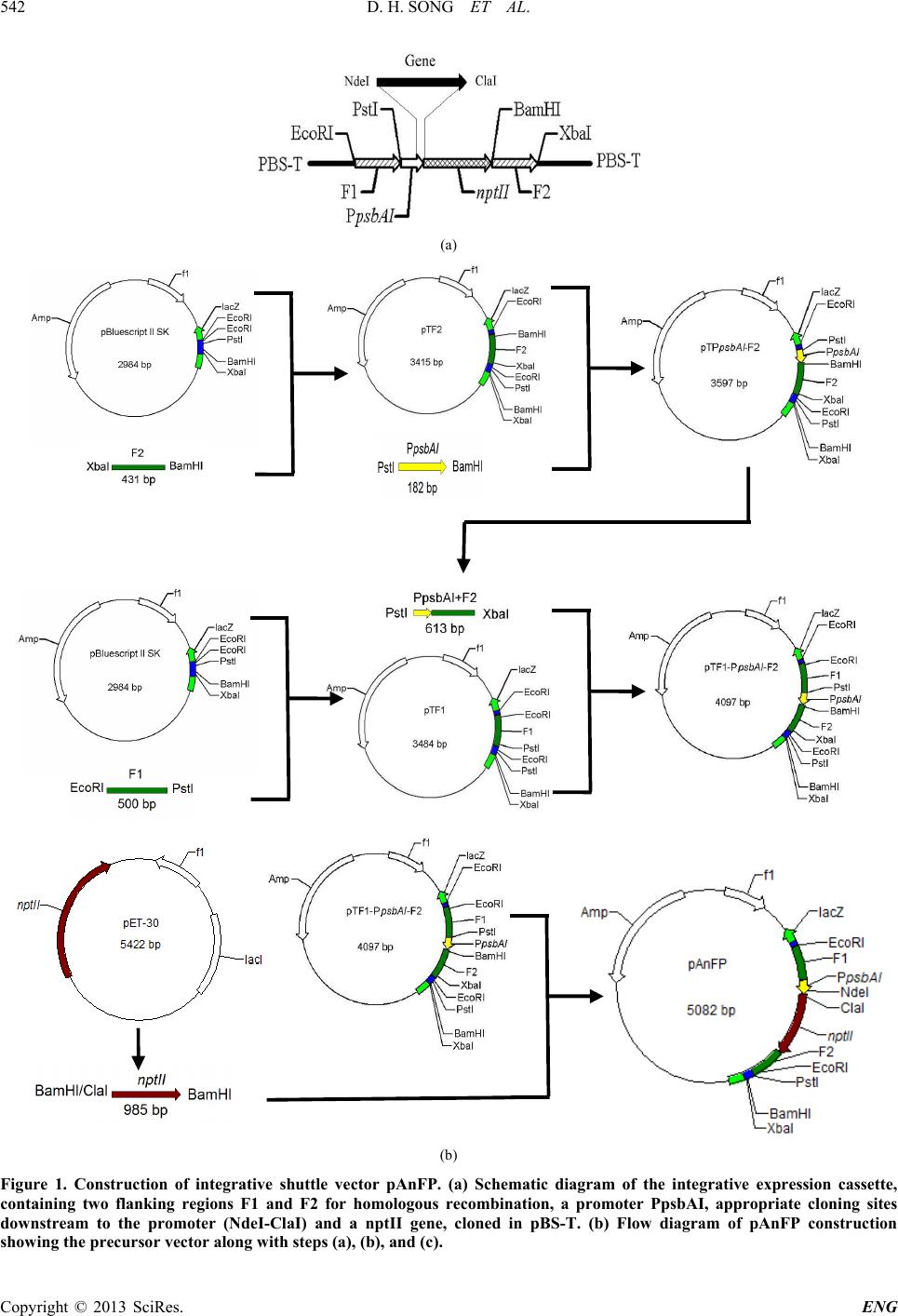 D. H. SONG ET AL. Copyright © 2013 SciRes. ENG 542 (a) (b) Figure 1. Construction of integrative shuttle vector pAnFP. (a) Schematic diagram of the integrative expression cassette, containing two flanking regions F1 and F2 for homologous recombination, a promoter PpsbAI, appropriate cloning sites downstream to the promoter (NdeI-ClaI) and a nptII gene, cloned in pBS-T. (b) Flow diagram of pAnFP construction showing the precursor vector along with steps (a), (b), and (c). 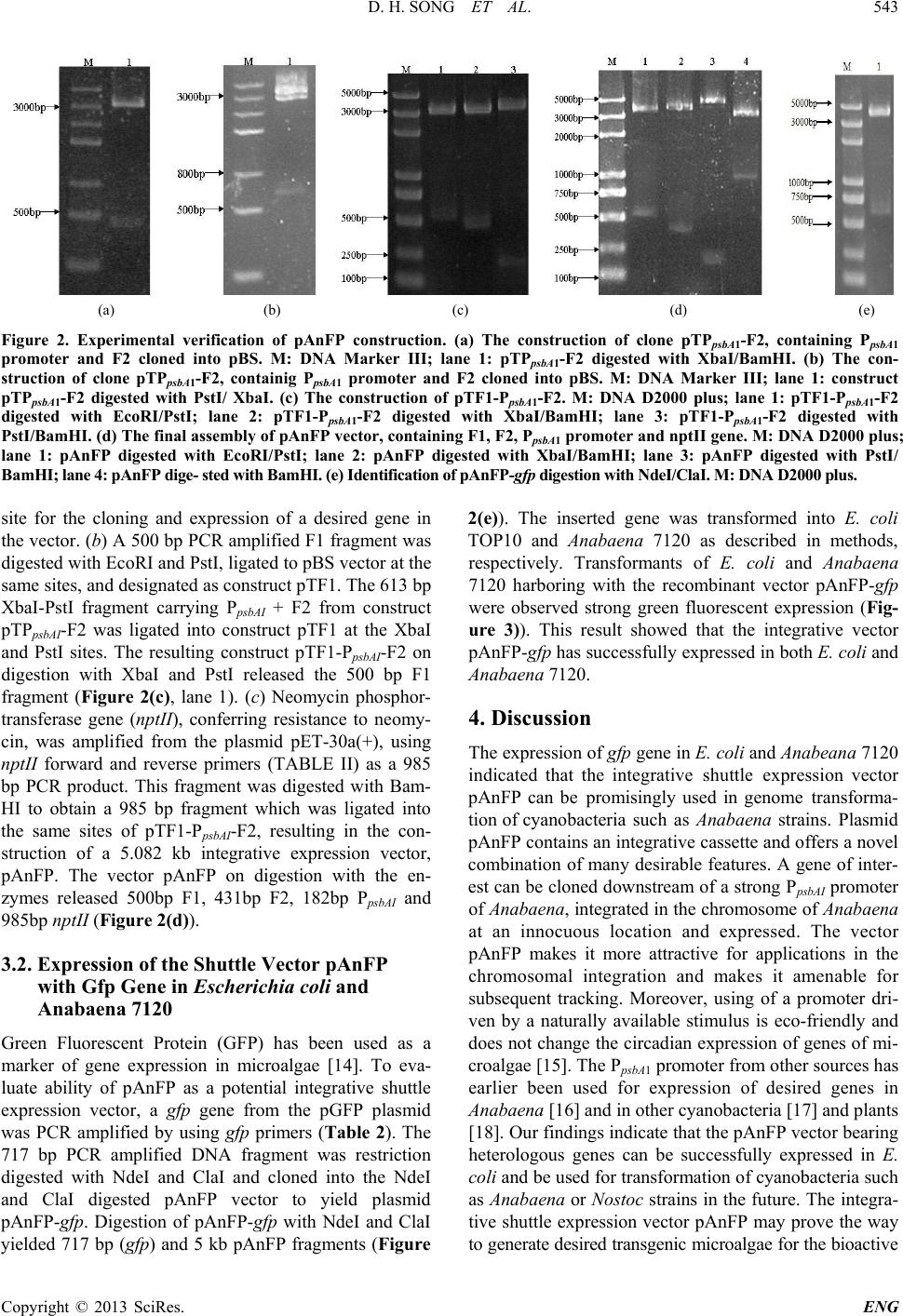 D. H. SONG ET AL. Copyright © 2013 SciRes. ENG 543 (a) (b) (c) (d) (e) Figure 2. Experimental verification of pAnFP construction. (a) The construction of clone pTPpsbA1-F2, containing PpsbA1 promoter and F2 cloned into pBS. M: DNA Marker III; lane 1: pTPpsbA1-F2 digested with XbaI/BamHI. (b) The con- struction of clone pTPpsbA1-F2, containig PpsbA1 promoter and F2 cloned into pBS. M: DNA Marker III; lane 1: construct pTPpsbA1-F2 digested with PstI/ XbaI. (c) The construction of pTF1-PpsbA1-F2. M: DNA D2000 plus; lane 1: pTF1-PpsbA1-F2 digested with EcoRI/PstI; lane 2: pTF1-PpsbA1-F2 digested with XbaI/BamHI; lane 3: pTF1-PpsbA1-F2 digested with PstI/BamHI. (d) The final assembly of pAnFP vector, containing F1, F2, PpsbA1 promoter and nptII gene. M: DNA D2000 plus; lane 1: pAnFP digested with EcoRI/PstI; lane 2: pAnFP digested with XbaI/BamHI; l ane 3: pAnFP digested with PstI/ BamHI; lane 4: pAnFP dige- sted with BamHI. (e) Identification of pAnFP-gfp digestion with NdeI/ClaI. M: DNA D2000 plus. site for the cloning and expression of a desired gene in the vector. (b) A 500 bp PCR amplified F1 fragment was digested with EcoRI and PstI, ligated to pBS vector at the same sites, and designated as construct pTF1. The 613 bp XbaI-PstI fragment carrying PpsbAI + F2 from construct pTPpsbAI-F2 was ligated into construct pTF1 at the XbaI and PstI sites. The resulting construct pTF1-PpsbAI-F2 on digestion with XbaI and PstI released the 500 bp F1 fragment (Figure 2(c), lane 1). (c) Neomycin phosphor- transferase gene (nptII), conferring resistance to neomy- cin, was amplified from the plasmid pET-30a(+), using nptII forward and reverse primers (TABLE II) as a 985 bp PCR product. This fragment was digested with Bam- HI to obtain a 985 bp fragment which was ligated into the same sites of pTF1-PpsbAI-F2, resulting in the con- struction of a 5.082 kb integrative expression vector, pAnFP. The vector pAnFP on digestion with the en- zymes released 500bp F1, 431bp F2, 182bp PpsbAI and 985bp nptII (Figure 2(d)). 3.2. Expression of the Shuttle Vector pAnFP with Gfp Gene in Escherichia coli and Anabaena 7120 Green Fluorescent Protein (GFP) has been used as a marker of gene expression in microalgae [14]. To eva- luate ability of pAnFP as a po tential integrative shuttle expression vector, a gfp gene from the pGFP plasmid was PCR amplified by using gfp primers (Table 2). The 717 bp PCR amplified DNA fragment was restriction digested with NdeI and ClaI and cloned into the NdeI and ClaI digested pAnFP vector to yield plasmid pAnFP-gfp. Digestion of pAnFP-gfp with NdeI and ClaI yielded 717 bp (gfp) and 5 kb pAnFP fragments (Figure 2(e)). The inserted gene was transformed into E. coli TOP10 and Anabaena 7120 as described in methods, respectively. Transformants of E. coli and Anabaena 7120 harboring with the recombinant vector pAnFP-gfp were observed strong green fluorescent expression (Fig- ure 3)). This result showed that the integrative vector pAnFP-gfp has successfully expressed in both E. coli and Anabaena 7120. 4. Discussion The expression of gfp gene in E. coli and Anabeana 7120 indicated that th e integr ativ e sh u ttle expres sion vector pAnFP can be promisingly used in genome transforma- tion of cyanobacteria such as Anabaena strains. Plasmid pAnFP contains an integrative cassette and offers a novel combination of many desirable features. A gene of inter- est can be cloned downstream of a strong PpsbAI promoter of Anabaena, integrated in the chromosome of Anabaena at an innocuous location and expressed. The vector pAnFP makes it more attractive for application s in the chromosomal integration and makes it amenable for subsequent tracking. Moreover, using of a promoter dri- ven by a naturally available stimulus is eco-friendly and does not change the circadian expression of genes of mi- croalgae [15]. The PpsbA1 promoter from other sources has earlier been us ed for expressi o n of desired genes in Anabaena [16] and in other cyanobacteria [17] and plants [18]. Our findings indicate that the pAnFP vector bearing heterologous genes can be successfully expressed in E. coli and be used for transformation of cyanobacteria such as Anabaena or Nostoc strains in the future. The integra- tive shuttle expression vector pAnFP may prove the way to generate desired transgenic microalgae for the bioactive 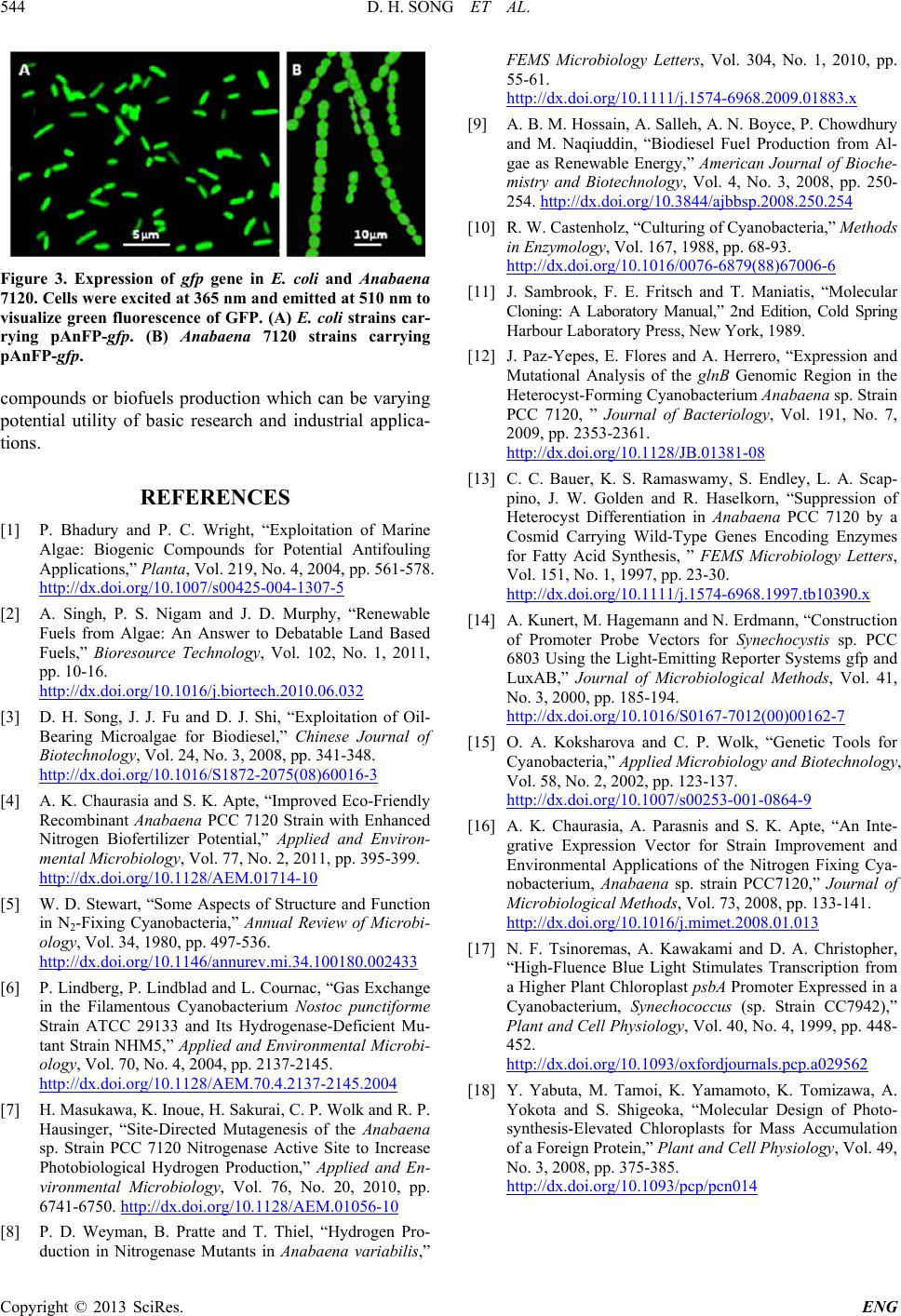 D. H. SONG ET AL. Copyright © 2013 SciRes. ENG 544 Figure 3. Expression of gfp gene in E. coli and Anabaena 7120. Cells were excited at 365 nm and emitted at 510 nm to visualize green fluorescence of GFP. (A) E. coli strains car- rying pAnFP-gfp. (B) Anabaena 7120 strains carrying pAnFP-gfp. compounds or biofuels production which can be varying potential utility of basic research and industrial applica- tions. REFERENCES [1] P. Bhadury and P. C. Wright, “Exploitation of Marine Algae: Biogenic Compounds for Potential Antifouling Applications,” Planta, Vol. 219, No. 4, 2004, pp. 561-578. http://dx.doi.org/10.1007/s00425-004-1307-5 [2] A. Singh, P. S. Ni gam and J. D. Murphy, “Renewable Fuels from Algae: An Answer to Debatable Land Based Fuels,” Bioresource Technology, Vol. 102, No. 1, 2011, pp. 10-16. http://dx.doi.org/10.1016/j.biortech.2010.06.032 [3] D. H. Song, J. J. Fu and D. J. Shi, “Exploitation of Oil- Bearing Microalgae for Biodiesel,” Chinese Journal of Biotechnology, Vol. 24, No. 3, 2008, pp. 341-348. http://dx.doi.org/10.1016/S1872-2075(08)60016-3 [4] A. K. Chaurasia and S. K. Apte, “Improved Eco-Friendly Recombinant Anabaena PCC 7120 Strain with Enhanced Nitrogen Biofertilizer Potential,” Applied and Environ- mental Microbiology, Vol. 77, No. 2, 2011, pp. 395-399. http://dx.doi.org/10.1128/AEM.01714-10 [5] W. D. Stewart, “Some Aspects of Structure and Function in N2-Fixing Cyanobacteria,” Annual Review of Microbi- ology, Vol. 34, 1980, pp. 497-536. http://dx.doi.org/10.1146/annurev.mi.34.100180.002433 [6] P. Lindberg, P. Lindblad and L. Cournac, “Gas Exchange in the Filamentous Cyanobacterium Nostoc punctiforme Strain ATCC 29133 and Its Hydrogenase-Deficient Mu- tant Strain NHM5,” Applie d and Environmental Microbi- ology, Vol. 70, No. 4, 2004, pp. 2137-2145. http://dx.doi.org/10.1128/AEM.70.4.2137-2145.2004 [7] H. Masukawa, K. Inoue, H. Sakurai, C. P. Wolk and R. P. Hausinger, “Site-Directed Mutagenesis of the Anabaena sp. Strain PCC 7120 Nitrogenase Active Site to Increase Photobiological Hydrogen Production,” Applied and En- vironmental Microbiology, Vol. 76, No. 20, 2010, pp. 6741-6750. http://dx.doi.org/10.1128/AEM.01056-10 [8] P. D. Weyman, B. Pratte and T. Thiel, “Hydrogen Pro- duction in Nitrogenase Mutants in Anabaena variabilis,” FEMS Microbiology Letters, Vol. 304, No. 1, 2010, pp. 55-61. http://dx.doi.org/10.1111/j.1574-6968.2009.01883.x [9] A. B. M. Hossain, A. Salleh, A. N. Boyce, P. Chowdhury and M. Naqiuddin, “Biodiesel Fuel Production from Al- gae as Renewable Energy,” American Journal of Bioche- mistry and Biotechnology, Vol. 4, No. 3, 2008, pp. 250- 254. http://dx.doi.org/10.3844/ajbbsp.2008.250.254 [10] R. W. Castenholz, “Culturing of Cyanobacteria,” Methods in Enzymology, Vol. 167, 1988, pp. 68-93. http://dx.doi.org/10.1016/0076-6879(88)67006-6 [11] J. Sambrook, F. E. Fritsch and T. Maniatis, “Molecular Cloning: A Laboratory Manua l,” 2nd Edition, Cold Spring Harbour Laboratory Press, New York, 1989. [12] J. Paz-Yepes, E. Flores and A. Herrero, “Expression and Mutational Analysis of the glnB Genomic Region in the Heterocyst -Forming Cyanobacterium Anabaena sp. Strain PCC 7120, ” Journal of Bacteriology, Vol. 191, No. 7, 2009, pp. 2353-2361. http://dx.doi.org/10.1128/JB.01381-08 [13] C. C. Bauer, K. S. Ramaswamy, S. Endley, L. A. Scap- pino, J. W. Golden and R. Haselkorn, “Suppression of Heterocyst Differentiation in Anabaena PCC 7120 by a Cosmid Carrying Wild-Type Genes Encoding Enzymes for Fatty Acid Synthesis, ” FEMS Microbiology Letters, Vol. 151, No. 1, 1997, pp. 23-30. http://dx.doi.org/10.1111/j.1574-6968.1997.tb10390.x [14] A. Kunert, M. Hagemann and N. Erdmann, “Construction of Promoter Probe Vectors for Synechocy stis sp. PCC 6803 Using the Light-Emitting Reporter Syste m s gfp and LuxAB,” Journal of Microbiological Methods, Vol. 41, No. 3, 2000, pp. 185-194. http://dx.doi.org/10.1016/S0167-7012(00)00162-7 [15] O. A. Koksharova and C. P. Wolk, “Genetic Tools for Cyanobacteria,” Applied Microbiology and Biotechnology, Vol. 58, No. 2, 2002, pp. 123-137 . http://dx.doi.org/10.1007/s00253-001-0864-9 [16] A. K. Chaurasia, A. Parasnis and S. K. Apte, “An Inte- grative Expression Vector for Strain Improvement and Environmental Applications of the Nitrogen Fixing Cya- nobacterium, Anabaena sp. strain PCC7120,” Journal of Microbiological Methods, Vol. 73, 2008, pp. 133-141. http://dx.doi.org/10.1016/j.mimet.2008.01.013 [17] N. F. Tsinoremas, A. Kawakami and D. A. Christopher, “High-Fluence Blue Light Stimulates Transcription from a Higher Plant Chloroplast psbA Promoter Expressed in a Cyanobacterium, Synechococcus (sp. Strain CC7942),” Plant and Cell Physiology, Vol. 40, No. 4, 1999, pp. 448- 452. http://dx.doi.org/10.1093/oxfordjournals.pcp.a029562 [18] Y. Yabuta, M. Tamoi, K. Yamamoto, K. Tomizawa, A. Yokota and S. Shigeoka, “Molecular Design of Photo- synthesis-Elevated Chloroplasts for Mass Accumulation of a Foreign Protein,” P l ant and Cell Physiology, Vol . 49, No. 3, 2008, pp. 375-385. http://dx.doi.org/10.1093/pcp/pcn014 |