

Paper Menu >>
Journal Menu >>
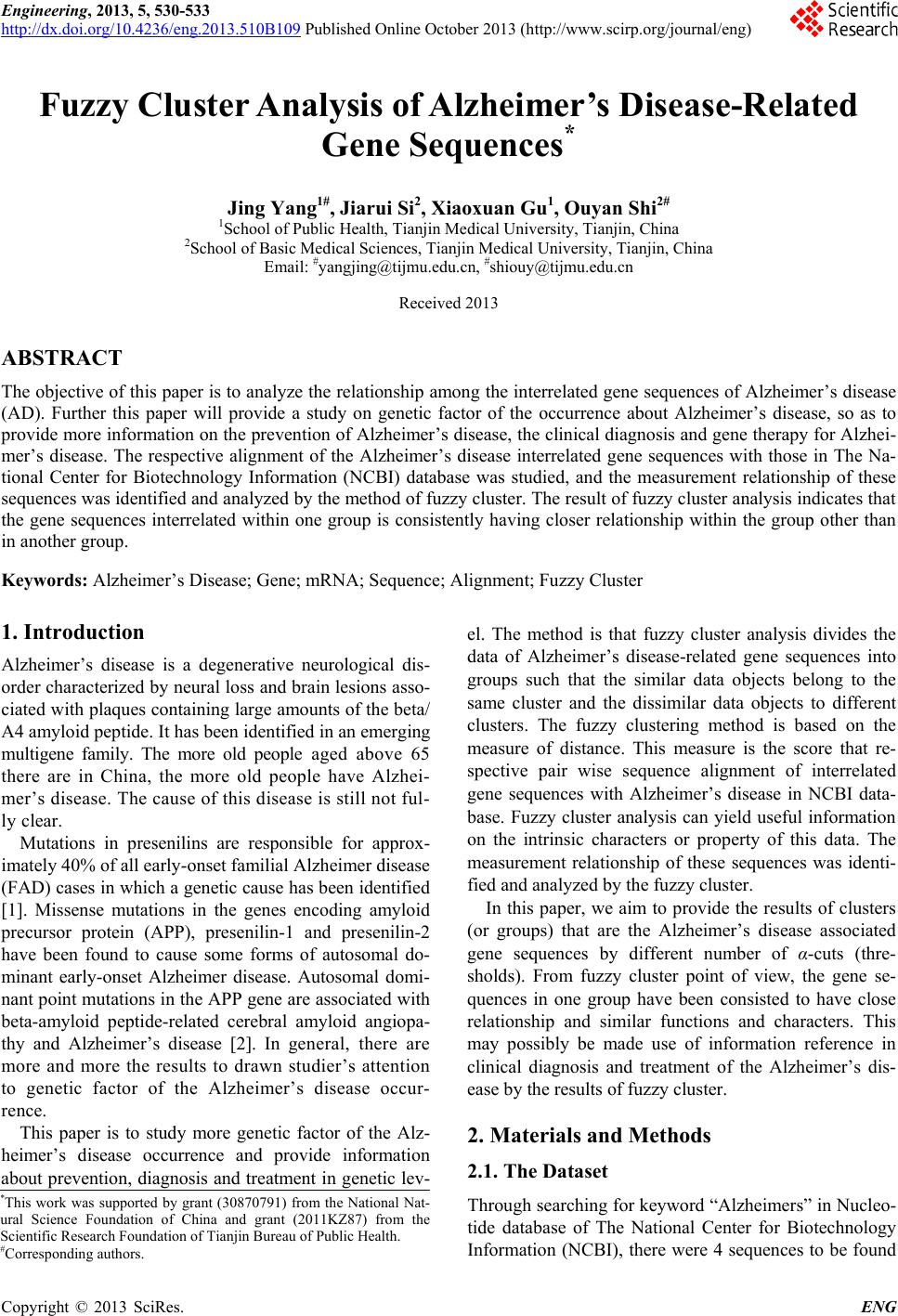 Engineering, 2013, 5, 530-533 http://dx.doi.org/10.4236/eng.2013.510B109 Published Online October 2013 (http://www.scirp.org/journal/eng) Copyright © 2013 SciRes. ENG Fuzzy Cluster Analysis of Alzheimer’s Disease-Related Gene Sequences* Jing Yang1#, Jiarui Si2, Xiaoxuan Gu1, Ouyan Shi2# 1School of Public Health, Tianjin Medical University, Tianjin, China 2School of Basic Medical Sciences, Tianjin Medical University, Tianjin, China Email: #[email protected], #[email protected] Received 2013 ABSTRACT The objective of this paper is to analyze the relationship among the interrelated gene sequences of Alzheimer’s disease (AD). Further this paper will provide a study on genetic factor of the occurrence about Alzheimer’s disease, so as to provide more information on the prevention of Alzheimer’s disease, the clinical diagnosis and gene therapy for Alzhei- mer’s disease. The respective alignment of the Alzheimer’s disease interrelated gene sequences with those in The Na- tional Center for Biotechnology Information (NCBI) database was studied, and the measurement relationship of these sequences was identified and analyzed by the method of fuzzy cluster. The result of fuzzy cluster analysis indicates that the gene sequences interrelated within one group is consistently having closer relationship within the group other than in anothe r gr oup. Keywords: Alzheimer’s Disease; Gene; mRNA; Sequence; Alignment; Fuzzy Cluster 1. Introduction Alzheimer’s disease is a degenerative neurological dis- order characterized by neural loss and brain lesio ns asso- ciated with plaques containing large amounts of the beta/ A4 amyloid peptide. It has been identified in an emerging multigene family. The more old people aged above 65 there are in China, the more old people have Alzhei- mer’s disease. The cau se of this d isease is stil l not ful- ly clear. Mutations in presenilins are responsible for approx- imately 40% of all early-onset familial Alzheimer disease (FAD) cases in which a genetic cause has been identified [1]. Missense mutations in the genes encoding amyloid precursor protein (APP), presenilin-1 and presenilin-2 have been found to cause some forms of autosomal do- minant early-onset Alzheimer disease. Autosomal domi- nant point mutations in the APP gene are associated with beta-amyloid peptide-related cerebral amyloid angiopa- thy and Alzheimer’s disease [2]. In general, there are more and more the results to drawn studier’s attention to genetic factor of the Alzheimer’s disease occur - rence. This paper is to study more genetic factor of the Alz- heimer’s disease occurrence and provide information about prevention, diagnosis and treatment in genetic lev- el. The method is that fuzzy cluster analysis divides the data of Alzheimer’s disease-related gene sequences into groups such that the similar data objects belong to the same cluster and the dissimilar data objects to different clusters. The fuzzy clustering method is based on the measure of distance. This measure is the score that re- spective pair wise sequence alignment of interrelated gene sequences with Alzheimer’s disease in NCBI data- base. Fuzzy cluster analysis can yield useful information on the intrinsic characters or property of this data. The measurement relationship of these sequences was identi- fied and analyzed by the fuzzy cluster. In this paper, we aim to provide the results of clusters (or groups) that are the Alzheimer’s disease associated gene sequen ce s by different number of α-cuts (thre- sholds). From fuzzy cluster point of view, the gene se- quences in one group have been consisted to have close relationship and similar functions and characters. This may possibly be made use of information reference in clinical diagnosis and treatment of the Alzheimer’s dis- ease by the results of fuzzy cluster. 2. Materials and Methods 2.1. The Dataset Through searching for keyword “Alzheimers” in Nu cleo- tide database of The National Center for Biotechnology Information (NCBI), there were 4 sequences to be found *This work was supported by grant (30870791) from the National Nat- ural Science Foundation of China and grant (2011KZ87) from the Scientific Research Foundation of Tianjin Bureau of Public Health. #Corresponding authors. 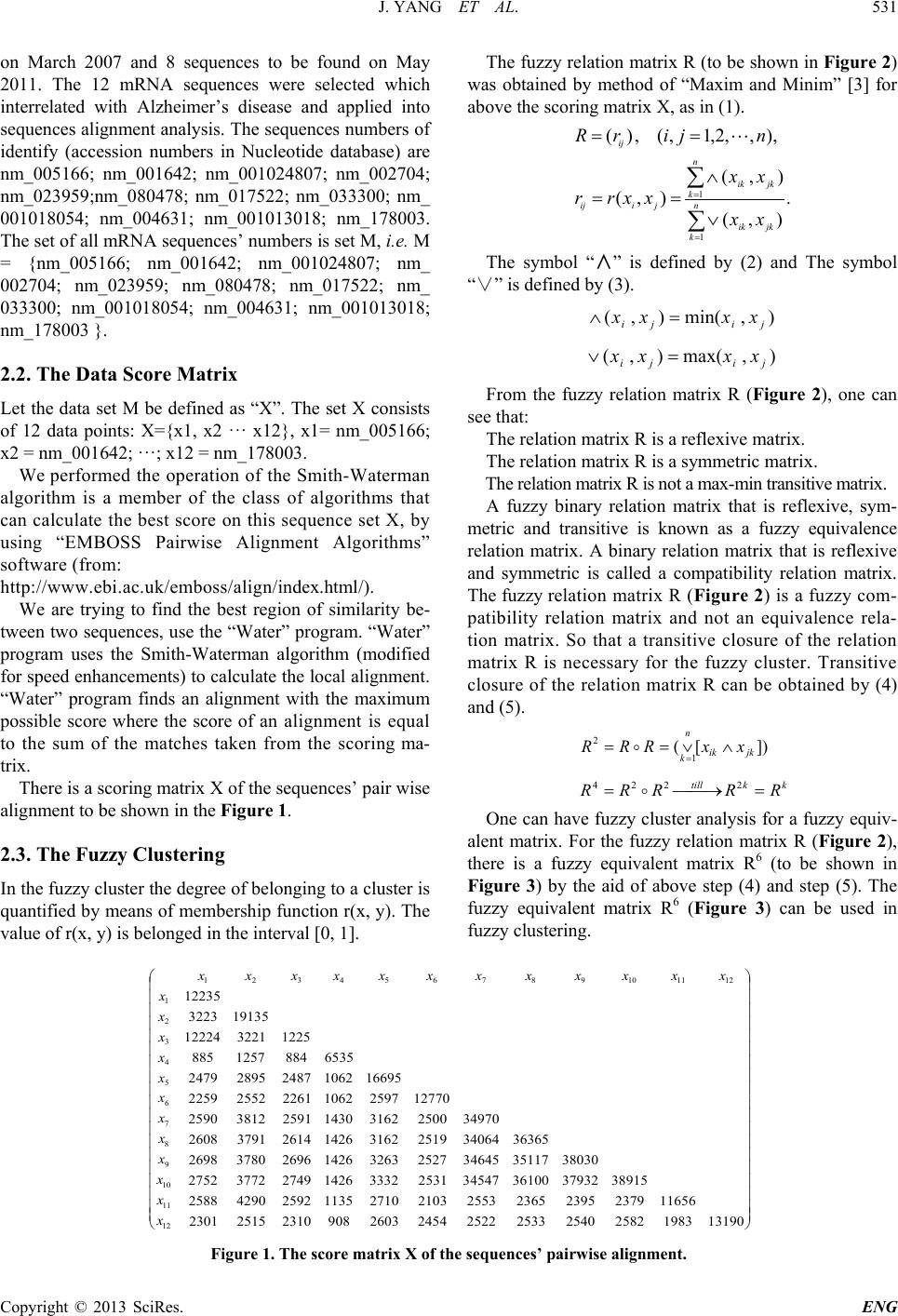 J. YANG ET AL. Copyright © 2013 SciRes. ENG 531 on March 2007 and 8 sequences to be found on May 2011. The 12 mRNA sequences were selected which interrelated with Alzheimer’s disease and applied into sequences alignment analysis. The sequences numbers of identify (accession numbers in Nucleotide database) are nm_005166; nm_001642; nm_001024807; nm_002704; nm_023959;nm_080478; nm_017522; nm_033300; nm_ 001018054; nm_004631; nm_001013018; nm_178003. The set of all mRNA sequen ce s’ numbers is set M, i. e . M = {nm_005166; nm_001642; nm_001024807; nm_ 002704; nm_023959; nm_080478; nm_017522; nm_ 033300; nm_001018054; nm_004631; nm_001013018; nm_178003 }. 2.2. The Data Score Matrix Let the data set M be defined as “X”. The set X consists of 12 data points: X={x1, x2 ··· x12}, x1= nm_005166; x2 = nm_001642; ···; x12 = nm_178003. We performed the operation of the Smith-Waterman algorithm is a member of the class of algorithms that can calculate the best score on this sequence set X, by using “EMBOSS Pairwise Alignment Algorithms” software (from: http://www.ebi.ac.uk/emboss/align/index.html/). We are trying to find the best region of similarity be- tween two sequences, use the “Water” program. “Water” program uses the Smith-Waterman algorithm (modified for speed enhancements) to calculate the local alignment. “Water” program finds an alignment with the maximum possible score where the score of an alignment is equal to the sum of the matches taken from the scoring ma- trix. There is a scoring matrix X of the sequences’ pair wise alignment to be shown in the Figure 1. 2.3. The Fuzzy Clustering In the fuzzy cluster the degree of belonging to a cluster is quantified by means of membership function r(x, y). The value of r(x, y) is belonged in the interval [0, 1]. The fuzzy relation matrix R (to be shown in Figure 2) was obtained by method of “Maxim and Minim” [3] for above the scoring matrix X, as in (1). . ),( ),( ),( ),,,2,1,(,)( 1 1 ∑ ∑ = = ∨ ∧ == == n kjkik n kjkik jiij ij xx xx xxrr njirR The symbol “∧” is defined by (2) and The symbol “∨” is defined by (3). ),min(),( jiji xxxx =∧ ),max(),( jiji xxxx =∨ From the fuzzy relation matrix R (Figure 2), one can see that: The relation matrix R is a reflexive matrix. The relation matrix R is a symmetric matrix. The relation m atrix R is not a m ax-m in tra nsitive matri x. A fuzzy binary relation matrix that is reflexive, sym- metric and transitive is known as a fuzzy equivalence relation matrix. A binary relation matrix that is reflexive and symmetric is called a compatibility relation matrix. The fuzzy relation matrix R (Figure 2) is a fuzzy com- patibility relation matrix and not an equivalence rela- tion matrix. So that a transitive closure of the relation matrix R is necessary for the fuzzy cluster. Transitive closure of the relation matrix R can be obtained by (4) and (5). One can have fuzzy cluster analysis for a fuzzy equiv- alent matrix. For the fuzzy relation matrix R (F ig ure 2), there is a fuzzy equivalent matrix R6 (to be shown in Figure 3) by the aid of above step (4) and step (5). The fuzzy equivalent matrix R6 (Figure 3) can be used in fuzzy clustering. Figure 1. The score matrix X of the sequences’ pairwise alignment. ])[( 1 2jkik n k xxRRR ∧∨== = kk till RRRRR =→= 2224 131901983258225402533252224542603908231025152301 116562379239523652553210327101135259242902588 38915379323610034547253133321426274937722752 380303511734645252732631426269637802698 3636534064251931621426261437912608 34970250031621430259138122590 1277025971062226125522259 166951062248728952479 65358841257885 1225322112224 191353223 12235 12 11 10 9 8 7 6 5 4 3 2 1 121110987654321 x x x x x x x x x x x x xxxxxxxxxxxx 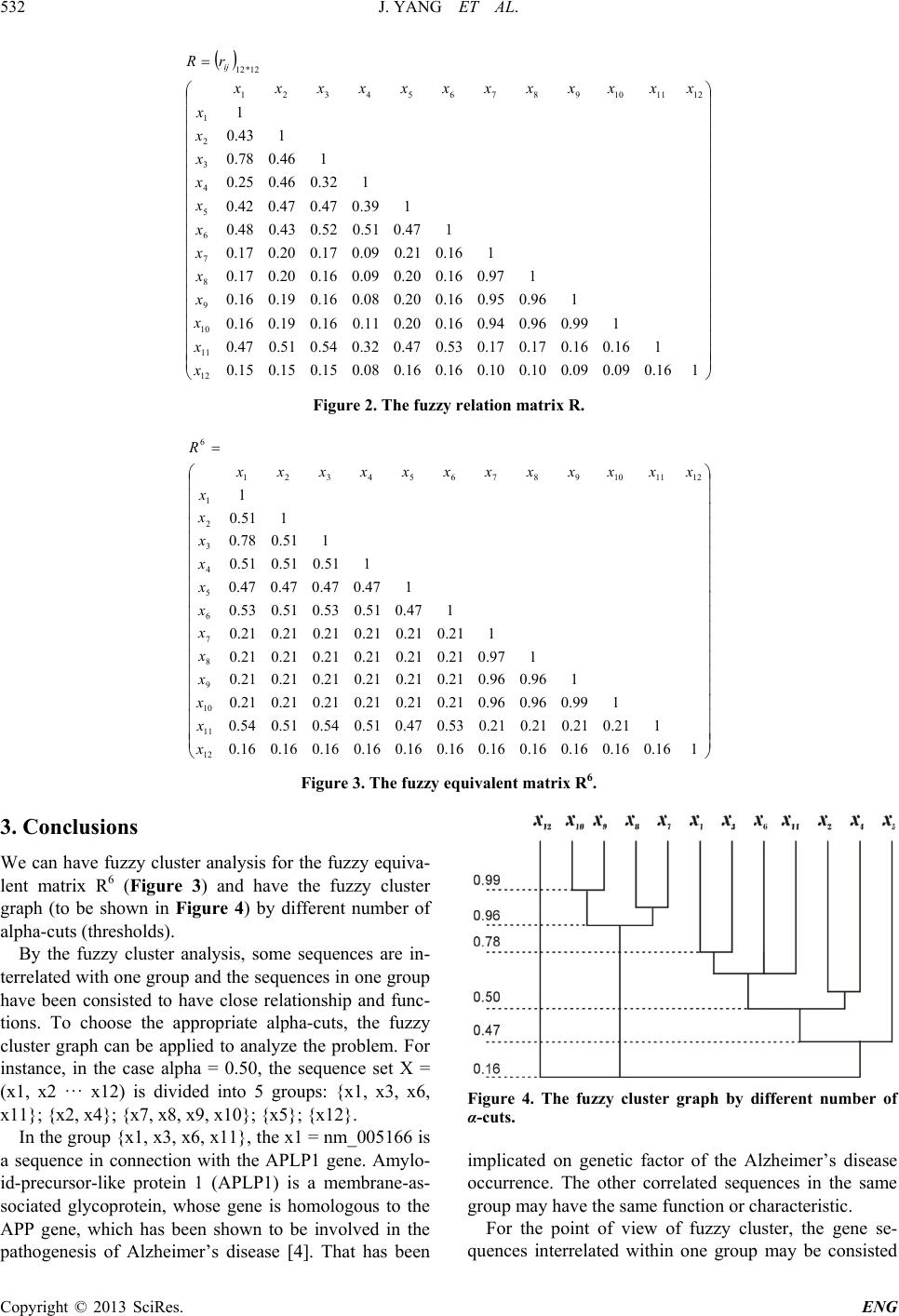 J. YANG ET AL. Copyright © 2013 SciRes. ENG 532 ( ) = 116.009.009.010.010.016.016.008.015.015.015.0 116.016.017.017.053.047.032.054.051.047.0 199.096.094.016.020.011.016.019.016.0 196.095.016.020.008.016.019.016.0 197.016.020.009.016.020.017.0 116.021.009.017.020.017.0 147.051.052.043.048.0 139.047.047.042.0 132.046.025.0 146.078.0 143.0 1 12 11 10 9 8 7 6 5 4 3 2 1 121110987654321 12*12 x x x x x x x x x x x x xxxxxxxxxxxx rR ij Figure 2. The fuzzy relation matrix R. Figure 3. The fuzzy equivalent matrix R6. 3. Conclusions We can have fuzzy cluster analysis for the fuzzy equiva- lent matrix R6 (Figure 3) and have the fuzzy cluster graph (to be shown in Figure 4) by different number of alpha-cuts (thresholds). By the fuzzy cluster analysis, some sequences are in- terrelated with one group and the sequences in one group have been consisted to have close relationship and func- tions. To choose the appropriate alpha-cuts, the fuzzy cluster graph can be applied to analyze the problem. For instance, in the case alpha = 0.50, the sequence set X = (x1, x2 ··· x12) is divided into 5 groups: {x1, x3, x6, x11}; {x2, x4}; {x7, x8, x9, x10}; {x5}; {x12}. In the group {x1, x3, x6, x11}, the x1 = nm_005166 is a sequence in connection with the APLP1 gene. Amylo- id-precursor-like protein 1 (APLP1) is a membrane-as- sociated glycoprotein, whose gene is homologous to the APP gene, which has been shown to be involved in the pathogenesis of Alzheimer’s disease [4]. That has been Figure 4. The fuzzy cluster graph by different number of α-cuts. implicated on genetic factor of the Alzheimer’s disease occurrence. The other correlated sequences in the same group may have the same function or characteristic. For the point of view of fuzzy cluster, the gene se- quences interrelated within one group may be consisted = 116.016.016.016.016.016.016.016.016.016.016.0 121.021.021.021.053.047.051.054.051.054.0 199.096.096.021.021.021.021.021.021.0 196.096.021.021.021.021.021.021.0 197.021.021.021.021.021.021.0 121.021.021.021.021.021.0 147.051.053.051.053.0 147.047.047.047.0 151.051.051.0 151.078.0 151.0 1 12 11 10 9 8 7 6 5 4 3 2 1 121110987654321 6 x x x x x x x x x x x x xxxxxxxxxxxx R 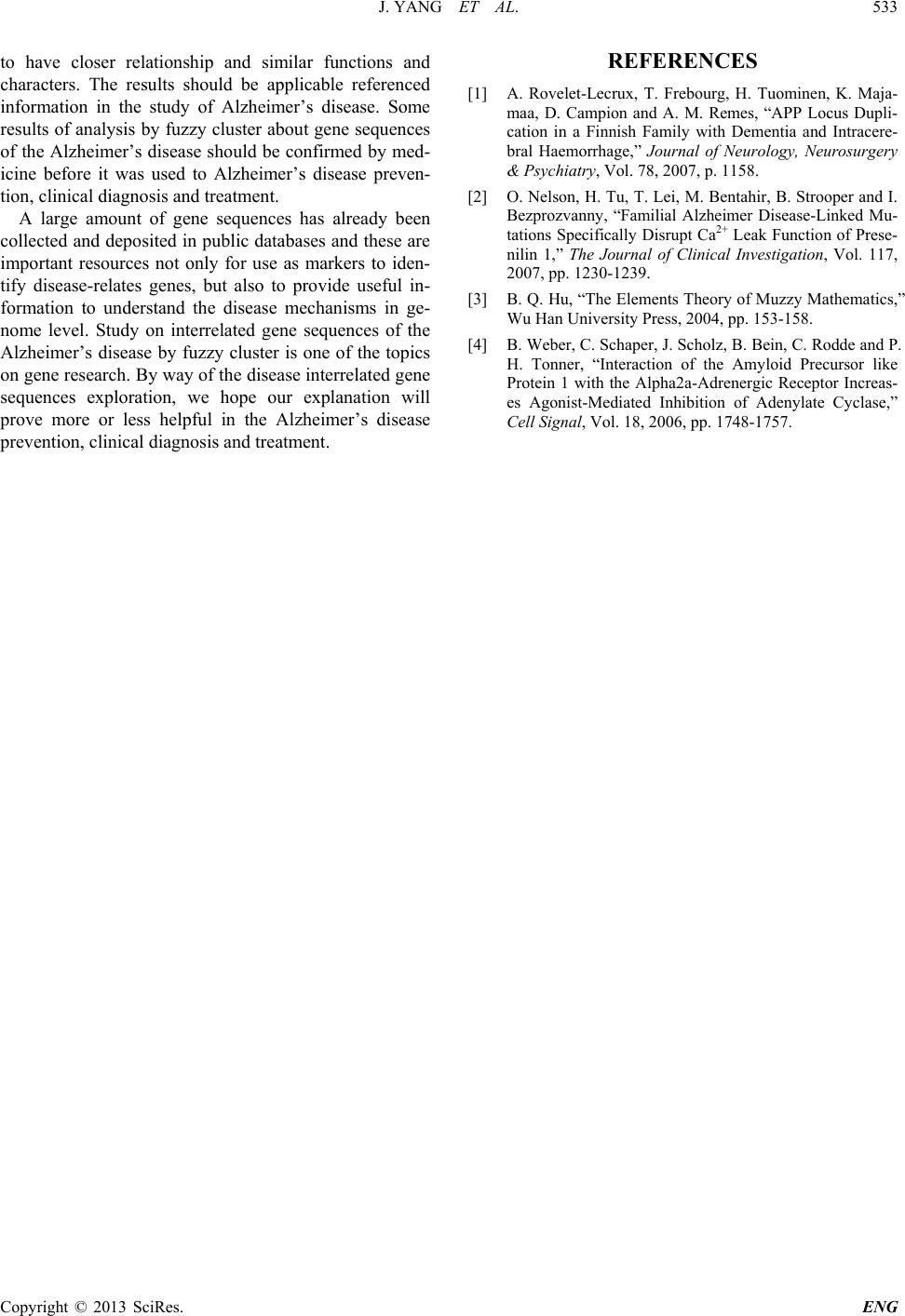 J. YANG ET AL. Copyright © 2013 SciRes. ENG 533 to have closer relationship and similar functions and characters. The results should be applicable referenced information in the study of Alzheimer’s disease. Some results of analysis by fuzzy cluster about gene sequences of the Alzheimer’s disease should be confirmed by med- icine before it was used to Alzheimer’s disease preven- tion, clinical diagnosis and treatment. A large amount of gene sequences has already been collected and deposited in public databases and these are important resources not only for use as markers to iden- tify disease-relates genes, but also to provide useful in- formation to understand the disease mechanisms in ge- nome level. Study on interrelated gene sequences of the Alzheimer’s disease by fuzzy cluster is one of the topics on gene research. By way o f th e d isease interrelated gene sequences exploration, we hope our explanation will prove more or less helpful in the Alzheimer’s disease prevention, clinical diagnos is and tr ea tment. REFERENCES [1] A. Rovelet-Lecrux, T. Frebourg, H. Tuominen, K. Maja- maa, D. Campion and A. M. Reme s , “APP Locus Dupli- cation in a Finnish Family with Dementia and Intracere- bral Haemorrhage,” Journal of Neurology, Neurosurgery & Psychiatry, Vol. 78, 2007, p. 1158. [2] O. Nel son, H. Tu, T. Lei, M. Bentahir, B. Strooper and I. Bezprozvanny, “Familial Alzheimer Disease-Linked Mu- tations Specifically Disrupt Ca2+ Leak Function of Prese- nilin 1,” The Journal of Clinical Investigation, Vol. 117, 2007, pp. 1230-1239. [3] B. Q. Hu, “The Elements Theory of Muzzy Mathematics,” Wu Han University Press, 2004, pp. 153-158. [4] B. Weber, C. Schaper, J. Scholz, B. Bein, C. Rodde and P. H. Tonner, “Interaction of the Amyloid Precursor like Protein 1 with the Alpha2a-Adrenergic Receptor Increas- es Agonist-Mediated Inhibition of Adenylate Cyclase,” Cell Signal, Vol. 18, 2006, pp. 1748-1757. |