

Paper Menu >>
Journal Menu >>
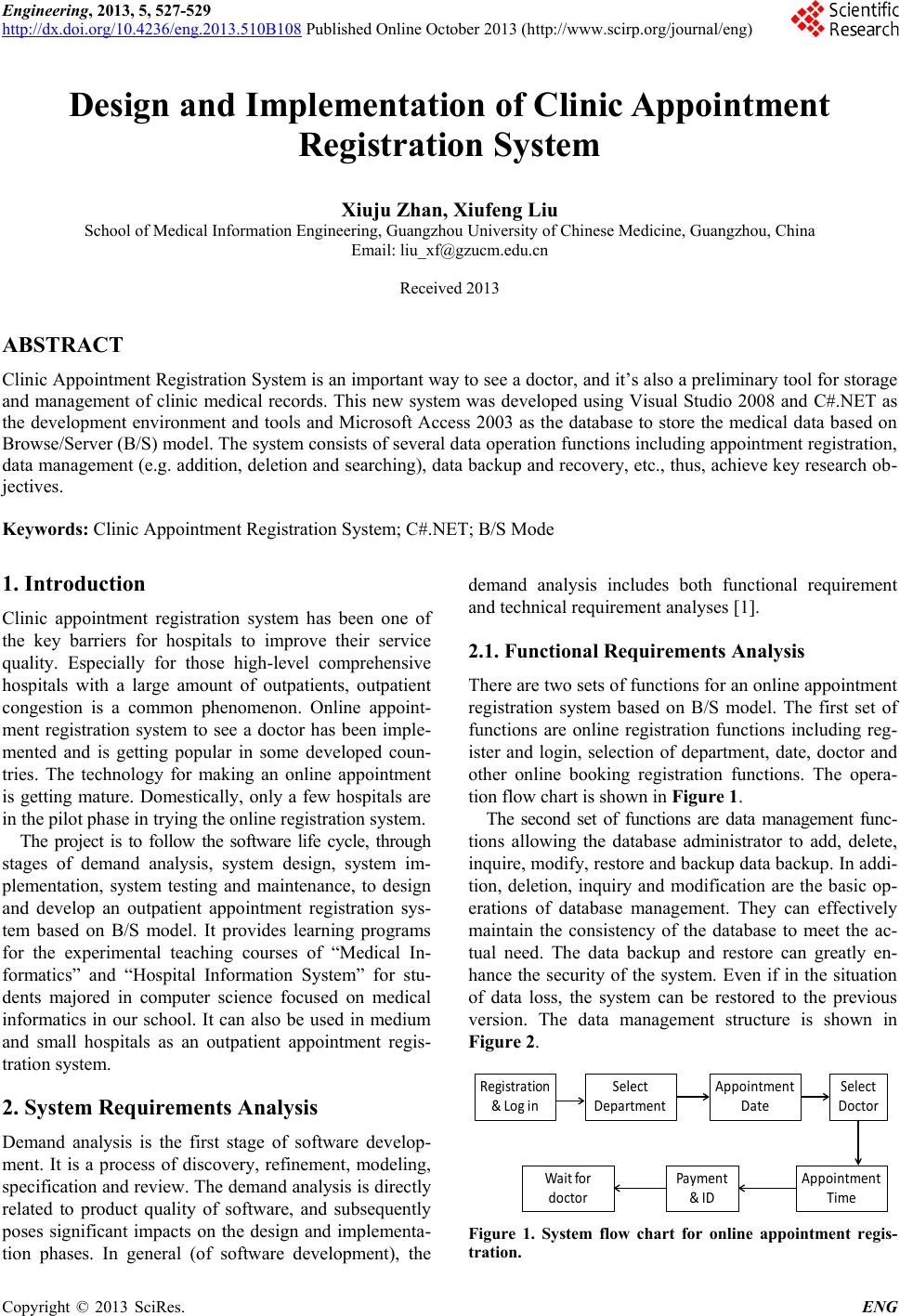 Engineering, 2013, 5, 527-529 http://dx.doi.org/10.4236/eng.2013.510B108 Published Online October 2013 (http://www.scirp.org/journal/eng) Copyright © 2013 SciRes. ENG Design and Implementation of Clinic Appointment Registration System Xiuju Zhan, Xiufeng Liu School of Medical Information Engineering, Guangzhou University of Chinese Medicine, Guangzhou, China Email: [email protected] Received 2013 ABSTRACT Clinic Appointment Registration System is an important way to se e a doctor, and it ’s also a preliminary tool for storage and management of clinic medical records. This new system was developed using Visual Studio 2008 and C#.NET as the development environment and tools and Microsoft Access 2003 as the database to store the medical data based on Browse/Server (B/S) model. The system consists of several data operation functions including appointment registration, data management (e.g. addition, deletion and searching), data backup and recovery, etc., thus, achieve key research ob- jectives. Keywords: Clinic Appointment Registration System; C#.NET; B/S Mod e 1. Introduction Clinic appointment registration system has been one of the key barriers for hospitals to improve their service quality. Especially for those high-level comprehensive hospitals with a large amount of outpatients, outpatient congestion is a common phenomenon. Online appoint- ment registration system to see a doctor has been imple- mented and is getting popular in some developed coun- tries. The technology for making an online appointment is getting mature. Domestically, only a few hospitals are in the pilot phase in trying the online registration system. The project is to follow the software life cycle, through stages of demand analysis, system design, system im- plementation, system testing and maintenance, to design and develop an outpatient appointment registration sys- tem based on B/S model. It provides learning programs for the experimental teaching courses of “Medical In- formatics” and “Hospital Information System” for stu- dents majored in computer science focused on medical informatics in our school. It can also be used in medium and small hospitals as an outpatient appointment regis- tration system. 2. System Requirements Analysis Demand analysis is the first stage of software develop- ment. It is a process of discovery, refinement, modeling, specification and review. The demand analysis is directly related to product quality of software, and subsequently poses significant impacts on the design and implementa- tion phases. In general (of software development), the demand analysis includes both functional requirement and technical requirement analyses [1]. 2.1. Functional Requirements Analysis There are two sets of functions for an online appointment registration system based on B/S model. The first set of functions are online registration functions including reg- ister and login, selection of department, date, doctor and other online booking registration functions. The opera- tion flow chart is shown in Figure 1. The second set of functions are data management func- tions allowing the database administrator to add, delete, inquire, modify, restore and backup data backup. In addi- tion, deletion, inquiry and modification are the basic op- erations of database management. They can effectively maintain the consistency of the database to meet the ac- tual need. The data backup and restore can greatly en- hance the security of the system. Even if in the situation of data loss, the system can be restored to the previous version. The data management structure is shown in Figure 2. Figure 1. System flow chart for online appointment regis- tration. Registration & Log in Select Department Appointment Date Select Doctor Appointment Time Payment & ID Wait for doctor 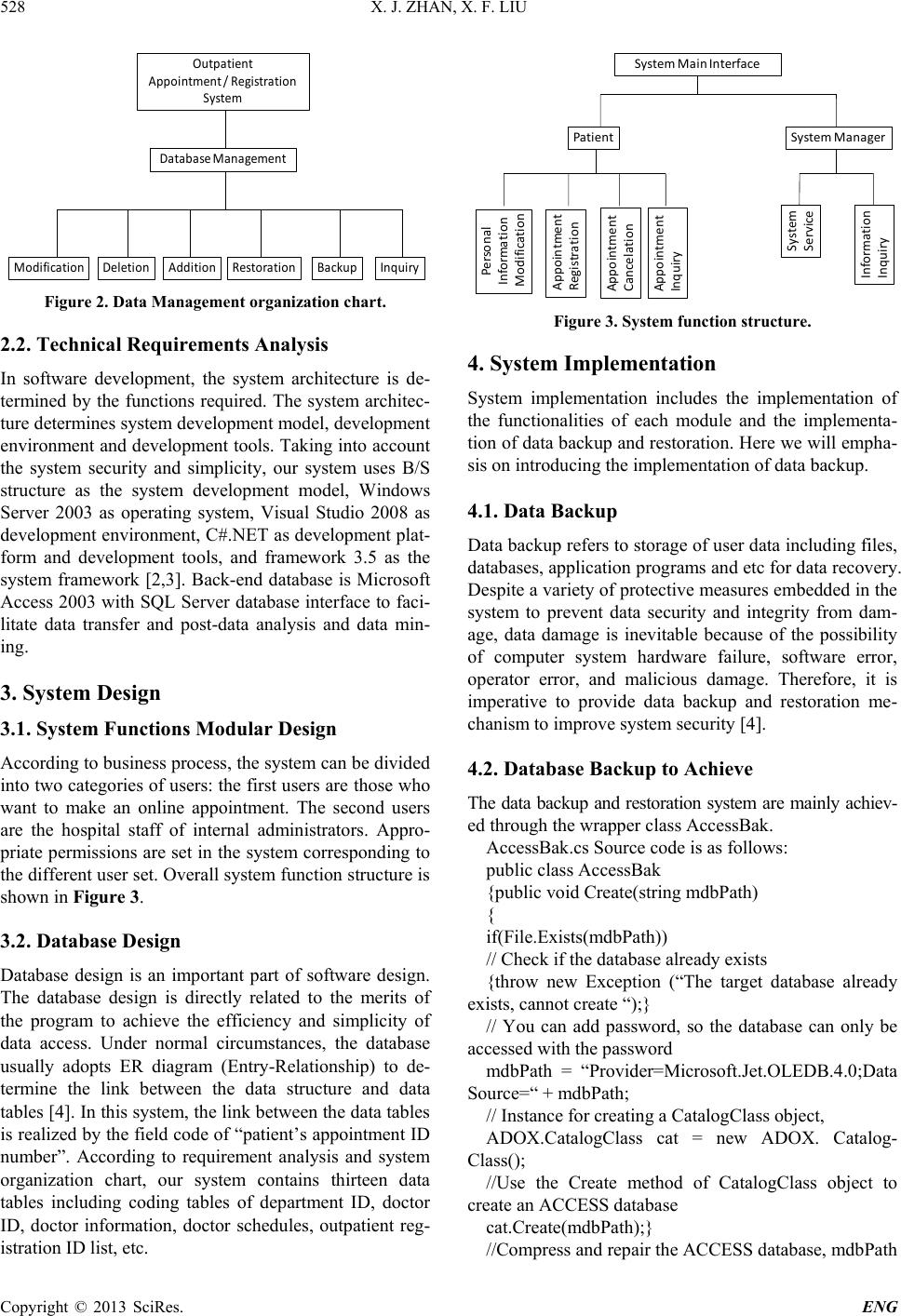 X. J. ZHAN, X. F. LIU Copyright © 2013 SciRes. ENG 528 Figure 2. Data Management organization chart. 2.2. Technical Requirements An alysis In software development, the system architecture is de- termined by the functions required. The system architec- ture determines system development model, development environment and development tools. Taking into account the system security and simplicity, our system uses B/S structure as the system development model, Windows Server 2003 as operating system, Visual Studio 2008 as development environment, C#.NET as development plat- form and development tools, and framework 3.5 as the system framework [2,3]. Back-end database is Microsoft Access 2003 with SQL Server database interface to faci- litate data transfer and post-data analysis and data min- ing. 3. System Design 3.1. System Functions Modular Design According to business process, the system can be divided into two ca tegories of users: the first user s are those who want to make an online appointment. The second users are the hospital staff of internal administrators. Appro- priate permissions are set in the system corresponding to the different user s et. Overall system fun ction struc ture is shown in Figur e 3. 3.2. Database Design Database design is an important part of software design. The database design is directly related to the merits of the program to achieve the efficiency and simplicity of data access. Under normal circumstances, the database usually adopts ER diagram (Entry-Relationship) to de- termine the link between the data structure and data tables [4]. In this system, the link between the data tables is realized by the field code of “patient’s appointment ID number”. According to requirement analysis and system organization chart, our system contains thirteen data tables including coding tables of department ID, doctor ID, doctor information, doctor schedules, outpatient reg- istration ID list, etc. Figure 3. System function structure. 4. System Implementation System implementation includes the implementation of the functionalities of each module and the implementa- tion of data backup and restoration. Here we will empha- sis on introducing the impl ementat i on of data backup. 4.1. Data Backup Data backup refers to storage of user data including files, databases, application programs and etc for data recovery. Despite a variety of protective measures embedded in the system to prevent data security and integrity from dam- age, data damage is inevitable because of the possibility of computer system hardware failure, software error, operator error, and malicious damage. Therefore, it is imperative to provide data backup and restoration me- chanism to improve system security [4 ]. 4.2. Database Backup to Achieve The data backup and restoration system are mainly achiev- ed through the wrapper class AccessBak. AccessBak.cs Source code is as follows: public class AccessBak {public void Create(string mdbPath) { if(File.Exists(mdbPath)) // Check if the database already exists {throw new Exception (“The target database already exists, cannot create “);} // You can add password, so the database can only be accessed with the password mdbPath = “Provider=Microsoft.Jet.OLEDB.4.0;Data Source=“ + mdbPath; // Instance for creating a CatalogClass object, ADOX.CatalogClass cat = new ADOX. Catalog- Class(); //Use the Create method of CatalogClass object to create an ACCESS database cat.Create(mdbPath);} //Compress and repair the ACCESS database, mdbPath Outpatient Appointment / Registration System Database Management Modification Deletion Addition Restoration Backup Inquiry System Main Interface System ManagerPatient Appointment Registration Appointment Cancelation Appointment Inquiry System Service Information Inquiry Personal Information Modification 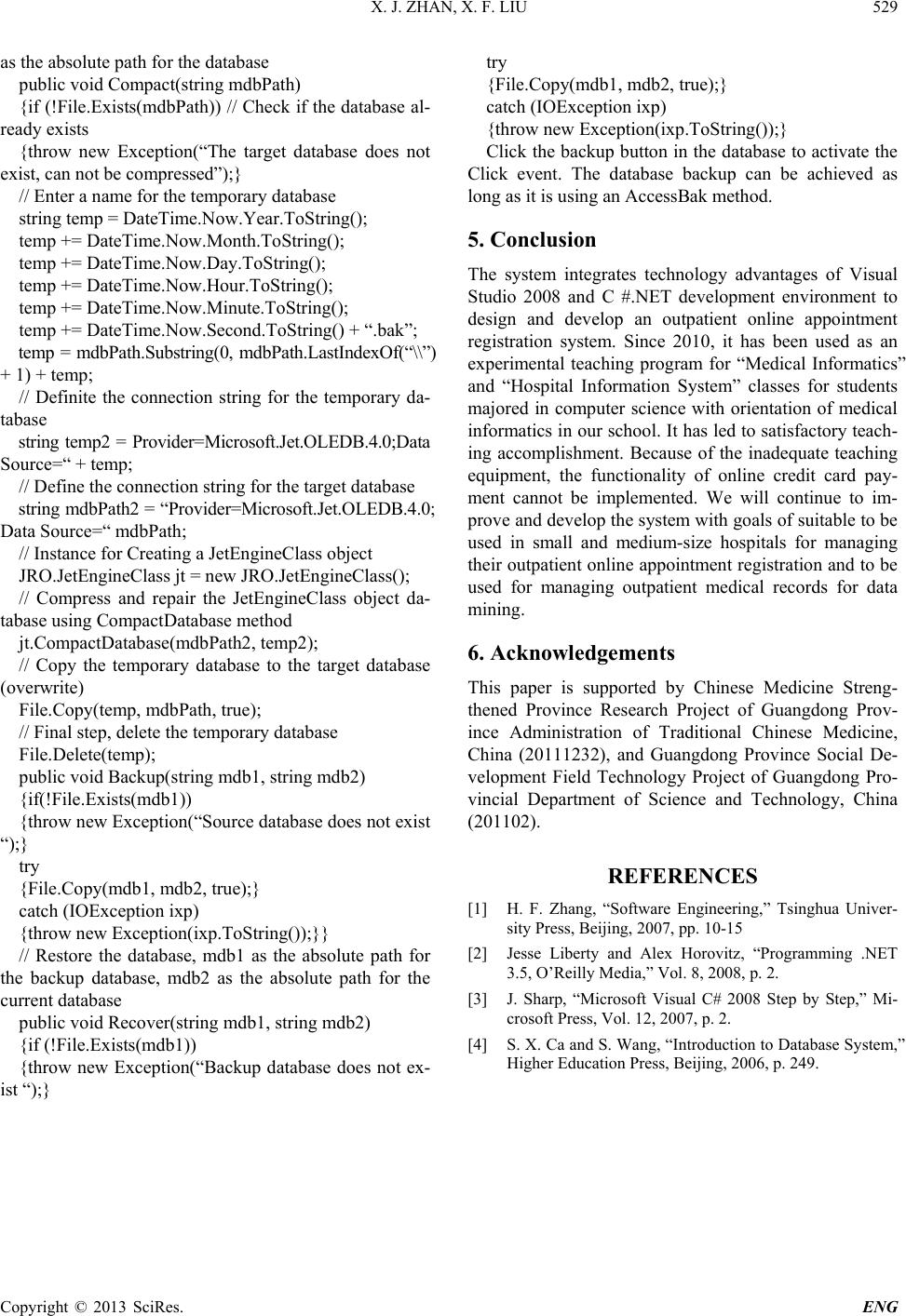 X. J. ZHAN, X. F. LIU Copyright © 2013 SciRes. ENG 529 as the absolute pa t h for the database public void Compact(string mdbPath) {if (!File.Exists(mdbPath)) // Check if the database a l- ready exists {throw new Exception(“The target database does not exist, can not be compressed”);} // Enter a name for the temporary database string temp = DateTime.Now.Year.ToString(); temp += DateTime.Now.Month.ToString(); temp += DateTime.Now.Day.ToString(); temp += DateTime.Now.Hour.ToString(); temp += DateTime.Now.Minute.ToString(); temp += DateTime.Now.Second.ToString() + “.bak”; temp = mdbPath.Substring(0, mdbPath.LastIndexOf(“\\”) + 1) + temp; // Definite the connection string for the temporary da- tabase string temp2 = Provider=Microsoft.Jet.OLEDB.4.0;Data Source=“ + temp; // Define the connection string for the target database string mdbPath2 = “Provider=Microsoft.Jet.OLEDB.4.0; Data Source=“ mdbPath; // Instance for Creating a JetEngineClass object JRO.JetEngineClass jt = new JRO.JetEngineClass(); // Compress and repair the JetEngineClass object da- tabase using CompactDatabase method jt.CompactDatabase(mdbPath2, temp2); // Copy the temporary database to the target database (overwrit e) File.Copy(temp, mdbPath, true); // Final step, delete the temporary database File.Delete(temp); public void Backup(string mdb1, string mdb2) {if(!File.Exists(mdb1)) {throw new Exception(“Source database does not exist “);} try {File.Copy(mdb1, mdb2, true);} catch (IOException ixp) {throw new Exception(ixp.ToString());}} // Restore the database, mdb1 as the absolute path for the backup database, mdb2 as the absolute path for the current database public void Recover(string mdb1, string mdb2) {if (!File.Exists(mdb1)) {throw new Exception(“Backup database does not ex- ist “);} try {File.Copy(mdb1, mdb2, true);} catch (IOException ixp) {throw new Exception(ixp.ToString());} Click the backup button in the database to activate the Click event. The database backup can be achieved as long as it is using an AccessBak method. 5. Conclusion The system integrates technology advantages of Visual Studio 2008 and C #.NET development environment to design and develop an outpatient online appointment registration system. Since 2010, it has been used as an experimental teaching program for “Medical Informatics” and “Hospital Information System” classes for students majored in computer science with orientation of medical informatics in our school. It has led to satisf actory teach- ing accomplishment. Because of the inadequate teaching equipment, the functionality of online credit card pay- ment cannot be implemented. We will continue to im- prove and develop the system with goals of suitable to be used in small and medium-size hospitals for managing their outpatient online appointment registration and to be used for managing outpatient medical records for data mining. 6. Acknowledgements This paper is supported by Chinese Medicine Streng- thened Province Research Project of Guangdong Prov- ince Administration of Traditional Chinese Medicine, China (20111232), and Guangdong Province Social De- velopment Field Technology Project of Guangdong Pro- vincial Department of Science and Technology, China (201102). REFERENCES [1] H. F. Zhang, “Software Engineering,” Tsinghua Univer- sity Press, Beijing, 2007, pp. 10-15 [2] Jesse Liberty and Alex Horovitz, “Programming .NET 3.5, O’Reilly Me dia,” Vol. 8, 2008, p. 2. [3] J. Sharp, “Microsoft Visual C# 2008 Step by Step,” Mi- crosoft Press, Vol. 12, 2007, p. 2. [4] S. X. Ca and S. Wang, “Introduction to Database System,” Higher Education Press, Beijing, 2006, p. 249. |