

Paper Menu >>
Journal Menu >>
 Advances in Infectious Diseases, 2013, 3, 290-294 Published Online December 2013 (http://www.scirp.org/journal/aid) http://dx.doi.org/10.4236/aid.2013.34044 Open Access AID Detection of 16S rRNA Methylase Genes in Gram-Negative Bacilli Isolated from Hospitals in Changchun, China Fan Zhao1, Hongyan Shi2, Jinghua Li2, Jiaqi Zhou2, Yanbo Sun2* 1Department of Orthopedics, China-Japan Union Hospital of Jilin University, Changchun, China; 2Department of Pathogen Biology, Basic Medical College of Jilin University, Changchun, China. Email: *[email protected] Received November 4th, 2013; revised December 3rd, 2013; accepted December 10th, 2013 Copyright © 2013 Fan Zhao et al. This is an open access article distributed under the Creative Commons Attribution License, which permits unrestricted use, distribution, and reproduction in any medium, provided the original work is properly cited. ABSTRACT Methylation of 16S rRNA is an important mechanism of aminoglycoside resistance among gram-negative pathogens. In this report, 16S rRNA methylase genes were amplified using PCR among gram-negative bacillus isolates from hospitals in the Changchun area of China and 16S rRNA methylase genotypes (armA, rmtB, rmtA, rmtC, rmtD, and npmA) were identified by direct sequencing. Fifty of the isolates (43.1%) harbored 16S rRNA methylase genes. The common 16S rRNA methylase genes were armA and rmtB (12.1% and 31.0%, respectively), whereas the rmtA, rmtC, rmtD, and npmA genes were absent from the sample. It suggests that the predominant 16S rRNA methylase genes among gram- negative bacilli in the Changchun area are armA and rmtB. Keywords: 16S rRNA; Methylases; Gram-Negative Bacilli 1. Introduction Aminoglycosides have strong antibacterial activity against gram-negative bacilli and gram-positive bacilli. Amino- glycosides are well received by clinicians because of their broad antimicrobial spectrum and efficacy. The irra- tional use of antibiotics is causing increasingly acute pro- blems associated with antimicrobial resistance, however. The methylation of 16S rRNAs in gram-negative bacilli is one of the mechanisms underlying strong resistance to aminoglycosides. Recent studies [1-2] showed that 16S rRNA methylase could methylate the 30S ribosomal sub- unit in gram-negative bacilli. 16S rRNA methylase can protect the target sites of the 30S ribosomal subunit, pre- venting the aminoglycosides from combining with the 30S ribosomal subunit. Following the first discovery of 16S rRNA methylase gene armA in France [3], other methylases such as rmtB, rmtA, and rmtC were found among gram-negative patho- gens [4,5]. The predominant methylase genes in southern China are armA and armB [6]; however, the prevalence of 16S rRNA methylases among clinical isolates of gram- negative bacilli in Changchun, Northeast of China, has not been previously assessed. 16S rRNA methylase me- diates high-level resistance to aminoglycosides in gram- negative isolates, and some spices in gram-negative ba- cilli are major causes of nosocomial infections [7]. The aim of this study was to investigate the prevalence of 16S rRNA methylases in aminoglycoside-resistant isolating from three hospitals in Changchun and to characterize the host bacteria. 2. Materials and Methods 2.1. Isolates and Drugs One hundred and sixteen strains of gram-negative bacilli were isolated from China-Japan Union Hospital of Jilin University (Changchun, China), the Affiliated Hospital to Changchun University of Chinese Medicine (Changchun, China), and the Clinical Laboratory of Jilin Province People’s Hospital (Changchun, China). The clinical iso- lates consisted of 33 Escherichia coli strains, 25 Klebsi- ella pneumoniae strains, 14 Enterobacter cloacae strains, 15 Acinetobacter baumannii strains, 19 Pseudomona s ae- ruginosa strains, and 10 Serratia marcescens strains. Iden- tification of these isolates was done using the VITEK-32 system (Mérieux, France). Amikacin was provided by the National Institute for the Control of Pharmaceutical and Biological Products (batch number 130335-200204) (Bei- *Corresponding author.  Detection of 16S rRNA Methylase Genes in Gram-Negative Bacilli Isolated from Hospitals in Changchun, China 291 jing, China). Gentamicin was supplied by Beijing Ding- guo Changsheng Biotech Co., Ltd. (batch number 1B310330) (Beijing, China). 2.2. Testing for Antibiotic Susceptibility by Agar Dilution The susceptibilities of the 116 strains to amikacin and gentamicin were determined by agar dilution. Isolates that were able to grow at antibiotic concentrations above 16 mg/L were regarded as being resistant to the antibiot- ics; and those that were not able to grow at concentra- tions above 2 mg/L were regarded as sensitive. 2.3. Extraction of Bacteria DNA One milliliter of bacterial culture was placed in a 1.5 mL centrifuge tube and centrifuged at 10,000 rpm for 1 min. The supernatant was removed, and 100 μL TE Buffer (1 mol/L Tris-HCl, pH 8.0; 500 mmol/L EDTA, pH8.0) was added. Then, an equal volume of mixed phenol, chloro- form, and isoamyl alcohol (25:24:1) was added. Vortex os- cillation was then performed for 30 s, and the mixture was subsequently centrifuged at 10,000 rpm for 5 min. The resulting supernatant was then stored at −20˚C until later use as the template for genetic testing. 2.4. Primer Design and Detection of 16S rRNA Methylase Genes Primers were self-designed for six different 16S rRNA methylase gene sequences available from GenBank. The primer sequences, target genes, and primer lengths are shown in Table 1. The conditions for producing PCR products with lengths greater than 500 bp were: 2 min at 93˚C; 35 cycles of 1 min at 93˚C, 1 min at 55˚C, and 1 min at 72˚C; followed by 5 min at 72˚C. The conditions for producing PCR products with lengths less than 500 bp were: 5 min at 93˚C; 35 cycles of 30 s at 93˚C, 30 s at 55˚C, and 1 min at 72˚C; followed by 5 min at 72˚C. Af- ter 2% agarose gel electrophoresis, the PCR products were observed under a gel imager and photos were taken. 2.5. PCR Product Sequencing The PCR products were sent to Beijing Genomics Insti- tute, (Beijing, China) for sequencing. The sequences were detected using the Chromas software and compared with those released by GenBank. 3. Results 3.1. Results of Antibiotic Susceptibility Testing Among the 116 gram-negative bacilli, 16 E. coli strains, 1 K. pneumoniae strain, 3 E. cloacae strains, 11 A. bau- mannii strains, 10 P. aeruginosa strains, and 9 S. marces- Table 1. Primer sequences for the six known 16S rRNA me- thylase genotypes. Target gene Primer sequences (5’ → 3’) Product length (bp) armAP1: ATGGAT AAGAATGATGTTGTTAAG P2: TTAT T TCTGAAATCCACTAGT AATTA774 rmtAP1: ACTGTGATGGGATACGCGTC P2:AGCGATATCCAACACACGATGG 315 rmtBP1: ATGAACATCAACGATGCCCTC P2:TTATCCATTCTTTTTTATCAAGTATAT 756 rmtCP1: ATGAAAACCAACGATAATTATC P2:TTACAATCTCGATACGATAAAATAC 846 rmtDP1:ATGAGCGAACTGAAGGAAAAACTGCT P2:TCATTTTCGTTTCAGCACGTAAAACAG 744 npmAP1:TTGGGTACTGGAGACGGTAG P2: CAGCT TTGTATTGT TCGCTC 421 cens strains showed resistance to amikacin concentra- tions exceeding 16 mg/L (Ta b l e 2). Likewise, 26 E. coli strains, 11 K. pneumoniae strains, 8 E. cloacae strains, 15 A. baumannii strains, 17 P. aeruginosa strains, and 10 S. marcescens strains exhibited resistance to gentamycin con- centrations exceeding 16 mg /L (Table 3). 3.2. Results of 16S rRNA Methylase Genetic Testing Fifty (43.1%) of the 116 isolates harbored 16S rRNA me- thylase genes. The common 16S rRNA methylase genes were armA (12.1%, 14/116) and rmtB (31.0%, 36/ 116). All of the isolates were negative for the rmtA, rmtC, rmtD, and npmA genotypes (Table 4). Additionally, three of the S. marcescens strains harbored both armA and rmtB and were highly resistant to both amikacin and gen- tamicin. An electrophoregram of the products of PCR amplification of armA and rmtB is shown in Figures 1 and 2. 3.3. Sequencing of 16S rRNA Methylase The results of the direct sequencing of the armA and rmtB genes isolated from our sample were compared with the corresponding sequences in the GenBank database, and the sequences in our sample were found to be identical to those in the database (arm A:HQ204573.1; rmt B:FJ539137.1). 4. Discussion Aminoglycosides exert their antibacterial action by binding to the highly conserved A site of the 16S rRNA of the bacterial 30S ribosomal subunits, interfering with protein synthesis with subsequent bacterial death. Fur- thermore, aminoglycosides have a broad antimicrobial Open Access AID 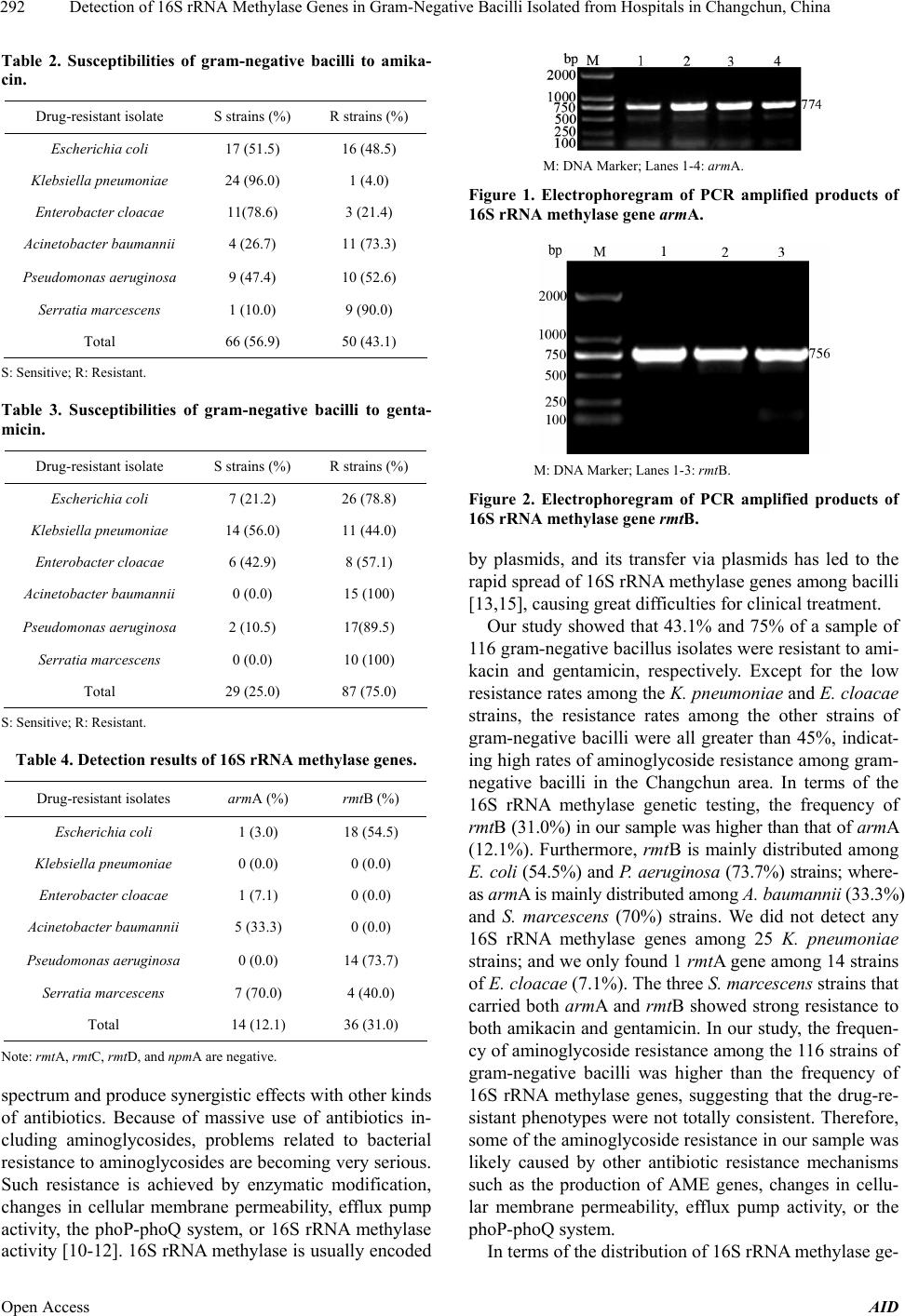 Detection of 16S rRNA Methylase Genes in Gram-Negative Bacilli Isolated from Hospitals in Changchun, China 292 Table 2. Susceptibilities of gram-negative bacilli to amika- cin. Drug-resistant isolate S strains (%) R strains (%) Escherichia coli 17 (51.5) 16 (48.5) Klebsiella pneumoniae 24 (96.0) 1 (4.0) Enterobacter cloacae 11(78.6) 3 (21.4) Acinetobacter baumannii 4 (26.7) 11 (73.3) Pseudomonas aeruginosa 9 (47.4) 10 (52.6) Serratia marcescens 1 (10.0) 9 (90.0) Total 66 (56.9) 50 (43.1) S: Sensitive; R: Resistant. Table 3. Susceptibilities of gram-negative bacilli to genta- micin. Drug-resistant isolate S strains (%) R strains (%) Escherichia coli 7 (21.2) 26 (78.8) Klebsiella pneumoniae 14 (56.0) 11 (44.0) Enterobacter cloacae 6 (42.9) 8 (57.1) Acinetobacter baumannii 0 (0.0) 15 (100) Pseudomonas aeruginosa 2 (10.5) 17(89.5) Serratia marcescens 0 (0.0) 10 (100) Total 29 (25.0) 87 (75.0) S: Sensitive; R: Resistant. Table 4. Detection results of 16S rRNA methylase genes. Drug-resistant isolates armA (%) rmtB (%) Escherichia coli 1 (3.0) 18 (54.5) Klebsiella pneumoniae 0 (0.0) 0 (0.0) Enterobacter cloacae 1 (7.1) 0 (0.0) Acinetobacter baumannii 5 (33.3) 0 (0.0) Pseudomonas aeruginosa 0 (0.0) 14 (73.7) Serratia marcescens 7 (70.0) 4 (40.0) Total 14 (12.1) 36 (31.0) Note: rmtA, rmtC, rmtD, and npmA are negative. spectrum and produce synergistic effects with other kinds of antibiotics. Because of massive use of antibiotics in- cluding aminoglycosides, problems related to bacterial resistance to aminoglycosides are becoming very serious. Such resistance is achieved by enzymatic modification, changes in cellular membrane permeability, efflux pump activity, the phoP-phoQ system, or 16S rRNA methylase activity [10-12]. 16S rRNA methylase is usually encoded M: DNA Marker; Lanes 1-4: armA. Figure 1. Electrophoregram of PCR amplified products of 16S rRNA methylase gene armA. M: DNA Marker; Lanes 1-3: rmtB. Figure 2. Electrophoregram of PCR amplified products of 16S rRNA methylase gene rmtB. by plasmids, and its transfer via plasmids has led to the rapid spread of 16S rRNA methylase genes among bacilli [13,15], causing great difficulties for clinical treatment. Our study showed that 43.1% and 75% of a sample of 116 gram-negative bacillus isolates were resistant to ami- kacin and gentamicin, respectively. Except for the low resistance rates among the K. pneumoniae and E. cloacae strains, the resistance rates among the other strains of gram-negative bacilli were all greater than 45%, indicat- ing high rates of aminoglycoside resistance among gram- negative bacilli in the Changchun area. In terms of the 16S rRNA methylase genetic testing, the frequency of rmtB (31.0%) in our sample was higher than that of armA (12.1%). Furthermore, rmtB is mainly distributed among E. coli (54.5%) and P. aeruginosa (73.7%) strains; where- as armA is mainly distributed among A. baumannii (33.3%) and S. marcescens (70%) strains. We did not detect any 16S rRNA methylase genes among 25 K. pneumoniae strains; and we only found 1 rmtA gene among 14 strains of E. cloacae (7.1%). The three S. marcescens strains that carried both armA and rm tB showed strong resistance to both amikacin and gentamicin. In our study, the frequen- cy of aminoglycoside resistance among the 116 strains of gram-negative bacilli was higher than the frequency of 16S rRNA methylase genes, suggesting that the drug-re- sistant phenotypes were not totally consistent. Therefore, some of the aminoglycoside resistance in our sample was likely caused by other antibiotic resistance mechanisms such as the production of AME genes, changes in cellu- lar membrane permeability, efflux pump activity, or the phoP-phoQ system. In terms of the distribution of 16S rRNA methylase ge- Open Access AID 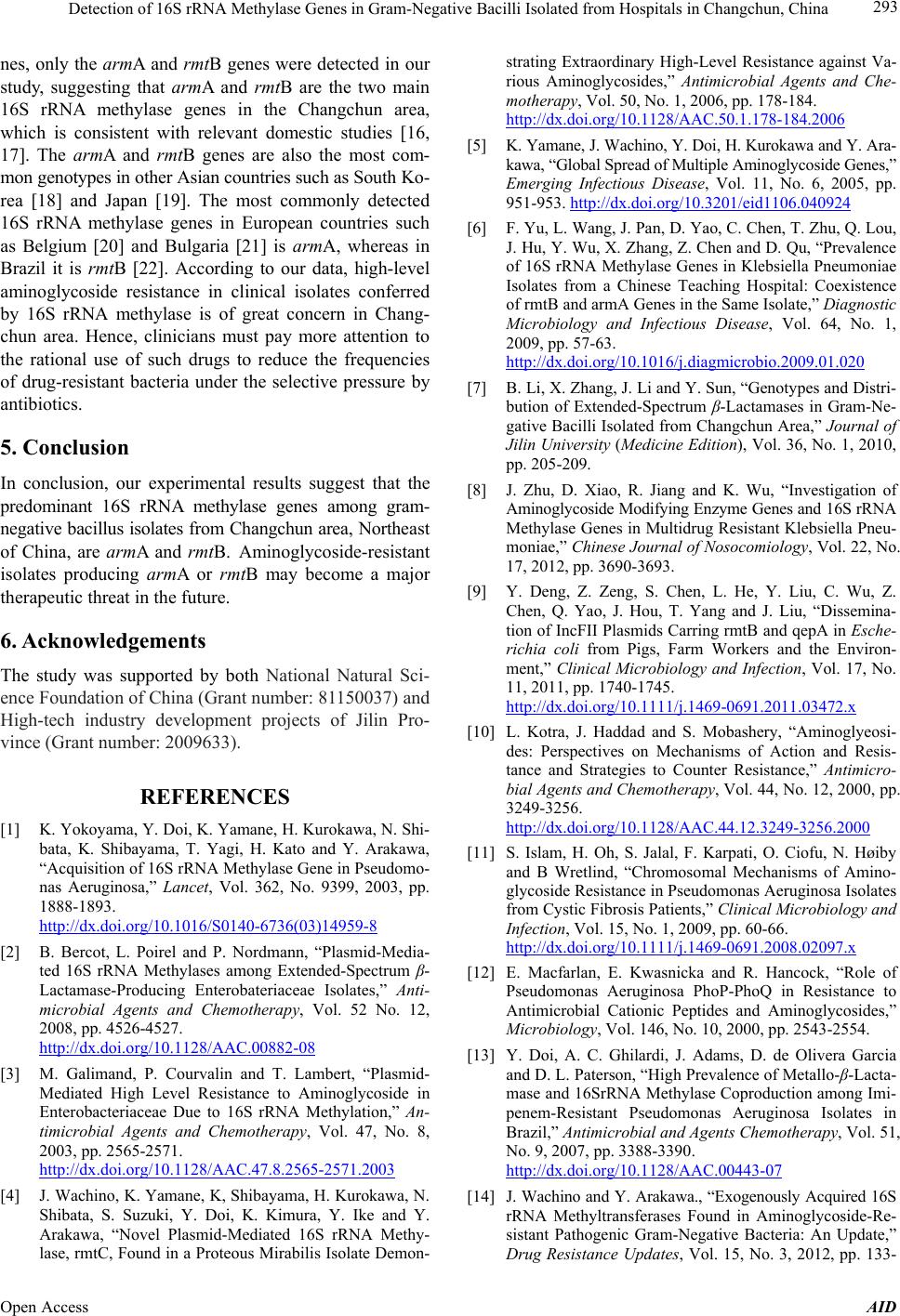 Detection of 16S rRNA Methylase Genes in Gram-Negative Bacilli Isolated from Hospitals in Changchun, China 293 nes, only the armA and rmtB genes were detected in our study, suggesting that armA and rmtB are the two main 16S rRNA methylase genes in the Changchun area, which is consistent with relevant domestic studies [16, 17]. The armA and rmtB genes are also the most com- mon genotypes in other Asian countries such as South Ko- rea [18] and Japan [19]. The most commonly detected 16S rRNA methylase genes in European countries such as Belgium [20] and Bulgaria [21] is armA, whereas in Brazil it is rmtB [22]. According to our data, high-level aminoglycoside resistance in clinical isolates conferred by 16S rRNA methylase is of great concern in Chang- chun area. Hence, clinicians must pay more attention to the rational use of such drugs to reduce the frequencies of drug-resistant bacteria under the selective pressure by antibiotics. 5. Conclusion In conclusion, our experimental results suggest that the predominant 16S rRNA methylase genes among gram- negative bacillus isolates from Changchun area, Northeast of China, are armA and rmtB. Aminoglycoside-resistant isolates producing armA or rmtB may become a major therapeutic threat in the future. 6. Acknowledgements The study was supported by both National Natural Sci- ence Foundation of China (Grant number: 81150037) and High-tech industry development projects of Jilin Pro- vince (Grant number: 2009633). REFERENCES [1] K. Yokoyama, Y. Doi, K. Yamane, H. Kurokawa, N. Shi- bata, K. Shibayama, T. Yagi, H. Kato and Y. Arakawa, “Acquisition of 16S rRNA Methylase Gene in Pseudomo- nas Aeruginosa,” Lancet, Vol. 362, No. 9399, 2003, pp. 1888-1893. http://dx.doi.org/10.1016/S0140-6736(03)14959-8 [2] B. Bercot, L. Poirel and P. Nordmann, “Plasmid-Media- ted 16S rRNA Methylases among Extended-Spectrum β- Lactamase-Producing Enterobateriaceae Isolates,” Anti- microbial Agents and Chemotherapy, Vol. 52 No. 12, 2008, pp. 4526-4527. http://dx.doi.org/10.1128/AAC.00882-08 [3] M. Galimand, P. Courvalin and T. Lambert, “Plasmid- Mediated High Level Resistance to Aminoglycoside in Enterobacteriaceae Due to 16S rRNA Methylation,” An- timicrobial Agents and Chemotherapy, Vol. 47, No. 8, 2003, pp. 2565-2571. http://dx.doi.org/10.1128/AAC.47.8.2565-2571.2003 [4] J. Wachino, K. Yamane, K, Shibayama, H. Kurokawa, N. Shibata, S. Suzuki, Y. Doi, K. Kimura, Y. Ike and Y. Arakawa, “Novel Plasmid-Mediated 16S rRNA Methy- lase, rmtC, Found in a Proteous Mirabilis Isolate Demon- strating Extraordinary High-Level Resistance against Va- rious Aminoglycosides,” Antimicrobial Agents and Che- motherapy, Vol. 50, No. 1, 2006, pp. 178-184. http://dx.doi.org/10.1128/AAC.50.1.178-184.2006 [5] K. Yamane, J. Wachino, Y. Doi, H. Kurokawa and Y. Ara- kawa, “Global Spread of Multiple Aminoglycoside Genes,” Emerging Infectious Disease, Vol. 11, No. 6, 2005, pp. 951-953. http://dx.doi.org/10.3201/eid1106.040924 [6] F. Yu, L. Wang, J. Pan, D. Yao, C. Chen, T. Zhu, Q. Lou, J. Hu, Y. Wu, X. Zhang, Z. Chen and D. Qu, “Prevalence of 16S rRNA Methylase Genes in Klebsiella Pneumoniae Isolates from a Chinese Teaching Hospital: Coexistence of rmtB and armA Genes in the Same Isolate,” Diagnostic Microbiology and Infectious Disease, Vol. 64, No. 1, 2009, pp. 57-63. http://dx.doi.org/10.1016/j.diagmicrobio.2009.01.020 [7] B. Li, X. Zhang, J. Li and Y. Sun, “Genotypes and Distri- bution of Extended-Spectrum β-Lactamases in Gram-Ne- gative Bacilli Isolated from Changchun Area,” Journal of Jilin University (Medicine Edition), Vol. 36, No. 1, 2010, pp. 205-209. [8] J. Zhu, D. Xiao, R. Jiang and K. Wu, “Investigation of Aminoglycoside Modifying Enzyme Genes and 16S rRNA Methylase Genes in Multidrug Resistant Klebsiella Pneu- moniae,” Chinese Journal of Nosocomiology, Vol. 22, No. 17, 2012, pp. 3690-3693. [9] Y. Deng, Z. Zeng, S. Chen, L. He, Y. Liu, C. Wu, Z. Chen, Q. Yao, J. Hou, T. Yang and J. Liu, “Dissemina- tion of IncFII Plasmids Carring rmtB and qepA in Esche- richia coli from Pigs, Farm Workers and the Environ- ment,” Clinical Microbiology and Infection, Vol. 17, No. 11, 2011, pp. 1740-1745. http://dx.doi.org/10.1111/j.1469-0691.2011.03472.x [10] L. Kotra, J. Haddad and S. Mobashery, “Aminoglyeosi- des: Perspectives on Mechanisms of Action and Resis- tance and Strategies to Counter Resistance,” Antimicro- bial Agents and Chemotherapy, Vol. 44, No. 12, 2000, pp. 3249-3256. http://dx.doi.org/10.1128/AAC.44.12.3249-3256.2000 [11] S. Islam, H. Oh, S. Jalal, F. Karpati, O. Ciofu, N. Høiby and B Wretlind, “Chromosomal Mechanisms of Amino- glycoside Resistance in Pseudomonas Aeruginosa Isolates from Cystic Fibrosis Patients,” Clinical Microbiology and Infection, Vol. 15, No. 1, 2009, pp. 60-66. http://dx.doi.org/10.1111/j.1469-0691.2008.02097.x [12] E. Macfarlan, E. Kwasnicka and R. Hancock, “Role of Pseudomonas Aeruginosa PhoP-PhoQ in Resistance to Antimicrobial Cationic Peptides and Aminoglycosides,” Microbiology, Vol. 146, No. 10, 2000, pp. 2543-2554. [13] Y. Doi, A. C. Ghilardi, J. Adams, D. de Olivera Garcia and D. L. Paterson, “High Prevalence of Metallo-β-Lacta- mase and 16SrRNA Methylase Coproduction among Imi- penem-Resistant Pseudomonas Aeruginosa Isolates in Brazil,” Antimicrobial and Agents Chemotherapy, Vol. 51, No. 9, 2007, pp. 3388-3390. http://dx.doi.org/10.1128/AAC.00443-07 [14] J. Wachino and Y. Arakawa., “Exogenously Acquired 16S rRNA Methyltransferases Found in Aminoglycoside-Re- sistant Pathogenic Gram-Negative Bacteria: An Update,” Drug Resistance Updates, Vol. 15, No. 3, 2012, pp. 133- Open Access AID  Detection of 16S rRNA Methylase Genes in Gram-Negative Bacilli Isolated from Hospitals in Changchun, China Open Access AID 294 148. http://dx.doi.org/10.1016/j.drup.2012.05.001 [15] Y. J. Park, “Aminoglycoside Resistance in Gram-Nega- tive Bacilli,” Korean Journal of Clinical Microbiology, Vol. 12, No. 2, 2009, pp. 57-61. http://dx.doi.org/10.5145/KJCM.2009.12.2.57 [16] J. Cui, S. Zhao, Y. Qin, T. Gao, X. Wang and G. Feng, “Investigation of Related Genes of Aminoglycoside Re- sistant on Multi-drug Resistance Pseudomonas Aerugino- sa,” Chinese Journal of Nosocomiology, Vol. 20, No. 20, 2010, pp. 3099-3012. [17] Y. Li, Y. Wu, H. Li and Y. Yang, “Investigation of 16S rRNA Methylase Genes in Gentamicin-Resistant Entero- bacter Cloacae,” Chinese Journal of Microecology, Vol. 23, No. 7, 2011, pp. 612-614. [18] M. Gurung, D. C. Moon, M. D. Tamang, J. Kim, Y. C. Lee, S. Y. Seol, D. T. Cho and J. C. Lee, “Emergence of 16S rRNA Methylase Gene armA and Cocarriage of bla- IMP-1 in Pseudomonas Aeruginosa Isolates from South Korea,” Diagnostic Microbiology and Infectious Disease, Vol. 68, No. 4, 2010, pp. 468-470. http://dx.doi.org/10.1016/j.diagmicrobio.2010.07.021 [19] Y. Doi, K. Yokoyama, K. Yamane, J. Wachino, N. Shiba- ta, T. Yagi, K. Shibayama, H. Kato and Y Arakawa, “Plasmid-Mediated 16S rRNA Methylase in Serratia Mar- cescens Conferring High-Level Resistance to Aminogly- cosides,” Antimicrobial Agents and Chemotherapy, Vol. 48, No. 2, 2004, pp. 491-496. http://dx.doi.org/10.1128/AAC.48.2.491-496.2004 [20] P. Bogaerts, M. Galimand, C. Bauraing, A. Deplano, R. Vanhoof, R. De Mendonca, H. Rodriquenz-Villalobos, M. Struelens and Y Glupczynski, “Emergence of ArmA and RmtB Aminoglycoside Resistance 16S rRNA Methylases in Belgium,” Journal of Antimicrobial Chemotherapy, Vol. 59, No. 3, 2007, pp. 459-464. http://dx.doi.org/10.1093/jac/dkl527 [21] S. Sabtcheva, T. Saga, T. Kantardjiev, M. Ivanova, Y. Ishii and M. Kaku, “Nosocomial Spread of Arma-Mediated High-Level Aminoglycoside Resistance in Enterobacteri- aceae Isolates Producing CTX-M-3 Beta-Lactamase in a Cancer Hospital in Bulgaria,” Journal of Chemotherapy, Vol. 20, No. 5, 2008, pp. 593-599. [22] Y. Doi, G. Oliveira, J. Adams and D. L. Paterson, “Co- production of Novel 16S rRNA Methylase RmtD and Metallo-β-Lactamase SPM-1 in a Panresistant Pseudomo- nas Aeruginosa Isolate from Brazil,” Antimicrobial Agents and Chemothearapy, Vol. 51, No. 3, 2007, pp. 852-856. http://dx.doi.org/10.1128/AAC.01345-06 |