

Paper Menu >>
Journal Menu >>
 Pharmacology & Pharmacy, 2013, 4, 684-688 Published Online December 2013 (http://www.scirp.org/journal/pp) http://dx.doi.org/10.4236/pp.2013.49095 Open Access PP Isolation and Spasmolytic Evaluation of New Alkaloids from Dichrostachys cinerea (L.) Wight et Arn. (Fabaceae) Amenan Geneviève N’guessan-Irié1,2, Joël Dade1, Pierre Champy1,3, N’doua Gisèle Siransy-Kouakou2, Véronique Leblais3,4 1Chimie des Substances Naturelles, CNRS UMR 8076 BioCIS, Châtenay-Malabry, France; 2Laboratoire de Pharmacologie et Physiologie, UFR Sciences Pharmaceutiques et Biologiques, Université Félix Houphouët-Boigny, Abidjan, République de Côte d’Ivoire; 3Faculté de Pharmacie, Université Paris-Sud 11, Châtenay-Malabry, France; 4INSERM UMR-S 769, Châtenay-Malabry, France. Email: [email protected] Received September 23rd, 2013; revised October 28th, 2013; accepted November 15th, 2013 Copyright © 2013 Amenan Geneviève N’guessan-Irié et al. This is an open access article distributed under the Creative Commons Attribution License, which permits unrestricted use, distribution, and reproduction in any medium, provided the original work is properly cited. ABSTRACT Dichrostachys cinerea (L.) Wight et Arn. (Fabaceae) root bark is used in Ivorian Traditional Medicine to treat asthma, which is a respiratory disorder characterized by inflammation and the restriction of tracheal muscles obstructing the air circulation. The tracheal relaxant effect of a crude aqueous-alcoholic extract of the plant root bark was previously shown. For the present study, alkaloids were isolated from the same extract and investigated ex vivo in C57Bl/6j mice isolated trachea contracted with carbachol 1 µM, in comparison with a reference bronchodilatator, i.e. salbutamol. Two extraction procedures allowed isolating 2 Alkaloids that monodimensional and bi-dimensional nuclear magnetic reso- nance (NMR) and mass specters allowed identifying a pyrolidine structure type nucleus with a long bi-hydroxyled alkyl chain. Alkaloid 1, carrier of a sugar, is a glycoside of Alkaloid 2. Both alkaloids induced similar spasmolytic effects, but Alkaloid 1 was more effective than Alkaloid 2 at 9 × 10⁻⁶ M (p ˂ 0.01), 3 × 10⁻⁵ M, and 9 × 10⁻⁵ M (p ˂ 0.001). Salbutamol induced its spasmolytic effect in a different way, and its maximal effect Emax (less than 30%) was obtained at 9 × 10⁻⁶ M, while Emax of both alkaloids (100%) was obtained at 3 × 10⁻⁴ M. Keywords: Alkaloids Isolated; Plant; Spasmolytic; Asthma 1. Introduction Dichrostachys cinerea (L.) Wight et Arn. (Fabaceae), among others numerous plants, is commonly used, alone or in association with other plants, in African Traditional Medicine. The ethnobotanic inquiries state that the roots of this plant are astringent and used in rheumatism, uri- nary calculi and renal troubles [1]; in Togo, the root de- coction is administered by oral route in abscesses [2]. In Ivory Coast, whereas the root decoction is used as mouthwash in case of tooth decays by people of the North, people of the South use it to treat asthma [3]. As asthma is a respiratory disorder which is essentially characterized by the restriction of tracheal muscles ob- structing the air circulation [4], the tracheal relaxant ef- fect of a crude aqueous-alcoholic extract of the plant root bark was previously shown [5]. Besides, bisnordihydro- toxiferine, a tertiary indole alkaloid isolated from the root of Strychnos divaricans was shown to antagonize ace- tylcholine-induced contractions in rat uterus and in guinea- pig ileum [6]; other alkaloids were also shown to have spasmolytic effects on guinea-pig isolated trachea con- tracted by carbachol, histamine, or KCl [7]. For the pre- sent study, alkaloids were isolated from the root bark extract and investigated ex vivo in mice isolated trachea in comparison with a reference bronchodilatator, i.e. sal- butamol. 2. Materials and Methods 2.1. Plant Material The roots of D. cinerea were collected in September 2009 in the South-East of Ivory Coast in bushes near Grand-Bassam. The plant was authenticated by Professor Aké-Assi Laurent, a taxonomist at the Centre National de Floristique (Ivory Coast), in comparison with identified specimens and vouchers were deposited there. The barks 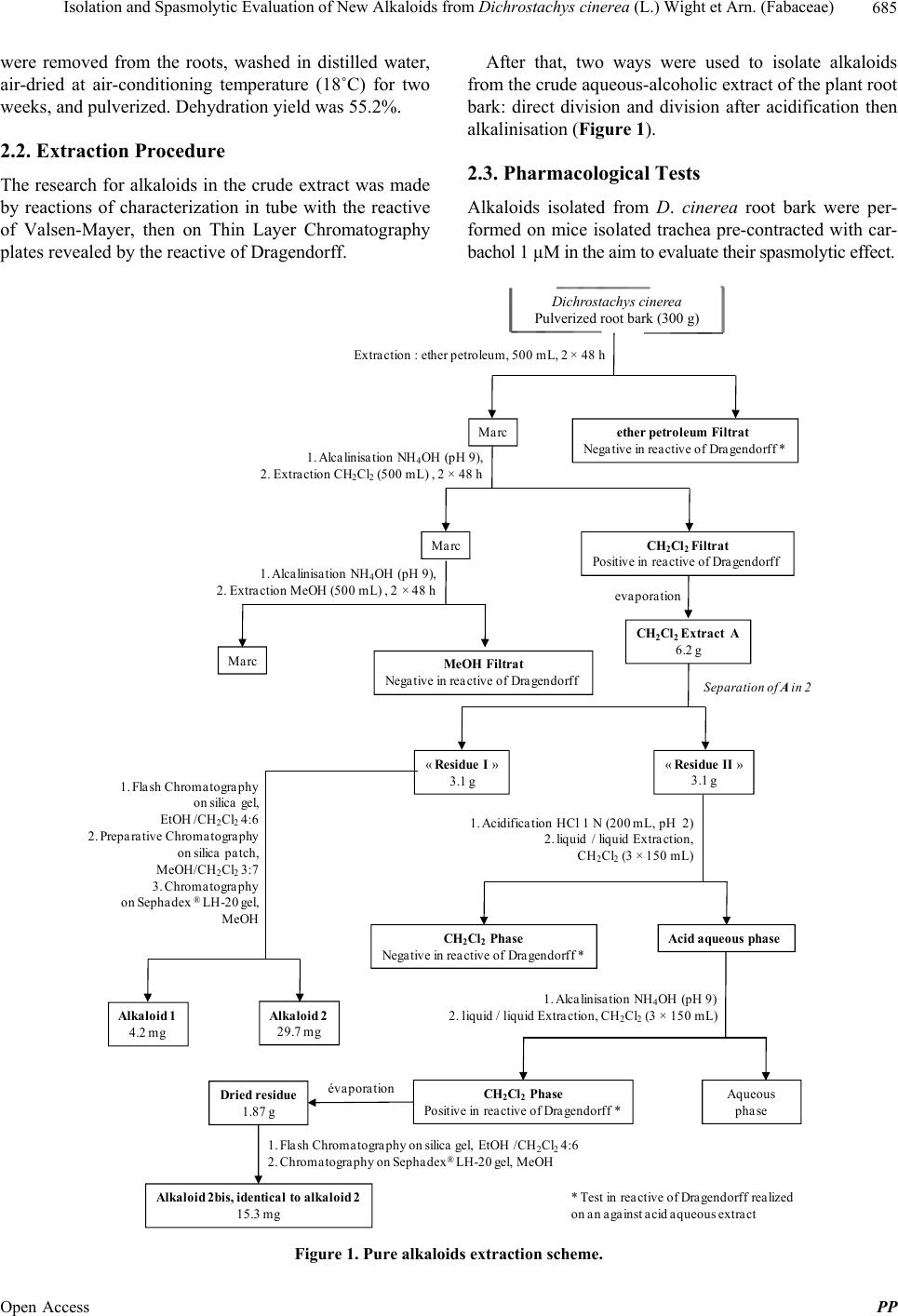 Isolation and Spasmolytic Evaluation of New Alkaloids from Dichrostachys cinerea (L.) Wight et Arn. (Fabaceae) 685 were removed from the roots, washed in distilled water, air-dried at air-conditioning temperature (18˚C) for two weeks, and pulverized. Dehydration yield was 55.2%. 2.2. Extraction Procedure The research for alkaloids in the crude extract was made by reactions of characterization in tube with the reactive of Valsen-Mayer, then on Thin Layer Chromatography plates revealed by the reactive of Dragendorff. After that, two ways were used to isolate alkaloids from the crude aqueous-alcoholic extract of the plant root bark: direct division and division after acidification then alkalinisation (Figure 1). 2.3. Pharmacological Tests Alkaloids isolated from D. cinerea root bark were per- formed on mice isolated trachea pre-contracted with car- bachol 1 µM in the aim to evaluate their spasmolytic effect. Extraction : ether petroleum, 500 mL, 2 × 48 h ether petroleum Filtrat Negative in reactive of Dragendorff * Marc CH 2 Cl 2 Filtra t Positive in reactive of Dragendorff Marc 1. Alca linisa tion NH 4 OH (pH 9), 2. Extraction CH 2 Cl 2 (500 mL) , 2 × 48 h 1. Alca linisa tion NH 4 OH (pH 9), 2. Extraction MeOH (500 mL) , 2 × 48 h MeOH Filtrat Negative in reactive of Dragendorff Marc CH 2 Cl 2 Extract A 6.2 g «Residue II » 3.1 g «Residue I » 3.1 g Separation of Ain 2 1. Flash Chromatography on silica gel, EtOH /CH 2 Cl 2 4:6 2. Preparative Chromatography on silica pa tch, MeOH/CH 2 Cl 2 3:7 3. Chromatography on Sephadex ® LH-20 gel, MeOH Alkaloid 2 29.7 mg Alkaloid 1 4.2 mg 1. Acidification HCl 1 N (200 mL, pH 2) 2. liquid / liquid Extraction, CH 2 Cl 2 (3 ×150 mL) Acid aqueous phase CH 2 Cl 2 Phase Negative in reactive of Dragendorff * 1. Alca linisa tion NH 4 OH (pH 9) 2. liquid / liquid Extraction, CH 2 Cl 2 (3 × 150 mL) Aqueous phase CH 2 Cl 2 Phase Positive in reactive of Dragendorff * Dried residue 1.87 g Alkaloid 2bis, identical to alkaloid 2 15.3 mg 1. Flash Chromatography on silica gel, EtOH /CH 2 Cl 2 4:6 2. Chromatography on Sephadex ® LH-20 gel, MeOH * Test in reactive of Dragendorff realized on an against acid aqueous extract evaporation évaporation Dichrostachys cinerea Pulverized root bark (300 g) Figure 1. Pure alkaloids extraction scheme. Open Access PP 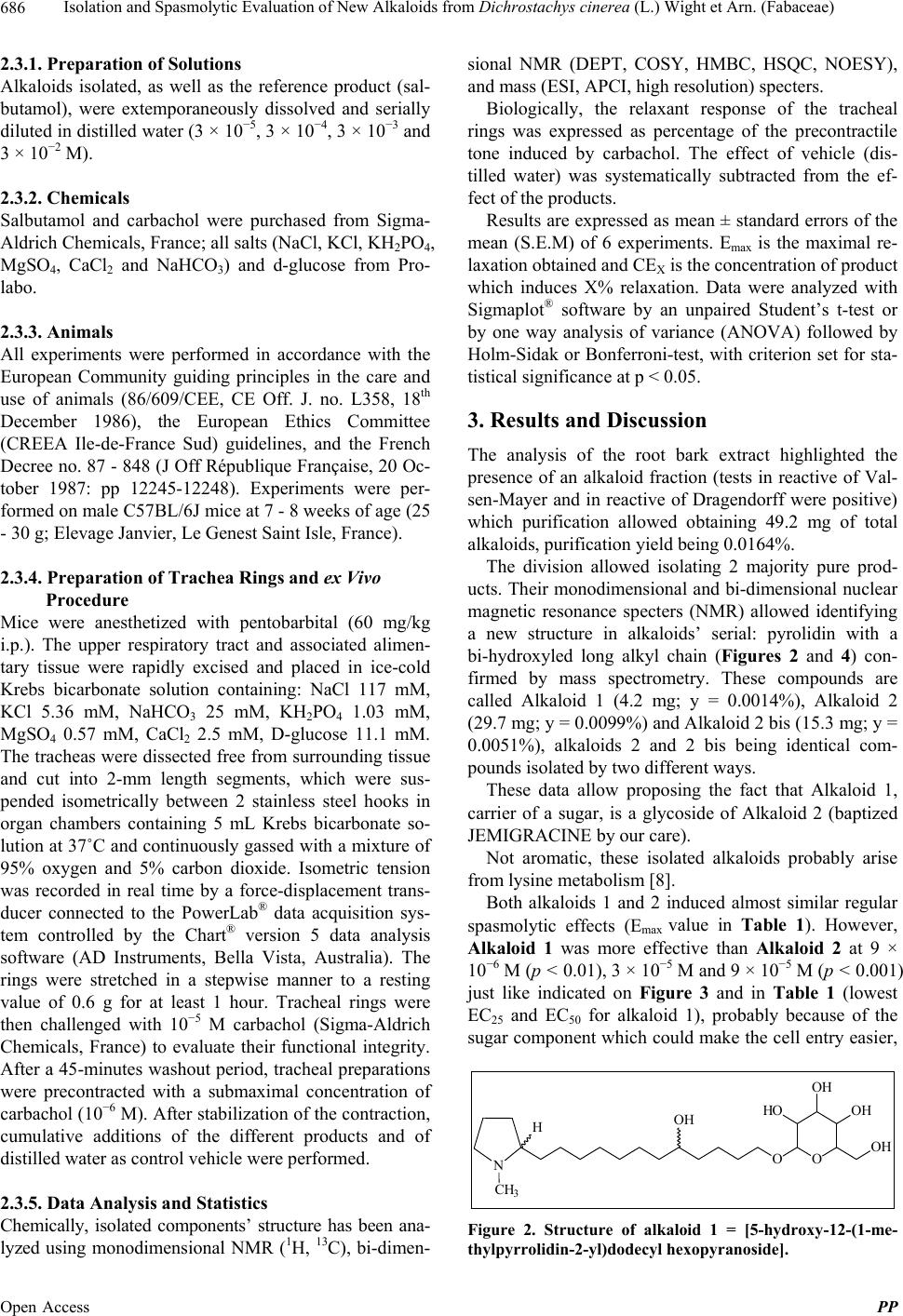 Isolation and Spasmolytic Evaluation of New Alkaloids from Dichrostachys cinerea (L.) Wight et Arn. (Fabaceae) 686 2.3.1. Preparation of Solutions Alkaloids isolated, as well as the reference product (sal- butamol), were extemporaneously dissolved and serially diluted in distilled water (3 × 10⁻⁵, 3 × 10⁻⁴, 3 × 10⁻³ and 3 × 10⁻² M). 2.3.2. Chemicals Salbutamol and carbachol were purchased from Sigma- Aldrich Chemicals, France; all salts (NaCl, KCl, KH2PO4, MgSO4, CaCl2 and NaHCO3) and d-glucose from Pro- labo. 2.3.3. Animals All experiments were performed in accordance with the European Community guiding principles in the care and use of animals (86/609/CEE, CE Off. J. no. L358, 18th December 1986), the European Ethics Committee (CREEA Ile-de-France Sud) guidelines, and the French Decree no. 87 - 848 (J Off République Française, 20 Oc- tober 1987: pp 12245-12248). Experiments were per- formed on male C57BL/6J mice at 7 - 8 weeks of age (25 - 30 g; Elevage Janvier, Le Genest Saint Isle, France). 2.3.4. Preparation of Trachea Rings and ex Vivo Procedure Mice were anesthetized with pentobarbital (60 mg/kg i.p.). The upper respiratory tract and associated alimen- tary tissue were rapidly excised and placed in ice-cold Krebs bicarbonate solution containing: NaCl 117 mM, KCl 5.36 mM, NaHCO3 25 mM, KH2PO4 1.03 mM, MgSO4 0.57 mM, CaCl2 2.5 mM, D-glucose 11.1 mM. The tracheas were dissected free from surrounding tissue and cut into 2-mm length segments, which were sus- pended isometrically between 2 stainless steel hooks in organ chambers containing 5 mL Krebs bicarbonate so- lution at 37˚C and continuously gassed with a mixture of 95% oxygen and 5% carbon dioxide. Isometric tension was recorded in real time by a force-displacement trans- ducer connected to the PowerLab® data acquisition sys- tem controlled by the Chart® version 5 data analysis software (AD Instruments, Bella Vista, Australia). The rings were stretched in a stepwise manner to a resting value of 0.6 g for at least 1 hour. Tracheal rings were then challenged with 10−5 M carbachol (Sigma-Aldrich Chemicals, France) to evaluate their functional integrity. After a 45-minutes washout period, tracheal preparations were precontracted with a submaximal concentration of carbachol (10−6 M). After stabilization of the contraction, cumulative additions of the different products and of distilled water as control vehicle were performed. 2.3.5. Data Analysis and Statistics Chemically, isolated components’ structure has been ana- lyzed using monodimensional NMR (1H, 13C), bi-dimen- sional NMR (DEPT, COSY, HMBC, HSQC, NOESY), and mass (ESI, APCI, high resolution) specters. Biologically, the relaxant response of the tracheal rings was expressed as percentage of the precontractile tone induced by carbachol. The effect of vehicle (dis- tilled water) was systematically subtracted from the ef- fect of the products. Results are expressed as mean ± standard errors of the mean (S.E.M) of 6 experiments. Emax is the maximal re- laxation obtained and CEX is the concentration of product which induces X% relaxation. Data were analyzed with Sigmaplot® software by an unpaired Student’s t-test or by one way analysis of variance (ANOVA) followed by Holm-Sidak or Bonferroni-test, with criterion set for sta- tistical significance at p < 0.05. 3. Results and Discussion The analysis of the root bark extract highlighted the presence of an alkaloid fraction (tests in reactive of Val- sen-Mayer and in reactive of Dragendorff were positive) which purification allowed obtaining 49.2 mg of total alkaloids, purification yield being 0.0164%. The division allowed isolating 2 majority pure prod- ucts. Their monodimensional and bi-dimensional nuclear magnetic resonance specters (NMR) allowed identifying a new structure in alkaloids’ serial: pyrolidin with a bi-hydroxyled long alkyl chain (Figures 2 and 4) con- firmed by mass spectrometry. These compounds are called Alkaloid 1 (4.2 mg; y = 0.0014%), Alkaloid 2 (29.7 mg; y = 0.0099%) and Alkaloid 2 bis (15.3 mg; y = 0.0051%), alkaloids 2 and 2 bis being identical com- pounds isolated by two different ways. These data allow proposing the fact that Alkaloid 1, carrier of a sugar, is a glycoside of Alkaloid 2 (baptized JEMIGRACINE by our care). Not aromatic, these isolated alkaloids probably arise from lysine metabolism [8]. Both alkaloids 1 and 2 induced almost similar regular spasmolytic effects (Emax value in Table 1). However, Alkaloid 1 was more effective than Alkaloid 2 at 9 × 10⁻⁶ M (p ˂ 0.01), 3 × 10⁻⁵ M and 9 × 10⁻⁵ M (p ˂ 0.001) just like indicated on Figure 3 and in Table 1 (lowest EC25 and EC50 for alkaloid 1), probably because of the sugar component which could make the cell entry easier, NO CH3 OOH OH OH HO OH H Figure 2. Structure of alkaloid 1 = [5-hydroxy-12-(1-me- thylpyrrolidin-2-yl)dodecyl hexopyranoside]. Open Access PP 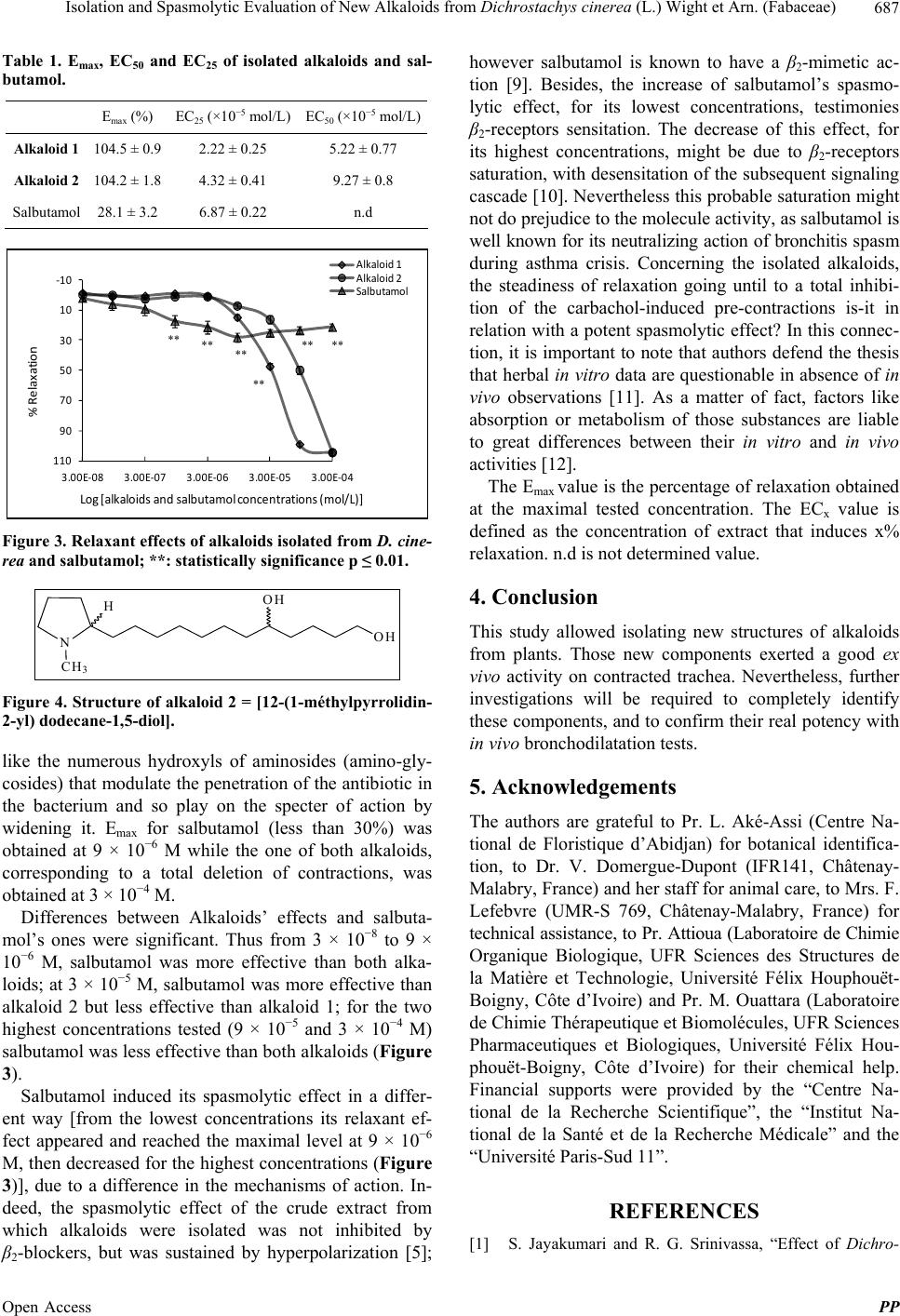 Isolation and Spasmolytic Evaluation of New Alkaloids from Dichrostachys cinerea (L.) Wight et Arn. (Fabaceae) 687 Table 1. Emax, EC50 and EC25 of isolated alkaloids and sal- butamol. E max (%) EC25 (×10−5 mol/L) EC50 (×10−5 mol/L) Alkaloid 1 104.5 ± 0.9 2.22 ± 0.25 5.22 ± 0.77 Alkaloid 2 104.2 ± 1.8 4.32 ± 0.41 9.27 ± 0.8 Salbutamol 28.1 ± 3.2 6.87 ± 0.22 n.d ‐10 10 30 50 70 90 110 3,00E‐08 3,00E‐07 3,00E‐06 3,00E‐05 3,00E‐04 Alkaloid1 Alkaloid2 Salbutamol %Relaxation Log [alkaloidsandsalbutamol concentrations(mol/L)] ** ** ** ** ** ** Figure 3. Relaxant effects of alkaloids isolated from D. cine- rea and salbutamol; **: statistically significance p ≤ 0.01. NOH CH3 OH H Figure 4. Structure of alkaloid 2 = [12-(1-méthylpyrrolidin- 2-yl) dodecane-1,5-diol]. like the numerous hydroxyls of aminosides (amino-gly- cosides) that modulate the penetration of the antibiotic in the bacterium and so play on the specter of action by widening it. Emax for salbutamol (less than 30%) was obtained at 9 × 10⁻⁶ M while the one of both alkaloids, corresponding to a total deletion of contractions, was obtained at 3 × 10⁻⁴ M. Differences between Alkaloids’ effects and salbuta- mol’s ones were significant. Thus from 3 × 10⁻⁸ to 9 × 10⁻⁶ M, salbutamol was more effective than both alka- loids; at 3 × 10⁻⁵ M, salbutamol was more effective than alkaloid 2 but less effective than alkaloid 1; for the two highest concentrations tested (9 × 10⁻⁵ and 3 × 10⁻⁴ M) salbutamol was less effective than both alkaloids (Figure 3). Salbutamol induced its spasmolytic effect in a differ- ent way [from the lowest concentrations its relaxant ef- fect appeared and reached the maximal level at 9 × 10⁻⁶ M, then decreased for the highest concentrations (Figure 3)], due to a difference in the mechanisms of action. In- deed, the spasmolytic effect of the crude extract from which alkaloids were isolated was not inhibited by β2-blockers, but was sustained by hyperpolarization [5]; however salbutamol is known to have a β2-mimetic ac- tion [9]. Besides, the increase of salbutamol’s spasmo- lytic effect, for its lowest concentrations, testimonies β2-receptors sensitation. The decrease of this effect, for its highest concentrations, might be due to β2-receptors saturation, with desensitation of the subsequent signaling cascade [10]. Nevertheless this probable saturation might not do prejudice to the molecule activity, as salbutamol is well known for its neutralizing action of bronchitis spasm during asthma crisis. Concerning the isolated alkaloids, the steadiness of relaxation going until to a total inhibi- tion of the carbachol-induced pre-contractions is-it in relation with a potent spasmolytic effect? In this connec- tion, it is important to note that authors defend the thesis that herbal in vitro data are questionable in absence of in vivo observations [11]. As a matter of fact, factors like absorption or metabolism of those substances are liable to great differences between their in vitro and in vivo activities [12]. The Emax value is the percentage of relaxation obtained at the maximal tested concentration. The ECx value is defined as the concentration of extract that induces x% relaxation. n.d is not determined value. 4. Conclusion This study allowed isolating new structures of alkaloids from plants. Those new components exerted a good ex vivo activity on contracted trachea. Nevertheless, further investigations will be required to completely identify these components, and to confirm their real potency with in vivo bronchodilatation tests. 5. Acknowledgements The authors are grateful to Pr. L. Aké-Assi (Centre Na- tional de Floristique d’Abidjan) for botanical identifica- tion, to Dr. V. Domergue-Dupont (IFR141, Châtenay- Malabry, France) and her staff for animal care, to Mrs. F. Lefebvre (UMR-S 769, Châtenay-Malabry, France) for technical assistance, to Pr. Attioua (Laboratoire de Chimie Organique Biologique, UFR Sciences des Structures de la Matière et Technologie, Université Félix Houphouët- Boigny, Côte d’Ivoire) and Pr. M. Ouattara (Laboratoire de Chimie Thérapeutique et Biomolécules, UFR Sciences Pharmaceutiques et Biologiques, Université Félix Hou- phouët-Boigny, Côte d’Ivoire) for their chemical help. Financial supports were provided by the “Centre Na- tional de la Recherche Scientifique”, the “Institut Na- tional de la Santé et de la Recherche Médicale” and the “Université Paris-Sud 11”. REFERENCES [1] S. Jayakumari and R. G. Srinivassa, “Effect of Dichro- Open Access PP  Isolation and Spasmolytic Evaluation of New Alkaloids from Dichrostachys cinerea (L.) Wight et Arn. (Fabaceae) Open Access PP 688 stachys cinerea (Linn.) Root Extract on Ethylene Glycol Induced Urolithiasis in Rats,” Natural Product Sciences, Vol. 13, No. 3, 2007, pp. 180-185. [2] E. J. Adjanohoun, A. M. R. Ahyi and L. Aké-Assi, “Médecine Traditionnelle et Pharmacopée: Contribution aux Etudes Ethnobotaniques et Floristiques au Togo,” Agence de Coopération Culturelle et Technique, Paris, 1986. [3] E. J. Adjanohoun and L. Aké-Assi, “Contribution au Re- censement des Plantes Médicinales de Côte d’Ivoire,” Centre National de Floristique, Côte d’Ivoire, 1979. [4] D. Ramanitrahasimbola, D. A. Rakotondramanana, P. Rasoanaivo, A. Randriantsoa, S. Ratsimamanga, G. Palaz- zino, C. Galeffi and M. Nicoletti, “Bronchodilatator Acti- vity of Phymatodes scolopendria (Burm.) Ching and Its Bioactive Constituents,” Journal of Ethnopharmacology, Vol. 102, No. 3, 2005, pp. 400-407. http://dx.doi.org/10.1016/j.jep.2005.06.037 [5] G. Irié-N’guessan, P. Champy, G. Kouakou-Siransy, A. Koffi, B. J. Kablan and V. Leblais, “Tracheal Relaxation of Five Ivorian Anti-Asthmatic Plants: Role of Epithe- lium and K+ Channels in the Effect of the Aqueous-Al- coholic Extract of Dichrostachys cinerea Root Bark,” Journal of Ethnopharmacology, Vol. 138, No. 2, 2011, pp. 432-438. http://dx.doi.org/10.1016/j.jep.2011.09.016 [6] B. A. Da Silva, A. P. De Araújo Filho, R. Mukherjee and A. Chiappeta, “Bisnordihydrotoxiferine and Vellosimine from Strychnos divaricans Root: Spasmolytic Properties of Bisnordihydrotoxiferine,” Phytotherapy Research, Vol. 7, No. 6, 1993, pp. 419-424. http://dx.doi.org/10.1002/ptr.2650070607 [7] C. C. Shi, J. F. Liao and C. F. Chen, “Spasmolytic Effects of Three Harmala Alkaloids on Guinea-Pig Isolated Tra- chea,” Pharmacology & Toxicology, Vol. 89, No. 5, 2001, pp. 259-264. http://dx.doi.org/10.1034/j.1600-0773.2001.d01-157.x [8] J. Bruneton, “Pharmacognosie: Phytochimie, Plantes Médi- cinales,”Tec & Doc Lavoisier, Lavoisier, 2009. [9] J. Garssen, H. Van Loveren, H. Van der Vliet and F. P. Nijkamp, “An Isometric Method to Study Respiratory Smooth Muscle Responses in Mice,” Journal of Phar- macological Methods, Vol. 24, 1990, pp. 209-217. http://dx.doi.org/10.1016/0160-5402(90)90031-F [10] S. A. Shore and P. E. Moore, “Regulation of β-Adrener- gic responses in Airway Smooth Muscle,” Respiratory Physiology & Neurobiology, Vol. 137, No. 2-3, 2003, pp. 179-195. http://dx.doi.org/10.1016/S1569-9048(03)00146-0 [11] N. R. Farnsworth, O. Akerele, A. S. Bingel, D. D. Soejarto and Z. Guo, “Place des Plantes Médicinales dans la Thé- rapeutique,” Bulletin de l’Oganisation Mondiale de la Santé, Vol. 64, No. 2, 1986, pp. 159-175. [12] P. J. Houghton, M.-J. Howesb, C. C. Lee and G. Steven- ton, “Uses and Abuses of in Vitro Tests in Ethnopharma- cology: Visualizing an Elephant,” Journal of Ethnophar- macology, Vol. 110, No. 3, 2007, pp. 391-400. http://dx.doi.org/10.1016/j.jep.2007.01.032 |