

Paper Menu >>
Journal Menu >>
 Advances in Biological Chemistry, 2013, 3, 549-552 ABC http://dx.doi.org/10.4236/abc.2013.36062 Published Online December 2013 (http://www.scirp.org/journal/abc/) A preliminary effort to assign sponge (Callispongia sp) as trace metal biomonitor for Pb, Cd, Zn, and Cr, an environmental perspective in Hative gulf waters Ambon Netty Siahaya1*, Alfian Noor2, Nunuk Sukamto2, Nicole de Voogd3 1Department of Chemistry, Pattimura University Kampus Poka-Unpatti, Ambon, Indonesia 2Department of Chemistry, Hasanuddin University Kampus UNHAS Tamalanrea, Makassar, Indonesia 3Netherlands Center for Biodiversity Naturalis, Leiden, The Netherlands Email: *[email protected] Received 4 November 2013; revised 5 December 2013; accepted 16 December 2013 Copyright © 2013 Netty Siahaya et al. This is an open access article distributed under the Creative Commons Attribution License, which permits unrestricted use, distribution, and reproduction in any medium, provided the original work is properly cited. ABSTRACT The aim of this investigation is to estimate metal con- centration distribution, Pb, Cd, Zn, and Cr, in Cal- lispongia sp, sediment, and water column in Hative waters of Ambon bay. After sampling, analytical pro- cesses were conducted by using a standard method and measured by ICP-OES (Inductively Coupled Plas- ma Optical Emission Spectroscopy). The results show- ed that Zn concentration was highest, 0.231 mg/kg dry weight (ppm) while in sediment and water the numbers were 1.180 and 0.790 ppm respectively. In the meantime, functional group studies through Fou- rier Transformed Infra Red spectroscopy revealed that OH-group (3421 cm−1), Conjugated Double Bond (1635 cm−1) and Ether Groups (1049 cm−1) of callis- pongia sp were found. Also, the appearance of wave- number 2926 cm−1 clearly indicates the existence of –CH sp3 group. Combining both results may guide us to establish a relation between metal concentration and organic substance transformation made during inter- action inside species. Thus, trace metal investigation can be a choice in doing rapid assessment and bio- monitor for the quality of coastal marine life. Fur- thermore, by more extensive studies, this connection could be developed and proposed as a low cost meth- od for EIA of metal pollution in coastal zone, particu- larly in coral reef system. Keywords: Callyspongia sp; ICP-OES; FTIR; Metal Distribution 1. INTRODUCTION The capital of Maluku province is surrounded by Ambon waters in the area about 187 thousand square kilometers, 17% slope, and relatively rugged land area. Its land use will have an impact on the ecological pressures to Ambon Bay waters [1]. Ambon Bay waters have multiple functions, namely as a regional fisheries and aquaculture, police seaport and Navy bases, PELNI ship port, and out of the traditional boats Ambon and ferry crossing pier, fishing port, Pertamina, ship repair dock space, recreation areas and sports, and electric power by PLN, so that the waters of Ambon Bay are very susceptible to environmental changes because each activity will produce many metal wastes. Island of Ambon is encircled by fringing type coral reefs which grow lengthwise along the shoreline on the north and south bay [2]. It is generally recognized that sponges are the animals that always associated with coral reefs. Sponges, in feeding, rely mostly on a constant flow of waters bringing its dissolved organic matters as well as particulate non organics such as metal associated compounds. The sponges also have long been a center of attention from scientists in different countries to look at the possibility using them as metal bioindicator due to its capacity to accumulate metals [3-6] without sacrificing its growth and survival rate. Copper, lead, and vanadium have been studied and showed a sponge capacity in absorbing them in high concentration [4]. Also, Petrossian tertudinaria species have been used as a biomarker for the detection of heavy metals in inshore areas (0.5 - 1 km) and offshore (5 - 7 km) in the Gulf of Mannar, India. In fact, sponge heavy metal concentration of inshore was about 64 times higher than the offshore [3]. The ability to accumulate heavy metals in the sponge is very important to be known as one of the guidelines in determining the status of water pollution in an area that has a coral reef ecosystem, in which the region is the *Corresponding author. OPEN ACCESS N. Siahaya et al. / Advances in Biological Chemistry 3 (2013) 549-552 550 habitat of a living sponge. This is in line with the opinions [3,4,9] that the metal content in aquatic biota generally increases over time because the metal is ex- pected, so the presence of a sponge in water Hative cycle can be used to determine the heavy metals Pb, Cd , Cr, and Zn in the sponge type callispongia sp, sediments and water in the waters Hative Ambon bay. 2. MATERIALS AND METHODS Research materials are: sponges from Hative waters in Ambon bay; Acetone (Merck), HNO3 (p.A), double dis- tilled water and Whatman filter paper. Sponge samples were collected by diving, cleaned and then placed in a plastic bag and put in the ice box. 0.5 grams of sample was put in beaker glass, add 5 mL HNO3 and then heated at 150˚C for 2 hours. After being cooled at room tem- perature, sample put in 25 mL volumetric flask, match the volume with double distilled water and filtered with Whatman paper and solution is ready to be analyzed by ICP-OES Perkin Elmer 3000. One litre of water sample was taken at the bottom, and immediately filtered with filter paper of cellulose nitrate (0.45 μ) after previously washed with 1N HNO3 and then preserved in HNO3 5%. 250 ml water sample is inserted in a Teflon separating funnel, then extracted with APDC- NaDDC/MIBK. The organic phase was extracted again with 5% HNO3 solu- tion, filtered back, and ready for analysis by ICP-OES Perkin Elmer 3000. For sediments, they were taken from the bottom with a Van Veen Grab sampler, stored in polyethylene bottles and taken in laboratory put in a Teflon beaker and dried in an oven at a temperature of 105˚C and after drying, rinsed 3 times with double distilled water then dried again. A total of 5 g sample was destructed in Teflon beaker with solution of HNO3/HCl (1:3) at 100˚C for 8 hours. After that, the solution was filtered, and the fil- trate is ready to be analyzed by ICP-OES Perkin 3000. 3. RESULTS AND DISCUSSION 3.1. General Situation of Sampling Locations Sampling was conducted on July 4, 2011, about noon under cloudy weather in Hative waters (Figure 1) sur- rounded by population settlement, estuaries, navy com- plex, harbour, oil depot of Pertamina, and sago plantation. Callispongia sp, ca 50 grams were taken under physico- chemical as shown in Table 1. The data clearly shows that its water quality fits with environmental conditions in general where sponges grow in tropical and sub- tropical conditions with vertical distribution on coral reefs at low tide up into the area of approximately 50 meters [6]. Also, water content, ash, and biomass of Cal- lispongia sp, represent an integral part of metal content in a biological sample [9]. Accumulation of Pb, Cd, Cr and Zn Callispongia sp can be seen in Table 2 as a function of organ as skeleton and tissue. Also determined were water and sediment around sponge. Logically before entering into cellular level of sponge, metals will be firstly existed in water and sediment It seems obvious that each element shows a different partitional pattern where cadmium as the least amount remain largely in sediment (86.4 %). Oppositely, chromium was almost all adsorbed by cellular sponge. It was also clear that majority of elements have stayed in cellular level. As for zinc as an essential element, its highest con- centration revealed that the source might not only come from industrial by products but also from excretion of living system in marine environment. So the total zinc in this Callispongia sp apparently not an abnormal case especially if one looks at a fraction remaining in sedi- ment (54.1%) and consumption level of skeleton and tissue on zinc. Generally the highest metal concentration in sediments is influenced by several processes like sedimentation, flocculation, precipitation, and adsorption [5,6]. Another important parameter is bioconcentration factor (BCF) in measuring the capability of organisms to accumulate metals from environment into its tissue. Ac- cording to Abdullah et al. 2007, BCF can be estimated by comparing metal absorption between in sponge tissue and in water (BCF sw) or sediment (BCF ss). The ability of organisms to accumulate metals from the environment into the tissues of the body can be cal- culated using the bioconcentration factor (BCF). BCF value can be obtained by comparing the ability of organ- isms (e.g. sponges) to absorbsi metals from water and sediment. Therefore there are two BCF values, BCF sponge-sediment (BCFs-s) and BCF-water sponge (BCFs- w). BCFs-s is the value of the ratio between the concen- tration of the metal absorbed into the sponge tissue with metal concentrations in the sediment, while the BCF sw is the value of the ratio between the concentration of metal that accumulates into the sponge tissue metal con- centrations in water [8] as found in table-3 below. From the result in Table 3 one can find the highest value for BCF is Cr either in water or in sediment. and this indicated that for the case of the location and sponge, Cr is the most appropriate element to be assigned as a bioindicator or biomonitor for Callispongia sp compared to other metals. Some results from several investigations have used the same method [4,5,7]. To assess the possible chemical bonding occurs be- tween organic molecules in sponge and metal, an FTIR analysis was carried out to look at the key functional groups that may link to bond formation with metals. FTIR spectrum of Callispongia sp sample can be seen in Figure 2. According to Terada et al. (1983) the interactions that Copyright © 2013 SciRes. OPEN ACCESS 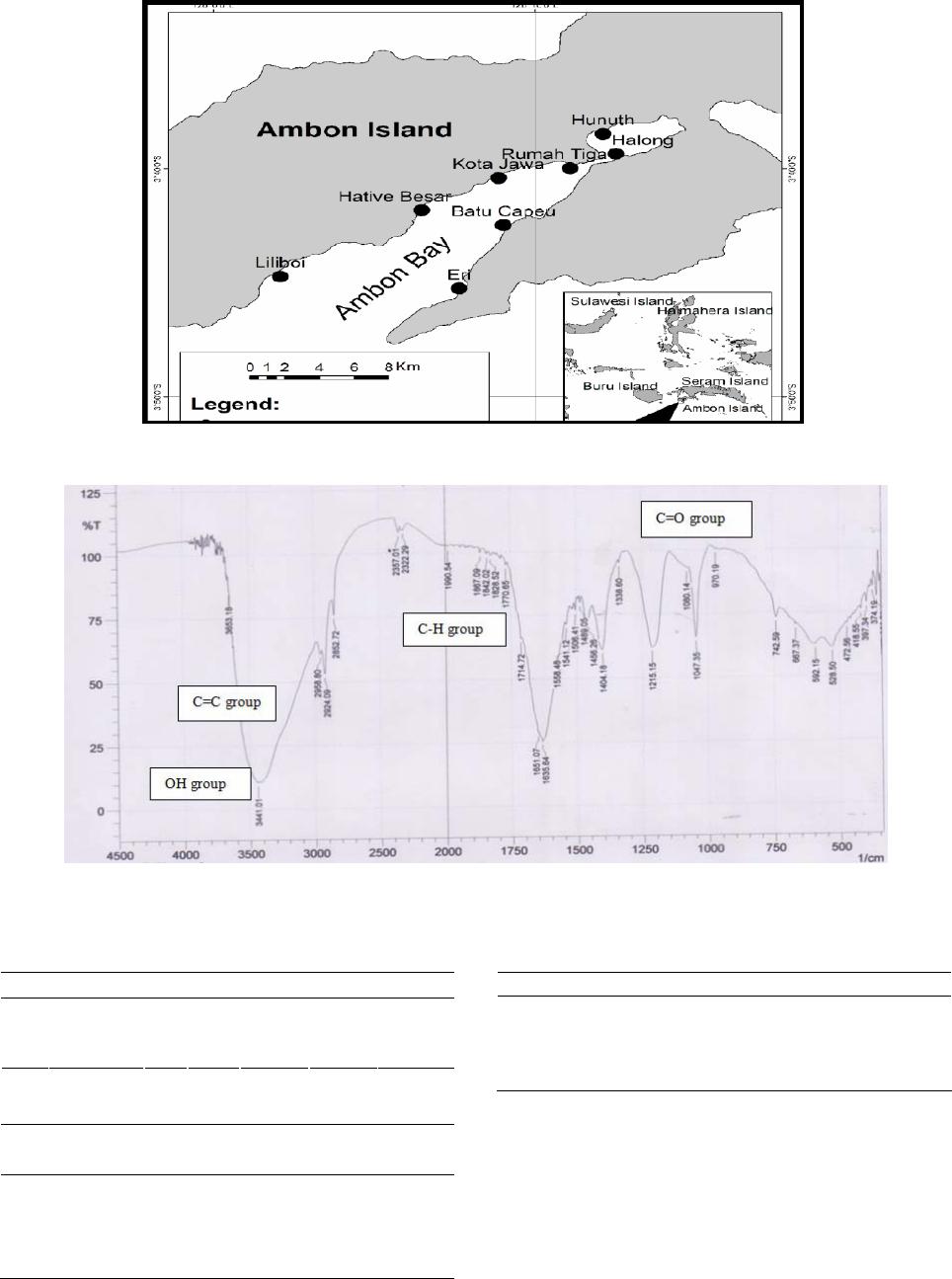 N. Siahaya et al. / Advances in Biological Chemistry 3 (2013) 549-552 Copyright © 2013 SciRes. 551 Figure 1. Sampling location is in the waters of Hative Besar municipal. Figure 2. Fourier Transformed Infra Red (FTIR) spectrum of Callispongia sp tissue sample. Table 1. Physicochemical conditions in Hative and sponge Callispongia sp. Table 3. BCF s-s and BCF sw of Pb, Cd, Zn, & Cr calculated from Callispongia sp. Site Waters conditions Content (%) Temperature (˚C) pH Salinity (0/00) Water Ash Biomass Hative 28 6.8 30 78.74 87.00 16.90 Metal BCF ss BCF sw Pb 0.32 0.41 Cd 0.52 10.0 Zn 0.09 0.13 Cr 262.0 262.0 Table 2. Metal content (ppm) in the sponge Callispongia sp. Metal Total Skeleton + Tissue Skeleton Tissue WatersSediment Pb 0.039 0.008 0.031 0.0750.098 Cd 0.012 0.002 0.01 0.0010.019 Zn 0.213 0.109 0.104 0.7901.180 Cr 0.280 0.018 0.262 0.0010.001 have occured between active functional groups of orga- nic molecules can be described as the behaviour of Lewis acid-base interaction to form a complex chemical struc- ture. In case of metal adsorption in a solution system, these reactions may be generalized as follow : GH MZGM1HZ (1) OPEN ACCESS  N. Siahaya et al. / Advances in Biological Chemistry 3 (2013) 549-552 552 2 2GH MZGM22HZ (2) 3.2. Where GH Is a Functional Group and M Is a Divalent Metal Ion Z The FTIR results showed that functional groups found in Callispongia sp are OH (3421 cm−1), the group of conjugated double bonds (1635 cm−1), and ether groups (1049 cm−1). While the wave number 2926 cm−1 region of the spectrum shows the possibilities that come from sp3 CH orbital. These are functional groups that have possibility to bind metals thus potential active groups to catch metals. 4. CONCLUSION It can be concluded that Callispongia sp may be assigned as a pollutant indicator for metal especially element chro- mium which is very toxic in certain forms and valences. A further investigation will be needed to explore sponge potential as the metal pollution bioindicator in approp- riate locations particularly in eastern island littoral re- gions where coral reef is found predominantly. REFERENCES [1] Pelasula, “Preliminary Studies of Ambon Bay Ecosys- tem,” Journal of Marine Fisheries, LON-LIPI, Vol. 14, No. 53, 2009. [2] Leatemia, “Kajian Asal Muasal Terumbu Karang Teluk Ambon,” Jurnal Osenologi, Vol. 7, No. 14, 1996. [3] Hansen, Andrew and Forester, “The Association between the Sponge Halichondria panacea (pallas) and Scallop chlamys varza: A Commensal-Protective Mutualism,” Jour- nal Marine Ecology Biology, Vol. 36, No. 120, 1995, pp. 1- 10. [4] Ceberean, J. Bremer, S. J. Rogers and C. L. J. Frid, “As- sesing Functional Diversity in Marine Benthic Ecosys- tems,” Journal Marine Ecology Progress, Vol. 76, No. 328, 2003, pp. 11-25. [5] Olsen and Weeks, “The Ecology Sponges at Lough Hyne Marine Natural Reserve,” PhD Thesis, University Col- lege Cork, Ireland, 1994. [6] Pattel and J. J. Bell, “Contrasting Patterns of Species and Functional Composition for Coral Reef Sponge Assem- blages,” Marine Ecology Progress, Vol. 20, No. 201, 1985, pp. 73-81. [7] Perez, J. J. Bell and D. Smith, “Ecology of Sponges in the Wakatobi Region, South-Eastern Sulawesi-Indonesia: Richness and Abudance,” Journal of Marine Biological Associations Kingdom, Vol. 113, No. 50, 2005, pp. 1199- 1208. [8] Darmono, “Logam Dalam Sistem Lingkungan Hidup,” Universitas Indonesia, Jakarta, 1995. [9] H. A. W. Cappenberg, “Galore and Diversity of Mega- bentos in the Waters of the Ambon Bay,” LON LIPI, Indonesian Oceanological Center, 2011. Copyright © 2013 SciRes. OPEN ACCESS |