

Paper Menu >>
Journal Menu >>
 Engineering, 2013, 5, 467-471 http://dx.doi.org/10.4236/eng.2013.510B096 Published Online October 2013 (http://www.scirp.org/journal/eng) Copyright © 2013 SciRes. ENG Screening and Fermentation Characteristics of PHA Bacteria in Activated Sludge* Yang Fang, Zhu Rui Hebei Electric Power Design & Research Institute, Hebei, China Email: z hurui [email protected], [email protected] Received 2013 Abstract Using sludge at the bottom of Hengshui Lake as samples, and screened out the SJ-9 strain with PHA synthesis capa- bility by enrichment, purification, Nile blue staining, far-infrared spectroscopy and gas qualitative and quantitative analysis. The infrared scanning of SJ-9 bacteria product showed that this product was middle chain PHA. Optimization of SJ-9 fermentation conditions obtained the optimal conditions with optimal carbon source of sodium butyrate, optimal C/N of 35, optimal fermentation time of 120 h, and op timal initial pH for cultur e substrate of 7.0. 10 L fermenter ampli- fication culture under these conditions showed consistent results with flask culture, and the bacteria and PHA had the highest yields at 120 h, with the maximal yields of 6.81 and 2.36 g/L, respectively. Keywords: PHA; Screening; Infrared Spectroscopy 1. Introduction Facing the constantly increasing threat of oil resource de- pletion and environmental pollution in the past two dec- ades, PHA (poly-hydroxy fatty acid esters) has attracted more and more attention because it can be completely biodegraded an d can be used to synthesize renewable re- sources [1]. It is considered to be environmentally friend- ly “biodegradable plastic”. With more and more in-depth understanding of PHA, its application has been devel- oped. For example, it can be used to make thermal-sen- sitive adhesive, pressure-sensitive adhesive and hydrosol, can be pulled into a fiber, and can be used as medical im- plant materials on the basis of its biodegradable and bio- compatible characteristics. Biosynthesis of PHA is a complex process catalyzed by a variety of enzymes and controlled by different me- tabolic pathways. Thus, biological synthesis of PHA has low yield and high cost. How to improve PHA yield and reduce PHA production cost are still key for its devel- opment and application. This study aimed to use acti- vated sludge screening to obtain strains with high PHA yield and study the fermentation characteristics of PHA- producing strains to increase PHA yield, reduce PHA production cost, and to further expand the development and applicatio n of PHA and benefit mankind. 2. Materials and Methods 2.1. Materials 2.1.1. Screening Sample 1) Experimental activated sludge was from the bottom of Hengshui Lake. 2) PHA standard was purchased from National Refer- ence Materials website. 2.1.2. Medium 1) Enrichment medium (g/100 mL) Peptone 1, Beef extract 0.5, and NaCl 1.5. 2) Isolation and enrichment medium (g/100 mL) Beef extract 0.3, Peptone 1, NaCl 1.5, Agar 1.5, and Nile blue dye 0.5 μg/100 mL, pH 7. 3) Liquid medium (g/L) Glucose 30.0, Yeast extract 6.0, (NH4)2SO4 1.0, Au- tomatic pH. 2.1.3. Experimental Methods 1) Enrichment and Purification of Targe t Bacteria 5 g sample (From sludge at Hengshui Lake bottom) was added to 500 mL flask containing 150 mL enrich- ment medium, and cultured in shaking incubator at 30˚C for 24 h. 0.1 mL enrichment fluid was diluted by with sterile water to 10−1, 10−2, 10−3, 10−4, and 10−5, coated respectively, and incubated at 30˚C for 24 h. Single co- lonies were picked for purification culture in beef extract peptone slant medium at 30˚C for 24 h. The growth of *Fund Projects: Science& Technology of Hebei (Serial number: 10215522). 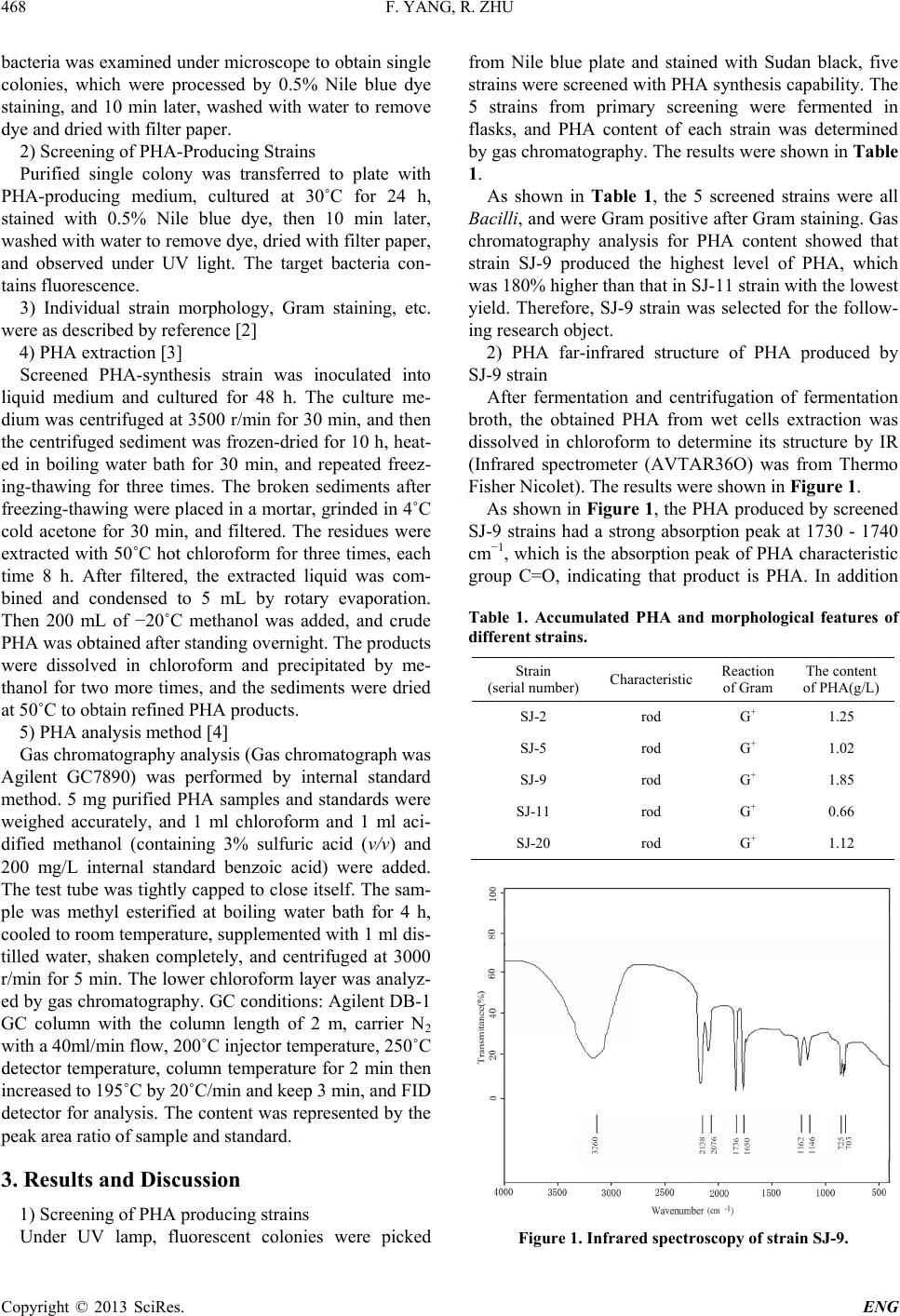 F. YANG, R. ZHU Copyright © 2013 SciRes. ENG 468 bacteria was examined under microscope to obtain single colonies, which were processed by 0.5% Nile blue dye staining, and 10 min later, washed with water to remove dye and dried with filter paper. 2) Screening of PHA -Producing Strains Purified single colony was transferred to plate with PHA-producing medium, cultured at 30˚C for 24 h, stained with 0.5% Nile blue dye, then 10 min later, washed with water to remove dye, dr ied with filter pap er, and observed under UV light. The target bacteria con- tains fluorescence. 3) Individual strain morphology, Gram staining, etc. were as described by reference [2] 4) PHA ext ra c tion [3] Screened PHA-synthesis strain was inoculated into liquid medium and cultured for 48 h. The culture me- dium was centrifuged at 3500 r/min for 30 min, and then the centrifuged sediment was frozen-dried for 10 h, heat- ed in boiling water bath for 30 min, and repeated freez- ing-thawing for three times. The broken sediments after freezing-thawing were placed in a mortar, grinded in 4˚C cold acetone for 30 min, and filtered. The residues were extracted with 50˚C hot chloroform for three times, each time 8 h. After filtered, the extracted liquid was com- bined and condensed to 5 mL by rotary evaporation. Then 200 mL of −20˚C methanol was added, and crude PHA was obtained after standing overnight. The products were dissolved in chloroform and precipitated by me- thanol for two more times, and the sediments were dried at 50˚C to obtain refined PHA produ c ts . 5) PHA analysis method [4] Gas chromatograph y analys is (Gas chromatograph was Agilent GC7890) was performed by internal standard method. 5 mg purified PHA samples and standards were weighed accurately, and 1 ml chloroform and 1 ml aci- dified methanol (containing 3% sulfuric acid (v/v) and 200 mg/L internal standard benzoic acid) were added. The test tube was tightly capped to close itself. The sam- ple was methyl esterified at boiling water bath for 4 h, cooled to room temperature, supplemented with 1 ml dis- tilled water, shaken completely, and centrifuged at 3000 r/min for 5 min. The lower chloroform layer was analyz- ed by gas chromatography. GC conditions: Agilent DB-1 GC column with the column length of 2 m, carrier N2 with a 40ml/min flow, 200 ˚C injector temperature, 250˚C detector temperature, column temperature for 2 min then increased to 195˚C by 20˚C/min and keep 3 min, and FID detector for analysis. The content was represented by the peak area ratio of sample and standard. 3. Results and Discussion 1) Screening of PHA producing s trains Under UV lamp, fluorescent colonies were picked from Nile blue plate and stained with Sudan black, five strains were scr ee ned with PHA synthesis capability. Th e 5 strains from primary screening were fermented in flasks, and PHA content of each strain was determined by gas chromatography. The results were shown in Table 1. As shown in Table 1, the 5 screened strains were all Bacilli, and were Gram positive after Gram staining. Gas chromatography analysis for PHA content showed that strain SJ-9 produced the highest level of PHA, which was 180% high er than that in SJ-11 strain with the lowest yield. Therefore, SJ-9 strain was selected for the follow- ing research object. 2) PHA far-infrared structure of PHA produced by SJ-9 strain After fermentation and centrifugation of fermentation broth, the obtained PHA from wet cells extraction was dissolved in chloroform to determine its structure by IR (Infrared spectrometer (AVTAR36O) was from Thermo Fisher Nicolet). The results were shown in Figure 1. As shown in Figure 1, th e PHA produced by scr eened SJ-9 strains had a strong absorption peak at 1730 - 1740 cm−1, which is the absorption peak of PHA characteristic group C=O, indicating that product is PHA. In addition Table 1. Accumulated PHA and morphological features of different strains. Strain (serial number) Characteristic Reaction of Gram The content of PHA(g/L) SJ-2 rod G+ 1.25 SJ-5 rod G+ 1.02 SJ-9 rod G+ 1.85 SJ-11 rod G+ 0.66 SJ-20 rod G+ 1.12 Figure 1. Infrared spectroscopy of strain SJ-9. 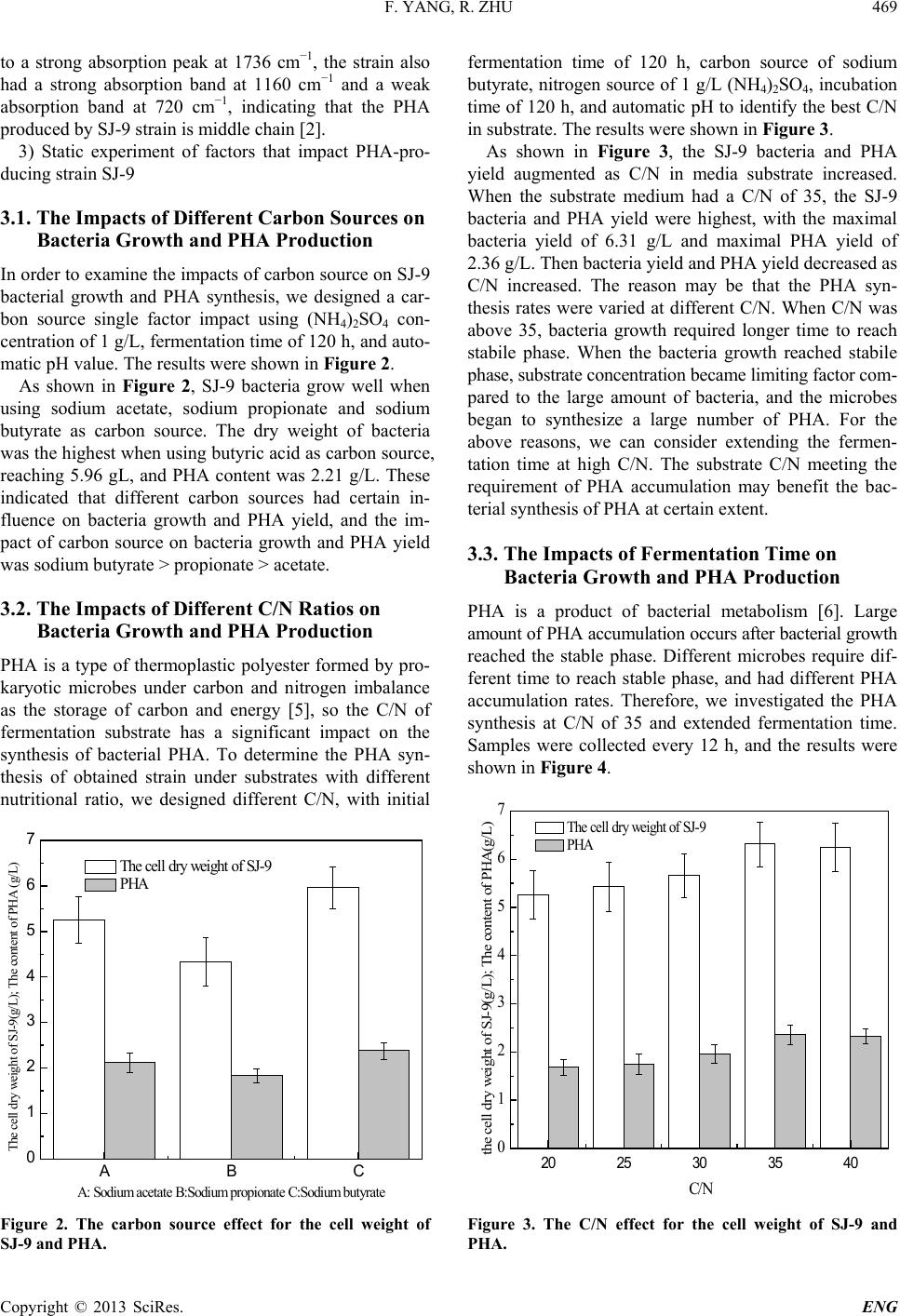 F. YANG, R. ZHU Copyright © 2013 SciRes. ENG 469 to a strong absorption peak at 1736 cm−1, the strain also had a strong absorption band at 1160 cm−1 and a weak absorption band at 720 cm−1, indicating that the PHA produce d by SJ-9 strain is middle chain [2]. 3) Static experiment of factors that impact PHA-pro- ducing strain SJ-9 3.1. The Impacts of Different Carbon Sources on Bacteria Growth and PHA Production In order to examine the impacts of carbon source on SJ -9 bacterial growth and PHA synthesis, we designed a car- bon source single factor impact using (NH4)2SO4 con- centration of 1 g/L, fermentatio n time of 120 h, and auto- matic pH value. The results were shown in Figure 2. As shown in Figure 2, SJ-9 bacteria grow well when using sodium acetate, sodium propionate and sodium butyrate as carbon source. The dry weight of bacteria was the highest when using butyric acid as carbon source, reaching 5.96 gL, and PHA content was 2.21 g/L. These indicated that different carbon sources had certain in- fluence on bacteria growth and PHA yield, and the im- pact of carbon source on bacteria growth and PHA yield was sodium butyrate > propionate > acetate. 3.2. The Impacts of Different C/N Ratio s on Bacteria Growth and PHA Production PHA is a type of thermoplastic polyester formed by pro- karyotic microbes under carbon and nitrogen imbalance as the storage of carbon and energy [5], so the C/N of fermentation substrate has a significant impact on the synthesis of bacterial PHA. To determine the PHA syn- thesis of obtained strain under substrates with different nutritional ratio, we designed different C/N, with initial AB C 0 1 2 3 4 5 6 7 The cell dry weight of SJ-9(g/L); The content of PHA (g/L) A : S od iu m ac e tate B :S od iu m pr op ion a te C:Sodiu m bu tyrate The cell dry w eight of SJ-9 PHA Figure 2. The carbon source effect for the cell weight of SJ-9 and PHA. fermentation time of 120 h, carbon source of sodium butyrate, nitrogen source of 1 g/L (NH4)2SO4, incubation time of 120 h, and automatic pH to identify the best C/N in substrate. The results were shown in Figure 3. As shown in Figure 3, the SJ-9 bacteria and PHA yield augmented as C/N in media substrate increased. When the substrate medium had a C/N of 35, the SJ-9 bacteria and PHA yield were highest, with the maximal bacteria yield of 6.31 g/L and maximal PHA yield of 2.36 g/L. Then bacteria yield and PHA yield decreased as C/N increased. The reason may be that the PHA syn- thesis rates were varied at different C/N. When C/N was above 35, bacteria growth required longer time to reach stabile phase. When the bacteria growth reached stabile phase, substrate concentration became limiting factor com- pared to the large amount of bacteria, and the microbes began to synthesize a large number of PHA. For the above reasons, we can consider extending the fermen- tation time at high C/N. The substrate C/N meeting the requirement of PHA accumulation may benefit the bac- terial synthesis of PHA at certain extent. 3.3. The Impacts of Fermentation Time on Bacteria Growth and PHA Production PHA is a product of bacterial metabolism [6]. Large amount of PH A accumu lation occurs af ter bac terial gro wth reached the stable phase. Different microbes require dif- ferent time to reach stable phase, and had different PHA accumulation rates. Therefore, we investigated the PHA synthesis at C/N of 35 and extended fermentation time. Samples were collected every 12 h, and the results were shown in Figur e 4. 20 25 30 35 40 0 1 2 3 4 5 6 7 the cell dry weight of SJ-9(g/L); The content of PHA (g/L) C/N The cell dry w eight of SJ-9 PHA Figure 3. The C/N effect for the cell weight of SJ-9 and PHA. 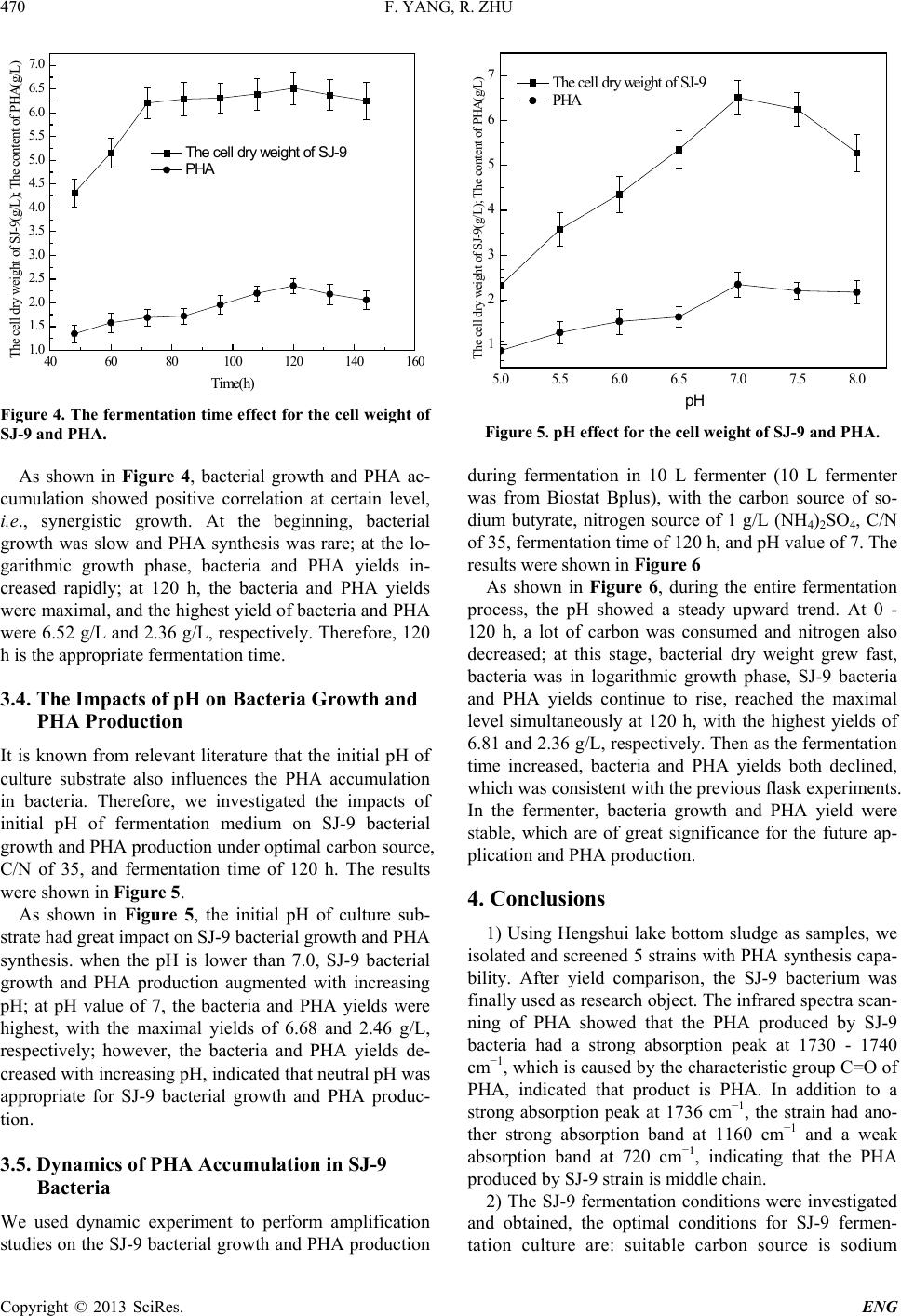 F. YANG, R. ZHU Copyright © 2013 SciRes. ENG 470 406080100 120 140 160 1.0 1.5 2.0 2.5 3.0 3.5 4.0 4.5 5.0 5.5 6.0 6.5 7.0 The cell dry weight of SJ-9(g/L); The content of PHA (g/L) Time(h) The cell dry weight of SJ-9 PHA Figure 4. The fermentation time effect for the cell weight of SJ-9 and PHA. As shown in Figure 4, bacterial growth and PHA ac- cumulation showed positive correlation at certain level, i.e., synergistic growth. At the beginning, bacterial growth was slow and PHA synthesis was rare; at the lo- garithmic growth phase, bacteria and PHA yields in- creased rapidly; at 120 h, the bacteria and PHA yields were maximal, and the highest yield of bacteria and PHA were 6.52 g/L and 2.36 g/L, respectively. Therefore, 120 h is the appropriate fermentation time. 3.4. The Impacts of pH on Bacteria Growth a nd PHA Production It is known from relevant literature that the initial pH of culture substrate also influences the PHA accumulation in bacteria. Therefore, we investigated the impacts of initial pH of fermentation medium on SJ-9 bacterial growth and PHA production under optimal carbon sourc e, C/N of 35, and fermentation time of 120 h. The results were shown in Figure 5. As shown in Figure 5, the initial pH of culture sub- strate had great impact on SJ-9 bacterial growth and PHA synthesis. when the pH is lower than 7.0, SJ-9 bacterial growth and PHA production augmented with increasing pH; at pH value of 7, the bacteria and PHA yields were highest, with the maximal yields of 6.68 and 2.46 g/L, respectively; howev er, the bacteria and PHA yields de- creased with increasing pH, indicated that neutral pH was appropriate for SJ-9 bacterial growth and PHA produc- tion. 3.5. Dynamics of PHA Accumulation in SJ-9 Bacteria We used dynamic experiment to perform amplification studies on the SJ-9 bacterial growth and PHA produ ction 5.0 5.56.0 6.5 7.07.5 8.0 1 2 3 4 5 6 7 The cell dry weight of SJ-9(g/L); The content of PHA (g/L) pH The cell dry w eight of SJ-9 PHA Figure 5. pH effect for the cell weight of SJ-9 and PHA. during fermentation in 10 L fermenter (10 L fermenter was from Biostat Bplus), with the carbon source of so- dium butyrate, nitrogen source of 1 g/L (NH4)2SO 4, C/N of 35, fermentation time of 120 h, and pH value of 7. The results were shown in Figure 6 As shown in Figure 6, during the entire fermentation process, the pH showed a steady upward trend. At 0 - 120 h, a lot of carbon was consumed and nitrogen also decreased; at this stage, bacterial dry weight grew fast, bacteria was in logarithmic growth phase, SJ-9 bacteria and PHA yields continue to rise, reached the maximal level simultaneously at 120 h, with the highest yields of 6.81 and 2.36 g/L, respectively. Then as the fermentation time increased, bacteria and PHA yields both declined, which was consistent with the previous flask experiments. In the fermenter, bacteria growth and PHA yield were stable, which are of great significance for the future ap- plication and PHA production. 4. Conclusions 1) Using Hengshui lake bottom sludge as samples, we isolated and screened 5 strains with PHA synthesis capa - bility. After yield comparison, the SJ-9 bacterium was finally used as research object. The infrared spectra scan- ning of PHA showed that the PHA produced by SJ-9 bacteria had a strong absorption peak at 1730 - 1740 cm−1, which is caused by the characteristic group C=O of PHA, indicated that product is PHA. In addition to a strong absorption peak at 1736 cm−1, the strain had an o- ther strong absorption band at 1160 cm−1 and a weak absorption band at 720 cm−1, indicating that the PHA produce d by SJ-9 strain is middle chain. 2) The SJ-9 fermentation conditions were investigated and obtained, the optimal conditions for SJ-9 fermen- tation culture are: suitable carbon source is sodium 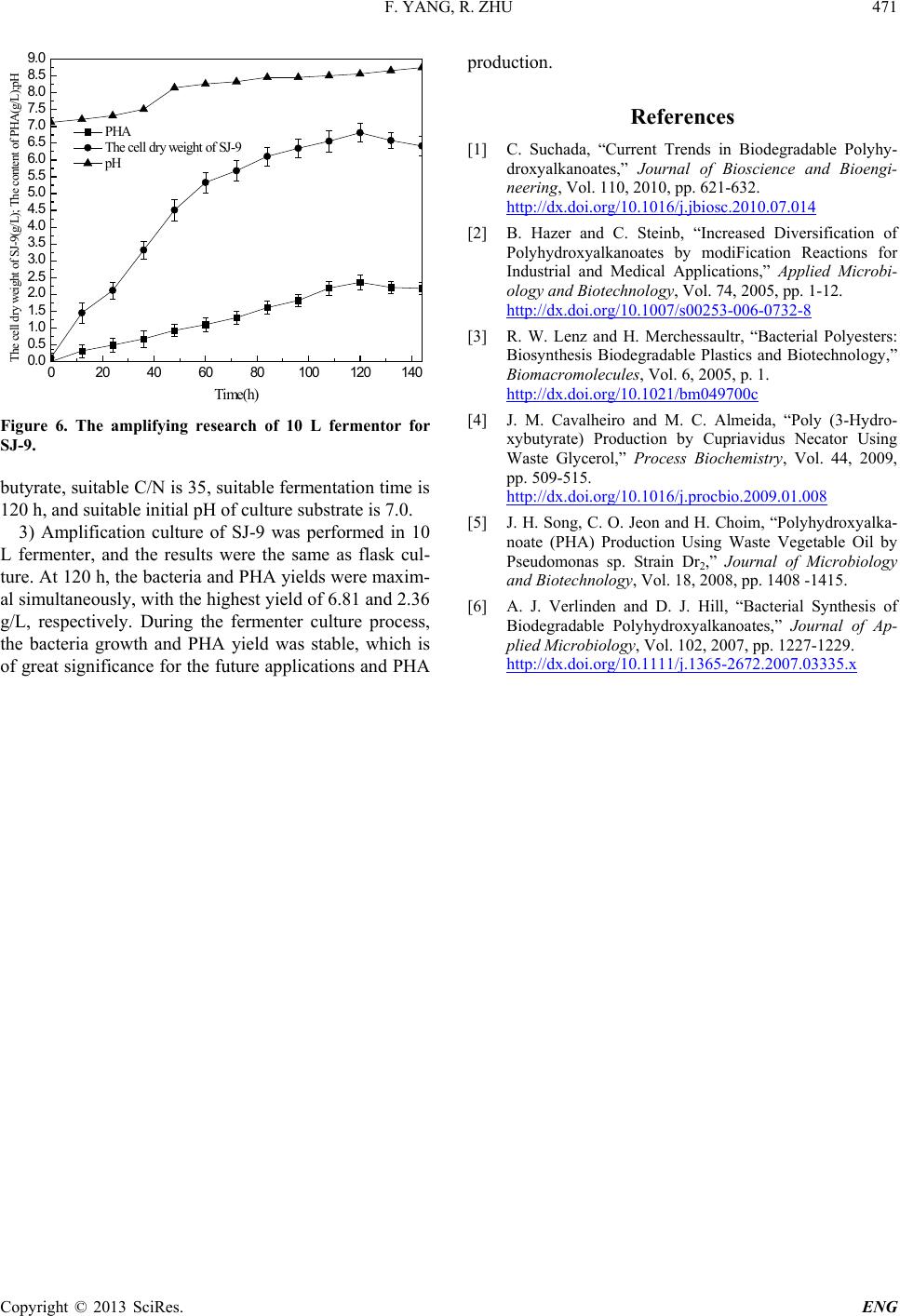 F. YANG, R. ZHU Copyright © 2013 SciRes. ENG 471 020 40 60 80100120140 0.0 0.5 1.0 1.5 2.0 2.5 3.0 3.5 4.0 4.5 5.0 5.5 6.0 6.5 7.0 7.5 8.0 8.5 9.0 The cell dry weight of SJ-9(g/L); The content of PHA(g/L);pH Time(h) PHA The cell dry w eight of SJ-9 pH Figure 6. The amplifying research of 10 L fermentor for SJ-9. butyrate, suitable C/N is 35, suitable fermentatio n time is 120 h, and suitable initial pH of culture substrate is 7.0. 3) Amplification culture of SJ-9 was performed in 10 L fermenter, and the results were the same as flask cul- ture. At 120 h, the bacteria and PHA yields were maxim- al simultaneously, with the highest yield of 6.81 and 2.36 g/L, respectively. During the fermenter culture process, the bacteria growth and PHA yield was stable, which is of great significance for the future applications and PHA production. References [1] C. Suchada, “Current Trends in Biodegradable Polyhy- droxyalkanoates,” Journal of Bioscience and Bioengi- neering, Vol. 110, 2010, pp. 621-632. http://dx.doi.org/10.1016/j.jbiosc.2010.07.014 [2] B. Hazer and C. Steinb, “Increased Diversification of Polyhydroxyalkanoates by modiFication Reactions for Industrial and Medical Applications,” Applied Microbi- ology and Biotechnology, Vol. 74, 2005, pp. 1-12. http://dx.doi.org/10.1007/s00253-006-0732-8 [3] R. W. Lenz and H. Merchessaultr, “Bacterial Polyesters: Biosynthesis Biodegradable Plastics and Biotechnology,” Biomacromolecules, Vol. 6, 2005, p. 1. http://dx.doi.org/10.1021/bm049700c [4] J. M. Cavalheiro and M. C. Almeida, “Poly (3-Hydro- xybutyrate) Production by Cupriavidus Necator Using Waste Glycerol,” Process Biochemistry, Vol. 44, 2009, pp. 509-515. http://dx.doi.org/10.1016/j.procbio.2009.01.008 [5] J. H. Song, C. O. Jeon and H. Choim, “Polyhydroxyalka- noate (PHA) Production Using Waste Vegetable Oil by Pseudomonas sp. Strain Dr2,” Journal of Microbiology and Biotechnology, Vol. 18, 2008, pp. 1408 -1415. [6] A. J. Verlinden and D. J. Hill, “Bacterial Synthesis of Biodegradable Polyhydroxyalkanoates,” Journal of Ap- plied Microbiology, Vol. 102, 2007, pp. 1227-1229. http://dx.doi.org/10.1111/j.1365-2672.2007.03335.x |