

Paper Menu >>
Journal Menu >>
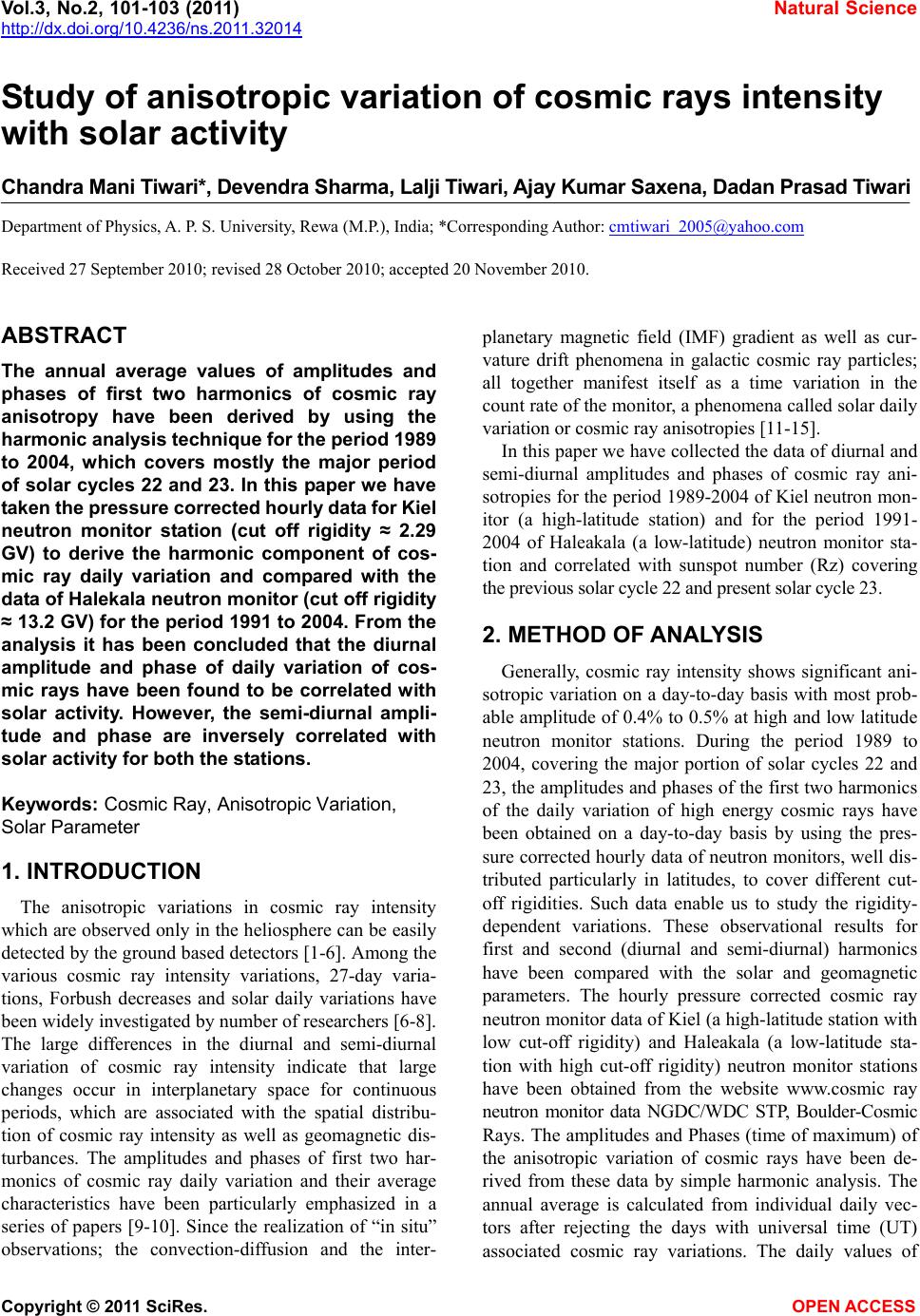 Vol.3, No.2, 101-103 (2011) Natural Science http://dx.doi.org/10.4236/ns.2011.32014 Copyright © 2011 SciRes. OPEN ACCESS Study of anisotropic variation of cosmic rays intensity with solar activity Chandra Mani Tiwari*, Devendra Sharma, Lalji Tiwari, Ajay Kumar Saxena, Dadan Prasad Tiwari Department of Physics, A. P. S. University, Rewa (M.P.), India; *Corresponding Author: [email protected] Received 27 September 2010; revised 28 October 2010; accepted 20 November 2010. ABSTRACT The annual average values of amplitudes and phases of first two harmonics of cosmic ray anisotropy have been derived by using the harmonic analysis technique for the period 1989 to 2004, which covers mostly the major period of solar cycles 22 and 23. In this paper we have taken the pressure corrected hourly data for Kiel neutron monitor station (cut off rigidity ≈ 2.29 GV) to derive the harmonic component of cos- mic ray daily variation and compared with the data of Halekala neutron monitor (cut off rigidity ≈ 13.2 GV) for the period 1991 to 2004. From the analysis it has been concluded that the diurnal amplitude and phase of daily variation of cos- mic rays have been found to be correlated with solar activity. However, the semi-diurnal ampli- tude and phase are inversely correlated with solar activity for both the stations. Keywords: Cosmic Ray, Anisotropic Variation, Solar Parameter 1. INTRODUCTION The anisotropic variations in cosmic ray intensity which are observed only in the heliosphere can be easily detected by the ground based detectors [1-6]. Among the various cosmic ray intensity variations, 27-day varia- tions, Forbush decreases and solar daily variations have been widely investigated by number of researchers [6-8]. The large differences in the diurnal and semi-diurnal variation of cosmic ray intensity indicate that large changes occur in interplanetary space for continuous periods, which are associated with the spatial distribu- tion of cosmic ray intensity as well as geomagnetic dis- turbances. The amplitudes and phases of first two har- monics of cosmic ray daily variation and their average characteristics have been particularly emphasized in a series of papers [9-10]. Since the realization of “in situ” observations; the convection-diffusion and the inter- planetary magnetic field (IMF) gradient as well as cur- vature drift phenomena in galactic cosmic ray particles; all together manifest itself as a time variation in the count rate of the monitor, a phenomena called solar daily variation or cosmic ray anisotropies [11-15]. In this paper we have collected the data of diurnal and semi-diurnal amplitudes and phases of cosmic ray ani- sotropies for the period 1989-2004 of Kiel neutron mon- itor (a high-latitude station) and for the period 1991- 2004 of Haleakala (a low-latitude) neutron monitor sta- tion and correlated with sunspot number (Rz) covering the previous solar cycle 22 and present solar cycle 23. 2. METHOD OF ANALYSIS Generally, cosmic ray intensity shows significant ani- sotropic variation on a day-to-day basis with most prob- able amplitude of 0.4% to 0.5% at high and low latitude neutron monitor stations. During the period 1989 to 2004, covering the major portion of solar cycles 22 and 23, the amplitudes and phases of the first two harmonics of the daily variation of high energy cosmic rays have been obtained on a day-to-day basis by using the pres- sure corrected hourly data of neutron monitors, well dis- tributed particularly in latitudes, to cover different cut- off rigidities. Such data enable us to study the rigidity- dependent variations. These observational results for first and second (diurnal and semi-diurnal) harmonics have been compared with the solar and geomagnetic parameters. The hourly pressure corrected cosmic ray neutron monitor data of Kiel (a high-latitude station with low cut-off rigidity) and Haleakala (a low-latitude sta- tion with high cut-off rigidity) neutron monitor stations have been obtained from the website www.cosmic ray neutron monitor data NGDC/WDC STP, Boulder-Cosmic Rays. The amplitudes and Phases (time of maximum) of the anisotropic variation of cosmic rays have been de- rived from these data by simple harmonic analysis. The annual average is calculated from individual daily vec- tors after rejecting the days with universal time (UT) associated cosmic ray variations. The daily values of 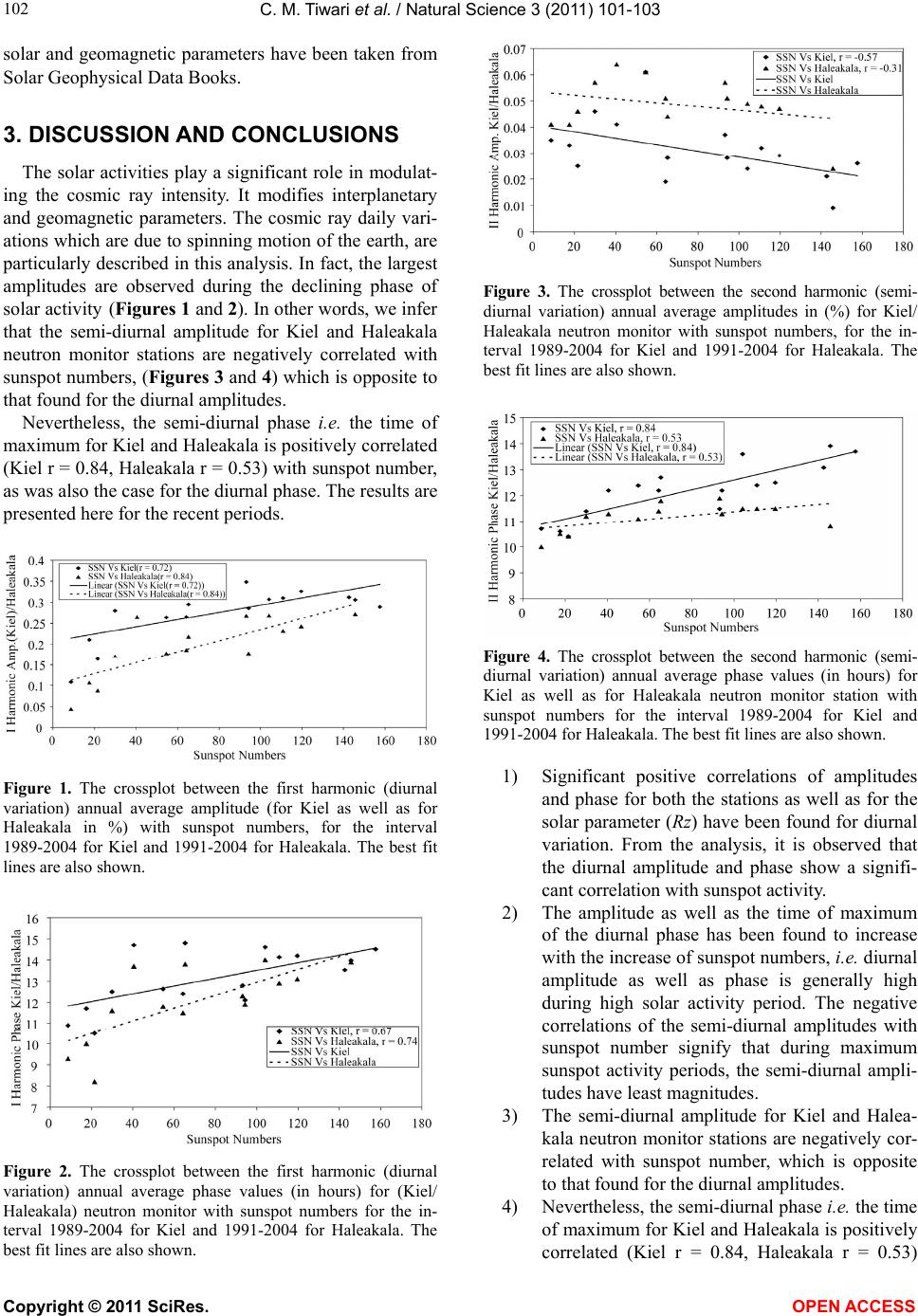 C. M. Tiwari et al. / Natural Science 3 (2011) 101-103 Copyright © 2011 SciRes. OPEN ACCESS 102 solar and geomagnetic parameters have been taken from Solar Geophysical Data Books. 3. DISCUSSION AND CONCLUSIONS The solar activities play a significant role in modulat- ing the cosmic ray intensity. It modifies interplanetary and geomagnetic parameters. The cosmic ray daily vari- ations which are due to spinning motion of the earth, are particularly described in this analysis. In fact, the largest amplitudes are observed during the declining phase of solar activity (Figures 1 and 2). In other words, we infer that the semi-diurnal amplitude for Kiel and Haleakala neutron monitor stations are negatively correlated with sunspot numbers, (Figures 3 and 4) which is opposite to that found for the diurnal amplitudes. Nevertheless, the semi-diurnal phase i.e. the time of maximum for Kiel and Haleakala is positively correlated (Kiel r = 0.84, Haleakala r = 0.53) with sunspot number, as was also the case for the diurnal phase. The results are presented here for the recent periods. Figure 1. The crossplot between the first harmonic (diurnal variation) annual average amplitude (for Kiel as well as for Haleakala in %) with sunspot numbers, for the interval 1989-2004 for Kiel and 1991-2004 for Haleakala. The best fit lines are also shown. Figure 2. The crossplot between the first harmonic (diurnal variation) annual average phase values (in hours) for (Kiel/ Haleakala) neutron monitor with sunspot numbers for the in- terval 1989-2004 for Kiel and 1991-2004 for Haleakala. The best fit lines are also shown. Figure 3. The crossplot between the second harmonic (semi- diurnal variation) annual average amplitudes in (%) for Kiel/ Haleakala neutron monitor with sunspot numbers, for the in- terval 1989-2004 for Kiel and 1991-2004 for Haleakala. The best fit lines are also shown. Figure 4. The crossplot between the second harmonic (semi- diurnal variation) annual average phase values (in hours) for Kiel as well as for Haleakala neutron monitor station with sunspot numbers for the interval 1989-2004 for Kiel and 1991-2004 for Haleakala. The best fit lines are also shown. 1) Significant positive correlations of amplitudes and phase for both the stations as well as for the solar parameter (Rz) have been found for diurnal variation. From the analysis, it is observed that the diurnal amplitude and phase show a signifi- cant correlation with sunspot activity. 2) The amplitude as well as the time of maximum of the diurnal phase has been found to increase with the increase of sunspot numbers, i.e. diurnal amplitude as well as phase is generally high during high solar activity period. The negative correlations of the semi-diurnal amplitudes with sunspot number signify that during maximum sunspot activity periods, the semi-diurnal ampli- tudes have least magnitudes. 3) The semi-diurnal amplitude for Kiel and Halea- kala neutron monitor stations are negatively cor- related with sunspot number, which is opposite to that found for the diurnal amplitudes. 4) Nevertheless, the semi-diurnal phase i.e. the time of maximum for Kiel and Haleakala is positively correlated (Kiel r = 0.84, Haleakala r = 0.53)  C. M. Tiwari et al. / Natural Science 3 (2011) 101-103 Copyright © 2011 SciRes. OPEN ACCESS 103 with sunspot number, as was also observed in case of the diurnal phase. 4. ACKNOWLEDGEMENT The authors are thankful to world Data Centers (ngdc and Omni web centers) whose data have been used by the present investigators for the analysis. REFERENCES [1] Forbush, S.E., (1953) Cosmic ray diurnal anisotropy 1937-1972. Journal of Geophysical Research, 78, 7933- 7941. doi:10.1029/JA078i034p07933 [2] Rao, U.R. (1972) Solar modulation of galactic cosmic radiation. Space Science Reviews, 12, 719-809. doi:10.1007/BF00173071 [3] Agrawal, S.P. and Bercovitch, M. (1983) Long term changes in the cosmic ray diurnal anisotropy. Proceed- ings of 18th ICRC, Bangalore, 3, 316. [4] Shrivastavs, P.K. (1990) Study of tri-diurnal anisotropy of cosmic radiation during 1976-1982. Proceedings of 21st International Cosmic Ray Conference, 353-356. [5] Ahluwalia, H.S. and Wilson, M.D. (1996) Present status of the recovery phase of cosmic ray 11-year modulation. Journal of Geophysical Research (USA), 101, 4879. doi:10.1029/95JA03636 [6] Tiwari, C.M., Tiwari, D.P., Ajay, K.P. and Shriva-Stava, P.K. (2005) Average anisotropy characteristics of high- energy cosmic ray particles and geomagnetic disturbance index Ap. Journal of Astrophysics and Astronomy, 26, 1-6. doi:10.1007/BF02702448 [7] Tiwari, C.M., Tiwari, D.P. and Shrivastava, P.K. (2005) Anomalous behavior of cosmic ray diurnal anisotropy during decending phase of the solar cycle 22. Current Science, 88, 8. [8] Tiwari, C.M., Tiwari, D.P., Agrawal, S.P. and Shriva- stava, P.K. (2003) Correlative study of various harmonics of the daily variation of Cosmic rays. Ultra Science, 15, 433. [9] Tiwari, C.M., Tiwari, D.P., Agrawal, S.P. and Shriva- stava, P.K. (2004) Relationship of first two harmonic of cosmic ray daily variation with solar activity. Indian Journal of Radio and Space Physcis, 33, 95. [10] Ananth, A.G., Agrawal, S.P. and Rao, U.R. (1974) Study of cosmic ray diurnal variation on a day to day basis. Pramana, 3, 74. doi:10.1007/BF02847116 [11] Venkatesan, D and Badruddin, R.S. (1990) Cosmic ray modulation. Space Science Reviews, 52, 121. doi:10.1007/BF00704241 [12] Krimsky, G.F. (1965) Diffusion mechanism of cosmic ray daily variation. Proceedings of 9th International Cosmic Ray Conference, 197-200. [13] Krimsky, G.F., Krivoshapkis, P.A., Gerasimova, S.K., Grigoryev, V.G., Mamrukova, V.P. and Skripin, G.V. (2003) Variation of high energy cosmic ray anisotropy with a solar activity cycle. 28th International Cosmic Ray Conference, 3985-3988. [14] Krymsky, G.F., Krivoshapkin, P.A., Gerasimova, S.K. Grisoryev, V.A., Mamrukova, G.P. and Skripin, G.V. (2003) Semi-diurnal variation of galactic cosmic rays. 28th International Cosmic Ray Conference, pp. 3989- 3992. [15] Belov, A.V., Eroshenko, E.A., Oleneva, V.A., Yanke, V.G. and Mavromichalki, H. (2006) Long-term behaviour of the cosmic ray anisotropy derived from the worldwide Neutron Monitor Network Data. Proceedings of 20th ECRS. http://www.lip.pt/events/2006/ecrs/proc/ecrs06-so123.pdf |