

Paper Menu >>
Journal Menu >>
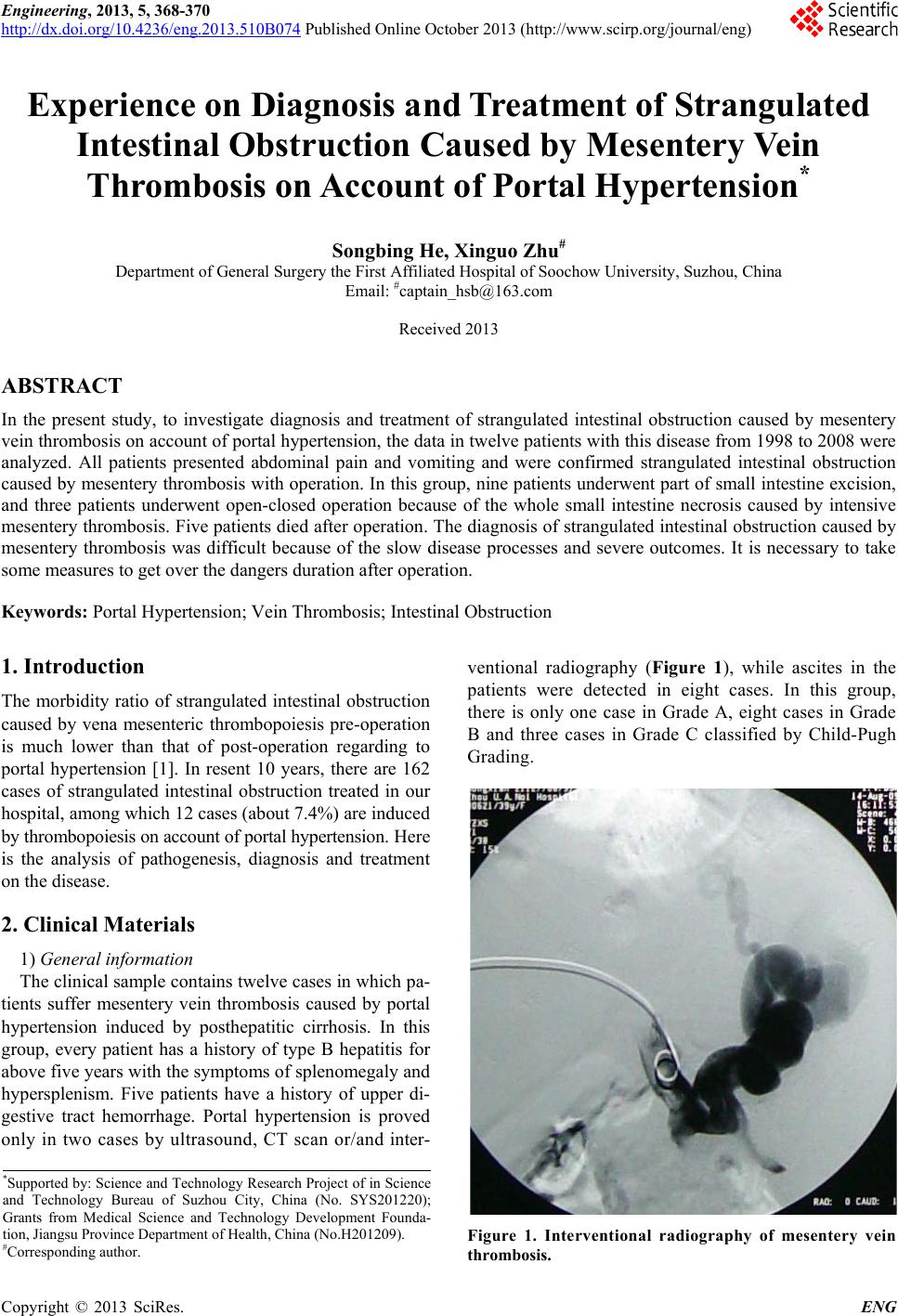 Engineering, 2013, 5, 368-370 http://dx.doi.org/10.4236/eng.2013.510B074 Published Online October 2013 (http://www.scirp.org/journal/eng) Copyright © 2013 SciRes. ENG Experience on Diagnosis and Treatment of Strangulated Intestinal Obstruction Caused by Mesentery Vein Thr ombosis on Account of Portal Hypertension* Songbing He, Xinguo Zhu# Department of General Surgery the First Affiliated Hospital of Soochow University, Suzhou, China Email: #[email protected] Received 2013 ABSTRACT In the present study, to investigate diagnosis and treatment of strangulated intestinal obstruction caused by mesentery vein thrombosis on account of portal hypertension, the data in twelve patients with this disease from 1998 to 2008 were analyzed. All patients presented abdominal pain and vomiting and were confirmed strangulated intestinal obstruction caused by mesentery thrombosis with operation. In this group, nine patients underwent part of small intestine excision, and three patients underwent open-closed operation because of the whole small intestine necrosis caused by intensive mesentery thrombosis. Five patients died after operation. The diagnosis of strangulated intestinal obstruction caused by mesentery thrombosis was difficult because of the slow disease processes and severe outcomes. It is necessary to take some measures to get over the dangers duration after operation. Keywords: Portal Hypertension; Vein Thrombosis; Intestinal Obstruction 1. Introduction The morbidity ratio of strangulated intestinal obstruction caused by vena mesenteric thrombopoiesis pre-operation is much lower than that of post-operation regarding to portal hypertension [1]. In resent 10 years, there are 162 cases of strangulated intestinal obstruction treated in our hospital, among which 12 cases (about 7.4%) are induced by thrombopoiesis on account of portal hypertension. Here is the analysis of pathogenesis, diagnosis and treatment on the disease. 2. Clinical Mater ial s 1) General information The clinical sample contains twelve cases in which pa- tients suffer mesentery vein thrombosis caused by portal hypertension induced by posthepatitic cirrhosis. In this group, every patient has a history of type B hepatitis for above five years with the symptoms of splenomegaly and hypersplenism. Five patients have a history of upper di- gestive tract hemorrhage. Portal hypertension is proved only in two cases by ultrasound, CT scan or/and inter- ventional radiography (Figure 1), while ascites in the patients were detected in eight cases. In this group, there is only one case in Grade A, eight cases in Grade B and three cases in Grade C classified by Child-Pugh Grading. Figure 1. Interventional radiography of mesentery vein thrombosis. * Supported by: Science an d Technology Research Proje ct of in Science and Technology Bureau of Suzhou City, China (No. SYS201220); Grants from Medical Science and Technology Development Founda- tion, Jiangsu Province Department of Health, China (No.H201209). #Corresponding author. 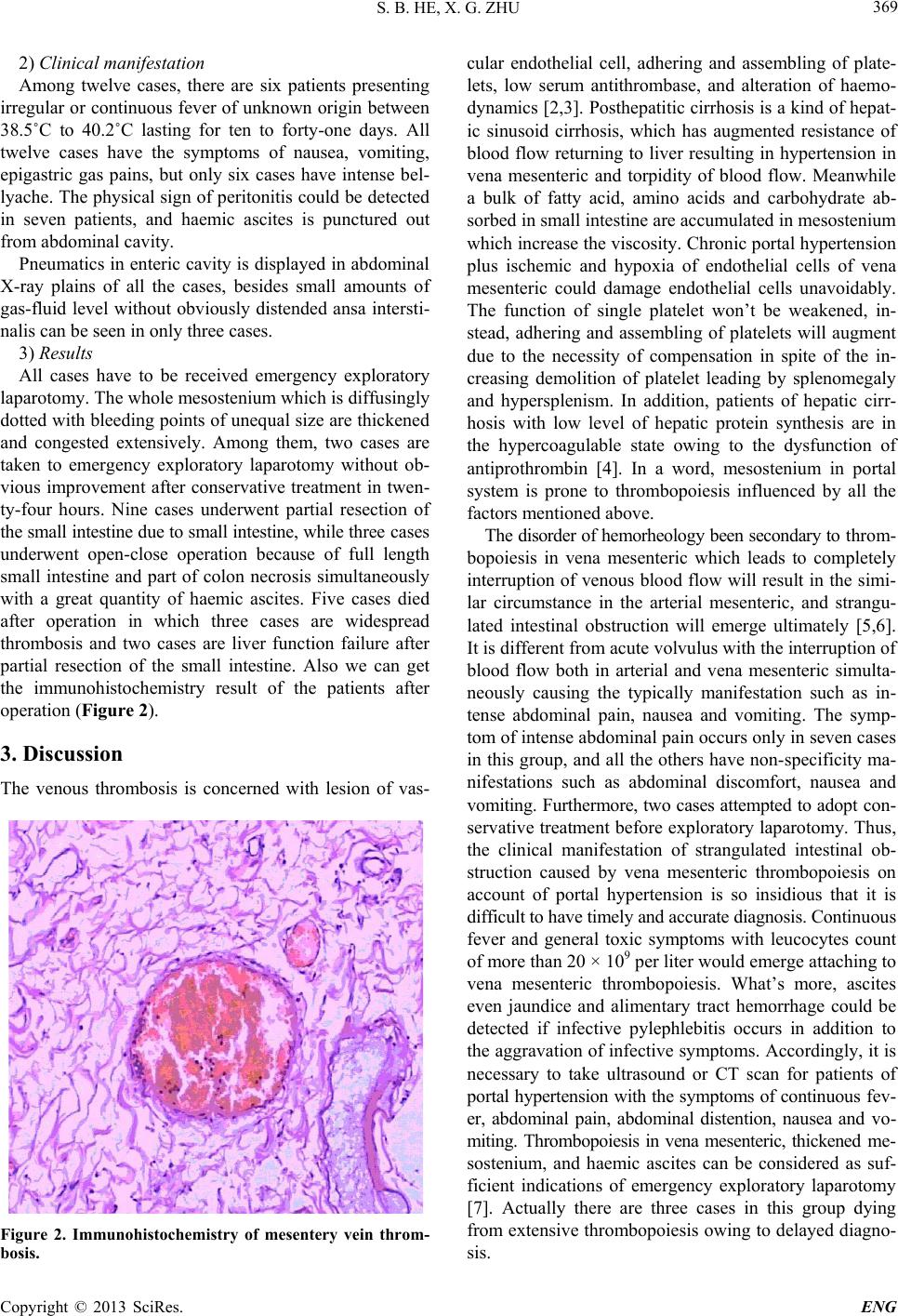 S. B. HE, X. G. ZHU Copyright © 2013 SciRes. ENG 369 2) Clinical manifestation Among twelve cases, there are six patients presenting irregular or continuous fever of unknown origin between 38.5˚C to 40.2˚C lasting for ten to forty-one days. All twelve cases have the symptoms of nausea, vomiting, epigastric gas pains, but only six cases have intense bel- lyache. The physical sign of per itonitis could be detected in seven patients, and haemic ascites is punctured out from abdominal cavity. Pneumatics in enteric cavity is displayed in abdo minal X-ray plains of all the cases, besides small amounts of gas-fluid level without obviously distended ansa intersti- nalis can be seen in only three cases. 3) Results All cases have to be received emergency exploratory laparotomy. The whole mesostenium which is diffusingly dotted with bleeding points of unequal size are thickened and congested extensively. Among them, two cases are taken to emergency exploratory laparotomy without ob- vious improvement after conservative treatment in twen- ty-four hours. Nine cases underwent partial resection of the small intes tine du e to small int estine, while three cases underwent open-close operation because of full length small intestine and part of colon necrosis simultaneously with a great quantity of haemic ascites. Five cases died after operation in which three cases are widespread thrombosis and two cases are liver function failure after partial resection of the small intestine. Also we can get the immunohistochemistry result of the patients after operation (Figure 2). 3. Discussion The venous thrombosis is concerned with lesion of vas- Figure 2. Immunohistochemistry of mesentery vein throm- bosis. cular endothelial cell, adhering and assembling of plate- lets, low serum antithrombase, and alteration of haemo- dynamics [2,3]. Posthepatitic cirrhosis is a kind of hepat- ic sinusoid cirrhosis, which has augmented resistance of blood flow returning to liver resulting in hypertension in vena mesenteric and torpidity of blood flow. Meanwhile a bulk of fatty acid, amino acids and carbohydrate ab- sorbed in small intestine are accumulated in mesostenium which increase the viscosity. Chronic portal hypertension plus ischemic and hypoxia of endothelial cells of vena mesenteric could damage endothelial cells unavoidably. The function of single platelet won’t be weakened, in- stead, adhering and assembling of platelets will augment due to the necessity of compensation in spite of the in- creasing demolition of platelet leading by splenomegaly and hypersplenism. In addition, patients of hepatic cirr- hosis with low level of hepatic protein synthesis are in the hypercoagulable state owing to the dysfunction of antiprothrombin [4]. In a word, mesostenium in portal system is prone to thrombopoiesis influenced by all the factors mentioned above. The disor der of hemorheology been secondary to throm- bopoiesis in vena mesenteric which leads to completely interruption of venous blood flow will result in the simi- lar circumstance in the arterial mesenteric, and strangu- lated intestinal obstruction will emerge ultimately [5,6]. It is different from acute volvulus with the interruption of blood flow both in arterial and vena mesenteric simulta- neously causing the typically manifestation such as in- tense abdominal pain, nausea and vomiting. The symp- tom of intense abdominal pain occurs only in seven cases in this group, and all the others have non-specificity ma- nifestations such as abdominal discomfort, nausea and vomiting. Furthermore, two cases attempted to adopt con- servative treatment before exploratory laparotomy. Thus, the clinical manifestation of strangulated intestinal ob- struction caused by vena mesenteric thrombopoiesis on account of portal hypertension is so insidious that it is difficult t o ha ve t imely and accura te diagnosis. C ontinuous fever and general toxic symptoms with leucocytes count of more than 20 × 109 per liter would emerge attachin g to vena mesenteric thrombopoiesis. What’s more, ascites even jaundice and alimentary tract hemorrhage could be detected if infective pylephlebitis occurs in addition to the aggravation of infective symptoms. Accordingly, it is necessary to take ultrasound or CT scan for patients of portal hypertension with the symptoms of continuous fev- er, abdominal pain, abdominal distention, nausea and vo- miting. Thrombopoiesis in vena mesenteric, thickened me- sostenium, and haemic ascites can be considered as suf- ficient indications of emergency exploratory laparotomy [7]. Actually there are three cases in this group dying from extensive thrombopoiesis owing to delayed diagno- sis.  S. B. HE, X. G. ZHU Copyright © 2013 SciRes. ENG 370 Since the residual embolic mesostenium is the original cause of fever and thrombopoiesis after emergency ex- ploratory laparotomy, pathologic mesostenium has to be resected thoroughly when removing the necrosis intestine for patients of the strangulated intestinal obstruction caused by vena mesenteric thrombopoiesis on account of portal hypertension. Meanwhile, adjunctive therapy such as pro- tection of hepatic function, nutritional support, diureses, and proper blood transfusion calls for more attention as most patients in emergency operations occupying a he- patic inadequacy state of Grade B even C. 4. Acknowledgements We would like to express our thanks to the anonymous reviewers for their suggestions, which helped to improve this paper. REFERENCES [1] M. C. Wang, S. Li, J. Y. Zhu, X. S. Leng and R. Y. Du, “The Reason and Treatment of Portal Vein Thrombosis in Patients with Portal Hypertension Postoperation,” Zhong- hua Wai Ke Za Zhi, Vol. 42, 2004, pp. 269-271. [2] J. Turnes, J. C. García-Pagán, M. González, C. Aracil, J. L. Calleja, C. Ripoll, J. G. Abraldes, R. Bañares, C. Vil- lanueva, A. Albillos, J. R. Ayuso, R. Gilabert and J. Bo- sch, “Portal Hypertension-Related Complications after Acute Portal Vein Thrombosis: Impact of Early Anticoa- gulation,” Clinical Gastroente rology and Hepatology, Vol. 6, 2008, pp. 1412-1417. http://dx.doi.org/10.1016/j.cgh.2008.07.031 [3] O. Harmanci and Y. Bayraktar, “Portal Hypertension Due to Portal Venous Thrombosis: Etiology, Clinical Out- comes,” World Journal of Gastroenterology, Vol. 13, 2007, pp. 2535-2540. [4] C. Vivian, McAlister, A. Noha and Al -Saleh, “Duodenal Dearterialization and Stapling for Severe Hemorrhage from Duodenal Varices with Portal Vein Thrombosis,” The American Journal of Surgery, Vol. 189, 2005, pp. 49- 52. http://dx.doi.org/10.1016/j.amjsurg.2004.04.011 [5] O. Ateş, G. Hakgüder, M. Olguner, M. Seçil, I. Karaca and F. M. Akgür, “Mesenterico Left Portal Bypass for Variceal Bleeding Owing to Extrahepatic Portal Hyper- tension Caused by Portal Vein Thrombosis,” Journal of Pediatric Surgery, Vol. 41, 2006, pp. 1259-1263. http://dx.doi.org/10.1016/j.jpedsurg.2006.03.043 [6] A. C. Chin, F. Thow and R. A. Superina, “Previous Portal Hypertension Surgery Negatively Affects Results of Me- senteric to Left Portal Vein Bypass,” J ournal of Pediatric Surgery, Vol. 43, 2008, pp. 114-119. http://dx.doi.org/10.1016/j.jpedsurg.2007.09.032 [7] Y. M. Galeev, Y. B. Lishmanov, E. G. Grigorev, M. V. Popov, K. A. Aparcin and O. V. Salato, “Scintigraphic Visualization of Bacterial Translocation in Experimental Strangulated Intestinal Obstruction,” European Journal of Nuclear Me d ici ne and Molecular Imaging, Vol. 36 , 2009, pp. 1822-1828. http://dx.doi.org/10.1007/s00259-009-1146-5 |