

Paper Menu >>
Journal Menu >>
 Open Journal of Nephrology, 2013, 3, 189-193 Published Online December 2013 (http://www.scirp.org/journal/ojneph) http://dx.doi.org/10.4236/ojneph.2013.34033 Open Access OJNeph Does Low-Dose Intravenous Methylprednisolone Pulse Therapy Pr oduce Unacceptable Adverse Effects in Children?* Daishi Hirano1,2, Shuichiro Fujinaga1, Amane Endo1, Tsuneki Watanabe1, Hi ro y u ki Ida2 1Division of Nephrology, Saitama Children’s Medical Center, Saitama, Japan 2Department of Pediatrics, Jikei University School of Medicine, Tokyo, Japan Email: [email protected] Received September 22, 2013; revised October 20, 2013; accepted November 15, 2013 Copyright © 2013 Daishi Hirano et al. This is an open access article distributed under the Creative Commons Attribution License, which permits unrestricted use, distribution, and reproduction in any medium, provided the original work is properly cited. ABSTRACT Background: Intravenous methylprednisolone pulse therapy has been used since the late 1960s for acute transplant rejection or severe renal involvement in systemic lupus erythematosus and primary glomerulonephritis. However, re- ports of serious adverse effects such as life-threatening cardiac arrhythmias and sudden death raise questions about its safety. Objective: To investigate the incidence of significant adverse effects associated with low-dose methylpredniso- lone pulse therapy (LDMPT) in pediatric patients. Methods: We retrospectively analyzed adverse effects during and after LDMPT in 68 patients (median age: 11.4 years; 43% male) with various glomerular diseases who were admitted to Saitama Children’s Medical Center between April 2007 and December 2010. LDMPT consisted of pulse methylpred- nisolone (15 - 20 mg/kg; maximum 600 mg/d) for 3 consecutive days weekly for 2 - 3 weeks. Results: Although ad- verse effects occurred in 54 of 68 patients (79%), most were mild and transient. Transient glycosuria was noted in 46 patients (68%), hypertension in 6 (9%), elevated intraocular pressure in 6 (9%), hypokalemia in 5 (7%), and liver dam- age in 2 (3%). No late-onset adverse effects such as osteoporotic fractures, steroid diabetes mellitus, or short stature were observed. Conclusion: LDMPT appears to be relatively safe and well tolerated in children with various glomeru- lar diseases. Keywords: Methylprednisolone Pulse Therapy; Adverse Effects; Side Effects; Steroid; Children 1. Introduction Conventional high-dose intravenous methylprednisolone pulse therapy (HDMPT) first came into clinical use over 40 years ago to treat acute renal graft rejection. Although MPT has since become an essential tool for clinicians treating various kidney diseases, little is known about its mechanism of effect and magnitude of associated adverse effects [1-5]. The most serious problems associated with HDMPT in adults are cardiovascular reactions, including death [6,7], but in children, the adverse effects are re- ported by some researchers to be quite different [8]. The most common adverse effects in children are psychiatric reactions (e.g., mood alteration, hyperactivity, psychosis, disorientation, and sleep disturbances), which are seen in about 10% of children receiving HDMPT [8]. According to recent reports, these adverse effects are associated with higher doses of methylprednisolone (mPSL) and higher rates of intravenous administration [5,9]. In fact, Klein-Gitelman et al. reported that remarkable improve- ment was observed in some children with a decreased dose or an increased time interval between administra- tions [8]. However, adverse effects of decreased doses of mPSL have not been clearly delineated. Based on these reports, we now treat a variety of kidney diseases using “low-dose” MPT (LDMPT), which extends the infusion time (>2 h) and reduces the dosage, in order to reduce adverse effects. The objective of this study was to deter- mine the frequency and severity of adverse effects asso- ciated with LDMPT in pediatric patients. 2. Patients and Materials 2.1. Patients In this retrospective case series study, we collected and *The authors have no conflicts of interest to declare. 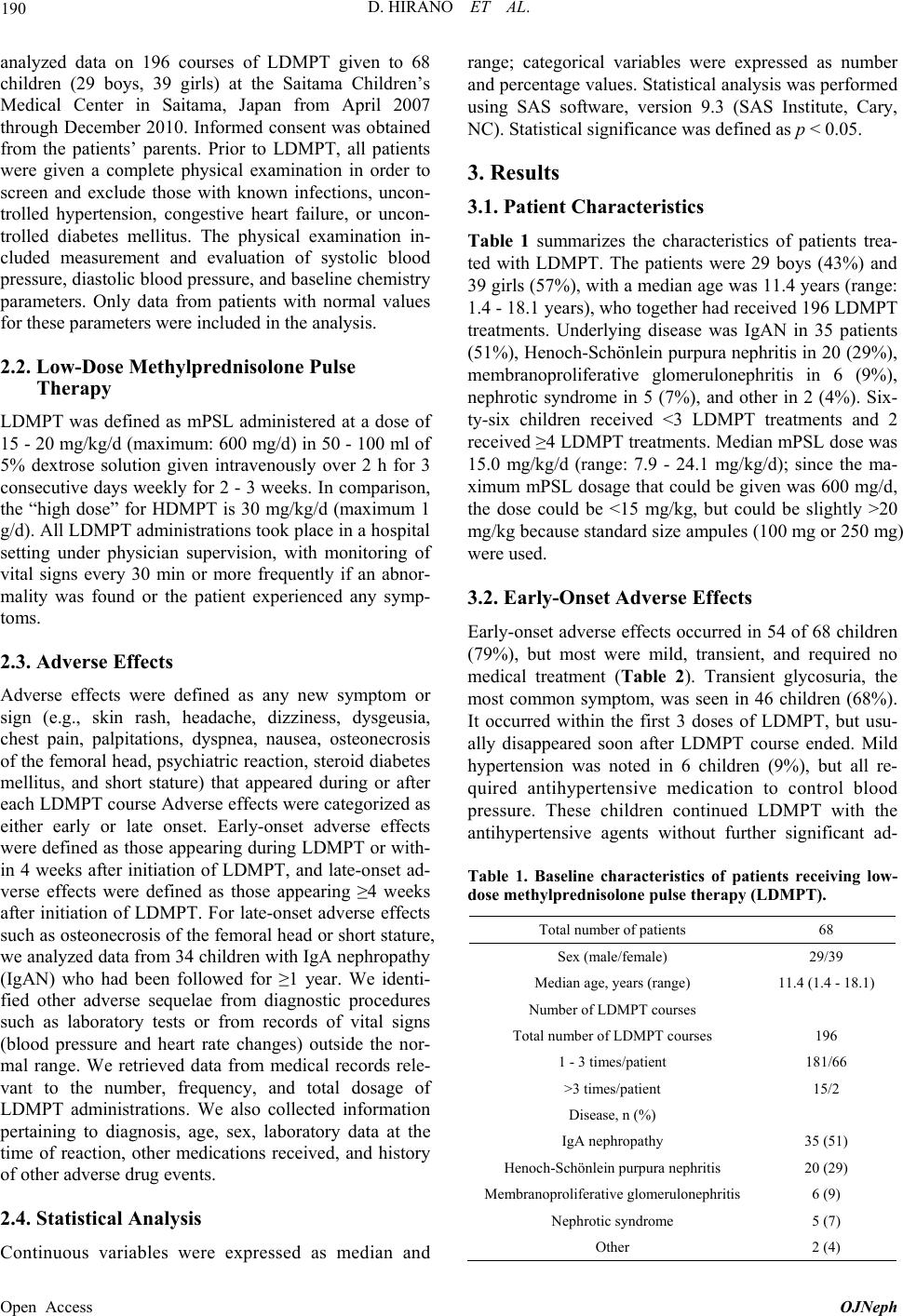 D. HIRANO ET AL. 190 analyzed data on 196 courses of LDMPT given to 68 children (29 boys, 39 girls) at the Saitama Children’s Medical Center in Saitama, Japan from April 2007 through December 2010. Informed consent was obtained from the patients’ parents. Prior to LDMPT, all patients were given a complete physical examination in order to screen and exclude those with known infections, uncon- trolled hypertension, congestive heart failure, or uncon- trolled diabetes mellitus. The physical examination in- cluded measurement and evaluation of systolic blood pressure, diastolic blood pressure, and baseline chemistry parameters. Only data from patients with normal values for these parameters were included in the analysis. 2.2. Low-Dose Methylprednisolone Pulse Therapy LDMPT was defined as mPSL administered at a dose of 15 - 20 mg/kg/d (maximum: 600 mg/d) in 50 - 100 ml of 5% dextrose solution given intravenously over 2 h for 3 consecutive days weekly for 2 - 3 weeks. In comparison, the “high dose” for HDMPT is 30 mg/kg/d (maximum 1 g/d). All LDMPT administrations took place in a hospital setting under physician supervision, with monitoring of vital signs every 30 min or more frequently if an abnor- mality was found or the patient experienced any symp- toms. 2.3. Adverse Effects Adverse effects were defined as any new symptom or sign (e.g., skin rash, headache, dizziness, dysgeusia, chest pain, palpitations, dyspnea, nausea, osteonecrosis of the femoral head, psychiatric reaction, steroid diabetes mellitus, and short stature) that appeared during or after each LDMPT course Adverse effects were categorized as either early or late onset. Early-onset adverse effects were defined as those appearing during LDMPT or with- in 4 weeks after initiation of LDMPT, and late-onset ad- verse effects were defined as those appearing ≥4 weeks after initiation of LDMPT. For late-onset adverse effects such as osteonecrosis of the femoral head or short stature, we analyzed data from 34 children with IgA nephropathy (IgAN) who had been followed for ≥1 year. We identi- fied other adverse sequelae from diagnostic procedures such as laboratory tests or from records of vital signs (blood pressure and heart rate changes) outside the nor- mal range. We retrieved data from medical records rele- vant to the number, frequency, and total dosage of LDMPT administrations. We also collected information pertaining to diagnosis, age, sex, laboratory data at the time of reaction, other medications received, and history of other adverse drug events. 2.4. Statistical Analysis Continuous variables were expressed as median and range; categorical variables were expressed as number and percentage values. Statistical analysis was performed using SAS software, version 9.3 (SAS Institute, Cary, NC). Statistical significance was defined as p < 0.05. 3. Results 3.1. Patient Characteristics Table 1 summarizes the characteristics of patients trea- ted with LDMPT. The patients were 29 boys (43%) and 39 girls (57%), with a median age was 11.4 years (range: 1.4 - 18.1 years), who together had received 196 LDMPT treatments. Underlying disease was IgAN in 35 patients (51%), Henoch-Schönlein purpura nephritis in 20 (29%), membranoproliferative glomerulonephritis in 6 (9%), nephrotic syndrome in 5 (7%), and other in 2 (4%). Six- ty-six children received <3 LDMPT treatments and 2 received ≥4 LDMPT treatments. Median mPSL dose was 15.0 mg/kg/d (range: 7.9 - 24.1 mg/kg/d); since the ma- ximum mPSL dosage that could be given was 600 mg/d, the dose could be <15 mg/kg, but could be slightly >20 mg/kg because standard size ampules (100 mg or 250 mg) were used. 3.2. Early-Onset Adverse Effects Early-onset adverse effects occurred in 54 of 68 children (79%), but most were mild, transient, and required no medical treatment (Table 2). Transient glycosuria, the most common symptom, was seen in 46 children (68%). It occurred within the first 3 doses of LDMPT, but usu- ally disappeared soon after LDMPT course ended. Mild hypertension was noted in 6 children (9%), but all re- quired antihypertensive medication to control blood pressure. These children continued LDMPT with the antihypertensive agents without further significant ad- Table 1. Baseline characteristics of patients receiving low- dose methylprednisolone pulse ther apy (LDMP T). Total number of patients 68 Sex (male/female) 29/39 Median age, years (range) 11.4 (1.4 - 18.1) Number of LDMPT courses Total number of LDMPT courses 196 1 - 3 times/patient 181/66 >3 times/patient 15/2 Disease, n (%) IgA nephropathy 35 (51) Henoch-Schönlein purpura nephritis 20 (29) Membranoproliferative glomerulonephritis 6 (9) Nephrotic syndrome 5 (7) Other 2 (4) Open Access OJNeph 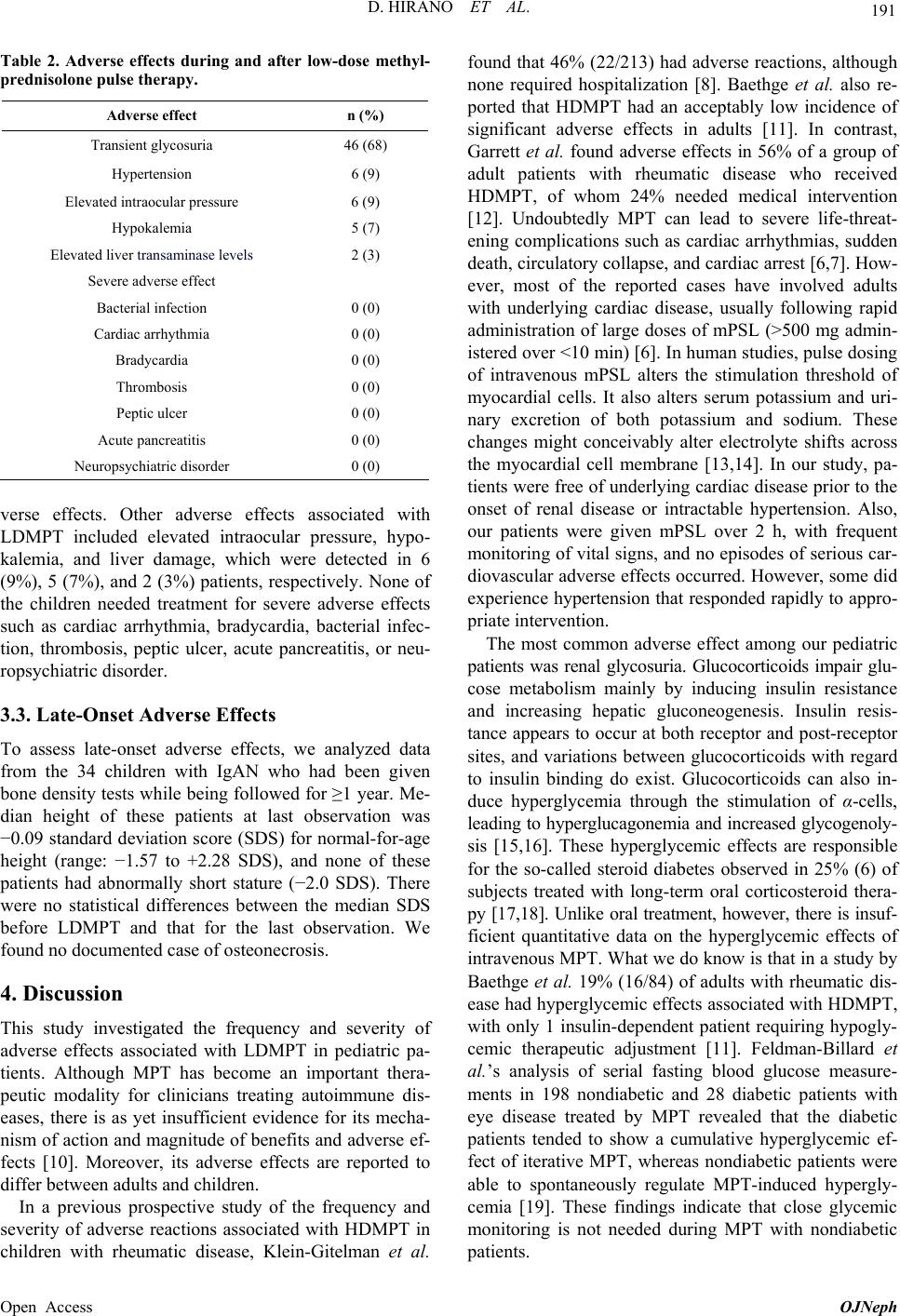 D. HIRANO ET AL. 191 Table 2. Adverse effects during and after low-dose methyl- prednisolone pulse therapy. Adverse effect n (%) Transient glycosuria 46 (68) Hypertension 6 (9) Elevated intraocular pressure 6 (9) Hypokalemia 5 (7) Elevated liver transaminase levels 2 (3) Severe adverse effect Bacterial infection 0 (0) Cardiac arrhythmia 0 (0) Bradycardia 0 (0) Thrombosis 0 (0) Peptic ulcer 0 (0) Acute pancreatitis 0 (0) Neuropsychiatric disorder 0 (0) verse effects. Other adverse effects associated with LDMPT included elevated intraocular pressure, hypo- kalemia, and liver damage, which were detected in 6 (9%), 5 (7%), and 2 (3%) patients, respectively. None of the children needed treatment for severe adverse effects such as cardiac arrhythmia, bradycardia, bacterial infec- tion, thrombosis, peptic ulcer, acute pancreatitis, or neu- ropsychiatric disorder. 3.3. Late-Onset Adverse Effects To assess late-onset adverse effects, we analyzed data from the 34 children with IgAN who had been given bone density tests while being followed for ≥1 year. Me- dian height of these patients at last observation was −0.09 standard deviation score (SDS) for normal-for-age height (range: −1.57 to +2.28 SDS), and none of these patients had abnormally short stature (−2.0 SDS). There were no statistical differences between the median SDS before LDMPT and that for the last observation. We found no documented case of osteonecrosis. 4. Discussion This study investigated the frequency and severity of adverse effects associated with LDMPT in pediatric pa- tients. Although MPT has become an important thera- peutic modality for clinicians treating autoimmune dis- eases, there is as yet insufficient evidence for its mecha- nism of action and magnitude of benefits and adverse ef- fects [10]. Moreover, its adverse effects are reported to differ between adults and children. In a previous prospective study of the frequency and severity of adverse reactions associated with HDMPT in children with rheumatic disease, Klein-Gitelman et al. found that 46% (22/213) had adverse reactions, although none required hospitalization [8]. Baethge et al. also re- ported that HDMPT had an acceptably low incidence of significant adverse effects in adults [11]. In contrast, Garrett et al. found adverse effects in 56% of a group of adult patients with rheumatic disease who received HDMPT, of whom 24% needed medical intervention [12]. Undoubtedly MPT can lead to severe life-threat- ening complications such as cardiac arrhythmias, sudden death, circulatory collapse, and cardiac arrest [6,7]. How- ever, most of the reported cases have involved adults with underlying cardiac disease, usually following rapid administration of large doses of mPSL (>500 mg admin- istered over <10 min) [6]. In human studies, pulse dosing of intravenous mPSL alters the stimulation threshold of myocardial cells. It also alters serum potassium and uri- nary excretion of both potassium and sodium. These changes might conceivably alter electrolyte shifts across the myocardial cell membrane [13,14]. In our study, pa- tients were free of underlying cardiac disease prior to the onset of renal disease or intractable hypertension. Also, our patients were given mPSL over 2 h, with frequent monitoring of vital signs, and no episodes of serious car- diovascular adverse effects occurred. However, some did experience hypertension that responded rapidly to appro- priate intervention. The most common adverse effect among our pediatric patients was renal glycosuria. Glucocorticoids impair glu- cose metabolism mainly by inducing insulin resistance and increasing hepatic gluconeogenesis. Insulin resis- tance appears to occur at both receptor and post-receptor sites, and variations between glucocorticoids with regard to insulin binding do exist. Glucocorticoids can also in- duce hyperglycemia through the stimulation of α-cells, leading to hyperglucagonemia and increased glycogenoly- sis [15,16]. These hyperglycemic effects are responsible for the so-called steroid diabetes observed in 25% (6) of subjects treated with long-term oral corticosteroid thera- py [17,18]. Unlike oral treatment, however, there is insuf- ficient quantitative data on the hyperglycemic effects of intravenous MPT. What we do know is that in a study by Baethge et al. 19% (16/84) of adults with rheumatic dis- ease had hyperglycemic effects associated with HDMPT, with only 1 insulin-dependent patient requiring hypogly- cemic therapeutic adjustment [11]. Feldman-Billard et al.’s analysis of serial fasting blood glucose measure- ments in 198 nondiabetic and 28 diabetic patients with eye disease treated by MPT revealed that the diabetic patients tended to show a cumulative hyperglycemic ef- fect of iterative MPT, whereas nondiabetic patients were able to spontaneously regulate MPT-induced hypergly- cemia [19]. These findings indicate that close glycemic monitoring is not needed during MPT with nondiabetic patients. Open Access OJNeph  D. HIRANO ET AL. 192 In a cohort of 539 patients with systemic lupus ery- thematosus, Zonana-Nacach et al. found no association between intravenous steroid therapy and osteoporotic fractures, but did find an association with high dose oral steroids, reporting a strong association between cumula- tive prednisolone dose and adverse effects [20]. In our study, we fortunately did not experience late-onset ad- verse effects such as osteoporotic fractures, steroid dia- betes mellitus, and short stature. This might be because we administered a lower dose of oral mPSL (1 mg/kg/d, maximum 30 mg/d) on alternate days after LDMPT. The minimum effective dose of mPSL is unclear. While one study has suggested that doses as low as 320 mg administered intravenously or intramuscularly are as effective as 1 g of intravenous mPSL [21], another study has shown that reducing the intravenous mPSL dose from 1 g to 500 mg results in a substantial loss of effi- cacy [22]. Our findings suggest that LDMPT could be a potentially effective and safe alternative for pediatric pa- tients with various glomerular diseases. However, more studies are needed to further characterize the optimal dosages and mechanisms of action of MPT. 5. Limitations The present study was a retrospective analysis of treat- ment performed at a single center, so there may be some selection bias in the cohort. The single center cohort de- sign also limits the external validity of our findings. In addition, we could not determine the true frequency of minor adverse effects such as metallic taste and facial flushing because of the manner in which this retrospec- tive study was performed. However, we are confident that we did not miss any serious treatment complications. 6. Conclusion This case series indicated that LDMPT might have an acceptably low risk of significant adverse effects and therefore can be an effective treatment modality for pe- diatric patients with various glomerular diseases. 7. Tables Table 1 summarizes the characteristics of patients treated with LDMPT. Adverse effects were categorized as either early or late onset. And Table 2 summarizes the adverse effects dur- ing and after low-dose methylprednisolone pulse therapy. REFERENCES [1] E. S. Cathcart, B. A. Idelson, M. A. Scheinberg and W. G. Couser, “Beneficial Effects of Methylprednisolone ‘Pu- lse’ Therapy in Diffuse Proliferative Lupus Nephritis,” The Lancet, Vol. 307, No. 7952, 1976, pp. 163-166. http://dx.doi.org/10.1016/S0140-6736(76)91272-1 [2] R. J. Levinsky, J. S. Cameron and J. F. Soothill, “Serum Immune Complexes and Disease Activity in Lupus Ne- phritis,” The Lancet, Vol. 309, No. 8011, 1977, pp. 564- 567. http://dx.doi.org/10.1016/S0140-6736(77)91998-5 [3] A. Sinha and A. Bagg, “Pulse Steroid Therapy,” The In- dian Journal of Pediatrics, Vol. 75, No. 10, 2008, pp. 1057-1066. http://dx.doi.org/10.1007/s12098-008-0210-7 [4] M. Ohya, H. Otani, Y. Minami, S. Yamanaka, T. Mima, S. Negi, S. Yukawa and T. Shigematsu, “Tonsillectomy with Steroid Pulse Therapy Has More Effect on the Relapse Rate than Steroid Pulse Monotherapy in IgA Nephropathy Patients,” Clinical Nephrology, Vol. 80, No. 1, 2013, pp. 47-52. http://dx.doi.org/10.5414/CN107861 [5] D. Gracey, R. Garsia, W. Britton and P. McKenzie. “Ra- pid Recovery of Renal Function after Pulse Steroid Ther- apy in a Human Immunodeficiency Virus-Infected Patient with Glomerulonephritis,” Internal Medicine Journal, Vol. 42, No. 12, 2012, pp. 1363-1365. http://dx.doi.org/10.1111/imj.12014 [6] B. L. Erstad, “Severe Cardiovascular Adverse Effects in Association with Acute, High-Dose Corticosteroid Ad- ministration,” Drug Intelligence and Clinical Pharmacy, Vol. 23, No. 12, 1989, pp. 1019-1023. [7] B. A. McDougal, F. C. Whittier and D. E. Cross, “Sudden Death after Bolus Steroid Therapy for Acute Rejection,” Transplantation Proceedings, Vol. 8, No. 3, 1976, pp. 493-496. [8] M. S. Klein-Gitelman and L. M. Pachman, “Intravenous Corticosteroids: Adverse Reactions Are More Variable than Expected in Children,” The Journal of Rheumatolo- gy, Vol. 25, No. 10, 1998, pp. 1995-2002. [9] “The Boston Collaborative Drug Surveillance Program. Acute Adverse Reactions to Prednisone in Relation to Dosage,” Clinical Pharmacology & Therapeutics, Vol. 13, No. 5, 1972, pp. 694-698. [10] M. D. Smith, M. J. Ahern and P. J. Roberts-Thomson, “Pulse Methylprednisolone Therapy in Rheumatoid Ar- thritis: Unproved Therapy, Unjustified Therapy, or Effec- tive Adjunctive Treatment?” Annals of the Rheumatic Diseases, Vol. 49, No. 4, 1990, pp. 265-267. http://dx.doi.org/10.1136/ard.49.4.265 [11] B. A. Baethge, M. D. Lidsky and J. W. Goldber, “A Study of Adverse Effects of High-Dose Intravenous (Pu- lse) Methylprednisolone Therapy in Patients with Rheu- matic Disease,” Annals of Pharmacotherapy, Vol. 25, No. 3, 1992, pp. 316-320. [12] R. Garrett and H. Paulus, “Complications of Intravenous Methylprednisolone Pulse Therapy (Abstract),” Arthritis & Rheumatism, Vol. 23, No. 6, 1980, p. 677. [13] S. Fujimoto, H. Kondoh, Y. Yamamoto, S. Hisanaga and K. Tanaka, “Holter Electrocardiogram Monitoring in Ne- phrotic Patients during Methylprednisolone Pulse Ther- apy,” American Journal of Nephrology, Vol. 10, No. 3, 1990, pp. 231-236. http://dx.doi.org/10.1159/000168087 [14] C. Svorcík and L. Bicíková, “Effect of Drugs on the Sti- mulation Threshold of the Human Heart,” Cor et Vasa, Vol. 20, No. 3, 1978, pp. 184-195. Open Access OJNeph  D. HIRANO ET AL. Open Access OJNeph 193 [15] G. Pagano, P. Cavallo-Perin, M. Cassader, A. Bruno, A. Ozzello, P. Masciola, A. M. Dall’omo and B. Imbimbo, “An in Vivo and in Vitro Study of the Mechanism of Prednisone-Induced Insulin Resistance in Healthy Sub- jects,” The Journal of Clinical Investigation, Vol. 72, No. 5, 1983, pp. 1814-1820. http://dx.doi.org/10.1172/JCI111141 [16] M. McMahon, J. Gerich and R. Rizza, “Effects of Gluco- corticoids on Carbohydrate Metabolism,” Diabetes/Me- tabolism Reviews, Vol. 4, No. 1, 1988, pp. 17-30. http://dx.doi.org/10.1002/dmr.5610040105 [17] M. K. Pandit, J. Burke, A. B. Gustafson, A. Minocha and A. N. Peiris, “Drug-Induced Disorders of Glucose Toler- ance,” Annals of Internal Medicine, Vol. 118, No. 7, 1993, pp. 529-539. http://dx.doi.org/10.7326/0003-4819-118-7-199304010-0 0008 [18] J. H. Gurwitz, R. L. Bohn, R. J. Glynn, M. Monane, H. Mogun and J. Avorn, “Glucocorticoids and the Risk for Initiation of Hypoglycemic Therap,” Archives of Internal Medicine, Vol. 154, No. 1, 1994, pp. 97-101. http://dx.doi.org/10.1001/archinte.1994.00420010131015 [19] S. Feldman-Billard, B. Lissak, R. Benrabah, R. Kassaei and E. Héron, “Intravenous Pulse Methylprednisolone Therapy in Eye Disease,” Ophthalmology, Vol. 110, No. 12, 2003, pp. 2369-2371. http://dx.doi.org/10.1016/S0161-6420(03)00818-2 [20] A. Zonana-Nacach, S. G. Barr, L. S. Magder and M. Petri, “Damage in Systemic Lupus Erythematosus and Its As- sociation with Corticosteroids,” Arthritis & Rheumatism, Vol. 43, No. 8, 2000, pp. 1801-1808. http://dx.doi.org/10.1002/1529-0131(200008)43:8<1801:: AID-ANR16>3.0.CO;2-O [21] M. Radia and D. E. Furst, “Comparison of Three Pulse Methylprednisolone Regimens in the Treatment of Rheumatoid Arthritis,” The Journal of Rheumatology, Vol. 15, No. 2, 1998, pp. 242-246. [22] M. E. Shipley, P. A. Bacon, H. Berry, B. L. Hazleman, R. D. Sturrock, D. R. Swinson and I. A. Williams, “Pulsed Methylprednisolone in Active Early Rheumatoid Disease: A Dose-Ranging Study,” British Journal of Rheumatol- ogy, Vol. 27, No. 3, 1988, pp. 211-214. http://dx.doi.org/10.1093/rheumatology/27.3.211 |