

Paper Menu >>
Journal Menu >>
 Open Journal of Genetics, 2013, 3, 280-284 OJGen http://dx.doi.org/10.4236/ojgen.2013.34031 Published Online December 2013 (http://www.scirp.org/journal/ojgen/) Effects of coat colour genes on body measurements, heat tolerance traits and haematological parameters in West African Dwarf sheep John S. Decampos1, Christian O. N. Ikeobi1*, Olajide Olowofeso1, Olusiji F. Smith2, Matthew A. Adeleke1, Mathew Wheto1, David O. Ogunlakin1, Abubakar A. Mohammed1, Timothy M. Sanni1, Babatunde A. Ogunfuye1, Raman A. Lawal1, Adeyemi S. Adenaike1, Samuel A. Amusan1 1Department of Animal Breeding and Genetics, Federal University of Agriculture, Abeokuta, Nigeria 2Department of Animal Physiology, Federal University of Agriculture, Abeokuta, Nigeria Email: *[email protected] Received 13 June 2013; revised 10 July 2013; accepted 6 August 2013 Copyright © 2013 John S. Decampos et al. This is an open access article distributed under the Creative Commons Attribution Li- cense, which permits unrestricted use, distribution, and reproduction in any medium, provided the original work is properly cited. ABSTRACT With 178 West African Dwarf sheep aged 1 to 3 years, a study was conducted to investigate the effects of coat colour genes on body measurements, heat toler- ance traits and haematological parameters. Body measurements considered included body length, hair length, ear length, hip width, tail length, height at withers, rump height, fore cannon bone length, chest depth, heart girth and body weight. Heat tolerance traits considered were skin temperature, rectal tem- perature, pulse rate and respiratory rate. Blood sam- ples were collected for the evaluation of white blood cell (WBC), red blood cell (RBC), haemoglobin (HGB), haematocrit (HCT), mean corpuscular vol- ume (MCV), mean corpuscular haemoglobin (MCH), mean corpuscular haemoglobin cell (MCHC), red cell distribution width (RDW), platelets (PLT), mean platelets volume (MPV), platelets distribution width (PDW) and plateletcrits (PCT). Results showed that coat colour gene (CCG) had significant (P < 0.01) ef- fect on rump height and tail length. Animals with black (BB) coat colour had the highest mean value for rump height (57.80 ± 1.29 cm) and tail length (22.10 ± 0.89 cm), while brown (Bb) coat colour had the least value of 53.00 ± 6.00 cm for rump height and 17.50 ± 0.50 cm for tail length. The CCG had significant (P < 0.01) effect on body temperature and pulse rate, with the grey/mouflon (Ag) colour possessing the highest body temperature (38.90˚C ± 0.22˚C), and Bb having the least value of 37.20˚C ± 0.35˚C. White/tan (Awt) had the highest pulse rate of 28.90 ± 0.66 beats/min and Bb had the least value of 20.00 ± 2.00 beats/min. The CCG had significant (P < 0.01) effect on RBC and MPV with brown (Bb) colour having the highest RBC counts (18.20 ± 0.00 L) and badgerface (Ab) having the least value (11.50 ± 0.62 L). The Bb had the highest value (5.60 ± 0.00 fL) for MPV and Ab had the least value (4.70 ± 0.15 fL). Sheep with Bb and Ab were found to withstand heat stress better than oth- ers. Keywords: Coat Colour Gene; Haematological Parameters; Morphological Indices; Sheep 1. INTRODUCTION The animal performance is an expression of genetic and environmental factors [1]. Genetic factors depict innate factors. They are the factors which are inherent and could re-occur from generation to generation. Coat col- our which is a genetic factor is known to adapt animals to different climatic zone s and has considerab le influence on the performance of various stocks [2-3]. The West African Dwarf (WAD) sheep is one of the breeds of sheep in Nigeria with a small, compact body which may be all white, all black, all brown, or spotted black or brown on a white coat. It is predominantly found within the rainforest, mangrove swamps and coastal regions in southern Nigeria [4]. Growth, often defined as the increase in size or body weight at a given age, is one of the important selection criteria for the improvement of meat animals such as sheep [5]. Body measurements can be used in assessing growth rate, feed u tilisation an d carcass characteristics in farm animals [6]. Body measurements are divided into skeletal and tissue measurements according to [7]. The *Corresponding author. OPEN ACCESS  J. S. Decampos et al. / Open Journal of Genetics 3 (2013) 280-284 281 height at withers is part of skeletal measurements, whereas the heart girth is part of tissue measurements [8]. Body measurements of meat animals have been found to be useful in quantifying the body size and shape [9] and necessary for estimating genetic parameters [10]. Heat tolerance is the ability to be comfortable when external temperature rises. The common heat tolerance traits in- clude sweating rate, heart and breathing rates, rectal temperature, and skin temperature [11]. When the physiological mechanism of the animal fails to negate the excessive heat load, the rectal temperature increases. At the same time, such exposure of sheep to heat stress evokes a series of drastic changes in the biological func- tions, which include a decrease in feed intake efficiency and utilization, disturb ances in water, protein, en erg y and mineral balances, enzymatic reactions, hormonal secre- tions and blood metabolites [12]. Haematological parameters are those parameters that are related to the blood and blood-forming organs [13]. The blood consists of components broadly divided into three parts: leukocytes, erythrocytes and platelets, and further sub-divided into haemoglobin (Hb), red blood cells (RBC), packed cell volume (PCV), mean corpuscu- lar haemoglobin (MCH), etc. These traits play important roles in animal immune function and disease resistance [14]. The use of blood examination as a way of assessing the health status of animals has been well documented [15]. This is because they play a vital role in physiologi- cal, nutritional and pathological status of the animals [16]. Although much work has been carried out to assess the effects of diseases and nutrition on sheep in Nigeria, lit- eratures on the tolerance of sheep to heat stress and its effects on productivity are however limited [17]. Infor- mation on the physiological responses of sheep to heat stress will not only assist in the provision of adequate housing, feed and other environmental conditions, but also be useful in the selection of suitable breeds for each ecological niche [17]. The knowledge of the response of different coat colour types of heat stress will help in the selection of suit able breeds for each ecological niche. The study of haematological parameters in WAD sheep could predetermine the genetic potential of an animal for selection [18]. This study was therefore carried out to investigate the influence of the coat colour gene on the productive and adaptive traits in WAD sheep in Nigeria. 2. MATERIALS AND METHODS 2.1. Study Location and Sample Size This study was carried out in Odeda Agro-ecological Zone of Ogun State, Nigeria. One hundred and seventy eight WAD sheep were sampled for eight months. West African Dwarf sheep in the zone are usually reared under the free-range system whereby the owners occasionally feed their animals with kitchen wastes, cassava and yam peels or whole cassava and corn shaff in the morning before they are left to roam about the houses and sur- rounding. There was no known common browse plant in the studied area, except that the animals browse on whatever comes their way. There was no known deliber- ate veterinary or ethno-veterinary practice engaged in by the livestock owners. 2.2. Data Collection and Analysis Exactly 7 ml of blood was collected via the jugular vein puncture of each animal using a 10 mm gauge syringe into sample bottles containing the antico agulant, ethylene diamine tetra acetic acid (EDTA). Sample bottles were well-labelled for proper identification and blood samples collected were transported to the laboratory for the analysis of the haematological parameters which in- cluded white blood cell (WBC), red blood cell (RBC), haemoglobin (HGB), haematocrit (HCT), mean corpus- cular volume (MCV), mean corpuscular haemoglobin (MCH), mean corpuscular haemoglobin cell (MCHC), red cell distribution width (RDW), platelets (PLT), mean platelets volume (MPV), platelets distribution width (PDW) and plateletcrits (PCT). Phenotypic measurements were taken on sampled sheep on site. These included both the quantitative and qualitative measurements of the body. Th e major qualita- tive description taken was the coat colour. Using the fleece colour in sheep as earlier observed by [19], the major coat colour gene variations observed included the white/tan (Awt), black (BB), spotted brown (Bb), grey/ mouflon (Agt) and badgerface (Ab). The age and sex of the animals were also noted. Quantitative measurements of the body taken included body weight using a spring balance attached to a scaffold, body length, heart girth, height at withers, ear length, hair length, rump height, hip width, tail length, fore cannon bone length and chest depth with the use of a measuring tape. Brief descrip- tions of the quantitative measurements are as follows: Height at withers: which is the dorsal midline at the highest point on the wither. Tail length: which is the distance between the tip of the tail and the base end tail touching the body of the animal. Ear length: distance between the tip of the ear and the base of the ear. Body length: distance between the tip of the mouth and the base of the tail. Heart girth: the body circumference immediately posterior to the front legs or the body circumference on the fore hips. Height at hips: it will be measured mid sacrum on the Copyright © 2013 SciRes. OPEN ACCESS 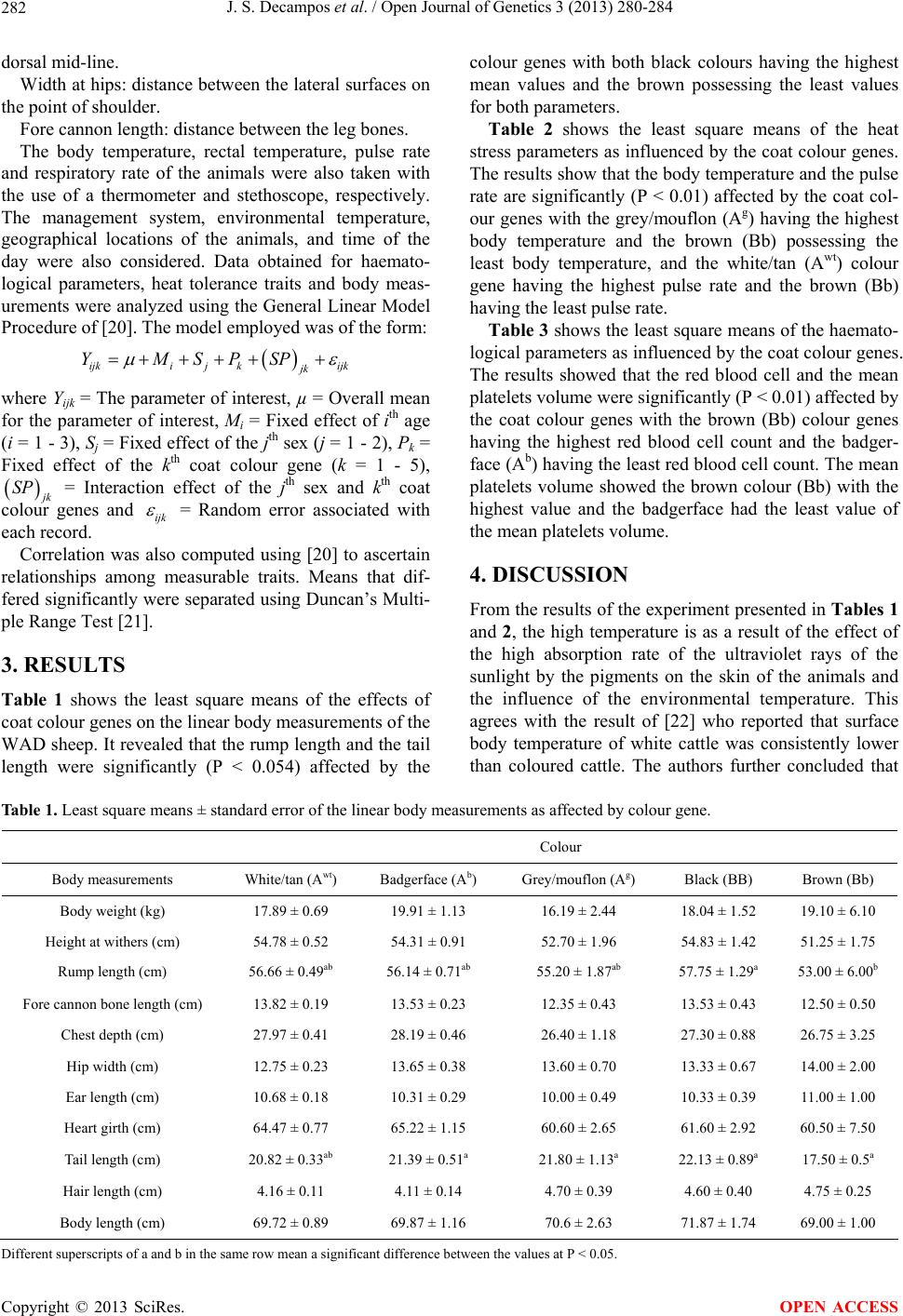 J. S. Decampos et al. / Open Journal of Genetics 3 (2013) 280-284 Copyright © 2013 SciRes. 282 dorsal mid-line. colour genes with both black colours having the highest mean values and the brown possessing the least values for both parameters. Width at hips: distance between the lateral surfaces on the point of shoulder. Table 2 shows the least square means of the heat stress parameters as influenced by the coat colour genes. The results show that th e body temperature and the pu lse rate are significantly (P < 0.01) affected by the coat col- our genes with the grey/mouflon (Ag) having the highest body temperature and the brown (Bb) possessing the least body temperature, and the white/tan (Awt) colour gene having the highest pulse rate and the brown (Bb) having the least pulse rate. Fore cannon length: distance between the leg bones. The body temperature, rectal temperature, pulse rate and respiratory rate of the animals were also taken with the use of a thermometer and stethoscope, respectively. The management system, environmental temperature, geographical locations of the animals, and time of the day were also considered. Data obtained for haemato- logical parameters, heat tolerance traits and body meas- urements were analyzed using the General Linear Model Procedure of [20]. The model employed was of the form: Table 3 shows the least square means of the haemato- logical parameters as influenced by the coat colour genes. The results showed that the red blood cell and the mean platelets volume were significantly (P < 0.01) affected by the coat colour genes with the brown (Bb) colour genes having the highest red blood cell count and the badger- face (Ab) having the least red blood cell count. The mean platelets volume showed the brown colour (Bb) with the highest value and the badgerface had the least value of the mean platelets volume. ijkij kijk jk YMSPSP where Yijk = The parameter of interest, µ = Overall mean for the parameter of interest, Mi = Fixed effect of ith age (i = 1 - 3), Sj = Fixed effect of the jth sex (j = 1 - 2), Pk = Fixed effect of the kth coat colour gene (k = 1 - 5), j k = Interaction effect of the jth sex and kth coat colour genes and SP ijk = Random error associated with each record. Correlation was also computed using [20] to ascertain relationships among measurable traits. Means that dif- fered significantly were separated using Duncan’s Multi- ple Range Test [21]. 4. DISCUSSION From the results of the expe riment presented in Tables 1 and 2, the high temperature is as a result of the effect of the high absorption rate of the ultraviolet rays of the sunlight by the pigments on the skin of the animals and the influence of the environmental temperature. This agrees with the result of [22] who reported that surface body temperature of white cattle was consistently lower than coloured cattle. The authors further concluded that 3. RESULTS Table 1 shows the least square means of the effects of coat colour genes on the linear body measurements of the WAD sheep. It revealed that the rump length and the tail length were significantly (P < 0.054) affected by the Table 1. Least square means ± standard error of the linear body measurements as affected by colour gene. Colour Body measurements White/tan (Awt) Badgerface (Ab) Grey/mouflon (Ag) Black (BB) Brown (Bb) Body weight (kg) 17.89 ± 0.69 19.91 ± 1.13 16.19 ± 2.44 18.04 ± 1.52 19.10 ± 6.10 Height at withers (cm) 54.78 ± 0.52 54.31 ± 0.91 52.70 ± 1.96 54.83 ± 1.42 51.25 ± 1.75 Rump length (cm) 56.66 ± 0.49ab 56.14 ± 0.71ab 55.20 ± 1.87ab 57.75 ± 1.29a 53.00 ± 6.00b Fore cannon bone length (cm) 13.82 ± 0.19 13.53 ± 0.23 12.35 ± 0.43 13.53 ± 0.43 12.50 ± 0.50 Chest depth (cm) 27.97 ± 0.41 28.19 ± 0.46 26.40 ± 1.18 27.30 ± 0.88 26.75 ± 3.25 Hip width (cm) 12.75 ± 0.23 13.65 ± 0.38 13.60 ± 0.70 13.33 ± 0.67 14.00 ± 2.00 Ear length (cm) 10.68 ± 0.18 10.31 ± 0.29 10.00 ± 0.49 10.33 ± 0.39 11.00 ± 1.00 Heart girth (cm) 64.47 ± 0.77 65.22 ± 1.15 60.60 ± 2.65 61.60 ± 2.92 60.50 ± 7.50 Tail length (cm) 20.82 ± 0.33ab 21.39 ± 0.51a 21.80 ± 1.13a 22.13 ± 0.89a 17.50 ± 0.5a Hair length (cm) 4.16 ± 0.11 4.11 ± 0.14 4.70 ± 0.39 4.60 ± 0.40 4.75 ± 0.25 Body length (cm) 69.72 ± 0.89 69.87 ± 1.16 70.6 ± 2.63 71.87 ± 1.74 69.00 ± 1.00 Different superscripts of a and b in the same row mean a significant difference between the values at P < 0.05. OPEN ACCESS 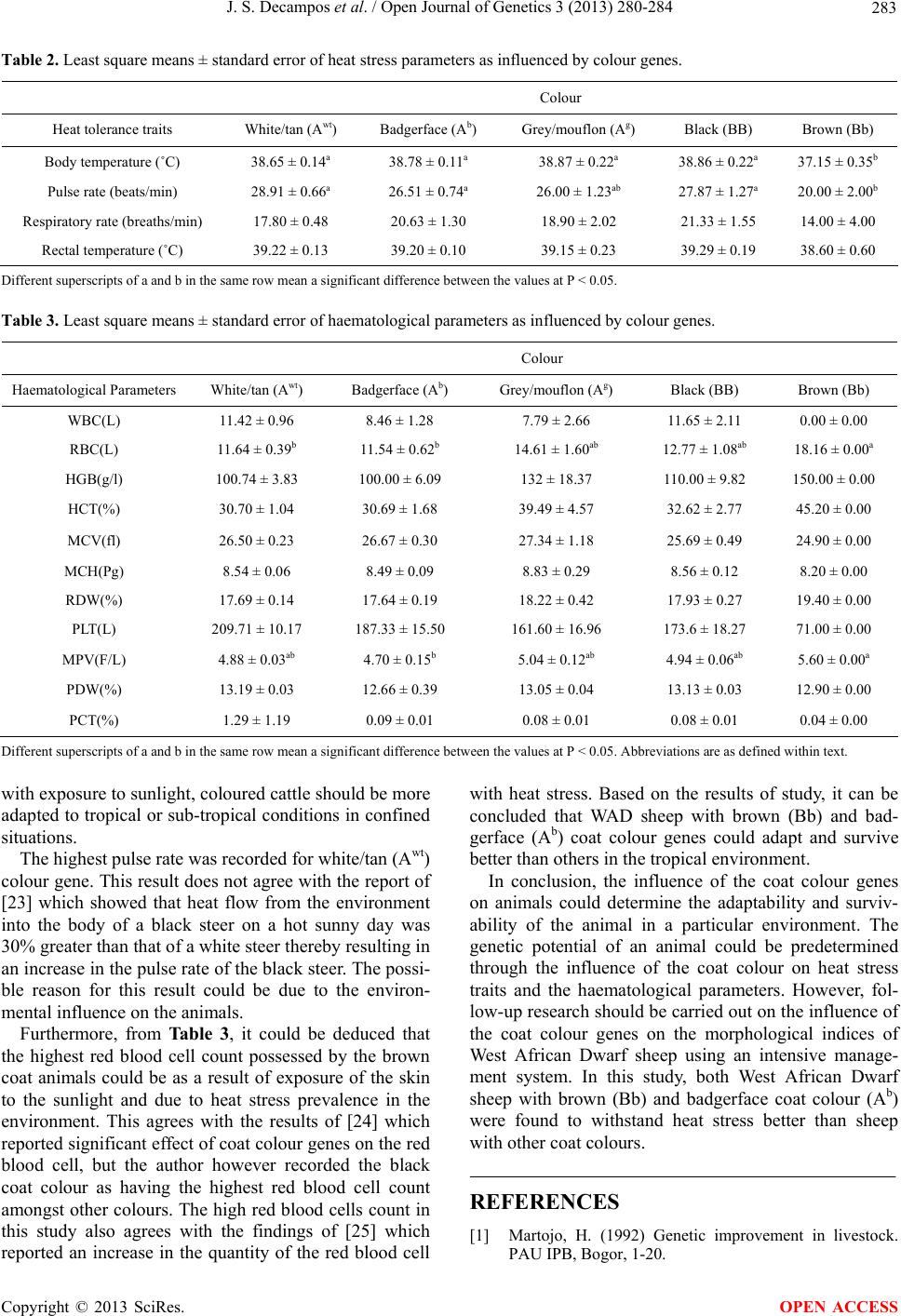 J. S. Decampos et al. / Open Journal of Genetics 3 (2013) 280-284 283 Table 2. Least square means ± standard error of heat stress parameters as influenced by colour genes. Colour Heat tolerance traits White/tan (Awt) Badgerface (Ab) Grey/mouflon (Ag) Black (BB) Brown (Bb) Body temperature (˚C) 38.65 ± 0.14a 38.78 ± 0.11a 38.87 ± 0.22a 38.86 ± 0.22a 37.15 ± 0.35b Pulse rate (beats/min) 28.91 ± 0.66a 26.51 ± 0.74a 26.00 ± 1.23ab 27.87 ± 1.27a 20.00 ± 2.00b Respiratory rate (breaths/min) 17.80 ± 0.48 20.63 ± 1.30 18.90 ± 2.02 21.33 ± 1.55 14.00 ± 4.00 Rectal temperature (˚C) 39.22 ± 0.13 39.20 ± 0.10 39.15 ± 0.23 39.29 ± 0.19 38.60 ± 0.60 Different superscripts of a and b in the same row mean a significant difference between the values at P < 0.05. Table 3. Least square means ± standard error of haematological parameters as influenced by colour genes. Colour Haematological Parameters White/tan (Awt) Badgerface (Ab) Grey/mouflon (Ag) Black (BB) Brown (Bb) WBC(L) 11.42 ± 0.96 8.46 ± 1.28 7.79 ± 2.66 11.65 ± 2.11 0.00 ± 0.00 RBC(L) 11.64 ± 0.39b 11.54 ± 0.62b 14.61 ± 1.60ab 12.77 ± 1.08ab 18.16 ± 0.00a HGB(g/l) 100.74 ± 3.83 100.00 ± 6.09 132 ± 18.37 110.00 ± 9.82 150.00 ± 0.00 HCT(%) 30.70 ± 1.04 30.69 ± 1.68 39.49 ± 4.57 32.62 ± 2.77 45.20 ± 0.00 MCV(fl) 26.50 ± 0.23 26.67 ± 0.30 27.34 ± 1.18 25.69 ± 0.49 24.90 ± 0.00 MCH(Pg) 8.54 ± 0.06 8.49 ± 0.09 8.83 ± 0.29 8.56 ± 0.12 8.20 ± 0.00 RDW(%) 17.69 ± 0.14 17.64 ± 0.19 18.22 ± 0.42 17.93 ± 0.27 19.40 ± 0.00 PLT(L) 209.71 ± 10.17 187.33 ± 15.50 161.60 ± 16.96 173.6 ± 18.27 71.00 ± 0.00 MPV(F/L) 4.88 ± 0.03ab 4.70 ± 0.15b 5.04 ± 0.12ab 4.94 ± 0.06ab 5.60 ± 0.00a PDW(%) 13.19 ± 0.03 12.66 ± 0.39 13.05 ± 0.04 13.13 ± 0.03 12.90 ± 0.00 PCT(%) 1.29 ± 1.19 0.09 ± 0.01 0.08 ± 0.01 0.08 ± 0.01 0.04 ± 0.00 Different superscripts of a and b in the same row mean a significant difference between the values at P < 0.05. Abbreviations are as defined within text. with exposure to sunlight, coloured cattle should be more adapted to tropical or sub-tropical conditions in confined situations. The highest pulse rate was recorded for white/tan (Awt) colour gene. This result do es not agree with the report of [23] which showed that heat flow from the environment into the body of a black steer on a hot sunny day was 30% greater than that of a white steer thereby resulting in an increase in the pulse rate of the black steer. The possi- ble reason for this result could be due to the environ- mental influence on the animals. Furthermore, from Table 3, it could be deduced that the highest red blood cell count possessed by the brown coat animals could be as a result of exposure of the skin to the sunlight and due to heat stress prevalence in the environment. This agrees with the results of [24] which reported significant effect of coat colour genes on the red blood cell, but the author however recorded the black coat colour as having the highest red blood cell count amongst other colours. The high red blood cells count in this study also agrees with the findings of [25] which reported an increase in the quantity of the red blood cell with heat stress. Based on the results of study, it can be concluded that WAD sheep with brown (Bb) and bad- gerface (Ab) coat colour genes could adapt and survive better than others in the tropical environment. In conclusion, the influence of the coat colour genes on animals could determine the adaptability and surviv- ability of the animal in a particular environment. The genetic potential of an animal could be predetermined through the influence of the coat colour on heat stress traits and the haematological parameters. However, fol- low-up resear ch should be carried out on the influence of the coat colour genes on the morphological indices of West African Dwarf sheep using an intensive manage- ment system. In this study, both West African Dwarf sheep with brown (Bb) and badgerface coat colour (Ab) were found to withstand heat stress better than sheep with other coat colours. REFERENCES [1] Martojo, H. (1992) Genetic improvement in livestock. PAU IPB, Bogor, 1-20. Copyright © 2013 SciRes. OPEN ACCESS  J. S. Decampos et al. / Open Journal of Genetics 3 (2013) 280-284 284 [2] Odubote, I.K. (1994) Influence of qualitative traits on the performance of West African Dwarf goats. Nigerian Journal of Animal Production, 21, 25-28. [3] Ebozoje, M.O. and Ikeobi, C.O.N. (1998) Colour varia- tion and reproduction in West African Dwarf goats. Small Ruminant Research, 27, 125-130. http://dx.doi.org/10.1016/S0921-4488(97)00045-X [4] Yakubu, A., Kuje, D. and Okpeku, M. (2010) Principal components as measure of size and shape in Nigerian in- digenous chickens. Thai Journal of Agricultural Science, 42, 167-176. [5] Afolayan, R.A., Adeyinka, I.A. and Lakpini, C.A.M. (2006) The estimation of live weight from body meas- urements of Yankassa sheep. African Journal of Bio- medical Research, 5, 81-82. [6] Brown, J.E., Brown, C.J. and Butts, W.T. (1973) Evalu- ating relationships among immature measures of size, shape and performance on beef bulls I: Principal compo- nent as measures of size and shape in young Hereford and Angus bulls. Journal of Animal Science, 36, 1010-1020. [7] Essien, A. and Adesope, O.M. (2003) Linear body meas- urements of N’dama calves at 12 months in a Southwest- ern zone of Nigeria. Livestock Research for Rural De- velopment, 15, 4. [8] Blackmore, D.W., McGulliard, L.D. and Lush, J.L. (1958) Genetic relationship between body measurements at three ages in Holstein. Journal of Dairy Science, 41, 1045- 1049. http://dx.doi.org/10.3168/jds.S0022-0302(58)91048-8 [9] Ibe, S.N. and Ezekwe, A.G. (1994) Quantifying size and shape difference between Muturu and N’dama breeds of cattle. Nigerian Journal of Animal Production, 21, 51-58. [10] Chineke, C.A. (2000) Characterization of physical body traits of domestic rabbit in humid tropics. Proceedings of the 25th Annual Conference of Nigerian Society for Ani- mal Production, March 2000, Umudike, 237-238. [11] Susan, C. (2010) University of Maryland Extension, So- lution in your community. http://www.sheepandgoat.com/ [12] Maraia, I.F.M., El-Darawanya, A.A., Fadiel, M.A.M. and Abdel-Hafez, M.A. (2005) Physiological traits as affected by heat stress in sheep. Indian Journal of Animal Health, 42, 20-21. [13] Stenesh, J. (1975) Dictionary of Biochemistry. Wiley- Interscience Publication, London, 137. [14] Gong, Y.F., Lu, X., Wang, Z.P., Hu, F., Luo, Y.R., Cai, S.Q., Qi, C.M., Li, S., Niu, X.Y., Qiu, X.T., Zeng, J. and Zhang, Q. (2010) Detection of quantitative trait loci af- fecting haematological traits in swine via genome scan- ning. BMC Genetics, 11, 56-57. http://dx.doi.org/10.1186/1471-2156-11-56 [15] Muhammad, N.O., Oloyede, O.B., Owoyele, B.V. and Olajide, J.E. (2004) Deleterious effect of defatted Termi- nalia catappa seed meal-based diet on haematological and urinary parameters of albino rats. NISEB Journal, 4, 51-57. [16] Kakade, M.L., Simons, N.R., Liener, I.E. and Lambert, J.W. (1972) Biochemical and nutritional assessment of different varieties of soybean. Journal of Agriculture and Food Chemistry, 20, 87-90. http://dx.doi.org/10.1021/jf60179a024 [17] Butswat, I.S., Mbap, S.T. and Ayibantoye, G.A. (2000) Heat to lerance of shee p in Bauchi. Nigerian Tropical Ag- riculture, 77, 265-268. [18] Alul, J.S., Ashok, S. and Klirn, F.H. (1995) Effect of haemoglobin types on reproductive tracts in Jersey cattle. Indian Veterinary Journal, 12, 642-644. [19] Ryder, M.L. (1980) Fleece colour in sheep and its inheri- tance. Animal Breeding Abstract, CAB, 48, 305-322. [20] SAS. (1999) SAS User’s Guide. Version 8.1, SAS Institute Inc., Cary. [21] Gomez, A.K. and Gomez, A.A. (1984) Statistical proce- dure for agricultural research. 2nd Edition, John Wiley and Sons Inc., New York, 680. [22] Arp, S.C., Owens, F.N. , Armbruster, S.L.V. and Scott, L. (1982) Relationships of coat colour, body surface tem- perature and respiration rate in feedlot steers. Oklahoma Agricultural Experimental Station. [23] Hutchinson, J.C.D., Brown, G.D. and Allen, T.E. (1976) The effects of solar radiation on the sensible heat ex- change of mammals. In: Johnson, H.J., ed., Progress in Animals Biometeorology, 42. [24] Sanusi, A.O. (2012) Effects of coat colour genes on heat stress and tolerance to Haemonchus contortus among West African Dwarf sheep. M. Agric. Dissertation, Fed- eral University of Agriculture, Abeokuta. [25] Borges, S.A., Ariki, J. and Cummings, K.R. (2003) Die- tary electrolyte balance for broiler chickens exposed to thermo-neutral and heat stress environments. Poultry Science, 82, 428-435. Copyright © 2013 SciRes. OPEN ACCESS |