

Paper Menu >>
Journal Menu >>
 Advances in Biological Chemistry, 2013, 3, 521-524 ABC http://dx.doi.org/10.4236/abc.2013.36058 Published Online December 2013 (http://www.scirp.org/journal/abc/) Synthesis of C-8 alkyl xanthines by pentaamminecobalt(III) complex Renuka Suravajhala Department of Science, Systems and Models, Roskilde University, Roskilde, Denmark Email: [email protected] Received 8 September 2013; revised 15 October 2013; accepted 29 October 2013 Copyright © 2013 Renuka Suravajhala. This is an open access article distributed under the Creative Commons Attribution License, which permits unrestricted use, distribution, and reproduction in any medium, provided the original work is properly cited. ABSTRACT Alkyl xanthines underwent selective homolytic aro- matic substitution at C-8 position with alkyl groups of pentaamminecobalt(III) complex. In this process of synthesis, we used monoalkyl hydrazines as the ra- dical source in aqueous ammonia solution. Evidence supporting coordination of the alkyl hydrazine to pentaamminecobalt(III) complex by radical trapping was in good agreement with literature. The products were characterized using GC-MS and 1H, 14N and 59Co NMR spectroscopy. Keywords: Alkyl Hydrazine; Radical Alkylation; Caffeine; Homolytic Aromatic Substitution; Pentaamminecobalt(III) 1. INTRODUCTION Alkyl xanthines belong to purine group of molecules and are of interest due to their therapeutic value. A number of xanthines are used as adenosine receptor antagonists to treat neurodegenerative diseases in humans [1]. Several xanthines are known to inhibit cells at the G2 checkpoint in the cell cycle, thereby making cells more sensitive to DNA damage [2]. Xanthines, such as caffeine, theophyl- line, theobromine (see Figure 1) and its derivatives have been used for antihyperuraemic therapy, inhibition of monoamine oxidase B [3], besides serving as anticancer agents. Xanthines are known to enhance affinity for cer- tain receptors selectively as well. This has led to an in- terest in synthesizing substituted alkyl xanthines. Aqueous organometallic chemistry and its catalysis have attracted much interest, partly due to the reduced requirement for organic solvents [4]. Many organoco- balt(III) complexes are sensitive to oxygen or moisture. Hydrolysis of a cobalt(III)-carbon bond is dependent on the nature of the ligand and requires mild conditions. Alkylcobalt(III) complex acts as a potential radical sour- ce, e.g. in organic synthesis [5] such as oxidation, re- duction, thermolysis, photolysis and sonolysis. Homo- lytic aromatic substitution is a well-known method for the preparation of 8-substituted xanthines. Previously, 8-methylcaffeine was known to be prepared by irradia- tion of a mixture of caffeine and tert-butyl peracetate with ultraviolet light [6]. Similarly, 8-(1-adamantyl) caf- feine and 8-cyclohexyl caffeine were obtained by em- ploying photochemically prepared radicals [7] while other 8-alkyl xanthines were known to be synthesized by reaction with solvent-derived alkyl radicals using ben- zoyl peroxide as a radical initiator [8]. Till date, no studies have been focused on Cobalt cat- alysed synthesis of C-8 alkyl xanthines. In this study, an attempt was made to synthesize and purify C-8 substi- tuted alkyl xanthines. 2. MATERIAL AND METHODS Concentrated aqueous NH3 (5 mL) was added to a solu- tion of Co (NO3)2·6H2O (30 mg, 0.1 mmol), the mo- noalkyl hydrazine (2.0 mmol), and methyl xanthine (1.0 mmol) in H2O (10 mL). The mixture was stirred for 8 - 10 h at room temperature in presence of atmospheric dioxygen. The reaction was monitored by GC-MS after extraction into CH2Cl2. Following completion, the prod- uct was extracted into CH2Cl2 (25 mL) and the solvent was removed by rotary evaporation. The resulting solid was dissolved in a 2:3 mixture of ethoxyacetate, n-hex- ane (5 mL) and purified by column chromatography us- ing silica gel (mesh, 11, 3.5 cm) and a 2:3 mixture of ethoxyacetate and n-hexane as eluent. The pure com- pounds were isolated and further characterized by GC- MS, 1H NMR and elemental analysis (See Figure 2). 3. RESULTS AND DISCUSSION The 8-alkyl xanthines have been synthesized and cha- racterized using GC-MS and 1H NMR. Further elemental analysis of the isolated compounds was done which were OPEN ACCESS 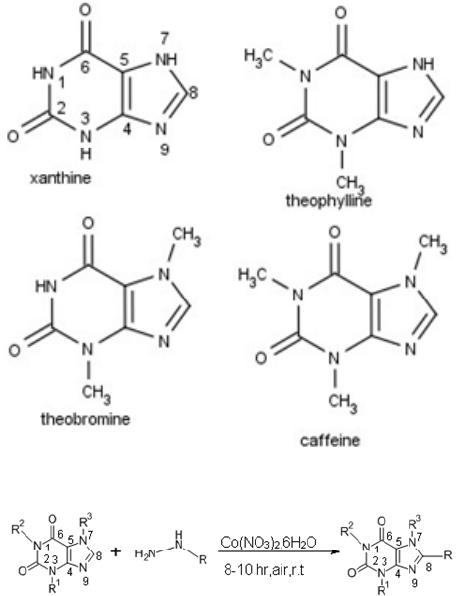 R. Suravajhala / Advances in Biological Chemistry 3 (2013) 521-524 522 Figure 1. Structures of xanthine and its derivatives. Figure 2. Preparation of C-8 substituted alkyl xanthines. in agreement with respect to molecular structures. While the following seven compounds synthesized, viz. 8-tert- butyl caffeine, 8-tertbutyl theophylline, 8-tertbutyl-3- isobutyl-1-methyl-theophylline,8-isopropyl -3- isobutyl- 1-methyl theophylline, 8-isopropyl caffeine,8-isopropyl theophylline and 8-isopropyl theobromine; had a con- version of 60% - 90% (See Table 1). These were further used to study their effect in cancer cell lines. However, two compounds, viz. 8-ethyl caffeine and 8-ethy tertbutyl theobromine were not considered due to their insolubility in aqeous solution. Although we tried to synthesize many compounds, we wereable to get good yields for se- condary and tertiary alkly hydrazines which have pre- dominantly yielded 8-substituted alkly xanthines The reaction of monoalkyl hydrazines with cobalt (III) in aqueous ammonia in the presence of atmospheric oxy- gen was analysed by 14N and 59Co NMR. A solution of 0.1 M Co(NO3)2 in 4 M NH3 provided a 59Co NMR sig- nal at 8759 ppm (line width at half height, Δυ½ = 11.2 kHz), which was assigned to the diamagnetic [(NH3)5CoOOCo(NH3)5]4+ and is in agreement with the literature [11]. Addition of a stoichiometric amount of a methyl hydrazine (or another alkyl hydrazine) to the so- lution resulted in immediate disappearance of the 59Co NMR signal. Rapid gas evolution (presumably O2) toge- ther with the disappearance of [(NH3)5CoOOCo(N H3)5]4+ was consistent with methyl hydrazine displacing the co- ordinated dioxygen to give a cobalt(III) compound. This was oxidized slowly to the [Co(NH3)5 (CH3)]2+ cation which was evident by the appearance of a 59Co signal at 7370 ppm (Δυ½ = 13.2 kHz) (Figure 3) [9]. Magnetic susceptibility measurements in solution fol- lowing Evans method [10] using tert-butanol with 1H NMR detection showed that a solution of 0.1 M Co(NO3)2 in 4 M NH3 was essentially diamagnetic and consistent with formation of the [(NH3)5CoOOCo(NH3)5]4+ cation. Addition of a stoichiometric amount of methyl hydrazine resulted in a paramagnetic species. This was consistent with the disappearance of the 59Co NMR sig- nal. Coordination of dioxygen to yield diamagnetic co- balt(III) complexes, as indicated by the 59Co NMR sig- nals, was conceivable indicating that dioxygen oxidizes the alkyl hydrazine via simultaneous coordination to the cobalt ion. Although many cobalt-dioxygen complexes are known to form in aqueous solution [11], to our knowledge, there are no reports on cobalt coordination compounds with both alkyl hydrazines and dioxygen ligands. Nevertheless, in view of many studies on co- balt-dioxygen complex formation with nitrogen donor ligands [12], it appears plausible that such species may form as intermediates. The 1H NMR spectra of the reac- tion mixtures showed that oxidation, e.g. of ethyl hydra- zine gives a [Co(NH3)5(CH2CH3)]2+ cation prior to xan- thine alkylation. The ethyl 1H NMR resonance signals of the ethyl hydrazine gradually decreased and instead, two new resonances at 3.90 and 3.97 ppm appeared. These were assigned to the [Co(NH3)5(CH2CH3)] 2+ cation by comparison with data for the isolated coordination com- pound [12]. The latter compound disappeared slowly and the for- mation of 8-ethylcaffeine was observed by the presence of appropriate 13C and 1H resonance signals along with 14N NMR studies. A solution of methyl hydrazine in 6 M NH3 yielded a broad 14N signal (−299 ppm); addition of a 25 M solution of Co(NO3)2 yielded signals correlating with -NH-NH2 (−262 ppm, −331 ppm). Thus we observe that the oxidation of hydrazine with cobalt(III) takes place prior to alkylation of the alkylated xanthine. This interpretation implies coordination of the alkyl hydrazine to cobalt(III) and is supported by the fact that methyl and ethyl hydrazine have been demonstrated to act as unidentate or bidentate bridging ligands towards cobalt(III) [13,14]. The rapid exchange reactions studied in alkylcobalt(III) complexes allow detection of alkyl radical released during the decomposition in aqueous solution. For example, in the case of pentaammine me- thylcobalt(III) complex [Co(NH3)2 (CH3)(NO3)2] the methyl radical can be trapped by α-phenyl-N-tert-butyl- nitrone (PBN) with the appearance of a (14N): 16.89 G signal, and furthermore, on addition of caffeine, there were no signals observed due to a methyl adduct of PBN. Copyright © 2013 SciRes. OPEN ACCESS  R. Suravajhala / Advances in Biological Chemistry 3 (2013) 521-524 Copyright © 2013 SciRes. 523 Table 1. The % conversion of C-8 substituted alkyl xanthines. Product R1 R 2 R 3 R Conversion Expected yeild mmol Isolated Yeild g/mmol 8-ethylcaffeine CH3 CH3 CH3Et 20% 0.16 10 mg/0.045 mmol 8-tert-butyl-3-isobutyl-1-methyl xanthine CH3 iBu H tBu85% 0.85 110 mg/0.39 mmol 8-tert-butylcaffeine CH3 CH3 CH3tBu55% 0.35 54 mg/0.2 mmol 8-tert-butyl theophylline CH3 CH3 H tBu95% 0.49 102 mg/0.43 mmol 8-tert-butyl theobromine H CH3 CH3tBu15% 0.1 16 mg/0.17 mmol 8-isopropyl -3-isobutyl-1-methyl xanthine CH3 iBu H iPr 70% 0.7 20 mg/0.75 mmol 8-isopropyl caffeine CH3 CH3 CH3iPr 58% 0.6 40 mg/0.16 mmol 8-isopropyl theophylline CH3 CH3 H iPr 67% 0.67 35 mg/0.15 mmol 8-isopropyl theobromine H CH3 CH3iPr 90% 0.9 30 mg/0.15 mmol Figure 3. 59Co NMR signal at δ = 8759 ppm [(NH3)5CoOOCo(NH3)5]4+ cation, and δ = 7370 ppm [Co(NH3)5(CH3)]2+ cation in DMSO-d6. OPEN ACCESS  R. Suravajhala / Advances in Biological Chemistry 3 (2013) 521-524 524 4. CONCLUSION We report that cobalt(III) in aqueous ammonia solution serves as a catalyst for obtaining new carbon-carbon bonds by homolytic aromatic substitution. The ammine- cobalt(III)-promoted aerial oxidation of alkyl hydrazines afforded alkyl radicals, and some primary alkyl radicals were trapped by pentaamminecobalt(III) to form alkyl cobalt(III) cations [15]. However, these compounds are labile and decomposed to return alkyl radicals. It has been previously shown that the [Co(NH3)5(CH3)]2+ cation acts as a methylating agent toward the C-8 atom of purine nucleotides [16-18]. We have applied a number of alkyl radicals for the preparation of C-8 substituted alkyl xan- thines. We were unable to obtain evidence of a cobalt(III) species with both an alkyl hydrazine ligand and a per- oxo ligand. However, this does not exclude the possibil- ity of such a species existing as a reactive intermediate. It may be speculated that a cobalt(III) species with both an alkyl hydrazine ligand and a peroxo ligand is very short- lived due to rapid oxidation of alkylhydrazine. 5. ACKNOWLEDGEMENTS Grateful appreciations towards financial support for the work carried out were rendered to the Danish Natural Science Research Council. The author thanks Drs. Pauli Kofod and AS Kumbhar for reviewing the manuscript. REFERENCES [1] S.M. Kaiser and R. J. Quinn, “Adenosine Receptors as Potential Therapeutic Targets,” Drug Discovery Today, Vol. 4, No. 12, 1999, pp. 542-551. http://dx.doi.org/10.1016/S1359-6446(99)01421-X [2] A. Tenzer and M. Pruschy, “Potentiation of DNA-Damage- Induced Cytotoxicity by G2Checkpoint Abrogators,” Current Medicinal Chemistry-Anti-Cancer Agents, Vol. 3, No. 1, 2003, pp. 35-46. http://dx.doi.org/10.2174/1568011033353533 [3] F. Borges, E. Fernandes and F. Roleira, “Progress to- wards the Discovery of Xanthine Oxidase Inhibitors,” Current Medicinal Chemistry, Vol. 9, No. 2, 2002, pp. 195-217. http://dx.doi.org/10.2174/0929867023371229 [4] F. Joo, “Aqueous Organometallic Catalysis,” Springer Series, Vol. 23, 2001, pp. 312-318. [5] S. Z. Zard, “Radical Reactions in Organic Synthesis,” Oxford University Press, Oxford, 2003. [6] M. F. Zady and J. L. Wong, “ Reactivities and Electronic Aspects of Nucleic Acid Heterocycles. Part 6. Kinetics and Mechanism of Carbon-8 Methylation of Purine Bases and Nucleosides by Methyl Radical,” Journal of the American Chemical Society, Vol. 99, No. 15, 1977, pp. 5096-5101. http://dx.doi.org/10.1021/ja00457a033 [7] E. Castagnino, S. Corsano, D. H. R. Barton and S. Z. Zard, “Decarboxylative Radical Addition onto Protonated Heteroaromatic Systems Including Purine Bases,” Tetra- hedron Letters, Vol. 27, No. 52, 1986, pp. 6337-6338. http://dx.doi.org/10.1016/S0040-4039(00)87802-8 [8] T. Itahara and N. Ide, “Free Radical Alkylation of 1,3- Dimethyluracils and Caffeine with Benzoyl Peroxide,” Bulletin of the Chemical Society of Japan, Vol. 65, No. 8, 1992, pp. 2045-2049. http://dx.doi.org/10.1246/bcsj.65.2045 [9] P. Kofod, “The Pentaamminemethylcobalt(III) Cation: Synthesis and Spectroscopic Characterization,” Inorganic Chemistry, Vol. 34, No. 10, 1995, pp. 2768-2770. http://dx.doi.org/10.1021/ic00114a040 [10] J. Evans, “Biomolecular NMR Methods,” Oxford Uni- versity Press, Oxford, 1995. [11] R. D. Jones, D. A. Summerville and F. Basolo, “Synthetic Oxygen Carriers Related to Biological Systems,” Chem- ical Reviews, Vol. 79, No. 2, 1979, pp. 139-179. http://dx.doi.org/10.1021/cr60318a002 [12] D. Nicholls, M. Rowley and R. Swindells, “Hydrazine Complexes of Cobalt(II) Chloride,” Journal of the Che- mical Society, Vol. 5, 1996, pp. 950-953. [13] A. Anagnostopoulos and D. J. Nicholls, “Some Complexes of Hydrazine, Methylhydrazine and 1,1-Dimethylhydra- zine with Cobalt(II) Salts,” Journal of Inorganic and Nuclear Chemistry, Vol. 38, No. 9, 1976, pp. 1615-1618. http://dx.doi.org/10.1016/0022-1902(76)80646-X [14] A. A. Rahman, M. P. Brown, M. M. Harding, C. E. Keggan and D. Nichols, “Coordination Compounds of Ethylhydrazine and 2,2,2-Trifluoroethylhydrazine; Crys- tal and Molecular Structure of Dichlorotetrakis(2,2,2- Trifluoroethylhydrazine) Nickel(II),” Polyhedron, Vol. 7, No. 13, 1988, pp. 1147-1152. http://dx.doi.org/10.1016/S0277-5387(00)81202-4 [15] P. Kofod, “Alkylcobalt(III) Compounds with Ammine Ligands,” Inorganic Chemistry Communications, Vol. 8, No. 10, 2005, pp. 943-946. http://dx.doi.org/10.1016/j.inoche.2005.07.014 [16] P. Kofod, “GMP and AMP as Methyl Radical Traps in the Reaction with Pentaamminemethylcobalt(III),” Jour- nal of Inorganic Biochemistry, Vol. 98, No. 11, 2004, pp. 1978-1980. http://dx.doi.org/10.1016/j.jinorgbio.2004.08.014 [17] S. C. F. Au-Yeung, S. Eaton and R. Donald, “A Model for Estimating 59Co nmr Chemical Shifts and Line Widths and Its Application to Cobalt Dioxygen Complexes,” Canadian Journal of Chemistry, Vol. 61, No. 10, 1983, pp. 2431-2441. http://dx.doi.org/10.1139/v83-420 [18] R. Suravajhala, N. Suri, M. Bhagat and A. K. Saxena, “Biological Evaluation of 8-Alkyl Xanthines as Potential Cytotoxic Agents,” Advances in Biological Chemistry, Vol. 3, No. 3, 2013, 314. Copyright © 2013 SciRes. OPEN ACCESS |