

Paper Menu >>
Journal Menu >>
 Journal of Biosciences and Medicines, 2013, 1, 22-25 JBM http://dx.doi.org/10.4236/jbm.2013.13005 Published Online December 2013 (http://www.scirp.org/journal/jbm/) OPEN ACCESS The comparison of the efficacy of swine FMD vaccine emulsified with oil adjuvant of ISA 201 VG or ISA 206 VG Dong Li*, Chunxue Zhou, Daliang She, Pinghua Li, Pu Sun, Xingwen Bai, Yingli Chen, Baoxia Xie, Zaixin Liu* State Key Laboratory of Veterinary Etiological Biology, Key Laboratory of Animal Virology of Ministry of Agriculture, OIE/Na- tional Foot and Mouth Disease reference laboratory of China, Lanzhou Veterinary Research Institute, Chinese Academy of Agricul- tural Sciences, Lanzhou, China Email: *[email protected], *[email protected] Received September 2013 ABSTRACT The Seppic Company developed a new adjuvant Montanide ISA 201 VG, the upgraded version of Montanide ISA 206 VG, which keep the advantage and added some chemical components on the basis of ISA 206 to improve the cellular responses. The aim of the study is to compare the efficacy of swine FMD (foot-a nd-mouth) vaccine emulsified with oil adjuvant of ISA 201 or ISA 206 respectively. The pigs were vaccinated with FMD vaccine emulsified with inactive FMD type O antigen and adjuvant ISA 201 or ISA 206 respectively, according to 2.0 ml (1/1 dose), 0.67 ml (1/3 dose), 0.22 ml (1/9 dose) to calculate their PD50. The sera were collected from the vaccination of the day 0, 3, 7, 14, 21, 28 and the ELISA FMD type O antibody were detected. Furthermore, the PD50 were calculated after the pigs were challenged with viru- lent FMDV type O on 28 days post vaccination. The ELISA antibody titers of 201vaccine were signifi- cantly higher than that of 206 (except the third time). The fifty percent of protection dose (PD50) of 201 vaccine (PD50 = 15.59) was higher than that of 206 vaccine (PD50 = 10.05). The above data showed that the efficacy of the FMD vaccine emulsified with ISA 201 was better than which with ISA 206. Keywords: Swine FMD Vaccine; Adjuvant; ISA 201; ISA 206; Immune Efficacy 1. INTRODUCTION Foot-and-mouth disease (FMD is an acute, febrile, and contagious vesicular disease affecting cloven-hoofed ani- mals. The causal agent, FMD virus (FMDV), is a mem- ber of the genus Aphthovirus in the family Picornaviri- dae and occurs as seven distinct serotypes throughout th e world: A, O, C, Asia1 and South African Terri torie s (SAT) 1-3 [1-3]. Vaccination is the most important control and eradication strategy for FMD, esp ecially the oil-adjuvant vaccine in developing countries. Significant advances in recent years have led to the introduction of ‘‘ready-to- formulate” oil adjuvants. Montanide ISA 206, the miner- al based oil, which readily forms water-in-oil-in-water emulsion. Its efficacy in eliciting immune response was studied in FMD vaccines against FMDV [4-7]. The advantage of oil adjuvant was attributed to depot formation at the site of injection, a vehicle for transport of the antigen throughout the lymphatic system and slow antigen release with the stimulation of antibody produc- ing cells. Moreover, being oil emulsion, Montanide ISA 206 had various advantages, like low viscosity, easy ad- ministration, longer term protection, greater stability and production of smaller nodules at the site of injec tion [5], compared to other oil adjuvants, making as an ideal ad- juvant candidate for FMD vaccines. It was also sug- gested that Montanide ISA 206 could prevent the loss of potency wa s due to the proteolysis o f VP1 or possibl y the physical breakdown of the virus followed adsorption to the aluminum hydroxide gel [8] and agree with the usage of Montanide ISA 206 ready to formulate oil adjuvant can be sued in all target species is ideal for emergency vaccination [9]. The usage of oil adjuvant (Montanide ISA 206) improve, enhance cell mediated immunity and give higher level and long lasting immunity [10,11]. Other researchers [12,13] detected that DOE vaccine containing Montanide ISA 206 is highly efficient, fluidy with low viscosity which is easily dispersed from the place of injection and gave high Ab titers and longest duration of immunity than alhdyragel vaccine and Daoud reported that the duration of immunity elicited by gel FMD vaccine was short lived and antibody concentra- tions rapidly fall after administration, while oils adju- ventated FMD vaccines gave a longer duration of im- munity and suggested that the oil adjuvenated vaccines *Corresponding a uthors. 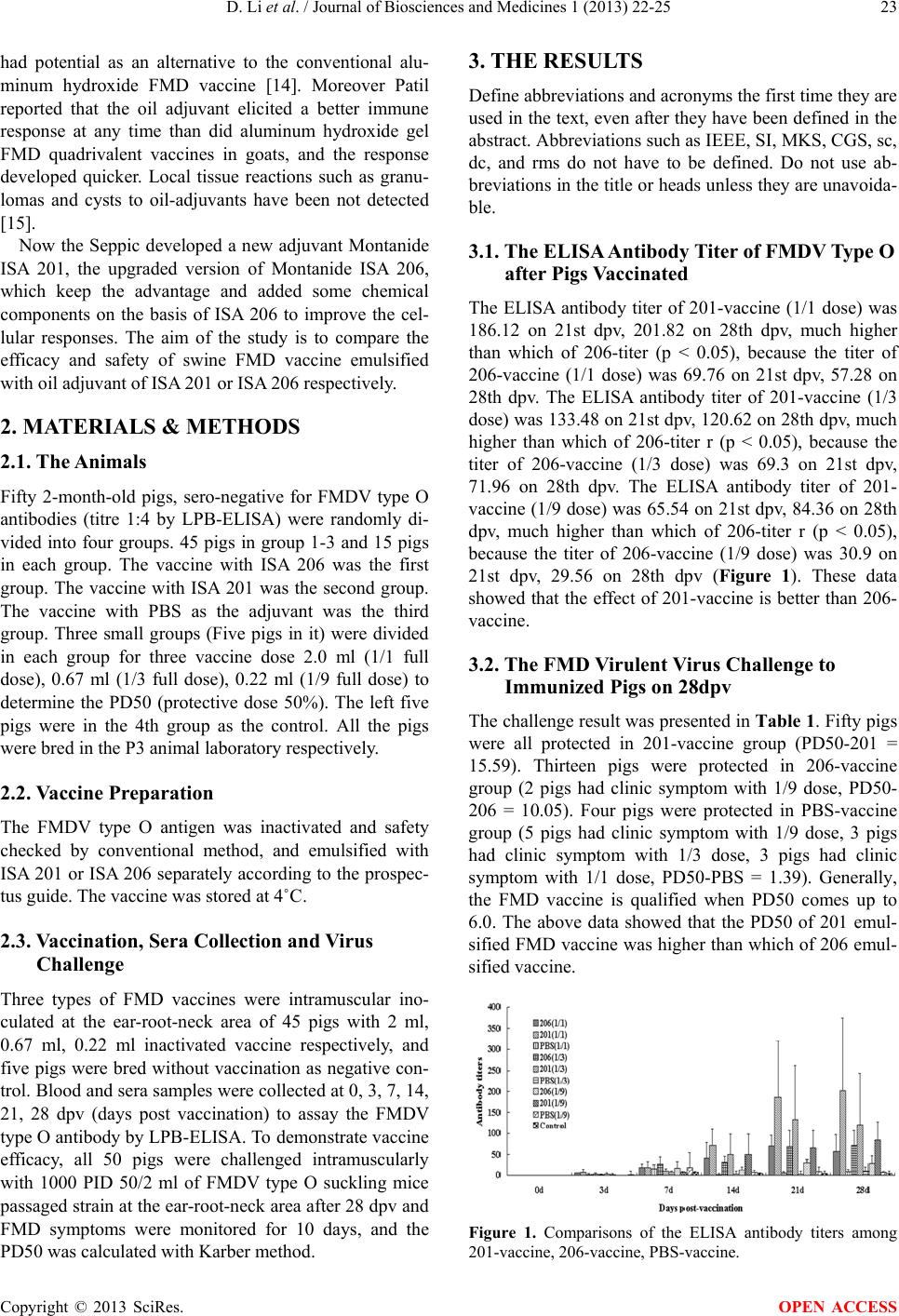 D. Li et al. / Journal of Biosciences and Medicines 1 (2013) 22-25 Copyright © 2013 SciRes. OPEN ACCESS 23 had potential as an alternative to the conventional alu- minum hydroxide FMD vaccine [14]. Moreover Patil reported that the oil adjuvant elicited a better immune response at any time than did aluminum hydroxide gel FMD quadrivalent vaccines in goats, and the response developed quicker. Local tissue reactions such as granu- lomas and cysts to oil-adjuvants have been not detected [15]. Now the Seppic developed a new adjuvant Montanide ISA 201, the upgraded version of Montanide ISA 206, which keep the advantage and added some chemical components on the basis of ISA 206 to improve the cel- lular responses. The aim of the study is to compare the efficacy and safety of swine FMD vaccine emulsified with oil ad juvant of ISA 201 or ISA 2 0 6 respecti ve l y. 2. MATERIALS & METHODS 2.1. The Animals Fifty 2-month-old pigs, sero-negative for FMDV type O antibodies (titre 1:4 by LPB-ELISA) were randomly di- vided into four groups. 45 pigs in group 1-3 and 15 pigs in each group. The vaccine with ISA 206 was the first group. The vaccine with ISA 201 was the second group. The vaccine with PBS as the adjuvant was the third group. Three small groups (Five pigs in it) were divided in each group for three vaccine dose 2.0 ml (1/1 full dose), 0.67 ml (1/3 full dose), 0. 22 ml (1/9 full dose) to determine the PD50 (protective dose 50%). The left five pigs were in the 4th group as the control. All the pigs were bred in the P3 animal laboratory respectively. 2.2. Vaccine Preparation The FMDV type O antigen was inactivated and safety checked by conventional method, and emulsified with ISA 201 or ISA 206 separately according to the prospec- tus guide . The vacc ine was stored at 4˚C. 2.3. Vaccination, Sera Collection and Virus Challenge Three types of FMD vaccines were intramuscular ino- culated at the ear-root-neck area of 45 pigs with 2 ml, 0.67 ml, 0.22 ml inactivated vaccine respectively, and five pigs were bred without vaccination as negative con- trol. Blood and sera samples were collected at 0, 3, 7, 14, 21, 28 dpv (days post vaccination) to assay the FMDV type O antibody by L PB -ELISA. To demonstrate vaccin e efficacy, all 50 pigs were challenged intramuscularly with 1000 PID 50/2 ml of FMDV type O suckling mice passaged strain at the ear-root-neck area after 28 dpv and FMD symptoms were monitored for 10 days, and the PD50 was calculated with Karber method. 3. THE RESULTS Define abbreviations and acronyms the first time they are used in the text, even after they have been defined in the abstract. Abbreviations such as IEEE, SI, MKS, CGS, sc, dc, and rms do not have to be defined. Do not use ab- breviations in the title or heads unless they are unavoida- ble. 3.1. The ELISA Antibody Titer of FMDV Type O after Pigs Vaccinated The ELISA antibody titer of 201-vaccine (1/1 dose) was 186.12 on 21st dpv, 201.82 on 28th dpv, much higher than which of 206-titer (p < 0.05), because the titer of 206-vaccine (1/1 dose) was 69.76 on 21st dpv, 57.28 on 28th dpv. The ELISA antibody titer of 201-vaccine (1/3 dose) was 133.48 on 21st dpv, 120.62 on 28th dpv, much higher than which of 206-titer r (p < 0.05), because the titer of 206-vaccine (1/3 dose) was 69.3 on 21st dpv, 71.96 on 28th dpv. The ELISA antibody titer of 201- vaccine (1/9 dose) was 65.54 on 21st dpv, 84.36 on 28th dpv, much higher than which of 206-titer r (p < 0.05), because the titer of 206-vaccine (1/9 dose) was 30.9 on 21st dpv, 29.56 on 28th dpv (Figure 1). These data showed that the effect of 201-vaccine is better than 206- vaccine. 3.2. The FMD V irule nt Virus Challenge to Immunized Pigs on 28dpv The challenge result was presented in Table 1. Fifty pig s were all protected in 201-vaccine group (PD50-201 = 15.59). Thirteen pigs were protected in 206-vaccine group (2 pigs had clinic symptom with 1/9 dose, PD50- 206 = 10.05). Four pigs were protected in PBS-vaccine group (5 pigs had clinic symptom with 1/9 dose, 3 pigs had clinic symptom with 1/3 dose, 3 pigs had clinic symptom with 1/1 dose, PD50-PBS = 1.39). Generally, the FMD vaccine is qualified when PD50 comes up to 6.0. The above data showed that the PD50 of 201 emul- sified FMD vaccine was higher than which of 206 emul- sified vaccine. Figure 1. Comparisons of the ELISA antibody titers among 201-vaccine, 206-vaccine, PBS-vaccine. 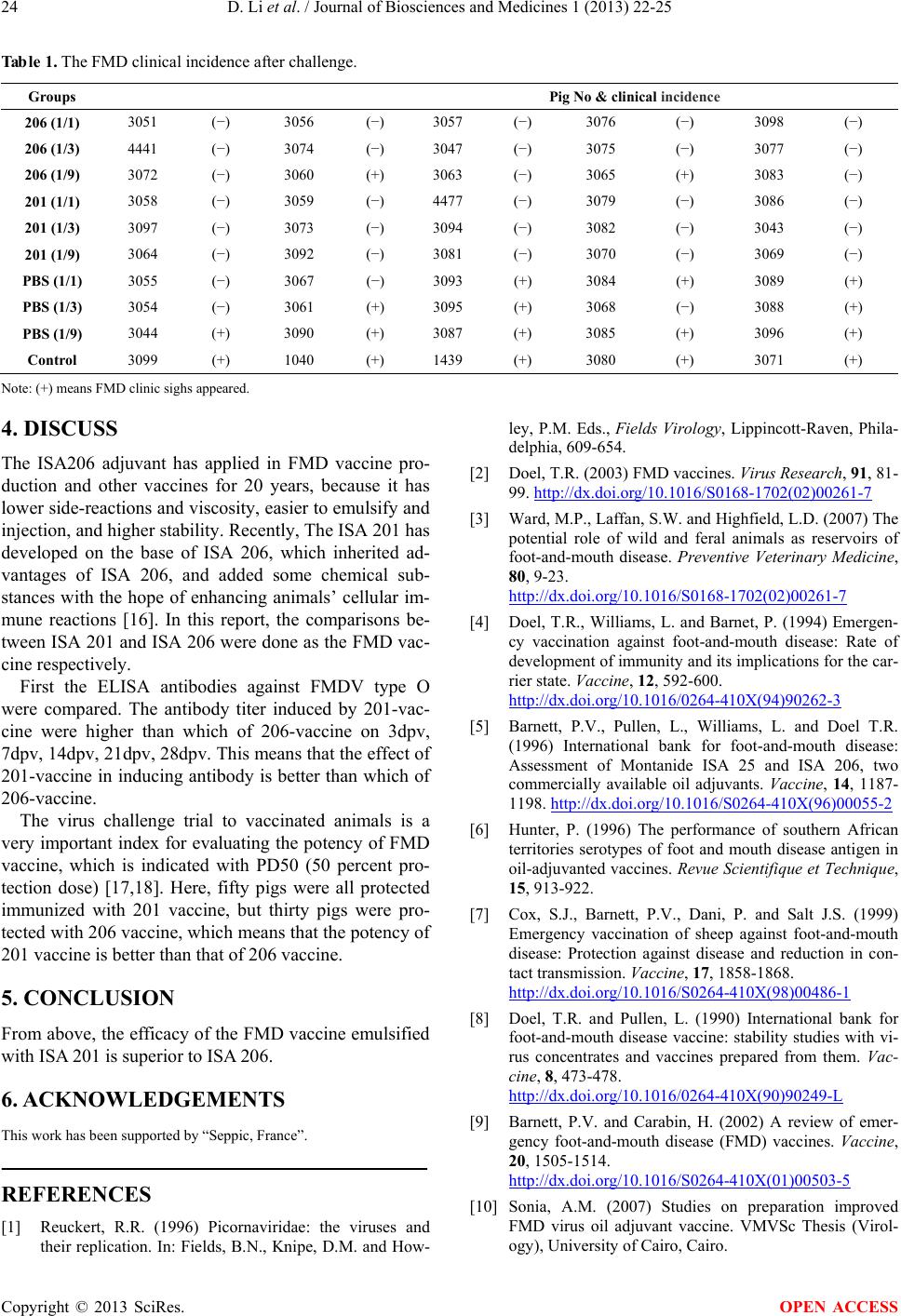 D. Li et al. / Journal of Biosciences and Medicines 1 (2013) 22-25 Copyright © 2013 SciRes. OPEN ACCESS 24 Table 1. The FMD clinical incidence after challenge. Groups Pig No & clinical incidence 206 (1/1) 3051 (−) 3056 (−) 3057 (−) 3076 (−) 3098 (−) 206 (1/3) 4441 (−) 3074 (−) 3047 (−) 3075 (−) 3077 (−) 206 (1/9) 3072 (−) 3060 (+) 3063 (−) 3065 (+) 3083 (−) 201 (1/1) 3058 (−) 3059 (−) 4477 (−) 3079 (−) 3086 (−) 201 (1/3) 3097 (−) 3073 (−) 3094 (−) 3082 (−) 3043 (−) 201 (1/9) 3064 (−) 3092 (−) 3081 (−) 3070 (−) 3069 (−) PBS (1/1) 3055 (−) 3067 (−) 3093 (+) 3084 (+) 3089 (+) PBS (1/3) 3054 (−) 3061 (+) 3095 (+) 3068 (−) 3088 (+) PBS (1/9) 3044 (+) 3090 (+) 3087 (+) 3085 (+) 3096 (+) Control 3099 (+) 1040 (+) 1439 (+) 3080 (+) 3071 (+) Note: (+) means FMD clinic sighs appeared. 4. DISCUSS The ISA206 adjuvant has applied in FMD vaccine pro- duction and other vaccines for 20 years, because it has lower side-reactions and viscosity, easier to emulsify and injection, and higher stability. Recen tly, T he ISA 201 has developed on the base of ISA 206, which inherited ad- vantages of ISA 206, and added some chemical sub- stances with the hope of enhanci ng animals’ cellular im- mune reactions [16]. In this report, the comparisons be- tween ISA 201 and ISA 206 were done as the FMD vac- cine respectively. First the ELISA antibodies against FMDV type O were compared. The antibody titer induced by 201-vac- cine were higher than which of 206-vaccine on 3dpv, 7dpv, 14dp v, 21 dpv , 2 8dpv. This means that the effect of 201-vaccine in inducing antibody is better than which of 206-vaccine. The virus challenge trial to vaccinated animals is a very important index for evaluating the potency of FMD vaccine, which is indicated with PD50 (50 percent pro- tection dose) [17,18]. Here, fifty pigs were all protected immunized with 201 vaccine, but thirty pigs were pro- tected with 206 vaccine, which means that the potency of 201 vacci ne is better than that of 206 va c c i ne. 5. CONCLUSION From above, the efficacy of the FMD vaccine emulsified with ISA 201 is su pe rior to ISA 206. 6. ACKNOWLEDGEMENTS This work has been supported by “Seppic, France”. REFERENCES [1] Reuckert, R.R. (1996) Picornaviridae: the viruses and their replication. In: Fields, B.N., Knipe, D.M. and How- ley, P.M. Eds., Fields Virology, Lippincott-Raven, Phila- delphia, 609-654. [2] Doel, T.R. (2003) FMD vaccines. Virus Research, 91, 81- 99. http://dx.doi.org/10.1016/S0168-1702(02)00261-7 [3] Ward, M.P., Laffan, S.W. and Highfield, L.D. (2007) The potential role of wild and feral animals as reservoirs of foot-and-mouth disease. Preventive Veterinary Medicine, 80, 9-23. http://dx.doi.org/10.1016/S0168-1702(02)00261-7 [4] Doel, T.R., Williams, L. and Barnet, P. (1994) Emergen- cy vaccination against foot-and-mouth disease: Rate of development of immunity and its implications for the car- rier state. Vaccine, 12, 592-600. http://dx.doi.org/10.1016/0264-410X(94)90262-3 [5] Barnett, P.V., Pullen, L., Williams, L. and Doel T.R. (1996) International bank for foot-and-mouth disease: Assessment of Montanide ISA 25 and ISA 206, two commercially available oil adjuvants. Vaccine, 14, 1187- 1198. http://dx.doi.org/10.1016/S0264-410X(96)00055-2 [6] Hunter, P. (1996) The performance of southern African territories serotypes of foot and mouth disease antigen in oil-adjuvanted vaccines. Revue Scientifique et Technique, 15, 913-922. [7] Cox, S.J., Barnett, P.V., Dani, P. and Salt J.S. (1999) Emergency vaccination of sheep against foot-and-mouth disease: Protection against disease and reduction in con- tact transmission. Vaccine, 17, 1858-1868. http://dx.doi.org/10.1016/S0264-410X(98)00486-1 [8] Doel, T.R. and Pullen, L. (1990) International bank for foot-and-mouth disease vaccine: stability studies with vi- rus concentrates and vaccines prepared from them. Vac- cine, 8, 473-478. http://dx.doi.org/10.1016/0264-410X(90)90249-L [9] Barnett, P.V. and Carabin, H. (2002) A review of emer- gency foot-and-mouth disease (FMD) vaccines. Vaccine, 20, 1505-1514. http://dx.doi.org/10.1016/S0264-410X(01)00503-5 [10] Sonia, A.M. (2007) Studies on preparation improved FMD virus oil adjuvant vaccine. VMVSc Thesis (Virol- ogy), University of Cairo, Cairo.  D. Li et al. / Journal of Biosciences and Medicines 1 (2013) 22-25 Copyright © 2013 SciRes. OPEN ACCESS 25 [11] Fatthia, A.M. (2003) Vaccination of goats with FMD vaccines. VMVSc Thesis (Infectious Disease), University of Alexandria, Alexandria. [12] Mohamed, A.A. (1998) Study on new double oil adjuvant for FMD virus vaccine. VMVSc Thesis (Virology), Uni- versity of Cairo, Cairo. [13] Wafaa, E.H. (1999) Epizootiological and immunological Studies on Foot and Mouth Disease. Ph.D. Thesis (Infec- tious Disease), University of Cairo, Cairo. [14] Daoud, A.M., Ali, S.M. and Yousef, M.R. (2002) Com- parative study between different new oil adjuvants used for production of FMD vaccine in sheep. 4th Internation- al Science Conference, 667-673. [15] Patil, P.K., Bayry, J., Ramakrishna, C., Hugar, B., Misra, L.D. and Prabhudas, K. (2002) Immune responses of sheep to quadrivalent double emulsion foot-and-mouth disease vaccines: Rate of development of immunity and variations among other ruminants. Journal of Clinical Microbiology, 40, 4367-4371. http://dx.doi.org/10.1016/S0264-410X(01)00503-5 [16] http://www.seppic.com/animal-health/vaccine-adjuvant/ montanide-isa [17] http://www.oie.int/ [18] Li, D., Lu, Z.J., Xie, B.X., Sun, P., Chen, Y.L., Fu, Y.F. and Liu, Z.X. (2010) Alternative way to test the efficacy of swine FMD vaccines: Regulation of live virus chal- lenge dose. Virology Journal, 7, 215. http://dx.doi.org/10.1186/1743-422X-7-215 |