

Paper Menu >>
Journal Menu >>
 Soft, 2013, 2, 19-26 Published Online December 2013 (http://www.scirp.org/journal/soft) http://dx.doi.org/10.4236/soft.2013.24005 Open Access Soft Thermo- and pH-Responsive Hydrogels Based on N-Isopropylacrylamide and Allylamine Copolymers Victoria Konovalova1, Yuri Samchenko2, Ganna Pobigai1, Anatoly Burban1, Zoya Ulberg2 1Department of Chemistry, National University of Kiev-Mohyla Academy, Kiev, Ukraine 2Institute of Biocolloidal Chemistry, National Academy of Sciences of Ukraine, Kiev, Ukraine Email: [email protected] Received October 17, 2013; revised November 19, 2013; accepted December 5, 2013 Copyright © 2013 Victoria Konovalova et al. This is an open access article distributed under the Creative Commons Attribution License, which permits unrestricted use, distribution, and reproduction in any medium, provided the original work is properly cited. ABSTRACT The thermo- and pH-responsive hydrogels were synthesized via copolymerization of N-isopropylacrylamide and al- lylamine hydrochloride monomers. The equilibrium swelling of the hydrogels was studied as a function of temperature and pH in aqueous solutions. It was shown that controlled alteration of the hydrogel phase transition temperature can be achieved by changing their composition and pH of the environment. Increase in content of hydrophilic allylamine from 10 to 60 wt% in monomer mixture causes a shift of the phase transition temperature from 35˚C to 47˚C. Hydrogels with N-isopropylacrylamide/allylamine hydrochloride mass ratio of 3:2 show the highest pH-response. Values of average molecular weight between polymer cross-links, c M , and Flory parameter, χ, were calculated using temperature de- pendences of the equilibrium swelling of the synthesized hydrogel. Keywords: Thermo-Responsive Hydrogels; Copolymer Hydrogels; Allylamine Hydrochloride; N-Isopropyl-Acrylamide; The Parameter of Flory 1. Introduction Polymer hydrogels are one of the most promising bio- medical materials in controlled drug delivery, immuno- assays, biotechnology, separation processes, etc. [1-3]. Stimuli-responsive hydrogels are of special interest ena- bling a variety of approaches in the development of smart materials. Thermo-sensitive hydrogels undergo an abrupt structural transition from the swollen to collapsed state at transition temperature (Tp). Important properties of thermo- sensitive hydrogels are temperature range, at which the network collapses, as well as the rate of the system re- sponse to the outer stimulus. Poly-N-isopropylacrylanide (PNIPA) is one of the most studied temperature-sensitive polymers [3-7]. At room temperature, polymer chains of (co)polymers based on NIPA adopt expanded conformation with high affinity to water due to intensive hydrogen bonding. Solutions are homogenous and clear [8]. As the temperature in- creases, molecular vibrations weaken H-bonds and water molecules migrate from the polymer. Hydrophobicity of the polymer chains increases and eventually this change initiates phase separation due to polymer aggregation and precipitation when temperature is higher than Tp [7]. The phase transition is reversible and is initiated by the slight temperature changes in both directions within Tp region. Similar transition takes place in hydrogels, which are cross-linked materials. Phase transition of poly-NIPA- based hydrogels occurs in a narrow temperature range between 32˚C and 34˚C. This temperature interval is very close to the temperature of a human body, though not reaching it, which limits some biomedical applications of thermo-sensitive hydrogels. Other disadvantages of the poly-NIPA-based hydrogels include their poor mechanic- cal strength and weak pH sensitivity. There are several ways to influence the transition temperature by controlling the hydrophilic-hydrophobic balance of a macromolecular system. This is achievable by changes in composition of both aqueous media and polymer molecular structure. They include variations in the solution ionic strength [4], introduction of surfactants [5] or changes in ratio of hydrophilic and hydrophobic units in the hydrogel polymer structure [6,7]. These fac- tors also influence the temperature range of the hydrogel thermo-stimulated response [9]. Both an abrupt discrete [10,11] and discontinuous [12] decrease in swelling de- gree at temperature rise are described in literature. Thus  V. KONOVALOVA ET AL. 20 it was shown that continuous phase transition transforms into discrete one with the decrease in cross-linking den- sity of NIPA-based hydrogels [13]. Non-ionized NIPA- based gels are characterized by continuous phase transi- tion, while phase transformation of ionized hydrogels is of discrete nature [14]. On the contrary, only continuous phase transition was observed for NIPA/acrylamide (AA) hydrogels [15]. Such a behavior was explained by the weakening of the aggregation of dehydrated NIPA chains at high temperatures due to the presence of highly hy- drophilic acrylamide moieties. Several publications [9,16] deal with mathematical modeling of the above-mentioned process, though this problem is still unclear and needs father investigation. Thermosensitivity can be combined with pH-sensitiv- ity via introduction of ionic moieties into the hydrogel structure [17,18]. Such a combination enhances pur- poseful controlling of hydrogels properties and thereby their applications. Incorporation of residues containing weak acidic groups causes the hydrogel collapse at lower pH and, vice versa, weak basic groups in the polymer structure lead to the phase transition at higher pH values. Temperature and pH influence on physical and chemical properties of NIPA co-polymers with non-ionogenic monomers (acrylamide, acrylonitrile, methylacrylate) and with ionogenic acidic monomer (acrylic acid) were stud- ied in detail in [19,20]. In this study, hydrogels based on NIPA copolymer with a basic monomer, allylamine, have been synthesized. Contrary to vinyl monomers allyl ones are known to po- lymerize with little yields due to high stability of the relevant radical and prevailing side reactions. In the pre- sent work, corresponding copolymer hydrogels were syn- thesized using allylamine hydrochloride. Introduction of AlAm component improves the me- chanical strength of PNIPA hydrogels and adds pH-sen- sivity to the system. The effect of external stimuli such as the pH and temperature on the equilibrium swelling ra- tios of these hydrogels was investigated. Values of aver- age molecular weight between polymer cross-links, c M , and Flory parameter, χ, were calculated using tempera- ture dependences of the equilibrium swelling of the hy- drogel synthesized. Such hydrogels have potential in the development of smart both pH-and thermo-responsive membranes, systems for targeted drug delivery, sensors, etc. 2. Experimental Sigma-Aldrich reagents were used to synthesize the hy- drogels. NIPA was recrystallizated from hexane. A cross- linking agent, N,N-methylenebisacrylamide (MBA), and components of redox initiating system, ammonium per- sulphate (APS) and tetramethylethylenediamine (TEMED), were used without further purification. Allylaminehydro- cloride (AlAmH) was synthesized via allylamine reaction with gaseous hydrochloride acid. 30 g of allylimine were dissolved in 300 cm3 of anhydrous diethyl ether and cooled to −15˚C. Gaseous HCl was allowed to bubble through the solution for one hour until white precipitate of allylamine hydrochloride was formed. White AlAmH crystals were filtered out and dried un- der vacuum at room temperature. Molecular structure of the product obtained was confirmed NMR spectroscopy. NMR spectra of allylamine hydrochloride are given in Figure 1 Contrary to unprotonated monomer (see spec- tral base of given organic compounds SDBS, No. 4258H SP-00-733)[http://rio db01.ibase.aist.go.jp /sdbs/cgi-bin /di rect_frame_top.cgi], amino-group protons of which pos- ses singlet with chemical shift 1.29 m.d., corresponding allylamine hydrochloride protons are characterized by singlet at 8.4 m.d.(Figure 1). 2.1. Synthesis of P(NIPA-co-AlAm) Hydrogels P(NIPA-co-AlAmH) hydrogels were synthesized by free- radical crosslinking copolymerization of NIPA and AlAmH in aqueous solutions. APS (0.056 M) and TEMED (0.32 M) were used as the redox initiator system (see Scheme 1). Cross-linking agent content was 0.125 wt% with re- spect to monomer amount and a total monomer concen- tration was 21 wt%. AlAmH concentration in the mixture with NIPA was varied in the range between 0 to 60 wt%. Monomer concentrations and the corresponding NIPA/ AlAm mass ratio of synthesized hydrogels are summa- rized in Table 1. Polymerisation was performed at about 0˚C in argon atmosphere. 2.2. Characterization NMR NMR spectra were obtained using the spectrometer Bruker 400 Avance (1 H 400.08 MHz) with dimethyl- sulfoxide as a solvent. Impulse duration constituted 12.15 microseconds, the receiver amplification being 39, ac- cumulation time −2.25 sec., and measurement tempera- ture −293 K. Swelling Measurements For the swelling measurements, the hydrogels were synthesized, washed in distillated water and then neu- tralized by 2 M NaOH during 24 h and then washed again up to pH = 7. Netralized hydrogels were dried and then immersed in buffer solution at pH at 1.69, 6.86 and 9.18 that corresponding ionic strength 0.05; 0.1; and 0.03 mol/dm3 respectively. Equilibrium swelling ratio was determined in the temperature range from 5˚C to 53˚C. The hydrogels were weighed at different times until the hydrated weight remained constant. Swelling ratio was Open Access Soft 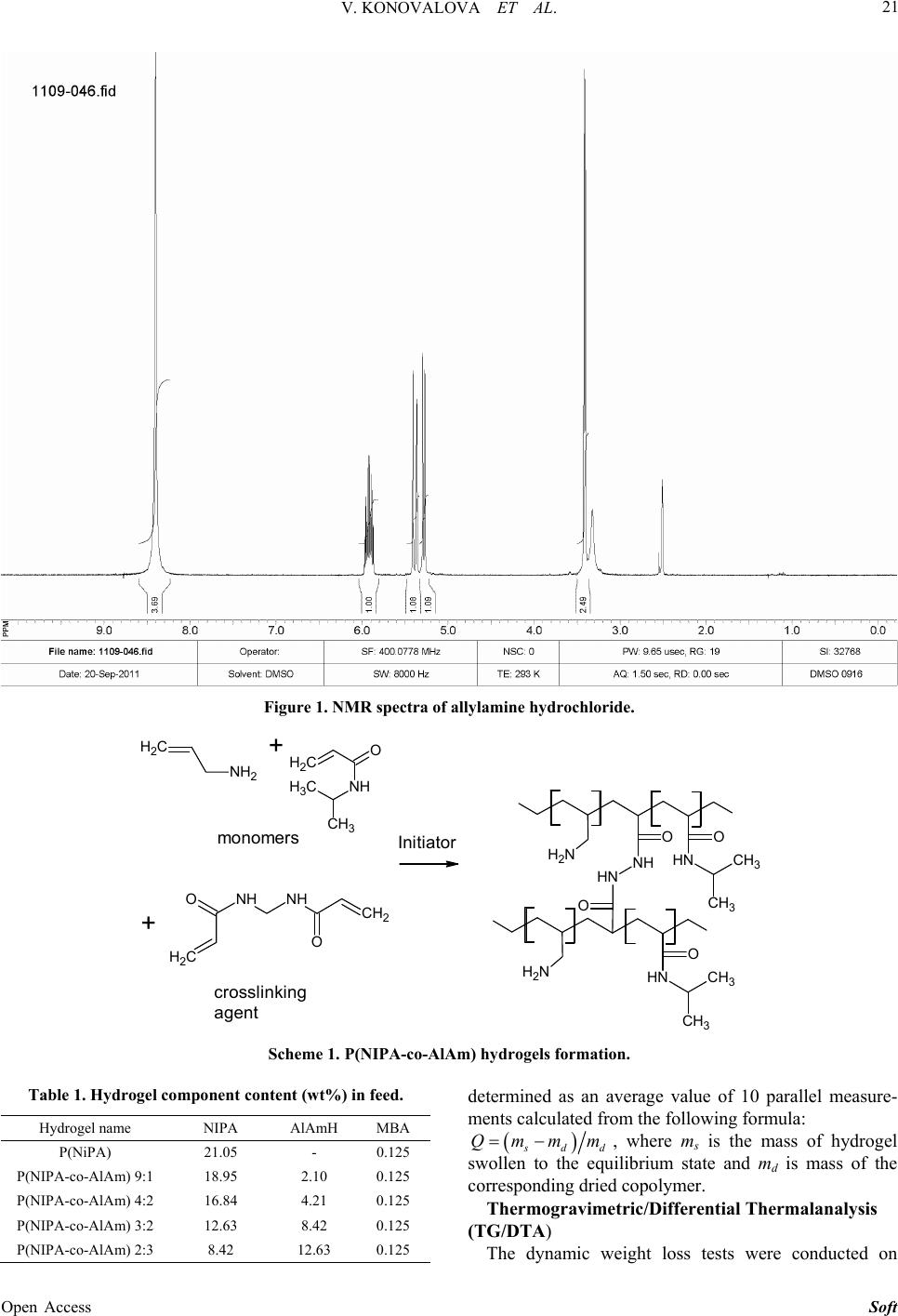 V. KONOVALOVA ET AL. Open Access Soft 21 Figure 1. NMR spectra of allylamine hydrochloride. NH NHO CH2 O CH2 + + crosslinking agent monomers CH2O NH CH3 CH3 CH2 NH2 AA NH2 O NH NH O O NH CH3 CH3 AA NH2 O NHCH 3 CH3 Initiator Scheme 1. P(NIPA-co-AlAm) hydrogels formation. Table 1. Hydrogel component content (wt%) in feed. Hydrogel name NIPA AlAmH MBA P(NiPA) 21.05 - 0.125 P(NIPA-co-AlAm) 9:1 18.95 2.10 0.125 P(NIPA-co-AlAm) 4:2 16.84 4.21 0.125 P(NIPA-co-AlAm) 3:2 12.63 8.42 0.125 P(NIPA-co-AlAm) 2:3 8.42 12.63 0.125 determined as an average value of 10 parallel measure- ments calculated from the following formula: s dd Qmmm , where ms is the mass of hydrogel swollen to the equilibrium state and md is mass of the corresponding dried copolymer. Thermogravimetric/Differential Thermalanalysis (TG/DTA) The dynamic weight loss tests were conducted on 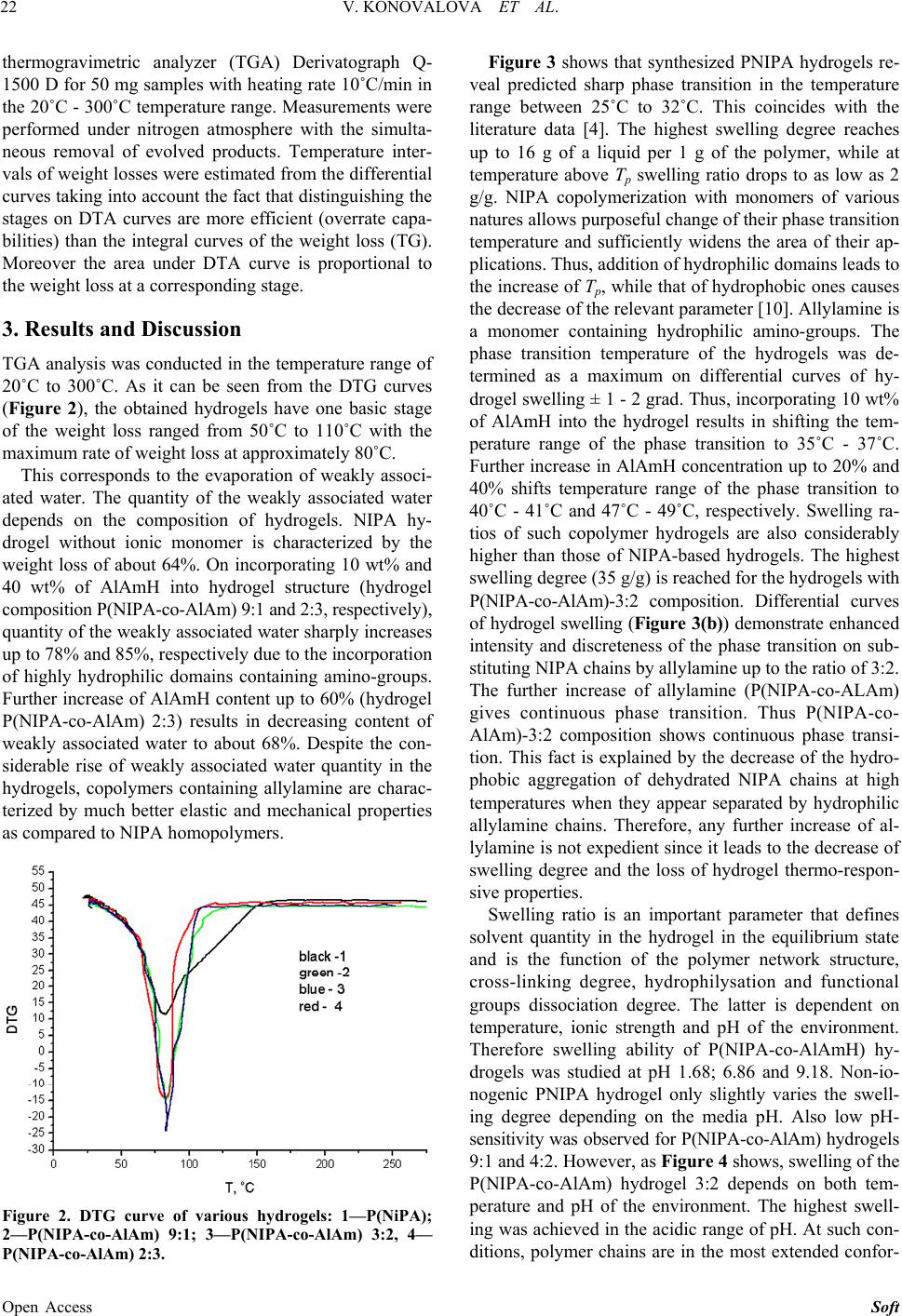 V. KONOVALOVA ET AL. 22 thermogravimetric analyzer (TGA) Derivatograph Q- 1500 D for 50 mg samples with heating rate 10˚C/min in the 20˚C - 300˚C temperature range. Measurements were performed under nitrogen atmosphere with the simulta- neous removal of evolved products. Temperature inter- vals of weight losses were estimated from the differential curves taking into account the fact that distinguishing the stages on DTA curves are more efficient (overrate capa- bilities) than the integral curves of the weight loss (TG). Moreover the area under DTA curve is proportional to the weight loss at a corresponding stage. 3. Results and Discussion TGA analysis was conducted in the temperature range of 20˚C to 300˚C. As it can be seen from the DTG curves (Figure 2), the obtained hydrogels have one basic stage of the weight loss ranged from 50˚C to 110˚C with the maximum rate of weight loss at approximately 80˚C. This corresponds to the evaporation of weakly associ- ated water. The quantity of the weakly associated water depends on the composition of hydrogels. NIPA hy- drogel without ionic monomer is characterized by the weight loss of about 64%. On incorporating 10 wt% and 40 wt% of AlAmH into hydrogel structure (hydrogel composition P(NIPA-co-AlAm) 9:1 and 2:3, respectively), quantity of the weakly associated water sharply increases up to 78% and 85%, respectively due to the incorporation of highly hydrophilic domains containing amino-groups. Further increase of AlAmH content up to 60% (hydrogel P(NIPA-co-AlAm) 2:3) results in decreasing content of weakly associated water to about 68%. Despite the con- siderable rise of weakly associated water quantity in the hydrogels, copolymers containing allylamine are charac- terized by much better elastic and mechanical properties as compared to NIPA homopolymers. Figure 2. DTG curve of various hydrogels: 1—P(NiPA); 2—P(NIPA-co-AlAm) 9:1; 3—P(NIPA-co-AlAm) 3:2, 4— P(NIPA-co-AlAm) 2:3. Figure 3 shows that synthesized PNIPA hydrogels re- veal predicted sharp phase transition in the temperature range between 25˚C to 32˚C. This coincides with the literature data [4]. The highest swelling degree reaches up to 16 g of a liquid per 1 g of the polymer, while at temperature above Tp swelling ratio drops to as low as 2 g/g. NIPA copolymerization with monomers of various natures allows purposeful change of their phase transition temperature and sufficiently widens the area of their ap- plications. Thus, addition of hydrophilic domains leads to the increase of Tp, while that of hydrophobic ones causes the decrease of the relevant parameter [10]. Allylamine is a monomer containing hydrophilic amino-groups. The phase transition temperature of the hydrogels was de- termined as a maximum on differential curves of hy- drogel swelling ± 1 - 2 grad. Thus, incorporating 10 wt% of AlAmH into the hydrogel results in shifting the tem- perature range of the phase transition to 35˚C - 37˚C. Further increase in AlAmH concentration up to 20% and 40% shifts temperature range of the phase transition to 40˚C - 41˚C and 47˚C - 49˚C, respectively. Swelling ra- tios of such copolymer hydrogels are also considerably higher than those of NIPA-based hydrogels. The highest swelling degree (35 g/g) is reached for the hydrogels with P(NIPA-co-AlAm)-3:2 composition. Differential curves of hydrogel swelling (Figure 3(b)) demonstrate enhanced intensity and discreteness of the phase transition on sub- stituting NIPA chains by allylamine up to the ratio of 3:2. The further increase of allylamine (P(NIPA-co-ALAm) gives continuous phase transition. Thus P(NIPA-co- AlAm)-3:2 composition shows continuous phase transi- tion. This fact is explained by the decrease of the hydro- phobic aggregation of dehydrated NIPA chains at high temperatures when they appear separated by hydrophilic allylamine chains. Therefore, any further increase of al- lylamine is not expedient since it leads to the decrease of swelling degree and the loss of hydrogel thermo-respon- sive properties. Swelling ratio is an important parameter that defines solvent quantity in the hydrogel in the equilibrium state and is the function of the polymer network structure, cross-linking degree, hydrophilysation and functional groups dissociation degree. The latter is dependent on temperature, ionic strength and pH of the environment. Therefore swelling ability of P(NIPA-co-AlAmH) hy- drogels was studied at pH 1.68; 6.86 and 9.18. Non-io- nogenic PNIPA hydrogel only slightly varies the swell- ing degree depending on the media pH. Also low pH- sensitivity was observed for P(NIPA-co-AlAm) hydrogels 9:1 and 4:2. However, as Figure 4 shows, swelling of the P(NIPA-co-AlAm) hydrogel 3:2 depends on both tem- perature and pH of the environment. The highest swell- ing was achieved in the acidic range of pH. At such con- ditions, polymer chains are in the most extended confor- Open Access Soft 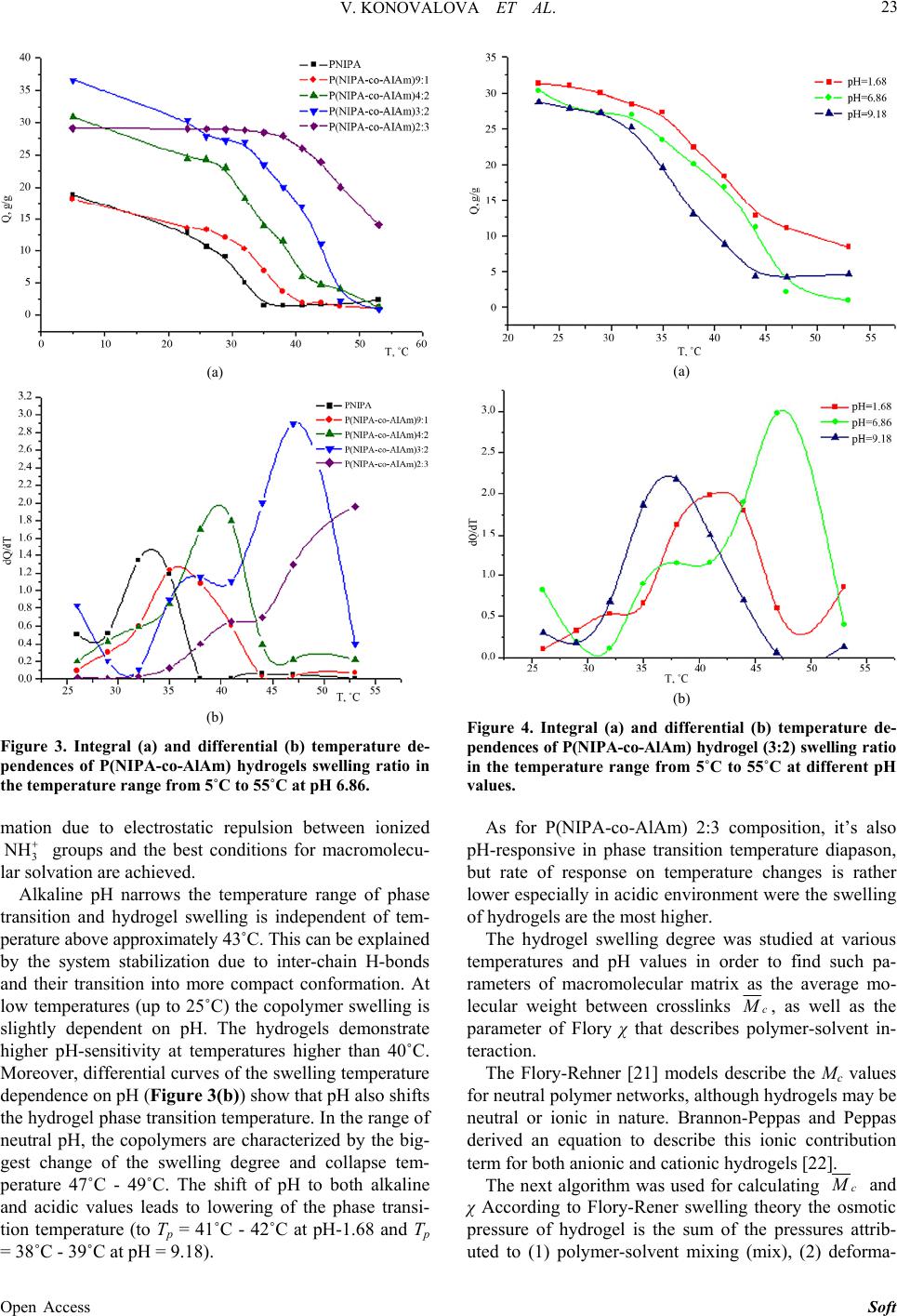 V. KONOVALOVA ET AL. Open Access Soft 23 (a) (a) (b) (b) Figure 4. Integral (a) and differential (b) temperature de- pendences of P(NIPA-co-AlAm) hydrogel (3:2) swelling ratio in the temperature range from 5˚C to 55˚C at different рН values. Figure 3. Integral (a) and differential (b) temperature de- pendences of P(NIPA-co-AlAm) hydrogels swelling ratio in the temperature range from 5˚C to 55˚C at рН 6.86. mation due to electrostatic repulsion between ionized 3 groups and the best conditions for macromolecu- lar solvation are achieved. NH As for P(NIPA-co-AlAm) 2:3 composition, it’s also pH-responsive in phase transition temperature diapason, but rate of response on temperature changes is rather lower especially in acidic environment were the swelling of hydrogels are the most higher. Alkaline pH narrows the temperature range of phase transition and hydrogel swelling is independent of tem- perature above approximately 43˚C. This can be explained by the system stabilization due to inter-chain H-bonds and their transition into more compact conformation. At low temperatures (up to 25˚C) the copolymer swelling is slightly dependent on pH. The hydrogels demonstrate higher pH-sensitivity at temperatures higher than 40˚C. Moreover, differential curves of the swelling temperature dependence on pH (Figure 3(b)) show that pH also shifts the hydrogel phase transition temperature. In the range of neutral pH, the copolymers are characterized by the big- gest change of the swelling degree and collapse tem- perature 47˚C - 49˚C. The shift of pH to both alkaline and acidic values leads to lowering of the phase transi- tion temperature (to Tp = 41˚C - 42˚C at pH-1.68 and Tp = 38˚C - 39˚C at pH = 9.18). The hydrogel swelling degree was studied at various temperatures and pH values in order to find such pa- rameters of macromolecular matrix as the average mo- lecular weight between crosslinks c M , as well as the parameter of Flory χ that describes polymer-solvent in- teraction. The Flory-Rehner [21] models describe the Mc values for neutral polymer networks, although hydrogels may be neutral or ionic in nature. Brannon-Peppas and Peppas derived an equation to describe this ionic contribution term for both anionic and cationic hydrogels [22]. The next algorithm was used for calculating c M and χ According to Flory-Rener swelling theory the osmotic pressure of hydrogel is the sum of the pressures attrib- uted to (1) polymer-solvent mixing (mix), (2) deforma- 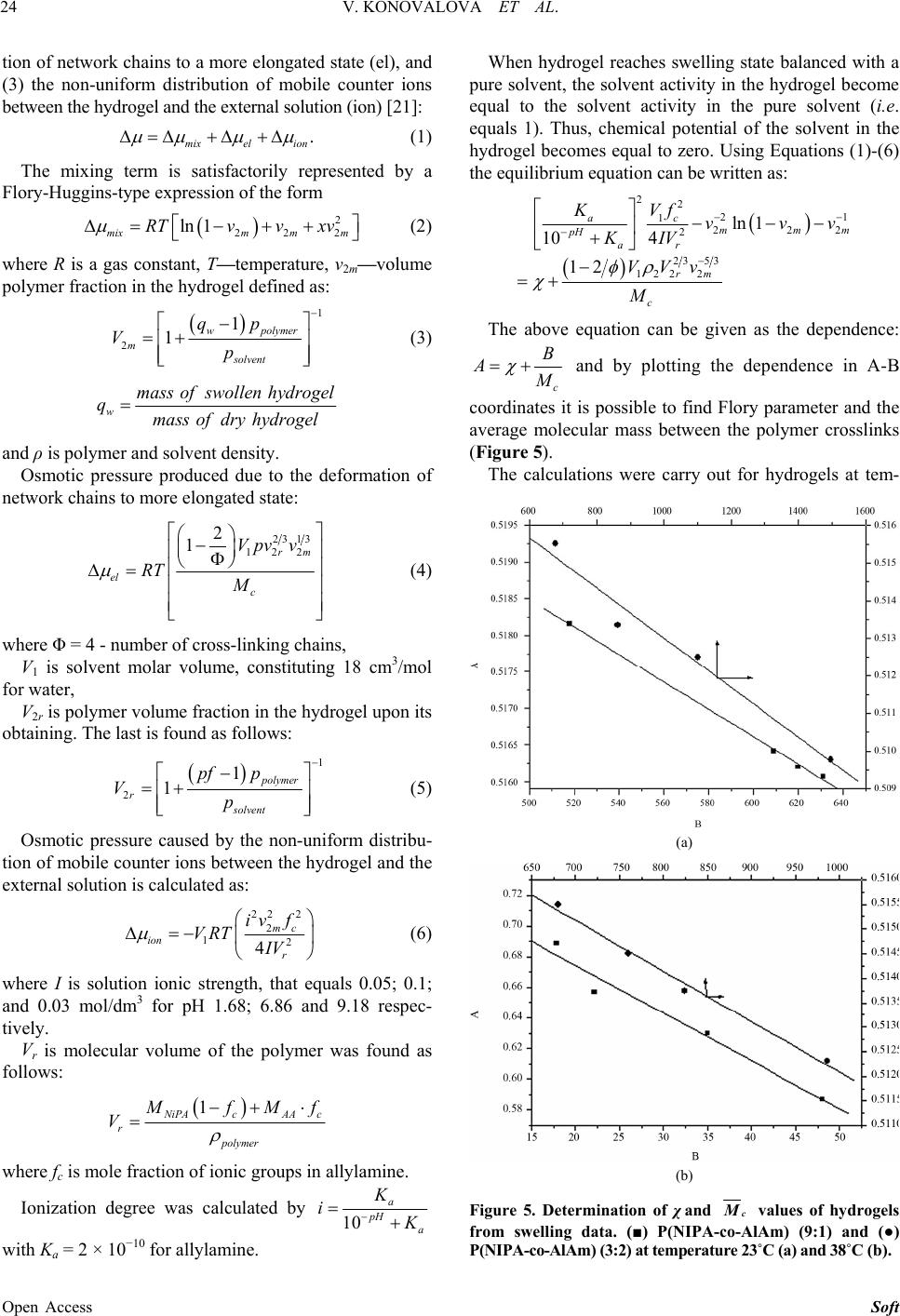 V. KONOVALOVA ET AL. 24 tion of network chains to a more elongated state (el), and (3) the non-uniform distribution of mobile counter ions between the hydrogel and the external solution (ion) [21]: . mix el ion (1) The mixing term is satisfactorily represented by a Flory-Huggins-type expression of the form 2 22 2 ln 1 mixm mm RTvv xv (2) where R is a gas constant, T—temperature, v2m—volume polymer fraction in the hydrogel defined as: 1 2 1 1w polymer m solvent qp Vp (3) w mass ofswollenhydrogel qmass ofdryhydrogel and ρ is polymer and solvent density. Osmotic pressure produced due to the deformation of network chains to more elongated state: 23 13 122 2 1rm el c Vpv v RT M (4) where Φ = 4 - number of cross-linking chains, V1 is solvent molar volume, constituting 18 cm3/mol for water, V2r is polymer volume fraction in the hydrogel upon its obtaining. The last is found as follows: 1 2 1 1polymer r solvent pf p Vp (5) Osmotic pressure caused by the non-uniform distribu- tion of mobile counter ions between the hydrogel and the external solution is calculated as: 22 2 2 12 4 mc ion r iv f VRT IV (6) where I is solution ionic strength, that equals 0.05; 0.1; and 0.03 mol/dm3 for pH 1.68; 6.86 and 9.18 respec- tively. Vr is molecular volume of the polymer was found as follows: 1 N iPAcAA c r polymer M fMf V where fc is mole fraction of ionic groups in allylamine. Ionization degree was calculated by 10 a pH a K i K with Kа = 2 × 10⁻¹⁰ for allylamine. When hydrogel reaches swelling state balanced with a pure solvent, the solvent activity in the hydrogel become equal to the solvent activity in the pure solvent (i. e. equals 1). Thus, chemical potential of the solvent in the hydrogel becomes equal to zero. Using Equations (1)-(6) the equilibrium equation can be written as: 22 21 1 22 2 23 53 122 2 ln 1 10 4 12 ac mm pH ar rm c KVf vv KIV VVv M 2 m v The above equation can be given as the dependence: c B A M and by plotting the dependence in A-B coordinates it is possible to find Flory parameter and the average molecular mass between the polymer crosslinks (Figure 5). The calculations were carry out for hydrogels at tem- (a) (b) Figure 5. Determination of χ and c M values of hydrogels from swelling data. (■) P(NIPA-co-AlAm) (9:1) and (●) P(NIPA-co-AlAm) (3:2) at temperature 23˚C (а) and 38˚C (b). Open Access Soft 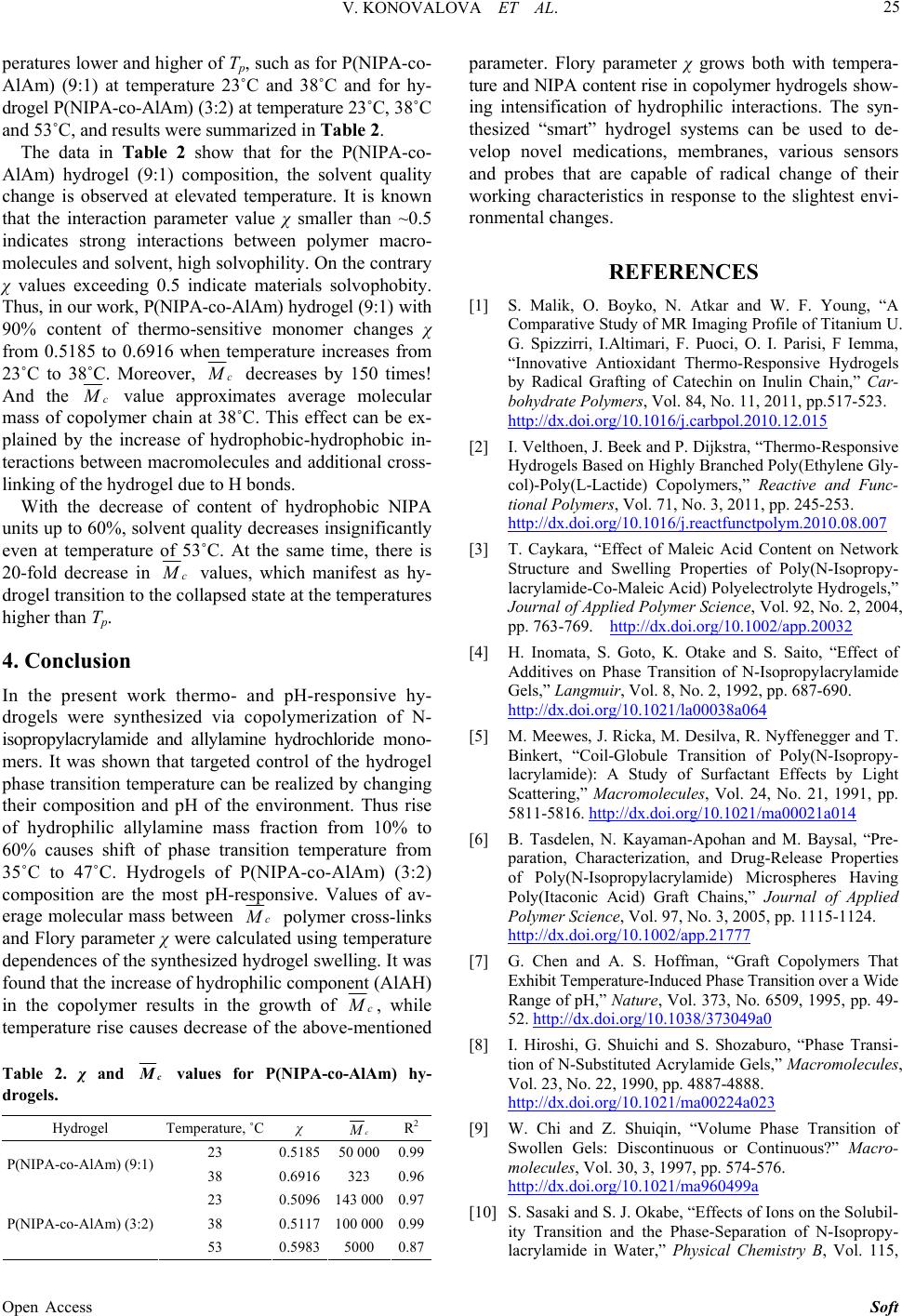 V. KONOVALOVA ET AL. 25 peratures lower and higher of Tp, such as for P(NIPA-co- AlAm) (9:1) at temperature 23˚C and 38˚C and for hy- drogel P(NIPA-co-AlAm) (3:2) at temperature 23˚C, 38˚C and 53˚C, and results were summarized in Table 2. The data in Table 2 show that for the P(NIPA-co- AlAm) hydrogel (9:1) composition, the solvent quality change is observed at elevated temperature. It is known that the interaction parameter value χ smaller than ~0.5 indicates strong interactions between polymer macro- molecules and solvent, high solvophility. On the contrary χ values exceeding 0.5 indicate materials solvophobity. Thus, in our work, P(NIPA-co-AlAm) hydrogel (9:1) with 90% content of thermo-sensitive monomer changes χ from 0.5185 to 0.6916 when temperature increases from 23˚C to 38˚C. Moreover, c M decreases by 150 times! And the c M value approximates average molecular mass of copolymer chain at 38˚C. This effect can be ex- plained by the increase of hydrophobic-hydrophobic in- teractions between macromolecules and additional cross- linking of the hydrogel due to H bonds. With the decrease of content of hydrophobic NIPA units up to 60%, solvent quality decreases insignificantly even at temperature of 53˚C. At the same time, there is 20-fold decrease in c M values, which manifest as hy- drogel transition to the collapsed state at the temperatures higher than Tp. 4. Conclusion In the present work thermo- and pH-responsive hy- drogels were synthesized via copolymerization of N- isopropylacrylamide and allylamine hydrochloride mono- mers. It was shown that targeted control of the hydrogel phase transition temperature can be realized by changing their composition and pH of the environment. Thus rise of hydrophilic allylamine mass fraction from 10% to 60% causes shift of phase transition temperature from 35˚C to 47˚C. Hydrogels of P(NIPA-co-AlAm) (3:2) composition are the most pH-responsive. Values of av- erage molecular mass between c M polymer cross-links and Flory parameter χ were calculated using temperature dependences of the synthesized hydrogel swelling. It was found that the increase of hydrophilic component (AlAH) in the copolymer results in the growth of c M , while temperature rise causes decrease of the above-mentioned Table 2. χ and c M values for P(NIPA-co-AlAm) hy- drogels. Hydrogel Temperature, ˚C χ c M R2 23 0.5185 50 0000.99 P(NIPA-co-AlAm) (9:1) 38 0.6916 323 0.96 23 0.5096 143 0000.97 38 0.5117 100 0000.99P(NIPA-co-AlAm) (3:2) 53 0.5983 5000 0.87 parameter. Flory parameter χ grows both with tempera- ture and NIPA content rise in copolymer hydrogels show- ing intensification of hydrophilic interactions. The syn- thesized “smart” hydrogel systems can be used to de- velop novel medications, membranes, various sensors and probes that are capable of radical change of their working characteristics in response to the slightest envi- ronmental changes. REFERENCES [1] S. Malik, O. Boyko, N. Atkar and W. F. Young, “A Comparative Study of MR Imaging Profile of Titanium U. G. Spizzirri, I.Altimari, F. Puoci, O. I. Parisi, F Iemma, “Innovative Antioxidant Thermo-Responsive Hydrogels by Radical Grafting of Catechin on Inulin Chain,” Car- bohydrate Polymers, Vol. 84, No. 11, 2011, pp.517-523. http://dx.doi.org/10.1016/j.carbpol.2010.12.015 [2] I. Velthoen, J. Beek and P. Dijkstra, “Thermo-Responsive Hydrogels Based on Highly Branched Poly(Ethylene Gly- col)-Poly(L-Lactide) Copolymers,” Reactive and Func- tional Polymers, Vol. 71, No. 3, 2011, pp. 245-253. http://dx.doi.org/10.1016/j.reactfunctpolym.2010.08.007 [3] T. Caykara, “Effect of Maleic Acid Content on Network Structure and Swelling Properties of Poly(N-Isopropy- lacrylamide-Co-Maleic Acid) Polyelectrolyte Hydrogels,” Journal of Applied Polymer Science, Vol. 92, No. 2, 2004, pp. 763-769. http://dx.doi.org/10.1002/app.20032 [4] H. Inomata, S. Goto, K. Otake and S. Saito, “Effect of Additives on Phase Transition of N-Isopropylacrylamide Gels,” Langmuir, Vol. 8, No. 2, 1992, pp. 687-690. http://dx.doi.org/10.1021/la00038a064 [5] M. Meewes, J. Ricka, M. Desilva, R. Nyffenegger and T. Binkert, “Coil-Globule Transition of Poly(N-Isopropy- lacrylamide): A Study of Surfactant Effects by Light Scattering,” Macromolecules, Vol. 24, No. 21, 1991, pp. 5811-5816. http://dx.doi.org/10.1021/ma00021a014 [6] B. Tasdelen, N. Kayaman-Apohan and M. Baysal, “Pre- paration, Characterization, and Drug-Release Properties of Poly(N-Isopropylacrylamide) Microspheres Having Poly(Itaconic Acid) Graft Chains,” Journal of Applied Polymer Science, Vol. 97, No. 3, 2005, pp. 1115-1124. http://dx.doi.org/10.1002/app.21777 [7] G. Chen and A. S. Hoffman, “Graft Copolymers That Exhibit Temperature-Induced Phase Transition over a Wide Range of pH,” Nature, Vol. 373, No. 6509, 1995, pp. 49- 52. http://dx.doi.org/10.1038/373049a0 [8] I. Hiroshi, G. Shuichi and S. Shozaburo, “Phase Transi- tion of N-Substituted Acrylamide Gels,” Macromolecules, Vol. 23, No. 22, 1990, pp. 4887-4888. http://dx.doi.org/10.1021/ma00224a023 [9] W. Chi and Z. Shuiqin, “Volume Phase Transition of Swollen Gels: Discontinuous or Continuous?” Macro- molecules, Vol. 30, 3, 1997, pp. 574-576. http://dx.doi.org/10.1021/ma960499a [10] S. Sasaki and S. J. Okabe, “Effects of Ions on the Solubil- ity Transition and the Phase-Separation of N-Isopropy- lacrylamide in Water,” Physical Chemistry B, Vol. 115, Open Access Soft 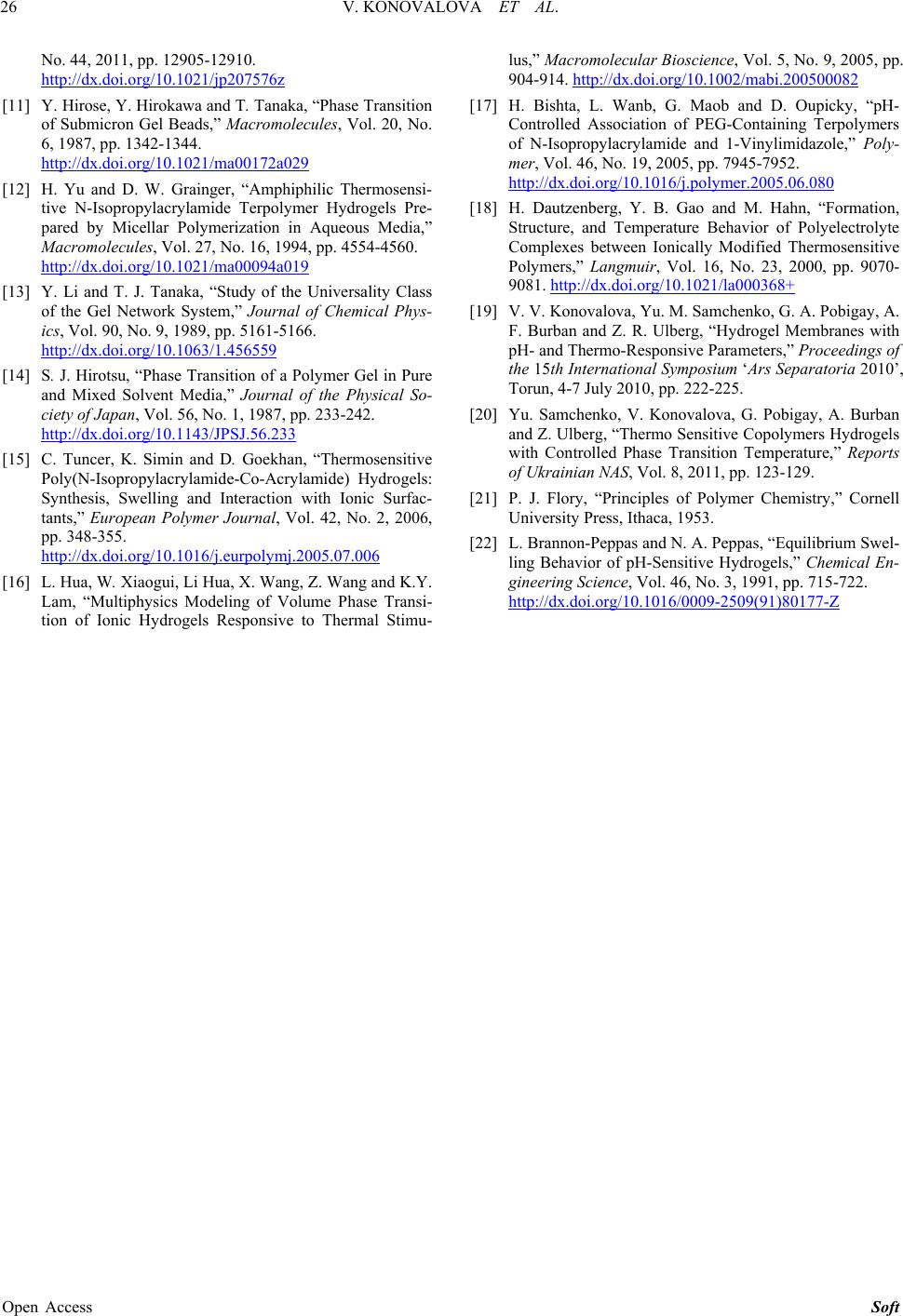 V. KONOVALOVA ET AL. Open Access Soft 26 No. 44, 2011, pp. 12905-12910. http://dx.doi.org/10.1021/jp207576z [11] Y. Hirose, Y. Hirokawa and T. Tanaka, “Phase Transition of Submicron Gel Beads,” Macromolecules, Vol. 20, No. 6, 1987, pp. 1342-1344. http://dx.doi.org/10.1021/ma00172a029 [12] H. Yu and D. W. Grainger, “Amphiphilic Thermosensi- tive N-Isopropylacrylamide Terpolymer Hydrogels Pre- pared by Micellar Polymerization in Aqueous Media,” Macromolecules, Vol. 27, No. 16, 1994, pp. 4554-4560. http://dx.doi.org/10.1021/ma00094a019 [13] Y. Li and T. J. Tanaka, “Study of the Universality Class of the Gel Network System,” Journal of Chemical Phys- ics, Vol. 90, No. 9, 1989, pp. 5161-5166. http://dx.doi.org/10.1063/1.456559 [14] S. J. Hirotsu, “Phase Transition of a Polymer Gel in Pure and Mixed Solvent Media,” Journal of the Physical So- ciety of Japan, Vol. 56, No. 1, 1987, pp. 233-242. http://dx.doi.org/10.1143/JPSJ.56.233 [15] C. Tuncer, K. Simin and D. Goеkhan, “Thermosensitive Poly(N-Isopropylacrylamide-Co-Acrylamide) Hydrogels: Synthesis, Swelling and Interaction with Ionic Surfac- tants,” European Polymer Journal, Vol. 42, No. 2, 2006, pp. 348-355. http://dx.doi.org/10.1016/j.eurpolymj.2005.07.006 [16] L. Hua, W. Xiaogui, Li Hua, X. Wang, Z. Wang and K.Y. Lam, “Multiphysics Modeling of Volume Phase Transi- tion of Ionic Hydrogels Responsive to Thermal Stimu- lus,” Macromolecular Bioscience, Vol. 5, No. 9, 2005, pp. 904-914. http://dx.doi.org/10.1002/mabi.200500082 [17] H. Bishta, L. Wanb, G. Maob and D. Oupicky, “pH- Controlled Association of PEG-Containing Terpolymers of N-Isopropylacrylamide and 1-Vinylimidazole,” Poly- mer, Vol. 46, No. 19, 2005, pp. 7945-7952. http://dx.doi.org/10.1016/j.polymer.2005.06.080 [18] H. Dautzenberg, Y. B. Gao and M. Hahn, “Formation, Structure, and Temperature Behavior of Polyelectrolyte Complexes between Ionically Modified Thermosensitive Polymers,” Langmuir, Vol. 16, No. 23, 2000, pp. 9070- 9081. http://dx.doi.org/10.1021/la000368+ [19] V. V. Konovalova, Yu. M. Samchenko, G. A. Pobigay, A. F. Burban and Z. R. Ulberg, “Hydrogel Membranes with pH- and Thermo-Responsive Parameters,” Proceedings of the 15th International Symposium ‘Ars Separatoria 2010’, Torun, 4-7 July 2010, pp. 222-225. [20] Yu. Samchenko, V. Konovalova, G. Pobigay, A. Burban and Z. Ulberg, “Thermo Sensitive Copolymers Hydrogels with Controlled Phase Transition Temperature,” Reports of Ukrainian NAS, Vol. 8, 2011, pp. 123-129. [21] P. J. Flory, “Principles of Polymer Chemistry,” Cornell University Press, Ithaca, 1953. [22] L. Brannon-Peppas and N. A. Peppas, “Equilibrium Swel- ling Behavior of pH-Sensitive Hydrogels,” Chemical En- gineering Science, Vol. 46, No. 3, 1991, pp. 715-722. http://dx.doi.org/10.1016/0009-2509(91)80177-Z |