

Paper Menu >>
Journal Menu >>
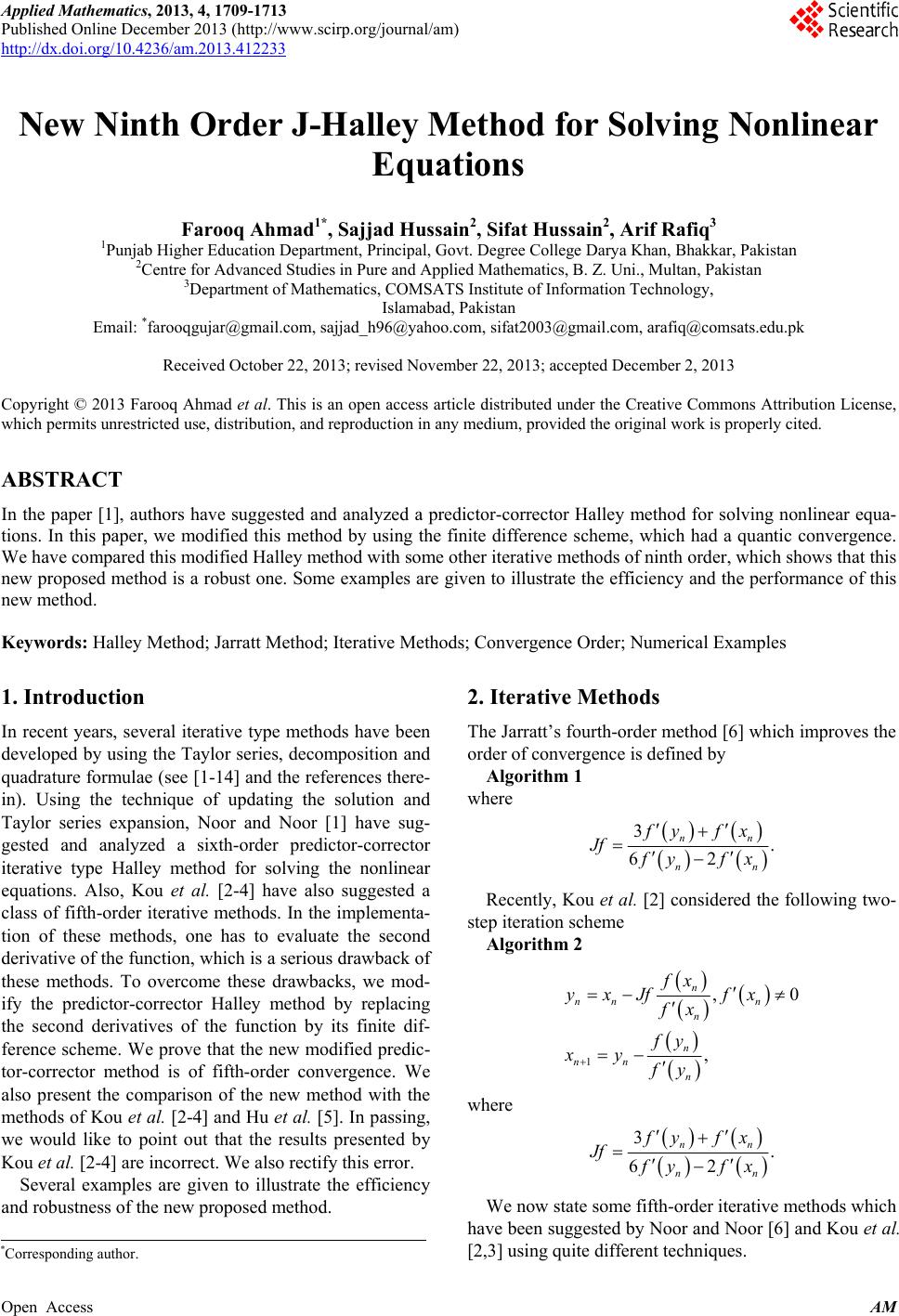 Applied Mathematics, 2013, 4, 1709-1713 Published Online December 2013 (http://www.scirp.org/journal/am) http://dx.doi.org/10.4236/am.2013.412233 Open Access AM New Ninth Order J-Halley Method for Solving Nonlinear Equations Farooq Ahmad1*, Sajjad Hussain2, Sifat Hussain2, Arif Rafiq3 1Punjab Higher Education Department, Principal, Govt. Degree College Darya Khan, Bhakkar, Pakistan 2Centre for Advanced Studies in Pure and Applied Mathematics, B. Z. Uni., Multan, Pakistan 3Department of Mathematics, COMSATS Institute of Information Technology, Islamabad, Pakistan Email: *[email protected], [email protected], sifat2003@gmail.com, [email protected] Received October 22, 2013; revised November 22, 2013; accepted December 2, 2013 Copyright © 2013 Farooq Ahmad et al. This is an open access article distributed under the Creative Commons Attribution License, which permits unrestricted use, distribution, and reproduction in any medium, provided the original work is properly cited. ABSTRACT In the paper [1], authors have suggested and analyzed a predictor-corrector Halley method for solving nonlinear equa- tions. In this paper, we modified this method by using the finite difference scheme, which had a quantic convergence. We have compared this modified Halley method with some other iterative methods of ninth order, which shows that this new proposed method is a robust one. Some examples are given to illustrate the efficiency and the performance of this new method. Keywords: Halley Method; Jarratt Method; Iterative Methods; Convergence Order; Numerical Examples 1. Introduction In recent years, several iterative type methods have been developed by using the Taylor series, decomposition and quadrature formulae (see [1-14] and the references there- in). Using the technique of updating the solution and Taylor series expansion, Noor and Noor [1] have sug- gested and analyzed a sixth-order predictor-corrector iterative type Halley method for solving the nonlinear equations. Also, Kou et al. [2-4] have also suggested a class of fifth-order iterative methods. In the implementa- tion of these methods, one has to evaluate the second derivative of the function, which is a serious drawback of these methods. To overcome these drawbacks, we mod- ify the predictor-corrector Halley method by replacing the second derivatives of the function by its finite dif- ference scheme. We prove that the new modified predic- tor-corrector method is of fifth-order convergence. We also present the comparison of the new method with the methods of Kou et al. [2-4] and Hu et al. [5]. In passing, we would like to point out that the results presented by Kou et al. [2-4] are incorrect. We also rectify this error. Several examples are given to illustrate the efficiency and robustness of the new proposed method. 2. Iterative Methods The Jarratt’s fourth-order method [6] which improves the order of convergence is defined by Algorithm 1 where 3. 62 nn nn fy fx Jf f yfx Recently, Kou et al. [2] considered the following two- step iteration scheme Algorithm 2 1 ,0 , n nn n n n nn n fx yxJf fx fx fy xy fy where 3. 62 nn nn fy fx Jf f yfx We now state some fifth-order iterative methods which have been suggested by Noor and Noor [6] and Kou et al. [2,3] using quite different techniques. *Corresponding author. 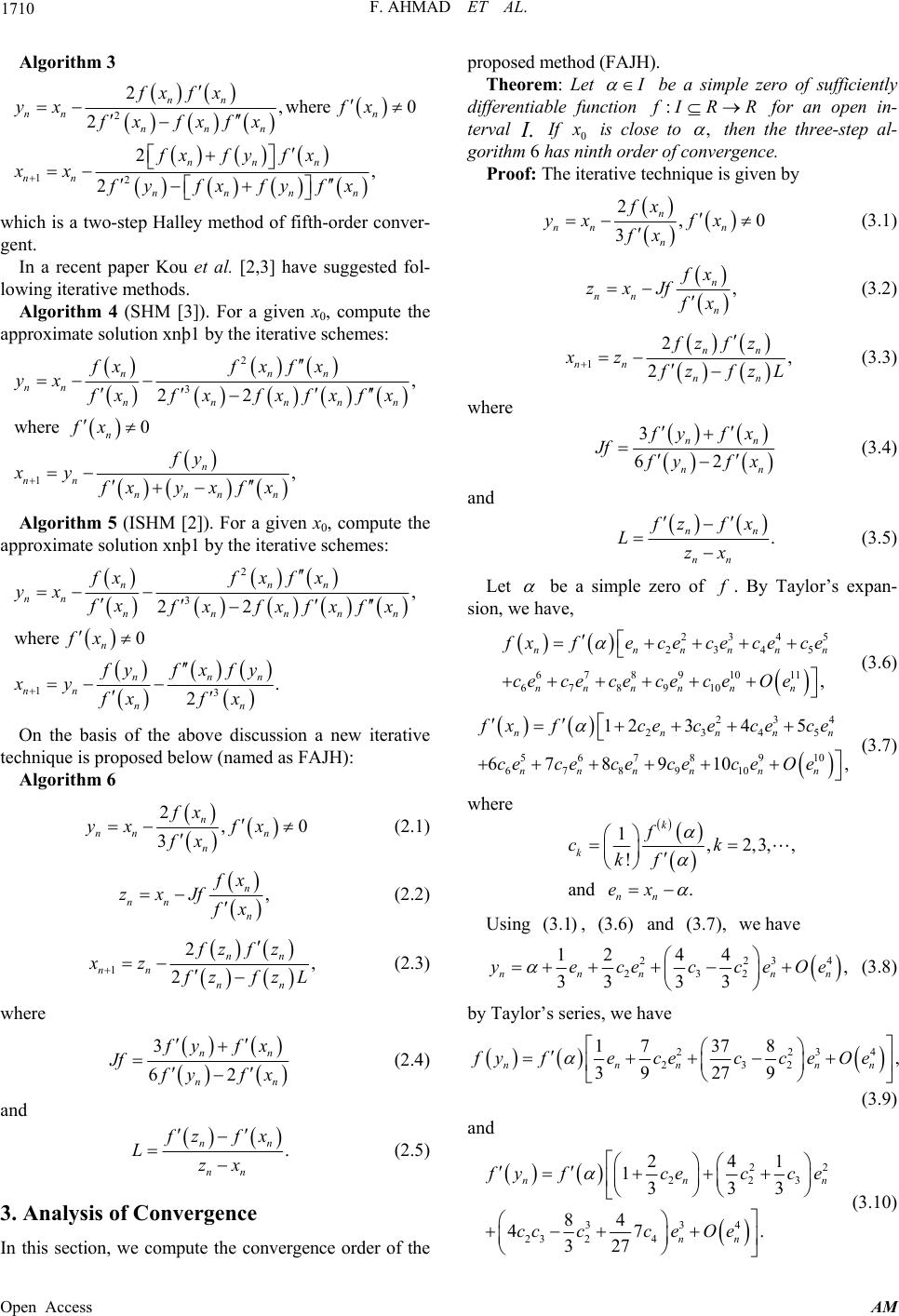 F. AHMAD ET AL. 1710 Algorithm 3 2 12 2,where 0 2 2, 2 nn nn n nnn nnn nn nnnn fxf x yx fx fx fxfx fxfyf x xxfyfx fyfx which is a two-step Halley method of fifth-order conver- gent. In a recent paper Kou et al. [2,3] have suggested fol- lowing iterative methods. Algorithm 4 (SHM [3]). For a given x0, compute the approximate solution xnþ1 by the iterative schemes: 2 3 1 , 22 where 0 , nnn nn nnnn n n nn nnn n fxfx fx yxfx n f xfxfxfx fx fy xy fxy xfx Algorithm 5 (ISHM [2]). For a given x0, compute the approximate solution xnþ1 by the iterative schemes: 2 3 13 , 22 where 0 . 2 nnn nn nnnn n nnn nn nn fxfx fx yxfx n f xfxfxfx fx fyfx fy xy fx fx On the basis of the above discussion a new iterative technique is proposed below (named as FAJH): Algorithm 6 2, 3 n nn n n fx yx fx fx 0 (2.1) , n nn n f x zxJf f x (2.2) 1 2, 2 nn nn nn fzf z xz f zfzL (2.3) where 3 62 n nn n f yfx Jf f yfx (2.4) and . n nn n f zfx Lzx (2.5) 3. Analysis of Convergence In this section, we compute the convergence order of the proposed method (FAJH). Theorem: Let I be a simple zero of sufficiently differentiable function for an open in- terval :fIRR I . If 0 x is close to , then the three-step al- gorithm 6 has ni nt h or der of convergence. Proof: The iterative technique is given by 2, 3 n nn n n fx yx fx fx 0 (3.1) , n nn n fx zxJf fx (3.2) 1 2, 2 nn nn nn fzf z xzfz fzL (3.3) where 3 62 n nn fy fx Jf fy fx n (3.4) and . n nn n f zfx Lzx (3.5) Let be a simple zero of f . By Taylor’s expan- sion, we have, 234 2345 67 8 91011 678910 , n nnnn nnnn nn 5 n f x fecececece cececececeO e (3.6) 23 23 45 5678910 6789 10 12 3 4 5 678910 nnnn nnnn nn 4 , n f xf cececece ce cece ceceOe (3.7) where 1,2,3, ! and . k k nn f ck kf ex , Using , and we have (3.1) (3.6) (3.7 ), 223 232 12 44, 33 33 nnn n 4 n y ece cceOe (3.8) by Taylor’s series, we have 223 232 17 378, 39 279 nnn n fyfececc eOe 4 n (3.9) and 22 223 334 23 24 241 1333 84 47. 327 nn nn fy fcec ce cccceO e n (3.10) Open Access AM 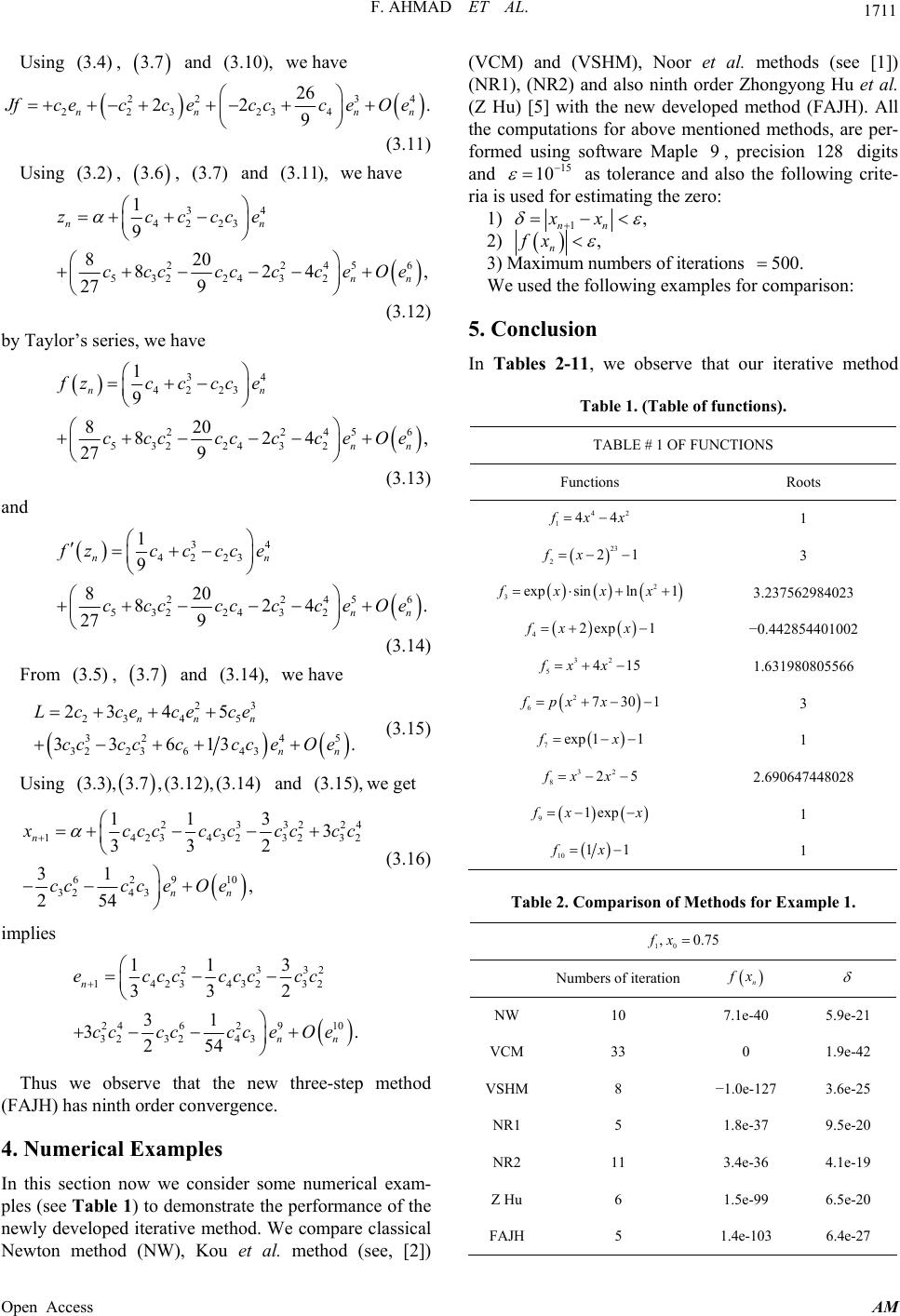 F. AHMAD ET AL. 1711 Using , and we have (3.4) 3.7 (3.10), 22 3 223 234 26 22 9 nn n 4 . n J fce cceccceOe (3.11) Using , , and (3.11 we have (3.2) 3.6 (3.7) ), 34 4223 2245 5322432 1 9 820 824 27 9 nn nn zcccce ccccccceOe 6 , (3.12) by Taylor’s series, we have 34 4223 2245 5322432 1 9 820 824 27 9 nn nn fzcccc e ccccccceOe 6 , (3.13) and 34 4223 2245 5322432 1 9 820 824 27 9 nn nn fzc c cce ccccccceOe 6 . (3.14) From , and we have (3.5) 3.7 (3.14), 23 23 4 5 32 4 32 23643 23 45 33613 nnn nn Lc cecece ccccccceO e 5 . (3.15) Using and (3.15 we get (3.3), 3.7,(3.12),(3.14)), 2332 14234323232 62910 32 43 113 3 332 31 , 254 n nn 24 x cccccccc cc cccceO e (3.16) implies 2332 1423 432 32 2462 910 32 3243 113 332 31 3. 254 n nn ecccccccc cccccc eOe Thus we observe that the new three-step method (FAJH) has ninth order convergence. 4. Numerical Examples In this section now we consider some numerical exam- ples (see Table 1) to demonstrate the performance of the newly developed iterative method. We compare classical Newton method (NW), Kou et al. method (see, [2]) (VCM) and (VSHM), Noor et al. methods (see [1]) (NR1), (NR2) and also ninth order Zhongyong Hu et al. (Z Hu) [5] with the new developed method (FAJH). All the computations for above mentioned methods, are per- formed using software Maple , precision digits and 9128 15 10 as tolerance and also the following crite- ria is used for estimating the zero: 1) 1, nn xx 2) , n fx 3) Maximum numbers of iterations 500. We used the following examples for comparison: 5. Conclusion In Tables 2-11, we observe that our iterative method Table 1. (Table of functions). TABLE # 1 OF FUNCTIONS Functions Roots 42 144 f xx 1 23 221fx 3 2 3exp sinln1fxxx 3.237562984023 42exp 1fx x −0.442854401002 32 541fxx 5 1.631980805566 2 67301fpx x 3 7exp 11fx 1 32 825fx x 2.690647448028 91exp f xx 1 10 11fx 1 Table 2. Comparison of Methods for Example 1. 10 , 0.75fx Numbers of iteration n f x NW 10 7.1e-40 5.9e-21 VCM 33 0 1.9e-42 VSHM 8 −1.0e-127 3.6e-25 NR1 5 1.8e-37 9.5e-20 NR2 11 3.4e-36 4.1e-19 Z Hu 6 1.5e-99 6.5e-20 FAJH 5 1.4e-103 6.4e-27 Open Access AM 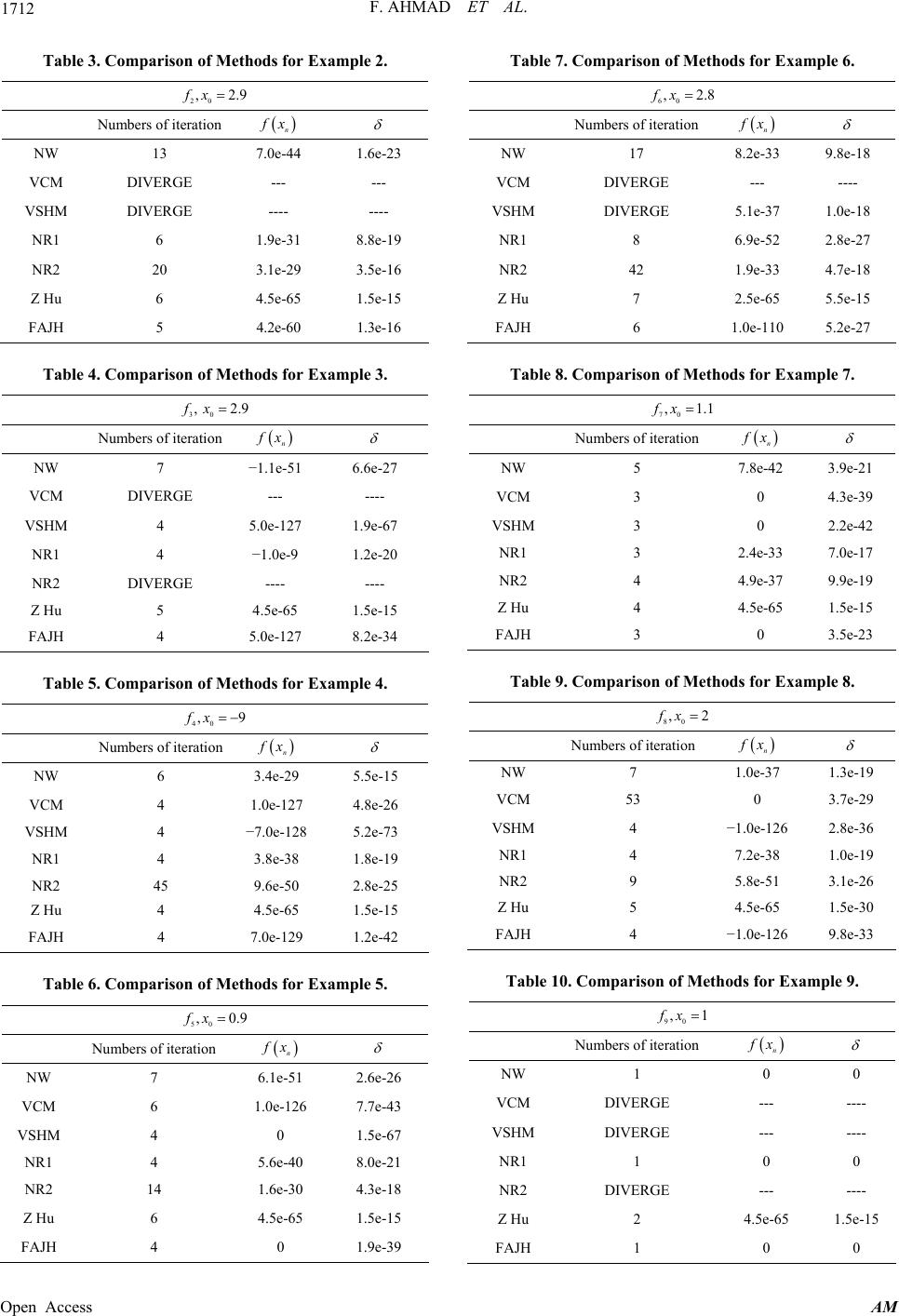 F. AHMAD ET AL. 1712 Table 3. Comparison of Methods for Example 2. 20 ,2.fx9 Numbers of iteration n f x NW 13 7.0e-44 1.6e-23 VCM DIVERGE --- --- VSHM DIVERGE ---- ---- NR1 6 1.9e-31 8.8e-19 NR2 20 3.1e-29 3.5e-16 Z Hu 6 4.5e-65 1.5e-15 FAJH 5 4.2e-60 1.3e-16 Table 4. Comparison of Methods for Example 3. 30 , 2.9fx Numbers of iteration n f x NW 7 −1.1e-51 6.6e-27 VCM DIVERGE --- ---- VSHM 4 5.0e-127 1.9e-67 NR1 4 −1.0e-9 1.2e-20 NR2 DIVERGE ---- ---- Z Hu 5 4.5e-65 1.5e-15 FAJH 4 5.0e-127 8.2e-34 Table 5. Comparison of Methods for Example 4. 40 ,9fx Numbers of iteration n f x NW 6 3.4e-29 5.5e-15 VCM 4 1.0e-127 4.8e-26 VSHM 4 −7.0e-128 5.2e-73 NR1 4 3.8e-38 1.8e-19 NR2 45 9.6e-50 2.8e-25 Z Hu 4 4.5e-65 1.5e-15 FAJH 4 7.0e-129 1.2e-42 Table 6. Comparison of Methods for Example 5. 50 ,0.fx Table 7. Comparison of Methods for Example 6. 60 ,2.fx8 Numbers of iteration n f x NW 17 8.2e-33 9.8e-18 VCM DIVERGE --- ---- VSHM DIVERGE 5.1e-37 1.0e-18 NR1 8 6.9e-52 2.8e-27 NR2 42 1.9e-33 4.7e-18 Z Hu 7 2.5e-65 5.5e-15 FAJH 6 1.0e-110 5.2e-27 Table 8. Comparison of Methods for Example 7. 70 ,1.fx1 Numbers of iteration n f x NW 5 7.8e-42 3.9e-21 VCM 3 0 4.3e-39 VSHM 3 0 2.2e-42 NR1 3 2.4e-33 7.0e-17 NR2 4 4.9e-37 9.9e-19 Z Hu 4 4.5e-65 1.5e-15 FAJH 3 0 3.5e-23 Table 9. Comparison of Methods for Example 8. 80 ,2fx Numbers of iteration n f x NW 7 1.0e-37 1.3e-19 VCM 53 0 3.7e-29 VSHM 4 −1.0e-126 2.8e-36 NR1 4 7.2e-38 1.0e-19 NR2 9 5.8e-51 3.1e-26 Z Hu 5 4.5e-65 1.5e-30 FAJH 4 −1.0e-126 9.8e-33 Table 10. Comparison of Methods for Example 9. 9 Numbers of iteration n f x NW 7 6.1e-51 2.6e-26 VCM 6 1.0e-126 7.7e-43 VSHM 4 0 1.5e-67 NR1 4 5.6e-40 8.0e-21 NR2 14 1.6e-30 4.3e-18 Z Hu 6 4.5e-65 1.5e-15 FAJH 4 0 1.9e-39 90 ,1fx Numbers of iteration n f x NW 1 0 0 VCM DIVERGE --- ---- VSHM DIVERGE --- ---- NR1 1 0 0 NR2 DIVERGE --- ---- Z Hu 2 4.5e-65 1.5e-15 FAJH 1 0 0 Open Access AM 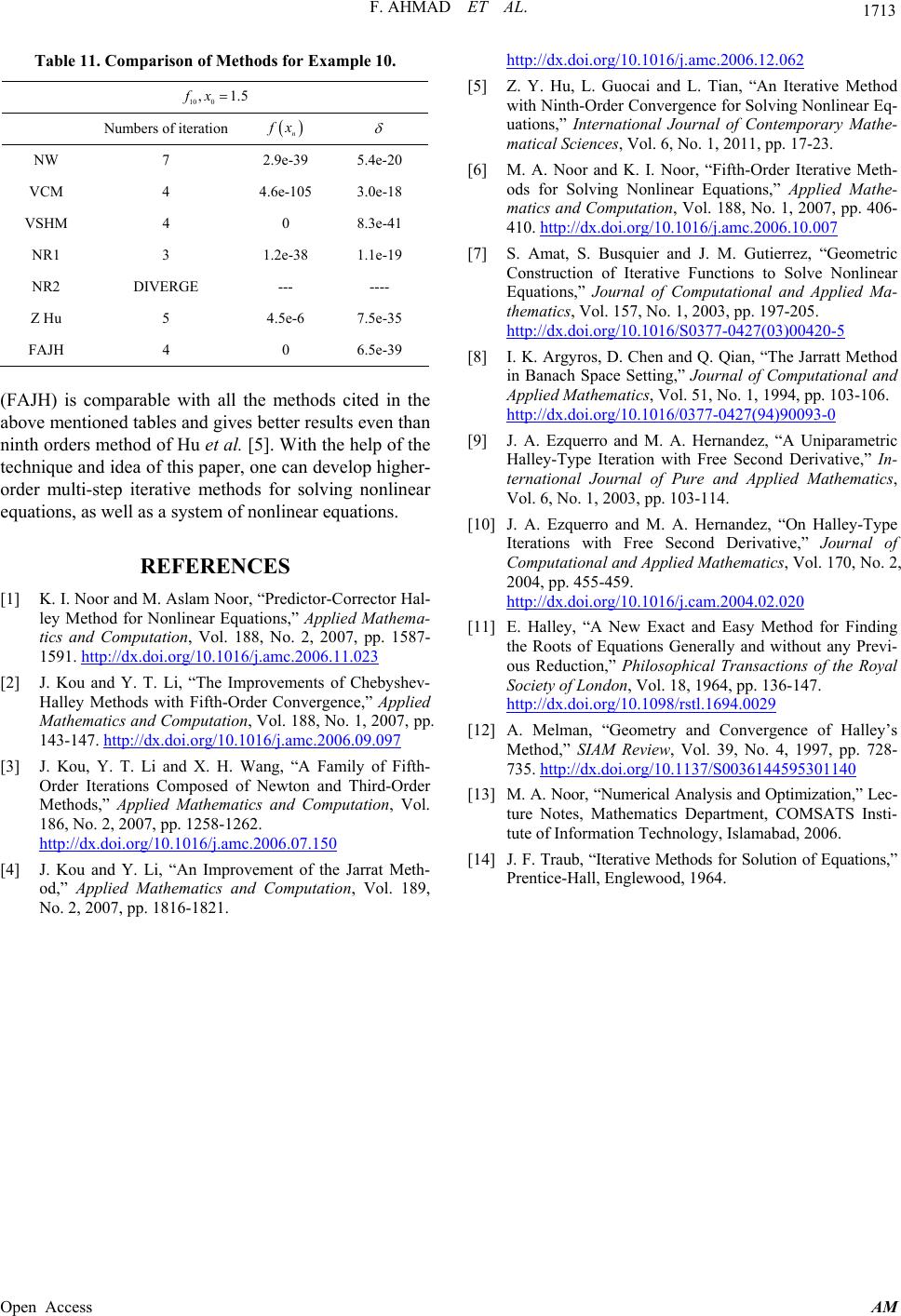 F. AHMAD ET AL. Open Access AM 1713 5 Table 11. Comparison of Methods for Example 10. 10 0 ,1.fx Numbers of iteration n f x NW 7 2.9e-39 5.4e-20 VCM 4 4.6e-105 3.0e-18 VSHM 4 0 8.3e-41 NR1 3 1.2e-38 1.1e-19 NR2 DIVERGE --- ---- Z Hu 5 4.5e-6 7.5e-35 FAJH 4 0 6.5e-39 (FAJH) is comparable with all the methods cited in the above mentioned tables and gives better results even than ninth orders method of Hu et al. [5]. With the help of the technique and idea of this paper, one can develop higher- order multi-step iterative methods for solving nonlinear equations, as well as a system of nonlinear equations. REFERENCES [1] K. I. Noor and M. Aslam Noor, “Predictor-Corrector Hal- ley Method for Nonlinear Equations,” Applied Mathema- tics and Computation, Vol. 188, No. 2, 2007, pp. 1587- 1591. http://dx.doi.org/10.1016/j.amc.2006.11.023 [2] J. Kou and Y. T. Li, “The Improvements of Chebyshev- Halley Methods with Fifth-Order Convergence,” Applied Mathematics and Computation, Vol. 188, No. 1, 2007, pp. 143-147. http://dx.doi.org/10.1016/j.amc.2006.09.097 [3] J. Kou, Y. T. Li and X. H. Wang, “A Family of Fifth- Order Iterations Composed of Newton and Third-Order Methods,” Applied Mathematics and Computation, Vol. 186, No. 2, 2007, pp. 1258-1262. http://dx.doi.org/10.1016/j.amc.2006.07.150 [4] J. Kou and Y. Li, “An Improvement of the Jarrat Meth- od,” Applied Mathematics and Computation, Vol. 189, No. 2, 2007, pp. 1816-1821. http://dx.doi.org/10.1016/j.amc.2006.12.062 [5] Z. Y. Hu, L. Guocai and L. Tian, “An Iterative Method with Ninth-Order Convergence for Solving Nonlinear Eq- uations,” International Journal of Contemporary Mathe- matical Sciences, Vol. 6, No. 1, 2011, pp. 17-23. [6] M. A. Noor and K. I. Noor, “Fifth-Order Iterative Meth- ods for Solving Nonlinear Equations,” Applied Mathe- matics and Computation, Vol. 188, No. 1, 2007, pp. 406- 410. http://dx.doi.org/10.1016/j.amc.2006.10.007 [7] S. Amat, S. Busquier and J. M. Gutierrez, “Geometric Construction of Iterative Functions to Solve Nonlinear Equations,” Journal of Computational and Applied Ma- thematics, Vol. 157, No. 1, 2003, pp. 197-205. http://dx.doi.org/10.1016/S0377-0427(03)00420-5 [8] I. K. Argyros, D. Chen and Q. Qian, “The Jarratt Method in Banach Space Setting,” Journal of Computational and Applied Mathematics, Vol. 51, No. 1, 1994, pp. 103-106. http://dx.doi.org/10.1016/0377-0427(94)90093-0 [9] J. A. Ezquerro and M. A. Hernandez, “A Uniparametric Halley-Type Iteration with Free Second Derivative,” In- ternational Journal of Pure and Applied Mathematics, Vol. 6, No. 1, 2003, pp. 103-114. [10] J. A. Ezquerro and M. A. Hernandez, “On Halley-Type Iterations with Free Second Derivative,” Journal of Computational and Applied Mathematics, Vol. 170, No. 2, 2004, pp. 455-459. http://dx.doi.org/10.1016/j.cam.2004.02.020 [11] E. Halley, “A New Exact and Easy Method for Finding the Roots of Equations Generally and without any Previ- ous Reduction,” Philosophical Transactions of the Royal Society of London, Vol. 18, 1964, pp. 136-147. http://dx.doi.org/10.1098/rstl.1694.0029 [12] A. Melman, “Geometry and Convergence of Halley’s Method,” SIAM Review, Vol. 39, No. 4, 1997, pp. 728- 735. http://dx.doi.org/10.1137/S0036144595301140 [13] M. A. Noor, “Numerical Analysis and Optimization,” Lec- ture Notes, Mathematics Department, COMSATS Insti- tute of Information Technology, Islamabad, 2006. [14] J. F. Traub, “Iterative Methods for Solution of Equations,” Prentice-Hall, Englewood, 1964. |