

Paper Menu >>
Journal Menu >>
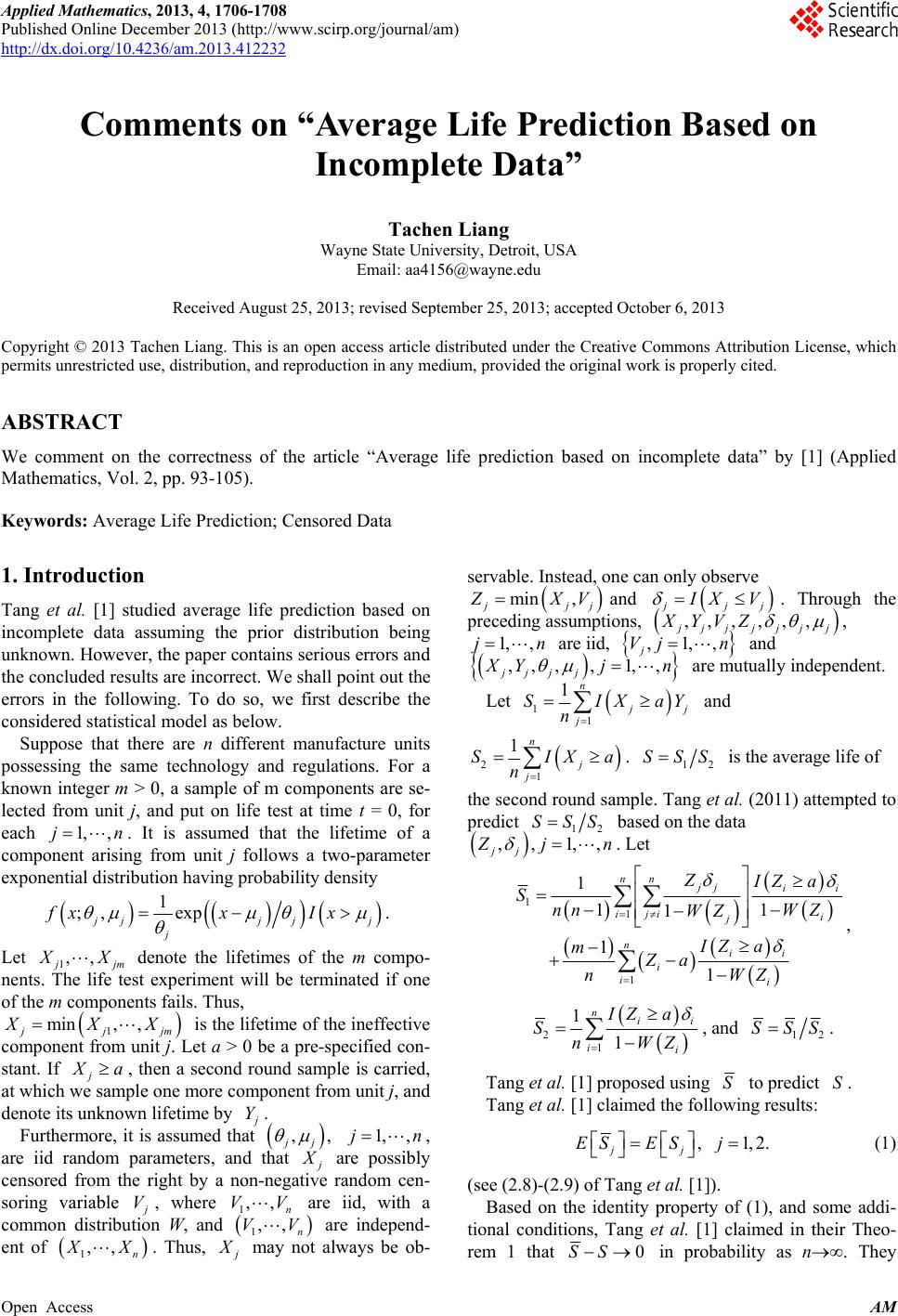 Applied Mathematics, 2013, 4, 1706-1708 Published Online December 2013 (http://www.scirp.org/journal/am) http://dx.doi.org/10.4236/am.2013.412232 Open Access AM Comments on “Average Life Prediction Based on Incomplete Data” Tachen Liang Wayne State University, Detroit, USA Email: [email protected] Received August 25, 2013; revised September 25, 2013; accepted October 6, 2013 Copyright © 2013 Tachen Liang. This is an open access article distributed under the Creative Commons Attribution License, which permits unrestricted use, distribution, and reproduction in any medium, provided the original work is properly cited. ABSTRACT We comment on the correctness of the article “Average life prediction based on incomplete data” by [1] (Applied Mathematics, Vol. 2, pp. 93-105). Keywords: Average Life Prediction; Censored Data 1. Introduction Tang et al. [1] studied average life prediction based on incomplete data assuming the prior distribution being unknown. However, the paper contains serious errors and the concluded results are incorrect. We shall point out the errors in the following. To do so, we first describe the considered statistical model as below. Suppose that there are n different manufacture units possessing the same technology and regulations. For a known integer m > 0, a sample of m components are se- lected from unit j, and put on life test at time t = 0, for each . It is assumed that the lifetime of a component arising from unit j follows a two-parameter exponential distribution having probability density 1, ,jn 1 ;, exp j jjj j fxxIx j . Let 1,, j jm X X 1 min , denote the lifetimes of the m compo- nents. The life test experiment will be terminated if one of the m components fails. Thus, , j j XXjm is the lifetime of the ineffective component from unit j. Let a > 0 be a pre-specified con- stant. If j X X a, then a second round sample is carried, at which we sample one more component from unit j, and denote its unknown lifetime by j Y. Furthermore, it is assumed that ,, jj 1, ,jn , are iid random parameters, and that j X are possibly censored from the right by a non-negative random cen- soring variable j V, where V are iid, with a common distribution W, and 1,, n V ,, n VV 1 are independ- ent of n1,, X X. Thus, j X may not always be ob- servable. Instead, one can only obser ve min , j jj Z XVand j jj I XV . Through the preceding assumptions, ,,,,, , j jj j XYVZ jj j , 1, ,jn are iid, ,1,,Vj n j and ,,,, , jjj j1, X Yj n are mutually independent. Let 11 1n j j XaY j SI n and a 21 1n j j SIX n . 12 SSS is the average life of the second round sample. Tang et al. (2011) attempted to predict 12 SSS based on the data ,,1,, jj Z jn . Let 11 11 1 ii i ii i IZ a Snn WZ a m Z 1 1 1 1 nn jj iji j n i i Z WZ IZ Za nW , 21 1 1 ni ii IZa SnWZ i , and 12 SSS. Tang et al. [1] proposed using S to predict . S Tang et al. [1] claimed the following results: , 1,2. jj ES ESj (1) (see (2.8)-(2.9) of Tang et al. [1]). Based on the identity property of (1), and some addi- tional conditions, Tang et al. [1] claimed in their Theo- rem 1 that 0SS in probability as n. They 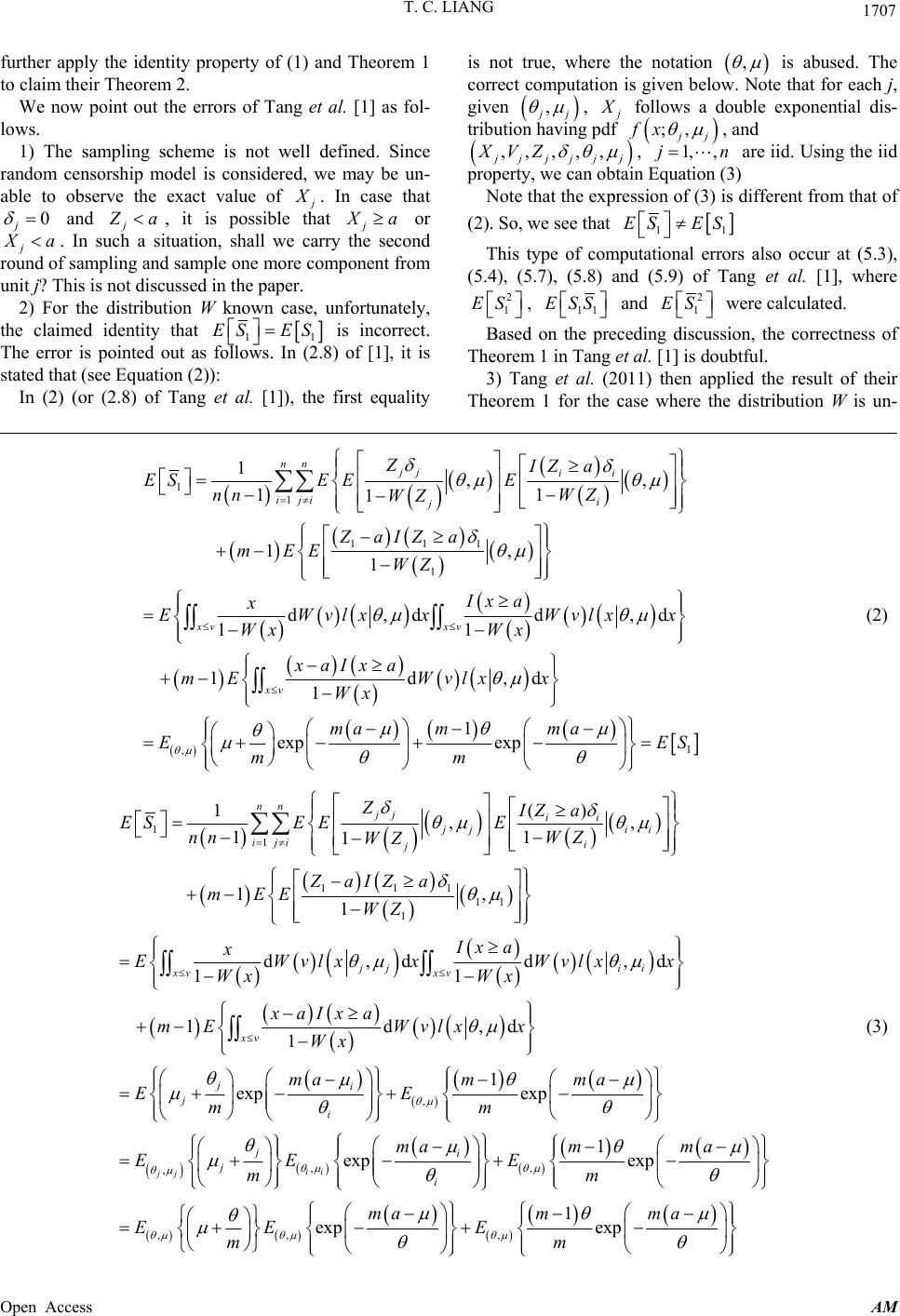 T. C. LIANG 1707 further apply the identity property of (1) and Theorem 1 to claim their Theorem 2. We now point out the errors of Tang et al. [1] as fol- lows. 1) The sampling scheme is not well defined. Since random censorship model is considered, we may be un- able to observe the exact value of j X . In case that 0 j and j Z a, it is possible that j X a or j X a. In such a situation, shall we carry the second round of sampling and sample one more component from unit j? This is not discussed in the paper. 2) For the distribution W known case, unfortunately, the claimed identity that 11 is incorrect. The error is pointed out as follows. In (2.8) of [1], it is stated that (see Equation (2)): ES ES In (2) (or (2.8) of Tang et al. [1]), the first equality is not true, where the notation , is abused. The correct computation is given below. Note that for each j, given , j j , j X follows a double exponential dis- tribution having pdf ;, j j fx , and ,,,,, j jjjjj XVZ , 1, ,jn are iid. Using the iid property, we can obtain E qua tion (3 ) Note that the expression of (3) is different from that of (2). So, we see that 11 ES ES This type of computational errors also occur at (5.3), (5.4), (5.7), (5.8) and (5.9) of Tang et al. [1], where 2 1 ES , 11 ESS and 2 1 ES were calculated. Based on the preceding discussion, the correctness of Theorem 1 in Tang et al. [1] is doubtful. 3) Tang et al. (2011) then applied the result of their Theorem 1 for the case where the distribution W is un- 11 111 1 1,, 11 1 1, 1 d,d d,d 11 1d, 1 nn jj ii iji i j xv xv ZIZ a ES EEE nn WZ WZ ZaIZa mEE WZ Ix a x EWvlxxWvlx Wx Wx xaIxa mE Wvlx Wx x 1 , d 1 exp exp xv x ma mma EE mm S (2) 11 111 11 1 () 1,, 11 1 1, 1 d,d d,d 11 1 nn jj ii jj ii iji i j jj ii xv xv ZIZ a ES EEE nn WZ WZ ZaIZa mEE WZ Ix a x EWvlxxWvlxx Wx Wx xaIx mE , , , , d,d 1 1 exp exp 1 exp exp ii jj xv ji ji ji ji aWvlx x Wx ma mma EE mm ma mma EE E mm ,, , 1 exp exp mam ma EE E mm (3) Open Access AM 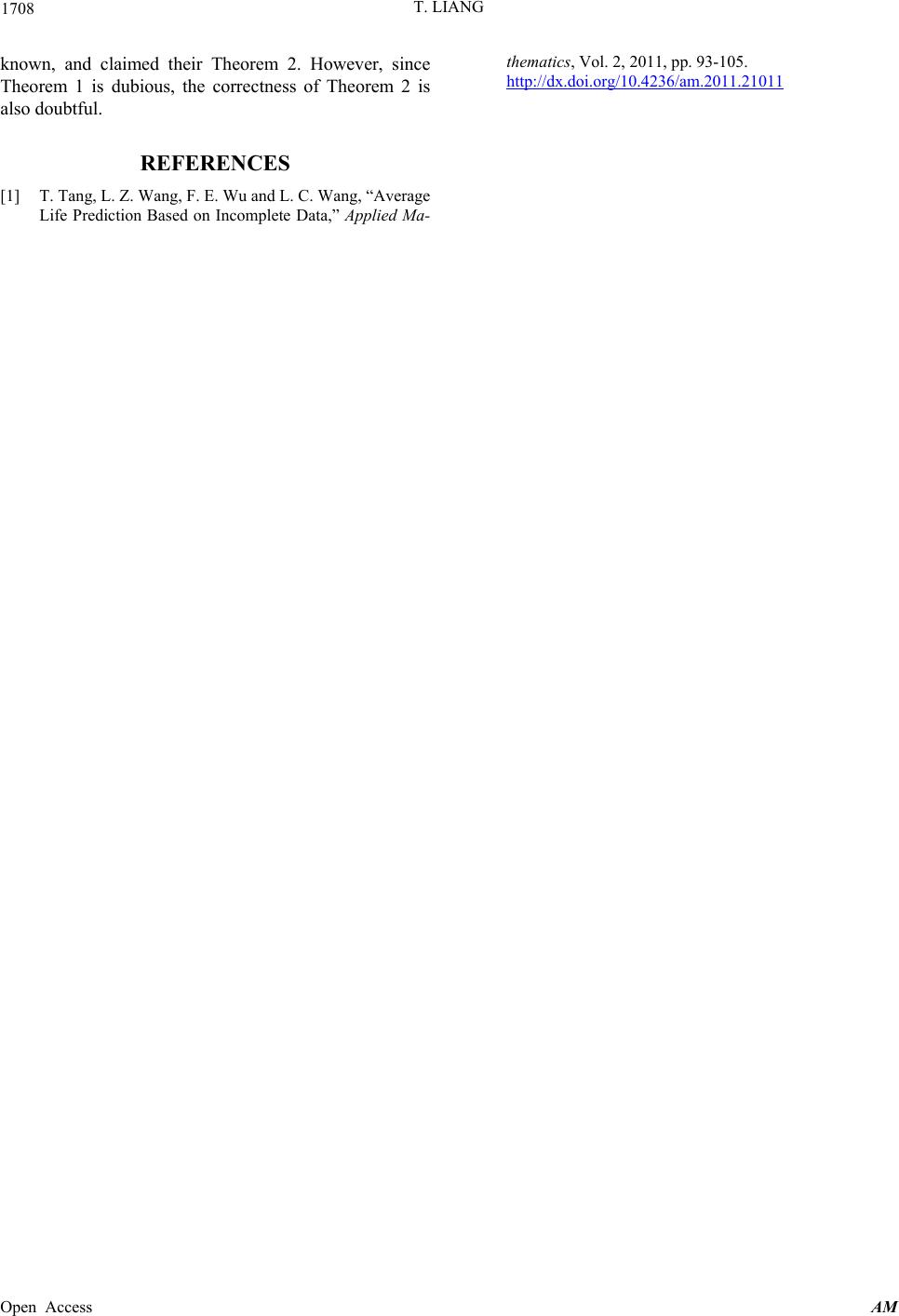 T. LIANG 1708 known, and claimed their Theorem 2. However, since Theorem 1 is dubious, the correctness of Theorem 2 is also doubtful. REFERENCES [1] T. Tang, L. Z. Wang, F. E. Wu and L. C. Wang, “Average Life Prediction Based on Incomplete Data,” Applied Ma- thematics, Vol. 2, 2011, pp. 93-105. http://dx.doi.org/10.4236/am.2011.21011 Open Access AM |