

Paper Menu >>
Journal Menu >>
 Surgical Science, 2013, 4, 530-534 Published Online December 2013 (http://www.scirp.org/journal/ss) http://dx.doi.org/10.4236/ss.2013.412103 Open Access SS Comparison of Double-Incision Laparoscopic Cholecystectomy and Needlescopic Cholecystectomy Kenju Ko*, Shigetoshi Yamada, Ken Hayashi, Akira Tsunoda, Hiroshi Kusanagi, Nobuyasu Kano Department of Surgery, Kameda Medical Center Kamogawa, Chiba, Japan Email: *[email protected] Received November 5, 2013; revised November 25, 2013; accepted December 2, 2013 Copyright © 2013 Kenju Ko et al. This is an open access article distributed under the Creative Commons Attribution License, which permits unrestricted use, distribution, and reproduction in any medium, provided the original work is properly cited. In accordance of the Creative Commons Attribution License all Copyrights © 2013 are reserved for SCIRP and the owner of the intellectual property Kenju Ko et al. All Copyright © 2013 are guarded by law and by SCIRP as a guardian. ABSTRACT Purpose: Recently, reduced port surgery is becoming popular for laparoscopic surgery. “Reduced” means reducing the size or number of ports, but it is controversial as to which procedure is better. We evaluated double-incision laparo- scopic cholecystectomy (DILC) and needlescopic cholecystectomy (NC) as reducing number or size of ports, respec- tively. Method: Patient records for 51 patients undergoing DILC and 22 patients undergoing NC were retrospectively evaluated. The p atien t and operatio n r elated var iab les of DILC and NC were co mpared by ag e, gend er , body mass index (BMI), operative time, blood loss, length of postoperative hospital stay, numerical rating scale (NRS) pain score, and frequency to administer NSAIDs postoperatively for three days. Results: The operative times of both groups were simi- lar (DILC 106 ± 31 min, NC 103 ± 35 min). Blood loss did not show any difference and each of them was small in amount (DILC 14 ± 29 ml, NC 22 ± 31 ml). Length of postoperative hospital stay of DILC (3.2 ± 0.4 days) was signifi- cantly shorter than that of NC (3.5 ± 0.7 days). Regarding postoperative pain, frequency to administer NSAIDs and pain score for three days postoperatively showed no significant difference. Conclusion: It is thought that DILC and NC have the same operative difficulty. As far as early postoperative pain was concerned, both procedures did not have any difference. Keywords: Double Incision Laparoscopic Cholecystectomy; Single Incision Laparoscopic Cholecystectomy; Thin Forceps; Needlescopic Cholecystectomy 1. Introduction Recently, laparoscopic cholecystectomy (LC) by single por t has come to be performed for cosmetic impro v e me n t. Single-incision LC has been proved to be superior in cosmetics, body image, and quality of life [1]. Mean- while, single-incision LC has a disadvantage as a surgical procedure in comparison with conventional LC. Some devices, including additional ports, are often used to keep safety. Additional devices or ports indicate a surgeon’s carefulness, and not a failure to perform an elegant pro- cedure [2,3]. We perform DILC, which has an additional 3.5 mm port with single-incision LC, for more safety. On the oth er hand, thin fo rceps are often use d for cos- metics without losing operability of conventional LC. We also have performed NC because operative safety of LC with thinner forceps than conventional LC is reported [4]. In our hospital, both DILC and NC are performed for better cosmetics after all. It is thought that DILC is more cosmetic but more difficult than NC. But it is not obv ious that which procedure is superior because there are no re- ports comparing with postoperative pain, operability, and the others. Therefore, we retrospectively analyzed and compared clinical outcomes of DILC and NC. 2. Patients and Methods 2.1. Patients In this retrospective study, data of 73 patients who had undergone DILC or NC were analyzed. All patients were treated between June 2010 and October 2012 at Kameda Medical Center. The cases given a diagnosis as being severe or moderate acute cholecystitis by the Tokyo guidelines [5] or performed with some kind of preopera- *Corresponding a uthor. 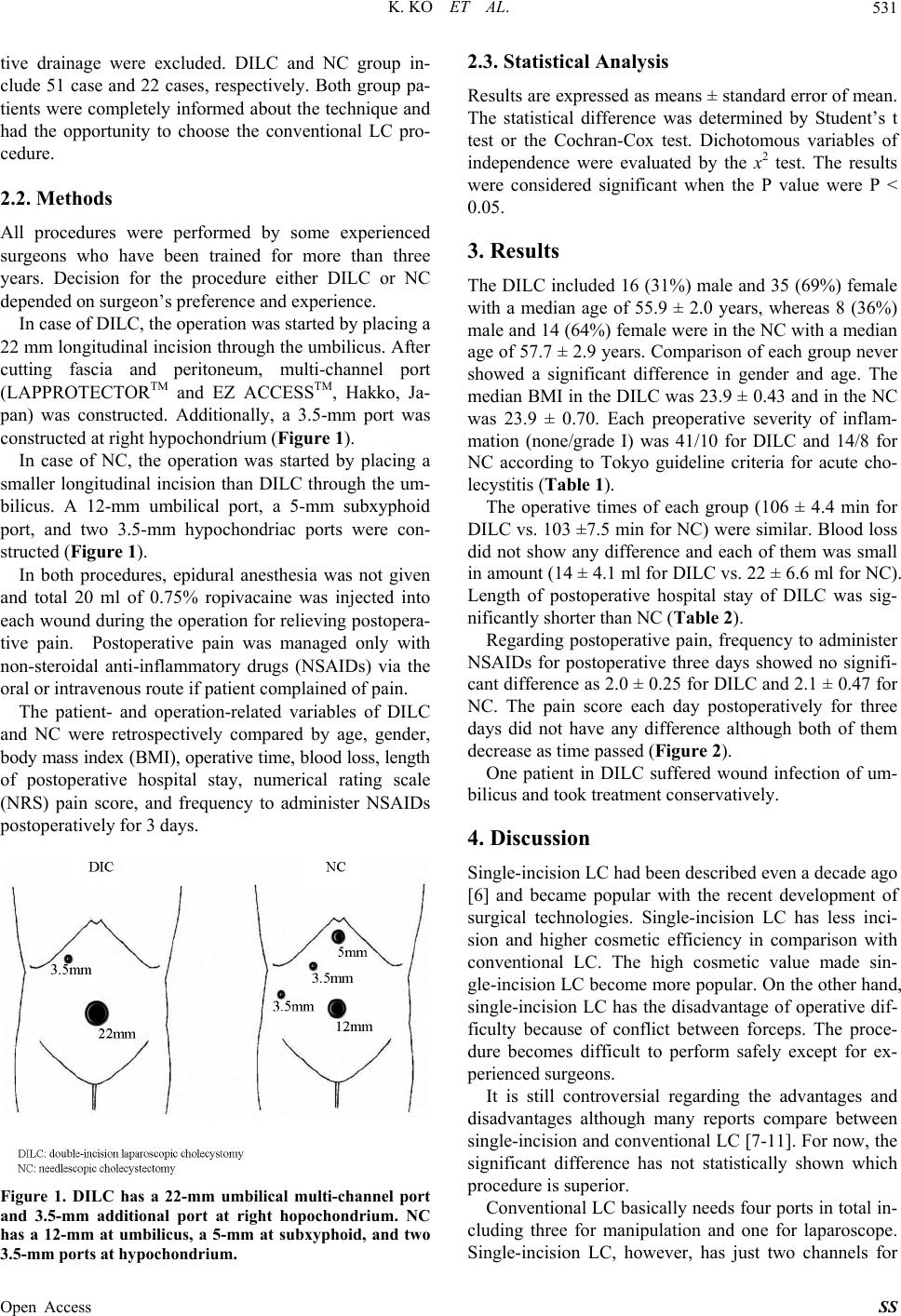 K. KO ET AL. 531 tive drainage were excluded. DILC and NC group in- clude 51 case and 22 cases, respectively. Both group pa- tients were completely informed ab out the technique and had the opportunity to choose the conventional LC pro- cedure. 2.2. Methods All procedures were performed by some experienced surgeons who have been trained for more than three years. Decision for the procedure either DILC or NC depended on surgeon’s preference and experience. In case of DILC, the operation was started by placing a 22 mm longitudin al incision through the u mbilicus. After cutting fascia and peritoneum, multi-channel port (LAPPROTECTORTM and EZ ACCESSTM, Hakko, Ja- pan) was constructed. Additionally, a 3.5-mm port was constructed at right hypochondrium (Figure 1). In case of NC, the operation was started by placing a smaller longitudinal incision than DILC through the um- bilicus. A 12-mm umbilical port, a 5-mm subxyphoid port, and two 3.5-mm hypochondriac ports were con- structed (Figure 1). In both procedures, epidural anesthesia was not given and total 20 ml of 0.75% ropivacaine was injected into each wound during the operation for relieving postopera- tive pain. Postoperative pain was managed only with non-steroidal anti-inflammatory drugs (NSAIDs) via the oral or intravenous route if patient complained of pain. The patient- and operation-related variables of DILC and NC were retrospectively compared by age, gender, body mass index (BMI), operative time, blood loss, length of postoperative hospital stay, numerical rating scale (NRS) pain score, and frequency to administer NSAIDs postope ra t ively fo r 3 da ys. Figure 1. DILC has a 22-mm umbilical multi-channel port and 3.5-mm additional port at right hopochondrium. NC has a 12-mm at umbilicus, a 5-mm at subxyphoid, and two 3.5-mm ports at hypochondrium. 2.3. Statistical Analysis Results are expressed as means ± standard error of mean. The statistical difference was determined by Student’s t test or the Cochran-Cox test. Dichotomous variables of independence were evaluated by the x2 test. The results were considered significant when the P value were P < 0.05. 3. Results The DILC included 16 (31%) male and 35 (6 9%) female with a median age of 55.9 ± 2.0 years, whereas 8 (36%) male and 14 (64%) female were in the NC with a median age of 57.7 ± 2.9 years. Comparison of each group never showed a significant difference in gender and age. The median BMI in the DILC was 23.9 ± 0.43 and in the NC was 23.9 ± 0.70. Each preoperative severity of inflam- mation (none/grade I) was 41/10 for DILC and 14/8 for NC according to Tokyo guideline criteria for acute cho- lecystitis (Table 1). The operative times of each group (106 ± 4.4 min for DILC vs. 103 ±7.5 min for NC) were similar. Blood loss did not show any difference and each of them was small in amount (14 ± 4.1 ml for DILC vs. 22 ± 6.6 ml for NC). Length of postoperative hospital stay of DILC was sig- nificantly shorter than NC (Table 2). Regarding postoperative pain, frequency to administer NSAIDs for postoperative three days showed no signifi- cant difference as 2.0 ± 0.25 fo r DILC and 2.1 ± 0.47 for NC. The pain score each day postoperatively for three days did not have any difference although both of them decrease as time passed (Figure 2). One patient in DILC suffered wound infection of um- bilicus and took treatment cons ervatively. 4. Discussion Single-incision LC had been described even a decade ago [6] and became popular with the recent development of surgical technologies. Single-incision LC has less inci- sion and higher cosmetic efficiency in comparison with conventional LC. The high cosmetic value made sin- gle-incision LC become more popular. On the other hand, single-incision LC has the disadvantage of operative dif- ficulty because of conflict between forceps. The proce- dure becomes difficult to perform safely except for ex- perienced surgeons. It is still controversial regarding the advantages and disadvantages although many reports compare between single-incision and conventional LC [7 -11]. For now, the significant difference has not statistically shown which procedure is superior. Convention al LC basically needs four ports in total in- cluding three for manipulation and one for laparoscope. Single-incision LC, however, has just two channels for Open Access SS 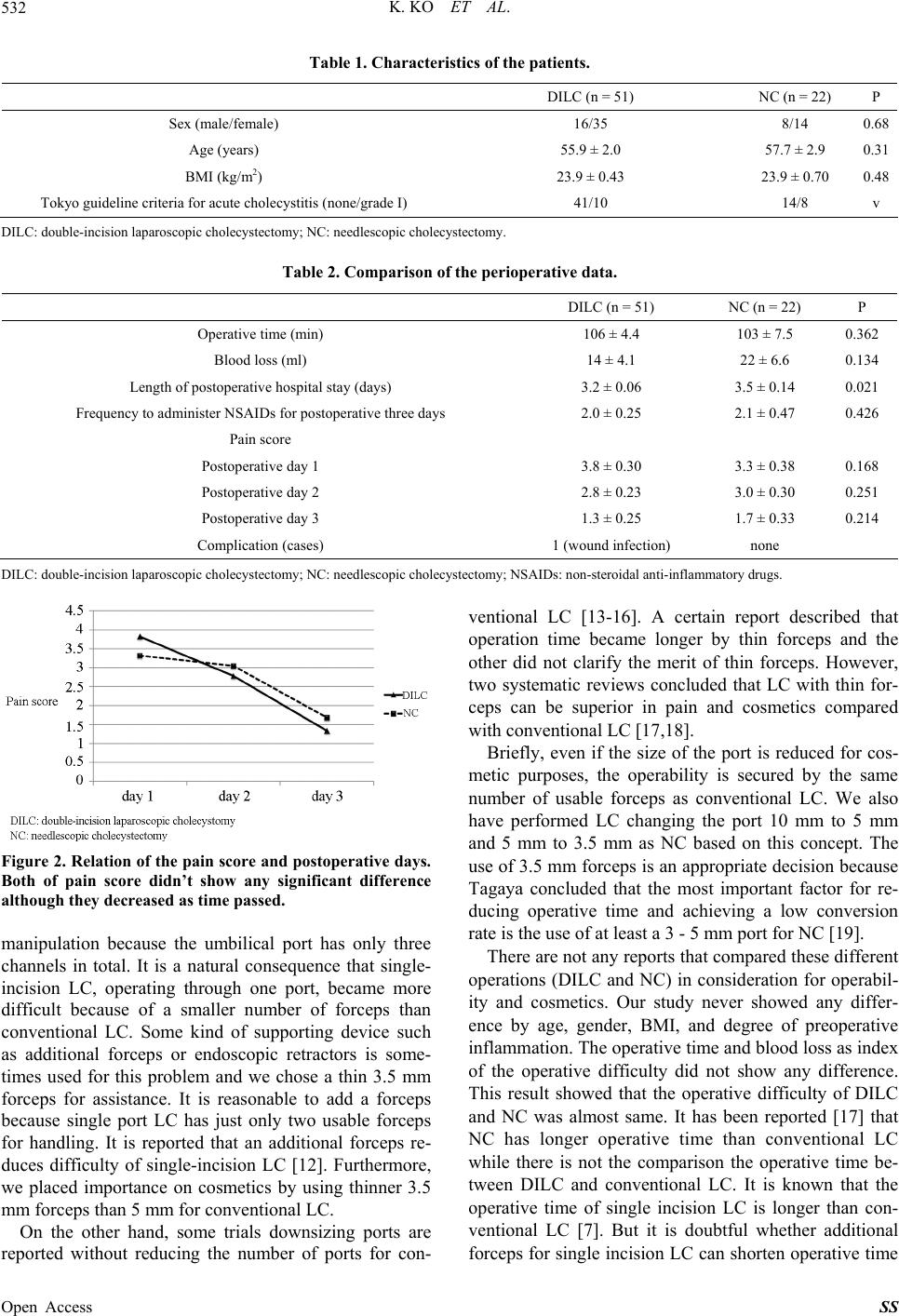 K. KO ET AL. Open Access SS 532 Table 1. Characteristics of the patients. DILC (n = 51) NC (n = 22) P Sex (male/fem ale) 16/35 8/14 0.68 Age (years) 55.9 ± 2.0 57.7 ± 2.9 0.31 BMI (kg/m2) 23.9 ± 0.43 23.9 ± 0.70 0.48 Tokyo guideline criteria for acute cholecystitis (none/grade I) 41/10 14/8 v DILC: doubl e-incision laparo s copic c h ol ecystec t o my; NC: needlescopic cholecy s t ectomy. Table 2. Comparison of the perioperative data. DILC (n = 51) NC (n = 22) P Operative time (min) 106 ± 4.4 103 ± 7.5 0.362 Blood loss (ml) 14 ± 4.1 22 ± 6.6 0.134 Length of postoperative hospital stay (days) 3.2 ± 0.06 3.5 ± 0.14 0.021 Frequency to administer NSAIDs for postoperative three days 2.0 ± 0 .25 2.1 ± 0.47 0.426 Pain score Postoperative day 1 3.8 ± 0.30 3.3 ± 0.38 0.168 Postoperative day 2 2.8 ± 0.23 3.0 ± 0.30 0.251 Postoperative day 3 1.3 ± 0.25 1.7 ± 0.33 0.214 Complication (cases) 1 (wound infection) none DILC: doubl e-incision laparo s copic c h ol ecystec t o my; NC: needlescopic cholecy s t ectomy; NSAIDs: non-steroidal anti-inflammatory drugs. ventional LC [13-16]. A certain report described that operation time became longer by thin forceps and the other did not clarify the merit of thin forceps. However, two systematic reviews concluded that LC with thin for- ceps can be superior in pain and cosmetics compared with conventional LC [17,18]. Briefly, even if the size of the port is reduced for cos- metic purposes, the operability is secured by the same number of usable forceps as conventional LC. We also have performed LC changing the port 10 mm to 5 mm and 5 mm to 3.5 mm as NC based on this concept. The use of 3.5 mm forceps is an appropriate decision because Tagaya concluded that the most important factor for re- ducing operative time and achieving a low conversion rate is the use of at least a 3 - 5 mm port for NC [19]. Figure 2. Relation of the pain score and postoperative days. Both of pain score didn’t show any significant difference although they decreased as time passed. manipulation because the umbilical port has only three channels in total. It is a natural consequence that single- incision LC, operating through one port, became more difficult because of a smaller number of forceps than conventional LC. Some kind of supporting device such as additional forceps or endoscopic retractors is some- times used for this problem and we chose a thin 3.5 mm forceps for assistance. It is reasonable to add a forceps because single port LC has just only two usable forceps for handling. It is reported that an additional forceps re- duces difficulty of single-incision LC [12]. Furthermore, we placed importance on cosmetics by using thinner 3.5 mm forceps than 5 mm for conventional LC. There are not any reports that compared these different operations (DILC and NC) in consideration for operabil- ity and cosmetics. Our study never showed any differ- ence by age, gender, BMI, and degree of preoperative inflammation. The op erativ e ti me an d bloo d lo ss as index of the operative difficulty did not show any difference. This result showed that the operative difficulty of DILC and NC was almost same. It has been reported [17] that NC has longer operative time than conventional LC while there is not the comparison the operative time be- tween DILC and conventional LC. It is known that the operative time of single incision LC is longer than con- ventional LC [7]. But it is doubtful whether additional forceps for single incision LC can shorten operative time On the other hand, some trials downsizing ports are reported without reducing the number of ports for con-  K. KO ET AL. 533 the same as conventional LC. Perhaps DILC is expected having longer operation time in comparison with con- ventional LC. Therefore, it is natural that DILC and NC needed almost same operative time as a result of our study. However, the surgeon’s experience had an effect on the decision of operative procedure in our study, and it might have caused no difference of operative time. The amount of blood loss was a minimal and no differences were seen in either procedure. It was supposed that DILC and NC have almost same operative difficulty although the surgeon’s experience differed between these proce- dures. Length of hospital stay of DILC group was signifi- cantly shorter than NC, but th e cause is not clear because NC had no complications which extended hospital stay. For the case which is expected to be difficult, NC might have been chosen because decision of the procedure de- pended on surgeon’s preference and experience. Regarding postoperative pain, single incision LC was expected to be less painful because of a smaller number of wounds than conventional LC at first. Recently, some reports have shown that single incision LC is more pain- ful than conventional LC [8,9]. However, there is no re- port found including a comparative review about postop- erative pain of DILC and NC like in our report. Our study compared frequency of administrating NSAIDs and pain scale for the evaluation of the pain and, as a result, it did not show any significant difference. There is a report that postoperative analgesia require- ments for the LC with needlescopic instruments, which has smaller ports, were 70% lower than for the conven- tional LC [20]. It is expected that a slightly bigger wound to construct multichannel port for DILC caused strong pain, but our study showed a different result. The effect of number or size of ports on postoperative pain remains an open que st ion. Regarding complications, no major complications oc- curred and both procedures seemed to be almost safe. 5. Conclusion It is thought that DILC and NC have the same operative difficulties on account of no difference with operative time and blood loss. Moreover, both procedures can be performed safely without any serious complication. Re- garding early postoperative pain, both procedures did not show any difference. REFERENCES [1] P. Bucher, F. Pugin, C. Buchs, S. Ostermann and P. Mo- rel, “Randomized Clinical Trial of Laparoendoscopic Sin- gle-Site versus Conventional Laparoscopic Cholecystec- tomy,” British Journal of Surgery, Vol. 98, No. 12, 2011, pp. 1695-1702. http://dx.doi.org/10.1002/bjs.7689 [2] D. Mutter, C. Callari, M. Diana, B. Dallemagne, J. Leroy and J. Marescaux, “Single Port Laparoscopic Cholecys- tectomy: Which Technique, Which Surgeon, for Which Patient? A Study of the Implementation in a Teaching Hospital,” Journal of Hepato-Biliary-Pancreatic Surgery, Vol. 18, No. 3, 2011, pp. 453-457. http://dx.doi.org/10.1007/s00534-010-0348-3 [3] M. A. Kia, C. Lee, J. M. Martinez and N. Zundel, “Single Port Cholecystectomy: The Pathway Back to a Standard- ized Technique,” Surgical Laparoscopy Endoscopy & Percutaneous Techniques, Vol. 21, No. 5, 2011, pp. 314- 317. http://dx.doi.org/10.1097/SLE.0b013e31822d00aa [4] P. L. Leggett, C. D. Bissell, R. Churchman-Winn and C. Ahn, “Three-Port Microlaparoscopic Cholecystectomy in 159 Patients,” Surgical Endoscopy, Vol. 15, No. 3, 2001, pp. 293-296. http://dx.doi.org/10.1007/s004640000302 [5] M. Hirota, T. Takada, Y. Kawarada, Y. Nimura, F. Miura, K. Hirata, et al., “Diagnostic Criteria and Severity Assess- ment of Acute Cholecystitis: Tokyo Guidelines,” Journal of Hepato-Biliary-Pancreatic Surgery, Vol. 14, No. 1, 2007, pp. 78-82. http://dx.doi.org/10.1007/s00534-006-1159-4 [6] G. Navarra, E. Pozza, S. Occhionorelli, P. Carcoforo and I. Donini, “One-Wound Laparoscopic Cholecystectomy,” British Journal of Surgery, Vol. 84, No. 5, 1997, p. 695. http://dx.doi.org/10.1002/bjs.1800840536 [7] S. R. Markar, A. Karthikesalingam, S. Thrumurthy, L. Muirhead, J. Kinross and P. Paraskeva, “Single-Incision Laparoscopic Surgery (SILS) vs. Conventional Multiport Cholecy stectomy: Systematic Review and Meta-Analysis,” Surgical Endoscopy, Vol. 26. No. 5, 2012, pp. 1205-1213. http://dx.doi.org/10.1007/s00464-011-2051-0 [8] M. S. Phillips, J. M. Marks, K. Roberts, R. Tacchino, R. Onders, G. DeNoto, et al., “Intermediate Results of a Pro- spective Randomized Controlled Trial of Traditional Four- Port Laparoscopic Cholecystectomy versus Single-Inci- sion Laparoscopic Cholecystectomy,” Surgical Endosco- py, Vol. 26, No. 5, 2012, pp. 1296-1303. http://dx.doi.org/10.1007/s00464-011-2028-z [9] D. J. Ostlie, O. O. A. D. Juang, C. W. Iqbal, S. W. Sharp, C. L. Snyde r, W. S. Andrews, et al., “Single Incision ver- sus Standard 4-Port Laparoscopic Cholecystectomy: A Prospective Randomized Trial,” Journal of Pediatric Sur- gery, Vol. 48. No. 1, 2013, pp. 209-214. http://dx.doi.org/10.1016/j.jpedsurg.2012.10.039 [10] J. Ma, M. A. Cassera, G. O. Spaun, C. W. Hammill, P. D. Hansen and S. Aliabadi-Wahle, “Randomized Controlled Trial Comparing Single-Port Laparoscopic Cholecystec- tomy and Four-Port Laparoscopic Cholecystectomy,” Ar- chives of Surgery, Vol. 254, No. 1, 2011, pp. 22-27. http://dx.doi.org/10.1097/SLA.0b013e3182192f89 [11] S. Trastulli, R. Cirocchi, J. Desiderio, S. Guarino, A. San- toro, A. Parisi, et al., “Systematic Review and Meta-Ana- lysis of Randomized Clinical Trials Comparing Single- Incision versus Conventional Laparoscopic Cholecystec- tomy,” British Journal of Surgery, Vol. 100, No. 2, 2013, pp. 191-208. http://dx.doi.org/10.1002/bjs.8937 [12] S. H. Ju, D. G. Lee, J. H. Lee, M. K. Baek, B. C. Jeong, S. Open Access SS  K. KO ET AL. Open Access SS 534 S. Jeon, et al., “Laparoendoscopic Single-Site Pyeloplasty Using Additional 2 mm Instruments: A Comparison with Conventional Laparoscopic Pyeloplasty,” Korean Journal of Urology, Vol. 52, No. 9, 2011, pp. 616-621. http://dx.doi.org/10.4111/kju.2011.52.9.616 [13] C. H. Hsieh, “Early Minil apa roscopic Chol ecy stec tomy i n Patients with Acute Cholecystitis,” The American Journal of Surgery, Vol. 185, No. 4, 2003, pp. 344-348. http://dx.doi.org/10.1016/S0002-9610(02)01417-4 [14] M. T. Huang, W. Wang, P. L. Wei, R. J. Chen and W. J. Lee, “Minilaparoscopic and Laparoscopic Cholecystecto- my: A Comparative Study,” Archives of Surgery, Vol. 138, No. 9, 2003, pp. 1017-1023. http://dx.doi.org/10.1001/archsurg.138.9.1017 [15] P. H. Cabral, I. T. Silva, J. V. Melo, F. S. Gimenez, C. R. Cabral and A. P. Lima, “Needlescopic versus Laparosco- pic Cholecystectomy. A Prospective Study of 60 Pa- tients,” Acta Cirurgica Brasileira, Vol. 23, No. 6, 2008, pp. 543-550. http://dx.doi.org/10.1590/S0102-86502008000600012 [16] Y. W. Novitsky, K. W. Kercher, D. R. Czerniach, G. K. Kaban, S. Khera, K. A. Gallagher-Dorval, et al., “Advan- tages of Mini-Laparoscopic vs. Conventional Laparosco- pic Cholecystectomy: Results of a Prospective Random- ized Trial,” Archives of Surgery, Vol. 140, No. 12, 2005, pp. 1178-1183. http://dx.doi.org/10.1001/archsurg.140.12.1178 [17] M. S. Sajid, M. A. Khan, K. Ray, E. Cheek and M. K. Baig, “Needlescopic versus Laparoscopic Cholecystecto- my: A Meta -Analysis,” ANZ Journal of Surgery, Vol. 79, No. 6, 2009, pp. 437-442. http://dx.doi.org/10.1111/j.1445-2197.2009.04945.x [18] R. McCloy, D. Randall, S. A. Schug, H. Kehlet, C. Si- manski, F. Bonnet, et al., “Is Smalle r Necessarily Better? A Systematic Review Comparing the Effects of Minila- paroscopic and Conventional Laparoscopic Cholecystec- tomy on P atient Outcomes,” Surgical Endoscopy, Vol. 22, No. 12, 2008, pp. 2541-2553. http://dx.doi.org/10.1007/s00464-008-0055-1 [19] N. Tagaya, A. Abe and K. Kubota, “Needlescopic Sur- gery for Liver, Gallbladder and Spleen Disease,” Journal of Hepato-Biliary-Pancreatic Sciences, Vol. 18, No. 4, 2001, pp. 516-524. http://dx.doi.org/10.1007/s00534-011-0398-1 [20] M. Gagner and A. Garcia-Ruiz, “Technical Aspects of Minimally Invasive Abdominal Surgery Performed with Needlescopic Instruments,” Surgical Laparoscopy Endo- scopy, Vol. 8, No. 3, 1998, pp. 171-179. http://dx.doi.org/10.1097/00019509-199806000-00002 |