

Paper Menu >>
Journal Menu >>
 Advances in Infectious Diseases, 2013, 3, 243-247 Published Online December 2013 (http://www.scirp.org/journal/aid) http://dx.doi.org/10.4236/aid.2013.34036 Open Access AID 243 Septic Shock after Intravesical BCG Instillation—A Case Report* Cristóvão Figueiredo1#, Diana Póvoas1, Carlos Alves1, Alcina Ferreira1, Paulo Figueiredo1, Teresa Carvalho2, Angélica Ramos2, Lurdes Santos1, António Sarmento1 1Infectious Diseases Intensive Care Unit, Research and Development Unit (FCT-725), Faculty of Medicine, University of Porto, Centro Hospitar São João EPE, Porto, Portugal; 2Microbiology Laboratory of Clinical Pathology Department, Centro Hospitar São João EPE, Porto, Portugal. Email: #[email protected] Received September 18th, 2013; revised October 15th, 2013; accepted October 20th, 2013 Copyright © 2013 Cristóvão Figueiredo et al. This is an open access article distributed under the Creative Commons Attribution License, which permits unrestricted use, distribution, and reproduction in any medium, provided the original work is properly cited. ABSTRACT Bacillus Calmette-Guérin (BCG) is a live attenuated form of Mycobacterium bovis, initially used in medicine as a vac- cination agent only. The discovery of its antineoplastic effects in bladder cancer has led to the widespread recognition of BCG intravesical instillation as a therap eutic option. Although sepsis following BCG intravesical instillation is rare, it is nonetheless a dreadful and potentially fatal complication. Therapy usually relies on antituberculous therapy and ste- roids, alongside with intensive care unit admission. The authors report a case of a 67-year-old male patient who devel- oped septic shock with multiple organ dysfunction after intravesical BCG instillation and review the currently avail- able knowledge concerning the risk factors, diagnosis, management and prevention of BCG sepsis. Keywords: Bacillus Calmette-Guérin; BCG; Sepsis; Shock 1. Introduction Bacillus Calmette-Guérin (BCG) is a low-virulence my- cobacteria originated from successive cultures of Myco- bacterium bovis [1], and intravesical instillation of BCG is a therapeutic option in bladder cancer [2]. Sepsis is a rare complication of this procedure, and certain aspects concerning its diagn ostic and treatment are still debatab le. We report the case of a patient who developed septic shock with multiple organ dysfunction after intravesical BCG instillation and review the currently available know- ledge concerning the risk factors, diagnosis, management and prevention of BCG sepsis. 2. Case Report We report the case of a 67-year-old male patient, with known Alzheimer’s and cerebrovascular disease, who had been diagnosed with a vesical urothelial carcinoma (pT1) on February 2012 and underwent transurethral re- section (TUR) in the following month. He began monthly intravesical Bacillus Calmette-Guérin (BCG) instillation on May 2012. After each session he complained of low- grade fever, which spontaneously waned on the follow- ing 24 - 48 h. On May 10th of 2013 (Day 1 - D1), he presented to the outpatient clinic complaining of persistent fever and in- creased sudoresis for 2 weeks, after the 12th BCG instil- lation; he denied any other symptoms. The physical ex- amination was unremarkable, apart from being slightly more disoriented than usual. The analytic panel revealed an elevated C reactive protein, elevated liver enzymes with normal bilirubin; elevated creatinine (see Table 1) and mild leucocyturia (89 cells/µL) without any other urinary changes. On abdominal ultrasonography, an en- larged liver with heterogenic parenchyma was noted, sug- gesting acute hepatitis. He was admitted to our hospital, a urine culture for mycobacteria was collected, and he began oral levoflox- acin (500 mg id). His clinical condition deterio rated, and on D6 he was admitted to the Infectious Diseases Inten- sive Care Unit (ID-ICU) due to dyspnoea and oxygen desaturation (86% on pulse oximetry) which did not re- solve with oxygen supplementation. He presented ta- chypnea (36 cpm), tachycardia (106 bpm), poor distal *Conflict of interest: The authors have no co nf l i ct o f i n terest to declare. #Corresponding author. 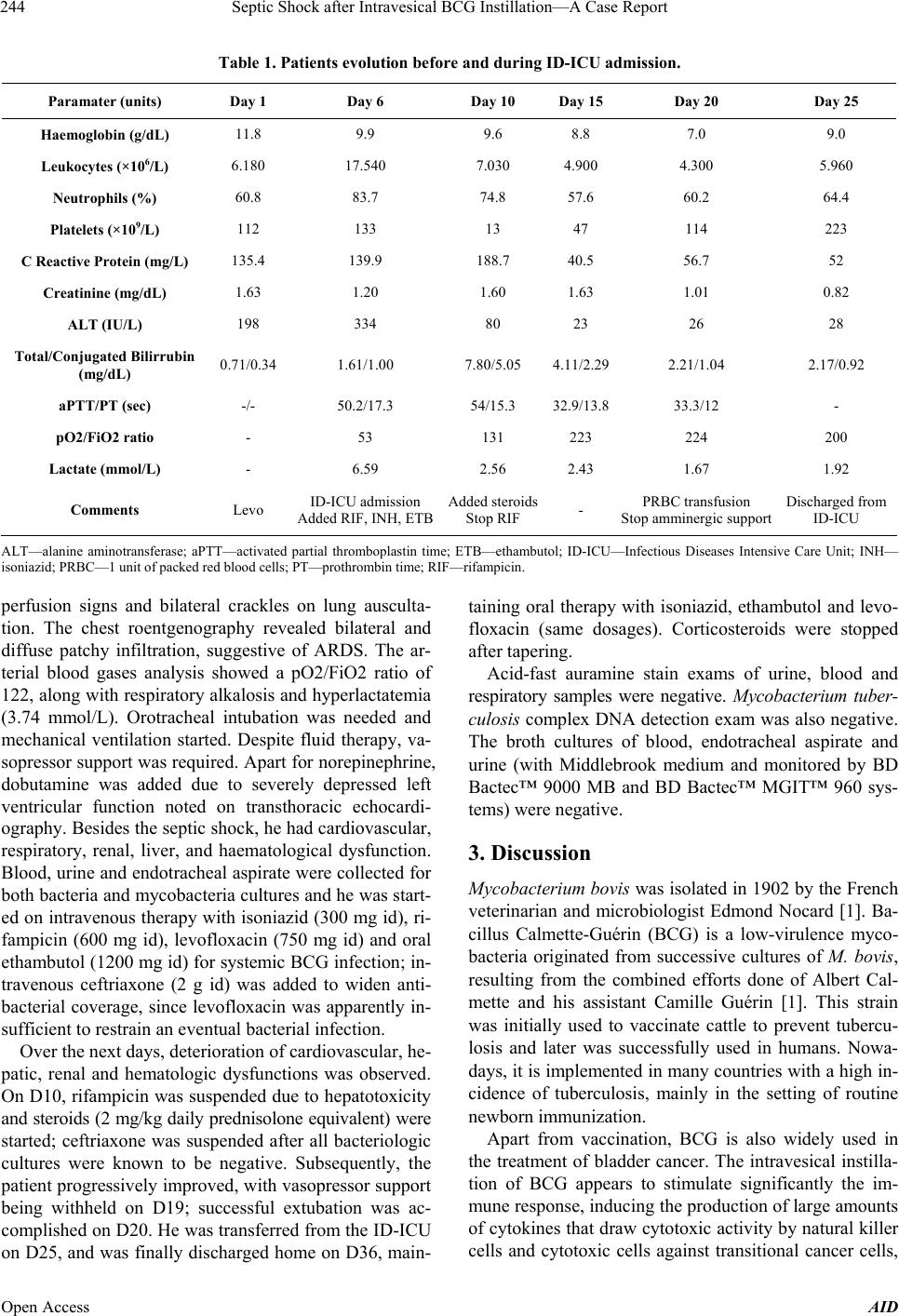 Septic Shock after Intravesical BCG Instillation—A Case Report 244 Table 1. Patients evolution before and dur ing ID-ICU admission. Paramater ( units) Day 1 Day 6 Day 10 Day 15Day 20 Day 25 Haemoglobin (g/dL) 11.8 9.9 9.6 8.8 7.0 9.0 Leukocytes (×106/L) 6.180 17.540 7.030 4.900 4.300 5.960 Neutrophils (%) 60.8 83.7 74.8 57.6 60.2 64.4 Platelets (×109/L) 112 133 13 47 114 223 C Reactive Protein (mg/L) 135.4 139.9 188.7 40.5 56.7 52 Creatinine (mg/dL) 1.63 1.20 1.60 1.63 1.01 0.82 ALT (IU/L) 198 334 80 23 26 28 Total/Conjugated Bilirrubin (mg/dL) 0.71/0.34 1.61/1.00 7.80/5.05 4.11/2.292.21/1.04 2.17/0.92 aPTT/PT (sec) -/- 50.2/17.3 54/15.3 32.9/13.833.3/12 - pO2/FiO2 ratio - 53 131 223 224 200 Lactate (mmol/L) - 6.59 2.56 2.43 1.67 1.92 Comments Levo ID-ICU admission Added RIF, INH, ETBAdded steroids Stop RIF - PRBC transfusion Stop amminergic support Discharged from ID-ICU ALT—alanine aminotransferase; aPTT—activated partial thromboplastin time; ETB—ethambutol; ID-ICU—Infectious Diseases Intensive Care Unit; INH— isoniazid; PRBC—1 unit of packed red blood cells; PT—prothrombin time; RIF—rifampicin. perfusion signs and bilateral crackles on lung ausculta- tion. The chest roentgenography revealed bilateral and diffuse patchy infiltration, suggestive of ARDS. The ar- terial blood gases analysis showed a pO2/FiO2 ratio of 122, along with respiratory alkalosis and hyperlactatemia (3.74 mmol/L). Orotracheal intubation was needed and mechanical ventilation started. Despite fluid therapy, va- sopressor suppo rt was requir ed. Apart for norepinephr ine, dobutamine was added due to severely depressed left ventricular function noted on transthoracic echocardi- ography. Besides the septic shock, he had cardiovascular, respiratory, renal, liver, and haematological dysfunction. Blood, urine and endotracheal aspirate were collected for both bacteria and mycobacteria cultures and he was start- ed on intravenous therap y with isoniazid (300 mg id), ri- fampicin (600 mg id), levofloxacin (750 mg id) and oral ethambutol (1200 mg id) for systemic BCG infection; in- travenous ceftriaxone (2 g id) was added to widen anti- bacterial coverage, since levofloxacin was apparently in- sufficient to restrain an eventual bacterial infection. Over the next days, deterioration of cardiovascular, he- patic, renal and hematologic dysfunctions was observed. On D10, rifampicin was suspended due to hepatotox icity and steroids (2 mg/kg daily prednisolone equivalent) were started; ceftriaxone was suspended after all bacteriologic cultures were known to be negative. Subsequently, the patient progressiv ely improved, with vasopresso r support being withheld on D19; successful extubation was ac- complished on D20. He was transferred from the ID-ICU on D25, and was finally discharged home on D36, main- taining oral therapy with isoniazid, ethambutol and levo- floxacin (same dosages). Corticosteroids were stopped after tapering. Acid-fast auramine stain exams of urine, blood and respiratory samples were negative. Mycobacterium tuber- culosis complex DNA detection exam was also negative. The broth cultures of blood, endotracheal aspirate and urine (with Middlebrook medium and monitored by BD Bactec™ 9000 MB and BD Bactec™ MGIT™ 960 sys- tems) were negative. 3. Discussion Mycobacterium bovis was isolated in 1902 by the French veterinarian and microbiologist Edmond Nocard [1]. Ba- cillus Calmette-Guérin (BCG) is a low-virulence myco- bacteria originated from successive cultures of M. bovis, resulting from the combined efforts done of Albert Cal- mette and his assistant Camille Guérin [1]. This strain was initially used to vaccinate cattle to prevent tubercu- losis and later was successfully used in humans. Nowa- days, it is implemented in many countries with a high in- cidence of tuberculosis, mainly in the setting of routine newborn immunization. Apart from vaccination, BCG is also widely used in the treatment of bladder cancer. The intravesical instilla- tion of BCG appears to stimulate significantly the im- mune response, inducing the production of large amounts of cytokines that draw cytotox ic activity by natural killer cells and cytotoxic cells against transitional cancer cells, Open Access AID  Septic Shock after Intravesical BCG Instillation—A Case Report 245 diminishing the prob ability of recidivant or invasive neo- plasia [2]. Intravesical administration of BCG can be associated with several complications. These may be local or sys- temic and occur early or late on the course of BCG treat- ment. The majority of patients experience local symp- toms (such as dysuria and frequency) within two hours of BCG instillation, which may be accompanied by low- grade fever and malaise. Like in the case reported, these symptoms usually resolve within 48 hours and may be more frequent in patients who have previously received intravesical instillations [3]. Some authors suggest that the occurrence of low fever and cystitis after intrav esical instillation may be signs of a good therapeutic response [4]. However, local complications can occur, and there are reports of granulomatous ulceration of the glans penis, prostatitis, epididymitis, ureteral obstruction, bladder con- tracture and renal abscess [5]. In the majority of the intravesical BCG sepsis cases, symptoms developed only after several instillation s. How- ever, in a case described by Frey et al. [6], septic shock developed rapidly after the first BCG intravesical instil- lation in a 31-year old patient not previously immunized with BCG. In the present case, the patient was on BCG treatment for a year. After the last instillation (without any known local trauma associated) he presented with persisting fever for 2 weeks, which alerted the clinicians for a possible complication. BCG-related sepsis diagnosis is freq uently challenging since symptoms are indistinct from other sepsis causes: patients often develop high fever, chills, hypotension, dis- orientation, disseminated intravascular coagulation, res- piratory insufficiency, jaundice and leucopenia. Lamm et al. [4] have suggested that fever or shivering during or shortly after BCG intravesical instillation may b e predic- tive for the risk of developing a severe infection. This patient had no lower urinary tract symptoms, but there was mild leucocyturia; persistent fever was the only sign of possible disseminated infection, but the seem- ingly benign clinical appearance led to assumption of local complication, and so he began the treatment with levofloxacin. This proved to be rather insufficient, since he subsequently developed septic shock with multiple organ dysf unction. Although BCG instillations contain live attenuated mycobacteria, the likelihood that BCG can be isolated through culture is affected by many factors, including the number of organisms present (which, in turn, reflects the ability of the immune system to control infection), the handling of the samples, and culture technique [7]. As happened in the case described, there is no direct proof of infection by M. bov is in almost a third of cases of serious complications [8]. In BCG disseminated infection or sep- sis, both the tuberculin skin test and the interferon gam- ma release assay (IGRA) can be positive, although IGRA performance for detection of active disease has not been fully evaluated and should not be part of the routine di- agnostic approach for M. bovis infection suspicion [9]. Staining of specimens for acid-fast bacilli, cultures and PCR testing for mycobacterial DNA should be performed in any patient with suspected disseminated BCG infec- tion, even though all of these procedures can b e negative in some cases. However, it is important to note that nu- cleic acid hybridization probe assays cannot be used to distinguish among members of the M. tuberculosis com- plex directly from samples, since they lack sensitivity. So the identification of mycobacteria through these techni- ques relies on the cultural isolation of M. bovis [9]. There are no controlled studies that determined the op- timal therapy of intravesical BCG-related sepsis. In a cli- nically suspected case of BCG related co mplication, some studies recommend immediate start of fluoroquinolone therapy, since this treatment is effective against both BCG and Gram-negative urinary pathogens [10]. Like M. bovis, BCG is susceptible to most of the antituberculous drugs, apart from pyrazinamide and cycloserine [11]. Iso- niazid (300 mg id) and rifampicin (600 mg id) are usual- ly recomm ended fo r 6 - 9 months [12,1 3]. Additionally to antituberculous therapy, some human and animal studies have suggested potentially beneficial effect of corticosteroid use in the treatment of severe cases of disseminated BCG infection [12-17]. The me- chanism related to this beneficial effect may be related to the possible hypersensitivity reaction developed during BCG treatment [2,12]. In the case reported, standard treatment for septic shock was started, and the antituber- culous scheme was broadened; nevertheless, the patient’s status deteriorated during the next 4 days. Steroid use in septic shock (of any aetiology) as long been controversial, but in this case it was only after steroid therapy introdu c- tion that the patient slowly (yet steadily) improved. We started with 2 mg/kg/daily prednisolone equivalent, tape- ring the dose to half every 3 - 4 days until suspension after 23 days. It’s rather tempting to attribute the initial improvement of this patient to the anti-inflammatory ef- fect of steroids. Yet, mixed outcomes and recognized side-effects associated with steroids lead to uncertainties concerning its recommendation. Besides, there have been descriptions of clinical aggravation after steroid suspen- sion [13]. Although potentially helpful in some cases of septic shock, steroid therap y in the setting of BCG sepsis remains debatable. With the increasing development of anti-inflammatory therapies (especially monoclonal an- tibodies), perhaps new and tailored-made therapies could have beneficial impact on this rare yet potentially fatal complication. Since optimal therapy is still uncertain, measures to prevent infection by BCG are of paramount importance. Open Access AID  Septic Shock after Intravesical BCG Instillation—A Case Report 246 These include deferral of BCG instillation in patients with difficult bladder catheterizations, cystitis, or persis- tent haematuria following transurethral resection of the bladder tumour [13]. Furthermore, BCG intravesical in- stillations should be permanently suspended in patients who develop infectious complications requiring antitu- berculous therapy. Drug prophylaxis has also been tested. Isoniazid (either 300 mg id, or concurrent administration with intravesical instillation of BCG) showed no efficacy in preventing BCG related complications and suggested contributing to lesser efficacy of BCG instillation treat- ment, since live organisms seem to be required for the in- stillation’s immunological effect [18,19]. Ofloxacin ad- ministered after each BCG instillation reduced the in- cidence of severe local reactions and the need for antitu- berculous therapy; a recent study using prulifloxacin re- ported similar findings [20]. Somehow, this strategy doesn’t seem to affect the efficacy of BCG anti-neoplasic treatment. Yet, present data is not sufficient for a clear recommendation about drug prophylaxis. 4. Conclusion BCG-induced sepsis after intravesical instillation for bladder cancer is a rare complication. Pathophysiology remains largely unknown, but BCG’s low virulence sug- gests that an immunological hipersensitivity reaction pro- bably plays a role. In severe cases, high-dose steroids could be added to antituberculous therapy and the corner- stone of BCG-induced sepsis. Measures to prevent BCG infection should be strictly observed. REFERENCES [1] U. V. A. Silva, L. S. Viana, P. T. O. Castro, R. Almeida and R. S. P. daSilva, “Fatal Sepsis after Intravesical In- stillation of BCG—Case Report,” Rev Bras Ter Intensiva, Vol. 23, No. 1, 2011, pp. 104-107. http://dx.doi.org/10.1590/S0103-507X2011000100016 [2] S. Brandau and H. Suttmann, “Thirty Years of BCG Im- munotherapy for Non-Muscle Invasive Bladder Cancer: A Success Story with Room for Improvement,” Biomed Pharmaceuticals, Vol. 61, No. 6, 2007, pp. 299-305. http://dx.doi.org/10.1016/j.biopha.2007.05.004 [3] M. J. Barza, J. H. Blum and F. M. Graeme-Cook, “A 57- Year-Old Man with Fever and Jaundice after Intravesical Instillation of Bacille Calmette-Guérin for Bladder Can- cer,” The New England Journal of Medicine, Vol. 339, No. 12, 1998, p. 831. [4] D. L. Lamm, “Efficacy and Safety of Bacille Calmette- Guérin Immunotherapy in Superficial Bladder Cancer,” Clinical Infectious Diseases, Vol. 31, No. S3, 2000, pp. S86-S90. http://dx.doi.org/10.1086/314064 [5] C. French, L. Hickey and D. Bell, “Caseating Granulomas on the Glans Penis as a Complication of Bacille Calmette- Guérin Intravesical Therapy,” Reviews in Urology, Vol. 3, No. 1, 2001, pp. 36-39. [6] H. M. Frey, “Septic Shock in a 3l-Year-Old Male with a Superficial Bladder Tumor,” Clinical Infectious Diseases, Vol. 2, No. 4, 1998, pp. 226-229. http://dx.doi.org/10.1016/S1201-9712(98)90058-3 [7] O. Gonzalez, D. Musher, I. Brar, S. Furgeson, M. Bok- tour, E. Septimus, R. Hamill and E. Graviss, “Spectrum of Bacille Calmette-Guérin (BCG) Infection after Intra- vesical BCG Immunotherapy,” Clinical Infectious Di- seases, Vol. 36, No. 2, 2003, pp. 140-148. http://dx.doi.org/10.1086/344908 [8] F. Saint, L. Salomon, R. Quintela, A. Cicco, C. C. Abbou and D. K. Chopin, “Classification, Facteurs Favorisants, Prévention et Traitement des Effets Indésirables Associés au Bacille de Calmette-Guérin dans le Traitement des Tumeurs Superficielles de Vessie,” Annales of Urology, Vol. 36, No. 2, 2002, pp. 120-131. http://dx.doi.org/10.1016/S0003-4401(01)00085-7 [9] E. Talbot, C. F. von Reyn and E. L. Baron, “Mycobac- terium Bovis,” 2013. http/www.uptodate.com/contents/mycobacterium-bovis [10] C. Durek, A. Jurczok, H. Werner, D. Jocham and A. Bo- hle, “Optimal Treatment of Systemic Bacillus Calmette- Guerin Infection: Investigations in an Animal Model,” Journal of Urology, Vol. 168, No. 2, 2002, pp. 826-831. http://dx.doi.org/10.1016/S0022-5347(05)64751-9 [11] C. Durek, S. Rüsch-Gerdes, D. Jocham and A. Böhle, “Sensitivity of BCG to Modern Antibiotics,” European Urology, Vol. 37, No. S1, 2000, p. s21. http://dx.doi.org/10.1159/000052378 [12] S. C. Koukol, J. I. DeHaven, D. R. Riggs and D. L. Lamm, “Drug Therapy of Bacillus Calmette-Guérin Sepsis,” Uro- logical Research, Vol. 22, No. 6, 1995, pp. 373-376. http://dx.doi.org/10.1007/BF00296878 [13] M. Elkabani, J. N. Greene, A. L. Vincent, S. Van Hook and R. L. Sandin, “Disseminated Mycobacterium bovis af- ter Intravesicular Bacillus Calmette-Guérin Treatments for Bladder Cancer,” Cancer Contact, Vol. 7, No. 5, 2000, pp. 476-481. [14] R. Wittes, L. Klotz and U. Kosecka, “Severe Bacillus Cal- mette-Guérin Cystitis Responds to Sy stemic Steroids When Antituberculous Drugs and Local Steroids Fail,” Journal of Urology, Vol. 161, No. 5, 1999, p. 1568. http://dx.doi.org/10.1016/S0022-5347(05)68961-6 [15] A. Steg, C. Leleu, B. Debré, et al., “Systemic Bacillus Calmette-Guérin Infection in Patients Treated by Intrave- sical BCG Therapy for Superficial Bladder Cancer,” Progress in Clinical and Biological Research, Vol. 310, No. 1, 1989, p. 325. [16] J. I. DeHaven, C. Tray nellis, D. R. Riggs, E. Ting and D. L. Lamm, “Antibiotic and Steroid Therapy of Massive Systemic Bacillus Calmette-Guérin Toxicity,” Journal of Urology, Vol. 147, No. 3, 1992, pp. 738-742. [17] D. L. Lamm, “Complications of Bacillus Calmette-Guérin Immunotherapy,” Urologic Clinics of North America, Vol. 19, No. 3, 1992, pp. 565-572. [18] Y. Durán, F. Santos, D. Serentill, P. Montaperto, P. Va- lencia and C. Solé, “Tuberculosis Miliar in a Patient Treat- ed with Intravesical Instillations
of Bacillus Calmette- Guérin,” Med Intensiva, Vol. 30, No. 3, 2006, pp. 116- Open Access AID  Septic Shock after Intravesical BCG Instillation—A Case Report Open Access AID 247 119. http://dx.doi.org/10.1016/S0210-5691(06)74485-0 [19] A. P. van der Meijden, M. Brausi, V. Zambon, W. Kirkels, C. de Balincourt and R. Sylvester, “Intravesical Instilla- tion of Epirubicin, Bacillus Calmette-Guérin and Bacillus Calmette-Guérin plus Isoniazid for Intermediate and High Risk Ta, T1 Papillary Carcinoma of the Bladder: A Euro- pean Organization for Research and Treatment of Cancer Genito-Urinary Group Randomized Phase III Trial,” Journal of Urology, Vol. 166, No. 2, 2001, p. 476. http://dx.doi.org/10.1016/S0022-5347(05)65966-6 [20] R. Damiano, M. De Sio, G. Quarto, et al., “Short-Term Administration of Prulifloxacin in Patients with Nonmus- cle-Invasive Bladder Cancer: An Effective Option for the Prevention of Bacillus Calmette-Guérin-Induced Toxic- ity?” BJU International, 2009, Vol. 104, p. 633. http://dx.doi.org/10.1111/j.1464-410X.2009.08469.x |