

Paper Menu >>
Journal Menu >>
 Journal of Cosmetics, Dermatological Sciences and Applications, 2013, 3, 256-262 Published Online December 2013 (http://www.scirp.org/journal/jcdsa) http://dx.doi.org/10.4236/jcdsa.2013.34039 Open Access JCDSA A Pilot Survey of Mercury in Drugs, Cosmetics and Household Products Using Reliable Analytical Methods Lian Liang1*, John Gilkeson2, Ed Swain3, Elizabeth Bennett1, Maya Li1, Mei Deng1, Patrick Pang1 1Cebam Analytical, Inc., Bothell, USA; 2Minnesota Pollution Control Agency, Resource Management and Assistance Division, St. Paul, USA; 3Minnesota Pollution Control Agency, Environmental Assessment and Outcomes Division, St. Paul, USA. Email: *[email protected] Received October 8th, 2013; revised November 2nd, 2013; accepted November 10th, 2013 Copyright © 2013 Lian Liang et al. This is an open access article distributed under the Creative Commons Attribution License, which permits unrestricted use, distribution, and reproduction in any medium, provided the original work is properly cited. ABSTRACT The concentration of mercury (Hg) was accurately determined in more than 228 drugs, cosmetics and household prod- ucts manufactured in a variety of countries. Some drugs were found to contain up to 4424 ppb Hg, and some skin creams contained up to 2769 ppm Hg. Hg in skin creams was found to be almost 100% elemental Hg (Hg0), a volatile species of Hg. Hg0 can enter the human body through inh alation and skin absorp tion, potentially resultin g in the serious consequence of mercury poisoning. The mercury can also volatilize, contaminating the surrounding air. Other people, for example, infants and children, who are close to or contacting the skin of the person using the cosmetics, can also absorb the mercury. Total mercury (THg) was determined by combustion/trap/CVAFS. Methyl mercury (MeHg) and inorganic mercury (Hg2+) were determined by the ethylation based method. The emission of Hg0 was determined by evaporation/trap/CVAFS. All analyses were performed in accordance with explicit quality assurance and quality control protocols and procedures. Keywords: Mercury Speciation; Drugs; Cosmetics; Households; Reliable Methods 1. Introduction As a well-recognized toxic metal [1], Hg has drawn at- tention from scientists all over the wo rld to investigate its effects on the environment and human health. However, the research works focused on its biogeochemical cycling in which water, soil, air, biota were directly involved [2, 3]. Compared to cycling in environmental media, little attention has been paid to drugs and cosmetics. Because drugs are directly taken into human gastrointestinal sys- tem, and cosmetics are directly put on human skin, these products can affect human health more directly and im- mediately than Hg in media from the surrounding envi- ronment [4]. To protect human health and environment, accurately monitoring Hg in these products is necessary, and this research indicates that there is much work to be done. Hg has a long history of use in many cultures as a readily available chemical that seems to have net bene- fits as a preservative or active ingr edient in personal care products, and pharmaceuticals. However, these uses are now seen to be unnecessary, counterproductive, or better accomplished by substituting modern chemical agents that have fewer negative effects, are biodegradable, and do not have significantly greater cost [5]. Due to the per- sistence and toxicity of Hg and its compounds, govern- ment agencies should consider banning its use in human personal care and pharmaceutical products. Government agencies have repeatedly warned the public about the dangers [6-10]. However, the situation apparently has not been improved in recent years. Some drug and biologic products are still being manu- factured with Hg as a preservative, fungicide, or antisep- tic, even though effective biodegradable non-Hg alterna- tives are available. Some high level Hg-containing anti- aging and skin lightening creams, lotions, and soaps are being produced by manufacturers from developing coun- tries, and the availability of these products seems to be increasing in recent years [4]. These products rarely identify Hg as an ingredient and are distributed world- wide through various channels of commerce, marketed primarily to women. Since these products “work well”, *Corresponding autho r . 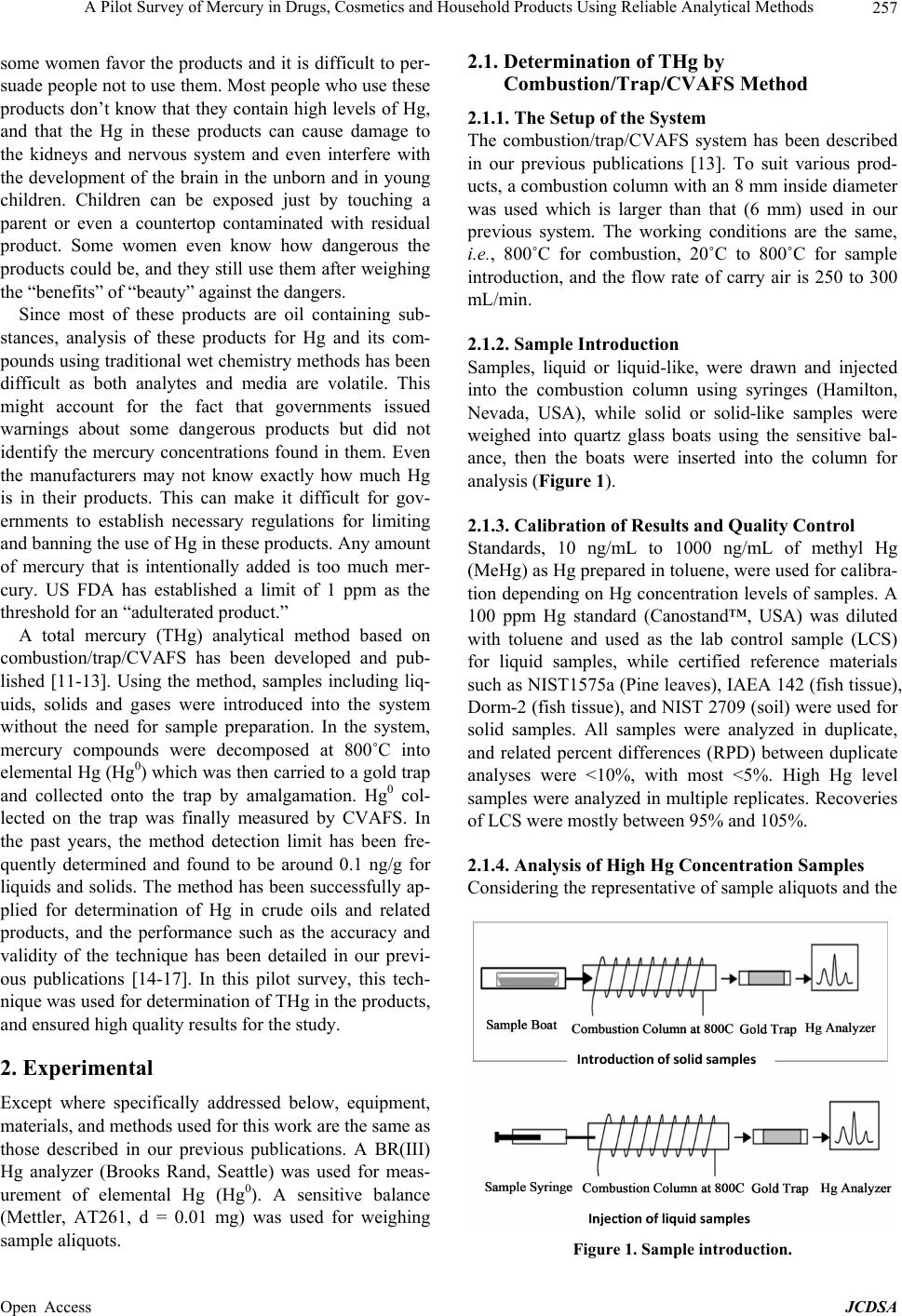 A Pilot Survey of Mercury in Drugs, Cosmetics and Household Products Using Reliable Analytical Methods 257 some women favor th e products and it is difficult to per- suade people not to use them. Most people who use these products don’t know that they contain high levels of Hg, and that the Hg in these products can cause damage to the kidneys and nervous system and even interfere with the development of the brain in the unborn and in young children. Children can be exposed just by touching a parent or even a countertop contaminated with residual product. Some women even know how dangerous the products could be, and they still use them after weighing the “benefits” of “beauty” against the dangers. Since most of these products are oil containing sub- stances, analysis of these products for Hg and its com- pounds using traditional wet chemistry methods has b een difficult as both analytes and media are volatile. This might account for the fact that governments issued warnings about some dangerous products but did not identify the mercury concentrations found in them. Even the manufacturers may not know exactly how much Hg is in their products. This can make it difficult for gov- ernments to establish necessary regulations for limiting and banning the use of Hg in these products. Any amount of mercury that is intentionally added is too much mer- cury. US FDA has established a limit of 1 ppm as the threshold for an “adulterated product.” A total mercury (THg) analytical method based on combustion/trap/CVAFS has been developed and pub- lished [11-13]. Using the method, samples including liq- uids, solids and gases were introduced into the system without the need for sample preparation. In the system, mercury compounds were decomposed at 800˚C into elemental Hg (Hg0) which was then carried to a gold trap and collected onto the trap by amalgamation. Hg0 col- lected on the trap was finally measured by CVAFS. In the past years, the method detection limit has been fre- quently determined and found to be around 0.1 ng/g for liquids and solids. The method has been successfully ap- plied for determination of Hg in crude oils and related products, and the performance such as the accuracy and validity of the technique has been detailed in our previ- ous publications [14-17]. In this pilot survey, this tech- nique was used for determination of THg in the products, and ensured high quality results for the study. 2. Experimental Except where specifically addressed below, equipment, materials, and methods used for this work are the same as those described in our previous publications. A BR(III) Hg analyzer (Brooks Rand, Seattle) was used for meas- urement of elemental Hg (Hg0). A sensitive balance (Mettler, AT261, d = 0.01 mg) was used for weighing sample aliquots. 2.1. Determination of THg by Combustion/Trap/CVAFS Method 2.1.1. The Setup of the System The combustion/trap/CVAFS system has been described in our previous publications [13]. To suit various prod- ucts, a combustion column with an 8 mm inside diameter was used which is larger than that (6 mm) used in our previous system. The working conditions are the same, i.e., 800˚C for combustion, 20˚C to 800˚C for sample introduction, and the flow rate of carry air is 250 to 300 mL/min. 2.1.2. Sa mpl e Introducti on Samples, liquid or liquid-like, were drawn and injected into the combustion column using syringes (Hamilton, Nevada, USA), while solid or solid-like samples were weighed into quartz glass boats using the sensitive bal- ance, then the boats were inserted into the column for analysis (Figure 1). 2.1.3. Calib ra t i on of Resul ts and Quality Cont rol Standards, 10 ng/mL to 1000 ng/mL of methyl Hg (MeHg) as Hg prepared in toluene, were used for calibra- tion depending on Hg concentration levels of samples. A 100 ppm Hg standard (Canostand™, USA) was diluted with toluene and used as the lab control sample (LCS) for liquid samples, while certified reference materials such as NIST1575a (Pine leaves), IAEA 142 (fish tissue), Dorm-2 (fish tissue), and NIST 2709 (soil) were used for solid samples. All samples were analyzed in duplicate, and related percent differences (RPD) between duplicate analyses were <10%, with most <5%. High Hg level samples were analyzed in multiple replicates. Recoveries of LCS were mostly between 95% and 105%. 2.1.4. Analysis of High Hg Concentration Samples Considering the representative of sample aliq uots and the Figure 1. Sample introduction. Open Access JCDSA 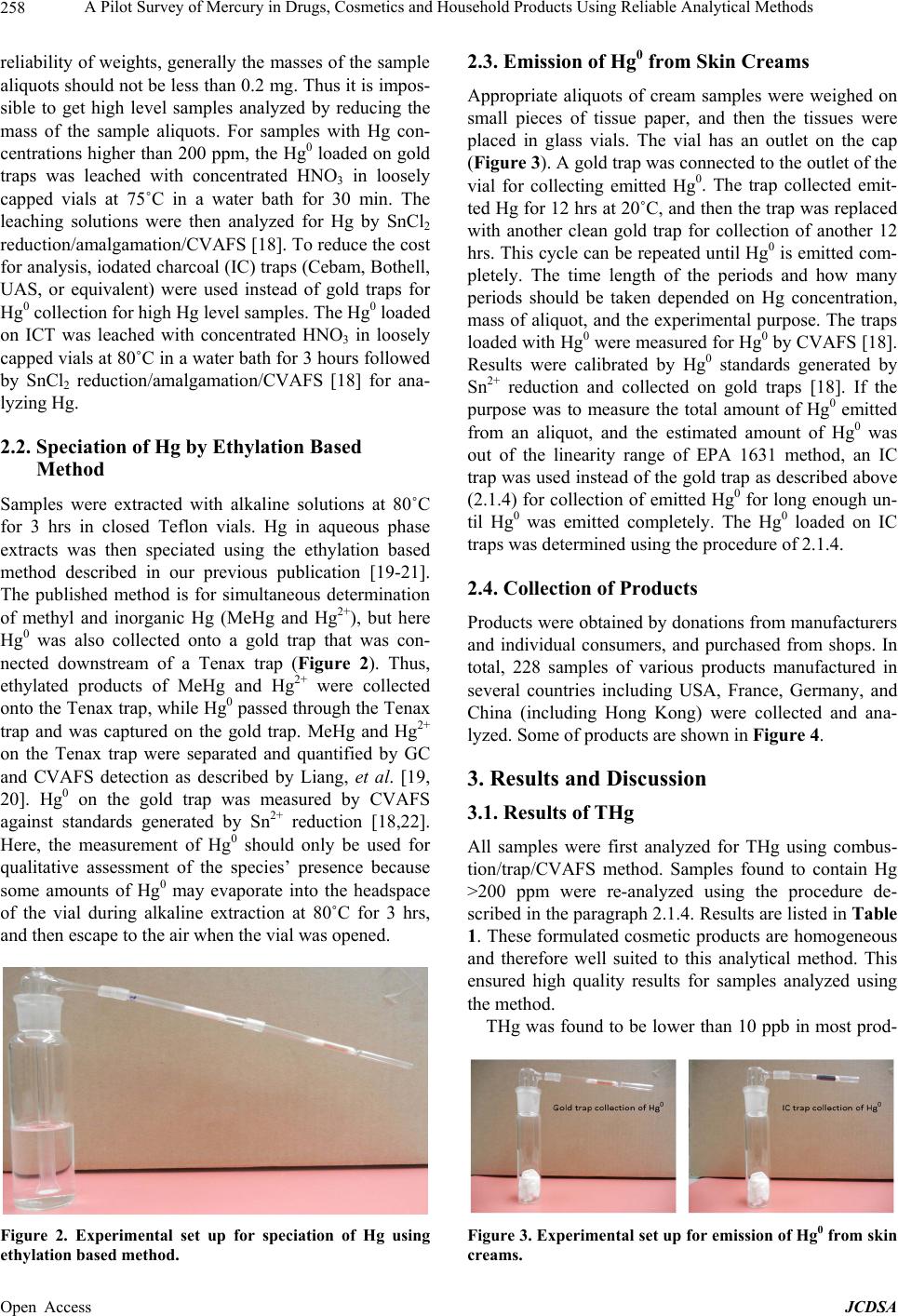 A Pilot Survey of Mercury in Drugs, Cosmetics and Household Products Using Reliable Analytical Methods 258 reliability of weights, generally the masses of the sample aliquots should not be less than 0.2 mg. Thus it is impos- sible to get high level samples analyzed by reducing the mass of the sample aliquots. For samples with Hg con- centrations higher than 200 ppm, the Hg0 loaded on gold traps was leached with concentrated HNO3 in loosely capped vials at 75˚C in a water bath for 30 min. The leaching solutions were then analyzed for Hg by SnCl2 reduction/amalgamation/CVAFS [18]. To reduce the cost for analysis, iodated charcoal (IC) traps (Cebam, Bothell, UAS, or equivalent) were used instead of gold traps for Hg0 collection for high Hg level samples. The Hg0 loaded on ICT was leached with concentrated HNO3 in loosely capped vials at 80˚C in a water bath for 3 hours followed by SnCl2 reduction/amalgamation/CVAFS [18] for ana- lyzing Hg. 2.2. Speciation of Hg by Ethylation Based Method Samples were extracted with alkaline solutions at 80˚C for 3 hrs in closed Teflon vials. Hg in aqueous phase extracts was then speciated using the ethylation based method described in our previous publication [19-21]. The published method is for simultaneous determination of methyl and inorganic Hg (MeHg and Hg2+), but here Hg0 was also collected onto a gold trap that was con- nected downstream of a Tenax trap (Figure 2). Thus, ethylated products of MeHg and Hg2+ were collected onto the Tenax trap, while Hg0 passed through the Tenax trap and was captured on the gold trap. MeHg and Hg2+ on the Tenax trap were separated and quantified by GC and CVAFS detection as described by Liang, et al. [19, 20]. Hg0 on the gold trap was measured by CVAFS against standards generated by Sn2+ reduction [18,22]. Here, the measurement of Hg0 should only be used for qualitative assessment of the species’ presence because some amounts of Hg0 may evaporate into the headspace of the vial during alkaline extraction at 80˚C for 3 hrs, and then escape to the air when the vial was opened. Figure 2. Experimental set up for speciation of Hg using ethylation based method. 2.3. Emission of Hg0 from Skin Creams Appropriate aliquots of cream samples were weighed on small pieces of tissue paper, and then the tissues were placed in glass vials. The vial has an outlet on the cap (Figure 3). A gold trap was connected to the outlet of the vial for collecting emitted Hg0. The trap collected emit- ted Hg for 12 hrs at 20˚C, and then the trap was replaced with another clean gold trap for collection of another 12 hrs. This cycle can be repeated until Hg0 is emitted com- pletely. The time length of the periods and how many periods should be taken depended on Hg concentration, mass of aliquot, and the experimental purpose. The traps loaded with Hg0 were measured for Hg0 by CVAFS [18]. Results were calibrated by Hg0 standards generated by Sn2+ reduction and collected on gold traps [18]. If the purpose was to measure the total amount of Hg0 emitted from an aliquot, and the estimated amount of Hg0 was out of the linearity range of EPA 1631 method, an IC trap was used instead of the gold trap as described above (2.1.4) for collection of emitted Hg0 for long enough un- til Hg0 was emitted completely. The Hg0 loaded on IC traps was determined using the procedure of 2.1.4. 2.4. Collection of Products Products were obtained by donations from manufacturers and individual consumers, and purchased from shops. In total, 228 samples of various products manufactured in several countries including USA, France, Germany, and China (including Hong Kong) were collected and ana- lyzed. Some of products are shown in Figure 4. 3. Results and Discussion 3.1. Results of THg All samples were first analyzed for THg using combus- tion/trap/CVAFS method. Samples found to contain Hg >200 ppm were re-analyzed using the procedure de- scribed in the paragraph 2.1.4. Results are listed in Table 1. These formulated cosmetic products are homogeneous and therefore well suited to this analytical method. This ensured high quality results for samples analyzed using the method. THg was found to be lower than 10 ppb in most prod- Figure 3. Experimental set up for emission of Hg0 from skin creams. Open Access JCDSA 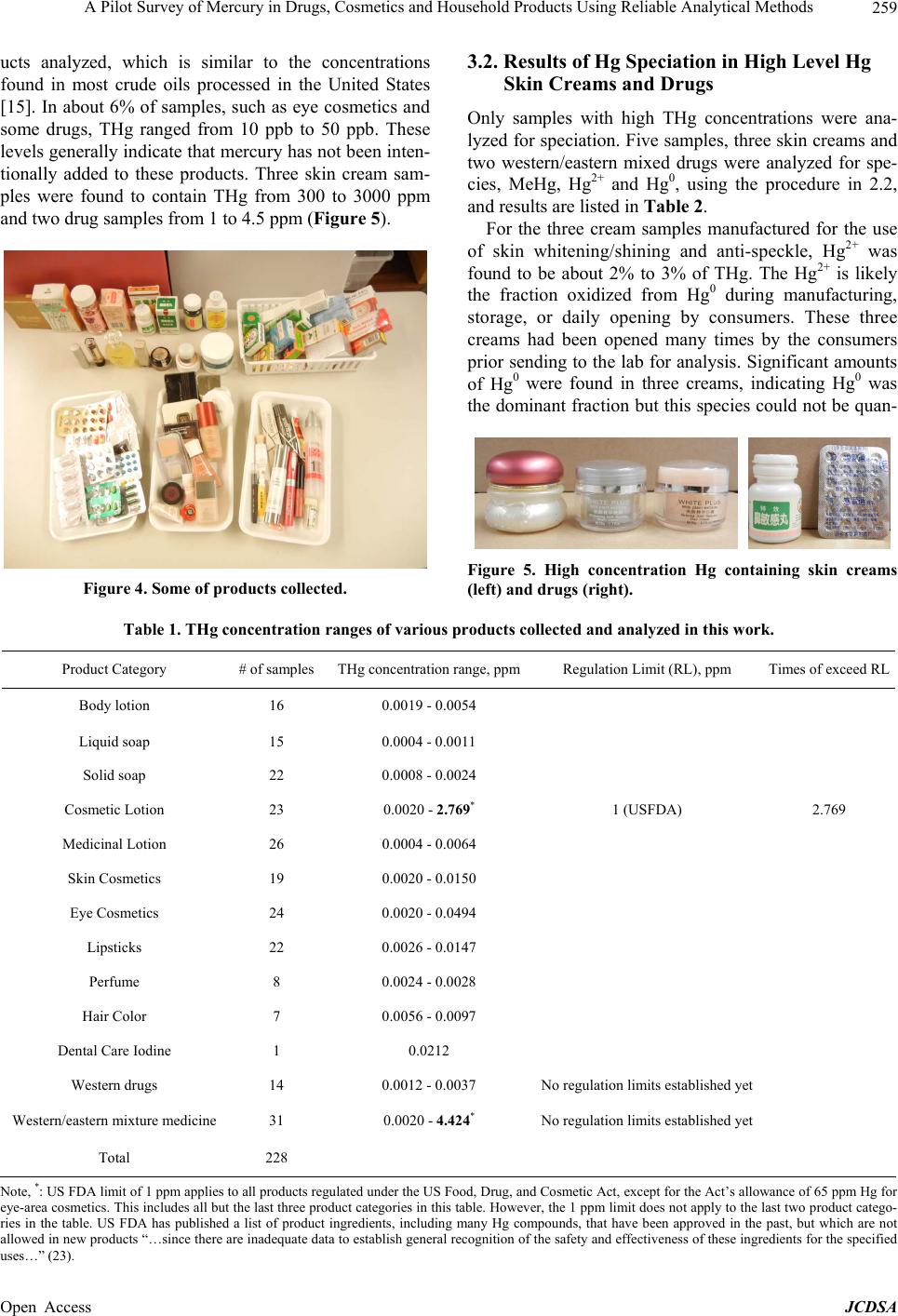 A Pilot Survey of Mercury in Drugs, Cosmetics and Household Products Using Reliable Analytical Methods Open Access JCDSA 259 3.2. Results of Hg Speciation in High Level Hg Skin Creams and Drugs ucts analyzed, which is similar to the concentrations found in most crude oils processed in the United States [15]. In about 6% of samples, such as eye cosmetics and some drugs, THg ranged from 10 ppb to 50 ppb. These levels generally indicate th at mercury has not been inten- tionally added to these products. Three skin cream sam- ples were found to contain THg from 300 to 3000 ppm and two drug samples from 1 to 4.5 ppm (Figure 5). Only samples with high THg concentrations were ana- lyzed for speciation. Five samples, three skin creams and two western/eastern mixed drugs were analyzed for spe- cies, MeHg, Hg2+ and Hg0, using the procedure in 2.2, and results are listed in Table 2. For the three cream samples manufactured for the use of skin whitening/shining and anti-speckle, Hg2+ was found to be about 2% to 3% of THg. The Hg2+ is likely the fraction oxidized from Hg0 during manufacturing, storage, or daily opening by consumers. These three creams had been opened many times by the consumers prior sending to the lab for analysis. Significant amounts of Hg0 were found in three creams, indicating Hg0 was the dominant fraction but this species could not be quan- Figure 5. High concentration Hg containing skin creams (left) and drugs (right). Figure 4. Some of products collected. Table 1. THg concentration ranges of various products collected and analyzed in this work. Product Category # of samples THg concentration range, ppmRegulation Limit (RL), ppm Times of exceed RL Body lotion 16 0.0019 - 0.0054 Liquid soap 15 0.0004 - 0.0011 Solid soap 22 0.0008 - 0.0024 Cosmetic Lotion 23 0.0020 - 2.769* 1 (USFDA) 2.769 Medicinal Lotion 26 0.0004 - 0.0064 Skin Cosmetics 19 0.0020 - 0.0150 Eye Cosmetics 24 0.0020 - 0.0494 Lipsticks 22 0.0026 - 0.0147 Perfume 8 0.0024 - 0.0028 Hair Color 7 0.0056 - 0.0097 Dental Care Iodine 1 0.0212 Western drugs 14 0.0012 - 0.0037 No regulation limits established yet Western/eastern mixture medicine 31 0.0020 - 4.424* No regulation limits established yet Total 228 Note, *: US FDA limit of 1 ppm applies to all products regulated under the US Food, Drug, and Cosmetic Act, except for the Act’s allowance of 65 ppm Hg for eye-area cosmetics. This includes all but the last three product categories in this table. However, the 1 ppm limit does not apply to the last two product catego- ries in the table. US FDA has published a list of product ingredients, including many Hg compounds, that have been approved in the past, but which are not allowed in new products “…since there are inadequate data to establish general recognition of the safety and effectiveness of these ingredients for the specified uses…” (23). 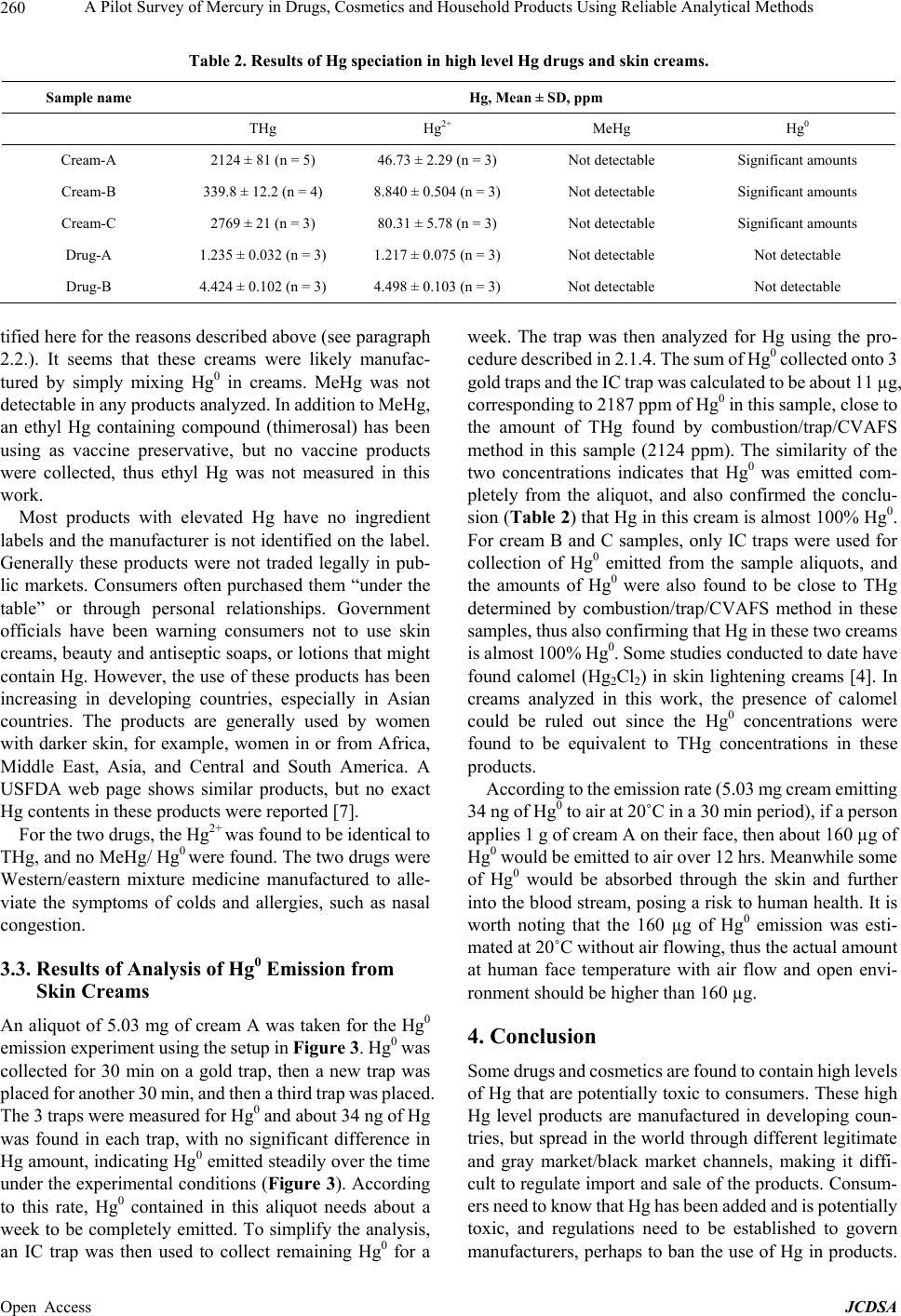 A Pilot Survey of Mercury in Drugs, Cosmetics and Household Products Using Reliable Analytical Methods 260 Table 2. Results of Hg speciation in high level Hg drugs and skin creams. Sample name Hg, Mean ± SD, ppm THg Hg2+ MeHg Hg0 Cream-A 2124 ± 81 (n = 5) 46.73 ± 2.29 (n = 3) Not detectable Significant amounts Cream-B 339.8 ± 12.2 (n = 4) 8.840 ± 0.504 (n = 3 ) Not detectable Significant amounts Cream-C 2769 ± 21 (n = 3) 80.31 ± 5.78 (n = 3) Not detectabl e Significant amounts Drug-A 1.235 ± 0.032 (n = 3) 1.217 ± 0.075 (n = 3) Not detectable Not detectable Drug-B 4.424 ± 0.102 (n = 3) 4.498 ± 0.103 (n = 3) Not detectable Not detectable tified here for the reasons described above (see paragraph 2.2.). It seems that these creams were likely manufac- tured by simply mixing Hg0 in creams. MeHg was not detectable in any produ cts analyzed. In addition t o MeHg, an ethyl Hg containing compound (thimerosal) has been using as vaccine preservative, but no vaccine products were collected, thus ethyl Hg was not measured in this work. Most products with elevated Hg have no ingredient labels and the manufacturer is no t identified on the label. Generally these products were not traded legally in pub- lic markets. Consumers often purchased them “under the table” or through personal relationships. Government officials have been warning consumers not to use skin creams, beauty and antiseptic soaps, or lotions that might contain Hg. However, the use of these products has been increasing in developing countries, especially in Asian countries. The products are generally used by women with darker skin, for example, women in or from Africa, Middle East, Asia, and Central and South America. A USFDA web page shows similar products, but no exact Hg contents in these products were reported [7]. For the tw o drugs , t he Hg2+ was found to be identical to THg, and no MeHg/ Hg0 were found. The two drugs were Western/eastern mixture medicine manufactured to alle- viate the symptoms of colds and allergies, such as nasal congestion. 3.3. Results of Analysis of Hg0 Emission from Skin Creams An aliquot of 5.03 mg of cream A was taken for the Hg0 emission e xperim ent using t he setu p in Figure 3. Hg0 wa s collected for 30 min on a gold trap, then a new trap was placed for another 30 min, and then a third trap was placed. The 3 tra ps were m eas ure d fo r Hg0 and about 34 ng of Hg was found in each trap, with no significant difference in Hg amount, indicating Hg0 emitted steadily over the time under the experimental conditions (Figure 3). According to this rate, Hg0 contained in this aliquot needs about a week to be completely emitted. To simplify the analysis, an IC trap was then used to collect remaining Hg0 for a week. The trap was then analyzed for Hg using the pro- cedure described in 2.1.4. The sum of Hg0 collected onto 3 gold traps and the IC trap was calculated to be about 11 µg, corresponding to 2187 ppm of Hg0 in this sample, close to the amount of THg found by combustion/trap/CVAFS method in this sample (2124 ppm). The similarity of the two concentrations indicates that Hg0 was emitted com- pletely from the aliquot, and also confirmed the conclu- sion (Tabl e 2) that Hg in this cream is almost 100% Hg0. For cream B and C samples, only IC traps were used for collection of Hg0 emitted from the sample aliquots, and the amounts of Hg0 were also found to be close to THg determined by combustion/trap/CVAFS method in these samples, thus also confirming that Hg in these two creams is almost 100% Hg0. Some studies conducted to date have found calomel (Hg2Cl2) in skin lightening creams [4]. In creams analyzed in this work, the presence of calomel could be ruled out since the Hg0 concentrations were found to be equivalent to THg concentrations in these products. According to the emission rate (5.03 mg cream emitting 34 ng of Hg0 to air at 20˚C in a 30 min period) , if a pers on applies 1 g of cream A on their face, then about 160 µg of Hg0 would be em i tted to air o ver 12 hrs. Meanw hil e som e of Hg0 would be absorbed through the skin and further into the blood stream, posing a risk to human health. It is worth noting that the 160 µg of Hg0 emission was esti- mated at 20˚C without ai r fl o wi ng, thus the act ual amount at human face temperature with air flow and open envi- ronment should be higher than 16 0 µ g. 4. Conclusion Some dru gs and cosm etics are found t o contain hi gh levels of Hg that are potentially toxic to consumers. These high Hg level products are manufactured in developing coun- tries, but spread in the world thro ugh different legitimate and gray market/black market channels, making it diffi- cult to regulate import and sale of the products. Consum- ers need to know that Hg has been added and is potentially toxic, and regulations need to be established to govern manufacturers, perhaps to ban the use of Hg in products. Open Access JCDSA 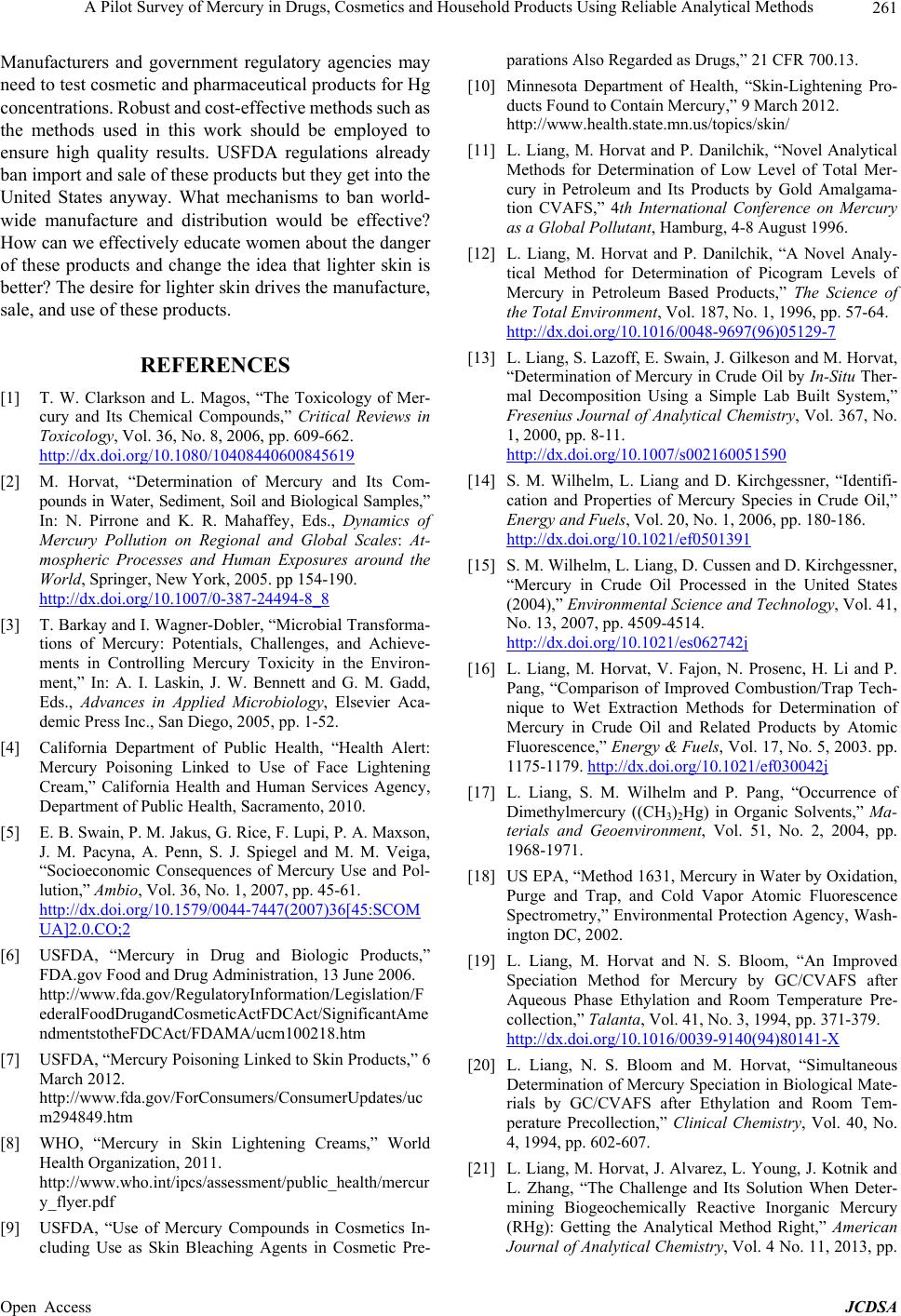 A Pilot Survey of Mercury in Drugs, Cosmetics and Household Products Using Reliable Analytical Methods 261 Manufacturers and government regulatory agencies may need to test cosmetic and pharmaceutical products for Hg concentrations. Robust and cost-effective methods such as the methods used in this work should be employed to ensure high quality results. USFDA regulations already ban import and sale of these products but they get into the United States anyway. What mechanisms to ban world- wide manufacture and distribution would be effective? How can we effectively educate women about the danger of these products and change the idea that lighter skin is better? The desire for lighter skin drives the manufacture, sale, and use of these products. REFERENCES [1] T. W. Clarkson and L. Magos, “The Toxicology of Mer- cury and Its Chemical Compounds,” Critical Reviews in Toxicology, Vol. 36, No. 8, 2006, pp. 609-662. http://dx.doi.org/10.1080/10408440600845619 [2] M. Horvat, “Determination of Mercury and Its Com- pounds in Water, Sediment, Soil and Biological Samples,” In: N. Pirrone and K. R. Mahaffey, Eds., Dynamics of Mercury Pollution on Regional and Global Scales: At- mospheric Processes and Human Exposures around the World, Springer, New York, 2005. pp 154-190. http://dx.doi.org/10.1007/0-387-24494-8_8 [3] T. Barkay and I. Wagner-Dobler, “Microbial Transforma- tions of Mercury: Potentials, Challenges, and Achieve- ments in Controlling Mercury Toxicity in the Environ- ment,” In: A. I. Laskin, J. W. Bennett and G. M. Gadd, Eds., Advances in Applied Microbiology, Elsevier Aca- demic Press Inc., San Diego, 2005, pp. 1-52. [4] California Department of Public Health, “Health Alert: Mercury Poisoning Linked to Use of Face Lightening Cream,” California Health and Human Services Agency, Department of Public Health, Sacramento, 2010. [5] E. B. Swain, P. M. Jakus, G. Rice, F. Lupi, P. A. Maxson, J. M. Pacyna, A. Penn, S. J. Spiegel and M. M. Veiga, “Socioeconomic Consequences of Mercury Use and Pol- lution,” Ambio, Vol. 36, No. 1, 2007, pp. 45-61. http://dx.doi.org/10.1579/0044-7447(2007)36[45:SCOM UA]2.0.CO;2 [6] USFDA, “Mercury in Drug and Biologic Products,” FDA.gov Food and Drug Administration, 13 June 2006. http://www.fda.gov/RegulatoryInformation/Legislation/F ederalFoodDrugandCosmeticActFDCAct/SignificantAme ndmentstotheFDCAct/FDAMA/ucm100218.htm [7] USFDA, “Mercury Poisoning Linked to Skin Products,” 6 March 2012. http://www.fda.gov/ForConsumers/ConsumerUpdates/uc m294849.htm [8] WHO, “Mercury in Skin Lightening Creams,” World Health Organization, 2011. http://www.who.int/ipcs/assessment/public_health/mercur y_flyer.pdf [9] USFDA, “Use of Mercury Compounds in Cosmetics In- cluding Use as Skin Bleaching Agents in Cosmetic Pre- parations Also Regarded as Drugs,” 21 CFR 700.13. [10] Minnesota Department of Health, “Skin-Lightening Pro- ducts Found to Contain Mercury,” 9 March 2012. http://www.health.state.mn.us/topics/skin/ [11] L. Liang, M. Horvat and P. Danilchik, “Novel Analytical Methods for Determination of Low Level of Total Mer- cury in Petroleum and Its Products by Gold Amalgama- tion CVAFS,” 4th International Conference on Mercury as a Global Pollutant, Hamburg, 4-8 August 1996. [12] L. Liang, M. Horvat and P. Danilchik, “A Novel Analy- tical Method for Determination of Picogram Levels of Mercury in Petroleum Based Products,” The Science of the Total Environment, Vol. 187, No. 1, 1996, pp. 57-64. http://dx.doi.org/10.1016/0048-9697(96)05129-7 [13] L. Liang, S. Lazoff, E. Swain, J. Gilkeson and M. Horvat, “Determination of Mercury in Crude Oil by In-Situ Ther- mal Decomposition Using a Simple Lab Built System,” Fresenius Journal of Analytical Chemistry, Vol. 367, No. 1, 2000, pp. 8-11. http://dx.doi.org/10.1007/s002160051590 [14] S. M. Wilhelm, L. Liang and D. Kirchgessner, “Identifi- cation and Properties of Mercury Species in Crude Oil,” Energy and Fuels, Vol. 20, No. 1, 2006, pp. 180-186. http://dx.doi.org/10.1021/ef0501391 [15] S. M. Wilhelm, L. Liang, D. Cussen and D. Kirchgessner, “Mercury in Crude Oil Processed in the United States (2004),” Environmental Science and Technology, Vol. 41, No. 13, 2007, pp. 4509-4514. http://dx.doi.org/10.1021/es062742j [16] L. Liang, M. Horvat, V. Fajon, N. Prosenc, H. Li and P. Pang, “Comparison of Improved Combustion/Trap Tech- nique to Wet Extraction Methods for Determination of Mercury in Crude Oil and Related Products by Atomic Fluorescence,” Energy & Fuels, Vol. 17, No. 5, 2003. pp. 1175-1179. http://dx.doi.org/10.1021/ef030042j [17] L. Liang, S. M. Wilhelm and P. Pang, “Occurrence of Dimethylmercury ((CH3)2Hg) in Organic Solvents,” Ma- terials and Geoenvironment, Vol. 51, No. 2, 2004, pp. 1968-1971. [18] US EPA, “Method 1631, Mercury in Water by Oxidation, Purge and Trap, and Cold Vapor Atomic Fluorescence Spectrometry,” Environmental Protection Agency, Wash- ington DC, 2002. [19] L. Liang, M. Horvat and N. S. Bloom, “An Improved Speciation Method for Mercury by GC/CVAFS after Aqueous Phase Ethylation and Room Temperature Pre- collection,” Talanta, Vol. 41, No. 3, 1994, pp. 371-379. http://dx.doi.org/10.1016/0039-9140(94)80141-X [20] L. Liang, N. S. Bloom and M. Horvat, “Simultaneous Determination of Mercury Speciation in Biological Mate- rials by GC/CVAFS after Ethylation and Room Tem- perature Precollection,” Clinical Chemistry, Vol. 40, No. 4, 1994, pp. 602-607. [21] L. Liang, M. Horvat, J. Alvarez, L. Young, J. Kotnik and L. Zhang, “The Challenge and Its Solution When Deter- mining Biogeochemically Reactive Inorganic Mercury (RHg): Getting the Analytical Method Right,” American Journal of Analytical Chemistry, Vol. 4 No. 11, 2013, pp. Open Access JCDSA  A Pilot Survey of Mercury in Drugs, Cosmetics and Household Products Using Reliable Analytical Methods Open Access JCDSA 262 623-632. http://dx.doi.org/10.4236/ajac.2013.411074 [22] L. Liang and N. S. Bloom, “Determination of Total Mer- cury by Single-Stage Gold Amalgamation with Cold Va- por Atomic Spectrometry,” Journal of Analytical Atomic Spectrometry, Vol. 8, 1993, pp. 591-594 http://dx.doi.org/10.1039/ja9930800591 [23] USFDA, “Drug Products Containing Certain Active In- gredients Offered Over-The-Counter (OTC) for Certain Uses,” 21 CFR 310.545, 1998. |