

Paper Menu >>
Journal Menu >>
 Journal of Cosmetics, Dermatological Sciences and Applications, 2013, 3, 250-255 Published Online December 2013 (http://www.scirp.org/journal/jcdsa) http://dx.doi.org/10.4236/jcdsa.2013.34038 Open Access JCDSA Treatment of Chronic Paronychia: A Double Blind Comparative Clinical Trial Using Singly Vaseline, Nystatin and Fucidic Acid Ointment* Khalifa E. Sharquie1#, Adil A. Noaimi2, Sunbul A. Galib3 1Scientific Council of Dermatology & Venereology, Iraqi Board for Medical Specializations, Department of Dermatology & Venereology, College of Medicine, University of Baghdad, Baghdad, Iraq; 2Department of Dermatology & Venereology, College of Medicine, University of Baghdad, Baghdad, Iraq; 3Department of Dermatology & Venereology, Baghdad Teaching Hospital, Bagh- dad, Iraq. Email: #[email protected] Received September 12th, 2013; revised October 10th, 2013; accepted October 18th, 2013 Copyright © 2013 Khalifa E. Sharquie et al. This is an open access article distributed under the Creative Commons Attribution Li- cense, which permits unrestricted use, distribution, and reproduction in any medium, provided the original work is properly cited. ABSTRACT Background: Chronic paronychia is a chronic inflammatory reaction of the proximal and lateral nail folds of multifac- torial in etiology like irritant, bacterial and monilial causes. But housewife work is a major cause of chronic paronychia. Objective: To assess the efficacy and prophylactic effects of Vaseline by occlusion of nail folds in comparison with nystatin ointment and fucidic acid in treatment of housewife chronic paronychia. Patients and Methods: This double, blinded, comparative therapeutic, clinical trial is conducted at the Department of Dermatology-Baghdad Teaching Hos- pital from May 2010 to May 2011. Eighty female housewife patients with chronic paronychia were included in this trial. They were divided into three groups according to the following therapeutic model: Group A treated by Vaseline con- sisted of 40 patients; Group B and Group C treated by nystatin ointment, fucidic acid ointment respectively and each group consisted of 20 patients. All demographic points related to the disease were recorded from all patients. Invented score system was applied to assess the severity of disease and the response to therapy. Patients had used therapy twice daily on the proximal and lateral nail folds. Treatment duration was 12 weeks. Results: Group A (Vaseline): The re- covery rate after 12 weeks of treatment was 26 (65%) patients, while there was no recovery in 14 (35%) patients. Group B (Nystatin ointment): The recovery rate after 12 weeks was 13 (65%) cases and there was no recovery in 7 (35%) patients. Group C (Fucidic acid ointment): The recovery rate 12 weeks of treatment was 12 (60%) patients and there was no recovery in 8 (40%) patients. The earliest signs of recovery in all groups were decreased in nail fold tenderness, redness, swelling followed by improvement in the nail shape, then decreased in the separation of proximal nail fold from nail bed followed by re-growth of cuticle. There was significant difference in clinical response before and after therapy in all groups (P ≤ 0.0001) while there was no statistical significant difference when the three groups were compared with each other (P = 0.784). Conclusions: Vaseline occlusion therapy of the nail folds in patient with chronic par- onychia was enough to induce recovery from the disease and there was no statistical significant difference when com- pared with nystatin or fucidic acid treatment of chronic paronychia. Keywords: Housewife; Paronychia; Vaseline; Occlusive Therapy 1. Introduction Chronic paronychia is a major health problem of which housewife paronychia is the main type seen in daily clinical practice [1]. The etiopathogenesis is multifactorial, but the wet con- dition during housewife work will cause loss of nail cuti- cle followed by separation of proximal and lateral nail folds and this will make a dead space thus allowing the entrance of water, detergents, bacteria under the nail folds followed by inflammation leading to the main fea- tures of chronic paronychia mainly swelling of the nail folds, nail dystrophy; this is so-called wet theory [2]. *Disclosure: This study is an independent study and not funded by any drug company. #Corresponding author. Accordingly, the presence of candida and bacteria like  Treatment of Chronic Paronychia: A Double Blind Comparative Clinical Trial Using Singly Vaseline, Nystatin and Fucidic Acid Ointment 251 Staph aureus, alpha, beta and gamma-haemolytic Strep- tococci, Klebsiella pneumonia, Bacteroides species and Coliform, Pseudomnas aeruginosa, Proteus species and other organisms as Diphtheroids, Streptococcus fecalis, and Staphphylococcus albus are considered as secondary invader in the pathogenesis of chronic paronchia [3]. Hence, the aim of therapy is to close the so-called dead space and encourage the adhesion of nail cuticle and nail folds thus preventing the entrance of water, detergents and bacteria. Therefore, the management of chronic par- onychia should start by prevention of wet conditions and giving antimicrobial agents to stop the process of in- flammation, but unfortunately, many practicing derma- tologists give antifungal, antibacterial drugs for long time aiming to enhance cure but without stopping the wet conditions, so recurrence is always high [2]. Still many housewives do not take the advice of wear- ing gloves and again will prevent healing of chronic par- onychia [4]. Accordingly, the aim of present work is to do occlu- sion of the dead space by Vaseline alone compared with using antimicrobial agents like fucidic acid and nystatin and to record the therapeutic response to these therapies. 2. Patients and Methods This double blind comparative therapeutic trial on the effectiveness of two drugs topically applied on the nail folds (nystatin and fucidic acid) compared with Vaseline on treatment of housewife chronic paronychia. This was conducted in the Department of Dermatology and Vene- reology-Baghdad Teaching Hospital, Baghdad, Iraq from May 2010-May 2011. Eighty female patients with house wife chronic par- onychia were enrolled in this study. Inclusion criteria included all patients with housewife chronic paronychia who attended for therapy. The diagnosis of chronic par- onychia was established according to the following crite- ria: housewife patients, absence of cuticle associated with swelling and erythema of proximal and lateral nail folds, separation of dorsal and lateral nail folds from nail plate. While, exclusion criteria as follow: acute par- onychia, infections like tinea unguam, warts, and her- petic whitlow. Also, dermatological diseases that can cause chronic paronychia such as pemphigus vulgaris, psoriasis, and lichen planus, connective tissue diseases like systemic lupus erythematosus, discoid lupus erythe- matosus, dermatomyositis, and scleroderma were ex- cluded. Peripheral vascular disease like perniosis, Bur- ger᾽s disease, Raynaud᾽s disease, patients with immuno- suppressive conditions, bone deformities, diabetes melli- tus, and conditions requiring systemic or topical use of corticosteroids, calcineurin inhibitors, retinoids and pro- tease inhibitors were not included. A full history was taken from each patient regarding name, age, gender, marital status, residence, social status, job, number of children, using of gloves and washing machine, right or left hand, baking, smoking. Also dura- tion, number of fingers involved, and type of treatment used before. All patients were examined regarding right or left hand involvement or both, number of nails involved, presence of swelling, tenderness, and purulent discharge, presence of nail changes as buckled nail plates, transverse ridging, nail discoloration and associated onycholysis or dystro- phy. Formal consent was taken from each patient before starting the trial of treatment after full explanation of nature of disease, course, prognosis, complications, na- ture of drug, method of application, duration of treatment and follow up and the ethical approval was obtained from Scientific Council of Dermatology and Venereology, Iraqi Board for Medical Specializations. Evaluation of the patients was done to re-evaluate the disease score and report any side effects from treatment clinically and by photograph during study period of 12 weeks. All patients were photographed by a digital camera as a baseline and then on 12 weeks, in the same place with fixed illumination and distance by using a digital camera (Sony: Cyber shoot with resolution 12 mega pixels). The following scoring system of the chronic par- onychia was invented: 1) Loss of cuticle score = 1 2) Separation of proximal nail fold from nail bed with different grades and this was measured by orange stick introduced under the nail folds: a. Separation just score = 1 b. Separation 2 mm score = 2 c. Separation > 2 mm score = 3 3) Swollen nail fold: a. Swollen just score = 1 b. Swollen red score = 2 c. Swollen tender score = 3 4) Secondary nail changes: a. Ridging score = 1 b. Dystrophy score = 3 When patients had multiple fingers involvement, the severely affected one was scored only and the others al- though treated they were not counted within scoring. The treatment protocol: Patients were divided into 3 groups: Group A: using topical white petrolatum (Vaseline®) manufactured by Anglo-Dutch Company Unilever. Group B: using topical nystatin ointment in Vaseline base (Mycodin®) is manufactured by The State Company Open Access JCDSA  Treatment of Chronic Paronychia: A Double Blind Comparative Clinical Trial Using Singly Vaseline, Nystatin and Fucidic Acid Ointment Open Access JCDSA 252 for Drug Industries and Medical Appliances Ninavaha- Iraq, under license of SDI Co.15 grams tube. Each gram contains nystatin 100.000 I.U of the ointment. Group C: using topical fucidic acid ointment in Vase- line base (Fusibact™) manufactured by Jamjoom Pharma. 15 grams tube. Each 100 gram of the ointment contains the active sub- stance sodium fusidate, which corresponds to 2 gram sodium fusidate. The treatment was applied twice daily on the proximal and lateral nail folds. Treatment duration was 12 weeks. All patients were advised to avoid cuticle trimming, nail biting, picking, trauma and also were encouraged to use rubber gloves with inner cotton lining for household tasks. Statistical analysis was carried out using paired t-test to compare differences before and after treatment in each group. Chi–square test was used to check relations be- tween results either recovery or no recovery. P value less than 0.05 was considered significant. SPSS (statistical package for social sciences) version 17 was used for the analysis. 3. Results Eighty housewife patients with chronic paronychia were completed the study their ages ranged from 15 - 68 with mean ± SD of 37.26 ± 11.06 years. The role of contrib- uting factors showed that moisture; super hydration, de- tergents and rough work played the highest role in dam- aging the nail cuticle and nail folds in all patients. Dura- tion of disease ranged from half year- 12 years with mean± SD of 2.166 ± 2.66 years. Total numbers of 184 fingers involved in 3 groups. Number of finger involved ranged from (1 - 8) with mean ± SD of 2 ± 9.61 fingers. The nail changes in patients of chronic paronychia dem- onstrated in (Table 1). Patients in Group A were treated by White petrolatum ointment; forty house wife patients were included in this group, their ages ranged from 15 - 60 years with mean ± SD of 36.37 ± 10.8 years. Married females were 32 (80%) patients. They had (0 - 8) children with mean of 4 children. Twenty seven (67.5%) patients were using washing machine, while only 3 (7.5%) patients were us- ing gloves. Twenty (50%) patients were baking regularly. All of them were right handed 40 (100%). Duration of disease ranged from less than 1 year - 12 years with mean ± SD of 2.6 ± 3.44 years. Total number of 88 fin- gers was involved. Right hand alone was involved in 29 (72.5%), while both right and left hands were involved in 11 (27.5%). Number of finger involved ranged from (1 - 7) with mean ± SD of 2 ± 1.55 finger. Seventeen (42.5%) pa- tients with 1 finger involvement, 8 (20%) patients with 2 fingers, 8 (20%) patients with 3 fingers, 4 (10%) patients with 4 fingers, 3 (7.5%) patients with 6 fingers. No any side effect reported from treatment. Most commonly in- volved finger in right hand was middle finger 22 (55%) followed by thumb 19 (47.5%), ring finger 18 (45%), index 13 (32.5%) with no little finger involvement. While in left hand most common finger involved was thumb 7 (17.5%), both middle and ring fingers 4 (10%) and index only 1 (2.5%). Patients in Group B were treated by nystatin ointment; twenty house wife patients were included in this group, their ages ranged from 19-55 years with mean ± SD of 37.40 ± 10.75 years. Married females were 18 (90%) patients. They had (0 - 7) children with a mean of 3 chil- dren. Twelve (60%) patients were using washing ma- chine. Three (15%) patients were using gloves. Ten (50%) patients were baking regularly. All of them were right handed 20 (100%). Duration of disease ranged from less than 1 year - 12 years with Table 1. The nail changes in patients of chronic paronychia at presentation. Group A (Vaseline) Group B (Nystatin ointment)Group C (Fucidic acid ointment) No. % No. % No. % Loss of cuticle 40 100 20 100 20 100 Nail fold swelling 40 100 20 100 20 100 Separation of nail fold from nail plate 40 100 20 100 20 100 Transverse ridging 39 95 20 100 20 100 Longitudinal ridging 8 20 2 10 2 10 Nail pitting 28 70 13 65 10 50 Onycholysis 8 20 1 5 2 10 Nail plate dystrophy 5 12.5 3 15 2 10 Color changes 34 85 17 85 15 75  Treatment of Chronic Paronychia: A Double Blind Comparative Clinical Trial Using Singly Vaseline, Nystatin and Fucidic Acid Ointment 253 mean ± SD of 1.98 ± 2.74 years. Total number of 39 fin- gers was involved. Number of finger involved ranged from (1 - 8) with mean of ± SD of 2 ± 1.71 fingers, thir- teen (65%) patients with 1 finger involvement, 2 (10%) patients with 2 fingers, 3 (15%) patients with 3 fingers, 1 (5%) patient with 4 fingers, 1 (5%) patient with 8 fingers. No any side effect reported from treatment. Right hand alone was involved in 13 (65%), left hand was involved in 2 (5%), while both right and left hands were involved in 5 (25%). Most commonly involved finger in right hand was thumb 11 (55%) followed by ring finger 7 (35%), middle finger 5 (25%), index 4 (20%), little fin- ger only 1 (5%), while in left hand most common finger involved was middle 4 (20%), followed by index 3 (15%), then both ring and thumb 2 (10%) for each one while little finger was not involved. Patients in Group C were treated by fucidic acid oint- ment; twenty house wife patients were included in this group, their ages ranged from 22 - 68 years with mean ± SD of 38.90 ± 12.195 years. Married females were 19 (95%) patients; they had (0 - 8) children with a mean of 4 children. Eleven (55%) patients were using washing machine. One (5%) patient was using gloves. Nine (45%) patients were baking regularly. All of them were right handed 20 (100%). Duration of disease ranged from less than 1 year - 10 years with mean ± SD of 2.035 ± 2.178 years. Total number of 57 fingers was involved. Number of finger involved ranged from (1 - 6) with mean of ± SD of 3 ± 1.576 fingers, four (20%) patients with 1 finger involvement, 7 (35%) patients with 2 fin- gers, 3 (15%) patients with 3 fingers, 3 (15%) patients with 4 fingers, 1 (5%) patient with 5 fingers, 2 (10%) patients with 6 fingers. No any side effect reported from treatment. Right hand alone was involved in 12 (60%), while both right and left hands were involved in 8 (40%). Most commonly involved finger in right hand was thumb 16 (80%) followed by index and middle fingers 10 (50%) for each finger, then ring finger 5 (25%), little finger only 1 (5%), while in left hand most common finger in- volved was thumb 6 (30%), followed by index 4 (20%), then middle 3 (15%) lastly ring finger was 2 (10%). Clinical Response According to the present study results we can divide pa- tients in each group into: patients with recovery and pa- tient without recovery. 1. Recovery: either cured: re-growth of cuticle, no sepa- ration of nail folds from nail bed, normal proximal nail fold, nail plate grows normally or improved: ab- sence of cuticle, nail folds just separated from nail bed, normal proximal nail fold, nail plate grows nor- mally (score = 0 - 2). 2. No recovery: either stable: absence of cuticle, nail folds separated from nail bed > 2 mm, proximal nail folds just swollen, abnormal nail plate (ridging, dys- trophy) or worse: absence of cuticle, nail fold sepa- rated from nail bed > 2 mm, proximal nail fold swol- len tender, abnormal nail plate (ridging, dystrophy) with purulent inflammation of the proximal nail fold (score = 3 - 11). There were highly statistically significant differences in recovery of paronychia in all groups when we com- pared the scoring before and after therapy after 3 months of treatment (P ≤ 0000.1) (Table 2 and Figure 1). When the three groups where compared between each other, there was no significant statically difference in recovery rate between them (P = 0.784) (Table 3). 4. Discussion Chronic paronychia is an inflammatory dermatosis of the nail folds, with secondary effects on the nail matrix; nail growth and soft-tissue attachments [5]. The etiology of chronic paronychia is multifactorial in origin [6]. Infection by multipule organism, especially- yeasts (commonly Candida albicans) and intestinal bac- Table 2. The recovery of chronic paronychia patients be- fore and after therapy in the 3 groups. Group Range of score Mean of score St. dev. t-test P-value A Before7 - 11 8.10 1.150 VaselineAfter0 - 11 3.65 2.627 10.779 <0.0001 B Before5 - 11 7.85 1.348 NystatinAfter0 - 10 3.60 2.945 6.514 <0.0001 C Before6 - 11 8.15 1.348 FucidinAfter0 - 8 3.70 2.452 5.973 <0.0001 Table 3. The clinical response to treatments in the 3 groups. Group Group A (Vaseline) Group B (Nystatin) Group C (Fucidin) No.% No. % No. % Recovery rate 2665 13 65 12 60 No recovery rate 1435 7 35 8 40 Total 40100 20 100 20 100 Value Df P value Chi-Square (x2) 0.487 2 0.784 Open Access JCDSA 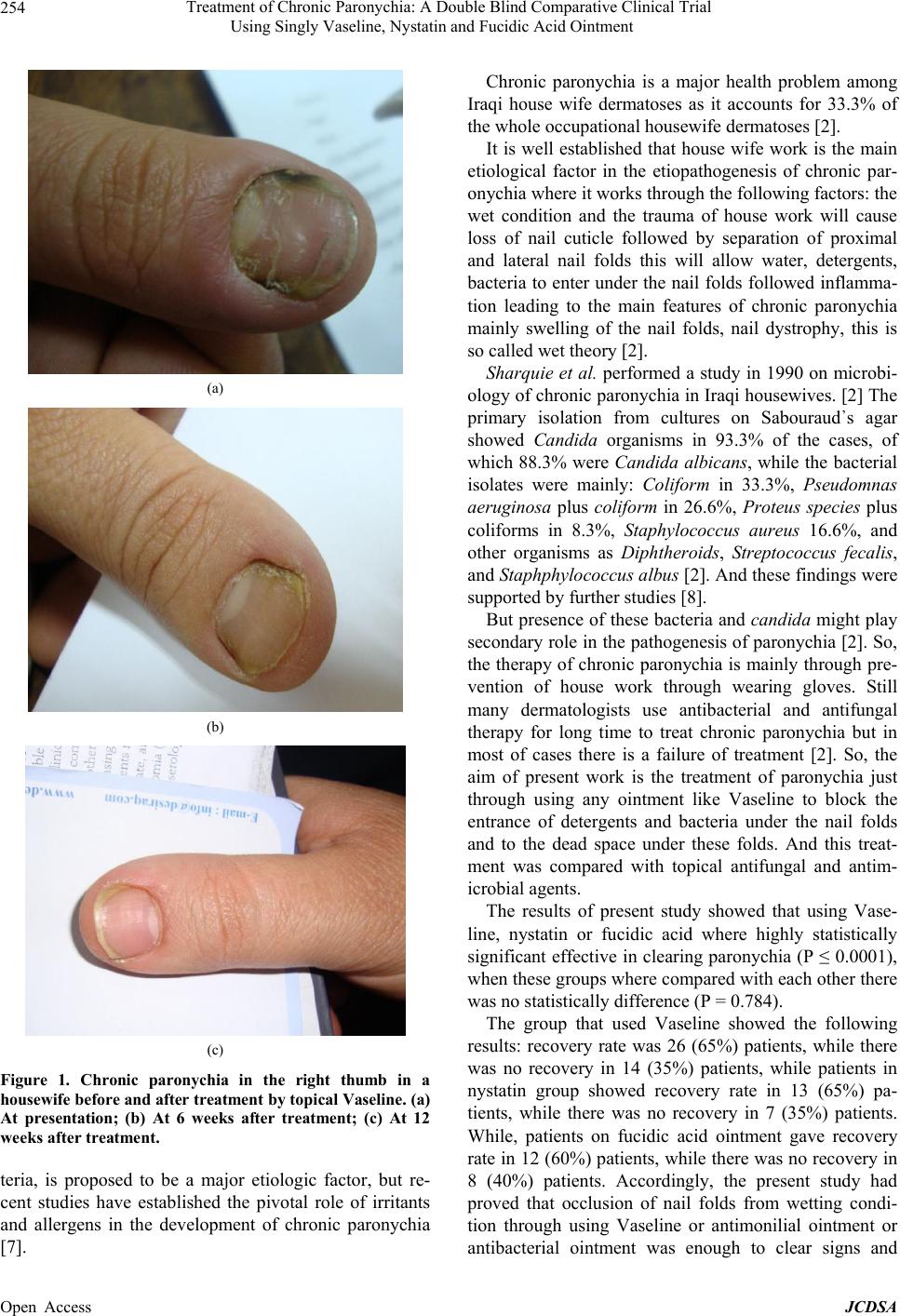 Treatment of Chronic Paronychia: A Double Blind Comparative Clinical Trial Using Singly Vaseline, Nystatin and Fucidic Acid Ointment 254 (a) (b) (c) Figure 1. Chronic paronychia in the right thumb in a housewife before and after treatment by topical Vaseline. (a) At presentation; (b) At 6 weeks after treatment; (c) At 12 weeks after treatment. teria, is proposed to be a major etiologic factor, but re- cent studies have established the pivotal role of irritants and allergens in the development of chronic paronychia [7]. Chronic paronychia is a major health problem among Iraqi house wife dermatoses as it accounts for 33.3% of the whole occupational housewife dermatoses [2]. It is well established that house wife work is the main etiological factor in the etiopathogenesis of chronic par- onychia where it works through the following factors: the wet condition and the trauma of house work will cause loss of nail cuticle followed by separation of proximal and lateral nail folds this will allow water, detergents, bacteria to enter under the nail folds followed inflamma- tion leading to the main features of chronic paronychia mainly swelling of the nail folds, nail dystrophy, this is so called wet theory [2]. Sharquie et al. performed a study in 1990 on microbi- ology of chronic paronychia in Iraqi housewives. [2] The primary isolation from cultures on Sabouraud᾽s agar showed Candida organisms in 93.3% of the cases, of which 88.3% were Candida albicans, while the bacterial isolates were mainly: Coliform in 33.3%, Pseudomnas aeruginosa plus coliform in 26.6%, Proteus species plus coliforms in 8.3%, Staphylococcus aureus 16.6%, and other organisms as Diphtheroids, Streptococcus fecalis, and Staphphylococcus albus [2]. And these findings were supported by further studies [8]. But presence of these bacteria and candida might play secondary role in the pathogenesis of paronychia [2]. So, the therapy of chronic paronychia is mainly through pre- vention of house work through wearing gloves. Still many dermatologists use antibacterial and antifungal therapy for long time to treat chronic paronychia but in most of cases there is a failure of treatment [2]. So, the aim of present work is the treatment of paronychia just through using any ointment like Vaseline to block the entrance of detergents and bacteria under the nail folds and to the dead space under these folds. And this treat- ment was compared with topical antifungal and antim- icrobial agents. The results of present study showed that using Vase- line, nystatin or fucidic acid where highly statistically significant effective in clearing paronychia (P ≤ 0.0001), when these groups where compared with each other there was no statistically difference (P = 0.784). The group that used Vaseline showed the following results: recovery rate was 26 (65%) patients, while there was no recovery in 14 (35%) patients, while patients in nystatin group showed recovery rate in 13 (65%) pa- tients, while there was no recovery in 7 (35%) patients. While, patients on fucidic acid ointment gave recovery rate in 12 (60%) patients, while there was no recovery in 8 (40%) patients. Accordingly, the present study had proved that occlusion of nail folds from wetting condi- tion through using Vaseline or antimonilial ointment or antibacterial ointment was enough to clear signs and Open Access JCDSA  Treatment of Chronic Paronychia: A Double Blind Comparative Clinical Trial Using Singly Vaseline, Nystatin and Fucidic Acid Ointment Open Access JCDSA 255 symptoms of paronychia and even might prevent the re- lapse of the disease through ointment. The present re- search to the best of our knowledge is the first one that has been carried out in the field of chronic paronychia. 5. Conclusion In conclusion, treatment of paronychia by occlusive therapy using Vaseline alone is enough to induce recov- ery and clearance of housewife paronychia. REFERENCES [1] K. E. Sharquie and S. I. Al-Omran, “Occupational House- wife Dermatosis,” Diploma Dissertation, University of Baghdad, Baghdad, 1988. [2] K. E. Sharquie, S. M. Al-Salloum and R. N. Al-Saadi, “Microbiology of Chronic Paronychia in Iraqi House- wives,” Journal of Pan Arab League of Dermatologists, Vol. 1, No. 2, 1990, pp. 17-23. [3] I. Brook, “Paronychia: A Mixed Infection: Microbiology and Management,” The Journal of Hand Surgery: Journal of the British Society for Surgery of the Hand, Vol. 18, No. 3, 1993, pp. 385-359. [4] C. R. Daniel, M. P. Daniel, C. M. Daniel, S. Sullivans and G. Ellis, “Chronic Paronychia and Onycholysis: A Thir- teen Year Experience,” Cutis, Vol. 85, No. 6, 1996, pp. 397-401. [5] D. A. R. De Berker and E. R. Baran, “Disorders of Nails,” In: T. Burns, S. Breathnach, N. Cox and C. Griffiths, Eds., Rooks Textbook of Dermatology, 6th Edition, Blackwell Scientific Publications, Melblorne, 1998, p. 65. [6] C. Grover, B. S. N. Reddy and K. U. Chaturvedi, “Nail Biopsy: An Assessment of Indications and Outcome,” Dermatologic Surgery, Vol. 31, No. 2, 2005, pp. 190-194. http://dx.doi.org/10.1111/j.1524-4725.2005.31042 [7] E. S. M. Wong, R. J. Hay, Y. M. Clayton and W. C. No- ble, “Comparison of the Therapeutic Effect of Ketocona- zole Tablets and Econazole Lotion in the Treatment of Chronic Paronychia,” Clinical and Experimental Derma- tology, Vol. 9, No. 5, 1984, pp. 489-496. http://dx.doi.org/10.1111/j.1365-2230.1984.tb00843.x [8] M. A. A. Al-Nuaimi, “Chronic Paronychia: The Fungal and Bacteriological Etiology in Iraqi Patients,” MS The- sis, University of Baghdad, Baghdad, 2001. |