

Paper Menu >>
Journal Menu >>
 Open Journal of Social Sciences 2013. Vol.1, No.6, 23-25 Published Online November 2013 in SciRes (http://www.scirp.org/journal/jss) http://dx.doi.org/10.4236/jss.2013.16005 Open Access 23 Salivary Amino Acids Determination and Their Changes in Vision Stress Experiments Wei Tang1, Xuesong Li1, Xiaoxiao Wu1, Yu Wang1, Xuejun Kang1,2* 1Key Laboratory of Child Development and Learning Science of Ministry of Education, Research Center for Learning Science, Southeast University, Nanjing, China 2Suzhou Key Laboratory of Enviroment and Biosafety, Southeast University, Suzhou, China Email: *[email protected] Received October 2013 Amino acid neurotransmitters represent a major class of compounds that are involved in neuronal com- munication at CNS synapses, which can provide the basis for a variety of disease diagnosis and treatments and the study of the mechanism of mental illness. An analytical method for the determination of several amino acids in saliva was established with reversed-phase high performance liquid chromatography (RP- HPLC) with UV detector. About ten kinds of amino acids were detected in saliva. Nine subjects have par- ticipated in the stress experiments which have undergone a 50-min three-dimensional cartoon watching. The result of the experiment has proved that four kinds of salivary amino acids respond to the vision stress experiment obviously. Keywords: Amino Acids; RP-HPLC; Stress Experiments Introduction Stress research in human health and diseases has occupied a prominent position. According to the literature survey, about 75 to 90% of the diseases have a connection with the activation of stress mechanisms. Many factors cause stress, such as mechan- ical trauma, undercooling, overheating, food poisoning, psy- chological fear, depression, heavily mental tension and so on. Stress has a variety of assessment methods. Many indicators of stress response can really and effectively show human being’s physiological stress response system, such as cortisol, catecho- lamines and so on. Among them the amino acid neurotransmit- ters are important stress markers. Glutamate, aspartate, γ-ami- nobutyric acid, glycine and taurine and many kinds of amino acids are important neurotransmitters in brain. Glutamate and aspartate are considered to be excitatory amino acids; while γ- aminobutyric acid, glycine and taurine are considered to be in- hibitory amino acids. They are important materials which can regulate the body's physiological activities. Thus separating and determining the content of biological tissue’s amino acid neu- rotransmitters can provide a basis for the diagnosis and the treatment of many diseases and mental illness’ mechanisms. As a result, the determination and study of stress amino acids are really important (Xuejun Kang, Jing Xiao, Xiao Huang, & Zhongze Gu, 2006). Amino acids are regarded as important nutrients which can directly involve brain protein synthesis and metabolism, (Spen- cer GS, 1994) play an important regulatory role on the brain function and psychological behavior. The researches of amino acids and nervous system’s function can be traced back to the forties and fifties last century. In recent years, neurotransmitters and their receptors, neurophysiological and biochemical phar- macology research also have many new developments (Yan SL, Zhao G, & Liu YL, 2003). Studies have shown that some ami- no acids are involved in learning and memorizing and some other complex nervous activi tie s (Jones DP, Carlson JL, & Samiec PS, 1998). Kodama and co-workers found that concentrations of gly- cine, alanine, threonine and histidine in the saliva are slightly elevated, whereas those of glutamic acid and lysine are reduced during the examination. The enhanced ratio of glycine/glutamic acid may reflect the change from the excited state to the de- pressed state (Nakamura Y, Kodama H, Satoh T, Adachi K, Watanabe S, Yokote Y et al., 2010). Our group’s researches imply that L-histidine in saliva may be another index in corre- lation with human stress (Jing Sun, Xuejun Kang, Yuqin Ma, Liqin Chen, Zijian Qu, Zhongze Gu, & Zuhong Lu, 2009) (Jing Sun, Shenglan Zheng, Yu Wang, Xuejun Kang, Zhongze Gu, & Zuhong Lu, 2010). The aim of the present study was to use HPLC to determine amino acids, and to evaluate the response of some salivary amino acids on the learning process of people submitted com- puter vision stress. Experimental Chemicals and Materials Methanol (chromatographic purity) was from Chengdu Xin- du area of the industrial development zone. (Chengdu, China). Acetonitrile was from Shanghai Ludu Chemical Reagent Co., Ltd. (Shanghai, China). Triethyl ammonium was from Sino- pharm Chemical Reagent Co., Ltd. Tetrabutyl ammonium hy- droxide was from Shanghai Kefeng Industry Co., Ltd. (Shang- hai, China). Dansyl chloride and amino acid standards were from Sigma (St. Louis, MO). Acetone was from Shanghai Lingfeng Chemical Reagent Co., Ltd. (Shanghai, China). Po- tassium bicarbonate, potassium hydroxide and glacial acetic acid were from Nanjing Chemical Reagent Co., Ltd. (Jiangsu Province, China). Triply distilled water was used for all studies. *Corresponding author. 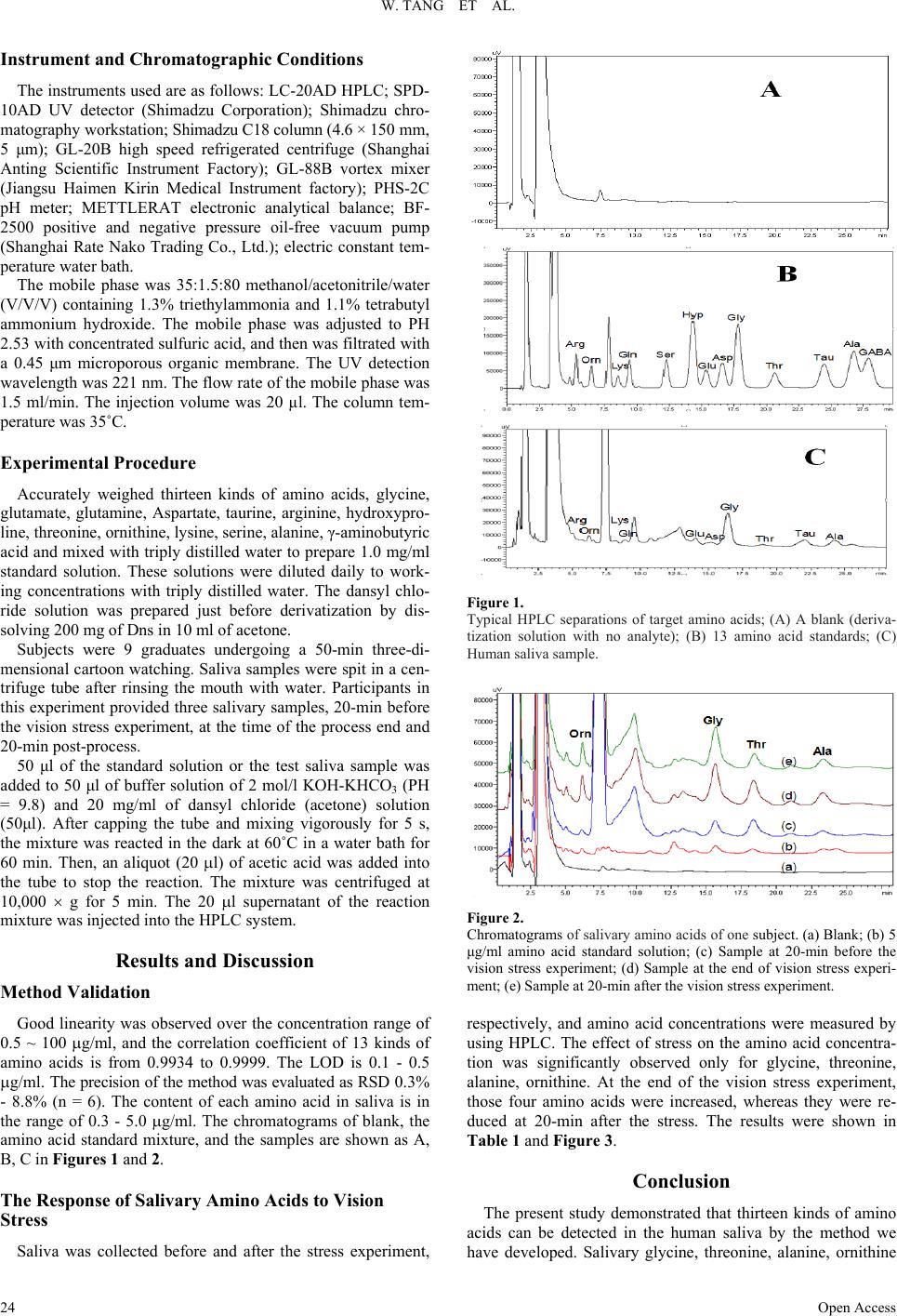 W. TANG ET AL. Open Access 24 Instrument and Chromatographic Conditions The instruments used are as follows: LC-20AD HPLC; SPD- 10AD UV detector (Shimadzu Corporation); Shimadzu chro- matography workstation; Shimadzu C18 column (4.6 × 150 mm, 5 μm); GL-20B high speed refrigerated centrifuge (Shanghai Anting Scientific Instrument Factory); GL-88B vortex mixer (Jiangsu Haimen Kirin Medical Instrument factory); PHS-2C pH meter; METTLERAT electronic analytical balance; BF- 2500 positive and negative pressure oil-free vacuum pump (Shanghai Rate Nako Trading Co., Ltd.); electric constant tem- perature water bath. The mobile phase was 35:1.5:80 methanol/acetonitr ile/water (V/V/V) containing 1.3% triethylammonia and 1.1% tetrabutyl ammonium hydroxide. The mobile phase was adjusted to PH 2.53 with concentrated sulfuric acid, and then was filtrated with a 0.45 μm microporous organic membrane. The UV detection wavelength was 221 nm . The flow rate of the mobile phase was 1.5 ml/min. The injection volume was 20 µl. The column tem- perature was 35˚C. Experimental Procedure Accurately weighed thirteen kinds of amino acids, glycine, glutamate, glutamine, Aspartate, taurine, arginine, hydroxypro- line, threonine, ornithine, lysine, serine, alanine, γ-aminobutyric acid and mixed with triply distilled water to prepare 1. 0 mg/ml standard solution. These solutions were diluted daily to work- ing concentrations with triply distilled water. The dansyl chlo- ride solution was prepared just before derivatization by dis- solving 200 mg of Dns in 10 ml of acetone. Subjects were 9 graduates undergoing a 50-min three-di- mensional cartoon watching. Saliva sampl es were spit in a cen- trifuge tube after rinsing the mouth with water. Participants in this experiment provided three salivary samples, 20-min before the vision stress experiment, at the time of the process end and 20-min post-process. 50 μl of the standard solution or the test saliva sample was added to 50 μl of buffer solution of 2 mol/l KOH-KHCO3 (PH = 9.8) and 20 mg/ml of dansyl chloride (acetone) solution (50μl). After capping the tube and mixing vigorously for 5 s, the mixture was reacted in the dark at 60˚C in a water bath for 60 min. Then, an aliquot (20 µl) of acetic acid was added into the tube to stop the reaction. The mixture was centrifuged at 10,000 × g for 5 min. The 20 µl supernatant of the reaction mixture was injected into the HPLC system. Results and Discussion Method Validation Good linearity was observed over the concentration range of 0.5 ~ 100 µg/ml, and the correlation coefficient of 13 kinds of amino acids is from 0.9934 to 0.9999. The LOD is 0.1 - 0.5 µg/ml. The precision of the method was evaluated as RSD 0.3% - 8.8% (n = 6). The content of each amino acid in saliva is in the range of 0.3 - 5.0 µg/ml. The chromatograms of blank, the amino acid standard mixture, and the samples are shown as A, B, C in Figures 1 and 2. The Response of Salivary Amino Acids to Vision Stress Saliva was collected before and after the stress experiment, Figure 1. Typical HPLC separations of target amino acids; (A) A blank (deriva- tization solution with no analyte); (B) 13 amino acid standards; (C) Human saliva sample. Figure 2. Chromatograms of salivary a mino acids of one subject. (a) Blank; (b) 5 μg/ml amino acid standard solution; (c) Sample at 20-min before the vision stress experiment; (d) Sample at the end of vision stress experi- ment; (e) Sample at 20-min after the vision stress experiment. respectively, and amino acid concentrations were measured by using HPLC. The effect of stress on the amino acid concentra- tion was significantly observed only for glycine, threonine, alanine, ornithine. At the end of the vision stress experiment, those four amino acids were increased, whereas they were re- duced at 20-min after the stress. The results were shown in Table 1 and Figure 3. Conclusion The present study demonstrated that thirteen kinds of amino acids can be detected in the human saliva by the method we have developed. Salivary glycine, threonine, alanine, ornithine 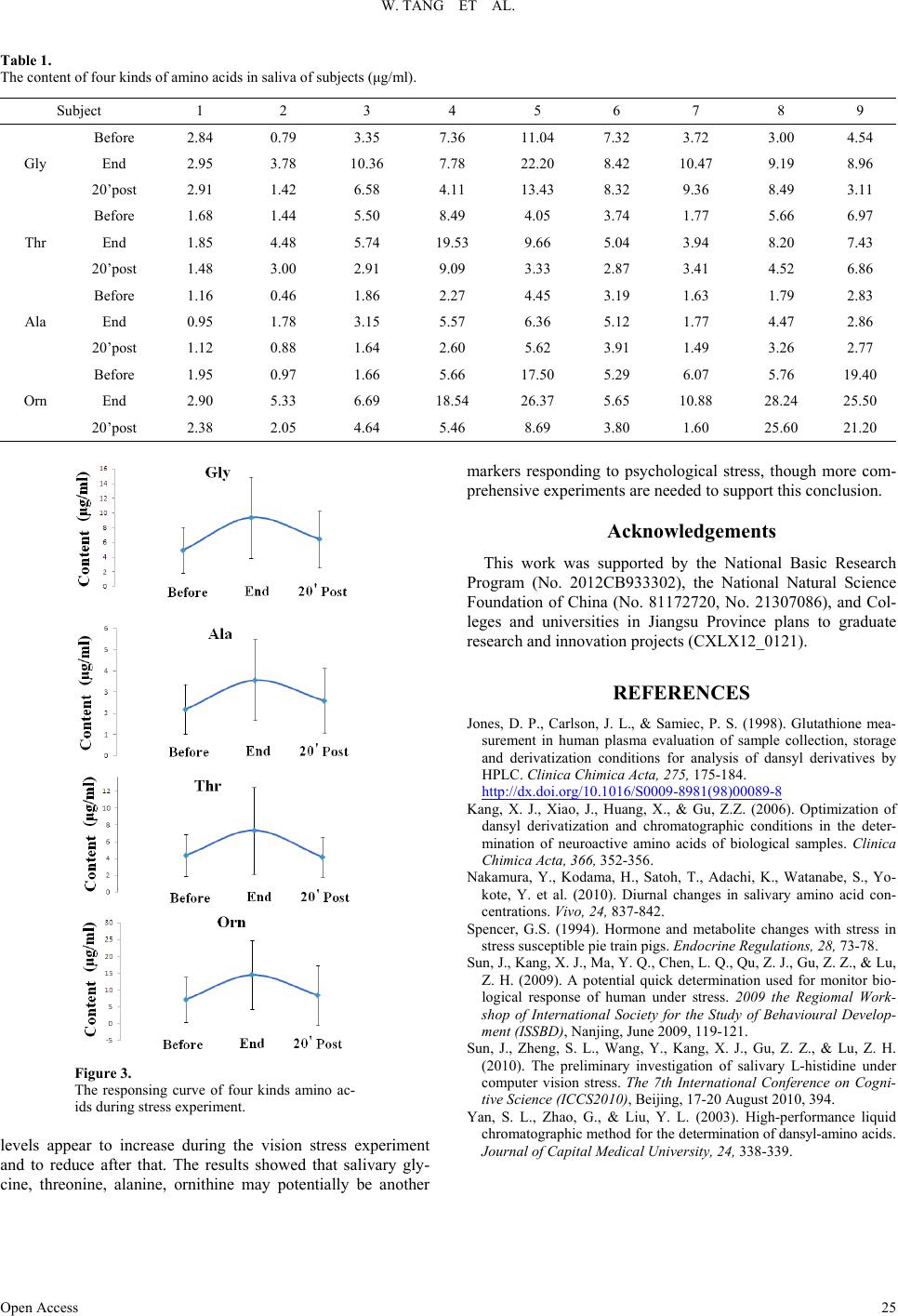 W. TANG ET AL. Open Access 25 Table 1. The content of fou r kinds of amino acids in saliva of subjects (μg/ml). Subject 1 2 3 4 5 6 7 8 9 Gly Before 2.84 0.79 3.35 7.36 11.04 7.32 3.72 3.00 4.54 End 2.95 3.78 10.36 7.78 22.20 8.42 10.47 9.19 8.96 20’post 2.91 1.42 6.58 4.11 13.43 8.32 9.36 8.49 3.11 Thr Before 1.68 1.44 5.50 8.49 4.05 3.74 1.77 5.66 6.97 End 1.85 4.48 5.74 19.53 9.66 5.04 3.94 8.20 7.43 20’post 1.48 3.00 2.91 9.09 3.33 2.87 3.41 4.52 6.86 Ala Before 1.16 0.46 1.86 2.27 4.45 3.19 1.63 1.79 2.83 End 0.95 1.78 3.15 5.57 6.36 5.12 1.77 4.47 2.86 20’post 1.12 0.88 1.64 2.60 5.62 3.91 1.49 3.26 2.77 Orn Before 1.95 0.97 1.66 5.66 17.50 5.29 6.07 5.76 19.40 End 2.90 5.33 6.69 18.54 26.37 5.65 10.88 28.24 25.50 20’post 2.38 2.05 4.64 5.46 8.69 3.80 1.60 25.60 21.20 Figure 3. The responsing curve of four kinds amino ac- ids during stress experiment. levels appear to increase during the vision stress experiment and to reduce after that. The results showed that salivary gly- cine, threonine, alanine, ornithine may potentially be another markers responding to psychological stress, though more com- prehensive experiments are needed to support this conclusion. Acknowledgements This work was supported by the National Basic Research Program (No. 2012CB933302), the National Natural Science Foundation of China (No. 81172720, No. 21307086), and Col- leges and universities in Jiangsu Province plans to graduate research and innovation projects (CXLX12_0121). REFERENCES Jones, D. P., Carlson, J. L., & Samiec, P. S. (1998). Glutathione mea- surement in human plasma evaluation of sample collection, storage and derivatization conditions for analysis of dansyl derivatives by HPLC. Clinica Chimica Acta, 275, 175-184. http://dx.doi.org/10.1016/S0009-8981(98)00089-8 Kang, X. J., Xiao, J., Huang, X., & Gu, Z.Z. (2006). Optimization of dansyl derivatization and chromatographic conditions in the deter- mination of neuroactive amino acids of biological samples. Clinica Chimica Acta, 366, 352-356. Nakamura, Y., Kodama, H., Satoh, T., Adachi, K., Watanabe, S., Yo- kote, Y. et al. (2010). Diurnal changes in salivary amino acid con- centrations. Vivo, 24, 837-842. Spencer, G.S. (1994). Hormone and metabolite changes with stress in stress susceptible pie train pigs. Endocrine Regulations, 28, 73-78. Sun, J., Kang, X. J., Ma, Y. Q., Chen, L. Q., Qu, Z. J., Gu, Z. Z., & Lu, Z. H. (2009). A potential quick determination used for monitor bio- logical response of human under stress. 2009 the Regiomal Work- shop of International Society for the Study of Behavioural Develop- ment (ISSBD), Nanjing, June 2009, 119-121. Sun, J., Zheng, S. L., Wang, Y., Kang, X. J., Gu, Z. Z., & Lu, Z. H. (2010). The preliminary investigation of salivary L-histidine under computer vision stress. The 7th International Conference on Cogni- tive Science (ICCS2010), Beijing, 17-20 August 2010, 394. Yan, S. L., Zhao, G., & Liu, Y. L. (2003). High-performance liquid chromatographic method for the determination of dansyl-amino acid s. Journal of Capital Medical University, 24, 338-339. |