

Paper Menu >>
Journal Menu >>
 Open Journal of Social Sciences 2013. Vol.1, No.6, 1-4 Published Online November 2013 in SciRes (http://www.scirp.org/journal/jss) http://dx.doi.org/10.4236/jss.2013.16001 Open Access 1 An Investigation of the Relationship between Resilience, Mindfulness, and Academic Self-Efficacy Michelle D. Keye, Aileen M. P idg eon Faculty of Humanities and Social Sciences, Bond Univertsity, Gold Coast, Australia Email: [email protected] Received August 2013 Resilience, mindfulness, and academic self-efficacy are topics of interests to psychologists; however, little is known about the relationships among the three. The primary purpose of this research was to explore the role of mindfulness and academic self-efficacy in predicting resilience among university students. 141 participants (m = 39, f = 102) completed The Freiburg Mindfulness Inventory, The Beliefs in Educational Success Test, and The Connor Davidson Resilience Scale. The results found that in the regression models, mindfulness and academic self-efficacy were significant predictors of resilience. This finding suggests that mindfulness and academic self-efficacy have a significant impact on resilience. Keywords: Resilience; Mindfulness; Academic Self-Efficacy Introduction The present study investigates the relationship between mindfulness, academic self-efficacy, and resilience. Resilience is referred to as the ability to “sustain psychological stability in the face of stress” (Combes-Malcome, 2007: p. 20). Positive outcomes associated with resilience are the alleviation of the negative effects of stress, the promotion of adaptation, and the development of effective coping skills to deal with change and adversity (Ahern, Kiehl, Sole, & Byers, 2006; Richardson, Neiger, Jensen, & Kumpfer, 1990). Resilience is an important factor for preventing the development of psychopathology and maintaining optimal functioning, physical health and psycho- logical health despite stressful life circumstances (Ryff & Sing- er, 2003). Many researchers believe that resilience can be strengthened because it is not a “hard-wired” personality trait possessed by only some individuals, and is the result of the development of protective factors (Reivich & Shatte, 2002). Therefore, strengthening the protective factors associated with resilience will strengthen resilience. Thompson, Arnkoff, and Glass (2011) have proposed that mindfulness is associated with resilience, and Greason & Cash- well (2009) research found evidence of an association between mindfulness and self-efficacy. These findings suggest that mindfulness and self-efficacy show potential to be protective factors to strengthening resilience (Hamill, 2003). However, to date there is little research supporting the predictive abilities of mindfulness and self-efficacy on resilience. Therefore the aim of the current study will be to investigate the relationship be- tween mindfulness and self-efficacy and their potential contri- bution to resilience. Resilience In recent years, resilience has been recognized as a develop- mental process, reflecting the capacity for positive adjustment in difficult life circumstances as opposed to a trait (Lightsey, 2006). For the purpose of the present study, resilience will be defined as the ability an individual has to recover from dis- tressing and challenging life events with increased knowledge to adaptively cope with similar adverse situations in the future. This definition is based on Flach’s (1989) theory of resilience, which states that resilience is made up of the psychological strengths required to successfully navigate change. Flach’s (1989) theory of resilience is based on the “Law of Disruption and Re-integration”, which suggests that the act of “falling apart”, or being distressed by change, is actually a necessary part of learning to cope with stressful life events. Flach describes disruption as the effect of life events, which remove individuals from their own personal homeostasis. As each person is unique, they also have unique levels of disrup- tion that they can manage. Disruption is an unpleasant expe- rience, even painful, and as such, Flach suggest that individuals experiencing disruption are forced to look inward and adapt to meet the new challenge. Flach’s theory postulates that tempo- rary challenges are good opportunities to deal with old hurts, discover new coping mechanisms, and generally re-organise one’s perspective on life. This process is called re-integration and involves re-forming ones view of the world and of oneself (Flach, 1989). When disruption occurs, individuals try to re- build their life, their homeostasis, by problem solving and looking at the situation from a different perspective. Each indi- vidual has a unique time-frame for the process of re-integration which depends not only on the level of distress caused by the life event, but by the capacity of that individual and the traits they possess (Flach, 1989). Over the last few decades, there has been research aiming to discover what these character traits are and certain traits, in- cluding self-efficacy, creative problem solving skills, personal introspection, and the ability to engage with the present, have consistently been shown to be associated with resilience (Thompson, Arnkoff, & Glass, 2011; VanBreda, 2001). Re- cently, research indicates that many of these traits associated with resilience, a r e also associated with mindfulness (Van Breda, 2001) and self-efficacy (Lightsey, 2006).  M. D. KEYE, A. M. PIDGEON Open Access 2 Mindfulness Although Buddhist philosophy states that cultivating mind- fulness is important to enhance well-being (Baer, 2003), mind- fulness is a relatively new construct in the field of psychology (Brown, Marquis, & Guiffrida, 2013; Catalino & Fredrickson, 2011). Mindfulness is a skill, which enhances adaptive coping to stressful events by the self-regulation of attention towards the immediate experience, and an open and accepting orienta- tion towards one’s experience of the present (Bishop et al., 2004). Thoughts and emotions that enter an individual’s aware- ness are observed, and not expanded on or evaluated, with at- tention being redirected towards the breath in the present mo- ment (Chiesa & Malinowski, 2011). A theory of mindfulness proposed by Bishop et al. (2004) postulates that mindfulness operates by individuals learning to abandon their efforts to forcibly control their negative thoughts and to instead acknowledge that the thoughts and emotions are present. The skill of mindfulness raises awareness to the tran- sient nature of these negative thoughts, emotions, and body sen- sations, which leads to more flexible and objective responses rather than reactions (Keng, Smoski, & Robins, 2011). This is contrasted with habitual judgments and interpretations of sti- muli that enter awareness, which trigger strong emotions and reactions, and subsequently contribute to poor mental health (Marchand, 2012). Resilience and Mindfulness A review of the literature revealed an association between mindfulness and resilience. Lightsey (2006) postulates that resilience can be taught through psychological interventions, and Van Breda (2001) postulates that mindfulness-based train- ing may be an efficacious intervention for increasing resilience. A study by Jha, Stanley, Kiyonaga, Wong, and Gelfand (2010) supported the notion of a relationship between mindfulness and resilience. The Jha et al. (2010) study showed that Mindful- ness-Based Fitness Training (MMFT) shows potential as an effective method of increasing the resilience and psychological well being of soldiers whose deployment and occupation in- creases the risk of psychological trauma. Further support for an association between resilience and mindfulness was found by Chavers (2013) research, which found a significant correlation between mindfulness and resilience, with mindfulness being a significant predictor of resilience. Academi c Self-Efficacy Self-efficacy has been found to be associated with increased resilience (Chemers, Hu, & Garcia, 2000; Pajares, 1996). Self- efficacy is the interpretation individuals give to their own per- formance and achievement (Hudson, 2007). This interpretation is formed by existing self-beliefs and has been found to directly affect an individual’s motivation to succeed in future situations (Pajares, 1996). A plethora of research has shown that academic self-efficacy has a positive relationship with university grades (Hudson, 2007) and persistence to succeed in future tasks (Bouffard-Bouchard, Parent, & Larivee, 1991). Resilience and Academic Self-Efficacy A number of theories postulate an association between aca- demic self-efficacy and resilience. For example, Lightsey’s (2006) theory, which proposes that individual’s self-efficacy is central to their level of resilience. This theory has been sup- ported empirically, by a study conducted by Speight (2009) who found a positive relationship between self-efficacy and re- silience in high school students. Although several studies have shown a relationship between resilience and self-efficacy, few have examined the relationship between academic self-efficacy and resilience. Therefore, the present study will further our understanding of this relationship by exploring the predictive ability of academic self-efficacy on resilience. The Current Study The aim of the current study is to investigate protective fac- tors of resilience by examining the predictive abilities of mind- fulness and academic self-efficacy on resilience. Therefore, it is hypothesized that: H1: There will be a significant positive correlation between the predictor variables for the regression model, with mindful- ness and academic self-efficacy showing significant correla- tions with each other. H2: Mindfulness and academic self-efficacy will be signifi- cant predictors of resilience with higher levels of mindfulness and academic self-efficacy predicting higher levels of resi- lience. Method Participants Participants were 39 male and 102 female university students (N = 141). Inclusion criteria for this study required participants to be aged 18 years or above. Measures The Freiburg Mindful ness Inve ntory (F MI) (Walach et al., 2006) is a 14-item scale measuring an individual’s experience of mindfulness. A total mindfulness score is given by summing participants’ scores across all items, with greater scores indi- cating greater levels of mindfulness. The Beliefs in Educational Success Test (BEST). The BEST (Majer, 2006), is a 10 -item scale measuring an individu- al’s belief in their ability to succeed academically. Values in- crease in increments of 10 with higher scores indicating greater academic self-efficacy; possible total scores for the BEST range from 100 - 1000. The Connor Davidson-Resilience Scale (CD-RISC). The CD-RISC (Connor & Davidson, 2003) is a 25-item scale whic h rates how individuals have felt over the last month and their stress coping ability. A total score is given by summing an in- dividual’s response across all items with higher scores indicat- ing higher levels of resilience. Results Participants’ total scores for mindfulness, academic self-ef- ficacy, and resilience were calculated by summing each item within each scale. Mean and standard deviations for each varia- ble can be seen in Table 1. Table 2 shows the correlations between the predictor and criterion variables. It can be seen that there is a significant cor- relation between mindfulness and academic sel f-efficacy, r = . 43, 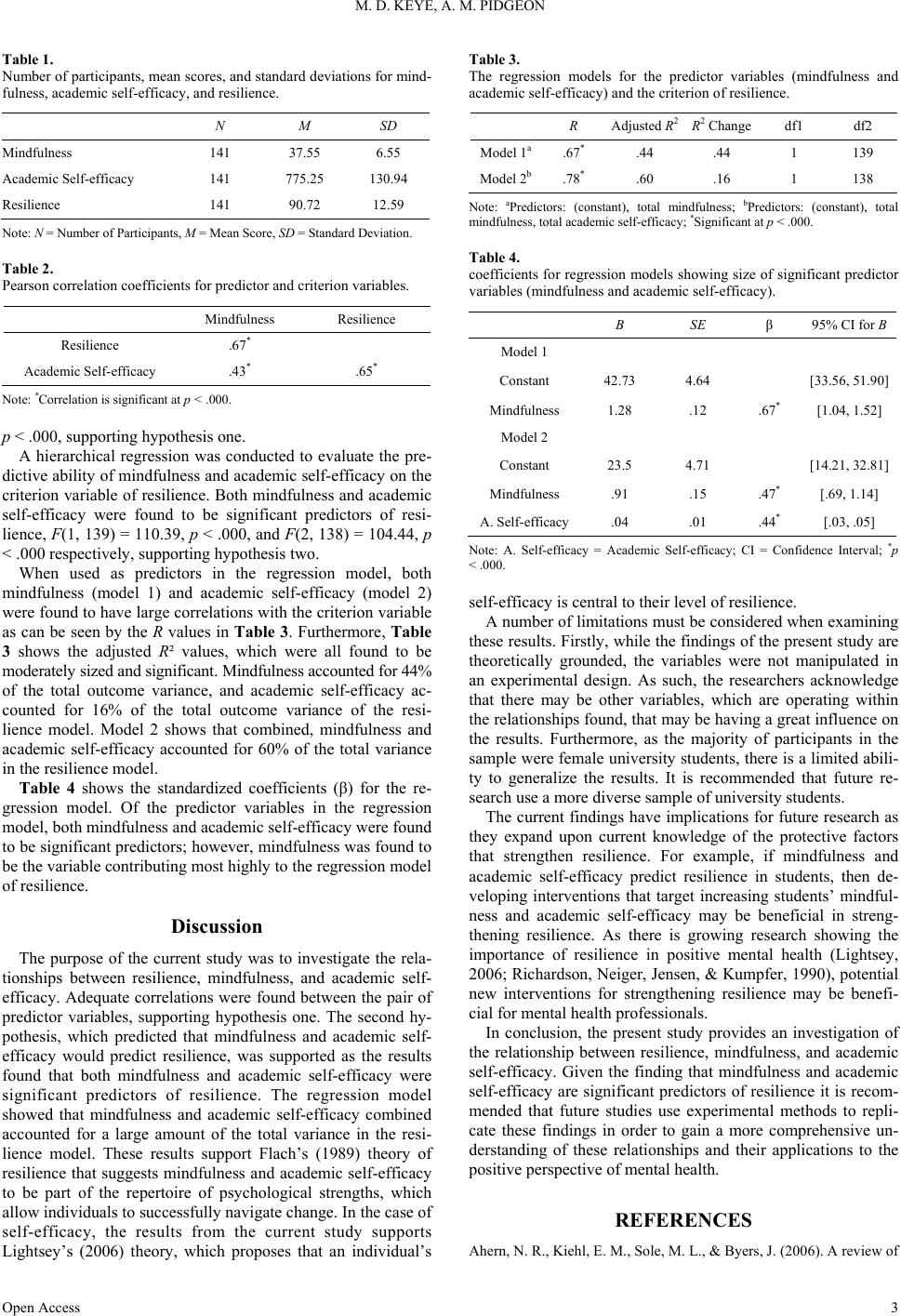 M. D. KEYE, A. M. PIDGEON Open Access 3 Table 1. Number of participants, mean scores, and stan dard deviations f or mi n d- fulness, academic self-efficacy, and resilience. N M SD Mindfulness 141 37.55 6.55 Academic Self-efficacy 1 41 775.25 130.94 Resilien ce 1 41 90.72 12.59 Note: N = Number of Participa nts, M = Mean Score, SD = Standard D eviation. Table 2. Pearson correlation coefficients for predictor and criterion variables. Mindfulness Resilience Resilien ce .67* Academic Self-efficacy .43* .65* Note: *Correlation is significant at p < .000. p < .000, supporting hypothesis one. A hierarchical regression was conducted to evaluate the pre- dictive ability of mindfulness and academic self-efficacy on the criterion variable of resilience. Both mindfulness and academic self-efficacy were found to be significant predictors of resi- lience, F(1, 139) = 110.39, p < .000, and F(2, 138) = 104.44, p < .000 respectively, supporting hypothesis two. When used as predictors in the regression model, both mindfulness (model 1) and academic self-efficacy (model 2) were found to have large correlations with the criterion variable as can be seen by the R values in Table 3. Furthermore, Table 3 shows the adjusted R² values, which were all found to be moderately sized a nd significant. Mindfulness accounted for 44% of the total outcome variance, and academic self-efficacy ac- counted for 16% of the total outcome variance of the resi- lience model. Model 2 shows that combined, mindfulness and academic self-efficacy accounted for 60% of the total variance in the resilience model. Table 4 shows the standardized coefficients (β) for the re- gression model. Of the predictor variables in the regression model, both mindfulness and academic self-efficacy were found to be significant predictors; however, mindfulness was found to be the variable contributing most highly to the regression model of resilience. Discussion The purpose of the current study was to investigate the rela- tionships between resilience, mindfulness, and academic self- efficacy. Adequate correlations were found between the pair of predictor variables, supporting hypothesis one. The second hy- pothesis, which predicted that mindfulness and academic self- efficacy would predict resilience, was supported as the results found that both mindfulness and academic self-efficacy were significant predictors of resilience. The regression model showed that mindfulness and academic self-efficacy combined accounted for a large amount of the total variance in the resi- lience model. These results support Flach’s (1989) theory of resilience that suggests mindfulness and academic self-efficacy to be part of the repertoire of psychological strengths, which allow individuals to successfully navigate change. In the case of self-efficacy, the results from the current study supports Lightsey’s (2006) theory, which proposes that an individual’s Table 3. The regression models for the predictor variables (mindfulness and academic self-efficacy) and the criterion of resilience. R Adjusted R2 R2 Change df1 df2 Model 1a .67* .44 .44 1 139 Model 2b .78* .60 .16 1 138 Note: aPredictors: (constant), total mindfulness; bPredictors: (cons tant ), total mindfulness, total academic self-efficacy; *Significant at p < .000. Table 4. coefficients for regressio n models showing size of sign ificant predictor variables (mindfulness and academic self-efficacy). B SE β 95% CI for B Model 1 Constant 42.73 4.64 [33.56, 51.90] Mindfulness 1.28 .12 .67* [1.04, 1.52] Model 2 Constant 23.5 4.71 [14.21, 32.81] Mindfulness .91 .15 .47* [.69, 1.14] A. Self-efficacy .04 .01 .44* [.03, .05] Note: A. Self-efficacy = Academic Self-efficacy; CI = Confidence Interval; *p < .000. self-efficacy is central to their level of resilience. A number of limitations must be considered when examining these results. Firstly, while the findings of the present study are theoretically grounded, the variables were not manipulated in an experimental design. As such, the researchers acknowledge that there may be other variables, which are operating within the relationships found, that may be having a great influence on the results. Furthermore, as the majority of participants in the sample were female university students, there is a limited abili- ty to generalize the results. It is recommended that future re- search use a more diverse sample of university students. The current findings have implications for future research as they expand upon current knowledge of the protective factors that strengthen resilience. For example, if mindfulness and academic self-efficacy predict resilience in students, then de- veloping interventions that target increasing students’ mindful- ness and academic self-efficacy may be beneficial in streng- thening resilience. As there is growing research showing the importance of resilience in positive mental health (Lightsey, 2006; Richardson, Neiger, Jensen, & Kumpfer, 1990), potential new interventions for strengthening resilience may be benefi- cial for mental health professionals. In conclusion, the present study provides an investigation of the relationship between resilience, mindfulness, and academic self-efficacy. Given the finding that mindfulness and academic self-efficacy are significant predictors of resilience it is recom- mended that future studies use experimental methods to repli- cate these findings in order to gain a more comprehensive un- derstanding of these relationships and their applications to the positive perspective of mental health. REFERENCES Ahern, N. R., Kiehl, E. M., Sole, M. L., & Byers, J. (2006). A review of  M. D. KEYE, A. M. PIDGEON Open Access 4 instruments measuring resilience. Issues in Comp rehensive Pediatric Nursing, 29, 103-125. http://dx.doi.org/10.1080/01460860600677643 Baer, R. A. (2003). Mindfulness training as a clinical intervention: A conceptual and empirical review. Clinical Psychology: Science and Practice, 10, 125-143. http://dx.doi.org/10.1093/clipsy.bpg015 Bishop, S. R ., Lau, M., Shapiro, S ., Carlson, L., An derson, N. D., C ar- mody, J. et al. (2004). Mindfulness: A proposed operational defini- tion. Clinical Psychology: Science and Practice, 11, 230-241. http://dx.doi.org/10.1093/clipsy.bph077 Bouffard-Bouchard, T., Parent, S., & Larivee, S. (1991). Influence of self-efficacy on self-regulation and performance among junior and senior high school aged students. International Journal of Behaviou- ral Development, 14, 153-164. http://dx.doi.org/10.1177/016502549101400203 Brown, A., Marquis, A., & Guiffrida, D. (2013). Mindfulness-based in- terventions in counseling. Journal of Counselling and Development, 91, 96-104. http://dx.doi.org/10.1002/j.1556-6676.2013.00077.x Catalino, L. I., & Fredrickson, B. L . (2011). A Tuesday in the life of a flourisher: The role of positive emotional reactivity in optimal mental health. Emotion, 11, 938-950. http://dx.doi.org/10.1037/a0024889 Chavers, D. J. (2013). Relationships between spirituality, religiosity, mindfulness, personality, and resilience. Doctoral Dissertation, Ala- bama: University of South Alabama. Chemers, M. M., Hu, L., & Garcia, B. F. (2001). Academic self-effi- cacy and first year college student performance and adjustment. Journal of Educational Psychology, 93, 55-64. http://dx.doi.org/10.1037/0022-0663.93.1.55 Chiesa, A., & Malinowski, P. (2011). Mindfulness-based approaches: Are they all the same? Journal of Clinical Psychology, 67, 404-424. http://dx.doi.org/10.1002/jclp.20776 Comb es-Malcome, L. A. (2007). Beginning teachers, resilience and retention. Doctoral Dissertation, San Marcos: Texas State University. Connor, K. M., & Davidson, J. R. T. (2003). Development of a new resilience scale: The connor-davidson resilience scale (cd-risc). De- pression and Anxiety, 18, 76-82. http://dx.doi.org/10.1002/da.10113 Flach, F. F. (1989). Resilience: Discovering new strength at times of stress. New York: Ballantine Books. Greason, P. B., & Cashwell. C. S . (2009). Mindfuln ess and counselling self-efficacy: The mediating role o f attention and empathy. Counsel- lor Education an d Supervision, 49, 2-19. http://dx.doi.org/10.1002/j.1556-6978.2009.tb00083.x Hamill, S. K. (2003) Resilience and self-efficacy: The importance of efficacy beliefs and coping mechanisms in resilient adolescents. Colgate University Journal of the Sciences, 35, 115-146. http://groups.colgate.edu/cjs/student_papers/2003/Hamill.pdf Hudson, W. E. (2007). The relation ship between aca demic self-efficacy and resilience to grades of students admitted under special criteria. Doctoral Dissertation, Tallahassee: The Florida State University. Jha, A. P., Stanley, E. A., Kiyonaga, A., Wong, L., & Gelfand, L. (2010). Examining the protective effects of mindfulness training on working memory capacity and af fective ex perience. Emotion, 10, 54- 64. http://dx.doi.org/10.1037/a0018438 Keng, S., Smoski, M. J., & Robins, C. J. (2011). Effects of mindfulness on psychological health: A rev iew of empirical stud ies. Clinical Psy- chology Review, 31, 1041-1056. http://dx.doi.org/10.1016/j.cpr.2011.04.006 Lightsey, O. R. (2006). Resilience, meaning, and well-being. The Counselling Psychologist, 34, 96-107. http://dx.doi.org/10.1177/0011000005282369 Majer, J. M. (2006). Beliefs in Educational Success Test (BEST). Un- published Instrument. Marchand, W. R. (2012). Mindfulness-based stress reduction, mindful- ness-based cognitive therapy, and zen meditation for depression, an- xiety, pain, and psychological distress. Journal of Psychiatric Prac- tice, 18, 233-252. http://dx.doi.org/10.1097/01.pra.0000416014.53215.86 Pajares, F. (1996). Self-efficacy beliefs in acade mic settings. Review of Educational Research, 66, 543-578. http://dx.doi.org/10.3102/00346543066004543 Reivich, K. & Shatte, A. (2002). The resilience factor. New York: Broadway Books . Richardson, G. E., Neiger, B.L., Jensen, S., & Kumpfer, K. L. (1990). The resilience model. Health Education, 21, 33-39. Ryff, C. D., & Singer, B. (2003 ). Flourishin g under fire: Res ilience as a prototype of challenged thriving. In C. L. M. Keyes, & J. Haidt (Eds.), Positive psychology and the life well-lived (pp. 15-36). Wash- ington DC: APA. http://dx.doi.org/10.1037/10594-001 Speight, N. P. (2009). The relationship between self-efficacy, resilience and academic achievement among African American urban adoles- cents. Doctoral Dissertation, Washington DC: Howard University. Thompson, R. W., Arnkoff, D. B., & Glass, C. R. (2011). Conceptua- lizing mindfulness and acceptance as components of psychological resilience to trauma. Trauma, Violence and Abuse, 12, 220-235. http://dx.doi.org/10.1177/1524838011416375 Van Breda, A. D. (2001). Resilience theory: A literature review (Re- search Report MPI/R/104/12/1/4). South African Military Psycho- logical Institute. http://vanbreda.org/adrian/resilience/resilience_theory_review.pdf Walach, H., Buchheld, N., Buttenmüller, V., Kleinknecht, N., & Sch- midt, S. (2006). Measuring mindfulness—The Freiburg mindfulness inventory (FMI). Personality and Individual Differences, 40, 1543- 1555. http://dx.doi.org/10.1016/j.paid.2005.11.025 |