

Paper Menu >>
Journal Menu >>
 Psychology 2013. Vol.4, No.11A, 11-15 Published Online November 2013 in SciRes (http://www.scirp.org/journal/psych) http://dx.doi.org/10.4236/psych.2013.411A003 Open Access 11 Characteristics of Depressed Patients Treated in Rural Areas of Chile*# Ariel Castro-Lara1†, Viviana Guajardo2,3, Rosemarie Fritsch2,4, Ruben Alvarado3, Graciela Rojas2 1Investigations Support Office, Clinical Hospital, Universidad de Chile, Santiago, Chile 2Clinical Hospital, Faculty of Medicine, Universidad de Chile, Santiago, Chile 3School of Public Health, Faculty of Medicine, Universidad de Chile, Santiago, Chile 4Psychiatry Department, Faculty of Medicine, Universidad de Los Andes, Santiago, Chile Email: †[email protected] Received September 19th, 2013; revised October 21st, 2013; accepted November 18th, 2013 Copyright © 2013 Ariel Castro-Lara et al. This is an open access article distributed under the Creative Com- mons Attribution License, which permits unrestricted use, distribution, and reproduction in any medium, pro- vided the original work is properly cited. Objective: To describe a group of depressed patients that participated in a clinical intervention to improve depression treatment in rural areas. Materials and Methods: It is a clinical intervention for depressed pa- tients from 15 rural hospitals. The principal outcome is depressive symptomatology measured with the Beck Depression Inventory (BDI), and the secondary outcome is quality of life. The intervention consists of a collaborative program between primary care teams and specialized teams, with support from an elec- tronic platform and a call center. Results: 254 subjects—13.8% men and 86.2% women—were recruited, with an age range between 18 and 65 years. The majority had a stable partner and attended high school. Homemakers made up 47.4% of the sample, and 38.7% were employed. The average BDI score was 29.8 (s. d. = 9.2). There was a history of previous depressive episodes in 42.9% of the cases, 37.4% presented severe suicide risk, and 59.1% had a comorbid anxiety disorder. Conclusion: It is a clinical sample of pa- tients with severe depressive symptoms who are treated by primary care physicians in rural zones. The sample had comorbid anxiety and poor quality of life associated with their mental illness. Keywords: Depression; Mental Health; Rural Health Introduction Depression is a highly disabling condition and a public health problem, due to its high prevalence, long duration, and recurrence. It is estimated that by 2012, depression will be the second leading cause of years lost to disability for both sexes worldwide (Murray & Lopez, 1996, 1997). Population-level studies carried out in Chile have calculated a prevalence of approximately 5% in the general population and 30% in the population served by the public primary care system (Florenzano, Acuña, Fullerton, & Castro, 1998; Kohn et al., 2005; Rojas, Araya, & Fritsch, 2000; Sartorius et al., 1993). In light of this issue, in 2001, the Chilean Ministry of Health created the “program for the detection, diagnosis, and treat- ment of depression in primary care,” and in June 2006, as part of a health reform, depression care for individuals over 15 years of age was incorporated into the country’s Explicit Health Guarantees (Law GES), thereby assuring universal access to depression treatment (Ministry of Health, 2012). The Ministry of Health Clinical Guidelines for the Treatment of Individuals with Depression gives primary care teams the central role of detecting, diagnosing, and treating depression. The most complex cases are referred to specialized mental health centers, which also support the primary care teams with their work (Ministry of Health, 2009) This article describes a sample of depressed patients treated in small, rural community hospitals, belonging to the regional health services of Reloncaví, Ñuble, and Coquimbo, Chile. The sample forms part of an investigation to measure the effective- ness of a collaborative telepsychiatry program between com- munity hospital care teams and a specialized mental health team to improve the management of depression. This study will characterize patients who received treatment for depression in rural zones of Chile, with the aim of support- ing the adaption and optimization of the national recommenda- tions for depression treatment in particular populations. Metodology A baseline evaluation was carried out with patients who en- tered depression treatment in each community hospital (N = 15) pertaining to the health services of Coquimbo, Ñuble, and Re- loncaví, Chile. These establishments are not currently super- vised by specialized mental health professionals. The clinical trial measured the effectiveness of a collabora- tive telepsychiatry program between primary care teams of rural community hospitals and a specialized mental health team from the Clinical Hospital of the Universidad de Chile to im- prove the management of depression. *Funding: FONDECYT 1100205. #Conflicts of Interest: None. †Corresponding author. 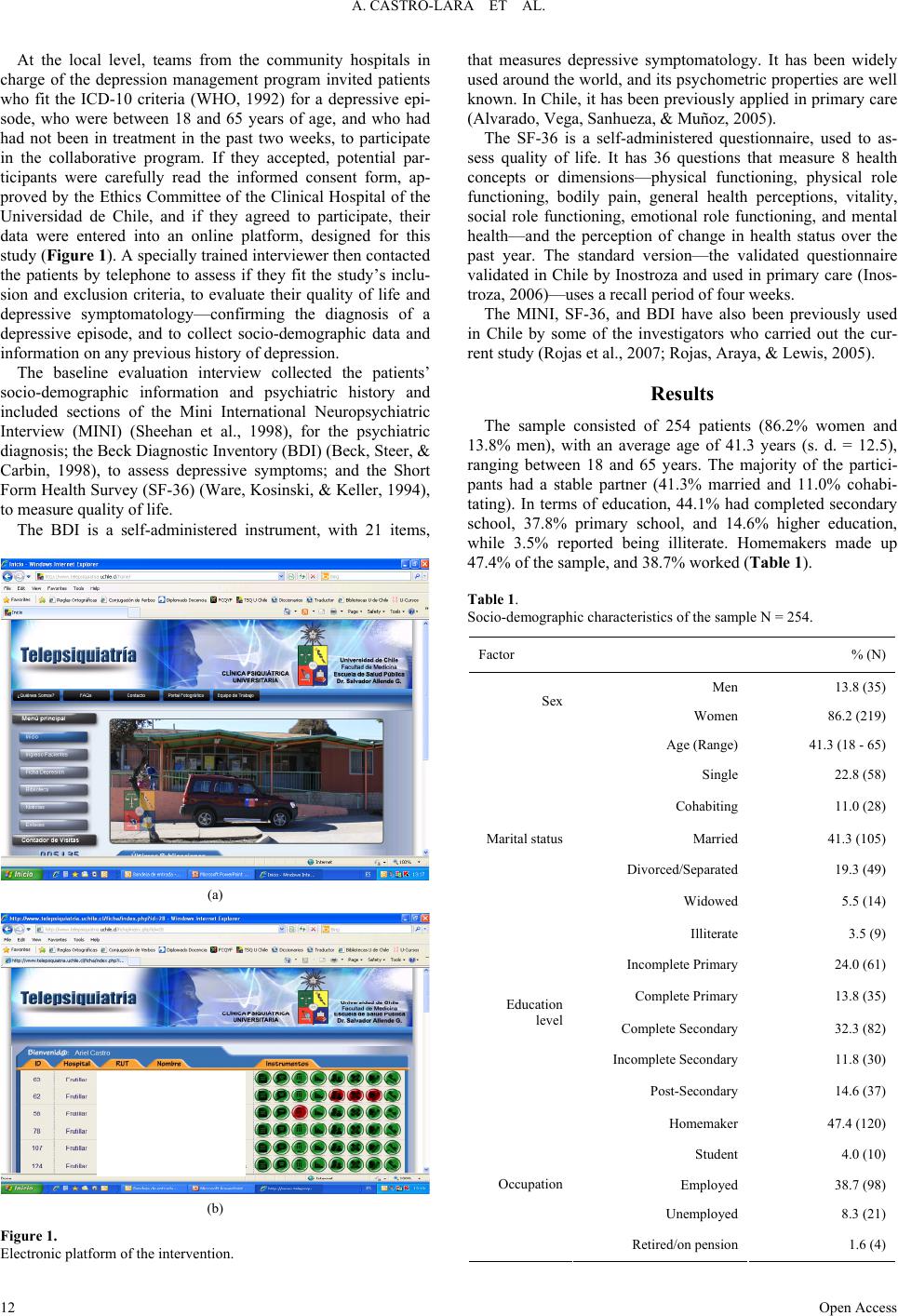 A. CASTRO-LARA ET AL. At the local level, teams from the community hospitals in charge of the depression management program invited patients who fit the ICD-10 criteria (WHO, 1992) for a depressive epi- sode, who were between 18 and 65 years of age, and who had had not been in treatment in the past two weeks, to participate in the collaborative program. If they accepted, potential par- ticipants were carefully read the informed consent form, ap- proved by the Ethics Committee of the Clinical Hospital of the Universidad de Chile, and if they agreed to participate, their data were entered into an online platform, designed for this study (Figure 1). A specially trained interviewer then contacted the patients by telephone to assess if they fit the study’s inclu- sion and exclusion criteria, to evaluate their quality of life and depressive symptomatology—confirming the diagnosis of a depressive episode, and to collect socio-demographic data and information on any previous history of depression. The baseline evaluation interview collected the patients’ socio-demographic information and psychiatric history and included sections of the Mini International Neuropsychiatric Interview (MINI) (Sheehan et al., 1998), for the psychiatric diagnosis; the Beck Diagnostic Inventory (BDI) (Beck, Steer, & Carbin, 1998), to assess depressive symptoms; and the Short Form Health Survey (SF-36) (Ware, Kosinski, & Keller, 1994), to measure quality of life. The BDI is a self-administered instrument, with 21 items, (a) (b) Figure 1. Electronic platform of the intervention. that measures depressive symptomatology. It has been widely used around the world, and its psychometric properties are well known. In Chile, it has been previously applied in primary care (Alvarado, Vega, Sanhueza, & Muñoz, 2005). The SF-36 is a self-administered questionnaire, used to as- sess quality of life. It has 36 questions that measure 8 health concepts or dimensions—physical functioning, physical role functioning, bodily pain, general health perceptions, vitality, social role functioning, emotional role functioning, and mental health—and the perception of change in health status over the past year. The standard version—the validated questionnaire validated in Chile by Inostroza and used in primary care (Inos- troza, 2006)—uses a recall period of four weeks. The MINI, SF-36, and BDI have also been previously used in Chile by some of the investigators who carried out the cur- rent study (Rojas et al., 2007; Rojas, Araya, & Lewis, 2005). Results The sample consisted of 254 patients (86.2% women and 13.8% men), with an average age of 41.3 years (s. d. = 12.5), ranging between 18 and 65 years. The majority of the partici- pants had a stable partner (41.3% married and 11.0% cohabi- tating). In terms of education, 44.1% had completed secondary school, 37.8% primary school, and 14.6% higher education, while 3.5% reported being illiterate. Homemakers made up 47.4% of the sample, and 38.7% worked (Table 1). Table 1. Socio-demographic characteristics of the sample N = 254. Factor % (N) Men 13.8 (35) Sex Women 86.2 (219) Age (Range) 41.3 (18 - 65) Single 22.8 (58) Cohabiting 11.0 (28) Married 41.3 (105) Divorced/Separated 19.3 (49) Marital status Widowed 5.5 (14) Illiterate 3.5 (9) Incomplete Primary 24.0 (61) Complete Primary 13.8 (35) Complete Secondary 32.3 (82) Incomplete Secondary 11.8 (30) Education level Post-Secondary 14.6 (37) Homemaker 47.4 (120) Student 4.0 (10) Employed 38.7 (98) Unemployed 8.3 (21) Occupation Retired/on pension 1.6 (4) Open Access 12 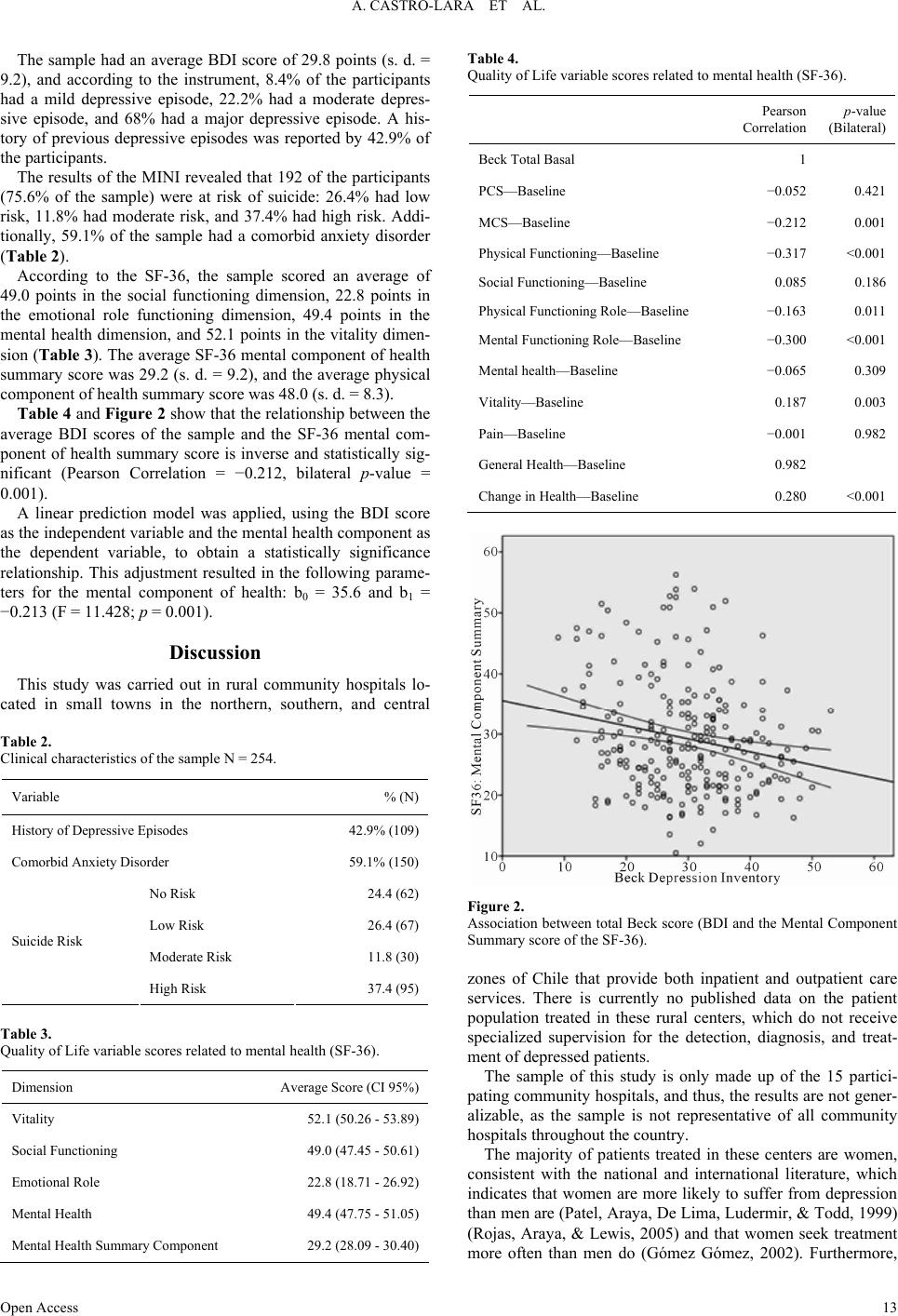 A. CASTRO-LARA ET AL. The sample had an average BDI score of 29.8 points (s. d. = 9.2), and according to the instrument, 8.4% of the participants had a mild depressive episode, 22.2% had a moderate depres- sive episode, and 68% had a major depressive episode. A his- tory of previous depressive episodes was reported by 42.9% of the participants. The results of the MINI revealed that 192 of the participants (75.6% of the sample) were at risk of suicide: 26.4% had low risk, 11.8% had moderate risk, and 37.4% had high risk. Addi- tionally, 59.1% of the sample had a comorbid anxiety disorder (Table 2). According to the SF-36, the sample scored an average of 49.0 points in the social functioning dimension, 22.8 points in the emotional role functioning dimension, 49.4 points in the mental health dimension, and 52.1 points in the vitality dimen- sion (Table 3). The average SF-36 mental component of health summary score was 29.2 (s. d. = 9.2), and the average physical component of health summary score was 48.0 (s. d. = 8.3). Table 4 and Figure 2 show that the relationship between the average BDI scores of the sample and the SF-36 mental com- ponent of health summary score is inverse and statistically sig- nificant (Pearson Correlation = −0.212, bilateral p-value = 0.001). A linear prediction model was applied, using the BDI score as the independent variable and the mental health component as the dependent variable, to obtain a statistically significance relationship. This adjustment resulted in the following parame- ters for the mental component of health: b0 = 35.6 and b1 = −0.213 (F = 11.428; p = 0.001). Discussion This study was carried out in rural community hospitals lo- cated in small towns in the northern, southern, and central Table 2. Clinical characteristics of the sample N = 254. Variable % (N) History of Depressive Episodes 42.9% (109) Comorbid Anxiety Disorder 59.1% (150) No Risk 24.4 (62) Low Risk 26.4 (67) Moderate Risk 11.8 (30) Suicide Risk High Risk 37.4 (95) Table 3. Quality of Life variable scores related to mental health (SF-36). Dimension Average Score (CI 95%) Vitality 52.1 (50.26 - 53.89) Social Functioning 49.0 (47.45 - 50.61) Emotional Role 22.8 (18.71 - 26.92) Mental Health 49.4 (47.75 - 51.05) Mental Health Summary Component 29.2 (28.09 - 30.40) Table 4. Quality of Life variable scores related to mental health (SF-36). Pearson Correlation p-value (Bilateral) Beck Total Basal 1 PCS—Baseline −0.052 0.421 MCS—Baseline −0.212 0.001 Physical Functioning—Baseline −0.317 <0.001 Social Functioning—Baseline 0.085 0.186 Physical Functioning Role—Baseline −0.163 0.011 Mental Functioning Role—Baseline −0.300 <0.001 Mental health—Baseline −0.065 0.309 Vitality—Baseline 0.187 0.003 Pain—Baseline −0.001 0.982 General Health—Baseline 0.982 Change in Health—Baseline 0.280 <0.001 Figure 2. Association between total Beck score (BDI and the Mental Component Summary score of the SF-36). zones of Chile that provide both inpatient and outpatient care services. There is currently no published data on the patient population treated in these rural centers, which do not receive specialized supervision for the detection, diagnosis, and treat- ment of depressed patients. The sample of this study is only made up of the 15 partici- pating community hospitals, and thus, the results are not gener- alizable, as the sample is not representative of all community hospitals throughout the country. The majority of patients treated in these centers are women, consistent with the national and international literature, which indicates that women are more likely to suffer from depression than men are (Patel, Araya, De Lima, Ludermir, & Todd, 1999) (Rojas, Araya, & Lewis, 2005) and that women seek treatment more often than men do (Gómez Gómez, 2002). Furthermore, Open Access 13  A. CASTRO-LARA ET AL. past research has shown that, in Chile, these depression risk and treatment access gaps between women and men are greater than in European countries. Nevertheless, it is probable that, in addi- tion to the aforementioned points, this difference is explained by the barriers men face to access treatment, due to the health centers’ hours of operation. The study sample is clinically complex, with depressive epi- sodes accompanied by suicide risk, comorbid anxiety disorders, significant associated disability, and a previous history of de- pression. Upon comparison to the 2011 study by Alvarado et al., which evaluated the national depression program in urban pri- mary care clinics (Alvarado & Rojas, 2011), the sample from this study, treated in rural community hospitals, had a higher percentage of severe depression, a finding which should be taken into account when designing methodologies to optimize depression treatment for this particular population. It is likely that in more rural zones, where these community hospitals are located, patients face obstacles to access special- ized treatment, given that two known treatment barriers are distance and cost considerations (Luo & Wang, 2003; Men- donza-Sassi & Béria, 2001; Rosenberg, 1998). Only 24.4% of patients in the sample did not present suicide risk. A study carried out by Escobar and Rojas found that 2.6% of the 2008-2009 discharges from a rural hospital were patients with suicidal behavior, approximately 70% of whom were women. In addition, close to 60% of the patients had a history of psychiatric disorders, and of those, 26.5% had a previous depressive episode. Strikingly, only 24.48% of the patients hospitalized in the rural community hospitals were evaluated by a specialized mental health professional (Escobar & Rojas, 2010). The high rate of attempted suicide in Chile has been previously described (Moyano Díaz & Barría, 2006; Tomas Baader et al., 2011). Sociopolitical explanations attribute this phenomenon to economic indicators of increasing inequality, job insecurity, interpersonal distrust, and weakening social networks (Moyano Díaz & Barría, 2006). This study found a correlation between the intensity of de- pressive symptoms, according to the BDI, and the SF-36 qual- ity of life components. The sample’s SF-36 scores revealed significant degrees of disability, and as the participants’ sever- ity of symptoms increased, they had worse quality of life. It is noteworthy that the majority of previous studies that have shown this correlation between depressive symptomatology and the SF-36 were carried out in urban populations (Friedman, Conwell, & Delavan, 2007). These results indicate that primary care teams in these rural health centers, with little mental health skills training, are treat- ing clinically complex patients, necessitating collaboration and networking with specialized professionals. There has yet to be sufficient research into what treatment alternative is most effec- tive and what barriers exist to achieve collaboration with spe- cialized secondary care teams and to ensure successful referral of complex cases. Collaborative initiatives between primary care and mental health professionals have shown positive re- sults in terms of reduced referral time, treatment duration, number of visits, and costs associated with treatment (Gilbody, Bower, Fletcher, Richards, & Sutton, 2006; Van Orden, Hoff- man, Haffmans, Spinhoven, & Hoencamp, 2009). Similar ini- tiatives, which have also incorporated telemedicine, have pro- duced good results in terms of improved mental health status, quality of life, and user satisfaction (Fortney et al., 2007). REFERENCES Alvarado, R., & Rojas, G. (2011). The national programme for the diagnosis and treatment of depression in primary care: An evaluation necessary. Revista Médica de Chile, 139, 592-599. http://dx.doi.org/10.4067/S0034-98872011000500005 Alvarado, R., Vega, J., Sanhueza, G., & Muñoz, M. G. (2005). Program Evaluation for the detection, diagnosis and comprehensive treatment of depression in primary care in Chile. Revista Panamericana de Salud Pública, 18, 278-286. Beck, A. T., Steer, R. A., & Carbin, M. G. (1998). Psychometric prop- erties of the Beck Depression Inventory: Twenty-five years of eva- luation. Clinical Ps y c hology Review, 8, 77-100. http://dx.doi.org/10.1016/0272-7358(88)90050-5 Escobar, C., & Rojas, G. (2010). Suicidal behavior observed in hospi- talizations Frutillar. Hospital’s revision 2008-2009. Revista de Psi- quiatría Clínica, 48, 7-14. Florenzano, R., Acuña, J., Fullerton, C., & Castro, C. (1998). Compara- tive study of the frequency and features of emotional disturbances in patients in primary care clinics. Revista Médica de Chile, 126, 397- 405. Fortney, J., Pyne, J., Edlund, M., Williams, D., Robinson, D., Mittal, D., & Henderson, K. (2007). A randomized trial of telemedicine-based collaborative care for depression. Journal of General Internal Medi- cine, 22, 1086-1093. http://dx.doi.org/10.1007/s11606-007-0201-9 Friedman, B., Conwell, Y., & Delavan, R. L. (2007). Correlates of late-life major depression: A comparison of urban and rural primary care patients. The American Journal of Geriatric Psychiatry, 15, 28- 41. http://dx.doi.org/10.1097/01.JGP.0000224732.74767.ad Gilbody, S., Bower, P., Fletcher, J., Richards, D., & Sutton, A. J. (2006). Collaborative care for depression: A cumulative meta-analy- sis and review of longer-term outcomes. Archives of Internal Medi- cine, 166, 2314-2321. http://dx.doi.org/10.1001/archinte.166.21.2314 Gómez Gómez, E. (2002). Gender, equity and access to health services: An empirical approach. Revista Panamericana de Salud Pública, 11, 327-334. Inostroza, M. (2006). Health status survey 2004-2005 Isapres’s pop- ulation. www. superintendenciadesalud Kohn, R., Levav, I., de Almeida, J. M., Vicente, B., Andrade, L., Caraveo-Anduaga, J. J., Saraceno, B., et al. (2005). Mental disorders in Latin America and the Caribbean: A public health priority. Revista Panamericana de Salud Pública, 18, 229-240. http://dx.doi.org/10.1590/S1020-49892005000900002 Luo, W., & Wang, F. (2003). Measures of spatial accessibility to health care in a GIS environment: Synthesis and a case study in the Chicago region. Environment and Pl anni ng B, 30, 865-884. http://dx.doi.org/10.1068/b29120 Mendonza-Sassi, R., & Béria, J. U. (2001). Use of health services: A systematic review of factors related. Cuadernos Médico Sociales, 81, 43-60. Ministry of Health (2009). Clinic guide treatment of people with de- pression. Santiago: Ministry of Health. Ministry of Health (2012). Department of health statistics and informa- tion. http://www.deis.cl/ Moyano Díaz, E., & Barría, R. (2006). Suicide and Gross Domestic Product (GDP) in Chile: Towards a model predictive quality of life. Revista Latinoamericana de Psicología, 38, 343-359. Murray, C. J. L., & Lopez, A. D. (1997). Alternative projections of mortality and disability by cause 1900-2020: Global burden of dis- ease study. The Lancet, 349, 1498-1504. http://dx.doi.org/10.1016/S0140-6736(96)07492-2 Murray, C. J. L., & Lopez, A. D. (1996). The global burden of disease. Cambridge, MA: Harvard School of Public Health on behalf of the World Bank. Patel, V., Araya, R., De Lima, M., Ludermir, A., & Todd, C. (1999). Women, poverty and common mental disorders in four restructuring societies. Social Science & Medicine, 49, 1461-1471. http://dx.doi.org/10.1016/S0277-9536(99)00208-7 Rojas, G., Araya, R., & Fritsch, R. (2000). Mental health, psychosocial and primary health care. Acta Psiquiátrica y Psicológica de América Latina, 46, 119-126. Open Access 14  A. CASTRO-LARA ET AL. Open Access 15 Rojas, G., Fritsch, R., Solis, J., Jadresic, E., Castillo, C., Gonzalez, M., Araya, R., et al. (2007). Treatment of postnatal depression in low- income mothers in primary care clinics in Santiago, Chile: A ran- domized controlled trial. The Lancet, 370, 1629-1637. http://dx.doi.org/10.1016/S0140-6736(07)61685-7 Rojas, G., Araya, R., & Lewis, G. (2005). Comparing sex inequalities in common affective disorders across countries: Great Britain and Chile. Social Science & Medicine, 60, 1693-1703. http://dx.doi.org/10.1016/j.socscimed.2004.08.030 Rosenberg, M. W. (1998). Medical or health geography? Populations, peoples and places. International Journal of Population Geography, 4, 211-226. http://dx.doi.org/10.1002/(SICI)1099-1220(199809)4:3<211::AID-IJ PG83>3.0.CO;2-O Sartorius, N., Üstün, T. B., Costa e Silva, J. A., Goldberg, D., Lecrubier, V., Ormel, J., Von Korff, M., & Wittchen, H. U. (1993). An interna- tional study of psychological problems in primary care. Preliminary Report from the WHO Collaborative Project on “Psychological Prob- lems in General Health Care”. Archives of General Psychiatry, 50, 819-824. http://dx.doi.org/10.1001/archpsyc.1993.01820220075008 Sheehan, D. V., Lecrubier, Y., Sheehan, K. H., Amorim, P., Janavs, J., Weiller, E., Dunbar, G. C., et al. (1998). The Mini-International Neuropsychiatric Interview (M.I.N.I.): The development and valida- tion of a structured diagnostic psychiatric interview for DSM-IV and ICD-10. Journal of Clinica l Psychiatry, 59, 22-33. Tomas Baader, M., Patricia Behne, H., José Luis Molina, F., Lorena Gacitúa, C., Lisette Yáñez, M., Edmundo Urra, P., & Rocío Millán, A. (2011). Are you changing the prevalence of suicides and their characteristics in the Chilean population? Analysis of suicide rates and their sociodemographic characteristics occurred in the province of Valdivia, Los Ríos Region today, between 1996-2008. Revista Chilena de Neuro-Psiquiatría, 49, 2. Van Orden, M., Hoffman, T., Haffmans, J., Spinhoven, P., & Hoencamp, E. (2009). Collaborative mental health care versus care as usual in a primary care setting: A randomized controlled trial. Psychiatric Ser- vices, 60, 74-79. http://dx.doi.org/10.1176/appi.ps.60.1.74 Ware, J. E., Kosinski, M., & Keller, S. D. (1994). SF-36 physical and mental summary scales: A user’s manual. Boston, MA: The Health Institute. |