

Paper Menu >>
Journal Menu >>
 Journal of Power and Energy Engineering, 2013, 1, 25-28 http://dx.doi.org/10.4236/jpee.2013.17005 Published Online December 2013 (http://www.scirp.org/journal/jpee) Copyright © 2013 SciRes. JPEE 25 Research of I norganic Hea t Transfer Element Starti ng Proprerty Qiangqiang Chen, Xi Chen, Xiaowei Zhang, Jing Li, Song Zhang, Quan Ma, Shuang Li China Petroleum Engineering Co., Ltd., Beijing, China. Email: [email protected] Received October 2013 ABSTRACT This article studies the wall temperature distribution of inorganic heat transfer element in different working conditions by experiments, and analyzes the impact of inclination angle, heating power, different kinds of cooling medium and different inlet temperature of cooling medium on the starting property of inorganic heat transfer element. Keywords: Inorganic Heat Transfer Element; Starting Property; Inclination Angle; Heating Power; Cooling Mediu m 1. Introduction Just like heat pipe, inorganic heat transfer element is a high efficient heat transfer technique. The air preheater, heat recovery boiler and other equipment with this technique are successfully used in the waste heat recovery and heating process of petrochemical industry, and have made a conducive social, economic and environmental benefit. Inorganic heat transfer technique provides a new kind of high efficient heat transfer element for the heat-ex- change equipment, and also provides conditions for the design of heat-exchange equipment with high effective- ness and long-term life [1]. But in order to give full play to the good properties of inorganic heat transfer element and ensure the high effectiveness and long-term life op- eration of equipment, the element must be reasonably designed and have a good starting property. So the re- search of inorganic heat transfer element starting proper- ty is important to the reasonable design of inorganic heat transfer equipment. 2. Experimental Research 2.1. Experimental Material and Thermocouple Arrangement The 1st and 2nd inorganic heat transfer elements are shown as the Figures 1 and 2. 2.2. Experimental Equipment The experiment was according to the methods of “GB/T 14812-93 Heat transfer property test methods of gravity heat pipe” [2], and set up a complete heat transfer prop- erty experiment table. The experiment table was con- sisted of test rig leg, inorganic heat transfer element, heat preservation system, cooling medium circulatory system and appropriate measuring system, which are as shown in Figure 3. In the above picture: 1—Test rig leg; 2 —Electric hea- ting pipe jacket; 3—Thermal insulation layer; 4—Inor- ganic heat transfer element; 5—Hinge pipe-host plate; 6—Cooling medium jacket; 7—Temperature measuring point of thermocouple; 8—Rock wool thermal insulation layer; 9—Slider lock equipment; 10—Pressure-regula- ting heating control box; 11—Low level constant tem- perature water box; 12—Water pump A; 13—High level water box; 14—Inlet valve; 15—Flowmeter; 16—Inlet thin copper sheet; 17—Outlet thin copper sheet; 18— Outlet valve; 19—Water box; 20—Control valve; 21— Water pump B; 22—Temperature measuring computer and indicating instrument. 2.3. Measurement of Mediu m Temperature in the Pipe of Element The inorganic heat transfer elements used in experiment Figure 1. Geometric dimension and thermocouple arrange- ment of 1st inorganic heat transfer element. Figure 2. Geometric dimension and thermocouple arrange- ment of 2nd inorganic heat transfer element. 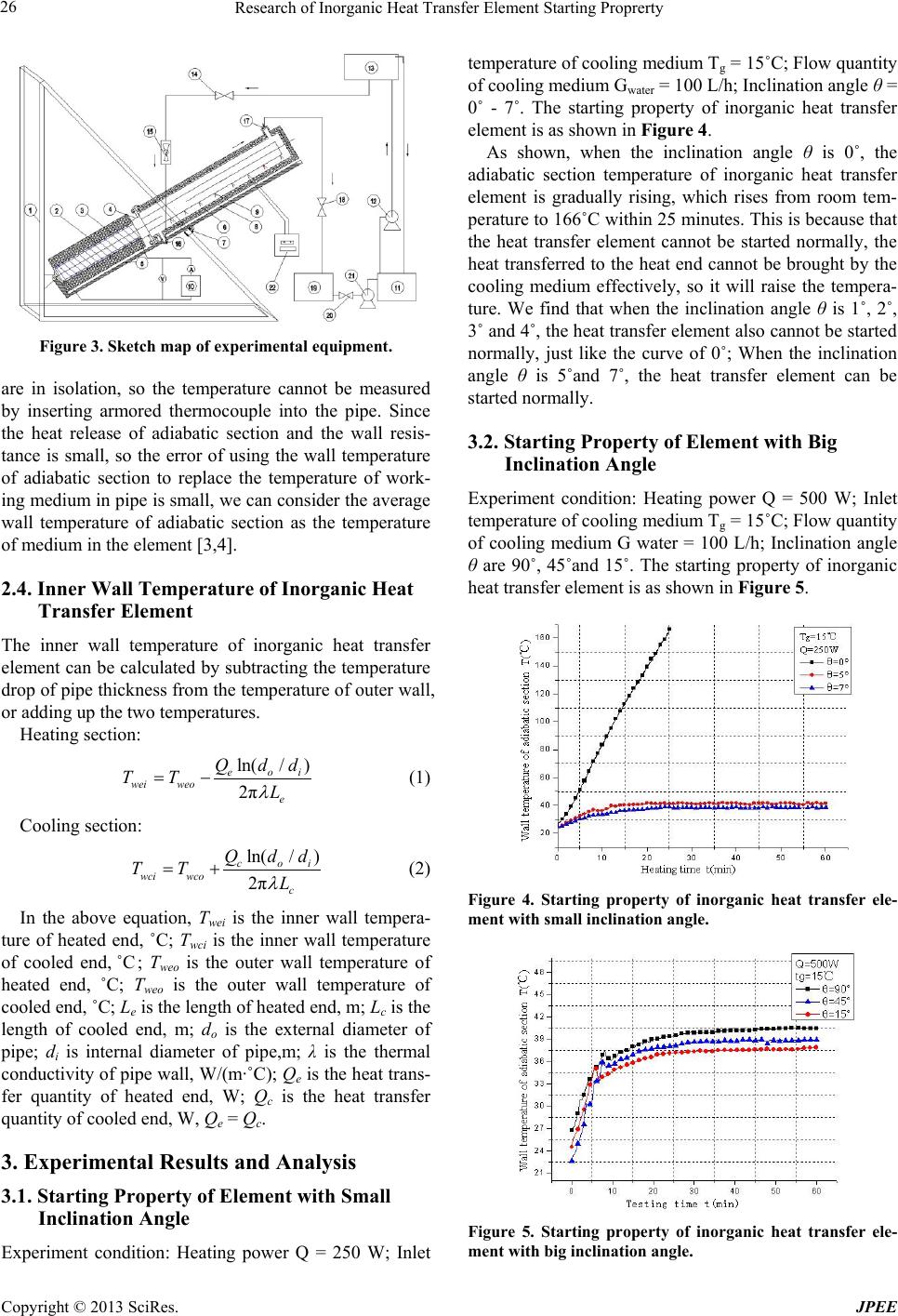 Research of Inorganic Heat Transfer Element Starting Proprerty Copyright © 2013 SciRes. JPEE 26 Figure 3. Sketch map of experimental equipment. are in isolation, so the temperature cannot be measured by inserting armored thermocouple into the pipe. Since the heat release of adiabatic section and the wall resis- tance is small, so the error of using the wall temperature of adiabatic section to replace the temperature of work- ing medium in pipe is small, we can consider the average wall temperature of adiabatic section as the temperature of medium in the element [3,4]. 2.4. Inner Wall Temperatu re of Inorganic Heat Transfer Element The inner wall temperature of inorganic heat transfer element can be calculated by subtracting the temperature drop of pipe thickness from the temperature of outer wall, or adding up the two temperatures. Heating section: ln(/ ) 2π e oi wei weoe Q dd TT L λ = − (1) Cooling section: ln(/ ) 2π c oi wci wcoc Q dd TT L λ = + (2) In the above equation, Twei is the inner wall tempera- ture of heated end, ˚C; Twci is the inner wall temperature of cooled end, ˚C ; Tweo is the outer wall temperature of heated end, ˚C; Tweo is the outer wall temperature of cooled end, ˚C; Le is the length of heated end, m; Lc is the length of cooled end, m; do is the external diameter of pipe; di is internal diameter of pipe,m; λ is the thermal conductivity of pipe wall, W /(m∙˚C); Qe is the heat trans- fer quantity of heated end, W; Qc is the heat transfer quantity of cooled end, W, Qe = Qc. 3. Experimental Results and Analysis 3.1. Starting Property of Element with Small Inclination Angle Experiment condition: Heating power Q = 250 W; Inlet temperature of cooling medium Tg = 15˚C; Flow quantity of cooling medium Gwater = 100 L/h; Inclination angle θ = 0˚ - 7˚. The starting property of inorganic heat transfer element is as shown in Figure 4. As shown, when the inclination angle θ is 0˚, the adiabatic section temperature of inorganic heat transfer element is gradually rising, which rises from room tem- perature to 166˚C within 25 minutes. This is because that the heat transfer element cannot be started normally, the heat transferred to the heat end cannot be brought by the cooling medium effectively, so it will raise the tempera- ture. We find that when the inclination angle θ is 1˚, 2˚, 3˚ and 4˚, the heat transfer element also cannot be started normally, just like the curve of 0˚; When the inclination angle θ is 5˚and 7˚, the heat transfer element can be started normally. 3.2. Starting Property of Element with Big Inclination Angle Experiment condition: Heating power Q = 500 W; Inlet temperature of cooling medium Tg = 15˚C; Flow quantity of cooling medium G water = 100 L/h; Inclination angle θ are 90˚, 45˚and 15˚. The starting property of inorganic heat transfer element is as shown in Figure 5. Figure 4. Starting property of inorganic heat transfer ele- ment with small inclination angle. Figure 5. Starting property of inorganic heat transfer ele- ment with big inclination angle. 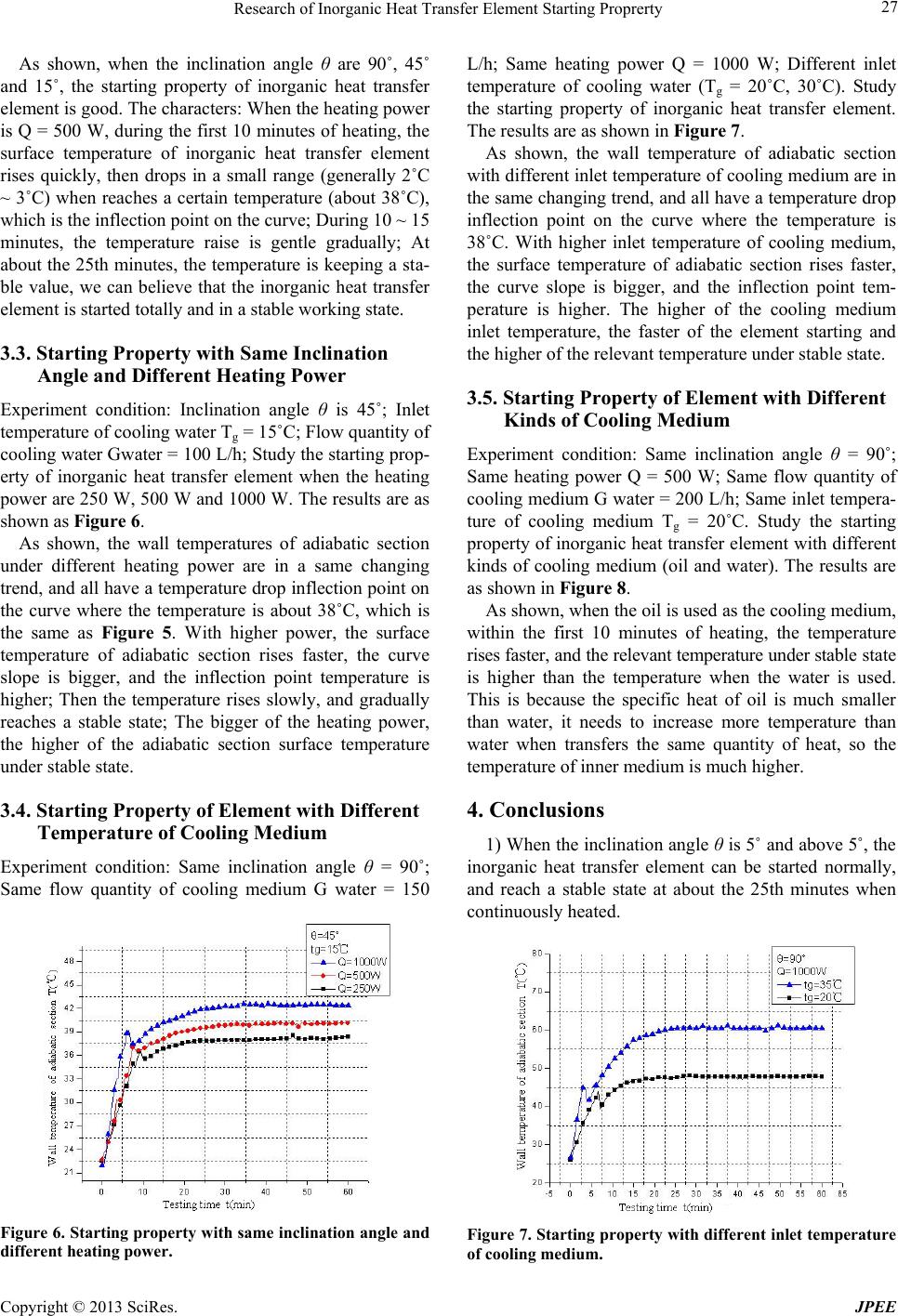 Research of Inorganic Heat Transfer Element Starting Proprerty Copyright © 2013 SciRes. JPEE 27 As shown, when the inclination angle θ are 90˚, 45˚ and 15˚, the starting property of inorganic heat transfer element is good. The characters: When the heating power is Q = 500 W, during the first 10 minutes of heating, the surface temperature of inorganic heat transfer element rises quickly, then drops in a small range (generally 2˚C ~ 3˚C) when reaches a certain temperature (about 38˚C), which is the inflection po int on the curve; During 10 ~ 15 minutes, the temperature raise is gentle gradually; At about the 25th minutes, the temperature is keeping a sta- ble value, we can believe that the inorganic heat transfer element is started totally and in a stable working state. 3.3. Starting Property with Same Inclination Angle and Different Heating P ower Experiment condition: Inclination angle θ is 45˚; Inlet temperature of cooling water T g = 15˚C; Flow quantity of cooling water Gwater = 100 L/h; Study the star ting prop- erty of inorganic heat transfer element when the heating power are 250 W, 500 W and 1000 W. The results are as shown as Figure 6. As shown, the wall temperatures of adiabatic section under different heating power are in a same changing trend, and all have a temperature drop inflection point on the curve where the temperature is about 38˚C, which is the same as Figure 5. With higher power, the surface temperature of adiabatic section rises faster, the curve slope is bigger, and the inflection point temperature is higher; Then the temperature rises slowly, and gradually reaches a stable state; The bigger of the heating power, the higher of the adiabatic section surface temperature under stable state. 3.4. Starting Property of Element with Different Temperature of Cooling Medium Experiment condition: Same inclination angle θ = 90˚; Same flow quantity of cooling medium G water = 150 Figure 6. Starting property with same inclination angle and differe nt heating power . L/h; Same heating power Q = 1000 W; Different inlet temperature of cooling water (Tg = 20˚C, 30˚C). Study the starting property of inorganic heat transfer element. The results are as shown in Figure 7. As shown, the wall temperature of adiabatic section with different inlet te mperature of cooling med ium are in the same changing trend, and all have a temperature drop inflection point on the curve where the temperature is 38˚C. With higher inlet temperature of cooling medium, the surface temperature of adiabatic section rises faster, the curve slope is bigger, and the inflection point tem- perature is higher. The higher of the cooling medium inlet temperature, the faster of the element starting and the higher of the relevant temperature under stable state. 3.5. Starting Property of Element with Different Kinds of Cooling Medium Experiment condition: Same inclination angle θ = 90˚; Same heating power Q = 500 W; Same flow quantity of cooling medium G water = 200 L/h; Same inlet tempera- ture of cooling medium Tg = 20˚C. Study the starting property of inorganic heat transfer element with different kinds of cooling medium (oil and water). The results are as shown in Figure 8. As shown, when the oil is used as the cooling medium, within the first 10 minutes of heating, the temperature rises faster, and the relevant temperature u nder stable state is higher than the temperature when the water is used. This is because the specific heat of oil is much smaller than water, it needs to increase more temperature than water when transfers the same quantity of heat, so the temperature of inner medium is much higher. 4. Conclusions 1) When the inclination angle θ is 5˚ and abo ve 5˚, the inorganic heat transfer element can be started normally, and reach a stable state at about the 25th minutes when continuously hea te d. Figure 7. Starting property with different inlet temperature of cooling medium. 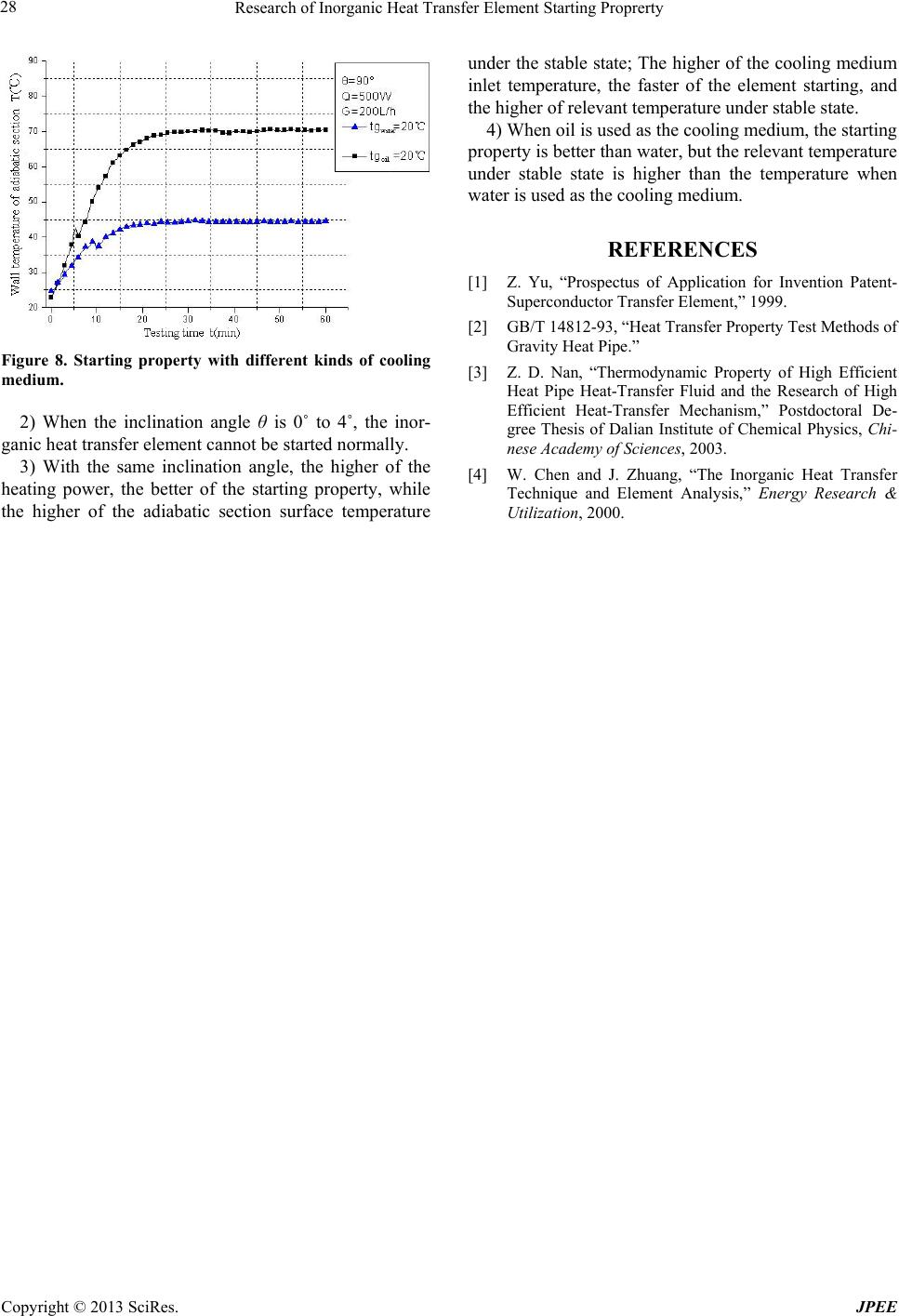 Research of Inorganic Heat Transfer Element Starting Proprerty Copyright © 2013 SciRes. JPEE 28 Figure 8. Starting property with different kinds of cooling medium. 2) When the inclination angle θ is 0˚ to 4˚, the inor- ganic heat transfer element cannot be started normally. 3) With the same inclination angle, the higher of the heating power, the better of the starting property, while the higher of the adiabatic section surface temperature under the stable state; The higher of the cooling medium inlet temperature, the faster of the element starting, and the higher of relevant temperature under stable state. 4) When oil is used as the cooling medium, the starting property is better than water, but the relevant temperature under stable state is higher than the temperature when water is used as the cooling medium. REFERENCES [1] Z. Yu, “Prospectus of Application for Invention Patent- Superconductor Transfer Element,” 1999. [2] GB/T 14812-93, “Heat Transfer Property Test Methods of Gravity Heat Pipe.” [3] Z. D. Nan, “Thermodynamic Property of High Efficient Heat Pipe Heat-Transfer Fluid and the Research of High Efficient Heat-Transfer Mechanism,” Postdoctoral De- gree Thesis of Dalian Institute of Chemical Physics, Chi- nese Academy of Sciences, 2003. [4] W. Chen and J. Zhuang, “The Inorganic Heat Transfer Technique and Element Analysis,” Energy Research & Utilization, 2000. |