

Paper Menu >>
Journal Menu >>
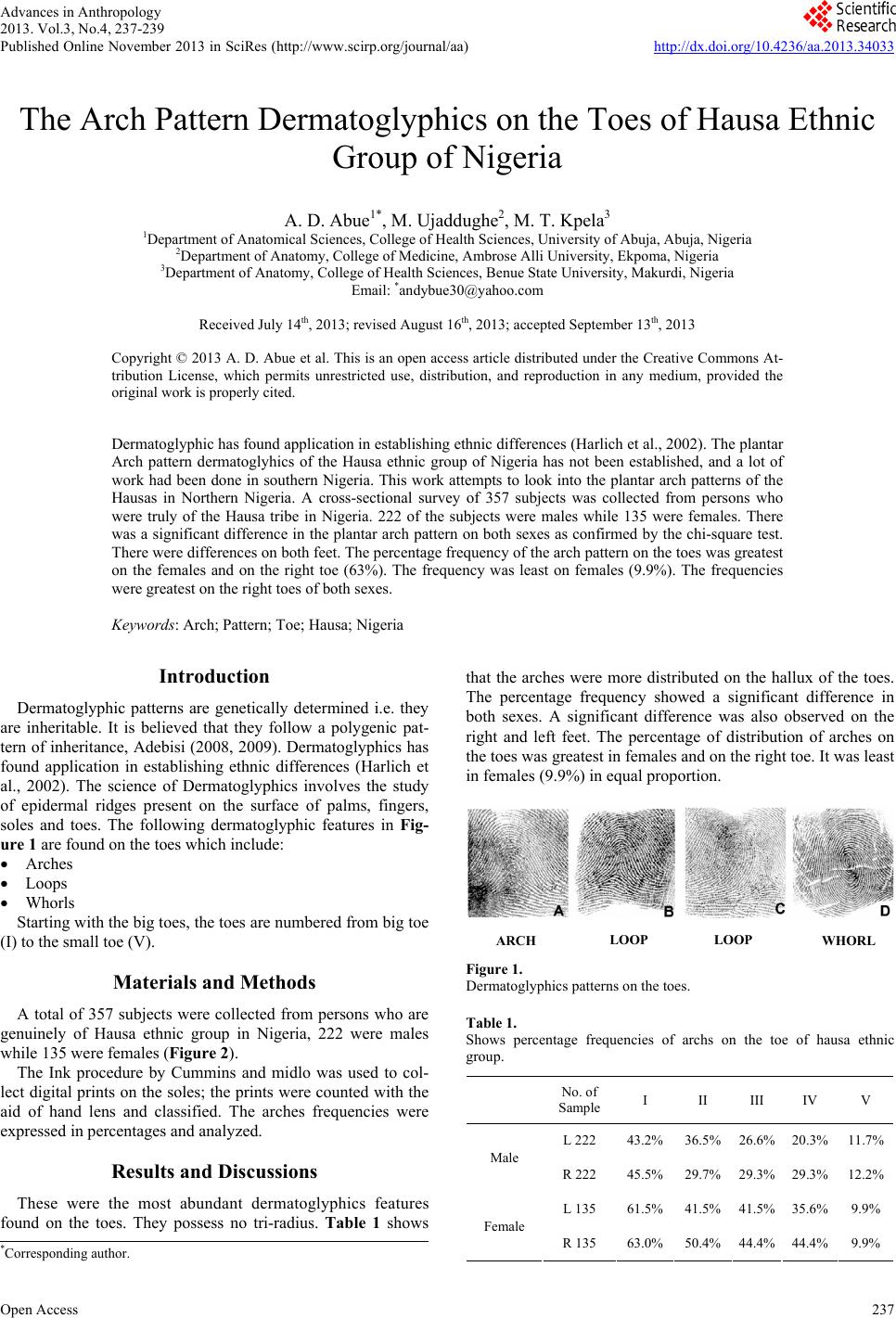 Advances in Anthropology 2013. Vol.3, No.4, 237-239 Published Online November 2013 in SciRes (http://www.scirp.org/journal/aa) http://dx.doi.org/10.4236/aa.2013.34033 Open Access 237 The Arch Pattern Dermatoglyphics on the Toes of Hausa Ethnic Group of Nigeria A. D. Abue1*, M. Ujaddughe2, M. T. Kpela3 1Department of Anatomical Sciences, College of Health Sciences, University of Abuja, Abuja, Nigeria 2Department of Anatomy, College of Medicine, Ambrose Alli University, Ekpoma, Nigeria 3Department of Anatomy, College of Health Sciences, Benue State University, Makurdi, Nigeria Email: *[email protected] Received July 14th, 2013; revised August 16th, 2013; accepted September 13th, 2013 Copyright © 2013 A. D. Abue et al. This is an open access article distributed under the Creative Commons At- tribution License, which permits unrestricted use, distribution, and reproduction in any medium, provided the original work is properly cited. Dermatoglyphic has found application in establishing ethnic differences (Harlich et al., 2002). The plantar Arch pattern dermatoglyhics of the Hausa ethnic group of Nigeria has not been established, and a lot of work had been done in southern Nigeria. This work attempts to look into the plantar arch patterns of the Hausas in Northern Nigeria. A cross-sectional survey of 357 subjects was collected from persons who were truly of the Hausa tribe in Nigeria. 222 of the subjects were males while 135 were females. There was a significant difference in the plantar arch pattern on both sexes as confirmed by the chi-square test. There were differences on both feet. The percentage frequency of the arch pattern on the toes was greatest on the females and on the right toe (63%). The frequency was least on females (9.9%). The frequencies were greatest on the right toes of both sexes. Keywords: Arch; Pattern; Toe; Hausa; Nigeria Introduction Dermatoglyphic patterns are genetically determined i.e. they are inheritable. It is believed that they follow a polygenic pat- tern of inheritance, Adebisi (2008, 2009). Dermatoglyphics has found application in establishing ethnic differences (Harlich et al., 2002). The science of Dermatoglyphics involves the study of epidermal ridges present on the surface of palms, fingers, soles and toes. The following dermatoglyphic features in Fig- ure 1 are found on the toes which include: Arches Loops Whorls Starting with the big toes, the toes are numbered from big toe (I) to the small toe (V). Materials and Methods A total of 357 subjects were collected from persons who are genuinely of Hausa ethnic group in Nigeria, 222 were males while 135 were females (Figure 2). The Ink procedure by Cummins and midlo was used to col- lect digital prints on the soles; the prints were counted with the aid of hand lens and classified. The arches frequencies were expressed in percentages and analyzed. Results and Discussions These were the most abundant dermatoglyphics features found on the toes. They possess no tri-radius. Table 1 shows that the arches were more distributed on the hallux of the toes. The percentage frequency showed a significant difference in both sexes. A significant difference was also observed on the right and left feet. The percentage of distribution of arches on the toes was greatest in females and on the right toe. It was least in females (9.9%) in equal proportion. ARCH LOOP LOOP WHORL Figure 1. Dermatoglyphics patterns on the toes. Table 1. Shows percentage frequencies of archs on the toe of hausa ethnic group. No. of Sample I II III IV V L 222 43.2%36.5% 26.6% 20.3%11.7% Male R 222 45.5%29.7% 29.3% 29.3%12.2% L 135 61.5%41.5% 41.5% 35.6%9.9% Female R 135 63.0%50.4% 44.4% 44.4%9.9% *Corresponding author. 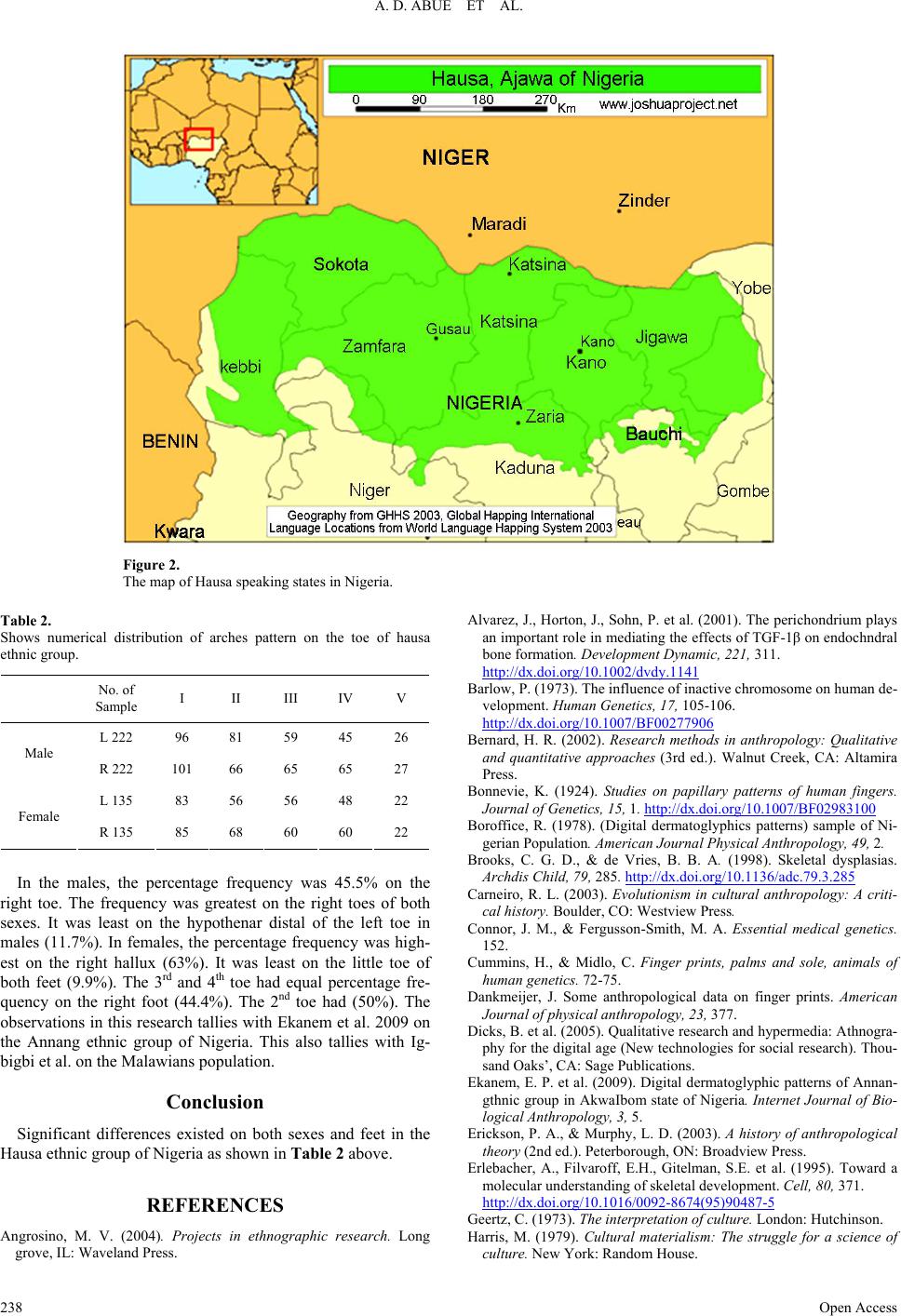 A. D. ABUE ET AL. Figure 2. The map of Hausa speaking states in Nigeria. Table 2. Shows numerical distribution of arches pattern on the toe of hausa ethnic group. No. of Sample I II III IV V L 222 96 81 59 45 26 Male R 222 101 66 65 65 27 L 135 83 56 56 48 22 Female R 135 85 68 60 60 22 In the males, the percentage frequency was 45.5% on the right toe. The frequency was greatest on the right toes of both sexes. It was least on the hypothenar distal of the left toe in males (11.7%). In females, the percentage frequency was high- est on the right hallux (63%). It was least on the little toe of both feet (9.9%). The 3rd and 4th toe had equal percentage fre- quency on the right foot (44.4%). The 2nd toe had (50%). The observations in this research tallies with Ekanem et al. 2009 on the Annang ethnic group of Nigeria. This also tallies with Ig- bigbi et al. on the Malawians population. Conclusion Significant differences existed on both sexes and feet in the Hausa ethnic group of Nigeria as shown in Table 2 above. REFERENCES Angrosino, M. V. (2004). Projects in ethnographic research. Long grove, IL: Waveland Press. Alvarez, J., Horton, J., Sohn, P. et al. (2001). The perichondrium plays an important role in mediating the effects of TGF-1β on endochndral bone formation. Develop m ent Dynamic, 221, 311. http://dx.doi.org/10.1002/dvdy.1141 Barlow, P. (1973). The influence of inactive chromosome on human de- velopment. Human Genetics, 17, 105-106. http://dx.doi.org/10.1007/BF00277906 Bernard, H. R. (2002). Research methods in anthropology: Qualitative and quantitative approaches (3rd ed.). Walnut Creek, CA: Altamira Press. Bonnevie, K. (1924). Studies on papillary patterns of human fingers. Journal of Genetics, 15, 1. http://dx.doi.org/10.1007/BF02983100 Boroffice, R. (1978). (Digital dermatoglyphics patterns) sample of Ni- gerian Population. American Jou r n a l Physical Anthropology, 49, 2. Brooks, C. G. D., & de Vries, B. B. A. (1998). Skeletal dysplasias. Archdis Child, 79, 285. http://dx.doi.org/10.1136/adc.79.3.285 Carneiro, R. L. (2003). Evolutionism in cultural anthropology: A criti- cal history. Boulder, CO: Westview Press. Connor, J. M., & Fergusson-Smith, M. A. Essential medical genetics. 152. Cummins, H., & Midlo, C. Finger prints, palms and sole, animals of human genetics. 72-75. Dankmeijer, J. Some anthropological data on finger prints. American Journal of physical anthropology, 23, 377. Dicks, B. et al. (2005). Qualitative research and hypermedia: Athnogra- phy for the digital age (New technologies for social research). Thou- sand Oaks’, CA: Sage Publications. Ekanem, E. P. et al. (2009). Digital dermatoglyphic patterns of Annan- gthnic group in AkwaIbom state of Nigeria. Internet Journal of Bio- logical Anthropology, 3, 5. Erickson, P. A., & Murphy, L. D. (2003). A history of anthropological theory (2nd ed.). Peterborough, ON: Broadview Press. Erlebacher, A., Filvaroff, E.H., Gitelman, S.E. et al. (1995). Toward a molecular understanding of skeletal development. Cell, 80, 371. http://dx.doi.org/10.1016/0092-8674(95)90487-5 Geertz, C. (1973). The interpretation of culture. London: Hutchinson. Harris, M. (1979). Cultural materialism: The struggle for a science of culture. New York: Random House. Open Access 238  A. D. ABUE ET AL. Holt, S. B. Genetics of dermal ridges. American Journal of Physical Anthropology, 42, 211-241. Igbigbi, P. S., & Didia, B. C. Plantar pattern of the Urhobos ethnic group of southern Nige ri a. Jantz, R. L. Sex and asymmetry of the finger ridge count. Annals of Human Biology, 5, 285. http://dx.doi.org/10.1080/03014467800002911 Jirasek, J. E. (2004). An atlas of human prenatal development mechan- ics. Anatomy and Staging, London and New York: Taylor & Francis. Komatz, Z., & Ohshiro, K. Hallucal ridge count in patients with kline- felter’s syndrome. Annals of Human Biology, 8, 171-174. Open Access 239 |