

Paper Menu >>
Journal Menu >>
 Journal of Power and Energy Engineering, 2013, 1, 73-76 http://dx.doi.org/10.4236/jpee.2013.15012 Published Online October 2013 (http://www.scirp.org/journal/jpee) Copyright © 2013 SciRes. JPEE 73 The Characteristics of the Evaporator/Evaporator for Direct Expansion Solar Assisted Heat Pump System Mingyan Zhu, Huanrong Xie, Biao Zhang, Xin Guan Institute of Energy and Power Engineering, University of Shanghai for Science and Technology, Shanghai, China. Email: [email protected] Received October 2013 ABSTRACT Direct expansion solar assisted heat pump (DX-SAHP) technology is developed by combining solar energy heat utiliza- tion with heat pump energy saving technology. The experimental researches of the DX-SAHP hot water system are conducted in this paper, and overall performance of DX-SAHP is analyzed with three different structures of collec- tors/evaporators, namely a bare-plate collector, a glass-plate collector and double collectors/evaporators (a bare-plate collector and a glass-plate collector). The influence factors and overall performance are studied, which show that the overall performance of the system is mainly influenced by solar irradiation intensity an d the collector area. Comparing with glass-plate collector in similar conditions, bare-plate collector system COP is higher. While increasing collector area is conducive to improve the system COP, but will reduce the collector efficiency and increase the workload of the compres s o r by c omparing the ba re -plate collector with double-plate collecto rs. Keywords: Direct Expansion Solar Assisted Heat Pump; Collector/Evaporator ; Experimental Research 1. Introduction Energy sources are widely utilized in many aspects with a high-speed human society development period. Solar energy is known as the renewable and “free” energy source, without doubt, it is the best choice to be a heat source of heat pump like the air source. In order to im- prove the heat pump COP, the idea of combining the heat pump with solar energy application system has been proposed and developed by many researchers around the world, which is the direct expansion solar assisted heat pump(DX-SAHP), the solar collector and the heat pump evaporator are installed into a single unit (collector/eva- porator), where the refrigerant is directly evaporated in the solar collector-evaporator by absorbing the solar energy (and/or ambient air energy) to undergo a phase transition from liquid to vapor. The DX-SAHP concept was first proposed by Sporm and Ambrose in 1955 [1]. Following their w ork, many theoretical and experimental studies (thermodynamic analysis, numerical simulation etc.) have been rep orted. Such as the United Sta tes Sporm S.K, Chaturvedi, M.P.O ‘Dell, Australian G.L. Morrison, Hawlader, Krakok and Lin in Japan, Huang BJ etc [1-8]. Chaturvedi conducted a theoretical analysis for several types of collectors/evaporators in 1979 and found that using the inexpensive bare-plate collector can have a high COP and collector efficiency, whether the capacity of the collector and the compressor capacity match or not, which directly affect system performance, in order to achieve higher COP and the collector efficiency, the col- lector/evaporation temperature should keep greater than ambient temperature at a range of 5˚C - 10˚C [3,4]. In order to solve the reliability problems, Shanghai Jiaotong University Guo Junjie studied two different evaporation areas and found that system’s reliability has improv ed by increasing the evaporation area in low-temperature con- ditions [9]. 2. Experimental System Device Introduction In order to investigate inf luence of collectors/ev aporators on thermal performance of DX-SAHP, we set up the DX-SAHP experimental equipment, which is shown in Figure 1. It mainly contains the solar energy collector/ evaporator, compressor, condenser, heat storage water tank, gas-liquid separator, filter drier and thermal expan- sion valve parts, and the structural parameters of the main components are as follows: 1) Solar collector/eva- porator: Sampux “PYT/L2.0-3” tablets of finned tube type collector/evaporator, two pieces of collectors/eva- porators (one is a bare-plate collector, the other is a glass-plate collector), both the collectors area are 2 m2, the valid heating area 1.87 m2; 2) Compressor: NJ6226Z type Hermetic reciprocating compressor, the rated power of 735 W; 3) condenser: “BL14-20D” type plate heat exchanger with heat transfer area of 0 .35 m2; 4) h eat sto- 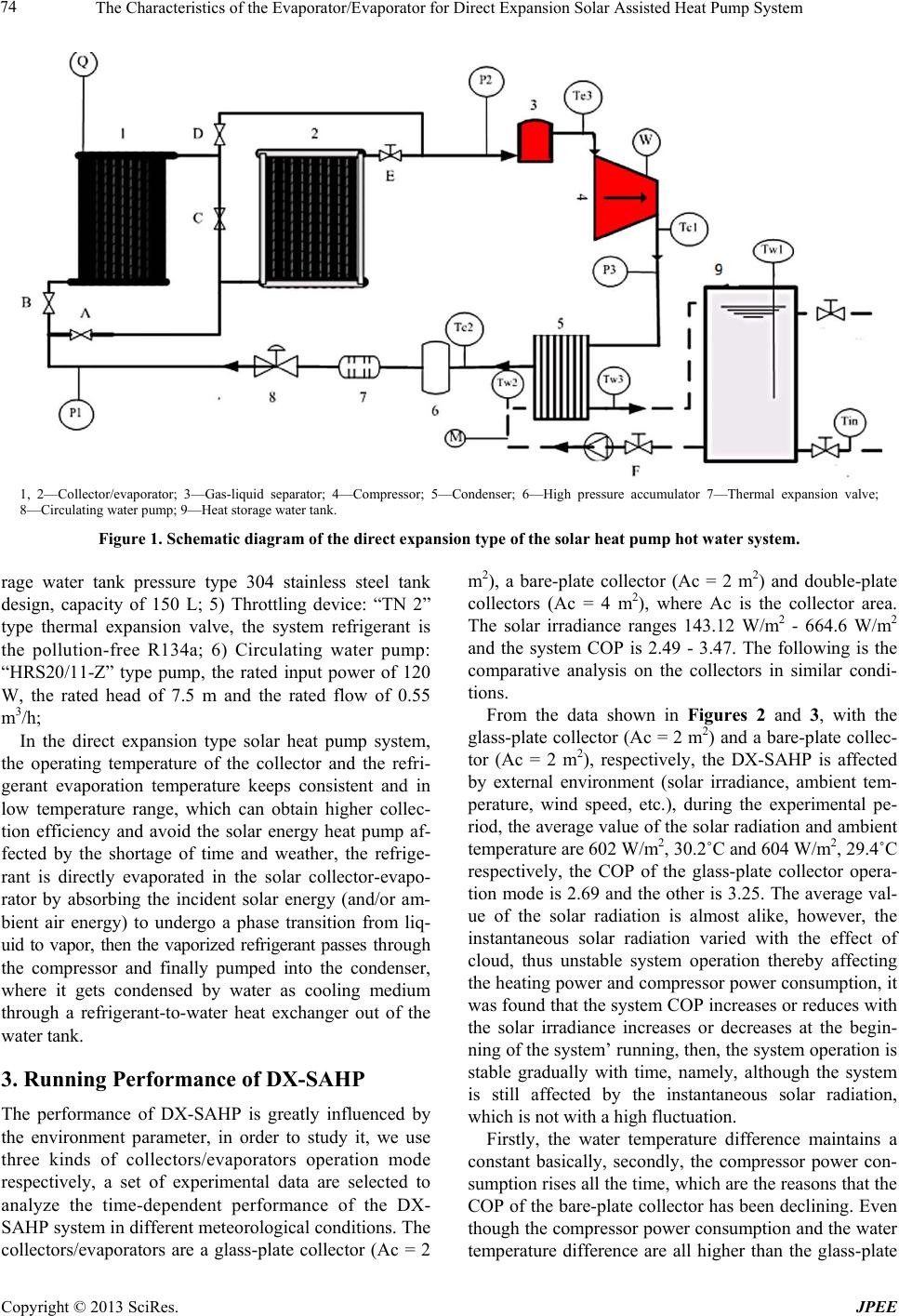 The Characteristics of the Evaporator/Evaporator for Direct Expansion Solar Assisted Heat Pump System Copyright © 2013 SciRes. JPEE 74 1, 2—Collector/evaporator; 3—Gas-liquid separator; 4—Compressor; 5—Condenser; 6—High pressure accumulator 7—Thermal expansion valve; 8—Circulating water pump; 9—Heat storage water tank. Figure 1. Schematic diagram of the direct expansion type of the solar heat pump hot water system. rage water tank pressure type 304 stainless steel tank design, capacity of 150 L; 5) Throttling device: “TN 2” type thermal expansion valve, the system refrigerant is the pollution-free R134a; 6) Circulating water pump: “HRS20/11-Z” type pump, the rated input power of 120 W, the rated head of 7.5 m and the rated flow of 0.55 m3/h; In the direct expansion type solar heat pump system, the operating temperature of the collector and the refri- gerant evaporation temperature keeps consistent and in low temperature range, which can obtain higher collec- tion efficiency and avoid the solar energy heat pump af- fected by the shortage of time and weather, the refrige- rant is directly evaporated in the solar collector-evapo- rator by absorbing the incident solar energy (and/or am- bient air energy) to undergo a phase transition from liq- uid to vapor, then the vaporized refrigerant passes through the compressor and finally pumped into the condenser, where it gets condensed by water as cooling medium through a refrigerant-to-water heat exchanger out of the water tank. 3. Running Performance of DX-SAHP The performance of DX-SAH P is greatly influenced by the environment parameter, in order to study it, we use three kinds of collectors/evaporators operation mode respectively, a set of experimental data are selected to analyze the time-dependent performance of the DX- SAHP system in different meteorological conditions. The collectors/evaporators are a glass-plate collector (Ac = 2 m2), a bare-plate collector (Ac = 2 m2) and double-plate collectors (Ac = 4 m2), where Ac is the collector area. The solar irradiance ranges 143.12 W/m2 - 664.6 W/m2 and the system COP is 2.49 - 3.47. The following is the comparative analysis on the collectors in similar condi- tions. From the data shown in Figures 2 and 3, with the glass-plate collector (Ac = 2 m2) and a bare-plate collec- tor (Ac = 2 m2), respectively, the DX-SAHP is affected by external environment (solar irradiance, ambient tem- perature, wind speed, etc.), during the experimental pe- riod, the average value of the solar radiation and ambient temperature are 602 W/m2, 30.2˚C and 604 W/m2, 29.4˚C respectively, the COP of the glass-plate collector opera- tion mode is 2.69 and the other is 3.25. The average val- ue of the solar radiation is almost alike, however, the instantaneous solar radiation varied with the effect of cloud, thus unstable system operation thereby affecting the heating power and compressor power consumption, it was found that the system COP increases or reduces with the solar irradiance increases or decreases at the begin- ning of the system’ running, then, the system operation is stable gradually with time, namely, although the system is still affected by the instantaneous solar radiation, which is not with a high fluctuation. Firstly, the water temperature difference maintains a constant basically, secondly, the compressor power con- sumption rises all the time, which are the reasons that the COP of the bare-plate collector has been declining. Even though the compressor power consumption and the water temperature difference are all higher than the glass-plate 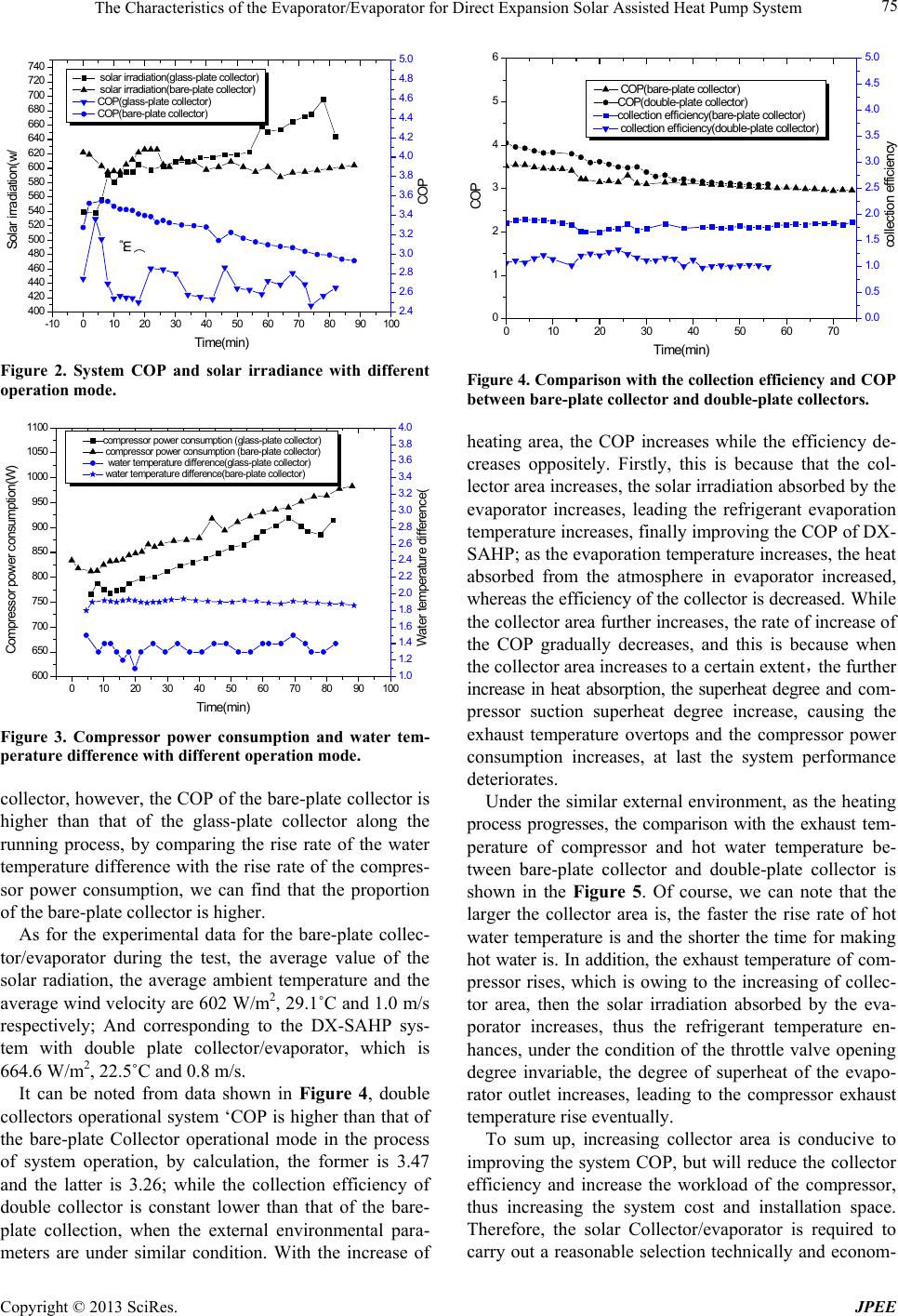 The Characteristics of the Evaporator/Evaporator for Direct Expansion Solar Assisted Heat Pum p Syste m Copyright © 2013 SciRes. JPEE 75 Figure 2. System COP and solar irradiance with different operation mode. Figure 3. Compressor power consumption and water tem- perature difference with different operation mode. collector, however, the COP of the bare-plate collector is higher than that of the glass-plate collector along the running process, by comparing the rise rate of the water temperature difference with the rise rate of the compres- sor power consumption, we can find that the proportion of the bare -plate collector is higher. As for the experimental data for the bare-plate collec- tor/evaporator during the test, the average value of the solar radiation, the average ambient temperature and the average wind velocity are 602 W/m2, 29.1˚C and 1.0 m/s respectively; And corresponding to the DX-SAHP sys- tem with double plate collector/evaporator, which is 664.6 W/m2, 22.5˚C and 0.8 m/s. It can be noted from data shown in Figure 4, double collectors operational sys tem ‘COP is higher than that of the bare-plate Collector operational mode in the process of system operation, by calculation, the former is 3.47 and the latter is 3.26; while the collection efficiency of double collector is constant lower than that of the bare- plate collection, when the external environmental para- meters are under similar condition. With the increase of Figure 4. Comparison with the collection efficiency and COP between bare-plate collector and double-plate collectors. heating area, the COP increases while the efficiency de- creases oppositely. Firstly, this is because that the col- lector area increases, the solar irradiation absorbed by the evaporator increases, leading the refrigerant evaporation temperature increases, finally improving the COP of DX- SAHP; as the evaporation temperature increases, the heat absorbed from the atmosphere in evaporator increased, whereas the efficien cy of the collector is decreased. While the collector area further increases, the rate of increase of the COP gradually decreases, and this is because when the collector area increases to a certain extent,the further increase in heat absorption, the superheat degree and com- pressor suction superheat degree increase, causing the exhaust temperature overtops and the compressor power consumption increases, at last the system performance deteriorates. Under the similar external environment, as the heating process progresses, the comparison with the exhaust tem- perature of compressor and hot water temperature be- tween bare-plate collector and double-plate collector is shown in the Figure 5. Of course, we can note that the larger the collector area is, the faster the rise rate of hot water temperature is and the shorter the time for making hot water is. In addition, the exhaust temperature of com- pressor rises, which is owing to the increasing of collec- tor area, then the solar irradiation absorbed by the eva- porator increases, thus the refrigerant temperature en- hances, under the condition of the throttle valve opening degree invariable, the degree of superheat of the evapo- rator outlet increases, leading to the compressor exhaust temperature rise eventually. To sum up, increasing collector area is conducive to improving the system COP, but will reduce the collector efficiency and increase the workload of the compressor, thus increasing the system cost and installation space. Therefore, the solar Collector/evaporator is required to carry out a reasonable selection technically and econom- -10 010 20 30 40 50 60 70 80 90100 400 420 440 460 480 500 520 540 560 580 600 620 640 660 680 700 720 740 solar irradiation(glass-plate collector) solar irradiation(bare-plate collector) COP(glass-plate collector) COP(bare-plate collector) Time( min) Solar irradiation(w/ ㎡ ) 2.4 2.6 2.8 3.0 3.2 3.4 3.6 3.8 4.0 4.2 4.4 4.6 4.8 5.0 COP 010 20 30 40 50 60 70 80 90100 600 650 700 750 800 850 900 950 1000 1050 1100 compressor power consumption (glass-plate collector) compressor power consumption (bare-plate collector) water temperature difference(glass-plate collector) water temperature difference(bare-plate collector) Time( min) Com pressor power consumption(W) 1.0 1.2 1.4 1.6 1.8 2.0 2.2 2.4 2.6 2.8 3.0 3.2 3.4 3.6 3.8 4.0 W ater temperature difference( 010 20 30 40 50 60 70 0 1 2 3 4 5 6 CO P(bare-plate collector) CO P(double-plate collector) collection efficiency(bare-plate collector) collection efficiency(double-plate collector) Time(min) COP 0.0 0.5 1.0 1.5 2.0 2.5 3.0 3.5 4.0 4.5 5.0 collection efficiency 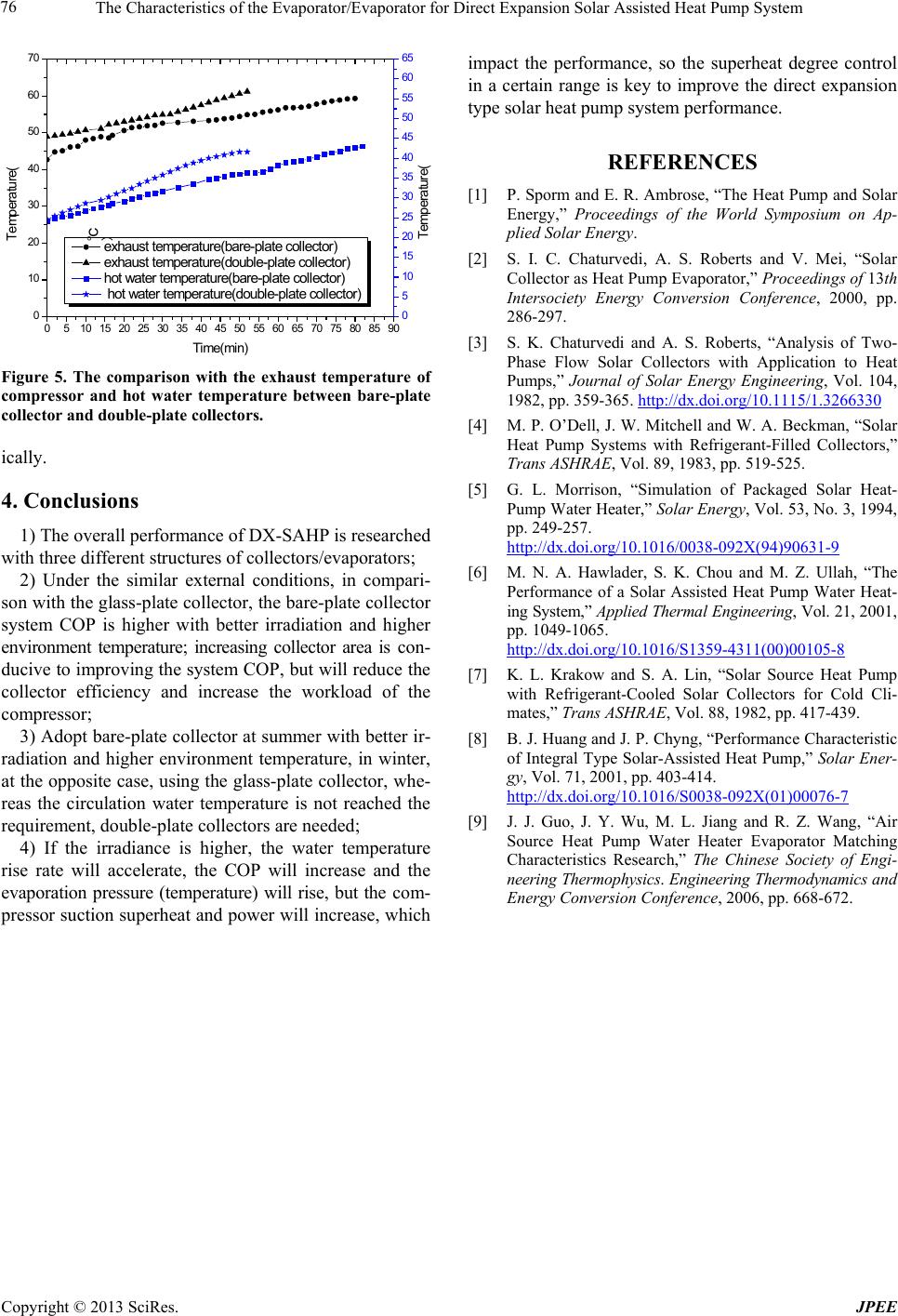 The Characteristics of the Evaporator/Evaporator for Direct Expansion Solar Assisted Heat Pump System Copyright © 2013 SciRes. JPEE 76 Figure 5. The comparison with the exhaust temperature of compressor and hot water temperature between bare-plate collector an d dou ble-plate collectors. ically. 4. Conclusions 1) The overall performance of DX-SAHP is researched with three different structures of collector s /evapor a tors; 2) Under the similar external conditions, in compari- son with the glass-plate collector, the bare-plate collector system COP is higher with better irradiation and higher environment temperature; increasing collector area is con- ducive to improving the system COP, but will reduce the collector efficiency and increase the workload of the compressor; 3) Adopt bare-plate collector at summer with better ir- radiation and higher environment temperature, in winter, at the opposite case, using the glass-plate collector, whe- reas the circulation water temperature is not reached the requirement, double-plate collectors are needed; 4) If the irradiance is higher, the water temperature rise rate will accelerate, the COP will increase and the evaporation pressure (temperature) will rise, but the com- pressor suction superheat and power will increase, which impact the performance, so the superheat degree control in a certain range is key to improve the direct expansion type solar heat pump system performance. REFERENCES [1] P. Sporm and E. R. Ambrose, “The Hea t Pump and Solar Energy,” Proceedings of the World Symposium on Ap- plied Solar Energy. [2] S. I. C. Chaturvedi, A. S. Roberts and V. Mei, “Solar Collector as Heat Pump Evaporator,” Proceedings of 13th Intersociety Energy Conversion Conference, 2000, pp. 286-297. [3] S. K. Chaturvedi and A. S. Roberts, “Analysis of Two- Phase Flow Solar Collectors with Application to Heat Pumps,” Journal of Solar Energy Engineering, Vol. 104, 1982, pp. 359-365. http://dx.doi.org/10.1115/1.3266330 [4] M. P. O’Dell, J. W. Mitchell and W. A. Beckman , “Solar Heat Pump Systems with Refrigerant-Filled Collectors,” Trans ASHRAE, Vol. 89, 1983, pp. 519-525. [5] G. L. Morrison, “Simulation of Packaged Solar Heat- Pump Water Heater,” Solar Energy, Vol. 53, No. 3, 1994, pp. 249-257. http://dx.doi.org/10.1016/0038-092X(94)90631-9 [6] M. N. A. Hawlader, S. K. Chou and M. Z. Ullah, “The Performance of a Solar Assisted Heat Pump Water Heat- ing Syst em,” Applied T hermal Enginee ring, Vol. 21, 2001, pp. 1049-1065. http://dx.doi.org/10.1016/S1359-4311(00)00105-8 [7] K. L. Krakow and S. A. Lin, “Solar Source Heat Pump with Refrigerant-Cooled Solar Collectors for Cold Cli- mates,” Trans ASHRAE, Vol. 88, 1982, pp. 417-439. [8] B. J. Huang and J. P. Chyng, “Performance Characteristic of Int egral Type Solar-Assisted Heat Pump,” Solar Ener- gy, Vol. 71, 2001, pp. 403-414. http://dx.doi.org/10.1016/S0038-092X(01)00076-7 [9] J. J. Guo, J. Y. Wu, M. L. Jiang and R. Z. Wang, “Air Source Heat Pump Water Heater Evaporator Matching Characteristics Research,” The Chinese Society of Engi- neering Thermop hysics. Engineering T hermodynamics and Energy Conversion Conference, 2006, pp. 668-672. 05 10 15 20 25 30 35 40 45 50 55 60 65 70 75 80 85 90 0 10 20 30 40 50 60 70 exhaust temperature(bare-plate collector) exhaust temperature(double-plate collector) hot water temperature(bare-plate collector) hot water temperature(double-plate collector) Time(min) Temperat ur e( ℃ ) 0 5 10 15 20 25 30 35 40 45 50 55 60 65 Tem perature( |