

Paper Menu >>
Journal Menu >>
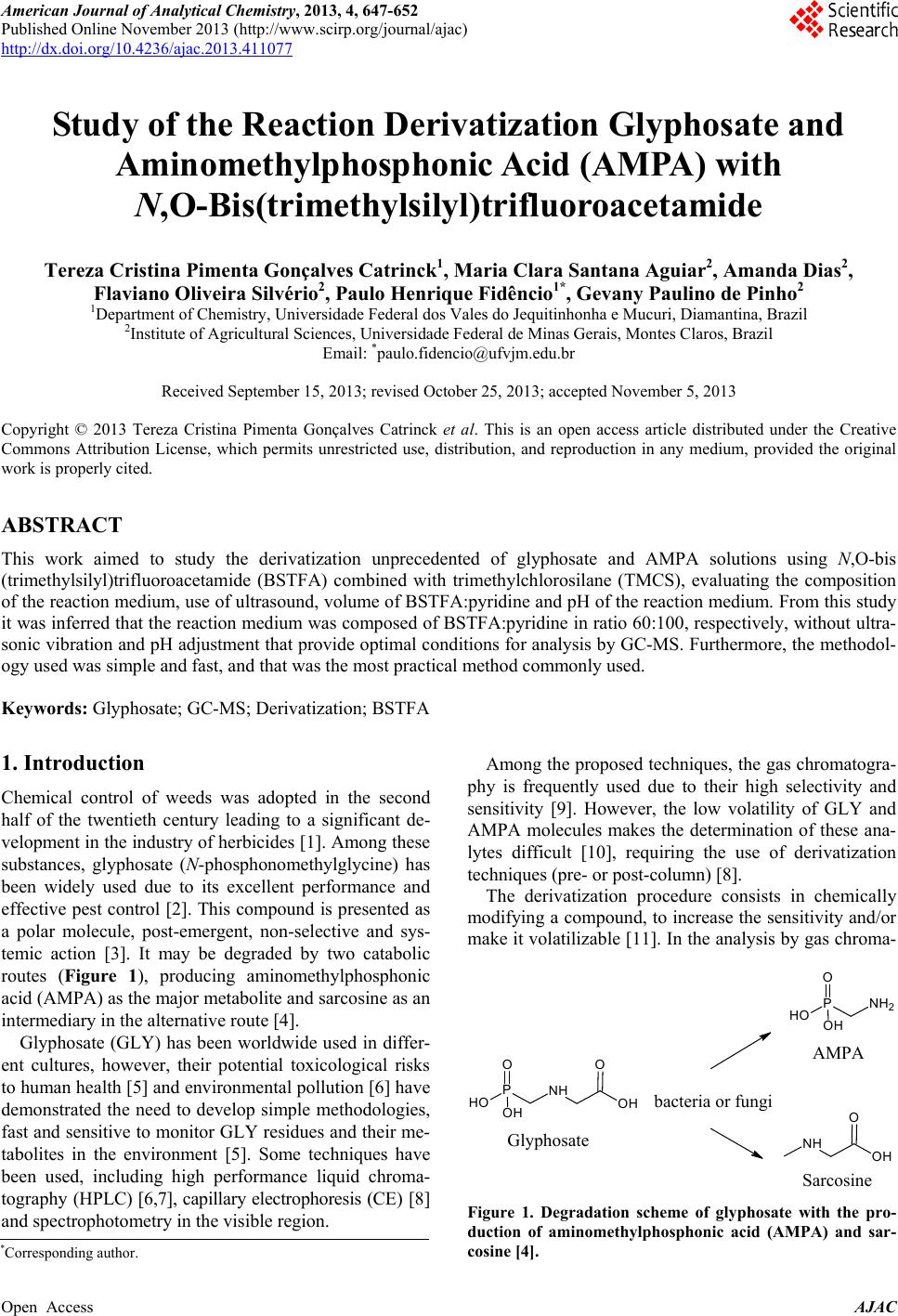 American Journal of Analytical Chemistry, 2013, 4, 647-652 Published Online November 2013 (http://www.scirp.org/journal/ajac) http://dx.doi.org/10.4236/ajac.2013.411077 Open Access AJAC Study of the Reaction Derivatization Glyphosate and Aminomethylphosphonic Acid (AMPA) with N,O-Bis(trimethylsilyl)trifluoroacetamide Tereza Cristina Pimenta Gonçalves Catrinck1, Maria Clara Santana Aguiar2, Amanda Dias2, Flaviano Oliveira Silvério2, Paulo Henrique Fidêncio1*, Gevany Paulino de Pinho2 1Department of Chemistry, Universidade Federal dos Vales do Jequitinhonha e Mucuri, Diamantina, Brazil 2Institute of Agricultural Sciences, Universidade Federal de Minas Gerais, Montes Claros, Brazil Email: *[email protected] Received September 15, 2013; revised October 25, 2013; accepted November 5, 2013 Copyright © 2013 Tereza Cristina Pimenta Gonçalves Catrinck et al. This is an open access article distributed under the Creative Commons Attribution License, which permits unrestricted use, distribution, and reproduction in any medium, provided the original work is properly cited. ABSTRACT This work aimed to study the derivatization unprecedented of glyphosate and AMPA solutions using N,O-bis (trimethylsilyl)trifluoroacetamide (BSTFA) combined with trimethylchlorosilane (TMCS), evaluating the composition of the reaction medium, use of ultrasound, volume of BSTFA:pyridine and pH of the reaction medium. From this study it was inferred that the reaction medium was composed of BSTFA:pyridine in ratio 60:100, respectively, without ultra- sonic vibration and pH adjustment that provide optimal conditions for analysis by GC-MS. Furthermore, the methodol- ogy used was simple and fast, and that was the most practical method commonly used. Keywords: Glyphosate; GC-MS; Derivatization; BSTFA 1. Introduction Chemical control of weeds was adopted in the second half of the twentieth century leading to a significant de- velopment in the industry of herbicides [1]. Among these substances, glyphosate (N-phosphonomethylglycine) has been widely used due to its excellent performance and effective pest control [2]. This compound is presented as a polar molecule, post-emergent, non-selective and sys- temic action [3]. It may be degraded by two catabolic routes (Figure 1), producing aminomethylphosphonic acid (AMPA) as the major metabolite and sarcosine as an intermediary in the alternative route [4]. Glyphosate (GLY) has been worldwide used in differ- ent cultures, however, their potential toxicological risks to human health [5] and environmental pollution [6] have demonstrated the need to develop simple methodologies, fast and sensitive to monitor GLY residues and their me- tabolites in the environment [5]. Some techniques have been used, including high performance liquid chroma- tography (HPLC) [6,7], capillary electrophoresis (CE) [8] and spectrophotometry in the visible region. Among the proposed techniques, the gas chromatogra- phy is frequently used due to their high selectivity and sensitivity [9]. However, the low volatility of GLY and AMPA molecules makes the determination of these ana- lytes difficult [10], requiring the use of derivatization techniques (pre- or post-column) [8]. The derivatization procedure consists in chemically modifying a compound, to increase the sensitivity and/or make it volatilizable [11]. In the analysis by gas chroma- PNH OH O O OH OH PNH2 O OH OH NH OH O AMPA Glyphosate Sarcosine bacteria or fungi Figure 1. Degradation scheme of glyphosate with the pro- duction of aminomethylphosphonic acid (AMPA) and sar- cosine [4]. *Corresponding author. 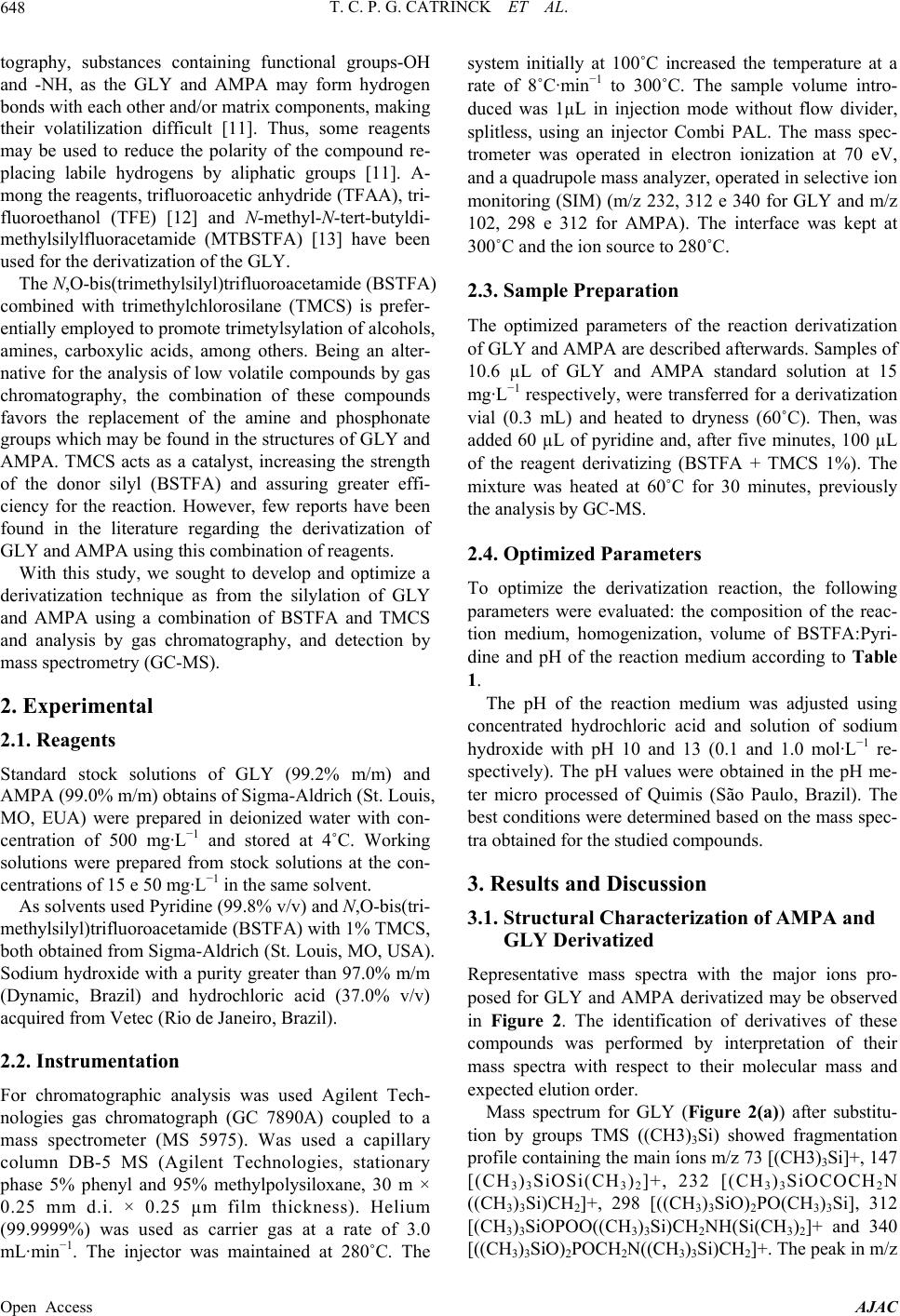 T. C. P. G. CATRINCK ET AL. 648 tography, substances containing functional groups-OH and -NH, as the GLY and AMPA may form hydrogen bonds with each other and/or matrix components, making their volatilization difficult [11]. Thus, some reagents may be used to reduce the polarity of the compound re- placing labile hydrogens by aliphatic groups [11]. A- mong the reagents, trifluoroacetic anhydride (TFAA), tri- fluoroethanol (TFE) [12] and N-methyl-N-tert-butyldi- methylsilylfluoracetamide (MTBSTFA) [13] have been used for the derivatization of the GLY. The N,O-bis(trimethylsilyl)trifluoroacetamide (BSTFA) combined with trimethylchlorosilane (TMCS) is prefer- entially employed to promote trimetylsylation of alcohols, amines, carboxylic acids, among others. Being an alter- native for the analysis of low volatile compounds by gas chromatography, the combination of these compounds favors the replacement of the amine and phosphonate groups which may be found in the structures of GLY and AMPA. TMCS acts as a catalyst, increasing the strength of the donor silyl (BSTFA) and assuring greater effi- ciency for the reaction. However, few reports have been found in the literature regarding the derivatization of GLY and AMPA using this combination of reagents. With this study, we sought to develop and optimize a derivatization technique as from the silylation of GLY and AMPA using a combination of BSTFA and TMCS and analysis by gas chromatography, and detection by mass spectrometry (GC-MS). 2. Experimental 2.1. Reagents Standard stock solutions of GLY (99.2% m/m) and AMPA (99.0% m/m) obtains of Sigma-Aldrich (St. Louis, MO, EUA) were prepared in deionized water with con- centration of 500 mg·L−1 and stored at 4˚C. Working solutions were prepared from stock solutions at the con- centrations of 15 e 50 mg·L−1 in the same solvent. As solvents used Pyridine (99.8% v/v) and N,O-bis(tri- methylsilyl)trifluoroacetamide (BSTFA) with 1% TMCS, both obtained from Sigma-Aldrich (St. Louis, MO, USA). Sodium hydroxide with a purity greater than 97.0% m/m (Dynamic, Brazil) and hydrochloric acid (37.0% v/v) acquired from Vetec (Rio de Janeiro, Brazil). 2.2. Instrumentation For chromatographic analysis was used Agilent Tech- nologies gas chromatograph (GC 7890A) coupled to a mass spectrometer (MS 5975). Was used a capillary column DB-5 MS (Agilent Technologies, stationary phase 5% phenyl and 95% methylpolysiloxane, 30 m × 0.25 mm d.i. × 0.25 µm film thickness). Helium (99.9999%) was used as carrier gas at a rate of 3.0 mL· mi n −1. The injector was maintained at 280˚C. The system initially at 100˚C increased the temperature at a rate of 8˚C·min −1 to 300˚C. The sample volume intro- duced was 1µL in injection mode without flow divider, splitless, using an injector Combi PAL. The mass spec- trometer was operated in electron ionization at 70 eV, and a quadrupole mass analyzer, operated in selective ion monitoring (SIM) (m/z 232, 312 e 340 for GLY and m/z 102, 298 e 312 for AMPA). The interface was kept at 300˚C and the ion source to 280˚C. 2.3. Sample Preparation The optimized parameters of the reaction derivatization of GLY and AMPA are described afterwards. Samples of 10.6 µL of GLY and AMPA standard solution at 15 mg· L −1 respectively, were transferred for a derivatization vial (0.3 mL) and heated to dryness (60˚C). Then, was added 60 µL of pyridine and, after five minutes, 100 µL of the reagent derivatizing (BSTFA + TMCS 1%). The mixture was heated at 60˚C for 30 minutes, previously the analysis by GC-MS. 2.4. Optimized Parameters To optimize the derivatization reaction, the following parameters were evaluated: the composition of the reac- tion medium, homogenization, volume of BSTFA:Pyri- dine and pH of the reaction medium according to Table 1. The pH of the reaction medium was adjusted using concentrated hydrochloric acid and solution of sodium hydroxide with pH 10 and 13 (0.1 and 1.0 mol·L−1 re- spectively). The pH values were obtained in the pH me- ter micro processed of Quimis (São Paulo, Brazil). The best conditions were determined based on the mass spec- tra obtained for the studied compounds. 3. Results and Discussion 3.1. Structural Characterization of AMPA and GLY Derivatized Representative mass spectra with the major ions pro- posed for GLY and AMPA derivatized may be observed in Figure 2. The identification of derivatives of these compounds was performed by interpretation of their mass spectra with respect to their molecular mass and expected elution order. Mass spectrum for GLY (Figure 2(a)) after substitu- tion by groups TMS ((CH3)3Si) showed fragmentation profile containing the main íons m/z 73 [(CH3)3Si]+, 147 [(CH3)3SiOSi(CH3)2]+, 232 [(CH3)3SiOCOCH2N ((CH3)3Si)CH2]+, 298 [((CH3)3SiO)2PO(CH3)3Si], 312 [(CH3)3SiOPOO((CH3)3Si)CH2NH(Si(CH3)2]+ and 340 [((CH3)3SiO)2POCH2N((CH3)3Si)CH2]+. The peak in m/z Open Access AJAC 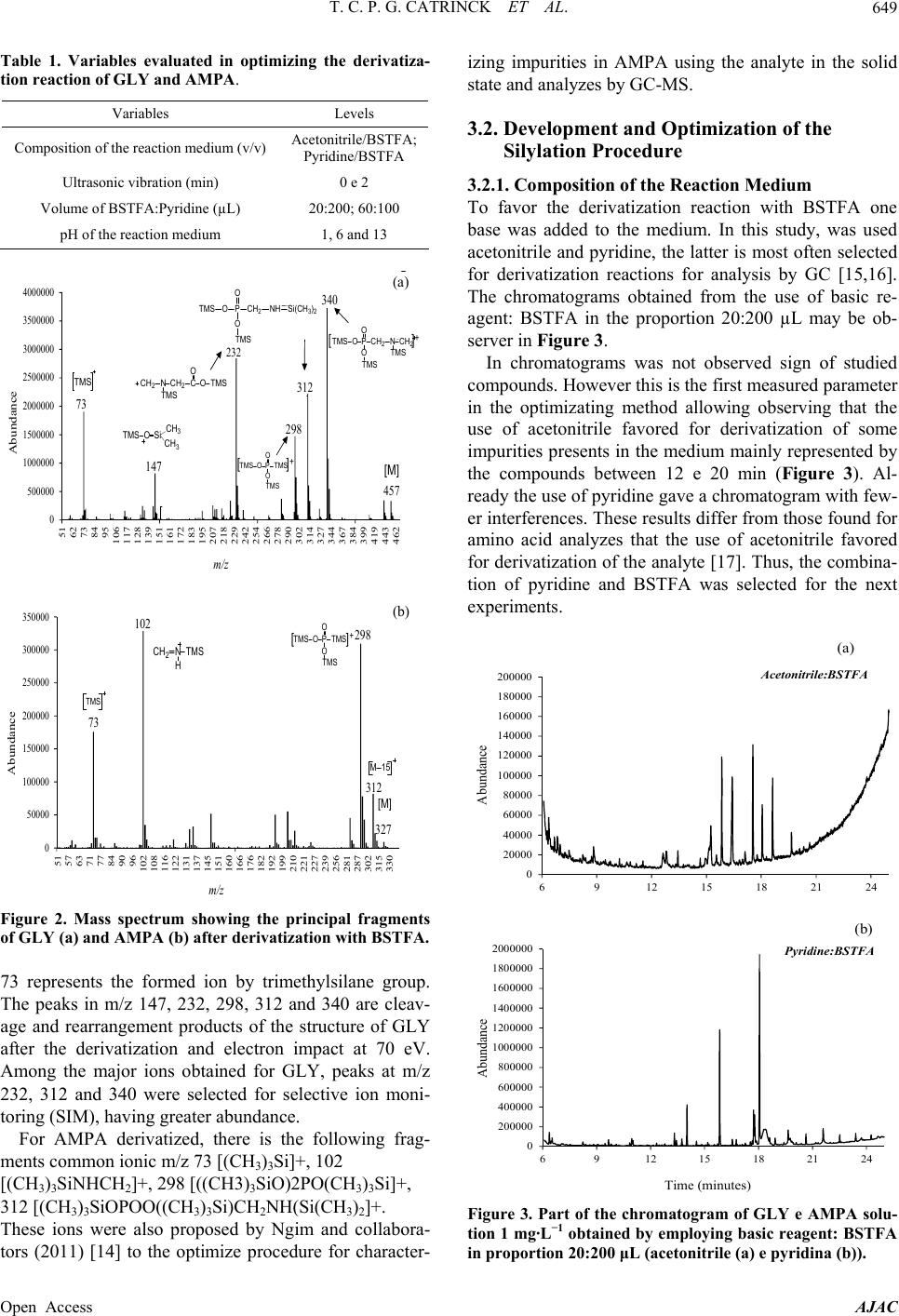 T. C. P. G. CATRINCK ET AL. 649 Table 1. Variables evaluated in optimizing the derivatiza- tion reaction of GLY and AMPA. Variables Levels Composition of the reaction medium (v/v) Acetonitrile/BSTFA; Pyridine/BSTFA Ultrasonic vibration (min) 0 e 2 Volume of BSTFA:Pyridine (µL) 20:200; 60:100 pH of the reaction medium 1, 6 and 13 [ ] + 0 50000 100000 150000 200000 250000 300000 350000 51 57 63 71 77 84 90 96 102 108 116 122 131 137 145 151 160 166 176 182 192 199 210 221 227 239 256 281 287 302 315 330 m/ z Abundance 73 312 298 102 CH 2 NTMS H TMS O P O OTMS TMS TMS M15 0 500000 1000000 1500000 2000000 2500000 3000000 3500000 4000000 51 62 73 84 95 106 117 128 139 151 161 172 183 195 207 218 229 242 254 266 278 290 302 314 327 344 367 384 399 419 443 462 m/z Abundance 73 232 340 312 298 147 TMS TMS O P O OTMS TMS TMS O SiCH 3 CH 3 CH 2 N TMS CH 2 CO OTMS TMS O P OCH 2 O TMS N TMS CH 2 TMS O PCH 2 O O NH TMS Si(CH 3 ) 2 B [ [ ] + 457 327 [M] [M] [ ] + A (a) (b) Figure 2. Mass spectrum showing the principal fragments of GLY (a) and AMPA (b) after derivatization with BSTFA. 73 represents the formed ion by trimethylsilane group. The peaks in m/z 147, 232, 298, 312 and 340 are cleav- age and rearrangement products of the structure of GLY after the derivatization and electron impact at 70 eV. Among the major ions obtained for GLY, peaks at m/z 232, 312 and 340 were selected for selective ion moni- toring (SIM), having greater abundance. For AMPA derivatized, there is the following frag- ments common ionic m/z 73 [(CH3)3Si]+, 102 [(CH3)3SiNHCH2]+, 298 [((CH3)3SiO)2PO(CH3)3Si]+, 312 [(CH3)3SiOPOO((CH3)3Si)CH2NH(Si(CH3)2]+. These ions were also proposed by Ngim and collabora- tors (2011) [14] to the optimize procedure for character- izing impurities in AMPA using the analyte in the solid state and analyzes by GC-MS. 3.2. Development and Optimization of the Silylation Procedure 3.2.1. Composition of the Reaction Medium To favor the derivatization reaction with BSTFA one base was added to the medium. In this study, was used acetonitrile and pyridine, the latter is most often selected for derivatization reactions for analysis by GC [15,16]. The chromatograms obtained from the use of basic re- agent: BSTFA in the proportion 20:200 µL may be ob- server in Figure 3. In chromatograms was not observed sign of studied compounds. However this is the first measured parameter in the optimizating method allowing observing that the use of acetonitrile favored for derivatization of some impurities presents in the medium mainly represented by the compounds between 12 e 20 min (Figure 3). Al- ready the use of pyridine gave a chromatogram with few- er interferences. These results differ from those found for amino acid analyzes that the use of acetonitrile favored for derivatization of the analyte [17]. Thus, the combina- tion of pyridine and BSTFA was selected for the next experiments. 0 20000 40000 60000 80000 100000 120000 140000 160000 180000 200000 6912 15 18 21 24 0 200000 400000 600000 800000 1000000 1200000 1400000 1600000 1800000 2000000 6912 15 18 21 24 Acetonitrile:BSTFA Pyridine:BSTFA Time (minutes) Abundance Abundance A B (a) (b) Figure 3. Part of the chromatogram of GLY e AMPA solu- tion 1 mg·L−1 obtained by employing basic reagent: BSTFA in proportion 20:200 μL (acetonitrile (a) e pyridina (b)). Open Access AJAC 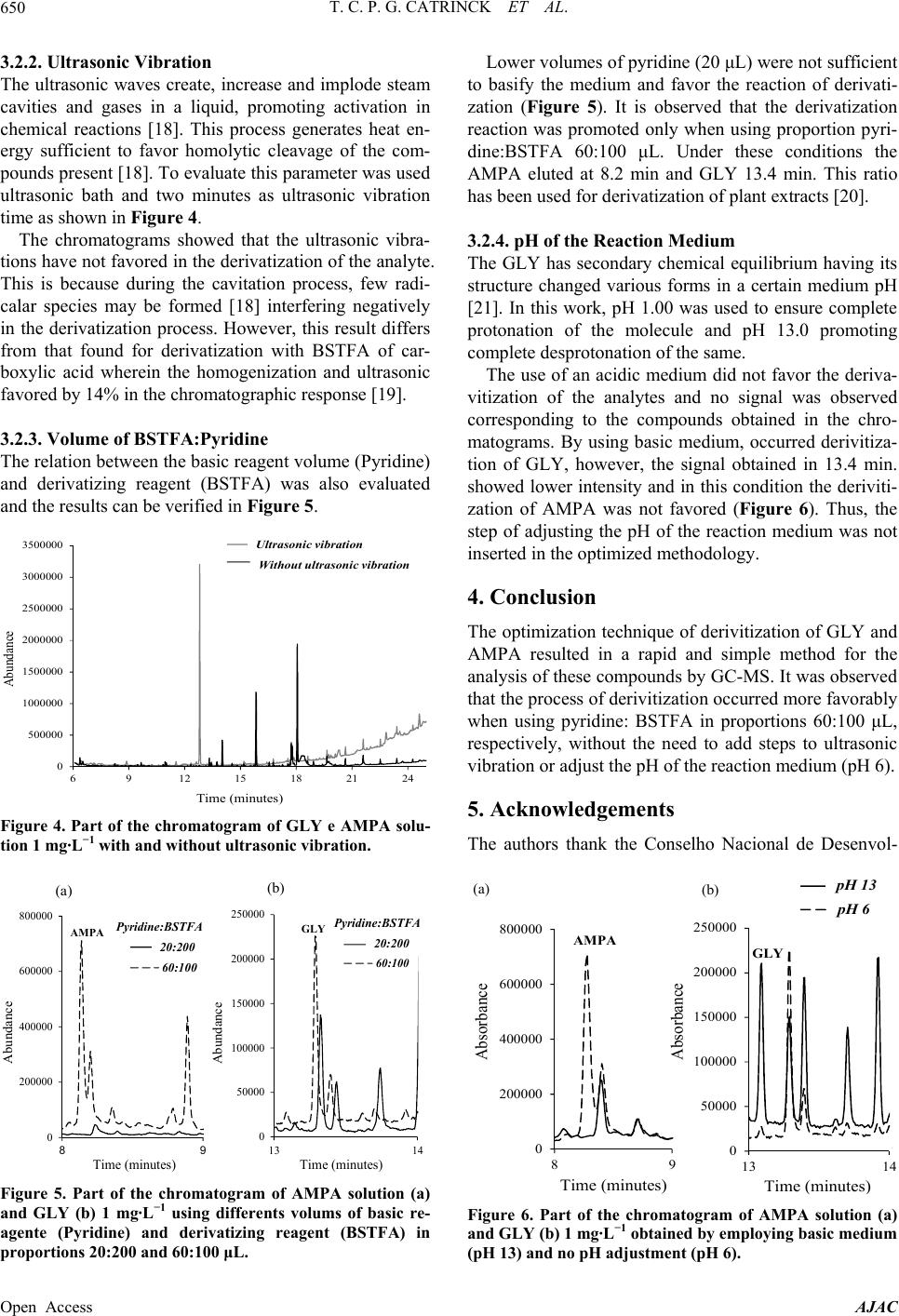 T. C. P. G. CATRINCK ET AL. 650 3.2.2. Ultrasonic Vibration The ultrasonic waves create, increase and implode steam cavities and gases in a liquid, promoting activation in chemical reactions [18]. This process generates heat en- ergy sufficient to favor homolytic cleavage of the com- pounds present [18]. To evaluate this parameter was used ultrasonic bath and two minutes as ultrasonic vibration time as shown in Figure 4. The chromatograms showed that the ultrasonic vibra- tions have not favored in the derivatization of the analyte. This is because during the cavitation process, few radi- calar species may be formed [18] interfering negatively in the derivatization process. However, this result differs from that found for derivatization with BSTFA of car- boxylic acid wherein the homogenization and ultrasonic favored by 14% in the chromatographic response [19]. 3.2.3. Volume of BSTFA:Pyridine The relation between the basic reagent volume (Pyridine) and derivatizing reagent (BSTFA) was also evaluated and the results can be verified in Figure 5. 0 500000 1000000 1500000 2000000 2500000 3000000 3500000 6912 15 18 21 24 Série1 Série2 Ultras onic vib ration Without u ltras onic vib ratio n Time ( minutes ) Abundance Figure 4. Part of the chromatogram of GLY e AMPA solu- tion 1 mg·L−1 with and without ultrasonic vibration. 0 200000 400000 600000 800000 89 60:200 60:100 Time (minutes) AMPA Abundance Pyridine:BSTFA 20:200 0 50000 100000 150000 200000 250000 13 14 60:200 60:100 Time (minutes) GLY Abundance Pyridine:BSTFA 20:200 AB (b) (a) Figure 5. Part of the chromatogram of AMPA solution (a) and GLY (b) 1 mg·L−1 using differents volums of basic re- agente (Pyridine) and derivatizing reagent (BSTFA) in proportions 20:200 and 60:100 μL. Lower volumes of pyridine (20 μL) were not sufficient to basify the medium and favor the reaction of derivati- zation (Figure 5). It is observed that the derivatization reaction was promoted only when using proportion pyri- dine:BSTFA 60:100 μL. Under these conditions the AMPA eluted at 8.2 min and GLY 13.4 min. This ratio has been used for derivatization of plant extracts [20]. 3.2.4. pH of the Reaction Medium The GLY has secondary chemical equilibrium having its structure changed various forms in a certain medium pH [21]. In this work, pH 1.00 was used to ensure complete protonation of the molecule and pH 13.0 promoting complete desprotonation of the same. The use of an acidic medium did not favor the deriva- vitization of the analytes and no signal was observed corresponding to the compounds obtained in the chro- matograms. By using basic medium, occurred derivitiza- tion of GLY, however, the signal obtained in 13.4 min. showed lower intensity and in this condition the deriviti- zation of AMPA was not favored (Figure 6). Thus, the step of adjusting the pH of the reaction medium was not inserted in the optimized methodology. 4. Conclusion The optimization technique of derivitization of GLY and AMPA resulted in a rapid and simple method for the analysis of these compounds by GC-MS. It was observed that the process of derivitization occurred more favorably when using pyridine: BSTFA in proportions 60:100 μL, respectively, without the need to add steps to ultrasonic vibration or adjust the pH of the reaction medium (pH 6). 5. Acknowledgements The authors thank the Conselho Nacional de Desenvol- 0 200000 400000 600000 800000 89 Time ( minutes ) Absorbance AMPA 0 50000 100000 150000 200000 250000 13 1 4 pH 13 sem ajust e Time ( minutes ) Absorbance GLY pH 6 pH 13 A B (b) (a) Figure 6. Part of the chromatogram of AMPA solution (a) and GLY (b) 1 mg·L−1 obtained by employing basic medium (pH 13) and no pH adjustment (pH 6). Open Access AJAC  T. C. P. G. CATRINCK ET AL. 651 vimento Científico e Tecnológico (CNPq) and Fundação de Amparo à Pesquisa do Estado de Minas Gerais (FAPEMIG) for their financial supports. At Universidade Federal de Minas Gerais for infrastructure available. REFERENCES [1] S. M. Sanches, C. H. T. P. Silva, S. X. Campos and E. M. Vieira, “Pesticidas e seus Respectivos Riscos Associados à Contaminação da Água,” Pesticidas: R. Ecotoxicol. e Meio Ambiente, Vol. 13, No. 0, 2003, pp. 53-58. [2] B. Li, X. Deng, D. Guo and S. Jin, “Determination of Glyphosate and Aminomethylphosphonic Acid Residues in Foods Using High Performance Liquid Chromatogra- phy-Mass Spectrometry/Mass Spectrometry,” Chinese Journal of Chromatography, Vol. 25, No. 4, 2007, pp. 486-490. http://dx.doi.org/10.1016/S1872-2059(07)60017-0 [3] M.-X. Chen, Z.-Y. Cao, Y. Jiang and Z.-W. Zhu, “Direct Determination of Glyphosate and Its Major Metabolite, Aminomethylphosphonic Acid, in Fruits and Vegetables by Mixed-Mode Hydrophilic Interaction/Weak Anion-Ex- change Liquid Chromatography Coupled with Electros- pray Tandem Mass Spectrometry,” Journal of Chroma- tography A, Vol. 1272, 2013, pp. 90-99. http://dx.doi.org/10.1016/j.chroma.2012.11.069 [4] Y. V. Kryuchkova, G. L. Burygin, N. E. Gogoleva, Y. V. Gogolev, M. P. Chernyshova, O. E. Makarov, E. E. Fe- dorov and O. V. Turkovskaya, “Isolation and Characteri- zation of a Glyphosate-Degrading Rhizosphere Stain, En- terobacter cloacae K7,” Microbiological Research, 2013, in press. http://dx.doi.org/10.1016/j.micres.2013.03.002 [5] Z.-X, Guo, Q. Cai and Z. Yang, “Determination of Gly- phosate and Phosphate in Water by Ion Chromatogra- phy-Inductively Coupled Plasma Mass Spectrometry De- tection,” Journal of Chromatography A, Vol. 1100, No. 2, 2005, pp. 160-167. http://dx.doi.org/10.1016/j.chroma.2005.09.034 [6] M. V. Khrolenko and P. P. Wieczorek, “Determination of Glyphosate and Its Metabolite Aminomethylphosphonic Acid in Fruit Juices Using Supported-Liquid Membrane Preconcentration method with High-Performance Liquid Chromatography and UV Detection after Derivatization with p-Toluenesulphonyl Chloride,” Journal of Chroma- tography A, Vol. 1093, No. 1-2, 2005, pp. 111-117. http://dx.doi.org/10.1016/j.chroma.2005.07.062 [7] K. Q. Qian, T. Tang, T. Shi, F. Wang, J. Li and Y. Cao, “Residue Determination of Glyphosate in Environmental Water Samples with High-Performance Liquid Chromato- graphy and UV Detection after Derivatization with 4-Chloro-3,5-dinitrobenzotrifluoride,” Analytica Chimica Acta, Vol. 635, No. 2, 2009, pp. 222-226. http://dx.doi.org/10.1016/j.aca.2009.01.022 [8] H.-Y. Chiu, Z.-Y. Lin, H.-L. Tu and C.-W. Whang, “Ana- lysis of Glyphosate and Aminomethylphosphonic Acid by Capillary Electrophoresis with Electrochemiluminescence Detection,” Journal of Chromatography A, Vol. 1177, No. 1, 2008, pp. 195-198. http://dx.doi.org/10.1016/j.chroma.2007.11.042 [9] I. Hanke, H. Singer and J. Hollender, “Ultratrace-Level Determination of Glyphosate, Aminomethylphosphonic Acid and Glufosinate in Natural Waters by Solid-Phase Extraction Followed by Liquid Chromatography-Tandem Mass Spectrometry: Performance Tuning of Derivatiza- tion, Enrichment and Detection,” Analytical and Bioana- lytical Chemistry, Vol. 391, No. 6, 2008, pp. 2265-2276. http://dx.doi.org/10.1007/s00216-008-2134-5 [10] C. Druart, O. Delhomme, A. Vaufleuty, E. Ntcho and M. Millet, “Optimization of Extraction Procedure and Chro- matographic Separation of Glyphosate, Glufosinate and Aminomethylphosphonic Acid in Soil,” Analytical and Bioanalytical Chemistry, Vol. 399, No. 4, 2011, pp. 1725- 1732. http://dx.doi.org/10.1007/s00216-010-4468-z [11] C. Shummer, O. Delhomme, B. M. R. Appenzeller, R. Wennig and M. Millet, “Comparison of MTBSTFA and BSTFA in Derivatization Reactions of Polar Compounds Prior to GC/MS Analysis,” Talanta, Vol. 77, No. 4, 2009, pp. 1473-1482. http://dx.doi.org/10.1016/j.talanta.2008.09.043 [12] T. A. Souza, M. H. R. Matta, É. Montagner and A. B. G. Abreu, “Estudo de Recuperação de Glifosato e AMPA Derivados em Solo Utilizando-se Resinas Nacionais,” Química Nova, Vol. 29, No. 6, 2006, pp. 1372-1376. http://dx.doi.org/10.1590/S0100-40422006000600037 [13] M. Motojyuku, T. Saito, K. Akieda, H. Otsuka, I. Yama- moto and S. Inokuchi, “Glyphosate Metabolites, and Glufosinate in Human Serum by Chromatography-Mass Spectrometry,” Journal of Chromatography B, Vol. 875, No. 2, 2008, pp. 509-514. http://dx.doi.org/10.1016/j.jchromb.2008.10.003 [14] K. K. Ngim, J. Green, J. Cuzzi, M. Ocampo and Z. Gu, “Optimizad Derivatization Procedure for Characterizing (Aminomethyl)phosphonic Acid Impurities by GC-MS,” Journal of Chromatographic Science, Vol. 49, No. 1, 2011, pp. 8-14. http://dx.doi.org/10.1093/chrsci/49.1.8 [15] M. B. Pessuto, I. C. Costa, A. B. Souza, F. M. Nicoli, J. C. P. Mello, F. Petereit and H. Luftmann, “Atividade An- tioxidante de Extratos e Taninos Condensados das Folhas Maytenus ilicifolia Mart. ex Reiss,” Química Nova, Vol. 32, No. 2, 2009, pp. 412-416. http://dx.doi.org/10.1590/S0100-40422009000200027 [16] J. R. Silva, L. T. Silva and J. I. Druzian, “Otimização e Validação Intralaboratorial de Método para Análise de Resíduos de Cloranfenicol em Leite Caprino por Croma- tografia Gasosa com Detecção por Captura de Elétrons (CG/DCE),” Química Nova, Vol. 33, No. 1, 2010, pp. 90- 96. http://dx.doi.org/10.1590/S0100-40422010000100017 [17] X. Shen, C. Deng, B. Wang and L. Dong, “Quantification of Trimetilsilyl Derivatives of Amino Acid Disease Bio- markers in Neonatal Blood Samples by Gas Chroma- tography-Mass Spectrometry,” Analytical and Bioanaly- tical Chemistry, Vol. 384, No. 4, 2006, pp. 931-938. http://dx.doi.org/10.1007/s00216-005-0241-0 [18] G. S. Garbellini, G. R. Salazar-Banda and L. A. Avaca, “Aplicação do Ultra-Som em Sistemas Eletroquímicos: Considerações Teóricas e Experimentais,” Química Nova, Vol. 31, No. 1, 2008, pp. 123-133. http://dx.doi.org/10.1590/S0100-40422008000100024 [19] V. M. Prata, E. S. Emídio and H. S. Dorea, “New Cata- Open Access AJAC  T. C. P. G. CATRINCK ET AL. Open Access AJAC 652 lytic Ultrasound Method for Derivatization of 11-Nor-Δ9- tetrahydrocannabinol-9-carboxylic Acid in Urine, with Analysis by GC-MS/MS,” Analytical and Bioanalytical Chemistry, Vol. 403, No. 2, 2012, pp. 625-632. http://dx.doi.org/10.1007/s00216-012-5827-8 [20] I. M. C. Rodrigues, A. P. S. Souza Filho, F. A. Ferreira and A. J. Demuner, “Prospecção Química de Compostos Produzidos por Senna Alata com Atividade Alelopática,” Planta Daninha, Vol. 28, No. 1, 2010, pp. 1-12. [21] C. F. B. Coutinho and L. H. Mazo, “Complexos Metáli- cos com o Herbicida Glyphosate: Revisão,” Química Nova, Vol. 28, No. 6, 2005, pp. 1038-1045. http://dx.doi.org/10.1590/S0100-40422005000600019 |