

Paper Menu >>
Journal Menu >>
 World Journal of Condensed Matter Physics, 2013, 3, 216-220 Published Online November 2013 (http://www.scirp.org/journal/wjcmp) http://dx.doi.org/10.4236/wjcmp.2013.34036 Open Access WJCMP The Temperature Dependence of the Density of States in Semiconductors Gafur Gulyamov1, Nosir Yusupjanovich Sharibaev1,2, Ulugbek Inoyatillaevich Erkaboev1 1Namangan Engineering Pedagogical Institute, Namangan, Uzbekistan; 2Namangan Engineering Institute of Technology, Namangan, Uzbekistan. Email: [email protected] Received September 17th, 2013; revised October 21st, 2013; accepted November 10th, 2013 Copyright © 2013 Gafur Gulyamov et al. This is an open access article distributed under the Creative Commons Attribution License, which permits unrestricted use, distribution, and reproduction in any medium, provided the original work is properly cited. ABSTRACT The temperature dependence of the density of energy states in semiconductors is considered. With the help of mathe- matical modeling of the thermal broadening of the energy levels, the temperature dependence of the band gap of semi- conductors is studied. In view of the non-parabolic and the temperature dependence of the effective mass of the density of states in the allowed bands, graphs of temperature dependence of the band gap are obtained. The theoretical results of mathematical modeling are compared with experimental data for Si, InAs and solid solutions of p-Bi2−xSbxTe3−ySey. The theoretical results satisfactorily explain the experimental results for Si and InAs. The new approach is investigated by the temperature dependence of the band gap of semiconductors. Keywords: Band Gap; The Effective Mass Density of States; The Energy Spectrum; The Numerical Simulation and Experiment 1. Introduction Density of states determines thermal, optical, magnetic, electric and other physical properties of semiconductors. The change of the energy gaps with increasing tempera- ture can be explained by the influence of lattice vibra- tions on the energy levels in crystals. Statistical analysis of the problem is carried out by analyzing the free energy of the crystal as the sum of the energies of the electron gas, lattice vibrations and electron-phonon interactions [1, 2]. On the other hand, one should take into account the thermal broadening of the energy levels of the radiative transitions [1,2]. In [3-8] the temperature dependence of the density of states is determined by relaxation spec- troscopy of energy levels in semiconductors. It is shown that the density of surface states varies according to tem- perature. Due to the thermal broadening of the levels, the discrete spectrum with hanging temperature becomes a continuous energy spectrum. With the expansion of the energy spectrum of the density of states in the energy derived from the probability required energy level, it was shown that the amount of energy slits is dependent on temperature. The temperature dependence of the band gap is determined by the density of states of the conduc- tion band and valence band of the semiconductor. Due to the thermal broadening of the density of states near the bottom of the conduction band, valence band reduces band gap. In the calculation of the temperature depend- ence of the forbidden assumed for simplicity, the density of states in the areas of constant edge of the conduction band and valence band is sharp and has a stepped shape. In these works, the effective mass of the density of states does not depend on the temperature. However, as shown in experiments [9], the effective mass of the density of states depends on the temperature. This change in the effective mass changes the temperature dependence of the band gap. However, in the real state of the semicon- ductor, density is a function of speed and energy band structure of the sample is determined. Moreover, the density of states is so general that it can be used even when there is no Brillouin zone and sharp boundaries of permitted and prohibited zones [10,11]. Thus, the analysis of experimental results for compari- son between theory and experiment is necessary to con- sider the specific form of the band structure of the semi- conductor and the dependence of the effective mass of the charge carriers of the temperature. The aim of this work is to study the temperature de- pendence of the band gap semiconductor with the band 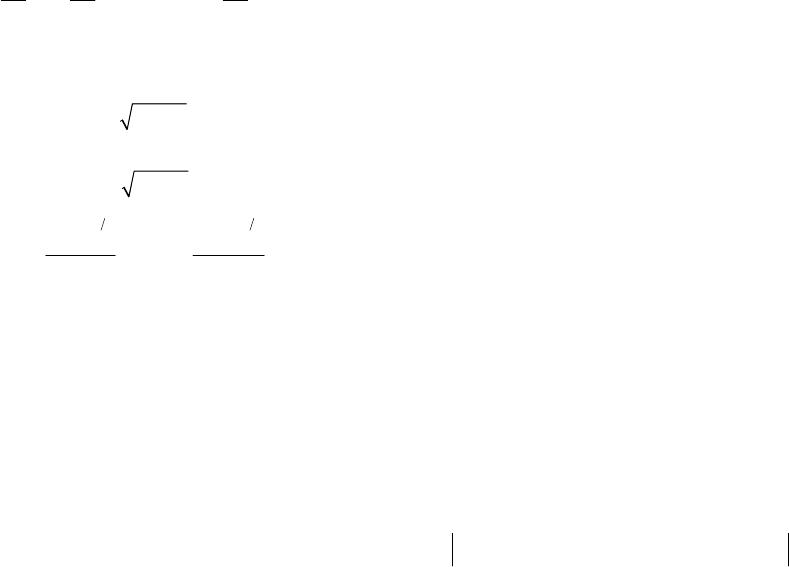 The Temperature Dependence of the Density of States in Semiconductors 217 structure and temperature dependence of the effective mass of carriers and comparison of theory with experi- ment. 2. The Dependence of the Energy Gap with Temperature As was shown in [3-8], the density of states can be de- composed into a series of GN functions. The temperature dependence of GN function will determine the statistical thermal broadening of the discrete levels. The resulting density of states is determined by the expansion of dis- crete states by GN-function takes into account the ther- mal broadening of each discrete level. We assume that the density of states at absolute zero parabolic Ns(E). We define a specific form of the electron dispersion. For ex- ample, the electron dispersion parabola or according to the Kane model. According to the procedure [3-8] we expand the density of states in a series of GN-functions. We will take into account nonparabolicity zones via the temperature dependence of the effective mass of the temperature: 1 , n ssiii i NEТNEGNEET ,, (1) where ,, 11 1 exp exp i ii GNEE T EE EE kT kTkT Ns(E)—the density of states at zero temperature [12, 13] 0 0 at 0at at nc scv pv v NEEEE NEEE E NEE EE c (2) where 32 * 023 2 2π n n m N, 32 * 023 2 2π p p m N and Ec, Ev— The value of the energy of the conduction band and valence band at T = 0. Substituting (2) into (1) we obtain the density of states at temperature T. In determining the width of the gap, we use the density of states, which depends on temperature. When modeling the process of measuring the width of the band gap with increasing temperature, use the condi- tion given in [8]. We assume that the density of states corresponding to the energy band gap edges Ec and Ev is Nk. Energy region where the density of states Ns(T) is less than the critical Nk assume band gap. The energy range where Ns(T) > Nk permission from the zones. The values of the edges of the band gap position of the bottom of the conduction band Ec(T) and valence bands Ev(T) is deter- mined by the solution of the equation transcendent 1 ,, n s ii ik i NEGNЕЕТ N (3) transcendent solution of Equation (3) with respect to E at the specified temperature T, and the critical value of the density of states Nk determines the position of the edges of the gap Ec(Nk, T) and Ev(Nk, T). In Equation (3) Nk included as a parameter. Nk value is determined by the condition of the experiment and by the accuracy of meas- urement techniques. Then the band gap is defined as the difference between the values of Ec(T, Nk) and Ev(T, Nk): ,, , g kc kv k ETNETN ETN (4) It follows that the method of determining the accuracy of the experiment and the important factors in determining the width of the gap. Indeed the band gap, determined by optical methods, “optical width” of the band gap can not match the value of the band gap, determined by the tem- perature dependence of the resistance of the semicon- ductor. One of the reasons is that different values for Nk optical and electrical measuring techniques. 3. The Influence of the Effective Mass of the Density of States at the Temperature Dependence of the Band Gap in Solid p-Bi2−xSbxTe3−ySey In [9] found that in solid p-Bi2−xSbxTe3−ySey effective density of states in the valence band is strongly depend- ent on temperature. Figure 1 shows the temperature de- pendence of the effective mass of the density of states in solid p-Bi2−xSbxTe3−ySey from [9]. Using the data of Fig- ure 1 calculated by the model bandgap variation with temperature. Figure 2 shows plots of the density of states at a tem- perature T = 100 K and T = 300 K. As can be seen from Figure 2 into account the change of the effective mass density of states significantly affects the density of states near the valence band. Figure 3 shows the temperature dependence of the graphics of the band gap for the solid solutions p- Bi2−xSbxTe3−ySey to changing the effective mass density of states taken from Figure 3 [9]. For example, for a solid solution of p-Bi2−xSbxTe3−ySey change in the band gap by changing the effective mass at T = 100 K is ** 100100, 0.93100, const ggp gp EEm Em 0.001эВ . By increasing the temperature to T = 300 K, changing the width of the band gap due to change in the effective mass of the density of states is 300 g E ** 300,1.35300,const 0.0165 gp gp Em EmэВ This shows that the reduction of the band gap by chang- ing the effective mass with increasing temperature from Open Access WJCMP 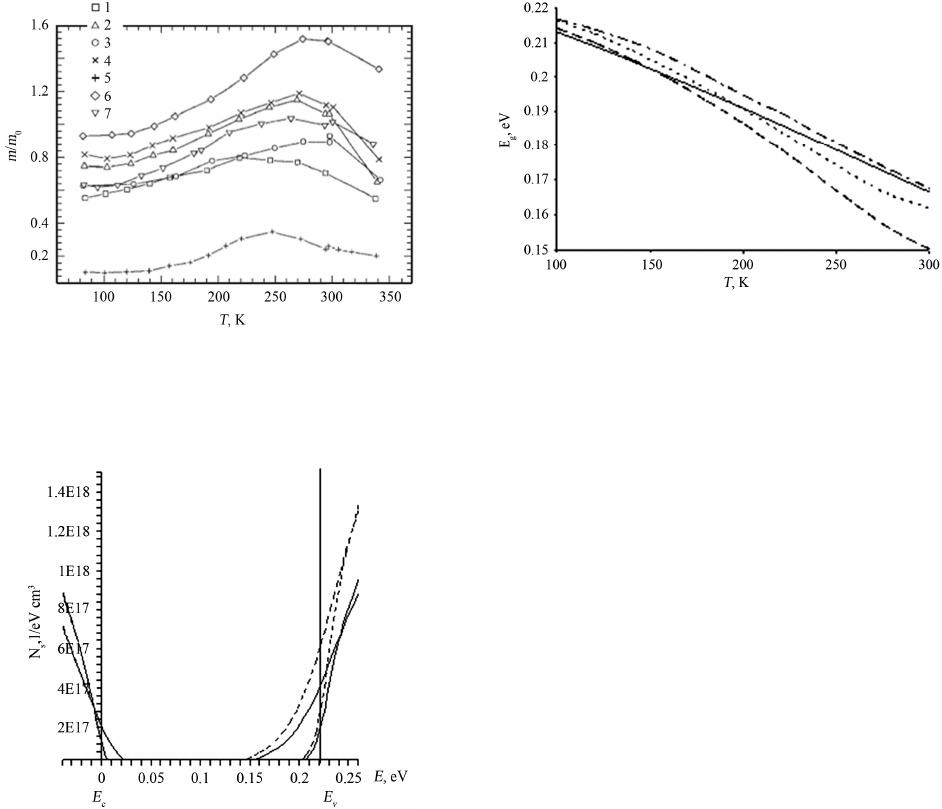 The Temperature Dependence of the Density of States in Semiconductors 218 Figure 1. The temperature dependence of the effective mass of the density of states m/m0 in solid solutions p-Bi2−xSbxTe3−ySey [14]. 1→ x = 1, y = 0.06; 2→ x = 1.1, y = 0.06; 3→ x = 1.2, y = 0.06; 4→ x = 1.2, y = 0.09; 5→ x = 1.3, y = 0.09, 6→ x = 1.3, y = 0.07; 7→ x = 1.5, y = 0.09. Figure 2. Graphic density of states at T = 100 K and 300 K. * p mmT and * p mmT. ______ ------ * p mсоnst* p m mT. 100 K to 300 K can be increased more than tenfold. Fig- ure 3 shows plots of the temperature dependence of the band gap of the solid solutions p-Bi2−xSbxTe3−ySey for the changes in the effective mass of the density of states taken from Figure 1. Thus, changes in the effective mass of the density of states with temperature can greatly af- fect the temperature dependence of the band gap. 4. Comparison of Theory with Experiment The temperature dependence of the width of the energy gap depends on the density of states at the absolute tem- perature. In the model used in [3-8] the temperature de- pendence of the density of states is determined by the temperature dependence of GN-functions and band struc- ture of the allowed bands at the bottom of the conduction Figure 3. Graphic Eg(T)—temperature dependence of the band gap. и * p mсоnst * p mmT. _____ ; ---- * p mсоnst * p mmT, p-Bi0.7Sb1.3Te2.93Se0.07; ...... * p mmT, p-Bi0.6Sb1.2Te2.91Se0.09; ···· * p mmT , p-Bi0.5Sb1.5Te2.91Se0.09. band and at the top of the valence band. Analysis of the results of numerical modeling of changes in the density of states at the temperature showed that the value of the density of states near the band edges is determined by the number of states of the band edges, a few tens of kT or about 0.1 meV, the density of states in the depths of the allowed zones does not affect the width of the gap. Since the GN-function of deep area of the zone does not pene- trate into the region band gap semiconductor, the main contribution to the shift of the band edges give the states lying close to the edges of the allowed bands. According to this law of dispersion near the top of the valence band and the conduction band edge is crucial in determining the temperature dependence of the band gap Eg(T). Fig- ures 4 and 5 are graphs of temperature dependence of the band gap of InAs [14] and Si [15]. Using mathematical modeling of the temperature de- pendence of Eg(T) for a parabolic band and Kane model obtained plots of the band gap of the temperature. As can be seen in the investigated temperature range of parabolic dispersion and a model for the use of Kane’s model is in good agreement with experimental data for InAs [14] and Si [15]. Theoretical calculations of the theoretical given for these materials is in good agreement with the experi- mental data. It follows that the temperature dependence of the band gap is satisfactorily described by a mathe- matical model of expansion of the density of states in a series of GN-functions, which describes the temperature dependence of the thermal broadening of individual en- ergy levels in the zones and in the forbidden zone. 5. Conclusion The temperature dependence of the energy spectrum of the density of states of solid solutions of Open Access WJCMP 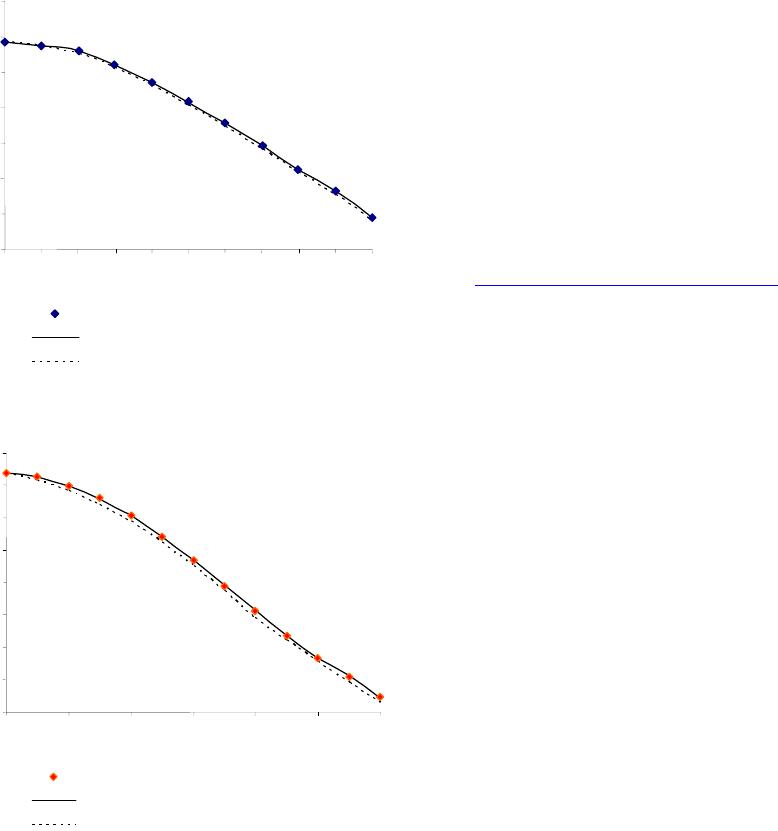 The Temperature Dependence of the Density of States in Semiconductors 219 1.050 1.070 1.090 1.110 1.130 1.150 1.170 1.190 0 50 100 150 200 250 300 350 400 450 500 Т, К E g , eV Experiment for Si [13] calculations for the parabolic zone calculation for the of Kane Figure 4. The temperature dependence of the band gap of Si. 0.3400 0.3500 0.3600 0.3700 0.3800 0.3900 0.4000 0.4100 0 50 100 150 200250300 T, K E g , eV 0.4200 Experiment for InAs [14] calculations for paraboliс zony calculation for the model of Kane Figure 5. The temperature dependence of the band gap of InAs. p-Bi2−xSbxTe3−ySey takes into account of the temperature dependence of the effective mass of the density of states in the valence band. The temperature dependence of the band gap for the changes in the effective mass of the density of states is obtained. The numerical experiments show that at temperatures T > 120 K, change in the effec- tive mass of the density of states by increasing T has sig- nificant effect on the temperature dependence of the band gap. In this temperature range ([0, 300 K], [0, 500 K]), mathematical modeling of the temperature dependence of the band gap is satisfactorily described by a parabolic dispersion law and the Kane model. The experimental results of changing the band gap of silicon [13] and InAs [14] within the accuracy of measurement is consistent with the results of theoretical calculations. Comparison of theory and experiment shows that the thermal broad- ening of the energy levels with the GN function satisfac- torily describes the process of the temperature depend- ence of the band gap of Si and InAs. REFERENCES [1] B. Ridley, “Quantum Processes in Semiconductors,” Clar- endon Press, Oxford, 1982. [2] R. Pässler, “Semi-Empirical Descriptions of Temperature Dependences of Band Gaps in Semiconductors,” Physica Status Solidi (b), Vol. 236, No. 3, 2003, pp. 710-728. http://dx.doi.org/10.1002/pssb.200301752 [3] G. Gulyamov and N. Yu. Sharibaev, “Determination of the Density of Surface States at the Semiconductor-Insu- lator Interface in a Metal-Insulator-Semiconductor Struc- ture,” FTP (Fizika Technika Poluprovodnikov), Vol. 45, No. 2, 2011, pp. 178-182. [4] G. Gulyamov and N. Yu. Sharibaev, “Determination of the Discrete Spectrum of Surface State Density in MOS- Structures Al-SiO2-Si Irradiated by Neutrons,” Poverkh- nost’. Rentgenovskie, Sinkhrotronnye i Neitronnye Issle- dovaniya, No. 9, 2012, pp. 13-17. [5] G. Gulyamov, N. Yu. Sharibaev and U. I. Erkaboev, “Thermal Broadening Density of States and Temperature Dependence of the Band Gap Ge,” FIP (Fyzicheckaya Injeneriya Poverkhnosti), Vol. 10, No. 4, 2012, pp. 366- 370. [6] G. Gulyamov and N. Yu. Sharibaev, “Temperature De- pendence of the Band Gap of Si and Due to the Thermal Broadening of the Density of States of,” FIP (Fyzi- checkaya Injeneriya Poverkhnosti), Vol. 10, No. 2, 2012, pp. 4-8. [7] G. Gulyamov, I. N. Karimov, N. Yu. Sharibaev and U. I. Erkaboev, “Determination of the Density of Surface States at the Semiconductor-Insulator Structures in Al-SiO2-Si and Al-SiO2-n-Si <Ni> at Low Temperatures,” Uzbek Journal of Physic, Vol. 12, No. 3, 2010, pp. 143-146. [8] G. Gulyamov, N. Yu. Sharibaev and U. I. Erkaboev, “Influence Effective Mass Density of States at Tem- perature Dependence of Band Gap in Solid Solutions p-Bi2−xSbxTe3−ySey,” FIP (Fyzicheckaya Injeneriya Po- verkhnosti), Vol. 11, No. 2, 2013, pp. 195-198. [9] L. N. Lukyanova, V. Kutasov and P. Konstantinov, “Effective Mass and Mobility in Solid p-Bi2−xSbxTe3−ySey for Temperatures <300K,” Solid State, Vol. 47, No. 2, 2005, pp. 224-228. [10] N. Mott and E. Devis, “Electronic Processes in Non-Crys- talline Materials,” 2nd Edition, Clarendon Press, Oxford, 1982. [11] V. B. Bonch-Bruyevich, et al., “Electronic Theory of Non- Crystalline Semiconductors,” Nauka, Moscow, 1981. [12] A. I. Anselm, “Introduction to Semiconductor,” Nauka, Moscow, 1978. [13] K. V. Shalimova, “Physics of Semiconductors,” Energ- oatomizdat, Moscow, 1985. [14] A. M. R. Godenir, “Novel Dilute Nitride Semiconductor Open Access WJCMP The Temperature Dependence of the Density of States in Semiconductors Open Access WJCMP 220 Materials for Mid-Infrared Applications,” University of Lancaster, 2008. [ 15] A. Caiafa, X. Wang, J. L. Hudgins, E. Santi and P. R. Palmer, “Cryogenic Study and Modeling of IGBTS,” IEEE 34th Annual Power Electronics Specialist Confer- ence, 15-19 June 2003, pp. 1897-1903. |