

Paper Menu >>
Journal Menu >>
 J. Biomedical Science and Engineering, 2011, 4, 94-99 doi:10.4236/jbise.2011.42013 Published Online February 2011 (http://www.SciRP.org/journal/jbise/ JBiSE ). Published Online February 2011 in SciRes. http://www.scirp.org/journal/JBiSE Thermal stability of proteins in the presence of aprotic ionic liquids Hidetaka Noritomi, Ken Minamisawa, Reo Kamiya, Satoru Kato Department of Applied Chemistry, Tokyo Metropolitan University, Minami-Ohsawa, Tokyo, Japan. Email: [email protected] Received 6 December 2010; revised 24 December 2010; accepted 28 December 2010. ABSTRACT Thermal stability of lysozyme dissolved in aqueous solutions was examined in the presence of wa- ter-miscible aprotic ionic liquids consisting of 1-ethyl- 3-methylimidazolium cation and several kinds of anions. Addition of ionic liquids to an aqueous solu- tion containing lysozyme prevented unfolded proteins from aggregating irreversibly at high temperatures. The thermal denaturation curve of lysozyme with ionic liquids was entirely shifted to higher tempera- ture, compared with that without ionic liquids. The remaining activity of lysozyme after the heat treat- ment was markedly dependent upon the kind and concentration of ionic liquids. The remaining activi- ties of lysozyme with 1.5 M 1-ethyl-3-methylimida- zolium tetrafluoroborate ([emim][BF4]) and 0.1 M 1- ethyl-3-methylimidazolium trifluoromethanesulfonate ([emim][Tf]) exhibited 88 and 68% after the heat treatment at 90oC for 30 min, respectively, although that without ionic liquids was perfectly lost. Keywords: Thermal Stability; Lysozyme; Ionic Liquid; Remaining Activity 1. INTRODUCTION In resent years, the production and applications of pro- teins have rapidly increased, not only in biochemical re- search, but also in the chemical, food, and pharmaceuti- cal industries, since proteins can exhibit exquisite bio- logical activities. Three-dimensional structure of proteins is kept by several weak interactions such as ionic effects, hydrogen bonds, and hydrophobic interactions. When these weak interactions are disrupted by changes of sev- eral different kinds in the environment of proteins, pro- teins are denatured, and inactivated via their unfolding [1-3]. In particular, modest heating can easily disrupt several of these stabilizing interactions. Thermal denatu- ration is a serious problem not only in the separation and storage of proteins but also in the processes of biotrans- formation, drug production, and food manufacturing. Several strategies have so far been proposed in order to prevent thermal denaturation [4-11,21]. They include chemical modification, immobilization, genetic modifi- cation, and addition of stabilizing agents. The addition of stabilizing agents to an aqueous solution containing pro- teins is one of the most convenient methods for minimiz- ing thermal denaturation. It has been reported that poly- ols, sugars, amino acids, amino acid derivatives, me- thylamines, and inorganic salts are available for improv- ing protein stability. However, these additives do not suf- ficiently prevent irreversible protein aggregation or some of them are no longer stable at high temperatures. Ionic solvent that is liquid at room temperature has at- tracted increasing attention as a green solvent for the chemical processes because of the lack of vapor pressure, the thermal stability, and the high polarity [12,13]. Chemical and physical properties of ionic liquids can be changed by the appropriate modification of organic cations and anions, which are constituents of ionic liquids. Biotransformation in ionic liquids has increasingly been studied [14,15,34]. We have found that the activity of protease is highly maintained not only in wa- ter-immiscible aprotic ionic liquids but also in wa- ter-miscible aprotic ionic liquids as well [22,23]. On the other hand, it has been reported that protic ionic liquids keep the stability of proteins in an aqueous solution at high temperatures [24,25], and amyloid fibrils of proteins are dissolved in protic ionic liquids and are refolded by dilution with an aqueous solution [32]. Moreover, aprotic ionic liquids can refold the denatured protein [33]. In our present work, we have focused on the remaining activity of proteins after heat treatment in order to ad- dress a question of whether or not water-miscible aprotic ionic liquids consisting of 1-ethyl-3-methylimidazolium cations and several kinds of anions affect the thermosta- bility of proteins in aqueous solutions. As a model protein, chicken egg-white lysozyme has been employed, since it is well investigated regarding its structure, properties, 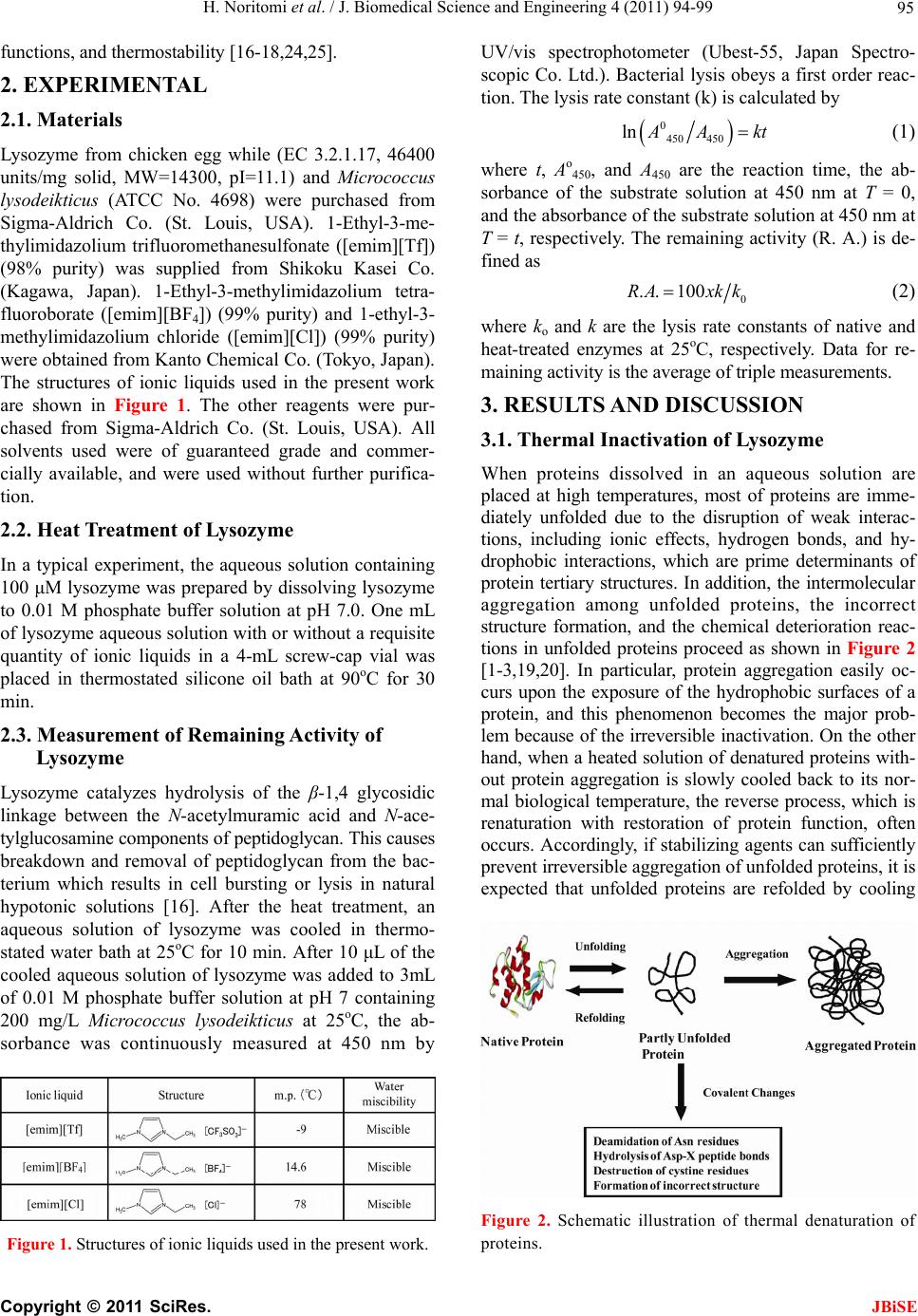 H. Noritomi et al. / J. Biomedical Science and Engineering 4 (2011) 94-99 95 functions, and thermostability [16-18,24,25]. 2. EXPERIMENTAL 2.1. Materials Lysozyme from chicken egg while (EC 3.2.1.17, 46400 units/mg solid, MW=14300, pI=11.1) and Micrococcus lysodeikticus (ATCC No. 4698) were purchased from Sigma-Aldrich Co. (St. Louis, USA). 1-Ethyl-3-me- thylimidazolium trifluoromethanesulfonate ([emim][Tf]) (98% purity) was supplied from Shikoku Kasei Co. (Kagawa, Japan). 1-Ethyl-3-methylimidazolium tetra- fluoroborate ([emim][BF4]) (99% purity) and 1-ethyl-3- methylimidazolium chloride ([emim][Cl]) (99% purity) were obtained from Kanto Chemical Co. (Tokyo, Japan). The structures of ionic liquids used in the present work are shown in Figure 1. The other reagents were pur- chased from Sigma-Aldrich Co. (St. Louis, USA). All solvents used were of guaranteed grade and commer- cially available, and were used without further purifica- tion. 2.2. Heat Treatment of Lysozyme In a typical experiment, the aqueous solution containing 100 μM lysozyme was prepared by dissolving lysozyme to 0.01 M phosphate buffer solution at pH 7.0. One mL of lysozyme aqueous solution with or without a requisite quantity of ionic liquids in a 4-mL screw-cap vial was placed in thermostated silicone oil bath at 90oC for 30 min. 2.3. Measurement of Remaining Activity of Lysozyme Lysozyme catalyzes hydrolysis of the β-1,4 glycosidic linkage between the N-acetylmuramic acid and N-ace- tylglucosamine components of peptidoglycan. This causes breakdown and removal of peptidoglycan from the bac- terium which results in cell bursting or lysis in natural hypotonic solutions [16]. After the heat treatment, an aqueous solution of lysozyme was cooled in thermo- stated water bath at 25oC for 10 min. After 10 μL of the cooled aqueous solution of lysozyme was added to 3mL of 0.01 M phosphate buffer solution at pH 7 containing 200 mg/L Micrococcus lysodeikticus at 25oC, the ab- sorbance was continuously measured at 450 nm by Figure 1. Structures of ionic liquids used in the present work. UV/vis spectrophotometer (Ubest-55, Japan Spectro- scopic Co. Ltd.). Bacterial lysis obeys a first order reac- tion. The lysis rate constant (k) is calculated by 0 450 450 ln A Akt (1) where t, Ao 450, and A450 are the reaction time, the ab- sorbance of the substrate solution at 450 nm at T = 0, and the absorbance of the substrate solution at 450 nm at T = t, respectively. The remaining activity (R. A.) is de- fined as 0 .. 100RAxk k (2) where ko and k are the lysis rate constants of native and heat-treated enzymes at 25oC, respectively. Data for re- maining activity is the average of triple measurements. 3. RESULTS AND DISCUSSION 3.1. Thermal Inactivation of Lysozyme When proteins dissolved in an aqueous solution are placed at high temperatures, most of proteins are imme- diately unfolded due to the disruption of weak interac- tions, including ionic effects, hydrogen bonds, and hy- drophobic interactions, which are prime determinants of protein tertiary structures. In addition, the intermolecular aggregation among unfolded proteins, the incorrect structure formation, and the chemical deterioration reac- tions in unfolded proteins proceed as shown in Figure 2 [1-3,19,20]. In particular, protein aggregation easily oc- curs upon the exposure of the hydrophobic surfaces of a protein, and this phenomenon becomes the major prob- lem because of the irreversible inactivation. On the other hand, when a heated solution of denatured proteins with- out protein aggregation is slowly cooled back to its nor- mal biological temperature, the reverse process, which is renaturation with restoration of protein function, often occurs. Accordingly, if stabilizing agents can sufficiently prevent irreversible aggregation of unfolded proteins, it is expected that unfolded proteins are refolded by cooling Figure 2. Schematic illustration of thermal denaturation of proteins. C opyright © 2011 SciRes. JBiSE 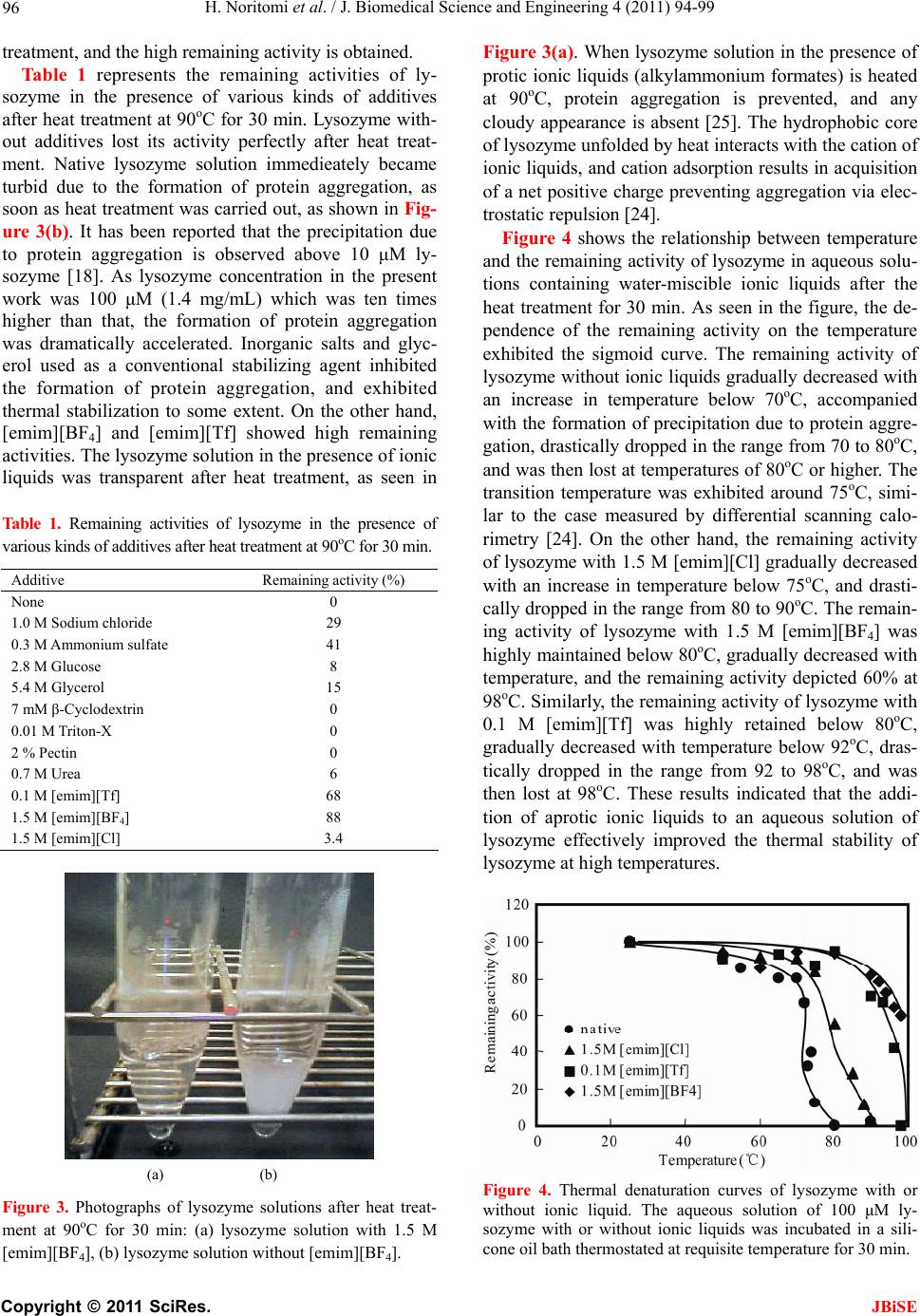 H. Noritomi et al. / J. Biomedical Science and Engineering 4 (2011) 94-99 96 treatment, and the high remaining activity is obtained. Table 1 represents the remaining activities of ly- sozyme in the presence of various kinds of additives after heat treatment at 90oC for 30 min. Lysozyme with- out additives lost its activity perfectly after heat treat- ment. Native lysozyme solution immedieately became turbid due to the formation of protein aggregation, as soon as heat treatment was carried out, as shown in Fig- ure 3(b). It has been reported that the precipitation due to protein aggregation is observed above 10 μM ly- sozyme [18]. As lysozyme concentration in the present work was 100 μM (1.4 mg/mL) which was ten times higher than that, the formation of protein aggregation was dramatically accelerated. Inorganic salts and glyc- erol used as a conventional stabilizing agent inhibited the formation of protein aggregation, and exhibited thermal stabilization to some extent. On the other hand, [emim][BF4] and [emim][Tf] showed high remaining activities. The lysozyme solution in the presence of ionic liquids was transparent after heat treatment, as seen in Table 1. Remaining activities of lysozyme in the presence of various kinds of additives after heat treatment at 90oC for 30 min. Additive Remaining activity (%) None 0 1.0 M Sodium chloride 29 0.3 M Ammonium sulfate 41 2.8 M Glucose 8 5.4 M Glycerol 15 7 mM β-Cyclodextrin 0 0.01 M Triton-X 0 2 % Pectin 0 0.7 M Urea 6 0.1 M [emim][Tf] 68 1.5 M [emim][BF4] 88 1.5 M [emim][Cl] 3.4 (a) (b) Figure 3. Photographs of lysozyme solutions after heat treat- ment at 90oC for 30 min: (a) lysozyme solution with 1.5 M [emim][BF4], (b) lysozyme solution without [emim][BF4]. Figure 3(a). When lysozyme solution in the presence of protic ionic liquids (alkylammonium formates) is heated at 90oC, protein aggregation is prevented, and any cloudy appearance is absent [25]. The hydrophobic core of lysozyme unfolded by heat interacts with the cation of ionic liquids, and cation adsorption results in acquisition of a net positive charge preventing aggregation via elec- trostatic repulsion [24]. Figure 4 shows the relationship between temperature and the remaining activity of lysozyme in aqueous solu- tions containing water-miscible ionic liquids after the heat treatment for 30 min. As seen in the figure, the de- pendence of the remaining activity on the temperature exhibited the sigmoid curve. The remaining activity of lysozyme without ionic liquids gradually decreased with an increase in temperature below 70oC, accompanied with the formation of precipitation due to protein aggre- gation, drastically dropped in the range from 70 to 80oC, and was then lost at temperatures of 80oC or higher. The transition temperature was exhibited around 75oC, simi- lar to the case measured by differential scanning calo- rimetry [24]. On the other hand, the remaining activity of lysozyme with 1.5 M [emim][Cl] gradually decreased with an increase in temperature below 75oC, and drasti- cally dropped in the range from 80 to 90oC. The remain- ing activity of lysozyme with 1.5 M [emim][BF4] was highly maintained below 80oC, gradually decreased with temperature, and the remaining activity depicted 60% at 98oC. Similarly, the remaining activity of lysozyme with 0.1 M [emim][Tf] was highly retained below 80oC, gradually decreased with temperature below 92oC, dras- tically dropped in the range from 92 to 98oC, and was then lost at 98oC. These results indicated that the addi- tion of aprotic ionic liquids to an aqueous solution of lysozyme effectively improved the thermal stability of lysozyme at high temperatures. Figure 4. Thermal denaturation curves of lysozyme with or without ionic liquid. The aqueous solution of 100 μM ly- sozyme with or without ionic liquids was incubated in a sili- cone oil bath thermostated at requisite temperature for 30 min. C opyright © 2011 SciRes. JBiSE 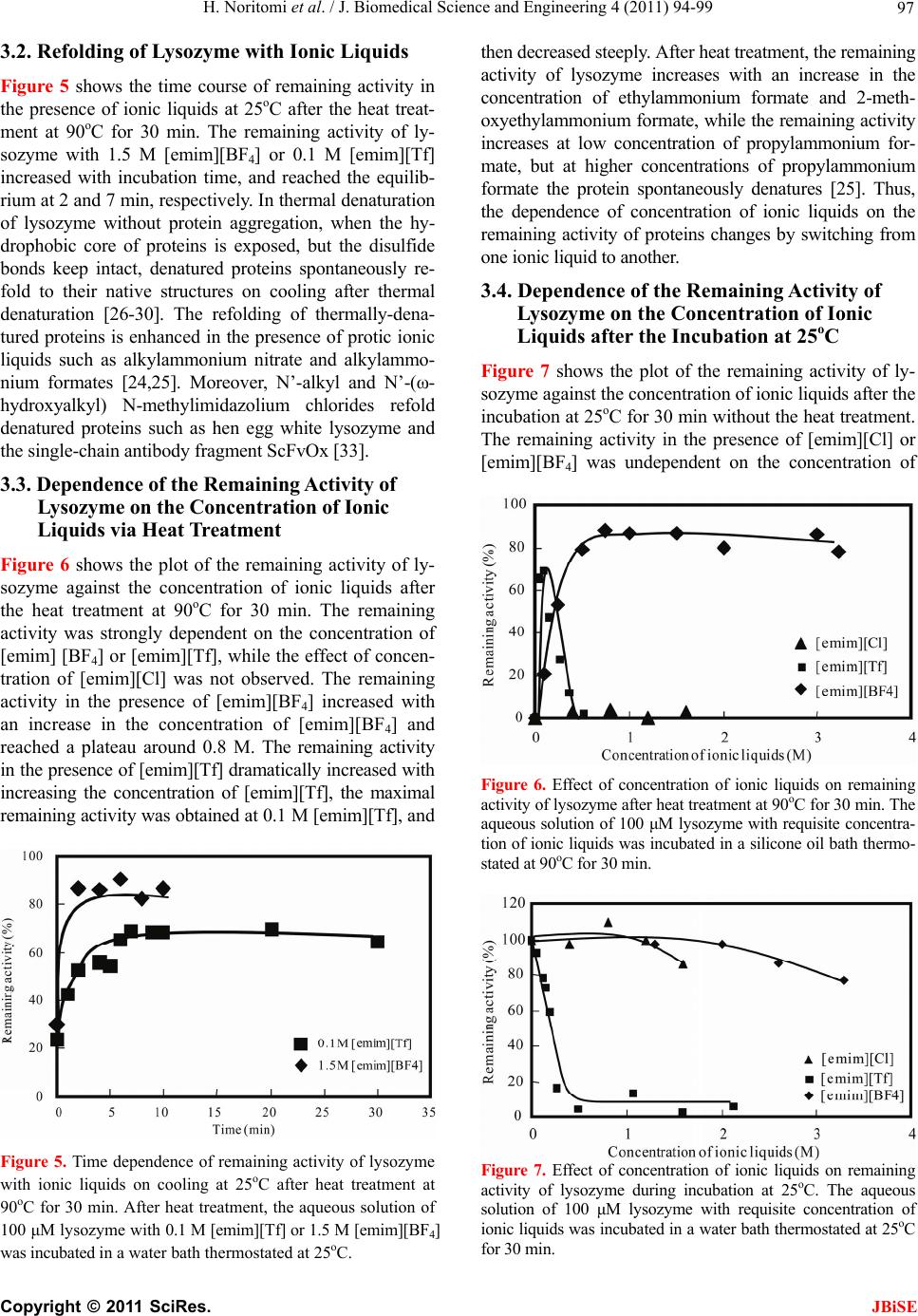 H. Noritomi et al. / J. Biomedical Science and Engineering 4 (2011) 94-99 97 3.2. Refolding of Lysozyme with Ionic Liquids Figure 5 shows the time course of remaining activity in the presence of ionic liquids at 25oC after the heat treat- ment at 90oC for 30 min. The remaining activity of ly- sozyme with 1.5 M [emim][BF4] or 0.1 M [emim][Tf] increased with incubation time, and reached the equilib- rium at 2 and 7 min, respectively. In thermal denaturation of lysozyme without protein aggregation, when the hy- drophobic core of proteins is exposed, but the disulfide bonds keep intact, denatured proteins spontaneously re- fold to their native structures on cooling after thermal denaturation [26-30]. The refolding of thermally-dena- tured proteins is enhanced in the presence of protic ionic liquids such as alkylammonium nitrate and alkylammo- nium formates [24,25]. Moreover, N’-alkyl and N’-(ω- hydroxyalkyl) N-methylimidazolium chlorides refold denatured proteins such as hen egg white lysozyme and the single-chain antibody fragment ScFvOx [33]. 3.3. Dependence of the Remaining Activity of Lysozyme on the Concentration of Ionic Liquids via Heat Treatment Figure 6 shows the plot of the remaining activity of ly- sozyme against the concentration of ionic liquids after the heat treatment at 90oC for 30 min. The remaining activity was strongly dependent on the concentration of [emim] [BF4] or [emim][Tf], while the effect of concen- tration of [emim][Cl] was not observed. The remaining activity in the presence of [emim][BF4] increased with an increase in the concentration of [emim][BF4] and reached a plateau around 0.8 M. The remaining activity in the presence of [emim][Tf] dramatically increased with increasing the concentration of [emim][Tf], the maximal remaining activity was obtained at 0.1 M [emim][Tf], and Figure 5. Time dependence of remaining activity of lysozyme with ionic liquids on cooling at 25oC after heat treatment at 90oC for 30 min. After heat treatment, the aqueous solution of 100 μM lysozyme with 0.1 M [emim][Tf] or 1.5 M [emim][BF4] then decreased steeply. After heat treatment, the was incubated in a water bath thermostated at 25oC. remaining emaining Activity of Figu ty of ly- activity of lysozyme increases with an increase in the concentration of ethylammonium formate and 2-meth- oxyethylammonium formate, while the remaining activity increases at low concentration of propylammonium for- mate, but at higher concentrations of propylammonium formate the protein spontaneously denatures [25]. Thus, the dependence of concentration of ionic liquids on the remaining activity of proteins changes by switching from one ionic liquid to another. 3.4. Dependence of the R Lysozyme on the Concentration of Ionic Liquids after the Incubation at 25oC re 7 shows the plot of the remaining activi sozyme against the concentration of ionic liquids after the incubation at 25oC for 30 min without the heat treatment. The remaining activity in the presence of [emim][Cl] or [emim][BF4] was undependent on the concentration of Figure 6. Effect of concentration of ionic liquids on remaining activity of lysozyme after heat treatment at 90oC for 30 min. The aqueous solution of 100 μM lysozyme with requisite concentra- tion of ionic liquids was incubated in a silicone oil bath thermo- stated at 90oC for 30 min. Figure 7. Effect of concentration of ionic liquids on remaining activity of lysozyme during incubation at 25oC. The aqueous solution of 100 μM lysozyme with requisite concentration of ionic liquids was incubated in a water bath thermostated at 25oC for 30 min. C opyright © 2011 SciRes. JBiSE  H. Noritomi et al. / J. Biomedical Science and Engineering 4 (2011) 94-99 98 ionic liquids till 1.2 M [emim][Cl] or 2.0 M [emim][BF4] of Figur aining activity of ly- and gradually droped, while it in the presence of [emim] [Tf] decreased with an increase in the concentration of [emim][Tf]. These results indicate that [emim][Tf] tends to strongly function as a denaturant, compared with [emim][Cl] and [emim][BF4]. Electrolytes promote or inhibit the stability of proteins according to the kind of electrolytes [35]. Moreover, chemical denaturants, such as urea and guanidine hydrochloride, can promote disso- lution of inclusion bodies, which are protein aggregation formed by prokaryotic expression systems [31]. Similarly, [emim][Tf] inhibits the formation of protein aggregation at low [emim][Tf] concentrations, but it mainly denatures proteins at higher [emim][Tf] concentrations. 3.5. Time Course of Remaining Activity Lysozyme via Heat Treatment with or without Ionic Liquids e 8 shows time course of rem sozyme with or without ionic liquids through the heat treatment at 90oC. The remaining activity of lysozyme without ionic liquids dramatically decreased with an in- crease in time, accompanied with the formation of pro- tein aggregation, and was almost lost at 10 min. It has been reported that the remaining activity in the thermal denaturation process accompanied with the formation of protein aggregation follows first-order kinetics [18]. As seen in the figure, the relationship of the remaining activ- ity of proteins in the absence of ionic liquids with heat treat time could be correlated by first-order kinetics. On the other hand, 1.5 M [emim][BF4] or 0.1 M [emim][Tf] prevented the thermal inactivation of lysozyme. In the presence of ionic liquids the turbidity of solutions due to protein aggregation was not observed through heat treat- ment. This indicates that the thermal inactivation mainly Figure 8. Time dependence of remaining activity with or on of ly- Rate constant (min-1) Half life (min) without ionic liquids after heat treatment at 90oC. The aqueous solution of 100 μM lysozyme with or without ionic liquids was incubated in a silicone oil bath thermostated at 90oC. Table 2. Rate constants and half lives of inactivati sozyme at 90oC. Ionic liquid none 0.43 1.6 1.5 M [emim][Cl] 0.065 11 0.1 M [emim][Tf] 0.0081 86 1.5 M [emim][BF4]0.0049 141 sults from the covalent change as shown in Figure 2. t the remaining activity of ly- Klibanov, A.M. (1989) Minimizing re The plots of remaining activity versus heat treatment time on thermal inactivation of lysozyme in the presence of ionic liquids followed first-order kinetics on linearity. It has been reported that the thermal inactivation of ly- sozyme obeyed first-order kinetics when it irreversibly proceeded by the covalent change without the formation of protein aggregation [17]. Ta b l e 2 represents rate con- stants and half lives of inactivation of lysozyme with or without ionic liquids calculated from the fitting curves. The half lives with 1.5 M [emim][BF4], 0.1 M [emim] [Tf], and 1.5 M [emim][Cl] were 88, 54, or 6.9 times longer than that without ionic liquids, respectively. 4. CONCLUSIONS We have demonstrated tha sozyme is sufficiently maintained after heat treatment at high temperatures, since aprotic ionic liquids prevented unfolded proteins from aggregating. The remaining activ- ity of lysozyme markedly depended upon the kind and concentration of ionic liquids. Specifically, [emim][Tf] exhibited thermostabilization effect of proteins at low concentrations, but denatured proteins at high concentra- tions. When the heat treatment was carried out at 90oC, the half lives with 1.5 M [emim][BF4] and 0.1 M [emim] [Tf] were much superior to that with 1.5 M [emim][Cl]. REFERENCES [1] Volkin, D.B. and protein inactivation, in T.E. Creighton Ed., Protein Func- tion: Practical Approach, 1-24, IRL Press, Oxford. [2] Klibanov, A.M. (1983) Stabilization of enzymes against thermal inactivation. Advances in Applied Microbiology, 29, 1-28. doi:10.1016/S0065-2164(08)70352-6 [3] Illanes, A. (1999) Stability of biocatalysts. Electronic Journal of Biotechnology, 2, 1-9. [4] Gerlsma, S.Y. (1968) Reversible denaturation of ribonu- . (1998) Thermal stability of In- clease in aqueous solutions as influenced by polyhydric alcohols and some other additives. Journal of Biological Chemistry, 243, 957-961. [5] Kaushik, J.K. and Bhat, R proteins in aqueous polyol solutions: Role of the surface tension of water in the stabilizing effect of polyols. Journal of Biological Chemistry. B, 102, 7058-7066. [6] Back, J.F., Oakenfull, D. and Smith, M.B. (1979) creased thermal stability of proteins in the presence of sugars and polyols. Biochemistry, 18, 5191-5196. C opyright © 2011 SciRes. JBiSE 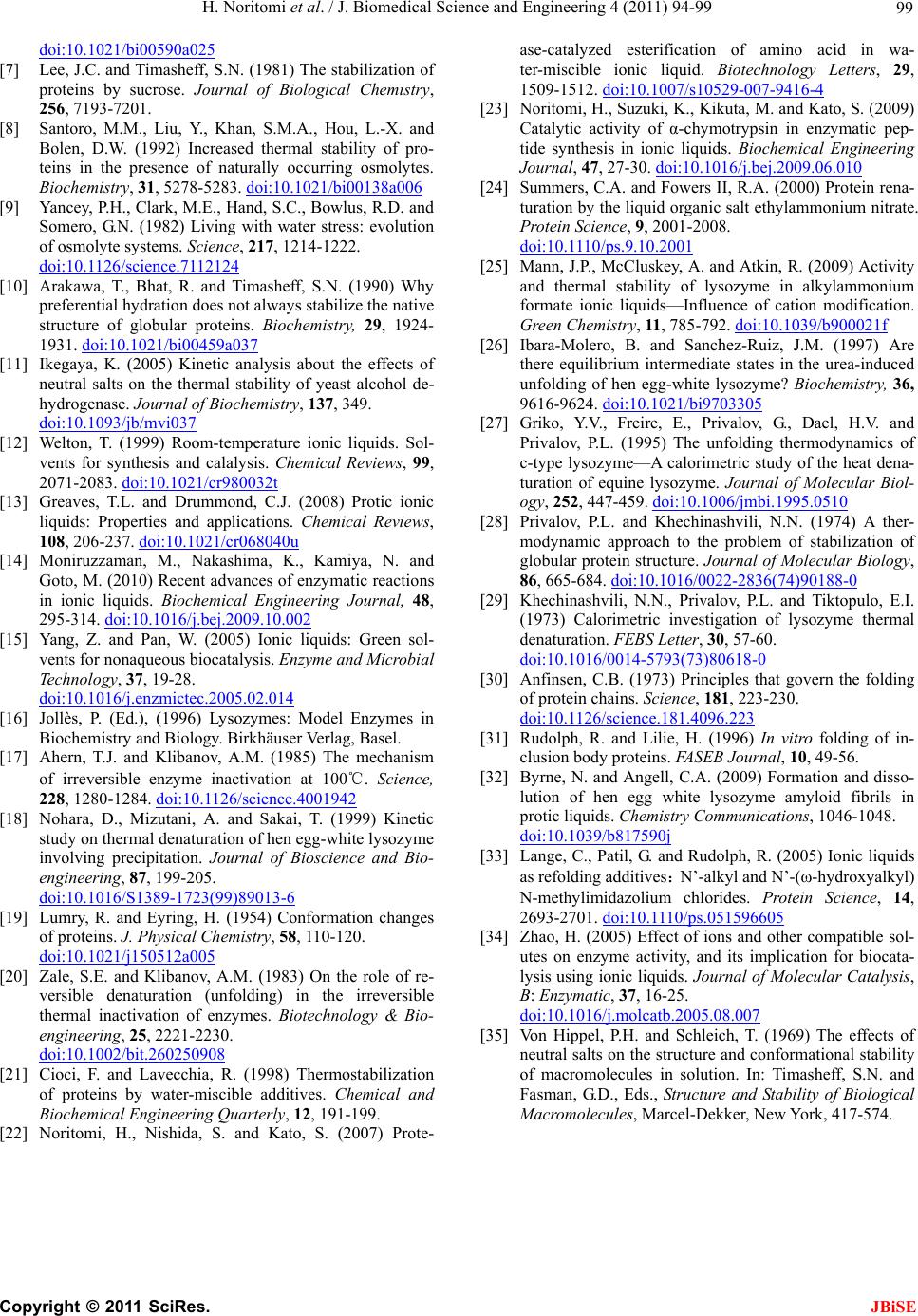 H. Noritomi et al. / J. Biomedical Science and Engineering 4 (2011) 94-99 Copyright © 2011 SciRes. 99 JBiSE doi:10.1021/bi00590a025 [7] Lee, J.C. and Timasheff, S.N. (1981) The stabilization of iu, Y., Khan, S.M.A., Hou, L.-X. a proteins by sucrose. Journal of Biological Chemistry, 256, 7193-7201. [8] Santoro, M.M., Lnd Bolen, D.W. (1992) Increased thermal stability of pro- teins in the presence of naturally occurring osmolytes. Biochemistry, 31, 5278-5283. doi:10.1021/bi00138a006 [9] Yancey, P.H., Clark, M.E., Hand, S.C., Bowlus, R.D. and Somero, G.N. (1982) Living with water stress: evolution of osmolyte systems. Science, 217, 1214-1222. doi:10.1126/science.7112124 [10] Arakawa, T., Bhat, R. and Timasheff, S.N. (1990) Why preferential hydration does not always stabilize the native structure of globular proteins. Biochemistry, 29, 1924- 1931. doi:10.1021/bi00459a037 [11] Ikegaya, K. (2005) Kinetic analysis about the effects of neutral salts on the thermal stability of yeast alcohol de- hydrogenase. Journal of Biochemistry, 137, 349. doi:10.1093/jb/mvi037 [12] Welton, T. (1999) Room-temperature ionic liquids. Sol- vents for synthesis and calalysis. Chemical Reviews, 99, 2071-2083. doi:10.1021/cr980032t [13] Greaves, T.L. and Drummond, C.J. (2008) Protic ionic liquids: Properties and applications. Chemical Reviews, 108, 206-237. doi:10.1021/cr068040u [14] Moniruzzaman, M., Nakashima, K., Kamiya, N. and Goto, M. (2010) Recent advances of enzymatic reactions in ionic liquids. Biochemical Engineering Journal, 48, 295-314. doi:10.1016/j.bej.2009.10.002 [15] Yang, Z. and Pan, W. (2005) Ionic liquids: Green sol- 005.02.014 vents for nonaqueous biocatalysis. Enzyme and Microbial Technology, 37, 19-28. doi:10.1016/j.enzmictec.2 zymes in [16] Jollès, P. (Ed.), (1996) Lysozymes: Model En Biochemistry and Biology. Birkhäuser Verlag, Basel. [17] Ahern, T.J. and Klibanov, A.M. (1985) The mechanism of irreversible enzyme inactivation at 100℃. Science, 228, 1280-1284. doi:10.1126/science.4001942 [18] Nohara, D., Mizutani, A. and Sakai, T. (1999) Kinetic )89013-6 study on thermal denaturation of hen egg-white lysozyme involving precipitation. Journal of Bioscience and Bio- engineering, 87, 199-205. doi:10.1016/S1389-1723(99 formation changes [19] Lumry, R. and Eyring, H. (1954) Con of proteins. J. Physical Chemistry, 58, 110-120. doi:10.1021/j150512a005 [20] Zale, S.E. and Klibanov, A.M. (1983) On the role of re- versible denaturation (unfolding) in the irreversible thermal inactivation of enzymes. Biotechnology & Bio- engineering, 25, 2221-2230. doi:10.1002/bit.260250908 [21] Cioci, F. and Lavecchia, R. (1998) Thermostabilization Prote- of proteins by water-miscible additives. Chemical and Biochemical Engineering Quarterly, 12, 191-199. [22] Noritomi, H., Nishida, S. and Kato, S. (2007) ase-catalyzed esterification of amino acid in wa- ter-miscible ionic liquid. Biotechnology Letters, 29, 1509-1512. doi:10.1007/s10529-007-9416-4 [23] Noritomi, H., Suzuki, K., Kikuta, M. and Kato, S. (2009) Catalytic activity of α-chymotrypsin in enzymatic pep- tide synthesis in ionic liquids. Biochemical Engineering Journal, 47, 27-30. doi:10.1016/j.bej.2009.06.010 [24] Summers, C.A. and Fowers II, R.A. (2000) Protein rena- turation by the liquid organic salt ethylammonium nitrate. Protein Science, 9, 2001-2008. doi:10.1110/ps.9.10.2001 [25] Mann, J.P., McCluskey, A. and Atkin, R. (2009) Activity and thermal stability of lysozyme in alkylammonium formate ionic liquids—Influence of cation modification. Green Chemistry, 11, 785-792. doi:10.1039/b900021f [26] Ibara-Molero, B. and Sanchez-Ruiz, J.M. (1997) Are there equilibrium intermediate states in the urea-induced unfolding of hen egg-white lysozyme? Biochemistry, 36, 9616-9624. doi:10.1021/bi9703305 [27] Griko, Y.V., Freire, E., Privalov, G., Dael, H.V. and Privalov, P.L. (1995) The unfolding thermodynamics of c-type lysozyme—A calorimetric study of the heat dena- turation of equine lysozyme. Journal of Molecular Biol- ogy, 252, 447-459. doi:10.1006/jmbi.1995.0510 [28] Privalov, P.L. and Khechinashvili, N.N. (1974) A ther- modynamic approach to the problem of stabilization of globular protein structure. Journal of Molecular Biology, 86, 665-684. doi:10.1016/0022-2836(74)90188-0 [29] Khechinashvili, N.N., Privalov, P.L. and Tiktopulo, E.I. (1973) Calorimetric investigation of lysozyme thermal denaturation. FEBS Letter, 30, 57-60. doi:10.1016/0014-5793(73)80618-0 [30] Anfinsen, C.B. (1973) Principles that govern the folding of protein chains. Science, 181, 223-230. doi:10.1126/science.181.4096.223 [31] Rudolph, R. and Lilie, H. (1996) In vitro folding of in- disso- clusion body proteins. FASEB Journal, 10, 49-56. [32] Byrne, N. and Angell, C.A. (2009) Formation and lution of hen egg white lysozyme amyloid fibrils in protic liquids. Chemistry Communications, 1046-1048. doi:10.1039/b817590j [33] Lange, C., Patil, G. and Rudolph, R. (2005) Ionic liquids as refolding additives:N’-alkyl and N’-(ω-hydroxyalkyl) N-methylimidazolium chlorides. Protein Science, 14, 2693-2701. doi:10.1110/ps.051596605 [34] Zhao, H. (2005) Effect of ions and other compatible sol- .08.007 utes on enzyme activity, and its implication for biocata- lysis using ionic liquids. Journal of Molecular Catalysis, B: Enzymatic, 37, 16-25. doi:10.1016/j.molcatb.2005 1969) The effects of [35] Von Hippel, P.H. and Schleich, T. ( neutral salts on the structure and conformational stability of macromolecules in solution. In: Timasheff, S.N. and Fasman, G.D., Eds., Structure and Stability of Biological Macromolecules, Marcel-Dekker, New York, 417-574. |