

Paper Menu >>
Journal Menu >>
 Journal of Power and Energy Engineering, 2013, 1, 58-62 http://dx.doi.org/10.4236/jpee.2013.15009 Published Online October 2013 (http://www.scirp.org/journal/jpee) Copyright © 2013 SciRes. JPEE Building Sustainable Score (BSS)—A Hybrid Process Approach for Sustainable Building Assessment in China Jiani Liu1, Grace K. C. Ding2, Bijan Samali1 1Faculty of Engineering & IT, University of Technology Sydney, Sydney, Australia; 2Faculty of Design, Architecture and Building, University of Technology Sydney, Sydney, Australia. Email: Jiani.Liu[email protected] Received August 2013 ABSTRACT Sustainable building in China has gained attention both domestically and abroad. Despite the fast i ncrease in sustainable assessment tools developed locally or adopted from overseas, there are still criticisms about the current situation of weak implementation and lack of comprehensive consideration. The lack of consideration of economic and social as- pects or building performance on whole building life cycle all lead to departure from the true meaning of sustainable development. And lack of participation on the part of stakeholders makes it too theoretical to be carried out. This re- search aims to develop a model to address this problem. This research started with review of current sustainable as- sessment tools applied in China. As the assessment indicators have clear regional disparities, and almost no current tool considers all three pillars of environmental, economic and social in building life cycle. A n industry survey was therefore designed for generation of indicators at different building stages, and personal interviews relevant to different occupa- tion in building industry were conducted to complement the questionnaire survey. After that, the model Building Sus- tainable Score (BSS) was developed based on the stakeholders’ participation. Finally, the model is verified by a case study. Keywords: Building Sustainability; Hybrid Process Approach; LCA; AHP 1. Introduction Buildings are one of the largest energy consumers in any industrialized country [1]. According to the report from Netherland Consulate in China [2], half of the new build- ings worldwide will be built in China by 2015. By then approximately 40% of China’s total energy consumption, 50% of concrete and 30% of steel, globally, will be con- sumed by the construction market in China. Therefore, sustainable buildings and the sustainable assessment tools have attracted much attention from the government both locally and nationally. In the past decades, several inter- national sustainable assessment tools have been adopted and used in the Chinese construction market such as Leadership in Energy and Environmental Design (LEED) from the US, Comprehensive Assessment System for Building Environment Efficiency (CASSBE) from Japan and BRE Environmental Assessment Method (BREEAM) from the UK. International green building assessment tools were use- ful to provide information on evaluating environmental performance of buildings in China. However, these tools have been developed as country specific and even though they have been modified to suit buildings in China, they may not have been used effectively and sufficiently. Gradu- ally, tools were developed in China to fill the gap. In 2003, the Tsinghua University developed and issued a ‘Green Olympic Building Assessment System (GOBAS) for the construction of buildings for Olympic games. The tool was adopted by Beijing Municipal Construction Com- mission as one of the Beijing’s local green building standards [3]. Following GOBAS, a national three star green building evaluation standard was launched in Chi- na in 2006 called the ‘Evaluation Standards for Green Buildings (ESGB). With the development of local building assessment tools, there are still some criticisms of these tools as most of them consider environmental factors only, and only a few take economic and social factors into consideration [4]. Further criticisms about the effectiveness of building assessment methods state that they typically assess a build- ing as a completed product and seldom consider impacts at different stages of a building cycle [5]. Environmental, economic and social criteria will have different impacts at various stages of a development and hence assessing building performance at different stages becomes impor- tant and necessary. Despite the fact that some research has focused on one or several of the building phases,  Building Sustainable Score (BSS)—A Hybrid Process Approach for Sustainable Building Assessment in China Copyright © 2013 SciRes. JPEE 59 none of them has considered all the stages from life cycle perspective [6-8]. Impacts duri ng the life cycle of a project are highly inter-dependent, as one phase can influence one or more of the other phases. Each phase in a building life cycle plays an important role in achieving the goal of sustainability for a project. Besides, an overall rating score to assess a building’s performance is hard to meet the requirements of all stake holders, as the definition of building performance varies according to different inter- est groups involved in building development [9]. In such cases, it is ideal to integrate social, environmental and economic factors at each stage of sustainability assess- ment in the decision-making process [10]. In order to fill this gap, this research is conducted to establish a model which assesses the building sustainable performance of the three pillars at all the stages in build- ing life cycle. A qu estionnaire survey and pers onal inter- views were used for data collection. With the survey, an assessment model based on building process approach (BPA) was established in this paper to aid decision mak- ing. The objectives of this paper are as follows: - Identifying the sustainable assessment indicators re- lated to bui lding processes. - Establishing Building Sus tainable Score (BSS) model based on building process approach (BPA). 2. Research Method In order to achieve the goal of sustainability, all the phases during the building life cycle should be taken into con- sideration when the sustainability performance of a con- struction project is examined. In that case, life cycle anal- ysis (LCA) and life cycle costing (LCC) are adopted in this research to assess environmental and economic fac- tors whilst value score is used for the social factor. The entire building life cycle performance, building stages and hence the major activities in each phase, are taken into consideration. The building life cycle for the research has been divided into four stages of inception and design, construction, operation , and demolition. At each stage, assessment indicators in conjunction with activities were identified using an industry questionnaire survey and semi-structured interviews. An online indus- try survey was conducted in February 2012 followed by 20 interviewees for deeper discussion. With this survey, an assessment model based on building process approach (BPA) is established in this paper to aid decision making. 3. Data Collection and Analysis An industry survey was conducted to identify key indi- cators for assessment at different stages in a building life cycle. After condu cting a pilot study with indu stry practi- tioners, an industry wide questionnaire survey was con- ducted online between February and May 2012. A total of 479 responses were collected. A follow-up semi- structured personal interview with industry practitioners was also conducted in Guangdong Province for deeper investigation of the issues between May and June 2012 . Participants in this questionnaire survey were devel- opers, design consultants, contractors, government agen- cies, academics and others. Others included lawyers, prop- erty managers, secretaries and construction workers. These six groups are highly relevant to the green building re- search and their opinion on sustainable assessment tools will contribute a lot to this research. Among those par- ticipants, 30.3% have more than 20 years of work expe- rience, 49.1% had 6 - 20 years and the rest had less than 5 years of work experience. Among these participants, about 56% of the them thought the current trend in green buildings in China is just starting and is developing slowly, 26% of the participants though t it has not started yet, 16% though t it has started and is de veloping fast and 2% thought it is almost at a mature stage but still behind the western countries. Compared with current literature about China’s green building situation, as the views were not as optimistic as por trayed. Thoug h the green building has started since the last century, they have not received enough attention from the public. As for the solution to this situation, “developing an assessment system” and “establishing a complete legal system” become their first choice. In order to establish an assessment model, the indica- tors were identified from a literature review. In this sur- vey, participants were asked to rank the relevant indica- tors based on their experience and knowledge. The Rela- tive Importance Index (RII) was adopted to analyze the results. The indicators chosen were based on their rela- tive importance. Table 1 shows the rankin g of the indi- cators fr om the ques t ionnair e s ur ve y. After that, semi-structured interviews were conducted to further explore the relevance and importance of indi- cators at each stage. 4. Model Development Based on the data analysis from the questionnaire survey and personal interviews, the indictors for each stage were developed. The conceptual model has been established as follows: Based on the conceptual model (Figure 1), a mathe- matics model based on building process approach (BPA) is established to aid decision making. The assessment model consists of five sub-models, each of which reflects sustainability performance of a building phase. Each sub- model will analyze the building performance in accor- dance with the environmental, economic and social as- pects of building activities at each stage. 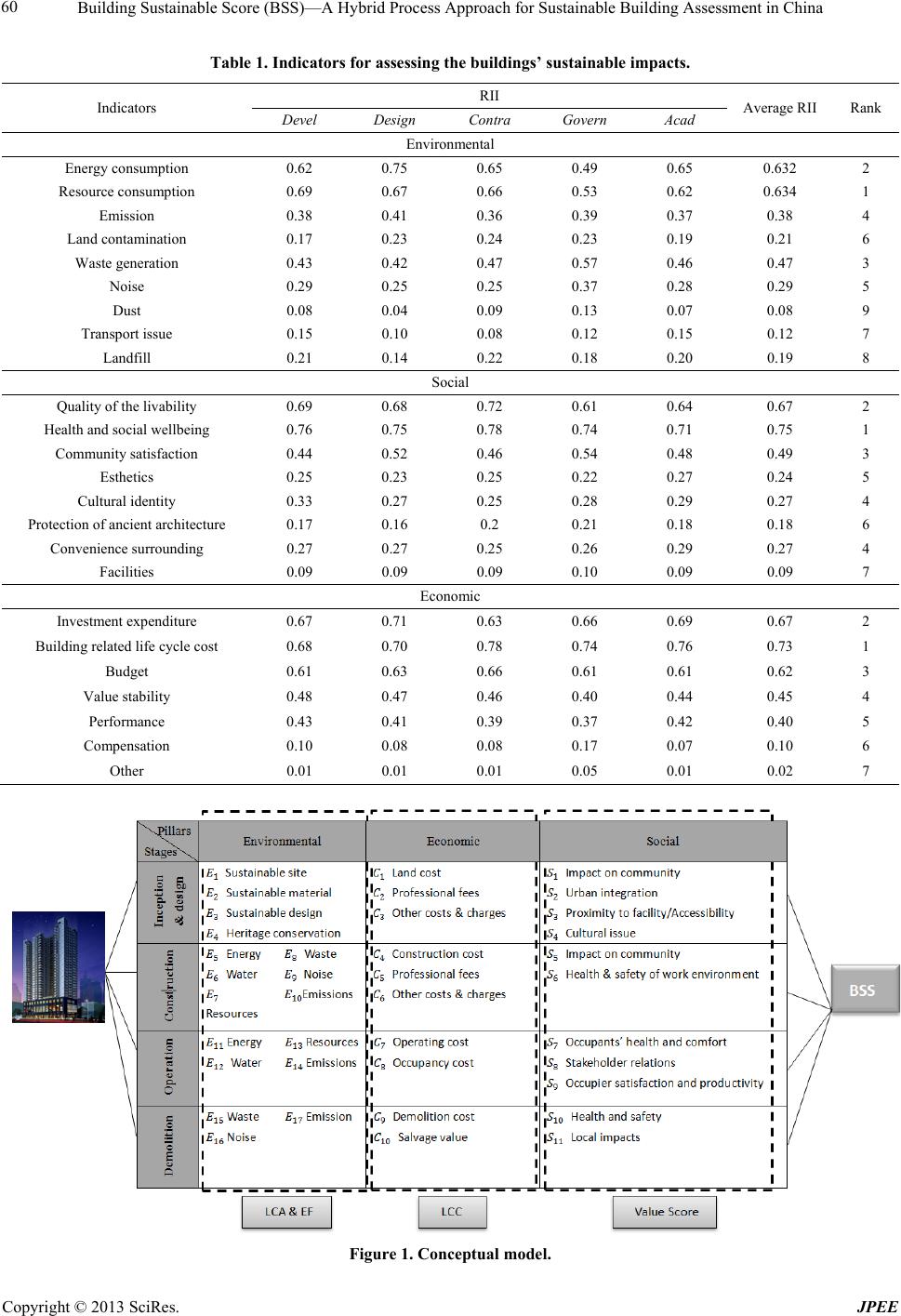 Building Sustainable Score (BSS)—A Hybrid Process Approach for Sustainable Building Assessment in China Copyright © 2013 SciRes. JPEE 60 Table 1. Indicators for assessing the buildings’ sustainable impacts. Indicators RII Average RII Rank Devel Design Contra Govern Acad Environmental Energy consumption 0.62 0.75 0.65 0.49 0.65 0.632 2 Resource consumption 0.69 0.67 0.66 0.53 0.62 0.634 1 Emission 0.38 0.41 0.36 0.39 0.37 0.38 4 Land contamination 0.17 0.23 0.24 0.23 0.19 0.21 6 Waste generation 0.43 0.42 0.47 0.57 0.46 0.47 3 Noise 0.29 0.25 0.25 0.37 0.28 0.29 5 Dust 0.08 0.04 0.09 0.13 0.07 0.08 9 Transport i s s ue 0.15 0.10 0.08 0.12 0.15 0.12 7 Landfill 0.21 0.14 0.22 0.18 0.20 0.19 8 Social Quality of the livability 0.69 0.68 0.72 0.61 0.64 0.67 2 Health and social wellbeing 0.76 0.75 0.78 0.74 0.71 0.75 1 Community satisfaction 0.44 0.52 0.46 0.54 0.48 0.49 3 Esthetics 0.25 0.23 0.25 0.22 0.27 0.24 5 Cultural identity 0.33 0.27 0.25 0.28 0.29 0.27 4 Protection of ancient architecture 0.17 0.16 0.2 0.21 0.18 0.18 6 Convenience surrounding 0.27 0.27 0.25 0.26 0.29 0.27 4 Facilities 0.09 0.09 0.09 0.10 0.09 0.09 7 Economic Investment expenditure 0.67 0.71 0.63 0.66 0.69 0.67 2 Building related life cycle cost 0.68 0.70 0.78 0.74 0.76 0.73 1 Budget 0.61 0.63 0.66 0.61 0.61 0.62 3 Value stability 0.48 0.47 0.46 0.40 0.44 0.45 4 Performance 0.43 0.41 0.39 0.37 0.42 0.40 5 Compensation 0.10 0.08 0.08 0.17 0.07 0.10 6 Other 0.01 0.01 0.01 0.05 0.01 0.02 7 Figure 1. Conceptual model. 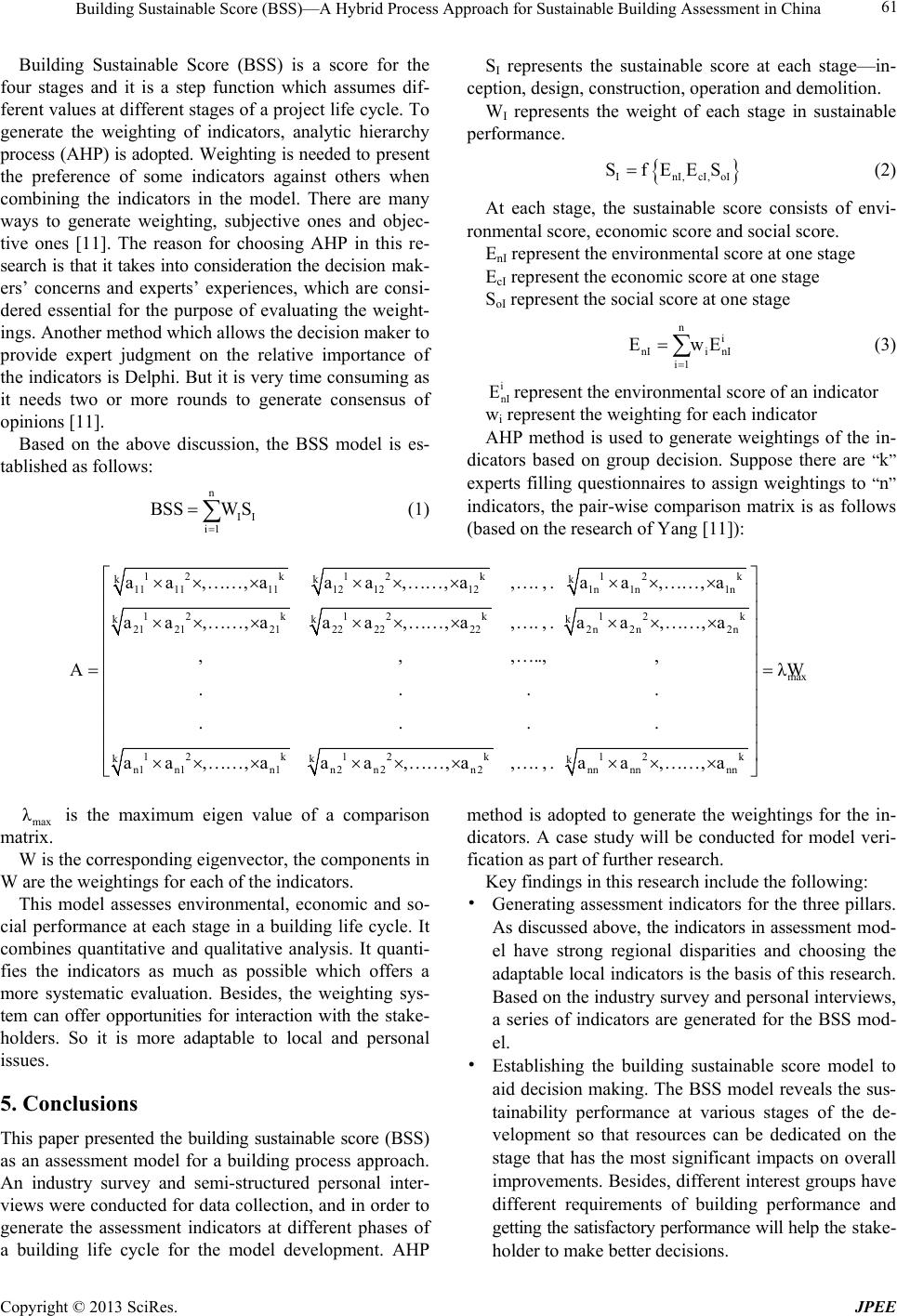 Building Sustainable Score (BSS)—A Hybrid Process Approach for Sustainable Building Assessment in China Copyright © 2013 SciRes. JPEE 61 Building Sustainable Score (BSS) is a score for the four stages and it is a step function which assumes dif- ferent values at different stages of a project life cycle. To generate the weighting of indicators, analytic hierarchy process (AHP) is adopted. Weighting is needed to present the preference of some indicators against others when combining the indicators in the model. There are many ways to generate weighting, subjective ones and objec- tive ones [11]. The reason for choosing AHP in this re- search is tha t it takes into co nsideration the decis ion mak- ers’ concerns and experts’ experiences, which are consi- dered essential for the purpose of evaluating the weight- ings. Another method which allows the dec ision maker to provide expert judgment on the relative importance of the indicators is Delphi. But it is very time consuming as it needs two or more rounds to generate consensus of opinions [11]. Based on the above discussion, the BSS model is es- tablished as follows: n II i1 BSSW S = = ∑ (1) SI represents the sustainable score at each stage—in- ception , de sign, cons t ructio n, operatio n and demolition. WI represents the weight of each stage in sustainable performance. { } InI,cI, oI S fEES= (2) At each stage, the sustainable score consists of envi- ronmental score, economic score and social score. EnI represent the environmental score at one stage EcI represent the economic score at one stage SoI represent the social score at one stage ni nIi nI i1 E wE = = ∑ (3) i nI E represent the environmental score of an indicator wi represent the weighting for each indicator AHP method is used to generate weightings of the in- dicators based on group decision. Suppose there are “k” experts filling questionnaires to assign weightings to “n” indicators, the pair-wise comparison matrix is as follows (based o n the research of Yang [11]): 12k 12k12k kk k 11 11111212121n1n1n 12k12k1 2k kk k 21 212122 22222n2n2n 12k12k1 kk n1 n1n1n2n2n2nn n aa, ,aaa, ,a,..,aa, ,a aa, ,aaa, ,a,..,aa, ,a ,,, ..,, . ... . ... aa, ,aaa, ,a,..,aa A ×× ……×××……×…×× ……× ××……××× ……×…×× ……× … ×× ……××× ……×…× = max 2k kn nn λW , ,a = × ……× max λ is the maximum eigen value of a comparison matrix. W is the corresponding eigenvector, the components in W are t he weightings for each of the indicators. This model assesses environmental, economic and so- cial performance at each stage in a building life cycle. It combines quantitative and qualitative analysis. It quanti- fies the indicators as much as possible which offers a more systematic evaluation. Besides, the weighting sys- tem can offer opportunities for interaction with the stake- holders. So it is more adaptable to local and personal issues. 5. Conclusions This paper presented the building sustainable score (BSS) as an assessment model for a building process approach. An industry survey and semi-structured personal inter- views were conducted for data collection, and in order to generate the assessment indicators at different phases of a building life cycle for the model development. AHP method is adopted to generate the weightings for the in- dicators. A case study will be conducted for model veri- fication as part of further research. Key findings in this research include the following: • Generating assessment indicator s for the three pillars. As discussed above, the indicators in assessment mod- el have strong regional disparities and choosing the adaptable local indicators is the basis of this research. Based on the industry survey and personal interviews, a series of indicators are generated for the BSS mod- el. • Establishing the building sustainable score model to aid decision making. The BSS model reveals the sus- tainability performance at various stages of the de- velopment so that resources can be dedicated on the stage that has the most significant impacts on overall improvements. Besides, different interest groups have different requirements of building performance and getting the satisfactory performance will help the stake- holder to make better decisions.  Building Sustainable Score (BSS)—A Hybrid Process Approach for Sustainable Building Assessment in China Copyright © 2013 SciRes. JPEE 62 REFERENCES [1] S. Junnila, A. Horvath and A. A. Goggemos, “Life-Cycle Assessment of Office Buildings in Europe and the United States,” Journal of Infrastructure Systems, Vol. 12, No. 1, 2006, pp. 10-17. http://dx.doi.org/10.1061/ (ASCE)1076-0342(2 006)12:1(10) [2] Netherland Consulate in China, “ChinaTop Sector Energy: Sustainable Building Opportunities for Dutch companies,” 2012. http://china.nlambassade.org/ [3] Green Olympic Building Research Center, “Green Olym- pic Building Assessment System,” China Construction Industrial Press, Beijing, 2003. [4] L. Y. Shen, M. Wu and J. Y. Wang, “A Model for As- sessing the Feasibility of Construction Project in Contri- bution to the Attainment of Sustainable Development,” Journal of Construction Research, Vol. 3, No. 3, 2002, pp. 255-269. http://dx.doi.org/10.1142/S1609945102000151 [5] E. Kaatz, D. Root, P. A. Bowen, and R. C. Hill, “Ad- vancing Key Outcomes of Sustainability Building As- sessment,” Building Research and Information, Vol. 34, No. 4, 2006, pp. 308-320. http://dx.doi.org/10.1080/09613210600724608 [6] M. M. Bilec, R. J. Ries and H. S. Matthews, “Life-Cycle Assessment Modeling of Construction Processes for Bui- ldings,” Infrastructure System, Vol. 16, No. 3, 2010, pp. 199-205. http://dx.doi.org/10.1061/(ASCE)IS.1943-555X.0000022 [7] C. Scheuer, G. A. Keoleian and P. Reppe, “Life Cycle Energy and Environmental Performance of a New Uni- versity Building: Modeling Challenges and Design Im- plications,” Energy and Buildings, Vol. 35, No. 10, 2003, pp. 1049-1064. http://dx.doi.org/10.1016/S0378-7788(03)00066-5 [8] A. Guggemos and A. Horvath, “Strategies of Extended Producer Responsibility for Buildings,” Infrastruc ture Sys- tem, Vol. 9, No. 2, 2003, pp. 65-74. http://dx.doi.or g/10.1061/(ASCE)1076-0342(2003)9:2(65) [9] R. J. Cole, “Emerging Trend in Building Environmental Assessment Methods,” Build Research and Information, Vol. 26, 1998, pp. 3-16. http://dx.doi.org/10.1080/096132198370065 [10] P. O. Akadiri, P. O. Olomolaiye and E. A. Chinyio, “Mul- ti-Criteria Evaluation Model for the Selection of Sustain- able Materials for Building Projects,” Automation in Con- struction, Vol. 30, 2013, pp. 113-125. http://dx.doi.org/10.1016/j.autcon.2012.10.004 [11] Y. Yang, B. Li and R. Yao, “A Method of Identifying a nd Weighting Indicators of Energy Efficiency Assessment i n Chinese Residential Buildings,” Energy Policy, Vol. 38, No. 12, 2010, pp. 7687-7697. http://dx.doi.org/10.1016/j.enpol.2010.08.018 |