

Paper Menu >>
Journal Menu >>
 Surgical Science, 2013, 4, 506-508 Published Online November 2013 (http://www.scirp.org/journal/ss) http://dx.doi.org/10.4236/ss.2013.411098 Open Access SS Pancreaticodu odenectomy for Pancreatic Metastases of Malignant Fibrous Histiocytoma* Jing Zhu, Huihua Cai#, Donglin Sun Department of Hepatobiliary Surgery, The First People’s Hospital of Changzhou, Soochow University, Changzhou, China Email: #[email protected] Received October 7, 2013; revised November 5, 2013; accepted November 13, 2013 Copyright © 2013 Jing Zhu et al. This is an open access article distributed under the Creative Commons Attribution License, which permits unrestricted use, distribution, and reproduction in any medium, provided the original work is properly cited. ABSTRACT Unlike primary pancreatic carcinoma, metastases to the pancreas are rare and their resection may be performed as a palliative treatment due to poorly defined outcome. We herein present an extremely rare case of pancreatic metastases of malignant fibrous histiocytoma (MFH) undergoing pancreaticoduodenectomy with tumor-free survival within post- operative 35-month follow-up. Pancreatic resection for metastatic MFH to the pancreas should be considered in selected patients. Long-term survival or good palliation may be achieved. Keywords: Pancreaticoduodenectomy; Pancreatic Metastasis; Malignant Fibro us Histiocytoma 1. Introduction The pancreas has been found to be a rare site of metasta- sis with malignant tumor; the kidney, breast, lung, colon, and skin are the most common sites of the primary tumor [1]. So the quantity of literatures of pancreatic metasta- sis (PM) of malignant fibrous histiocytoma (MFH) is very limited and only a few cases have been reported in the world till now [2-5]. In this repo rt we will describe a patient suffering from isolated pancreatic metastasis of MFH, and the clinical features of the treatme nt. The out- comes are also discussed. 2. Case Report The patient was a 69-year-old male. His past medical history showed that he had undergone lumpectomy in the left back at anoth er hospital in May 2006, and MFH was diagnosed by pathologic examination. Unfortunately, he suffered from another two radical operation because of local recurrence on June 21, 2006 and October 31, 2006 respectively. Local radiotherapy was followed by the third operation and relapse was no longer found in the back. He was admitted to our hospital on October 8, 2008 because of expectorated blood-tinged sputum intermit- tently for a month. Lower left lung mass was prompted by chest radiography and CT. The left lower pulmonary lobectomy was performed on October 13 and postopera- tive pathology indicated metastatic MFH (Figure 1). Three courses of CAP (CTX/ADM/DDP) regimen chemotherapy were additionally treated after pulmonary lobectomy and the regular re-examination prompted a stable condition un til June 2010. He presen ted abdominal pain for three days and CT indicated a tumor in the head of the pancreas. The values of serum CEA, CA 19-9, CA 15-3 were within normal laboratory range. Without con- traindications, pancreaticoduodenectomy was performed on June 28, 2010, and metastatic malignant fibrous his- tiocytoma of the head of the pancreas was proved by pos- toperative pathology (Figure 1). The patient recovered from the operations without complications and has been remaining free of tumor in follow-up 35 months (Figure 2). 3. Discussion Unlike primary pancreatic carcinoma, metastatic lesions to the pancreas are rare, accounting for less than 5% of all pancreatic neoplasms [6] and approximately 2% of pancreatic malignancies [1,7]. Patients with pancreatic metastases are often asymptomatic and detected inciden- tally or during follow-up investigations even several *Competing interest: no benefits in any form have been received or will be received from a commercial party related directly or indirectly to the subject of this article. #Corres p ondin g author. 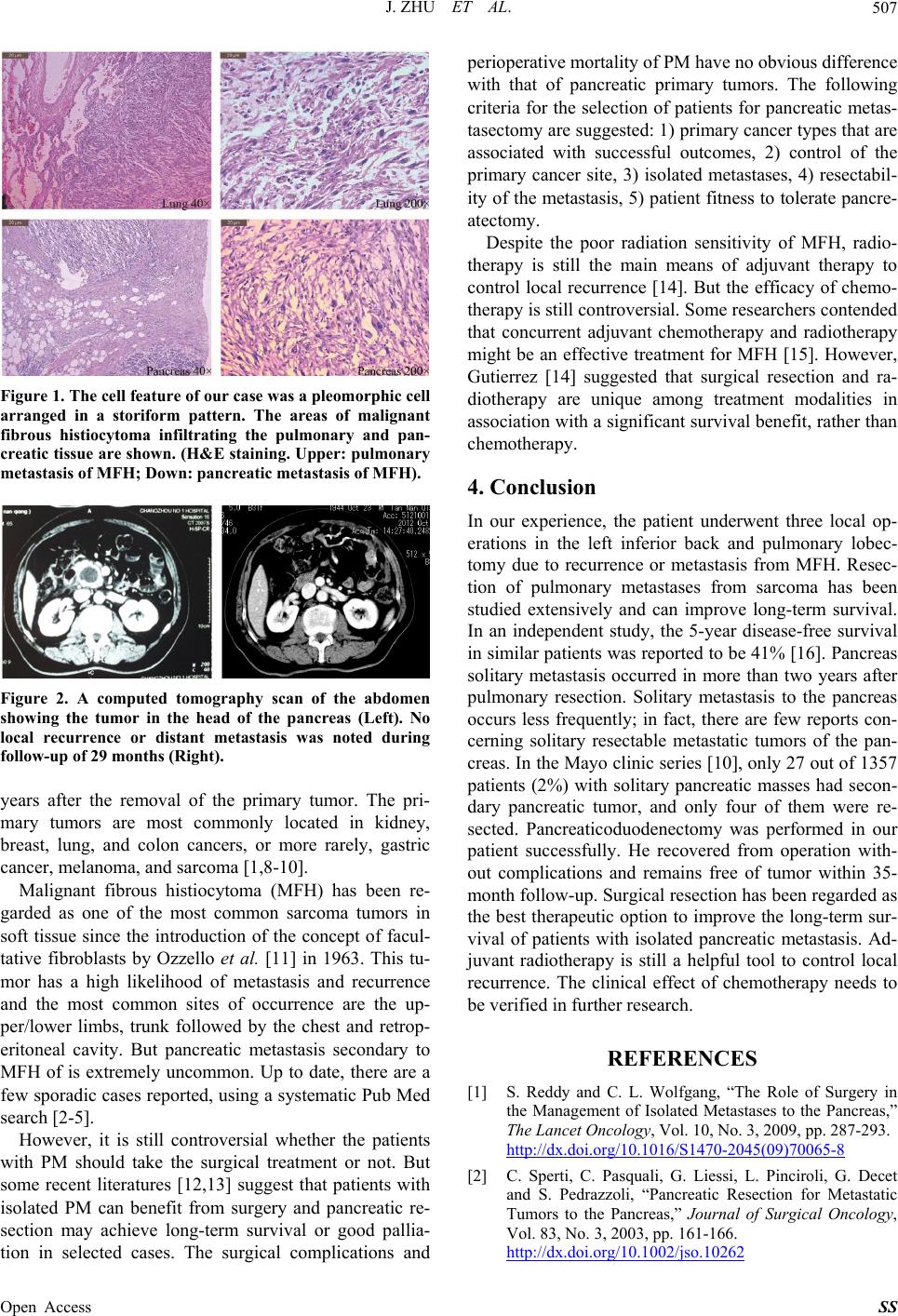 J. ZHU ET AL. 507 Figure 1. The cell feature of our case was a pleomorphic cell arranged in a storiform pattern. The areas of malignant fibrous histiocytoma infiltrating the pulmonary and pan- creatic tissue are shown. (H&E staining. Upper: pulmonary metastasis of MFH; Down: pancreatic metastasis of MFH). Figure 2. A computed tomography scan of the abdomen showing the tumor in the head of the pancreas (Left). No local recurrence or distant metastasis was noted during follow-up of 29 months (Right). years after the removal of the primary tumor. The pri- mary tumors are most commonly located in kidney, breast, lung, and colon cancers, or more rarely, gastric cancer, melanoma, and sarcoma [1,8-10]. Malignant fibrous histiocytoma (MFH) has been re- garded as one of the most common sarcoma tumors in soft tissue since the introduction of the concept of facul- tative fibroblasts by Ozzello et al. [11] in 1963. This tu- mor has a high likelihood of metastasis and recurrence and the most common sites of occurrence are the up- per/lower limbs, trunk followed by the chest and retrop- eritoneal cavity. But pancreatic metastasis secondary to MFH of is extremely uncommon. Up to date, there are a few sporadic cases reported, using a systematic Pub Med search [2-5]. However, it is still controversial whether the patients with PM should take the surgical treatment or not. But some recent literatures [12,13] suggest that patients with isolated PM can benefit from surgery and pancreatic re- section may achieve long-term survival or good pallia- tion in selected cases. The surgical complications and perioperat i ve mortality of PM have no obvious diffe rence with that of pancreatic primary tumors. The following criteria for the selection of patients for pancreatic metas- tasectomy are suggested: 1) primary cancer types that are associated with successful outcomes, 2) control of the primary cancer site, 3) isolated metastases, 4) resectabil- ity of the metastasis, 5) patient fitness to tolerate pancre- atectomy. Despite the poor radiation sensitivity of MFH, radio- therapy is still the main means of adjuvant therapy to control local recurrence [14]. But the efficacy of chemo- therapy is still controversial. Some researchers contended that concurrent adjuvant chemotherapy and radiotherapy might be an effective treatment for MFH [15]. However, Gutierrez [14] suggested that surgical resection and ra- diotherapy are unique among treatment modalities in association with a significant su rvival benefit, rather than chemotherapy. 4. Conclusion In our experience, the patient underwent three local op- erations in the left inferior back and pulmonary lobec- tomy due to recurrence or metastasis from MFH. Resec- tion of pulmonary metastases from sarcoma has been studied extensively and can improve long-term survival. In an independent study, the 5-year disease-free survival in similar patients was reported to be 41% [16]. Pancreas solitary metastasis occurred in more than two years after pulmonary resection. Solitary metastasis to the pancreas occurs less frequently; in fact, there are few reports con- cerning solitary resectable metastatic tumors of the pan- creas. In the Mayo clinic series [10], only 27 out of 1357 patients (2%) with solitary pancreatic masses had secon- dary pancreatic tumor, and only four of them were re- sected. Pancreaticoduodenectomy was performed in our patient successfully. He recovered from operation with- out complications and remains free of tumor within 35- month follow-up. Surgical resection has been regarded as the best therapeutic option to improve the long-term sur- vival of patients with isolated pancreatic metastasis. Ad- juvant radiotherapy is still a helpful tool to control local recurrence. The clinical effect of chemotherapy needs to be verified in further research. REFERENCES [1] S. Reddy and C. L. Wolfgang, “The Role of Surgery in the Management of Isolated Metastases to the Pancreas,” The Lancet Oncology, Vol. 10, No. 3, 2009, pp. 287-293. http://dx.doi.org/10.1016/S1470-2045(09)70065-8 [2] C. Sperti, C. Pasquali, G. Liessi, L. Pinciroli, G. Decet and S. Pedrazzoli, “Pancreatic Resection for Metastatic Tumors to the Pancreas,” Journal of Surgical Oncology, Vol. 83, No. 3, 2003, pp. 161-166. http://dx.doi.org/10.1002/jso.10262 Open Access SS 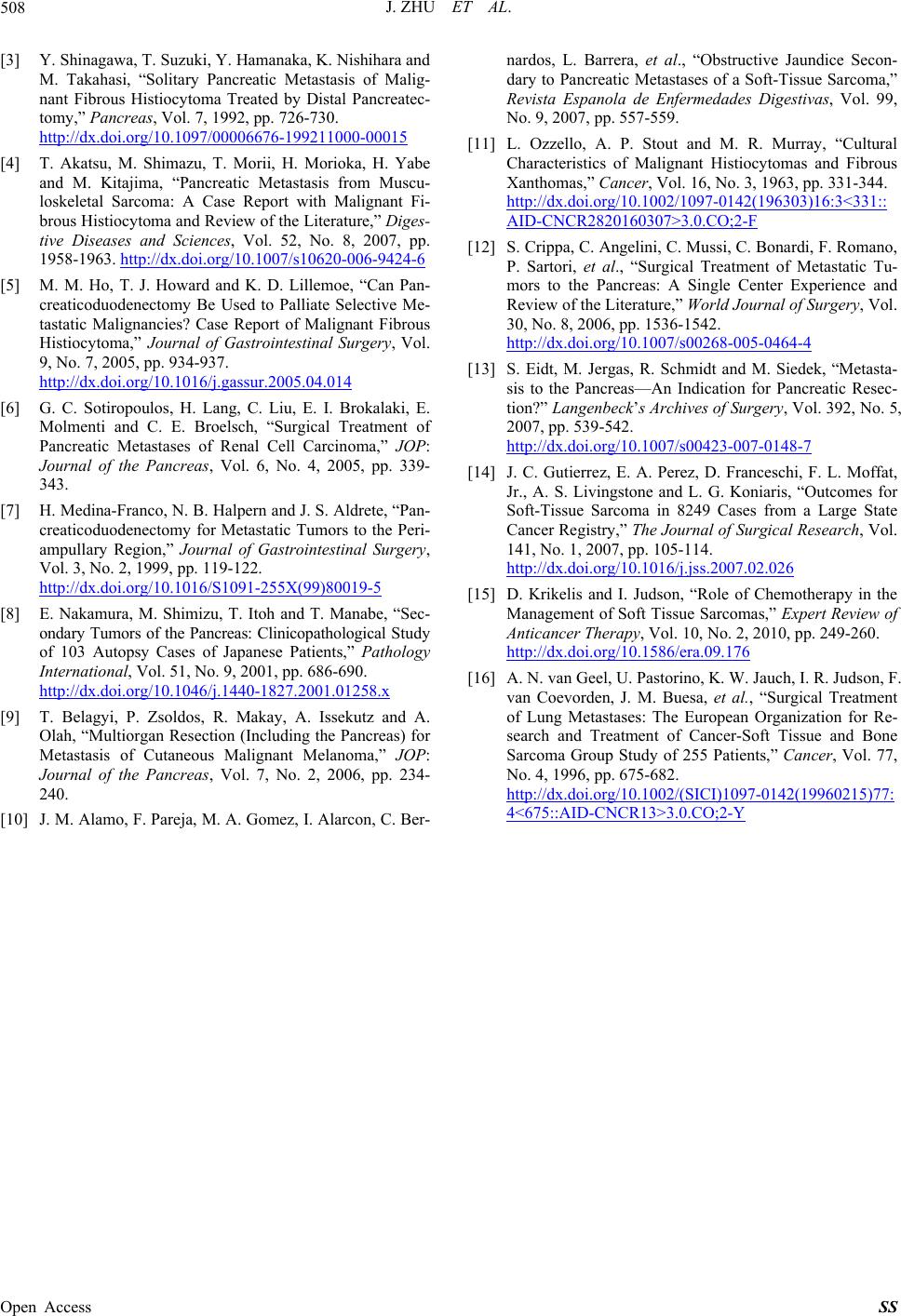 J. ZHU ET AL. Open Access SS 508 [3] Y. Shinagawa, T. Suz uki , Y. Hamanaka, K. Nishihara and M. Takahasi, “Solitary Pancreatic Metastasis of Malig- nant Fibrous Histiocytoma Treated by Distal Pancreatec- tomy,” Pancreas, Vol. 7, 1992, pp. 726-730. http://dx.doi.org/10.1097/00006676-199211000-00015 [4] T. Akatsu, M. Shimazu, T. Morii, H. Morioka, H. Yabe and M. Kitajima, “Pancreatic Metastasis from Muscu- loskeletal Sarcoma: A Case Report with Malignant Fi- brous Histiocytoma and Review of the Literature,” Diges- tive Diseases and Sciences, Vol. 52, No. 8, 2007, pp. 1958-1963. http://dx.doi.org/10.1007/s10620-006-9424-6 [5] M. M. Ho, T. J. Howard and K. D. Lillemoe, “Can Pan- creaticoduodenectomy Be Used to Palliate Selective Me- tastatic Malignancies? Case Report of Malignant Fibrous Histiocytoma,” Journal of Gastrointestinal Surgery, Vol. 9, No. 7, 2005, pp. 934-937. http://dx.doi.org/10.1016/j.gassur.2005.04.014 [6] G. C. Sotiropoulos, H. Lang, C. Liu, E. I. Brokalaki, E. Molmenti and C. E. Broelsch, “Surgical Treatment of Pancreatic Metastases of Renal Cell Carcinoma,” JOP: Journal of the Pancreas, Vol. 6, No. 4, 2005, pp. 339- 343. [7] H. Medina-Franco, N. B. Halpern and J. S. Aldrete, “Pan- creaticoduodenectomy for Metastatic Tumors to the Peri- ampullary Region,” Journal of Gastrointestinal Surgery, Vol. 3, No. 2, 1999, pp. 119-122. http://dx.doi.org/10.1016/S1091-255X(99)80019-5 [8] E. Nakamura, M. Shimizu, T. Itoh and T. Manabe, “Sec- ondary Tumors of the Pancreas: Clinicopatholo gical Stu dy of 103 Autopsy Cases of Japanese Patients,” Pathology International, Vol. 51, No. 9, 2001, pp. 686-690. http://dx.doi.org/10.1046/j.1440-1827.2001.01258.x [9] T. Belagyi, P. Zsoldos, R. Makay, A. Issekutz and A. Olah, “Multiorgan Resection (Including the Pancreas) for Metastasis of Cutaneous Malignant Melanoma,” JOP: Journal of the Pancreas, Vol. 7, No. 2, 2006, pp. 234- 240. [10] J. M. Alamo, F. Pareja, M. A. Gomez, I. Alarcon, C. Ber- nardos, L. Barrera, et al., “Obstructive Jaundice Secon- dary to Pancreatic Metastases of a Soft-Tissue Sarcoma,” Revista Espanola de Enfermedades Digestivas, Vol. 99, No. 9, 2007, pp. 557-559. [11] L. Ozzello, A. P. Stout and M. R. Murray, “Cultural Characteristics of Malignant Histiocytomas and Fibrous Xanthomas,” Cancer, Vol. 16, No. 3, 1963, pp. 331-344. http://dx.doi.org/10.1002/1097-0142(196303)16:3<331:: AID-CNCR2820160307>3.0.CO;2-F [12] S. Crippa, C. Angelini, C. Mussi, C. Bonardi, F. Romano, P. Sartori, et al., “Surgical Treatment of Metastatic Tu- mors to the Pancreas: A Single Center Experience and Review of the Literature,” World Journal of Surgery, Vol. 30, No. 8, 2006, pp. 1536-1542. http://dx.doi.org/10.1007/s00268-005-0464-4 [13] S. Eidt, M. Jergas, R. Schmidt and M. Siedek, “Metasta- sis to the Pancreas—An Indication for Pancreatic Resec- tion?” Langenbeck’s Archives of Surgery, Vol. 392, No. 5, 2007, pp. 539-542. http://dx.doi.org/10.1007/s00423-007-0148-7 [14] J. C. Gutierrez, E. A. Perez, D. Franceschi, F. L. Moffat, Jr., A. S. Livingstone and L. G. Koniaris, “Outcomes for Soft-Tissue Sarcoma in 8249 Cases from a Large State Cancer Registry,” The Journal of Surgical Research, Vol. 141, No. 1, 2007, pp. 105-114. http://dx.doi.org/10.1016/j.jss.2007.02.026 [15] D. Krikelis and I. Judson, “Role of Chemotherapy in the Management of Soft Tissue Sarcomas,” Expert Review of Anticancer Therapy, Vol. 10, No. 2, 2010, pp. 249-260. http://dx.doi.org/10.1586/era.09.176 [16] A. N. van Geel, U. Pastorino, K. W. Jauch, I. R. Judson, F. van Coevorden, J. M. Buesa, et al., “Surgical Treatment of Lung Metastases: The European Organization for Re- search and Treatment of Cancer-Soft Tissue and Bone Sarcoma Group Study of 255 Patients,” Cancer, Vol. 77, No. 4, 1996, pp. 675-682. http://dx.doi.org/10.1002/(SICI)1097-0142(19960215)77: 4<675::AID-CNCR13>3.0.CO;2-Y |