

Paper Menu >>
Journal Menu >>
 Open Journal of Gastroenterology, 2013, 3, 307-310 OJGas http://dx.doi.org/10.4236/ojgas.2013.37053 Published Online November 2013 (http://www.scirp.org/journal/ojgas/) Post-transplant plasma cell hepatitis in a liver transplant patient treated with pegylated interferon plus ribavirin Miguel Jiménez-Pérez, Francisco Javier Rando-Muñoz, Rocío González-Grande, Fernando González-Panizo Tamargo, Jesús de la Cruz Lombardo, Juan Miguel Rodrigo López, Román Manteca González Department of Gastroenterology and Hepatology, Liver Transplantation Unit, University Hospital Carlos Haya, Málaga, Spain Email: [email protected] Received 18 August 2013; revised 25 September 2013; accepted 15 October 2013 Copyright © 2013 Miguel Jiménez-Pérez et al. This is an open access article distributed under the Creative Commons Attribution License, which permits unrestricted use, distribution, and reproduction in any medium, provided the original work is properly cited. ABSTRACT The recurrence of hepatitis C after a liver transplant remains an important cause of graft loss and retrans- plant. Antiviral therapy with peginterferon plus ri- bavirin (PEG-INF/RBV) can achieve a sustained viral response and histological improvement in a high per- centage of cases. However, this treatment is not ex- empt from important side effects or from the possi- bility of precipitating rejection, with the resulting graft loss. We report the case of a liver transplant patient who received treatment with PEG-INF/RBV and developed plasma cell hepatitis as the presenting form of rejection. Keywords: Liver Transplantation; C Hepatitis Treatment; Plasmatic Cells; Allograft Rejection; Autoinmune Response 1. INTRODUCTION Despite the fact that new triple therapy with the associa- tion of proteasa inhibitor has achieved satisfactory re- sponse rates for HCV-Genotype 1, even in liver trans- plant patient, the treatment combination of peginterferon plus ribavirin (PEG-INF/RBV) was the best treatment available in our daily clinical practice in 2010 for relapse of hepatitis C virus (HCV) in liver transplant patients. However, its efficacy and tolerability are somewhat less than in non-transplant patients, and special consideration must be given to the frequency and severity of its side effects, as they may cause important morbidity, which can even lead to graft loss [1,2]. Acute or chronic rejec- tion in association with this treatment is potentially se- vere, though controversial complication, and rates vary considerably between the different studies (0% - 25%) [2-5]. Diagnosis of this complication is often difficult because of its form of presentation and the existence of histological features that are superimposed on other enti- ties, such as recurrent hepatitis C or autoimmune hepati- tis [3,6]. We report the case of a patient who developed plasma cell hepatitis after treatment with PEG-INF/RBV, which we believe was an unusual form of presentation of acute rejection leading to graft loss and the death of the patient. 2. CASE REPORT A 61-year-old man underwent liver transplantation in January 2010 due to hepatic cirrhosis associated with HCV and hepatocarcinoma. When he was enlisted for liver transplantation presented Child-Score of B-7 and MELD-Score of 13, laboratory findings of hypertension portal as well as splenomegaly and pancytopenia that was decisive for not treating with antiviral therapy HCV infection before liver transplantation. After transplanta- tion, immunosuppression theraphy consisted of neoral cycolosporine and steroids that were gradually tapered during the first year. In the immediate post-transplanta- tion liver (LT) period the pacient was keeping a good liver function until the 30th day post-transplantation when laboratory findings reported the result of HCV- RNA 9,290,000 copies per mililiter. Eventually, there was a progressive biochemical and virological worsening which was decisive to perform a liver biopsy in 21th month post-LT, this reported the histological relapse. In that moment, laboratory findings included AST (ami- notransferase) 239 IU/L (15 - 35); ALT (alanine ami- notransferase) 427 IU/L (30 - 65); Ɣ-GT (gamma-glu- tamiltransferase) 185 IU/L (15 - 85); AP (alkaline phos- fatase) 208 IU/L (50 - 135); and HCV RNA, 16,353,000 copies per milliliter (Figure 1). Histologically, a mild interfase hepatitis was reported with focal apoptotic bodies and portal-portal linkage distorsion with periportal fibrosis, OPEN ACCESS 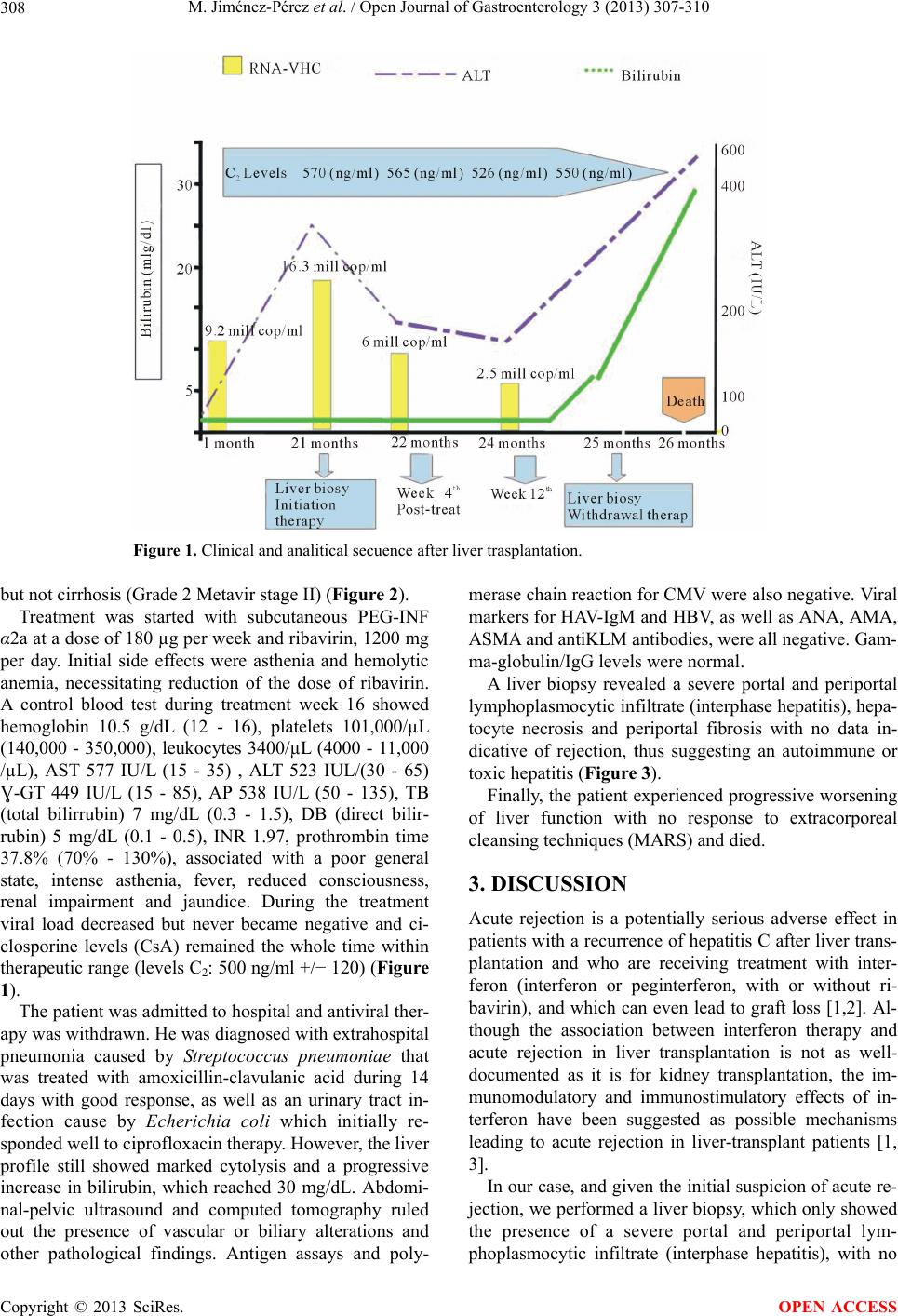 M. Jiménez-Pérez et al. / Open Journal of Gastroenterology 3 (2013) 307-310 308 Figure 1. Clinical and analitical secuence after liver trasplantation. but not cirrhosis (Grade 2 Metavir stage II) (Figure 2). Treatment was started with subcutaneous PEG-INF α2a at a dose of 180 µg per week and ribavirin, 1200 mg per day. Initial side effects were asthenia and hemolytic anemia, necessitating reduction of the dose of ribavirin. A control blood test during treatment week 16 showed hemoglobin 10.5 g/dL (12 - 16), platelets 101,000/µL (140,000 - 350,000), leukocytes 3400/µL (4000 - 11,000 /µL), AST 577 IU/L (15 - 35) , ALT 523 IUL/(30 - 65) Ɣ-GT 449 IU/L (15 - 85), AP 538 IU/L (50 - 135), TB (total bilirrubin) 7 mg/dL (0.3 - 1.5), DB (direct bilir- rubin) 5 mg/dL (0.1 - 0.5), INR 1.97, prothrombin time 37.8% (70% - 130%), associated with a poor general state, intense asthenia, fever, reduced consciousness, renal impairment and jaundice. During the treatment viral load decreased but never became negative and ci- closporine levels (CsA) remained the whole time within therapeutic range (levels C2: 500 ng/ml +/− 120) (Figure 1). The patient was admitted to hospital and antiviral ther- apy was withdrawn. He was diagnosed with extrahospital pneumonia caused by Streptococcus pneumoniae that was treated with amoxicillin-clavulanic acid during 14 days with good response, as well as an urinary tract in- fection cause by Echerichia coli which initially re- sponded well to ciprofloxacin therapy. However, the liver profile still showed marked cytolysis and a progressive increase in bilirubin, which reached 30 mg/dL. Abdomi- nal-pelvic ultrasound and computed tomography ruled out the presence of vascular or biliary alterations and other pathological findings. Antigen assays and poly- merase chain reaction for CMV were also negative. Viral markers for HAV-IgM and HBV, as well as ANA, AMA, ASMA and antiKLM antibodies, were all negative. Gam- ma-globulin/IgG levels were normal. A liver biopsy revealed a severe portal and periportal lymphoplasmocytic infiltrate (interphase hepatitis), hepa- tocyte necrosis and periportal fibrosis with no data in- dicative of rejection, thus suggesting an autoimmune or toxic hepatitis (Figure 3). Finally, the patient experienced progressive worsening of liver function with no response to extracorporeal cleansing techniques (MARS) and died. 3. DISCUSSION Acute rejection is a potentially serious adverse effect in patients with a recurrence of hepatitis C after liver trans- plantation and who are receiving treatment with inter- feron (interferon or peginterferon, with or without ri- bavirin), and which can even lead to graft loss [1,2]. Al- though the association between interferon therapy and acute rejection in liver transplantation is not as well- documented as it is for kidney transplantation, the im- munomodulatory and immunostimulatory effects of in- terferon have been suggested as possible mechanisms leading to acute rejection in liver-transplant patients [1, 3]. In our case, and given the initial suspicion of acute re- jection, we performed a liver biopsy, which only showed the presence of a severe portal and periportal lym- phoplasmocytic infiltrate (interphase hepatitis), with no Copyright © 2013 SciRes. OPEN ACCESS 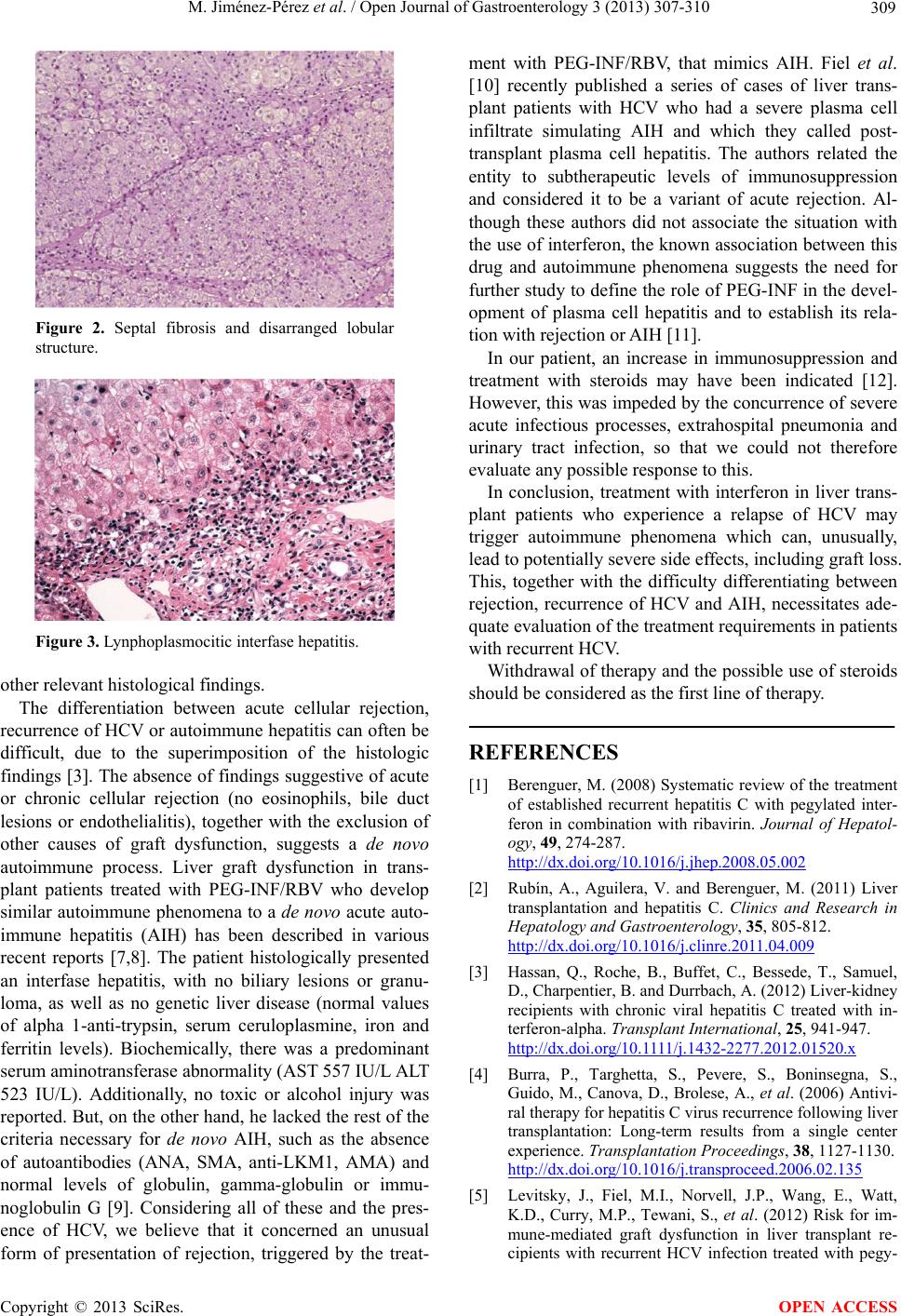 M. Jiménez-Pérez et al. / Open Journal of Gastroenterology 3 (2013) 307-310 309 Figure 2. Septal fibrosis and disarranged lobular structure. Figure 3. Lynphoplasmocitic interfase hepatitis. other relevant histological findings. The differentiation between acute cellular rejection, recurrence of HCV or autoimmune hepatitis can often be difficult, due to the superimposition of the histologic findings [3]. The absence of findings suggestive of acute or chronic cellular rejection (no eosinophils, bile duct lesions or endothelialitis), together with the exclusion of other causes of graft dysfunction, suggests a de novo autoimmune process. Liver graft dysfunction in trans- plant patients treated with PEG-INF/RBV who develop similar autoimmune phenomena to a de novo acute auto- immune hepatitis (AIH) has been described in various recent reports [7,8]. The patient histologically presented an interfase hepatitis, with no biliary lesions or granu- loma, as well as no genetic liver disease (normal values of alpha 1-anti-trypsin, serum ceruloplasmine, iron and ferritin levels). Biochemically, there was a predominant serum aminotransferase abnormality (AST 557 IU/L ALT 523 IU/L). Additionally, no toxic or alcohol injury was reported. But, on the other hand, he lacked the rest of the criteria necessary for de novo AIH, such as the absence of autoantibodies (ANA, SMA, anti-LKM1, AMA) and normal levels of globulin, gamma-globulin or immu- noglobulin G [9]. Considering all of these and the pres- ence of HCV, we believe that it concerned an unusual form of presentation of rejection, triggered by the treat- ment with PEG-INF/RBV, that mimics AIH. Fiel et al. [10] recently published a series of cases of liver trans- plant patients with HCV who had a severe plasma cell infiltrate simulating AIH and which they called post- transplant plasma cell hepatitis. The authors related the entity to subtherapeutic levels of immunosuppression and considered it to be a variant of acute rejection. Al- though these authors did not associate the situation with the use of interferon, the known association between this drug and autoimmune phenomena suggests the need for further study to define the role of PEG-INF in the devel- opment of plasma cell hepatitis and to establish its rela- tion with rejection or AIH [11]. In our patient, an increase in immunosuppression and treatment with steroids may have been indicated [12]. However, this was impeded by the concurrence of severe acute infectious processes, extrahospital pneumonia and urinary tract infection, so that we could not therefore evaluate any possible response to this. In conclusion, treatment with interferon in liver trans- plant patients who experience a relapse of HCV may trigger autoimmune phenomena which can, unusually, lead to potentially severe side effects, including graft loss. This, together with the difficulty differentiating between rejection, recurrence of HCV and AIH, necessitates ade- quate evaluation of the treatment requirements in patients with recurrent HCV. Withdrawal of therapy and the possible use of steroids should be considered as the first line of therapy. REFERENCES [1] Berenguer, M. (2008) Systematic review of the treatment of established recurrent hepatitis C with pegylated inter- feron in combination with ribavirin. Journal of Hepatol- ogy, 49, 274-287. http://dx.doi.org/10.1016/j.jhep.2008.05.002 [2] Rubín, A., Aguilera, V. and Berenguer, M. (2011) Liver transplantation and hepatitis C. Clinics and Research in Hepatology and Gastroenterology, 35, 805-812. http://dx.doi.org/10.1016/j.clinre.2011.04.009 [3] Hassan, Q., Roche, B., Buffet, C., Bessede, T., Samuel, D., Charpentier, B. and Durrbach, A. (2012) Liver-kidney recipients with chronic viral hepatitis C treated with in- terferon-alpha. Transplant International, 25, 941-947. http://dx.doi.org/10.1111/j.1432-2277.2012.01520.x [4] Burra, P., Targhetta, S., Pevere, S., Boninsegna, S., Guido, M., Canova, D., Brolese, A., et al. (2006) Antivi- ral therapy for hepatitis C virus recurrence following liver transplantation: Long-term results from a single center experience. Transplantation Proceedings, 38, 1127-1130. http://dx.doi.org/10.1016/j.transproceed.2006.02.135 [5] Levitsky, J., Fiel, M.I., Norvell, J.P., Wang, E., Watt, K.D., Curry, M.P., Tewani, S., et al. (2012) Risk for im- mune-mediated graft dysfunction in liver transplant re- cipients with recurrent HCV infection treated with pegy- Copyright © 2013 SciRes. OPEN ACCESS  M. Jiménez-Pérez et al. / Open Journal of Gastroenterology 3 (2013) 307-310 Copyright © 2013 SciRes. 310 OPEN ACCESS lated interferon. Gastroenterology, 142, 1132-1139. http://dx.doi.org/10.1053/j.gastro.2012.01.030 [6] Belli, L.S., Volpes, R., Graziadei, I., Fagiouli, S., Starkel, P., Burra, P., Alberti, A.B., et al. (2012) Antiviral therapy and fibrosis progression in patients with mild-moderate hepatitis C recurrence after liver transplantation. A ran- domized controlled study. Digestive and Liver Disease, 44, 603-609. http://dx.doi.org/10.1016/j.dld.2012.01.017 [7] Berardi, S., Lodato, F., Gramenzi, A., D’Errico, A., Lenzi, M., Bontadini, A., Morelli, M.C., et al. (2007) High inci- dence of allograft dysfunction in liver transplanted pa- tients treated with pegylated-interferon alpha-2b and ri- bavirin for hepatitis C recurrence: Posible de novo auto- inmune hepatitis? Gut, 56, 237-242. http://dx.doi.org/10.1136/gut.2006.092064 [8] Fiel, M.I. and Schiano, T.D. (2012) Plasma cell hepatitis (de-novo autoinmune hepatitis) developing post liver transplantation. Current Opinion in Organ Transplanta- tion, 17, 287-292. http://dx.doi.org/10.1097/MOT.0b013e3283536622 [9] Czaja, A. (2008) Performance parameters of the diagnos- tic scoring systems for autoimmune hepatitis. Hepatology, 48, 1540-1548. http://dx.doi.org/10.1002/hep.22513 [10] Fiel, M.I., Agarwal, K., Stanca, C., Elhajj, N., Kontorinis, N., Thung, S.N., Schiano, T.D., et al. (2008) Posttrans- plant plasma cell hepatitis (de novo autoinmune hepatitis) is a variant of rejection and may lead to a negative out- come in patients with hepatitis C virus. Liver Transplan- tation, 14, 861-871. http://dx.doi.org/10.1002/lt.21447 [11] Demetris, A.J. and Sebagh, M. (2008) Plasma cell hepati- tis in liver allografts: Variant of rejection or autoimmune hepatitis? Liver Transplantation, 14, 750-755. http://dx.doi.org/10.1002/lt.21518 [12] Czaja, A.J. (2012) Diagnosis, pathogenesis, and treatment of autoinmune hepatitis after liver transplantation. Diges- tive Diseases and Sciences, 57, 2248-2266. http://dx.doi.org/10.1007/s10620-012-2179-3 ABBREVIATIONS PEG-INF: pegylated interferon; RBV: ribavirin; CMV: cytomegalovirus; HCV: hepatitis C virus; HAV: hepatitis A virus; HBV: hepatitis B virus; ANA: antinuclear antibody; AMA: antimitocondrial antibody; ASMA: anti-smooth muscle antibody; antiKLM: anti-liver/kidney microsomal antibody. |