

Paper Menu >>
Journal Menu >>
 American Journal of Plant Sciences, 2013, 4, 2275-2279 Published Online November 2013 (http://www.scirp.org/journal/ajps) http://dx.doi.org/10.4236/ajps.2013.411281 Open Access AJPS 2275 Attraction of Idioscopus clypealis (Leith) (Cicadellidae: Homoptera) to Sticky Colored Traps in Mango Orchard Shafqat Saeed1*, Muhammad Abrar Amin1*, Qamar Saeed1, Muhammad Farooq2 1Department of Entomology, Faculty of Agricultural Sciences and Technology, Bahauddin Zakariya University, Multan, Pakistan; 2Directorate of Quality Enhancement, Bahauddin Zakariya University, Multan, Pakistan. Email: *[email protected], *[email protected] Received September 4th, 2013; revised October 6th, 2013; accepted October 31st, 2013 Copyright © 2013 Shafqat Saeed et al. This is an open access article distributed under the Creative Commons Attribution License, which permits unrestricted use, distribution, and reproduction in any medium, provided the original work is properly cited. ABSTRACT The present study was conducted at the Faiz Chaman mango orchard, Multan to find out the attraction of mango hopper Idioscopus clypealis to sticky traps of different colors. The experiment was laid out in randomized complete block de- signed with three replications. The sticky traps were hung vertically with the branch/twig under the canopy of mango trees. Data were recorded under binocular stereoscope. Results indicated significant differences in the number of I. cly- pealis (adults) captured in the different colored sticky traps. Yellow color was found most attractive with a capture of highest number of adults of I. clypealis (11.53 adults/trap). While pink and purple colors were found less attractive. The peak population of mango hoppers was recorded at the 31.96˚C during 25-April to 9-May. Yellow sticky traps were found most effective in trapping a considerably higher number of hoppers throughout the study period. Correlation analysis revealed a strong positive correlation between temperature and the mean number of I. clypealis adults. Popula- tion peaks of I. clypealis were recorded at temperatures >30˚C, while at lower temperatures relatively low numbers of adults were recorded. Keywords: Mango Hoppers; Sticky Colored Traps; Mango; Attraction; Idioscopus clypealis 1. Introduction Mango (Magifera indica L.,) is very popular and eco- nomically important. Nearly 87 countries are known for commercial mango production. China, India, Indonesia, Mexico, Pakistan, Philippines and Thailand are well- known as prominent mango producing countries [1]. In Pakistan, mango has a 2nd position among the produc- tion of different fruits [2]. Pakistan is ranked as 5th major producer of mango in the world [3]. Punjab and Sindh are the main provinces for mango production in Pakistan which contribute about 66% and 32.5% in total mango production, while the remaining shares i.e. ≤2% come from Khyber Pakhtun Khaw and Balochistan [4]. Paki- stan is also a 3rd major exporter of mangoes in the world [5]. Middle East, China and Iran are the most important export markets of Pakistani mangoes [6]. Insect pest and diseases are the main factors that affect mango production and yield. Mango hoppers (Idioscopus clypealis Leth., and Amritodus atkinsoni Leth.), midge (Erosomya indica Grover and Prasad), mealybug (Drosi- cha stebbingii Green), scale insect (Aulaca sp is tubercu- laris Newstead), fruit flies (Bactrocera zonata Saunders and B. dorsalis Hendel), thrips (Frankliniella occiden- talis Pergande) and bark beetle (Hypocryphalus mangif- erae Stebbing) are the important insect pests which cause damage to mango in Pakistan [7]. Among these, mango hoppers are serious pests of mango and attack leaves, shoots, inflorescence, flowers and sometimes fruits [8]. Out of 18 species of mango leaf hoppers in the world, Idioscopus clypealis Leith., Amaritodus atkinsoni Leith., I. niveosparsus Leith., and I. nagpurensis Pruthi are the most important [9]. Both nymphs and adults cause damage by egg laying in florets and suck sap from tender vegetative and repro- ductive parts resulting in withering, wilting and drying of these parts [10,11]. Nymphs and adults of mango hop- pers inhabit blossoming and affect fruit setting. The nymphs cause maximum damage by sucking sap and secrete honeydews and as a result interfere with fertiliza- tion of flowers [12]. In case of severe infestation by *Corresponding authors. 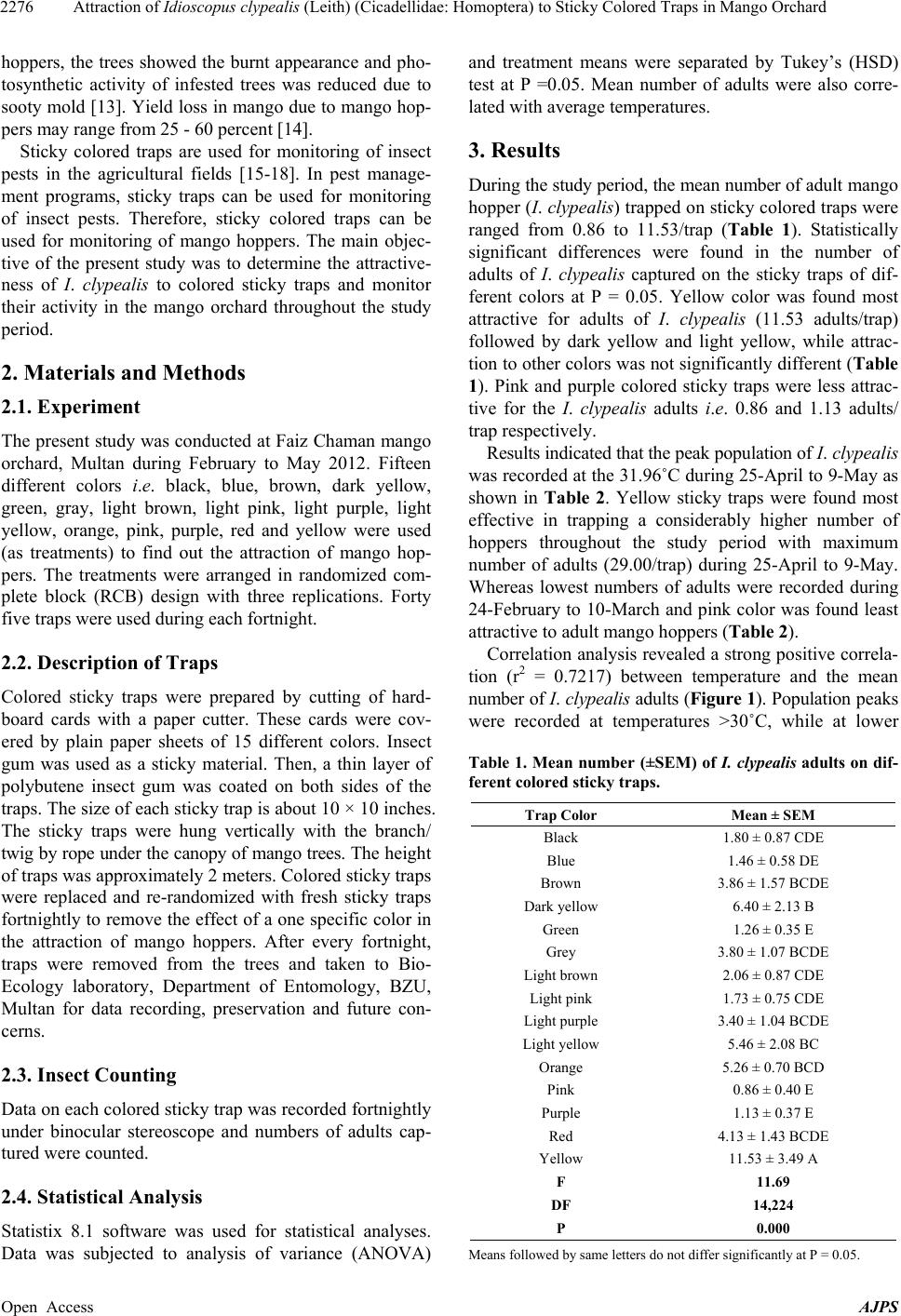 Attraction of Idioscopus clypealis (Leith) (Cicadellidae: Homoptera) to Sticky Colored Traps in Mango Orchard 2276 hoppers, the trees showed the burnt appearance and pho- tosynthetic activity of infested trees was reduced due to sooty mold [13]. Yield loss in mango due to mango hop- pers may range from 25 - 60 percent [14]. Sticky colored traps are used for monitoring of insect pests in the agricultural fields [15-18]. In pest manage- ment programs, sticky traps can be used for monitoring of insect pests. Therefore, sticky colored traps can be used for monitoring of mango hoppers. The main objec- tive of the present study was to determine the attractive- ness of I. clypealis to colored sticky traps and monitor their activity in the mango orchard throughout the study period. 2. Materials and Methods 2.1. Experiment The present study was conducted at Faiz Chaman mango orchard, Multan during February to May 2012. Fifteen different colors i.e. black, blue, brown, dark yellow, green, gray, light brown, light pink, light purple, light yellow, orange, pink, purple, red and yellow were used (as treatments) to find out the attraction of mango hop- pers. The treatments were arranged in randomized com- plete block (RCB) design with three replications. Forty five traps were used during each fortnight. 2.2. Description of Traps Colored sticky traps were prepared by cutting of hard- board cards with a paper cutter. These cards were cov- ered by plain paper sheets of 15 different colors. Insect gum was used as a sticky material. Then, a thin layer of polybutene insect gum was coated on both sides of the traps. The size of each sticky trap is about 10 × 10 inches. The sticky traps were hung vertically with the branch/ twig by rope under the canopy of mango trees. The height of traps was approximately 2 meters. Colored sticky traps were replaced and re-randomized with fresh sticky traps fortnightly to remove the effect of a one specific color in the attraction of mango hoppers. After every fortnight, traps were removed from the trees and taken to Bio- Ecology laboratory, Department of Entomology, BZU, Multan for data recording, preservation and future con- cerns. 2.3. Insect Counting Data on each colored sticky trap was recorded fortnightly under binocular stereoscope and numbers of adults cap- tured were counted. 2.4. Statistical Analysis Statistix 8.1 software was used for statistical analyses. Data was subjected to analysis of variance (ANOVA) and treatment means were separated by Tukey’s (HSD) test at P =0.05. Mean number of adults were also corre- lated with average temperatures. 3. Results During the study period, the mean number of adult mango hopper (I. clypealis) trapped on sticky colored traps were ranged from 0.86 to 11.53/trap (Table 1). Statistically significant differences were found in the number of adults of I. clypealis captured on the sticky traps of dif- ferent colors at P = 0.05. Yellow color was found most attractive for adults of I. clypealis (11.53 adults/trap) followed by dark yellow and light yellow, while attrac- tion to other colors was not significantly different (Table 1). Pink and purple colored sticky traps were less attrac- tive for the I. clypealis adults i.e. 0.86 and 1.13 adults/ trap respectively. Results indicated that the peak population of I. clypealis was recorded at the 31.96˚C during 25-April to 9-May as shown in Table 2. Yellow sticky traps were found most effective in trapping a considerably higher number of hoppers throughout the study period with maximum number of adults (29.00/trap) during 25-April to 9-May. Whereas lowest numbers of adults were recorded during 24-February to 10-March and pink color was found least attractive to adult mango hoppers (Table 2). Correlation analysis revealed a strong positive correla- tion (r2 = 0.7217) between temperature and the mean number of I. c lypealis adults (Figure 1). Population peaks were recorded at temperatures >30˚C, while at lower Table 1. Mean number (±SEM) of I. clypealis adults on dif- ferent colored sticky traps. Trap Color Mean ± SEM Black 1.80 ± 0.87 CDE Blue 1.46 ± 0.58 DE Brown 3.86 ± 1.57 BCDE Dark yellow 6.40 ± 2.13 B Green 1.26 ± 0.35 E Grey 3.80 ± 1.07 BCDE Light brown 2.06 ± 0.87 CDE Light pink 1.73 ± 0.75 CDE Light purple 3.40 ± 1.04 BCDE Light yellow 5.46 ± 2.08 BC Orange 5.26 ± 0.70 BCD Pink 0.86 ± 0.40 E Purple 1.13 ± 0.37 E Red 4.13 ± 1.43 BCDE Yellow 11.53 ± 3.49 A F 11.69 DF 14,224 P 0.000 Means followed by same letters do not differ significantly at P = 0.05. Open Access AJPS 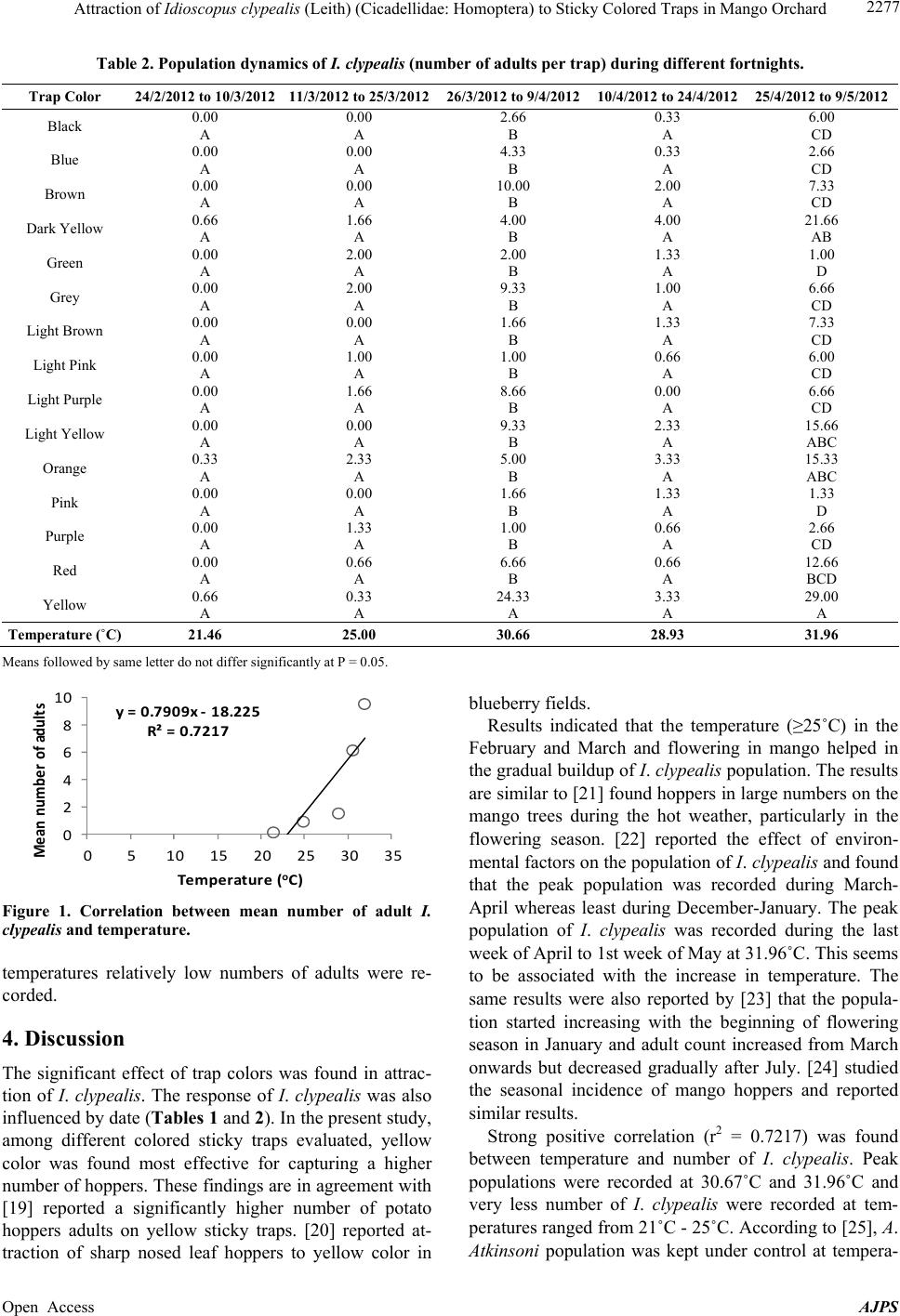 Attraction of Idioscopus clypealis (Leith) (Cicadellidae: Homoptera) to Sticky Colored Traps in Mango Orchard Open Access AJPS 2277 Table 2. Population dynamics of I. clypealis (number of adults per trap) during different fortnights. Trap Color 24/2/2012 to 10/3/2012 11/3/2012 to 25/3/201226/3/2012 to 9/4/201210/4/2012 to 24/4/20 12 25/4/2012 to 9/5/2012 Black 0.00 A 0.00 A 2.66 B 0.33 A 6.00 CD Blue 0.00 A 0.00 A 4.33 B 0.33 A 2.66 CD Brown 0.00 A 0.00 A 10.00 B 2.00 A 7.33 CD Dark Yellow 0.66 A 1.66 A 4.00 B 4.00 A 21.66 AB Green 0.00 A 2.00 A 2.00 B 1.33 A 1.00 D Grey 0.00 A 2.00 A 9.33 B 1.00 A 6.66 CD Light Brown 0.00 A 0.00 A 1.66 B 1.33 A 7.33 CD Light Pink 0.00 A 1.00 A 1.00 B 0.66 A 6.00 CD Light Purple 0.00 A 1.66 A 8.66 B 0.00 A 6.66 CD Light Yellow 0.00 A 0.00 A 9.33 B 2.33 A 15.66 ABC Orange 0.33 A 2.33 A 5.00 B 3.33 A 15.33 ABC Pink 0.00 A 0.00 A 1.66 B 1.33 A 1.33 D Purple 0.00 A 1.33 A 1.00 B 0.66 A 2.66 CD Red 0.00 A 0.66 A 6.66 B 0.66 A 12.66 BCD Yellow 0.66 A 0.33 A 24.33 A 3.33 A 29.00 A Temperature (˚C) 21.46 25.00 30.66 28.93 31.96 Means followed by same letter do not differ significantly at P = 0.05. y=0.7909x‐ 18.225 R²=0.7217 0 2 4 6 8 10 0510 15 20 25 30 35 Meannumberofadults Temp erature( o C) Figure 1. Correlation between mean number of adult I. clypealis and temperature. temperatures relatively low numbers of adults were re- corded. 4. Discussion The significant effect of trap colors was found in attrac- tion of I. clyp ea lis . The response of I. clypealis was also influenced by date (Tables 1 and 2). In the present study, among different colored sticky traps evaluated, yellow color was found most effective for capturing a higher number of hoppers. These findings are in agreement with [19] reported a significantly higher number of potato hoppers adults on yellow sticky traps. [20] reported at- traction of sharp nosed leaf hoppers to yellow color in blueberry fields. Results indicated that the temperature (≥25˚C) in the February and March and flowering in mango helped in the gradual buildup of I. clypealis population. The results are similar to [21] found hoppers in large numbers on the mango trees during the hot weather, particularly in the flowering season. [22] reported the effect of environ- mental factors on the population of I. clypealis and found that the peak population was recorded during March- April whereas least during December-January. The peak population of I. clypea lis was recorded during the last week of April to 1st week of May at 31.96˚C. This seems to be associated with the increase in temperature. The same results were also reported by [23] that the popula- tion started increasing with the beginning of flowering season in January and adult count increased from March onwards but decreased gradually after July. [24] studied the seasonal incidence of mango hoppers and reported similar results. Strong positive correlation (r2 = 0.7217) was found between temperature and number of I. clypealis. Peak populations were recorded at 30.67˚C and 31.96˚C and very less number of I. clypealis were recorded at tem- peratures ranged from 21˚C - 25˚C. According to [25], A. Atkinsoni population was kept under control at tempera-  Attraction of Idioscopus clypealis (Leith) (Cicadellidae: Homoptera) to Sticky Colored Traps in Mango Orchard 2278 tures less than 20˚C and outbreak of the pest could occur between 20˚C - 25˚C. The results are very much similar to [26] reported maximum numbers of mango hopper per shoot during March and positive significant correlation between mango hopper population and temperature. Mild temperature between 28.86˚C - 32.68˚C, relative humid- ity (69 - 80.5 percent) and onset of inflorescence with new flushes of leaves during January-March and Sep- tember to October favored pest multiplication. [27] stud- ied the seasonal abundance of A. atkinsoni and I. cly- pealis on Dasheri and reported that the period from March to May was reasonably favorable for multiplica- tion of these pests and it coincided with the emergence of inflorescence. 5. Findings of the Research Among the different colors of sticky traps tested, yellow color was found most attractive for Idioscopus clypealis. So, yellow color was suggested for monitoring of Idio- scopus clypealis in the mango orchards. Spraying of mango orchards in March with insecticides recommended for Idioscopus clypealis can prevent further buildup and infestations of hopper populations in April. REFERENCES [1] R. N. Tharanathan, H. M. Yashoda and T. N. Prabha, “Mango (Mangifera indica L.), ‘The King of Fruits’— An Overview,” Food Reviews International, Vol. 22, No. 2, 2006, pp. 95-123. http://dx.doi.org/10.1080/87559120600574493 [2] Federal Bureau of Statistics, Government of Pakistan, Karachi, Pakistan, 2010-2011. http://www.pbs.gov.pk/sites/default/files/agriculture_stati stics/publications/Agricultural_Statistics_of_Pakistan_20 1011/tables/table46.pdf [3] FAOSTAT, Food and Agriculture Organization of the United Nations, FAOSTAT-Production: Countries by Commodity, Crop., 2013. http://faostat3.fao.org/home/index.html#DOWNLOAD [4] S. R. A. Khan, “Management in Mango Production,” Hort. Manag, Vol. 12, 2005, pp. 6-7. [5] M. Shahnawz, S. A. Sheikh and S. G. Khaskheli, “Effect of Storage on the Physicochemical Characteristics of the Mango (Mangifera indica L.) Variety, Langra,” African Journal of Biotechnology, Vol. 11, No. 41, 2012, pp 9825- 9828. [6] “Fruit, Vegetable and Condiment Statistics of Pakistan,” Ministry of Food, Agriculture and Livestock. Government of Pakistan, Islamabad, 2004-2005. [7] A. I. Mohyuddin and R. Mahmood, “Integrated Control of Mango Pests in Pakistan,” Acta Horticulturae, Vol. 341, 1993, pp. 467-487. [8] N. M. Das, K. S. Ramamany and M. R. G. K. Nair, “Bi- ology of a New Jassid of Mango Amrasca splendens Gauri,” Indian Journal of Entomology, Vol. 31, No. 3, 1969, pp 288-290. [9] A. H. Soomro, R. D. Khuhro and H. U. Ansari, “Status of Insects Associated with Mango Blossom,” Proceedings 5th Pakistan Congress of Zoology, University of Karachi, 8-11 June 1986, Karachi, pp.123-125. [10] A. S. Atwal, “Agricultural Pests of India and South East Asia,” Kalyani Publishers, Ludhiana, 1976, p. 502. [11] D. K. Butani, “Insects and Fruits,” Periodical Experts Book Agency, New Delhi, 1979, p. 415. [12] A. C. Sen and D. Prasad, “Experiments with New Syn- thetic Insecticides for the Control of Mango Hoppers in Bihar,” Indian Journal of Entomology, Vol. 16, No. 3, 1954, pp. 234-246. [13] A. C. Sen and D. P. Chaudhari, Indian Agriculturist, Vol. 5, No. 1, 1961, pp. 85-86. [14] P. B. Patil, R. S. Giraddi and B. S. Goudreddy, “Tree Hoppers Infesting Mango Seedlings and Its Control,” A.R.S. India, Vol. 22, 1988, pp. 12-14. [15] R. J. Prokopy and E. D. Owens, “Visual Detection of Plants by Herbivorous Insects,” Annual Review of Entomology, Vol. 28, 1983, pp. 337-364. http://dx.doi.org/10.1146/annurev.en.28.010183.002005 [16] D. E. Meyerdirk and D. S. Moreno, “Flight Behavior and Colour Trap Preference of Parabemesia myricae (Ku- wana) (Homoptera: Aleyrodidae) in Citrus Orchard,” En- vironmental Entomology, Vol. 13, 1984, pp. 167-170. [17] A. L. Knight and E. Miliczky, “Influence of Trap Colour on the Capture of Codling Moth (Lepidoptera: Tortrici- dae), Honeybees, and Non-Target Flies,” Journal of Brit- ish Columbia Entomological Society, Vol. 100, 2003, pp 65-70. [18] E. Atakan and R. Canhilal, “Evaluation of Yellow Sticky Traps at Various Heights for Monitoring Cotton Insect Pests,” Journal of Agricuture and Urban Entomoloy, Vol. 21, 2004, pp. 15-24. [19] T. A. DeGooyer, L. P. Pedigo and E. R. Marlin, “Devel- opment of Sticky Trap Sampling Technique for Potato Leafhopper Adults,” Journal of Agricultural Entomology, Vol. 15, No. 1, 1998, pp. 33-37. [20] J. R. Meyer and S. A. Colvin, “Diel Periodicity and Trap bias in Sticky Trap Sampling of Sharpnosed Leafhopper Populations,” Journal of Entomology and Science, Vol. 20, No. 2, 1985, pp. 237-243. [21] H. M. Lefroy, “Indian Insect Pest. Today and Tomor- row,” Printers and Publishers, New Delhi, 1906, p. 786. [22] P. L. Tandon, B. Lal and G. S. P. Rao, “Prediction of the Mango Hoppers Idioscopus clypealis (Lethierry) Popula- tion in Relation to Physical Environmental Factors,” Jour- nal of Entomology, Vol. 8, 1983, pp. 257-261. [23] R. K. Patel, “Population Behaviour (Sex-Ratio) of Mango Hopper, Amritodus atkinsoni Leth (Jassidae: Homoptera) and Their Parasitism under Prevailing Temperature and Humidity under Field Conditions in South Gujurat,” In- dian Journal of Entomology, Vol. 52, 1990, pp. 393-396. [24] C. S. Dalvi and R. B. Dumbre, “Breeding and Seasonal Incidence of Mango Hoppers,” Bulletin of Entomology, Open Access AJPS  Attraction of Idioscopus clypealis (Leith) (Cicadellidae: Homoptera) to Sticky Colored Traps in Mango Orchard Open Access AJPS 2279 Vol. 35, 1994, pp. 1008-1010. [25] A. M. Sheikh, H. C. Ratanpara, J. R. Patel and S. N. Patel, “Effect of Weather on Mango Hopper Population in Mid- dle Gujarat,” Rainfed Agricultural Research Newsletter, Vol. 2, No. 3, 1993, pp. 2-3. [26] M. A. Talpur, R. D. Khuhro and I. A. Nizamani, “Pheno- logical Relationship between Mango Hoppers Idioscopus spp and Mango Inflorescence/Fruit,” Pakistan Journal of Applied Sciences, Vol. 2, No. 5, 2002, pp 533-536. http://dx.doi.org/10.3923/jas.2002.533.536 [27] J. S. Khangura, et al. In: National Symposium on Mango Production and Export, Lucknow, 25-27 June 1998, Cen- tral Institute of Subtropical Horticulture, Lucknow, p. 58. |