

Paper Menu >>
Journal Menu >>
 American Journal of Plant Sciences, 2013, 4, 2271-2274 Published Online November 2013 (http://www.scirp.org/journal/ajps) http://dx.doi.org/10.4236/ajps.2013.411280 Open Access AJPS 2271 Effect of 24-Epibrassinolide on Growth of in Vitro Shoot Tips of Different Yam (Dioscorea Spp.) Species Isabelle Engelmann-Sylvestre, Florent Engelmann IRD, UMR DIADE, Agropolis, Montpellier, France. Email: florent.en[email protected] Received September 26th, 2013; revised October 29th, 2013; accepted November 10th, 2013 Copyright © 2013 Isabelle Engelmann-Sylvestre, Florent Engelmann. This is an open access article distributed under the Creative Commons Attribution License, which permits unrestricted use, distribution, and reproduction in any medium, provided the original work is properly cited. ABSTRACT In this work we compared the effect of the growth regulator content of the culture medium on the growth of in vitro shoot tips of five yam accessions belonging to four yam species (one Dioscorea alata, one D. rotundata, one D. cay- enensis and two D. trifida). Medium S contained 0.6 µM benzyl adenine, 1.07 µM naphthalene acetic acid and 0.23 µM gibberellic acid while medium EBR contained 0.23 µM gibberellic acid and 0.1 µM 24-epibrassinolide. After 2 months of culture, oxidation level was significantly reduced on medium EBR compared to medium S for four of the five acces- sions tested. By contrast, medium EBR did not have any positive effect on shoot length since length of shoots produced after 2 months of culture on medium S and EBR were similar, except with accession 3-45T, for which shoot length was shorter on medium S compared to medium EBR. These results underline the potential of 24-epibrassinolide to reduce oxidation phenomena during in vitro culture and call for its utilization for regeneration of cryopreserved yam shoot tips, which is often impeded by oxidation phenomena. Keywords: Yam; Dioscorea Spp.; 24-Epibrassinolide; Oxidation; Shoot Tip; In Vitro Culture; Cryopreservation 1. Introduction Cryopreservation (liquid nitrogen, −196˚C) currently is the only safe and cost-effective option for long-term conservation of vegetatively propagated plants such as yam [1]. Indeed, at this temperature, all cell divisions stop and metabolism is virtually arrested. Explants can thus be conserved for extended periods (several thousand years) without modification or alteration, sheltered from contamination, in a limited volume and with reduced maintenance. Cryopreservation protocols have been developed for Dioscorea alata, D. cayenensis, D. rotundata and D. floribunda shoot tips using different techniques [2-7]. A droplet-vitrification protocol jointly established by the International Institute of Tropical Agriculture (IITA, Ibadan, Nigeria) and our laboratory has been applied to a total of 42 D. cayenensis, D. rotundata, D. alata, D. bul- bifera and D. mangotiana accessions, with an average recovery of 29% (Gueye et al. unpublished results). Cryopreservation experiments performed in IRD Mont- pellier with American yam (D. trifida) shoot tips showed that, even though positive results were obtained, no re- producible protocol was yet available for this species (Engelmann-Sylvestre et al. unpublished results). In all these reports, the authors mentioned that if high survival could be consistently achieved, regeneration of whole plantlets from cryopreserved shoot tips was variable, depending on the species and the technique used, and was generally much lower than survival. The occurrence of severe oxidation phenomena was also consistently re- ported. In order to optimize the regrowth rate and pattern of D. trifida shoot tips, an experiment was performed recently with one D. trifida accession (N˚ 278) to compare the effect of the recovery medium used after their cryopre- servation, which included 6-benzylaminopurine (BAP), naphthalene acetic acid (NAA) and gibberellic acid (GA3), with media in which BAP and NAA were re- placed by 24-epibrassinolide (EBR), zeatine riboside or meta-topolin [8]. This experiment showed that EBR in- duced the production of well developed shoots and sig- nificantly reduced oxidation compared to the other media tested. EBR belongs to brassinosteroids (BRs), a class of  Effect of 24-Epibrassinolide on Growth of in Vitro Shoot Tips of Different Yam (Dioscorea Spp.) Species 2272 plant steroid hormones, which possess significant growth- controlling activity, and are involved in the promotion of cell elongation, cell division, differentiation, disease re- sistance, stress tolerance, and senescence throughout the plant life cycle. BRs have been reported to help modu- lating the plant antioxidant defence system and thus scavenging the free radicals and help the plant protecting itself from oxidative stress [9] and have also been found to have an activity in vitro. They were reported to in- crease the rate of cell division and colony formation of Chinese cabbage mesophyll protoplasts [10] and Petunia hybrida protoplasts [11]. BRs are also proved to be es- sential for the differentiation of isolated Zinnia mesophyll cells into tracheary elements [12] and in the morpho- genesis of Arabidopsis [13]. In this study, we compared the regrowth of shoot tips of a total of five yam accessions including one D. cayenensis, D. rotundata and D. alata accession and two D. trifida accessions on medium containing EBR and GA3, or BAP, NAA and GA3, which are the plant growth regulators (PGRs) usually added to the regeneration medium after cryopreservation of yam shoot tips. Our objective was to observe if the EBR-containing growth medium which had been successfully employed with D. trifida accession N˚ 278 [8] was also effective with other D. trifida accessions and accessions of the other yam species selected. 2. Materials and Methods 2.1. Plant Material This study was performed using in vitro shoot cultures of three yam accessions provided by the International Insti- tute of Tropical Agriculture (IITA, Ibadan, Nigeria) in- cluding accessions N˚ 1454 (D. alata), N˚ 2790 (D. cay- enensis) and N˚ 3675 (D. rotundata) and of two acces- sions provided by the Institut National de la Recherche Agronomique (INRA) Guadeloupe, French West Indies (D. trifida accessions N˚ 278 and 3-45T). 2.2. Methods Mother-plants were subcultured every 3 - 5 months on medium containing Murashige and Skoog [14] basal salts and vitamins, 3% sucrose, 0.2% activated charcoal and 0.7% agar. The pH was adjusted to 5.8 ± 0.1 and the me- dium was autoclaved for 20 min at 120˚C. Cultures were maintained at 27˚C ± 1˚C under a 12 h light/12 h dark photoperiod and a light intensity of 50 µmol·m−2·s−1. Single node cultures were transferred to yam multipli- cation medium consisting of MS basal salts and vitamins [14], 0.476 µM KIN, 0.164 µM L-cysteine, 3% sucrose and 0.7% agar. After 3 weeks, shoot tips (approx. 1 - 2 mm in length) were excised under the binocular micro- scope and used for experiments. Half of the shoot tips were cultured on medium S, which was used for regeneration of yam shoot tips after cryopreservation, which consisted of MS mineral salts and vitamins [14], 0.164 µM L-cysteine, 0.22 mM ade- nine hemisulfate, 0.6 µM BAP, 1.07 µM NAA, 0.23 µM GA3 (filter-sterilized), 3% sucrose and 0.7% agar. The other half of the shoot tips was cultured on me- dium EBR, consisting of MS mineral salts and vitamins [14], 0.164 µM L-cysteine, 0.22 mM adenine hemisulfate, 0.23 µM GA3 (filter-sterilized), 0.1 µM 24-epibrassino- lide (Sigma-Aldrich ref E1641, filter-sterilized), 3% su- crose and 0.7% agar. Shoot tips were kept in the dark for 1 week, and then transferred to the culture conditions employed for mother-plants. 2.3. Observations Performed and Statistical Analysis of Results The experiment was performed once, with three repli- cates of 10 shoot tips per experimental condition. After 1 and 2 months of culture on medium S or EBR, the size of shoot tips (mm) was measured and the oxidation level was evaluated using a scale from 0 (no oxidation) to 3 (very high oxidation). One-way ANOVA was performed to compare the growth of shoot tips and oxidation levels on medium S and EBR. Means were statistically differ- entiated using Duncan test at a significance level of Po < 0.05. 3. Results When comparing the growth of shoot tips of the five ac- cessions studied on the two culture media tested, it ap- peared that accessions 278 and 2790 had a lower growth compared to the other three accessions on both S and EBR medium (Table 1). Studying the effect of the cul- ture medium on the growth of each individual accession revealed that shoot length was lower after 1 month on medium S compared to medium EBR for three acces- sions (1454, 278 and 3-45T). By contrast, no differences in shoot length were observed after 2 months of culture on medium S and EBR, except with accession 3-45T, for which shoot length was lower on medium S compared to medium EBR. When comparing the effect of culture medium on oxi- dation level, it was observed that accessions reacted dif- ferently depending on the culture medium and the culture duration (Table 2). After 1 month on medium S, oxida- tion was significantly lower in accessions 2790 and 3675, compared to the other three accessions. After 2 months on medium S, oxidation remained significantly lower in accession 2790, and was comparably higher in the four other accessions. After 1 and 2 months on medium EBR, oxidation was significantly higher in accession 1454 compared to the other four accessions studied. When Open Access AJPS 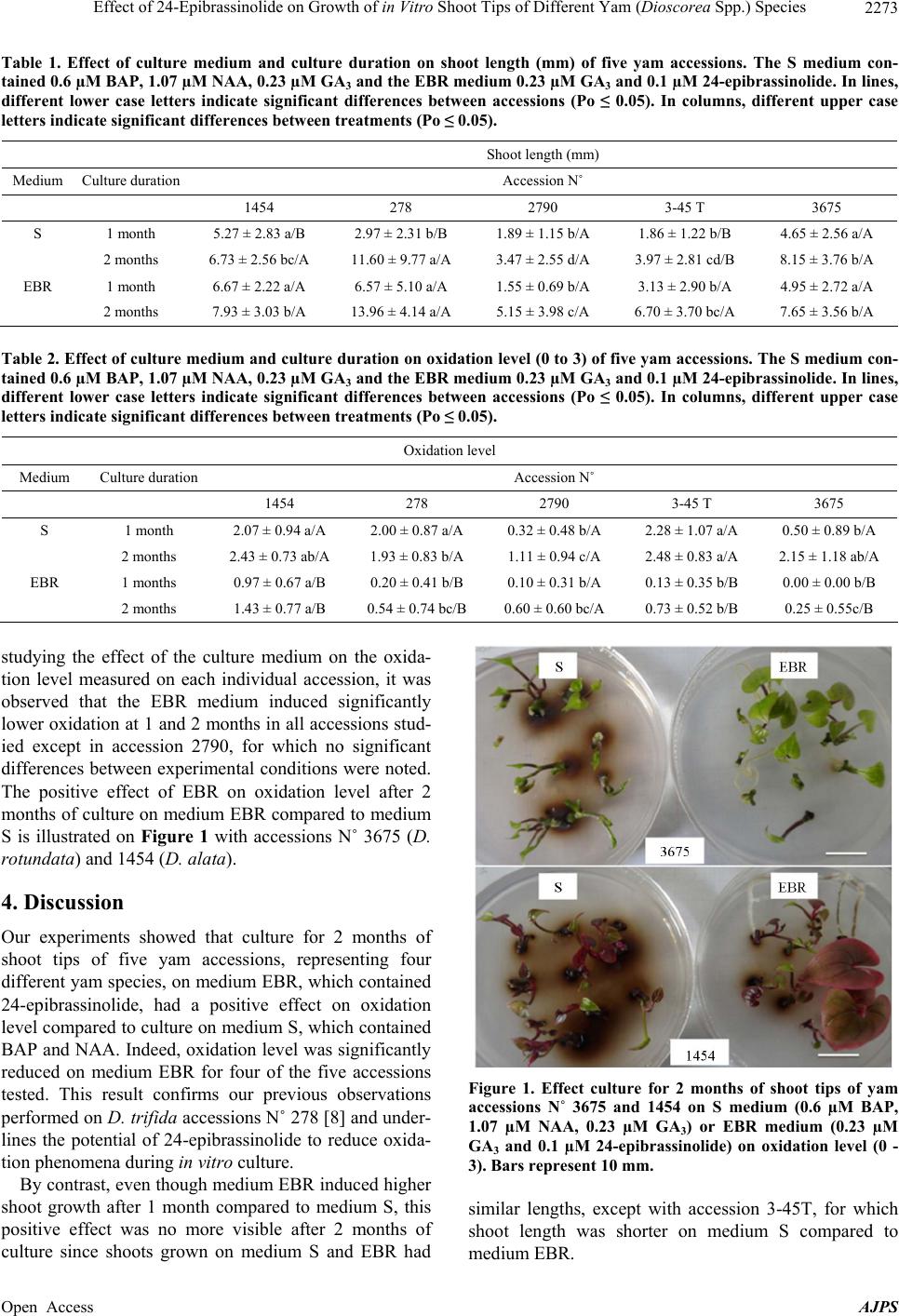 Effect of 24-Epibrassinolide on Growth of in Vitro Shoot Tips of Different Yam (Dioscorea Spp.) Species Open Access AJPS 2273 Table 1. Effect of culture medium and culture duration on shoot length (mm) of five yam accessions. The S medium con- tained 0.6 µM BAP, 1.07 µM NAA, 0.23 µM GA3 and the EBR medium 0.23 µM GA3 and 0.1 µM 24-epibrassinolide. In lines, different lower case letters indicate significant differences between accessions (Po ≤ 0.05). In columns, different upper case letters indicate significant differences between treatments (Po ≤ 0.05). Shoot length (mm) Medium Culture duration Accession N˚ 1454 278 2790 3-45 T 3675 S 1 month 5.27 ± 2.83 a/B 2.97 ± 2.31 b/B 1.89 ± 1.15 b/A 1.86 ± 1.22 b/B 4.65 ± 2.56 a/A 2 months 6.73 ± 2.56 bc/A 11.60 ± 9.77 a/A 3.47 ± 2.55 d/A 3.97 ± 2.81 cd/B 8.15 ± 3.76 b/A EBR 1 month 6.67 ± 2.22 a/A 6.57 ± 5.10 a/A 1.55 ± 0.69 b/A 3.13 ± 2.90 b/A 4.95 ± 2.72 a/A 2 months 7.93 ± 3.03 b/A 13.96 ± 4.14 a/A 5.15 ± 3.98 c/A 6.70 ± 3.70 bc/A 7.65 ± 3.56 b/A Table 2. Effect of culture medium and culture duration on oxidation level (0 to 3) of five yam accessions. The S medium con- tained 0.6 µM BAP, 1.07 µM NAA, 0.23 µM GA3 and the EBR medium 0.23 µM GA3 and 0.1 µM 24-epibrassinolide. In lines, different lower case letters indicate significant differences between accessions (Po ≤ 0.05). In columns, different upper case letters indicate significant differences between treatments (Po ≤ 0.05). Oxidation level Medium Culture duration Accession N˚ 1454 278 2790 3-45 T 3675 S 1 month 2.07 ± 0.94 a/A 2.00 ± 0.87 a/A 0.32 ± 0.48 b/A 2.28 ± 1.07 a/A 0.50 ± 0.89 b/A 2 months 2.43 ± 0.73 ab/A 1.93 ± 0.83 b/A 1.11 ± 0.94 c/A 2.48 ± 0.83 a/A 2.15 ± 1.18 ab/A EBR 1 months 0.97 ± 0.67 a/B 0.20 ± 0.41 b/B 0.10 ± 0.31 b/A 0.13 ± 0.35 b/B 0.00 ± 0.00 b/B 2 months 1.43 ± 0.77 a/B 0.54 ± 0.74 bc/B 0.60 ± 0.60 bc/A 0.73 ± 0.52 b/B 0.25 ± 0.55c/B studying the effect of the culture medium on the oxida- tion level measured on each individual accession, it was observed that the EBR medium induced significantly lower oxidation at 1 and 2 months in all accessions stud- ied except in accession 2790, for which no significant differences between experimental conditions were noted. The positive effect of EBR on oxidation level after 2 months of culture on medium EBR compared to medium S is illustrated on Figure 1 with accessions N˚ 3675 (D. rotundata) and 1454 (D. alata). 4. Discussion Our experiments showed that culture for 2 months of shoot tips of five yam accessions, representing four different yam species, on medium EBR, which contained 24-epibrassinolide, had a positive effect on oxidation level compared to culture on medium S, which contained BAP and NAA. Indeed, oxidation level was significantly reduced on medium EBR for four of the five accessions tested. This result confirms our previous observations performed on D. trifida accessions N˚ 278 [8] and under- lines the potential of 24-epibrassinolide to reduce oxida- tion phenomena during in vitro culture. Figure 1. Effect culture for 2 months of shoot tips of yam accessions N˚ 3675 and 1454 on S medium (0.6 µM BAP, 1.07 µM NAA, 0.23 µM GA3) or EBR medium (0.23 µM GA3 and 0.1 µM 24-epibrassinolide) on oxidation level (0 - 3). Bars represent 10 mm. By contrast, even though medium EBR induced higher shoot growth after 1 month compared to medium S, this positive effect was no more visible after 2 months of culture since shoots grown on medium S and EBR had similar lengths, except with accession 3-45T, for which shoot length was shorter on medium S compared to medium EBR.  Effect of 24-Epibrassinolide on Growth of in Vitro Shoot Tips of Different Yam (Dioscorea Spp.) Species 2274 It has been demonstrated in numerous species that modifying the PGR composition of the recovery medium can have a dramatic effect on regrowth of cryopreserved plant material [1]. Notably, alteration of post-cryopreservation culture media with PGRs and their application at various stages of growth recovery was crucial for regeneration of shoot tips and formation of in vitro plantlets in D. alata and D. bulbifera [5,7]. A recent report showed that the addition of vitamin E, vitamin C or both vitamins together, which have antioxidant properties, at different steps of the pro- tocol (pre- and/or post-cryopreservation) had a positive effect on regrowth of cryopreserved blackberry shoot tips [15]. In view of the potential of the PGR 24-epibrassinolide in reducing oxidation, which has been shown in this work, experiments will be performed to test its effect on regrowth of cryopreserved yam shoot tips using the five accessions employed in this study. 5. Acknowledgements This work has received financial support from ARCAD, a flagship programme of Agropolis Fondation (Montpel- lier, France) (I. Engelmann-Sylvestre). The assistance of Giuseppe Barraco for performing the statistical analysis of results is acknowledged. REFERENCES [1] F. Engelmann, “Plant Cryopreservation: Progress and Prospects,” In Vitro Cellular & Developmental Biology— Plant, Vol. 40, No. 5, 2004, pp. 427-433. [2] B. B. Mandal, K. P. S. Chandel and S. Dwivedi, “Cryo- preservation of Yam (Dioscorea spp.) Shoot Apices by Encapsulation-Dehydration,” Cryo Letters, Vol. 17, No. 3, 1996, pp. 165-174. [3] B. Malaurie, M. F. Trouslot, F. Engelmann and N. Chabrillange, “Effect of Pretreatment Conditions on the Cryopreservation of in Vitro Cultured Yam (Dioscorea alata and D. bulbifera) Shoot Apices by Encapsulation- Dehydration,” Cryo Letters, Vol. 19, No. 1, 1998, pp. 15- 26. [4] S. Leunufna and E. R. J. Keller, “Cryopreservation of Yam Using Vitrification Modified by Including Droplet Method: Effects of Cold Acclimation and Sucrose,” Cryo Letters, Vol. 26, No. 2, 2005, pp. 93-102. [5] B. B. Mandal and S. Ahuja-Ghosh, “Regeneration of Dio- scorea floribunda Plants from Cryopreserved Encapsu- lated Shoot Tips: Effect of Plant Growth Regulators,” Cryo Letters, Vol. 28, No. 5, 2007, pp. 329-336. [6] B. B. Mandal, S. Ahuja-Ghosh and P. S. Srivastava, “Cryopreservation of Dioscorea rotundata Poir.: A Com- parative Study with Two Cryogenic Procedures and As- sessment of True-to-Type of Regenerants by RAPD Analysis,” Cryo Letters, Vol. 29, No. 5, 2008, pp. 399- 408. [7] P. Mukherjee, B. B. Mandal, K. V. Bhat and A. K. Biswas, “Cryopreservation of Asian Yam Dioscorea bulbifera and D. alata by Vitrification: Importance of Plant Growth Regulators,” Cryo Letters, Vol. 30, No. 2, 2009, pp. 100- 111. [8] Engelmann-Sylvestre and F. Engelmann, “Effect of Vari- ous Growth Regulators on Growth of Yam (Dioscorea trifida L.) in Vitro Shoot Tips,” African Journal of Bio- technology, submitted. [9] A. Verma, C. P. Malik and V. K. Gupta, “In Vitro Effects of Brassinosteroids on the Growth and Antioxidant En- zyme Activities in Groundnut,” ISRN Agronomy, Vol. 2012, 2012, Article ID: 356485. http://dx.doi.org/10.5402/2012/356485 [10] N. Nakajima, A. Shida and S. Toyama, “Effects of Brass- inosteroid on Cell Division and Colony Formation of Chinese Cabbage Mesophyll Protoplasts,” Japanese Jour- nal of Crop Science, Vol. 65, No. 1, 1996, pp. 114-118. http://dx.doi.org/10.1626/jcs.65.114 [11] M. H. Oh and S. D. Clouse, “Brassinolide Affects the Rate of Cell Division in Isolated Leaf Protoplasts of Pe- tunia hybrida,” Plant Cell Reports, Vol. 17, No. 12, 1998, pp. 921-924. http://dx.doi.org/10.1007/s002990050510 [12] T. Iwasaki and H. Shibaoka, “Brassinosteroids Act as Regulators of Tracheary-Element Differentiation in Iso- lated Zinnia Mesophyll Cells,” Plant Cell Physiology, Vol. 32, No. 7, 1991, pp. 1007-1014. [13] J. Li, P. Nagpal, V. Vitart, T. C. McMorris and J. Chory, “A Role for Brassinosteroids in Light-Dependent Devel- opment of Arabidopsis,” Science, Vol. 272, No. 5260, 1996, pp. 398-401. http://dx.doi.org/10.1126/science.272.5260.398 [14] T. Murashige and F. Skoog, “A Revised Medium for Rapid Growth and Bioassays with Tobacco Tissue Cul- tures,” Physiologia Plantarum, Vol. 15, No. 3, 1962, pp. 473-497. http://dx.doi.org/10.1111/j.1399-3054.1962.tb08052.x [15] E. E. Uchendu, M. Muminova, S. Gupta and B. M. Reed, “Antioxidant and Anti-Stress Copmounds Improve Re- growth of Cryopreserved Rubus Shoot Tips,” In Vitro Cellular & Developmental Biology—Plant, Vol. 46, No. 4, 2010, pp. 386-393. http://dx.doi.org/10.1007/s11627-010-9292-9 Open Access AJPS |