

Paper Menu >>
Journal Menu >>
 Journal of Cancer Therapy, 2013, 4, 1429-1434 Published Online November 2013 (http://www.scirp.org/journal/jct) http://dx.doi.org/10.4236/jct.2013.49170 Open Access JCT 1429 Is Post Operative Radiotherapy Justified for Completely Resected Locally Advanced Renal Cell Cancers? Reham Abdulmoniem1,2, Tarek Haikal3, Hossam Darwiesh3 1Radiation Oncology Department, National Cancer Institute, Cairo University, Cairo, Egypt; 2Comprehensive Cancer Center, King Fahad Medical City, Riyadh, Saudi Arabia; 3Medical Oncology Department, Damietta Cancer Institute, Ministry of Health, Damietta, Egypt. Email: [email protected] Received September 9th, 2013; revised October 8th, 2013; accepted October 16th, 2013 Copyright © 2013 Reham Abdulmoniem et al. This is an open access article distributed under the Creative Commons Attribution License, which permits unrestricted use, distribution, and reproduction in any medium, provided the original work is properly cited. ABSTRACT Background: There is an underutilization of postoperative radiation therapy (PORT) in renal cell carcinoma (RCC) fol- lowing radical nephrectomy (RN). The main reason for that is the lack of strong evidence and the contradictory data in the literature regarding its benefit. We aimed to evaluate the efficacy of PORT in locally advanced patients with RCC following complete resection. Materials and Methods: The patients had RN and at least two of the poor prognostic factors like lymph nodes involvement (LN+), renal vein invasion (RVI), inferior vena cava invasion (IVCI) and renal capsule infiltration (RCI) were included in the study. Ninety-four patients were retrospectively evaluated; 56 patient received PORT 50Gy/25 fractions/5 weeks and 38 patients who did not receive PORT were compared. The LN+, RVI, IVCI and RCI were documented in 63 (67%), 46 (49%), 30 (32%) and 71 (76%) patients respectively. Results: Eight patients (14%) in PORT arm developed local recurrence (LR) are compared with 10 patients (26%) for non-PORT arm. Five-year overall survival (OS) rates were 78% and 70% for PORT and non-PORT arms respectively (p = 0.3), while 5- year locoregional control (LRC) rates were 88% for PORT arm and 70% for the non-PORT arm (p = 0.05). The IVCI and LN+ affected OS significantly (p values 0.007 and 0.009) respectively. The RCI and LN+ only affected the LRC with p values 0.03, 0.04 respectively. Two out of 56 patients (3.5%) received PORT developed intestinal obstruction which was treated surgically. Conclusion: The PORT decreased the LR rate in high risk locally advanced RCC patients significantly. The high incidence of distant metastasis offsets this improvement at the level of overall survival. Keywords: Renal Cell Carcinoma; Locally Advanced; Postoperative Radiation Therapy; Outcomes 1. Introduction The incidence of RCC, which accounts for 3% of all adult malignancies, is gradually increasing and consid- ered as the most lethal carcinoma of the genitourinary tumors, with >40% of patients dying from their tumor [1,2]. Seventy percent of patients presented by locally advanced disease are still potentially curable by RN; however, LR rate is high for such group of patients [3,4]. The lymph node involvement, renal capsule invasion, renal vein involvement and inferior venal cava thrombo- sis are well-known bad prognostic indicators specially if the patients had 2 or more of these factors [5,6]. Some retrospective studies showed survival benefit for adju- vant post-operative radiation therapy [7-10]. However, this has not been confirmed in prospective randomized trials, mostly because these trials were performed during the era of conventional irradiation using old radiotherapy techniques [11,12]. Theoretically, PORT would improve the local control in patients with high-risk features. The use of targeted therapy following RN as adjuvant treat- ment had improved the survival, and hence the local re- currence became a real problem especially in patients with high risk features for local recurrence. The purpose of the present study was to evaluate the value of post-operative radiotherapy on local control and survival in high risk RCC patients for local recurrence following RN. 2. Materials and Methods 2.1. Inclusion Criteria The medical records of 230 patients with RCC treated at Damietta Cancer Institute (DCI) from 1998 to 2006 were  Is Post Operative Radiotherapy Justified for Completely Resected Locally Advanced Renal Cell Cancers? 1430 reviewed. One hundred thirty six patients were excluded for the following reasons: incomplete hospital records, early stage disease, second malignancy, incomplete re- section and distant metastasis at diagnosis. High risk patient for local recurrence were only se- lected for analysis. High risk patients were defined as patients with stage III or IV and having two factors of following of poor prognostic factors; 1) lymph node in- volvement, 2) renal capsule invasion, 3) renal vein in- volvement and 4) inferior venal cava thrombosis. Total 94 patients met the criteria and were evaluated for the purpose of this study. 2.2. Radiation Therapy Details The PORT patients were treated as per Institutional pro- tocol. The patients treated in supine position using verti- cal, transverse and lateral laser beams for alignment. All patients were simulated using Philips AcQsim RT CT- Simulator, with multiple slices taken. The target volume was limited to the renal bed and para-aortic lymph nodes. The radiation was delivered with anteroposterior/poste- roanterior portals to a total dose of 50.4 Gy with a daily fraction of 1.8 Gy five times per week. After 45Gy spinal cord was protected by using lead shielding. In right sided tumors, part of the liver was shielded after 30 Gy. The mean dose to the small bowel was kept below 45 Gy and 0% of the volume was not allowed above 55 Gy. The dose was prescribed at the patient’s midplane at the field central axis. No attempt was done to include the entire surgical scar in the treated fields. MULTIDATA plan- ning system was used for dose calculation. Radiotherapy was administered with megavoltage Elekta Linear accel- erator machine dual energy using photon beams 6 and 10 MV. Acute and late toxic effects were graded according to EORTC/RTOG scale. 2.3. Follow-Up The follow up protocol included physical examination every 3 - 4 months during the first 2 years, every 4 - 6 months during the following 3 years and once yearly thereafter. Annual CT chest and abdomen was done dur- ing follow up or as per patient complaints. Information about the disease and survival status was obtained from the clinical records. For any uncertainty, phone calls were made to patients by the cancer registry department at our institute; otherwise patients were con- sidered lost to follow-up and censored at the date of their last visit for survival calculations. 2.4. Statistical Analysis The duration of local control was measured from day 1 of treatment to the date of LR or last contact with the patient. Overall survival was measured from day 1 of diagnosis till death or the last follow up date. Statistical package software system for windows was used for evaluation of the data. Descriptive statistics in- cluded values and percentages for quantitative data. Sur- vival curves were obtained with the Kaplan-Meier me- thod. The log-rank test was used to compare LR-FS and OS between groups, and a p value of ≥0.05 was con- sidered statistically significant. Univariate analyses of the prognostic features were realized. Factors chosen for the final model for multivariable analysis were based on the elimination of non-significant factors on Univariate ana- lysis. Multivariable regression analyses were performed to assess the independent impact of factors on the out- comes. 3. Results The pathology reports showed that 89% of the patients were renal cell carcinoma and 11% were clear cell car- cinoma and granular subtypes. Excised tumor sizes ran- ged from 7 to 23 cm in greatest diameter, with a median of 10 cm. The pathological grade was G III and IV in 82% of patients. Fifty-five patients had right-sided tumor, and 39 patients had left-sided tumors. The follow up pe- riod ranges from 8 to 74 months with 59 months median value. Fifty six (60%) patient who had received post- operative radiotherapy (PORT arm) compared to 38 (40%) patients who did not receive PORT (non-PORT arm). Table 1 shows patients’ characteristics with dif- ferent prognostic factors in each group of patients. Sixty patients were male, and 34 patients were females. The age of the patients ranges from 29 to 71 years with me- dian age 50 years (52-year in PORT arm and 45-year in non-PORT arm). Seventy one (75%) patients had RCI (43 patients in PORT arm and 28 in non-PORT arms). Forty six (49%) had RVI (31 patients in PORT arm and 15 patients in non-PORT arm). Thirty patients (32%) had IVCI (19 patients in PORT arm and 11 in non-PORT arms). Sixty three (67%) patients had LN+ disease (40 patients in PORT arm and 23 in non-PORT arm). As shown in Table 2, 18 patients (19%) developed LR and 30 patients (32%) developed DM. Nine patients had both LR and DM. The LR documented in 10 (26%) patients in non-PORT arm and in 8 (14%) patients in PORT arm. At the time of analysis, 70 patients (74%) were alive and 55 patients (59%) were disease free. Using the Kaplan Meier estimate, the 5y-OS and 5y- LR-FS for all patients were 75% ± 10% and 82% ± 9% respectively. The prognostic factors studied include RCI, RVI, IVCI and LN+ in addition to PORT. 3.1. Local Recurrence Free Survival The 5-year local recurrence free survival rate for PORT arm was 88% ± 7% compared to 70% ± 11% for the non- Open Access JCT 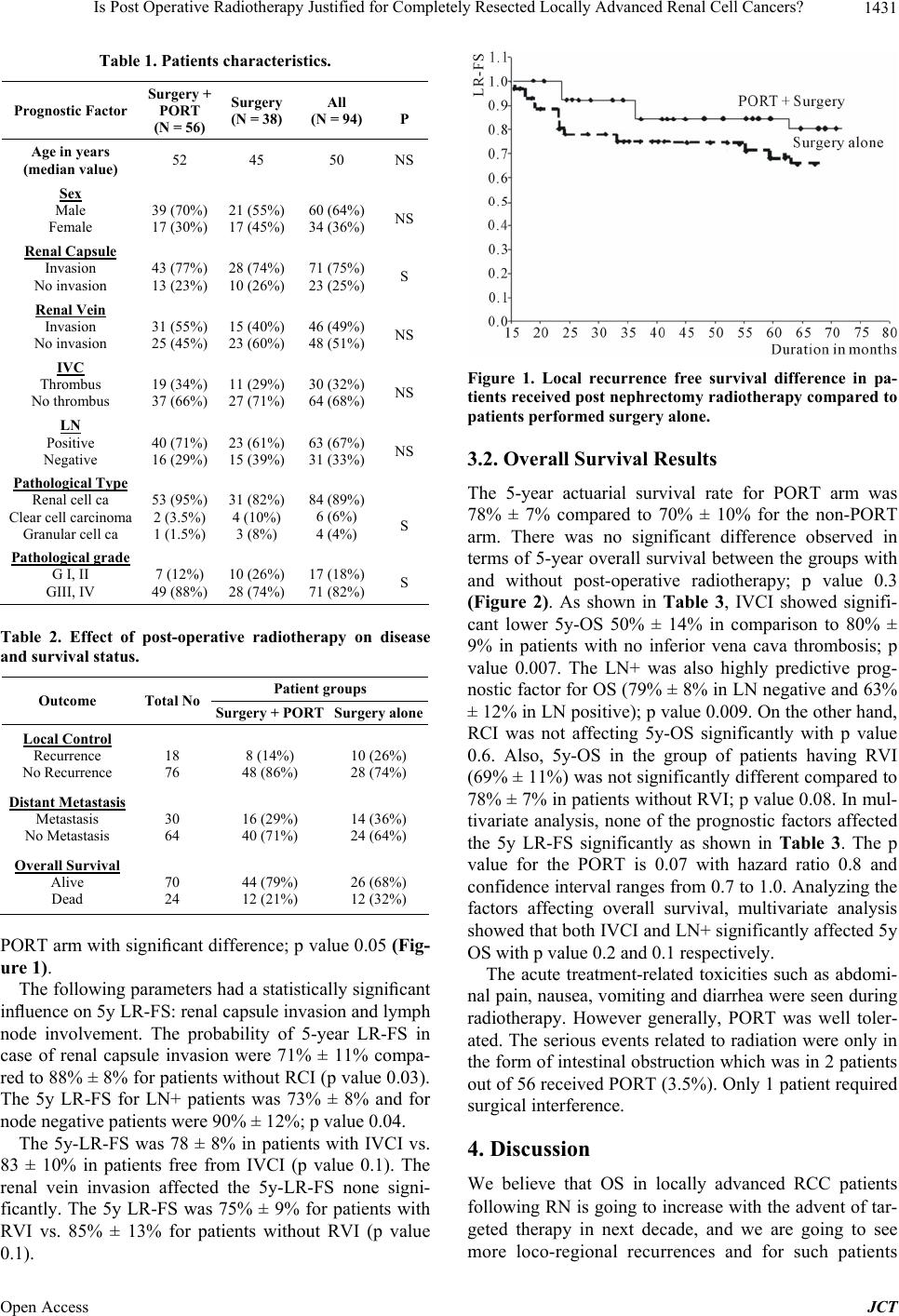 Is Post Operative Radiotherapy Justified for Completely Resected Locally Advanced Renal Cell Cancers? 1431 Table 1. Patients characteristics. Prognostic Factor Surgery + PORT (N = 56) Surgery (N = 38) All (N = 94) P Age in years (median value) 52 45 50 NS Sex Male Female 39 (70%) 17 (30%) 21 (55%) 17 (45%) 60 (64%) 34 (36%) NS Renal Capsule Invasion No invasion 43 (77%) 13 (23%) 28 (74%) 10 (26%) 71 (75%) 23 (25%) S Renal Vein Invasion No invasion 31 (55%) 25 (45%) 15 (40%) 23 (60%) 46 (49%) 48 (51%) NS IVC Thrombus No thrombus 19 (34%) 37 (66%) 11 (29%) 27 (71%) 30 (32%) 64 (68%) NS LN Positive Negative 40 (71%) 16 (29%) 23 (61%) 15 (39%) 63 (67%) 31 (33%) NS Pathological Type Renal cell ca Clear cell carcinoma Granular cell ca 53 (95%) 2 (3.5%) 1 (1.5%) 31 (82%) 4 (10%) 3 (8%) 84 (89%) 6 (6%) 4 (4%) S Pathological grade G I, II GIII, IV 7 (12%) 49 (88%) 10 (26%) 28 (74%) 17 (18%) 71 (82%) S Table 2. Effect of post-operative radiotherapy on disease and survival status. Patient groups Outcome Total No Surgery + PORT Surgery alone Local Control Recurrence No Recurrence 18 76 8 (14%) 48 (86%) 10 (26%) 28 (74%) Distant Metastasis Metastasis No Metastasis 30 64 16 (29%) 40 (71%) 14 (36%) 24 (64%) Overall Survival Alive Dead 70 24 44 (79%) 12 (21%) 26 (68%) 12 (32%) PORT arm with significant difference; p value 0.05 (Fig- ure 1). The following parameters had a statistically significant influence on 5y LR-FS: renal capsule invasion and lymph node involvement. The probability of 5-year LR-FS in case of renal capsule invasion were 71% ± 11% compa- red to 88% ± 8% for patients without RCI (p value 0.03). The 5y LR-FS for LN+ patients was 73% ± 8% and for node negative patients were 90% ± 12%; p value 0.04. The 5y-LR-FS was 78 ± 8% in patients with IVCI vs. 83 ± 10% in patients free from IVCI (p value 0.1). The renal vein invasion affected the 5y-LR-FS none signi- ficantly. The 5y LR-FS was 75% ± 9% for patients with RVI vs. 85% ± 13% for patients without RVI (p value 0.1). Figure 1. Local recurrence free survival difference in pa- tients received post nephrectomy radiotherapy compared to patients performed surgery alone. 3.2. Overall Survival Results The 5-year actuarial survival rate for PORT arm was 78% ± 7% compared to 70% ± 10% for the non-PORT arm. There was no significant difference observed in terms of 5-year overall survival between the groups with and without post-operative radiotherapy; p value 0.3 (Figure 2). As shown in Table 3, IVCI showed signifi- cant lower 5y-OS 50% ± 14% in comparison to 80% ± 9% in patients with no inferior vena cava thrombosis; p value 0.007. The LN+ was also highly predictive prog- nostic factor for OS (79% ± 8% in LN negative and 63% ± 12% in LN positive); p value 0.009. On the other hand, RCI was not affecting 5y-OS significantly with p value 0.6. Also, 5y-OS in the group of patients having RVI (69% ± 11%) was not significantly different compared to 78% ± 7% in patients without RVI; p value 0.08. In mul- tivariate analysis, none of the prognostic factors affected the 5y LR-FS significantly as shown in Table 3. The p value for the PORT is 0.07 with hazard ratio 0.8 and confidence interval ranges from 0.7 to 1.0. Analyzing the factors affecting overall survival, multivariate analysis showed that both IVCI and LN+ significantly affected 5y OS with p value 0.2 and 0.1 respectively. The acute treatment-related toxicities such as abdomi- nal pain, nausea, vomiting and diarrhea were seen during radiotherapy. However generally, PORT was well toler- ated. The serious events related to radiation were only in the form of intestinal obstruction which was in 2 patients out of 56 received PORT (3.5%). Only 1 patient required surgical interference. 4. Discussion We believe that OS in locally advanced RCC patients following RN is going to increase with the advent of tar- geted therapy in next decade, and we are going to see more loco-regional recurrences and for such patients Open Access JCT 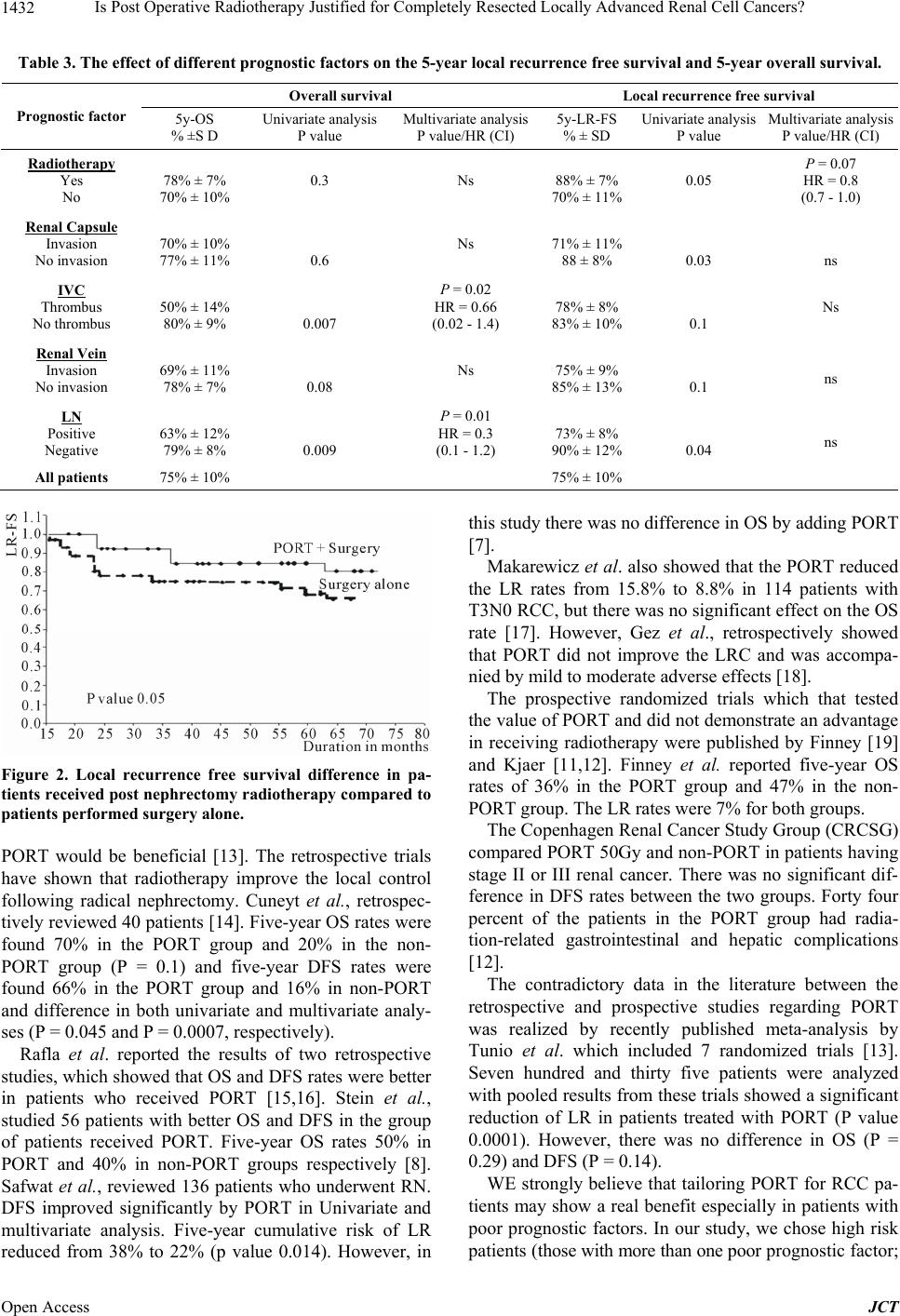 Is Post Operative Radiotherapy Justified for Completely Resected Locally Advanced Renal Cell Cancers? Open Access JCT 1432 Table 3. The effect of different prognostic factors on the 5-year local recurrence free survival and 5-year overall survival. Overall survival Local recurrence free survival Prognostic factor 5y-OS % ±S D Univariate analysis P value Multivariate analysis P value/HR (CI) 5y-LR-FS % ± SD Univariate analysis P value Multivariate analysis P value/HR (CI) Radiotherapy Yes No 78% ± 7% 70% ± 10% 0.3 Ns 88% ± 7% 70% ± 11% 0.05 P = 0.07 HR = 0.8 (0.7 - 1.0) Renal Capsule Invasion No invasion 70% ± 10% 77% ± 11% 0.6 Ns 71% ± 11% 88 ± 8% 0.03 ns IVC Thrombus No thrombus 50% ± 14% 80% ± 9% 0.007 P = 0.02 HR = 0.66 (0.02 - 1.4) 78% ± 8% 83% ± 10% 0.1 Ns Renal Vein Invasion No invasion 69% ± 11% 78% ± 7% 0.08 Ns 75% ± 9% 85% ± 13% 0.1 ns LN Positive Negative 63% ± 12% 79% ± 8% 0.009 P = 0.01 HR = 0.3 (0.1 - 1.2) 73% ± 8% 90% ± 12% 0.04 ns All patients 75% ± 10% 75% ± 10% Figure 2. Local recurrence free survival difference in pa- tients received post nephrectomy radiotherapy compared to patients performed surgery alone. PORT would be beneficial [13]. The retrospective trials have shown that radiotherapy improve the local control following radical nephrectomy. Cuneyt et al., retrospec- tively reviewed 40 patients [14]. Five-year OS rates were found 70% in the PORT group and 20% in the non- PORT group (P = 0.1) and five-year DFS rates were found 66% in the PORT group and 16% in non-PORT and difference in both univariate and multivariate analy- ses (P = 0.045 and P = 0.0007, respectively). Rafla et al. reported the results of two retrospective studies, which showed that OS and DFS rates were better in patients who received PORT [15,16]. Stein et al., studied 56 patients with better OS and DFS in the group of patients received PORT. Five-year OS rates 50% in PORT and 40% in non-PORT groups respectively [8]. Safwat et al., reviewed 136 patients who underwent RN. DFS improved significantly by PORT in Univariate and multivariate analysis. Five-year cumulative risk of LR reduced from 38% to 22% (p value 0.014). However, in this study there was no difference in OS by adding PORT [7]. Makarewicz et al. also showed that the PORT reduced the LR rates from 15.8% to 8.8% in 114 patients with T3N0 RCC, but there was no significant effect on the OS rate [17]. However, Gez et al., retrospectively showed that PORT did not improve the LRC and was accompa- nied by mild to moderate adverse effects [18]. The prospective randomized trials which that tested the value of PORT and did not demonstrate an advantage in receiving radiotherapy were published by Finney [19] and Kjaer [11,12]. Finney et al. reported five-year OS rates of 36% in the PORT group and 47% in the non- PORT group. The LR rates were 7% for both groups. The Copenhagen Renal Cancer Study Group (CRCSG) compared PORT 50Gy and non-PORT in patients having stage II or III renal cancer. There was no significant dif- ference in DFS rates between the two groups. Forty four percent of the patients in the PORT group had radia- tion-related gastrointestinal and hepatic complications [12]. The contradictory data in the literature between the retrospective and prospective studies regarding PORT was realized by recently published meta-analysis by Tunio et al. which included 7 randomized trials [13]. Seven hundred and thirty five patients were analyzed with pooled results from these trials showed a significant reduction of LR in patients treated with PORT (P value 0.0001). However, there was no difference in OS (P = 0.29) and DFS (P = 0.14). WE strongly believe that tailoring PORT for RCC pa- tients may show a real benefit especially in patients with poor prognostic factors. In our study, we chose high risk patients (those with more than one poor prognostic factor;  Is Post Operative Radiotherapy Justified for Completely Resected Locally Advanced Renal Cell Cancers? 1433 RVI, IVCI, LN+ and RCI) for evaluation of PORT ret- rospectively. Five-year LRC in our study is 82% ± 9% which is higher than that reported by Safwat et al. [7] and similar to Aref series [4] and Gez et al. [18]. This is mainly due to better case selection in our series (inclu- sion of patients who underwent RN with lymphadenec- tomy and exclusion of patients with positive surgical margin or gross residual following surgery). The radio- therapy improved the local recurrence rate (26% in non- PORT arm and 14% in PORT arm) however the DM was 29% and 39% in PORT and non-PORT patients respec- tively. These data is nearly similar to Aref and Maka- rewicz data. The isolated LRR were observed in 9 (10%) patients only; six of them in the non-RT arm. Five-year LRC was worst in the group of patients having RCI and LN+ with P values 0.03, and 0.04 respectively. These findings are comparable to studies by Stein, Rafla and Finney data [8,16,19]. The radiotherapy did not improve OS rates in our study and this is comparable to all retrospective and pro- spective studies [12-18]. Five-year OS in PORT arm was 78% as compared to 70% in non-PORT arm (p = 0.3). The univariate analysis showed that IVCI and LN+ affected the OS with p values 0.007 and 0.009 respec- tively. These findings were confirmed by multivariate analysis with p value 0.02 for the IVCI and 0.01 for LN+. These results are comparable to the studies of Maka- rewicz et al. [17] and Safwat et al. [7]. The exclusion of the pathological types and the pathology grade was main- ly due to unequal distribution of cases between the two treatment groups. 5. Conclusion and Recommendation Our study showed the benefit of PORT in reducing local recurrence in locally advanced RCC. The overall survival was also better in irradiated patients, but the difference did not reach statistical significance. The high DM rate could justify the need for use of adjuvant targeted ther- apy in such high risk patients. As there are conflicting data in the literature regarding the value of PORT, multi- institutional prospective randomized trials using modern radiotherapy techniques in addition to targeted therapy are necessary to evaluate the real role of PORT and im- prove survival in locally advanced RCC patients. REFERENCES [1] W. H. Chow, S. S. Devesa, J. L. Warren and J. F. Frau- meni Jr., “Rising Incidence of Renal Cell Cancer in the United States,” JAMA, Vol. 281, No. 17, 1999, pp. 1628- 1631. http://dx.doi.org/10.1001/jama.281.17.1628 [2] A. Jemal, R. Siegel, E. Ward, et al., “Cancer Statistics 2008,” CA Cancer Journal for Clinicians, Vol. 58, No. 2, 2008, pp. 71-96. http://dx.doi.org/10.3322/CA.2007.0010 [3] J. Pantuck, A. Zisman and A. Bellderun, “The Changing Natural History of Renal Cell Carcinoma,” The Journal of Urology, Vol. 166, No. 5, 2001, pp. 1611-1623. http://dx.doi.org/10.1016/S0022-5347(05)65640-6 [4] I. Aref, G. Bociek and D. Salhani, “Is Postoperative Ra- diotherapy for Renal Cell Carcinoma Justified?” Radio- therapy & Oncology, Vol. 43, No. 2, 1997, pp. 155-157. http://dx.doi.org/10.1016/S0167-8140(97)01949-X [5] A. P. Sene, R. F. T. Hunt, T. McMahon and R. N. P. Carol, “Renal Carcinoma in Patients Undergoing Nephrec- tomy: Analysis of Survival and Prognostic Factors,” Brit- ish Journal of Urology, Vol. 70, No. 2, 1992, pp. 125-134. http://dx.doi.org/10.1111/j.1464-410X.1992.tb15689.x [6] R. A. Rabinovitch, M. J. Zelefsky, J. J. Gaynor and Z. Fuks, “Patterns of Failure Following Surgical Resection of Renal Cell Carcinoma: Implications for Adjuvant Lo- cal and Systemic Therapy,” Journal of Clinical Oncology, Vol. 12, 1994, pp. 206-212. [7] A. Safwat, T. Shouman and E. Hamada, “Postoperative Radiotherapy Improves Disease Free but Not Overall Sur- vival in High Risk Cell Carcinoma Patients,” Journal of the Egyptian National Cancer Institute, Vol. 12, 2000, pp. 17-22. [8] M. Stein, A. Kuten, J. Halperin, N. M. Coachman, Y. Cohen and E. Robinson, “The Value of Postoperative in Renal Cell Cancer,” Radiotherapy and Oncology, Vol. 24, No. 1, 1992, pp. 41-45. http://dx.doi.org/10.1016/0167-8140(92)90352-U [9] M. Eilenberger, R. Kodyam and R. Seyess, “A Retro- spective Study of the Results of Postoperative Radiother- apy of Hypernephroma,” Radiobiologia, Radiotherapia (Berlin), Vol. 31, 1990, pp. 491-496. [10] E. Scherer and C. Wirtz, “The Role of Postoperative Ra- diotherapy in the Treatment of Hypernephroid Carcino- ma,” Strahlentherapie und Onkologie, Vol. 164, 1988, pp. 371-385. [11] M. Kjaer, P. L. Frederiksen and S. A. Engelholm, “Post- operative Radiotherapy in Stage II and III Renal Adeno- carcinoma. A Randomized Trial by the Copenhagen Re- nal Cancer Study Group,” International Journal of Ra- diation Oncology & Biology & Physics, Vol. 13, No. 5, 1987, pp. 665-672. http://dx.doi.org/10.1016/0360-3016(87)90283-5 [12] M. Kjaer, P. Iversen, V. Hvidt, E. Bruun, P. Skaarup, H. J. Bech and P. L. Frederiksen, “A Randomized Trial of Postoperative Radiotherapy versus Observation in Stage II and III Renal Adenocarcinoma. A Study by the Co- penhagen Renal Cancer Study Group,” Scandinavian Journal of Urology, Vol. 21, No. 4, 1987, pp. 285-289. http://dx.doi.org/10.3109/00365598709180784 [13] M. A. Tunio, A. Hashmi and M. Rafi, “Need for New Trial to Evaluate PORT in Renal Cell Carcinoma: A Meta-Analysis of Randomized Controlled Trials,” Annals of Oncology, Vol. 21, No. 9, 2010, pp. 1839-1845. http://dx.doi.org/10.1093/annonc/mdq028 [14] U. Cuneyt, A. Gorkem, F. Merdan, O. Kuzhan, L. Tah- maz and M. Beyzadeoglu, “The Value of Postoperative Radiotherapy in Renal Cell Carcinoma: A Single Institu- tion Experience,” Tumori, Vol. 92, 2006, pp. 202-206. Open Access JCT  Is Post Operative Radiotherapy Justified for Completely Resected Locally Advanced Renal Cell Cancers? Open Access JCT 1434 [15] S. Rafla, “Renal Cell Carcinoma,” Cancer, Vol. 25, 1970, pp. 26-40. http://dx.doi.org/10.1002/1097-0142(197001)25:1<26::AI D-CNCR2820250106>3.0.CO;2-4 [16] S. Rafla and K. Parikh, “The Role of Adjuvant Radio- therapy in the Management of Renal Cell Carcinoma,” In: N. Javadpour, Ed., Cancer of the Kidney, Thieme-Stratton, New York, 1984, p. 231. [17] R. Makarewicz, M. Zarzycka, G. Kulinska and W. Win- dorbska, “The Value of Postoperative Radiotherapy in Advanced Renal Cell Cancer,” Neopla sma, Vol. 45, 1998, pp. 380-383. [18] E. Gez, M. Libes, R. Bar-Deroma, R. Rubinov, M. Stein and A. Kuten, “Postoperative Irradiation in Localized Renal Cell Carcinoma: The Rambam Medical Center Ex- perience,” Tumori, Vol. 88, 2002, pp. 500-502. [19] R. Finney, “An Evaluation of Postoperative Radiotherapy in Hypernephroma Treatment—A Clinical Trial,” Cancer, Vol. 32, No. 6, 1973, pp. 1332-1340. http://dx.doi.org/10.1002/1097-0142(197312)32:6<1332:: AID-CNCR2820320607>3.0.CO;2-E |